
Operations Management Statistical Process Control Supplement 6 Power
- Slides: 45
Operations Management Statistical Process Control Supplement 6 Power. Point presentation to accompany Operations Management, 6 E (Heizer & Render) 1 © 2001 by Prentice Hall, Inc. , Upper Saddle River, N. J. 07458
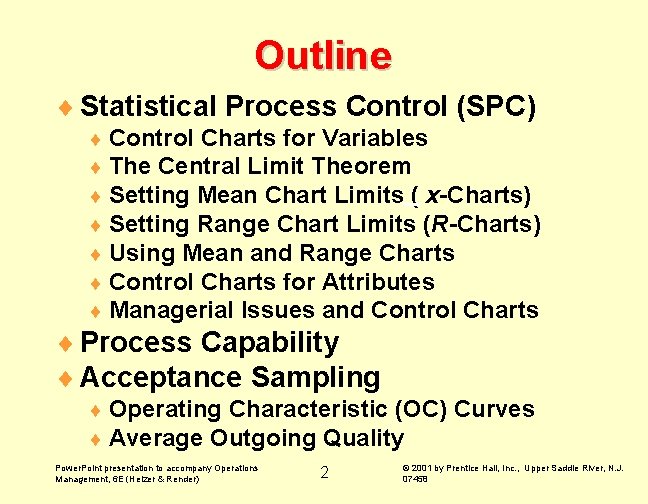
Outline ¨ Statistical Process Control (SPC) ¨ Control Charts for Variables ¨ The Central Limit Theorem ¨ Setting Mean Chart Limits ( x-Charts) ¨ Setting Range Chart Limits (R-Charts) ¨ Using Mean and Range Charts ¨ Control Charts for Attributes ¨ Managerial Issues and Control Charts ¨ Process Capability ¨ Acceptance Sampling ¨ Operating Characteristic (OC) ¨ Average Outgoing Quality Power. Point presentation to accompany Operations Management, 6 E (Heizer & Render) 2 Curves © 2001 by Prentice Hall, Inc. , Upper Saddle River, N. J. 07458
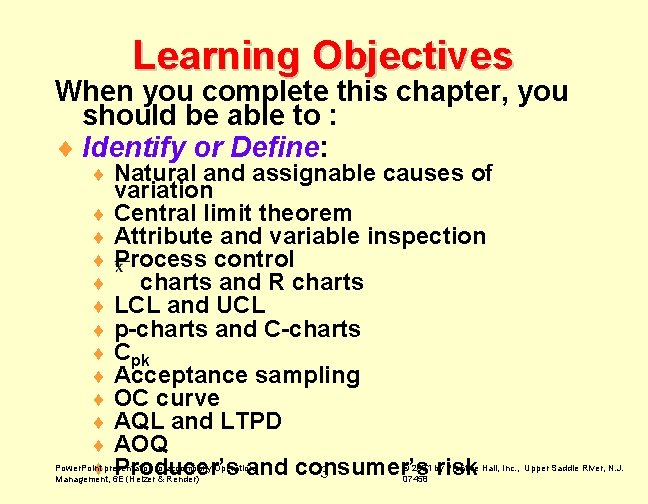
Learning Objectives When you complete this chapter, you should be able to : ¨ Identify or Define: ¨ Natural and assignable causes of variation Central limit theorem Attribute and variable inspection Process control charts and R charts LCL and UCL p-charts and C-charts Cpk Acceptance sampling OC curve AQL and LTPD AOQ Producer’s and consumer’s risk 3 ¨ ¨ ¨ Power. Point ¨presentation to accompany Operations Management, 6 E (Heizer & Render) © 2001 by Prentice Hall, Inc. , Upper Saddle River, N. J. 07458
Learning Objectives continued When you complete this chapter, you should be able to : ¨ Describe or explain: ¨ The role of statistical quality control Power. Point presentation to accompany Operations Management, 6 E (Heizer & Render) 4 © 2001 by Prentice Hall, Inc. , Upper Saddle River, N. J. 07458
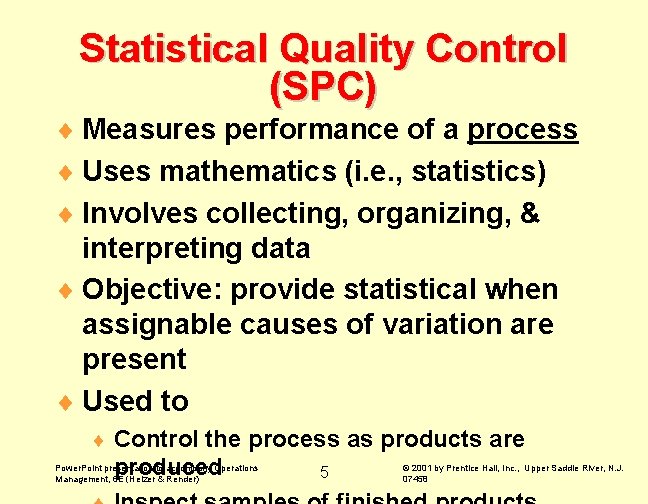
Statistical Quality Control (SPC) ¨ Measures performance of a process ¨ Uses mathematics (i. e. , statistics) ¨ Involves collecting, organizing, & interpreting data ¨ Objective: provide statistical when assignable causes of variation are present ¨ Used to ¨ Control the process as products are produced 5 Power. Point presentation to accompany Operations Management, 6 E (Heizer & Render) © 2001 by Prentice Hall, Inc. , Upper Saddle River, N. J. 07458
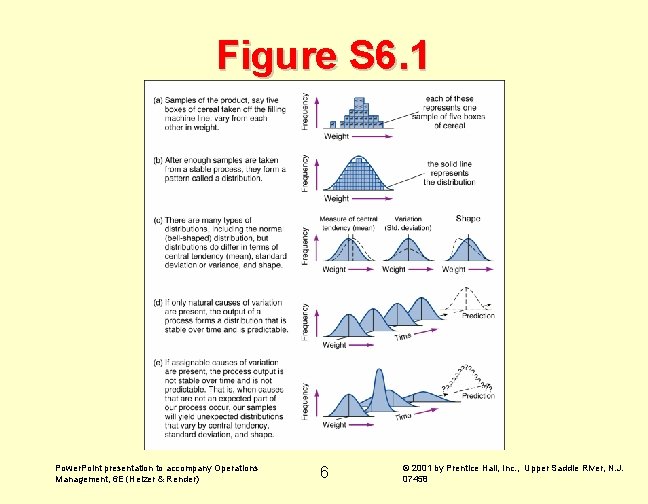
Figure S 6. 1 Power. Point presentation to accompany Operations Management, 6 E (Heizer & Render) 6 © 2001 by Prentice Hall, Inc. , Upper Saddle River, N. J. 07458
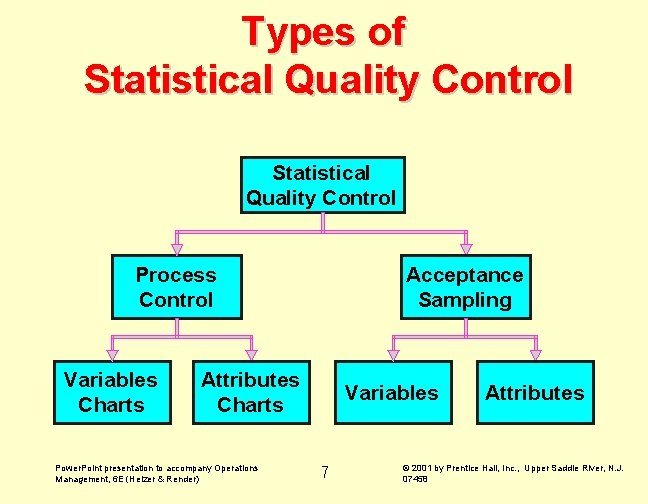
Types of Statistical Quality Control Process Control Variables Charts Acceptance Sampling Attributes Charts Power. Point presentation to accompany Operations Management, 6 E (Heizer & Render) Variables 7 Attributes © 2001 by Prentice Hall, Inc. , Upper Saddle River, N. J. 07458
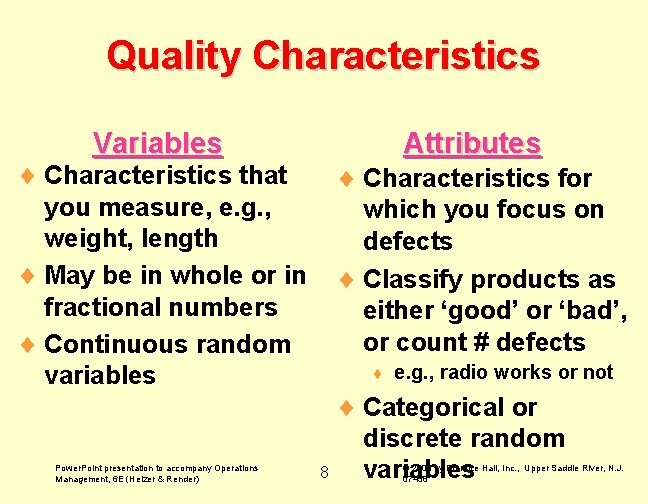
Quality Characteristics Variables ¨ Characteristics that you measure, e. g. , weight, length ¨ May be in whole or in fractional numbers ¨ Continuous random variables Power. Point presentation to accompany Operations Management, 6 E (Heizer & Render) Attributes ¨ Characteristics for which you focus on defects ¨ Classify products as either ‘good’ or ‘bad’, or count # defects ¨ e. g. , radio works or not ¨ Categorical or discrete random 8 variables © 2001 by Prentice Hall, Inc. , Upper Saddle River, N. J. 07458
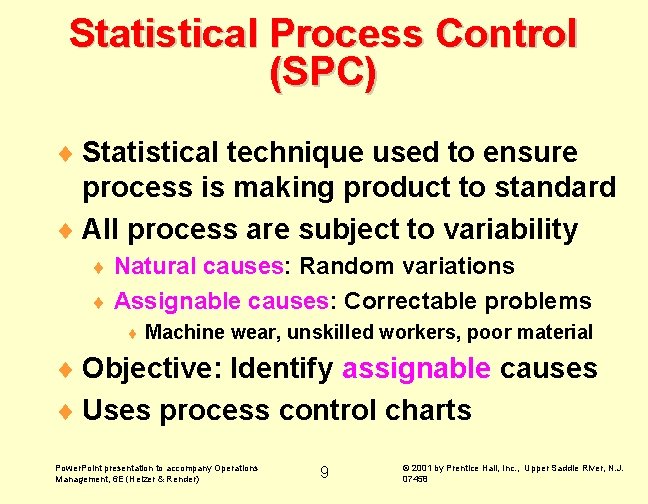
Statistical Process Control (SPC) ¨ Statistical technique used to ensure process is making product to standard ¨ All process are subject to variability Natural causes: Random variations ¨ Assignable causes: Correctable problems ¨ ¨ Machine wear, unskilled workers, poor material ¨ Objective: Identify assignable causes ¨ Uses process control charts Power. Point presentation to accompany Operations Management, 6 E (Heizer & Render) 9 © 2001 by Prentice Hall, Inc. , Upper Saddle River, N. J. 07458
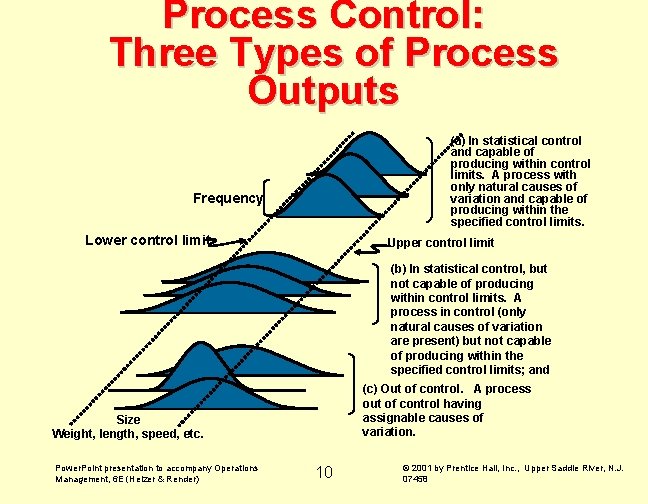
Process Control: Three Types of Process Outputs (a) In statistical control and capable of producing within control limits. A process with only natural causes of variation and capable of producing within the specified control limits. Frequency Lower control limit Upper control limit (b) In statistical control, but not capable of producing within control limits. A process in control (only natural causes of variation are present) but not capable of producing within the specified control limits; and (c) Out of control. A process out of control having assignable causes of variation. Size Weight, length, speed, etc. Power. Point presentation to accompany Operations Management, 6 E (Heizer & Render) 10 © 2001 by Prentice Hall, Inc. , Upper Saddle River, N. J. 07458
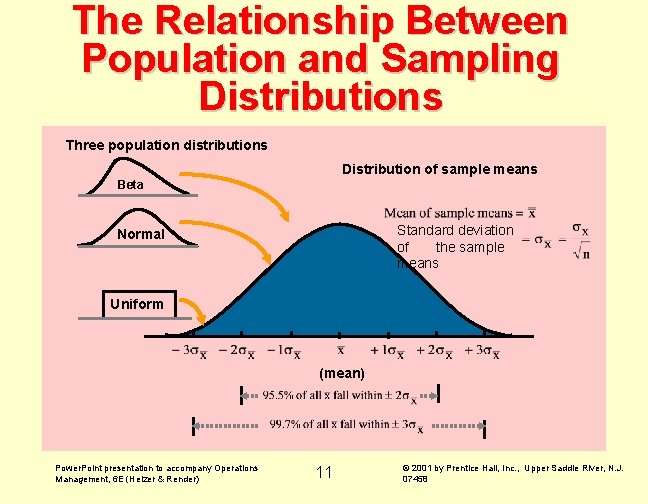
The Relationship Between Population and Sampling Distributions Three population distributions Distribution of sample means Beta Standard deviation of the sample means Normal Uniform (mean) Power. Point presentation to accompany Operations Management, 6 E (Heizer & Render) 11 © 2001 by Prentice Hall, Inc. , Upper Saddle River, N. J. 07458
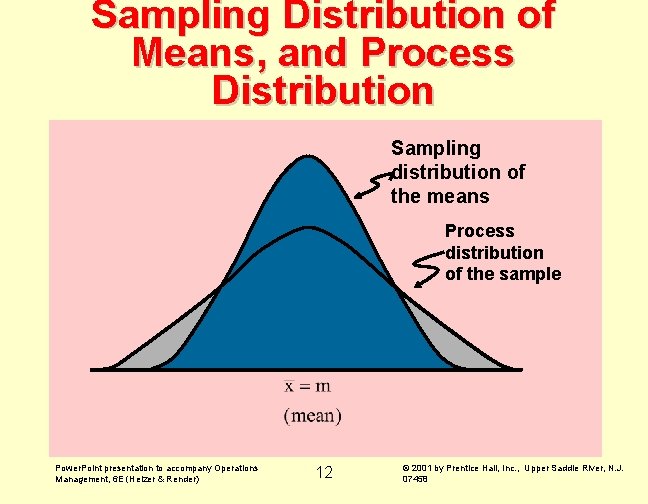
Sampling Distribution of Means, and Process Distribution Sampling distribution of the means Process distribution of the sample Power. Point presentation to accompany Operations Management, 6 E (Heizer & Render) 12 © 2001 by Prentice Hall, Inc. , Upper Saddle River, N. J. 07458
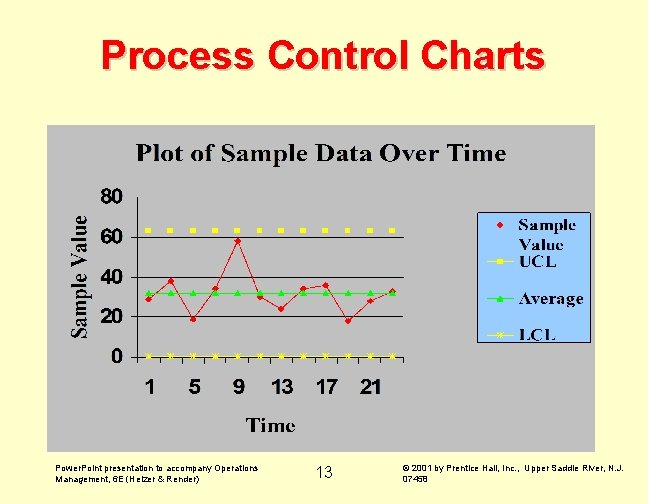
Process Control Charts Power. Point presentation to accompany Operations Management, 6 E (Heizer & Render) 13 © 2001 by Prentice Hall, Inc. , Upper Saddle River, N. J. 07458
Control Chart Purposes ¨ Show changes in data pattern ¨ e. g. , trends ¨ Make corrections before process is out of control ¨ Show causes of changes in data ¨ Assignable causes ¨ ¨ Data outside control limits or trend in data Natural causes ¨ Random variations around average Power. Point presentation to accompany Operations Management, 6 E (Heizer & Render) 14 © 2001 by Prentice Hall, Inc. , Upper Saddle River, N. J. 07458
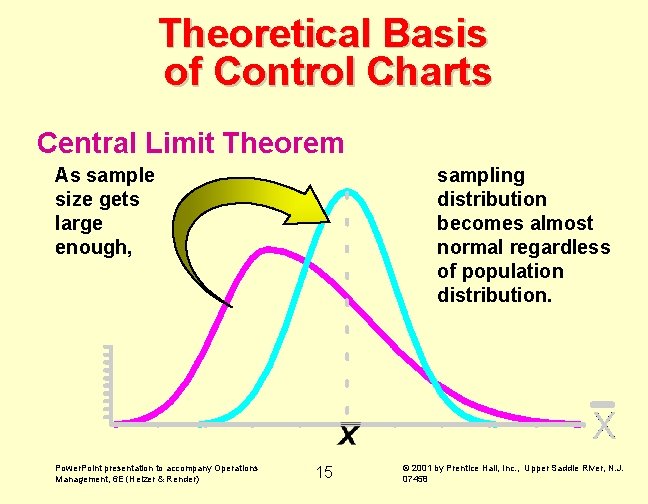
Theoretical Basis of Control Charts Central Limit Theorem As sample size gets large enough, Power. Point presentation to accompany Operations Management, 6 E (Heizer & Render) sampling distribution becomes almost normal regardless of population distribution. 15 © 2001 by Prentice Hall, Inc. , Upper Saddle River, N. J. 07458
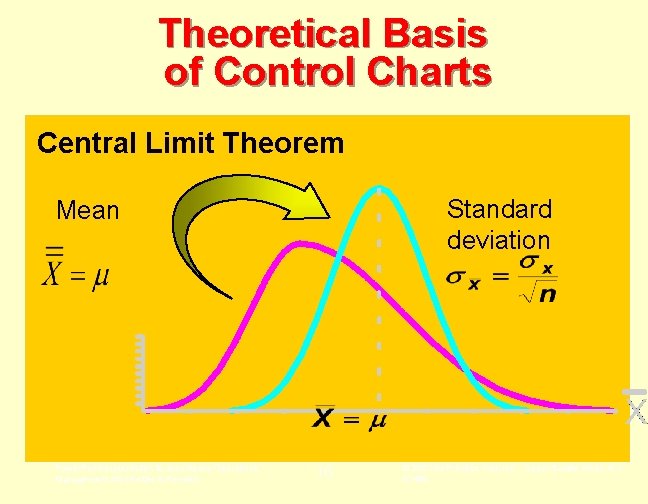
Theoretical Basis of Control Charts Central Limit Theorem Standard deviation Mean Power. Point presentation to accompany Operations Management, 6 E (Heizer & Render) 16 © 2001 by Prentice Hall, Inc. , Upper Saddle River, N. J. 07458
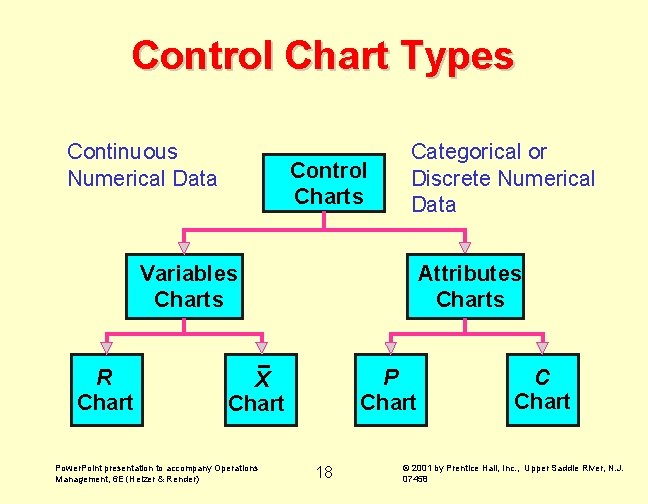
Control Chart Types Continuous Numerical Data Control Charts Categorical or Discrete Numerical Data Variables Charts R Chart Attributes Charts P Chart X Chart Power. Point presentation to accompany Operations Management, 6 E (Heizer & Render) 18 C Chart © 2001 by Prentice Hall, Inc. , Upper Saddle River, N. J. 07458
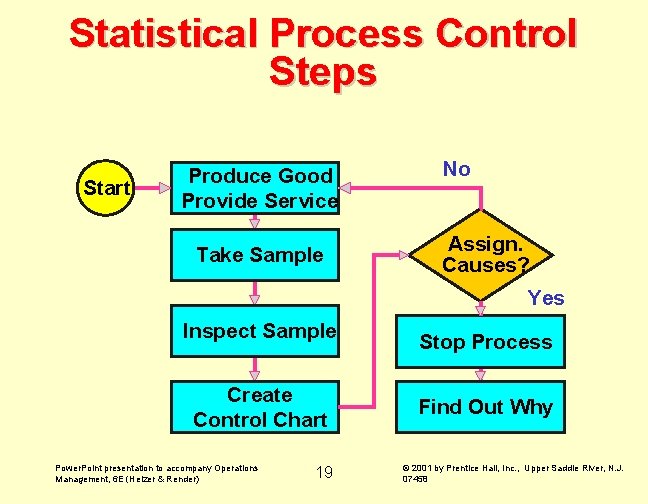
Statistical Process Control Steps Start Produce Good Provide Service Take Sample No Assign. Causes? Yes Inspect Sample Stop Process Create Control Chart Find Out Why Power. Point presentation to accompany Operations Management, 6 E (Heizer & Render) 19 © 2001 by Prentice Hall, Inc. , Upper Saddle River, N. J. 07458
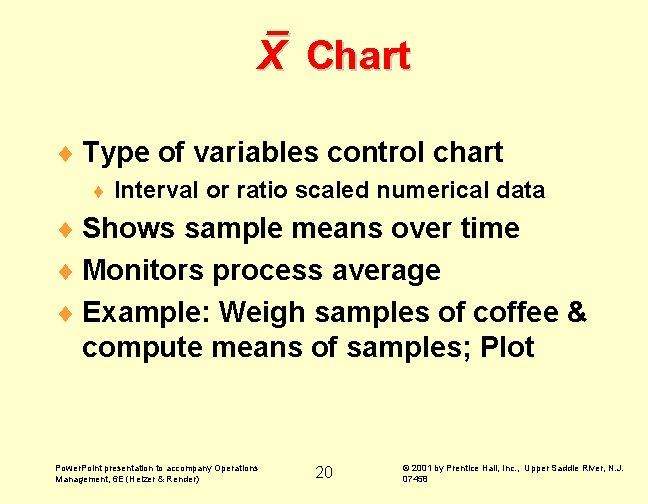
X Chart ¨ Type of variables control chart ¨ Interval or ratio scaled numerical data ¨ Shows sample means over time ¨ Monitors process average ¨ Example: Weigh samples of coffee & compute means of samples; Plot Power. Point presentation to accompany Operations Management, 6 E (Heizer & Render) 20 © 2001 by Prentice Hall, Inc. , Upper Saddle River, N. J. 07458
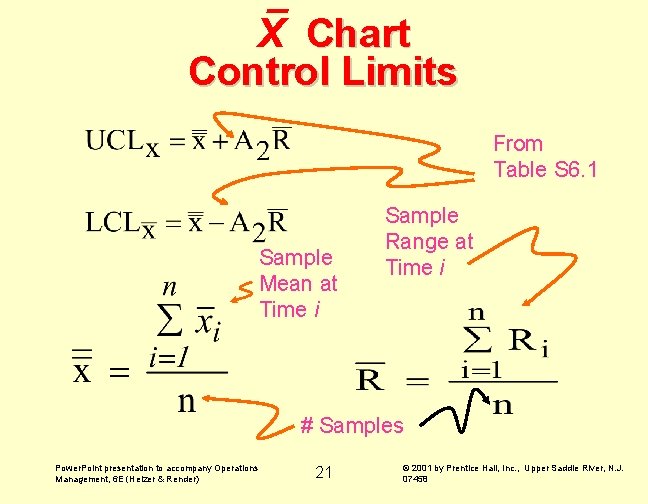
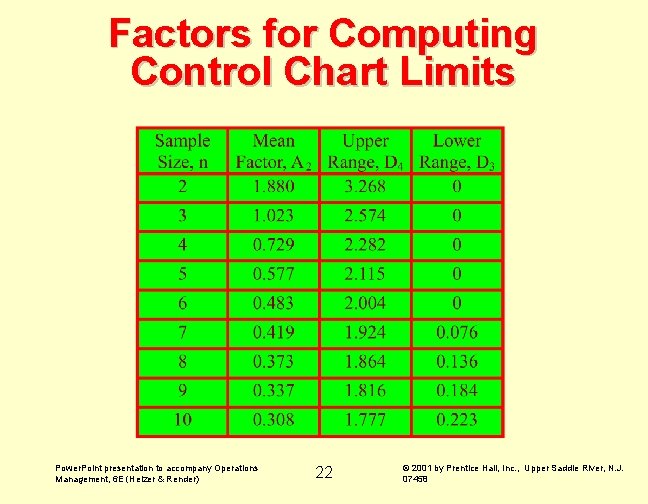
X Chart Control Limits From Table S 6. 1 Sample Mean at Time i Sample Range at Time i # Samples Power. Point presentation to accompany Operations Management, 6 E (Heizer & Render) 21 © 2001 by Prentice Hall, Inc. , Upper Saddle River, N. J. 07458
Factors for Computing Control Chart Limits Power. Point presentation to accompany Operations Management, 6 E (Heizer & Render) 22 © 2001 by Prentice Hall, Inc. , Upper Saddle River, N. J. 07458
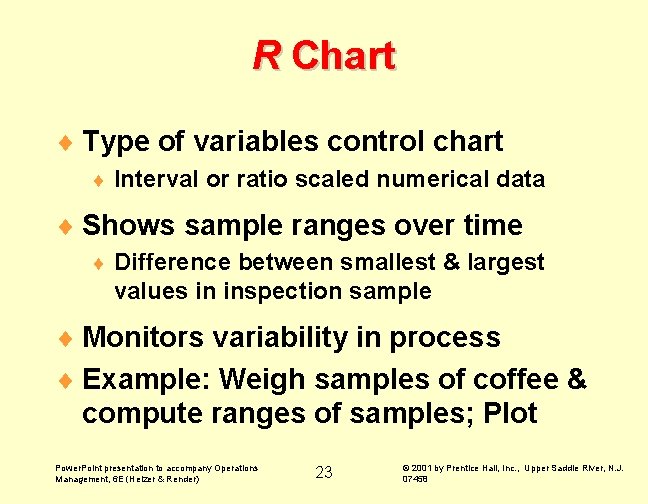
R Chart ¨ Type of variables control chart ¨ Interval or ratio scaled numerical data ¨ Shows sample ranges over time ¨ Difference between smallest & largest values in inspection sample ¨ Monitors variability in process ¨ Example: Weigh samples of coffee & compute ranges of samples; Plot Power. Point presentation to accompany Operations Management, 6 E (Heizer & Render) 23 © 2001 by Prentice Hall, Inc. , Upper Saddle River, N. J. 07458
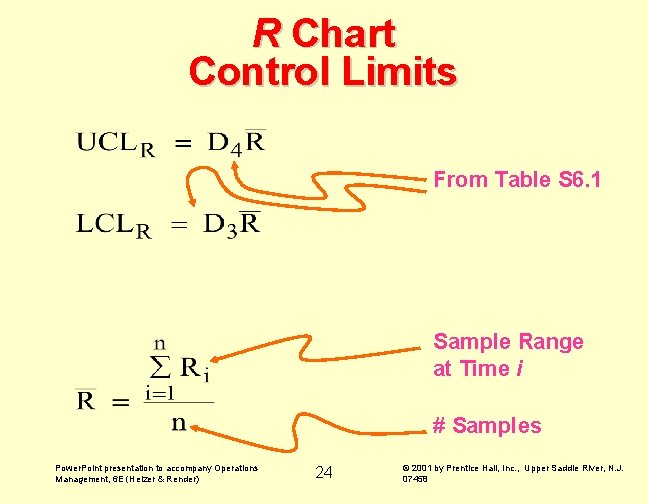
R Chart Control Limits From Table S 6. 1 Sample Range at Time i # Samples Power. Point presentation to accompany Operations Management, 6 E (Heizer & Render) 24 © 2001 by Prentice Hall, Inc. , Upper Saddle River, N. J. 07458
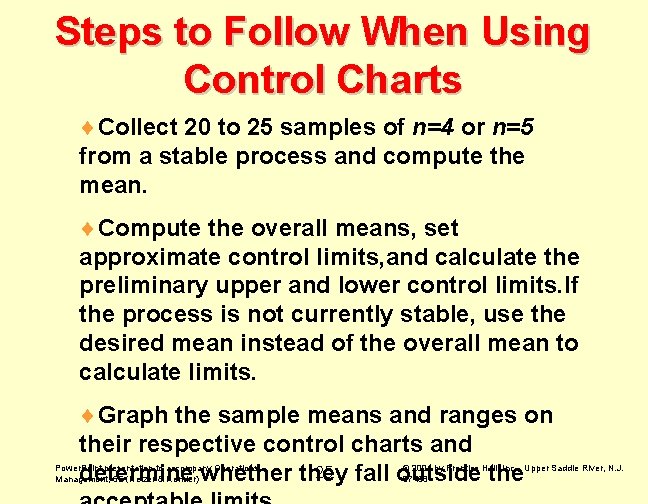
Steps to Follow When Using Control Charts ¨Collect 20 to 25 samples of n=4 or n=5 from a stable process and compute the mean. ¨Compute the overall means, set approximate control limits, and calculate the preliminary upper and lower control limits. If the process is not currently stable, use the desired mean instead of the overall mean to calculate limits. ¨Graph the sample means and ranges on their respective control charts and 25 fall outside the determine whether they Power. Point presentation to accompany Operations Management, 6 E (Heizer & Render) © 2001 by Prentice Hall, Inc. , Upper Saddle River, N. J. 07458
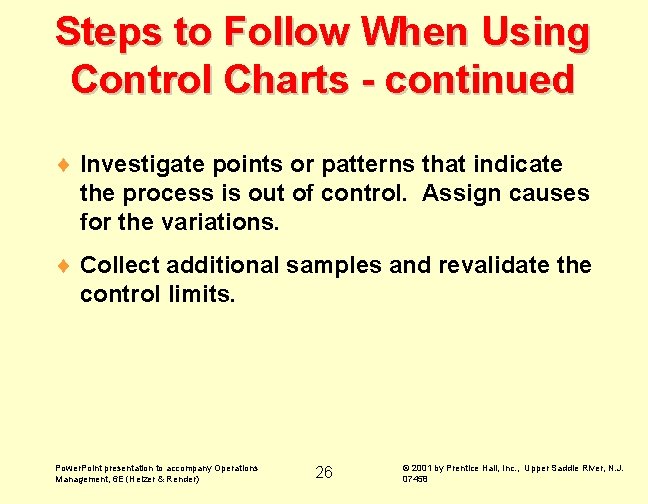
Steps to Follow When Using Control Charts - continued ¨ Investigate points or patterns that indicate the process is out of control. Assign causes for the variations. ¨ Collect additional samples and revalidate the control limits. Power. Point presentation to accompany Operations Management, 6 E (Heizer & Render) 26 © 2001 by Prentice Hall, Inc. , Upper Saddle River, N. J. 07458
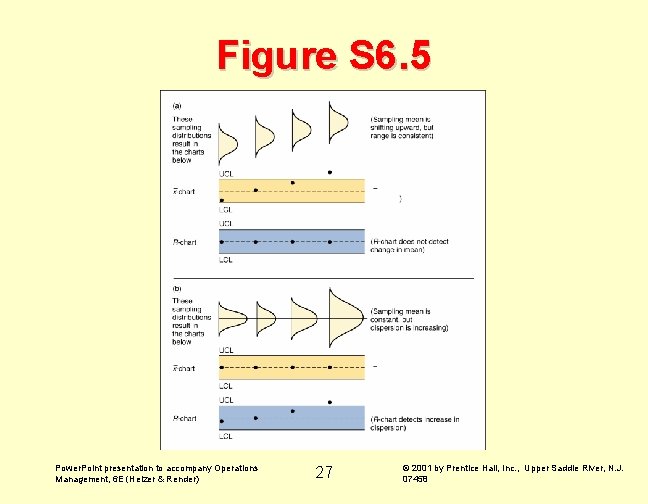
Figure S 6. 5 Power. Point presentation to accompany Operations Management, 6 E (Heizer & Render) 27 © 2001 by Prentice Hall, Inc. , Upper Saddle River, N. J. 07458
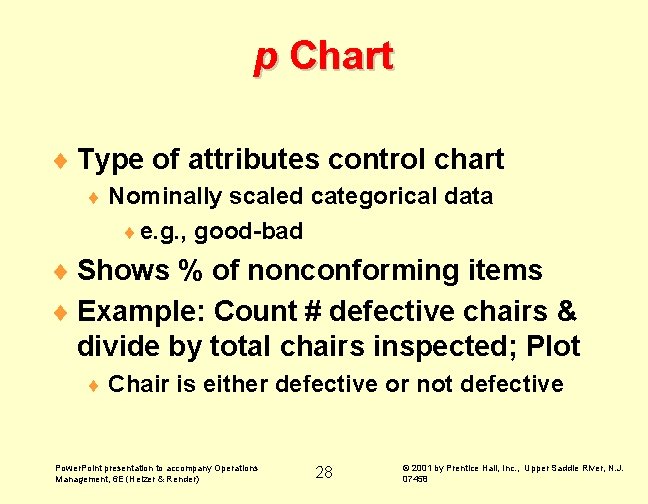
p Chart ¨ Type of attributes control chart ¨ Nominally scaled categorical data ¨ e. g. , good-bad ¨ Shows % of nonconforming items ¨ Example: Count # defective chairs & divide by total chairs inspected; Plot ¨ Chair is either defective or not defective Power. Point presentation to accompany Operations Management, 6 E (Heizer & Render) 28 © 2001 by Prentice Hall, Inc. , Upper Saddle River, N. J. 07458
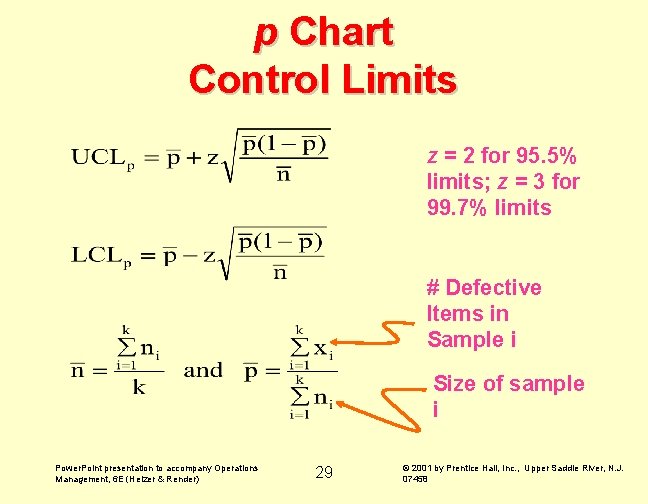
p Chart Control Limits z = 2 for 95. 5% limits; z = 3 for 99. 7% limits # Defective Items in Sample i Size of sample i Power. Point presentation to accompany Operations Management, 6 E (Heizer & Render) 29 © 2001 by Prentice Hall, Inc. , Upper Saddle River, N. J. 07458
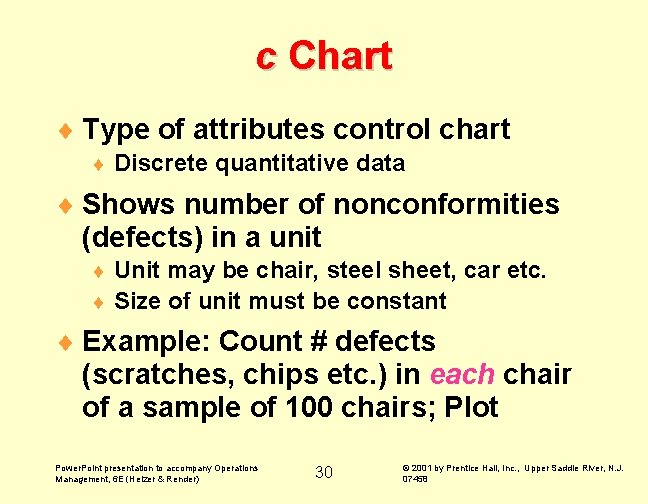
c Chart ¨ Type of attributes control chart ¨ Discrete quantitative data ¨ Shows number of nonconformities (defects) in a unit Unit may be chair, steel sheet, car etc. ¨ Size of unit must be constant ¨ ¨ Example: Count # defects (scratches, chips etc. ) in each chair of a sample of 100 chairs; Plot Power. Point presentation to accompany Operations Management, 6 E (Heizer & Render) 30 © 2001 by Prentice Hall, Inc. , Upper Saddle River, N. J. 07458
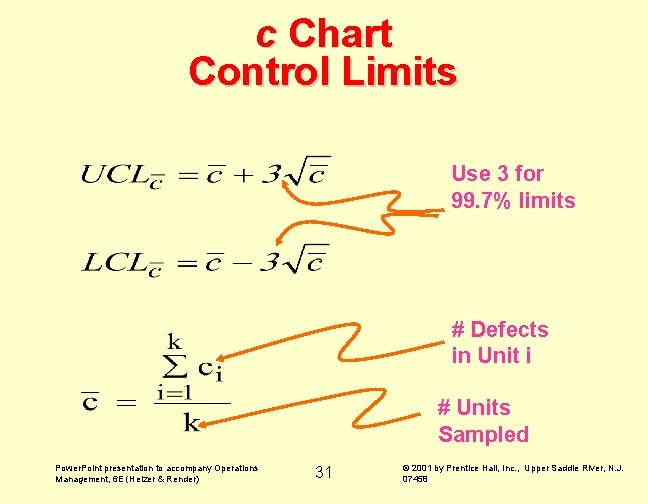
c Chart Control Limits Use 3 for 99. 7% limits # Defects in Unit i # Units Sampled Power. Point presentation to accompany Operations Management, 6 E (Heizer & Render) 31 © 2001 by Prentice Hall, Inc. , Upper Saddle River, N. J. 07458
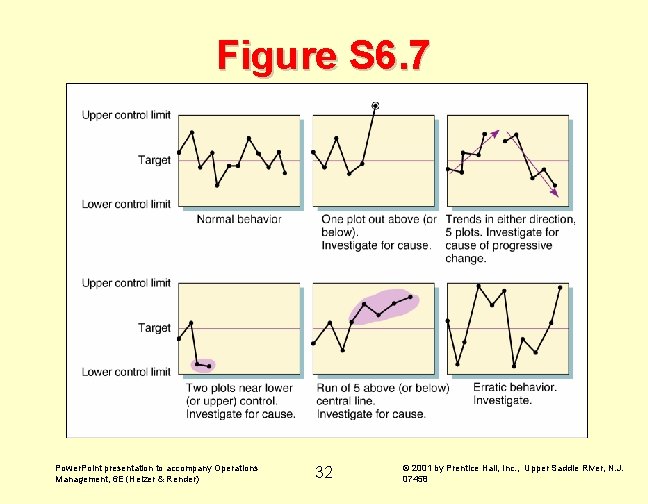
Figure S 6. 7 Power. Point presentation to accompany Operations Management, 6 E (Heizer & Render) 32 © 2001 by Prentice Hall, Inc. , Upper Saddle River, N. J. 07458
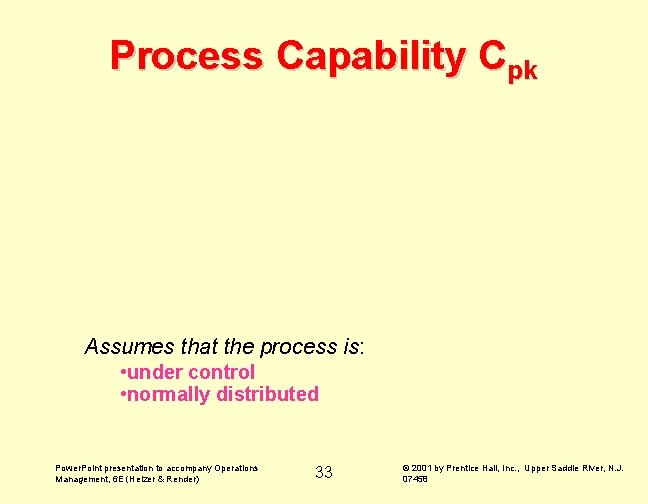
Process Capability Cpk Assumes that the process is: • under control • normally distributed Power. Point presentation to accompany Operations Management, 6 E (Heizer & Render) 33 © 2001 by Prentice Hall, Inc. , Upper Saddle River, N. J. 07458
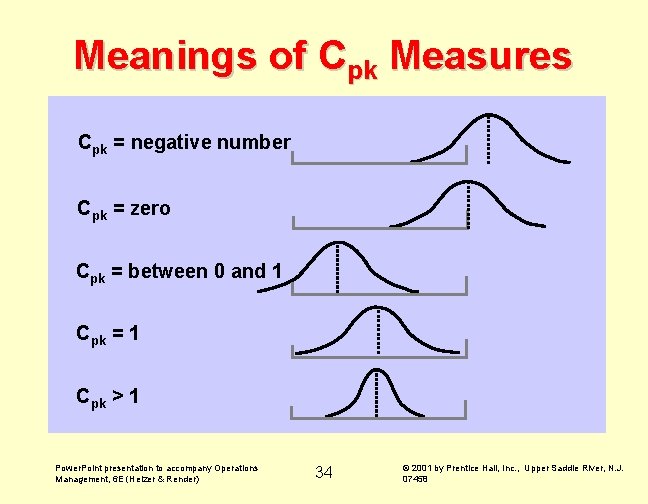
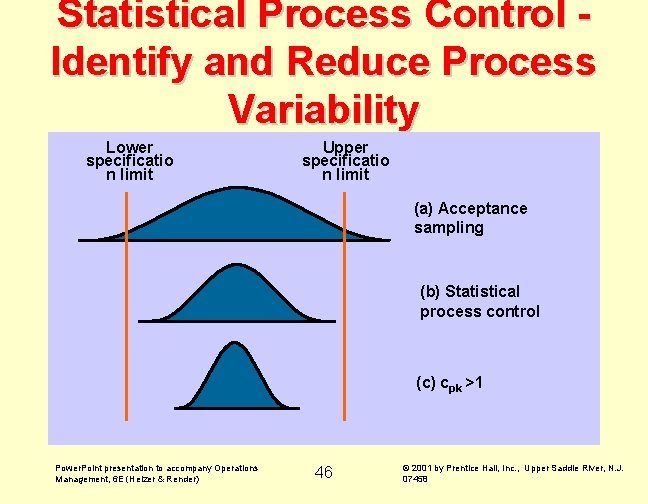
Meanings of Cpk Measures Cpk = negative number Cpk = zero Cpk = between 0 and 1 Cpk = 1 Cpk > 1 Power. Point presentation to accompany Operations Management, 6 E (Heizer & Render) 34 © 2001 by Prentice Hall, Inc. , Upper Saddle River, N. J. 07458
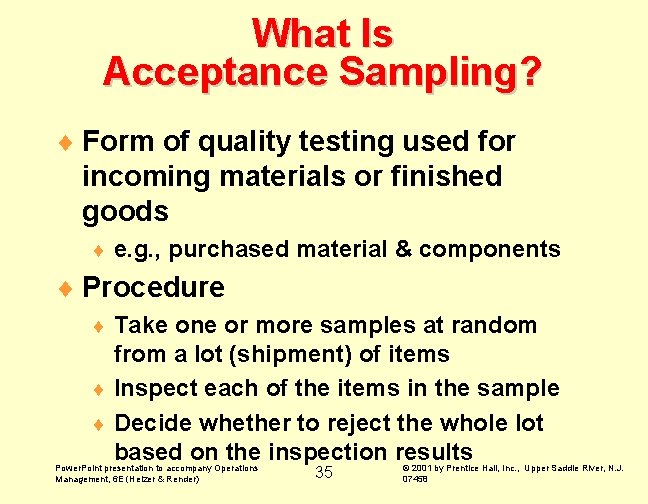
What Is Acceptance Sampling? ¨ Form of quality testing used for incoming materials or finished goods ¨ e. g. , purchased material & components ¨ Procedure Take one or more samples at random from a lot (shipment) of items ¨ Inspect each of the items in the sample ¨ Decide whether to reject the whole lot based on the inspection results ¨ Power. Point presentation to accompany Operations Management, 6 E (Heizer & Render) 35 © 2001 by Prentice Hall, Inc. , Upper Saddle River, N. J. 07458
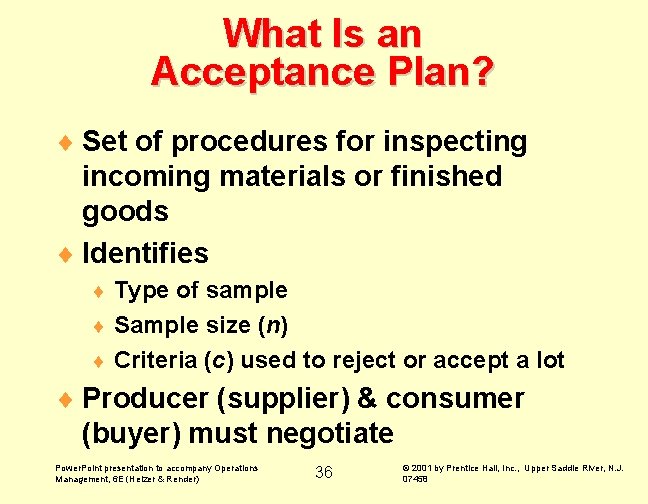
What Is an Acceptance Plan? ¨ Set of procedures for inspecting incoming materials or finished goods ¨ Identifies Type of sample ¨ Sample size (n) ¨ Criteria (c) used to reject or accept a lot ¨ ¨ Producer (supplier) & consumer (buyer) must negotiate Power. Point presentation to accompany Operations Management, 6 E (Heizer & Render) 36 © 2001 by Prentice Hall, Inc. , Upper Saddle River, N. J. 07458
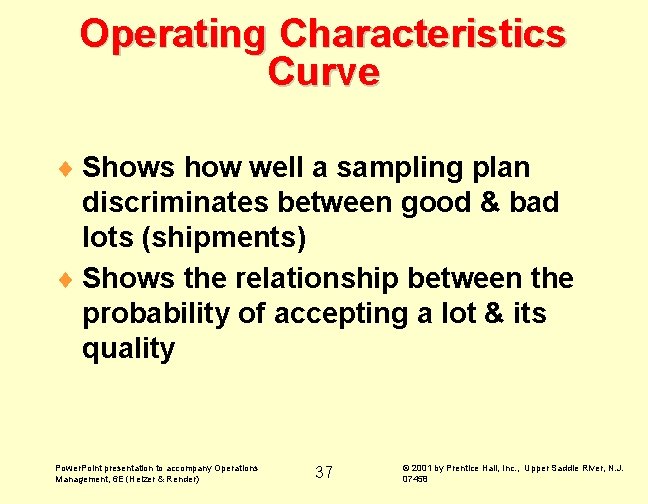
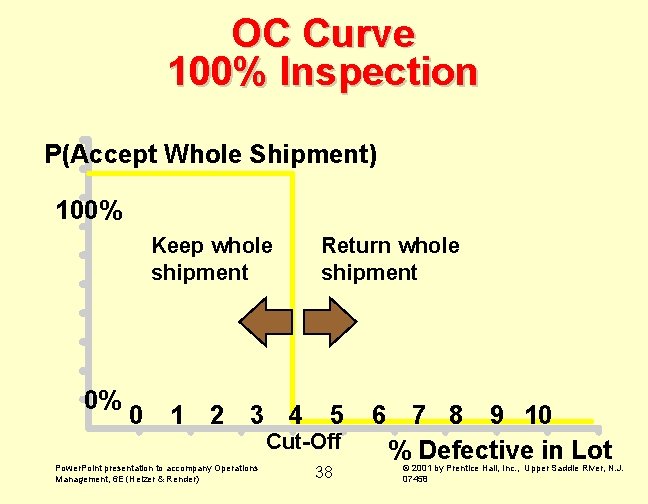
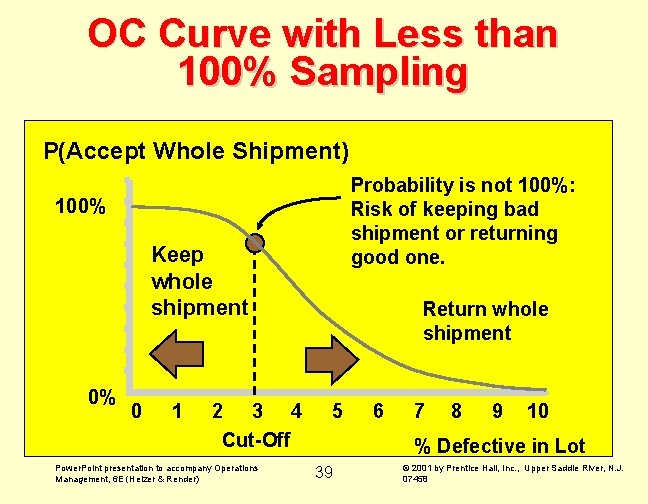
Operating Characteristics Curve ¨ Shows how well a sampling plan discriminates between good & bad lots (shipments) ¨ Shows the relationship between the probability of accepting a lot & its quality Power. Point presentation to accompany Operations Management, 6 E (Heizer & Render) 37 © 2001 by Prentice Hall, Inc. , Upper Saddle River, N. J. 07458
OC Curve 100% Inspection P(Accept Whole Shipment) 100% Keep whole shipment 0% 0 1 2 3 4 Power. Point presentation to accompany Operations Management, 6 E (Heizer & Render) Return whole shipment 5 Cut-Off 38 6 7 8 9 10 % Defective in Lot © 2001 by Prentice Hall, Inc. , Upper Saddle River, N. J. 07458
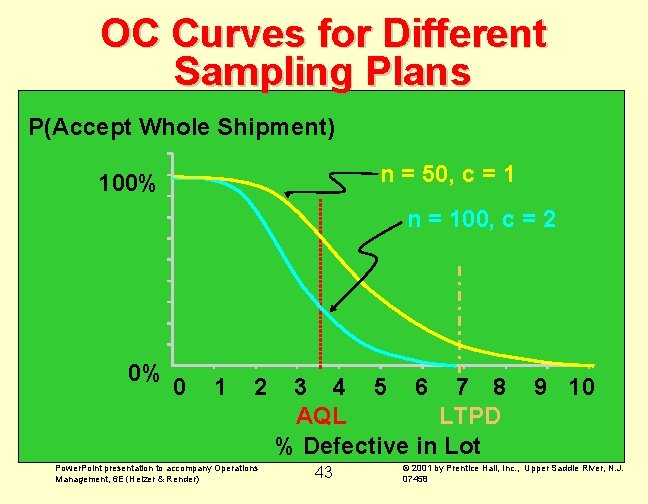
OC Curve with Less than 100% Sampling P(Accept Whole Shipment) Probability is not 100%: Risk of keeping bad shipment or returning good one. 100% Keep whole shipment 0% 0 1 2 3 4 Cut-Off Power. Point presentation to accompany Operations Management, 6 E (Heizer & Render) Return whole shipment 5 6 7 8 9 10 % Defective in Lot 39 © 2001 by Prentice Hall, Inc. , Upper Saddle River, N. J. 07458
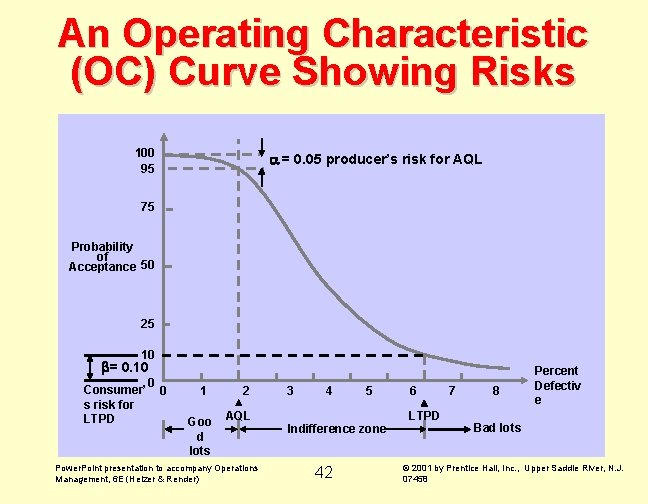
AQL & LTPD ¨ Acceptable quality level (AQL) Quality level of a good lot ¨ Producer (supplier) does not want lots with fewer defects than AQL rejected ¨ ¨ Lot tolerance percent defective (LTPD) Quality level of a bad lot ¨ Consumer (buyer) does not want lots with more defects than LTPD accepted ¨ Power. Point presentation to accompany Operations Management, 6 E (Heizer & Render) 40 © 2001 by Prentice Hall, Inc. , Upper Saddle River, N. J. 07458
Producer’s & Consumer’s Risk ¨ Producer's risk ( ) Probability of rejecting a good lot ¨ Probability of rejecting a lot when fraction defective is AQL ¨ ¨ Consumer's risk (ß) Probability of accepting a bad lot ¨ Probability of accepting a lot when fraction defective is LTPD ¨ Power. Point presentation to accompany Operations Management, 6 E (Heizer & Render) 41 © 2001 by Prentice Hall, Inc. , Upper Saddle River, N. J. 07458
An Operating Characteristic (OC) Curve Showing Risks 100 95 = 0. 05 producer’s risk for AQL 75 Probability of Acceptance 50 25 10 = 0. 10 Consumer’ s risk for LTPD 0 0 1 Goo d lots 2 AQL Power. Point presentation to accompany Operations Management, 6 E (Heizer & Render) 3 4 5 Indifference zone 42 6 LTPD 7 8 Percent Defectiv e Bad lots © 2001 by Prentice Hall, Inc. , Upper Saddle River, N. J. 07458
OC Curves for Different Sampling Plans P(Accept Whole Shipment) n = 50, c = 1 100% n = 100, c = 2 0% 0 1 2 Power. Point presentation to accompany Operations Management, 6 E (Heizer & Render) 3 4 5 6 7 8 AQL LTPD % Defective in Lot 43 9 10 © 2001 by Prentice Hall, Inc. , Upper Saddle River, N. J. 07458
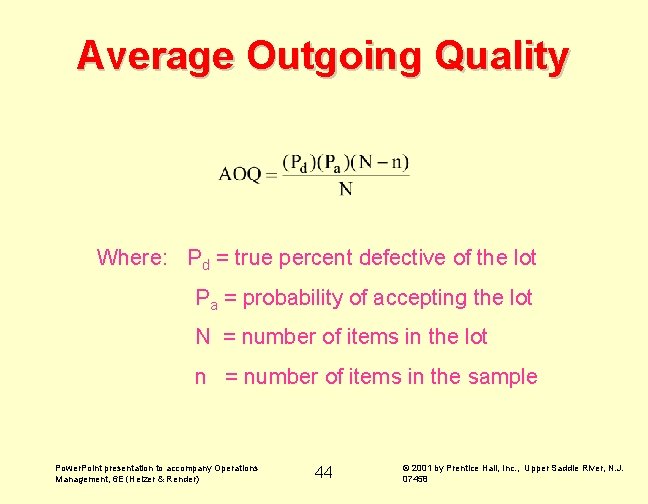
Average Outgoing Quality Where: Pd = true percent defective of the lot Pa = probability of accepting the lot N = number of items in the lot n = number of items in the sample Power. Point presentation to accompany Operations Management, 6 E (Heizer & Render) 44 © 2001 by Prentice Hall, Inc. , Upper Saddle River, N. J. 07458
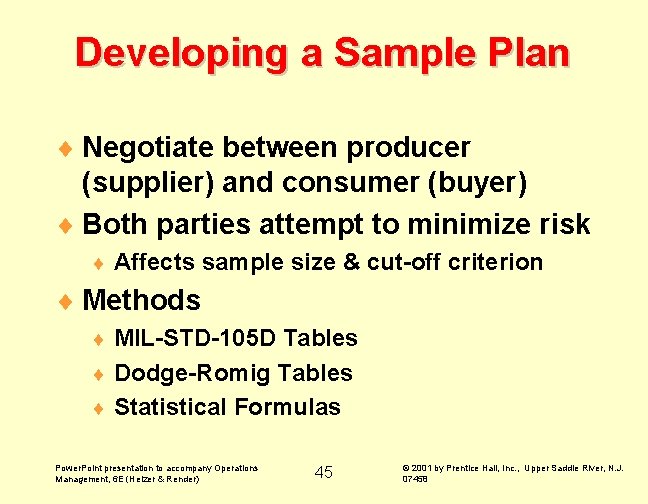
Developing a Sample Plan ¨ Negotiate between producer (supplier) and consumer (buyer) ¨ Both parties attempt to minimize risk ¨ Affects sample size & cut-off criterion ¨ Methods MIL-STD-105 D Tables ¨ Dodge-Romig Tables ¨ Statistical Formulas ¨ Power. Point presentation to accompany Operations Management, 6 E (Heizer & Render) 45 © 2001 by Prentice Hall, Inc. , Upper Saddle River, N. J. 07458
Statistical Process Control Identify and Reduce Process Variability Lower specificatio n limit Upper specificatio n limit (a) Acceptance sampling (b) Statistical process control (c) cpk >1 Power. Point presentation to accompany Operations Management, 6 E (Heizer & Render) 46 © 2001 by Prentice Hall, Inc. , Upper Saddle River, N. J. 07458