
Operations Management Performance Modeling 1 2 3 4
- Slides: 19
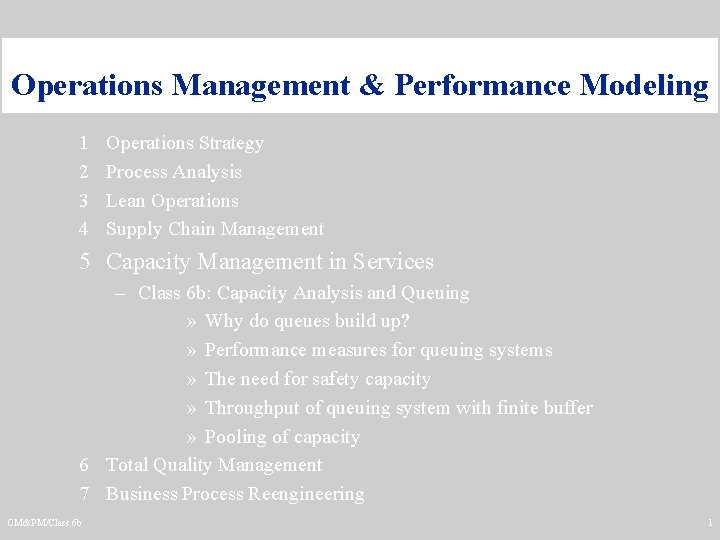
Operations Management & Performance Modeling 1 2 3 4 Operations Strategy Process Analysis Lean Operations Supply Chain Management 5 Capacity Management in Services – Class 6 b: Capacity Analysis and Queuing » Why do queues build up? » Performance measures for queuing systems » The need for safety capacity » Throughput of queuing system with finite buffer » Pooling of capacity 6 Total Quality Management 7 Business Process Reengineering OM&PM/Class 6 b 1
Telemarketing at L. L. Bean u u During some half hours, 80% of calls dialed received a busy signal. Customers getting through had to wait on average 10 minutes for an available agent. Extra telephone expense per day for waiting was $25, 000. For calls abandoned because of long delays, L. L. Bean still paid for the queue time connect charges. In 1988, L. L. Bean conservatively estimated that it lost $10 million of profit because of sub-optimal allocation of telemarketing resources. OM&PM/Class 6 b 5
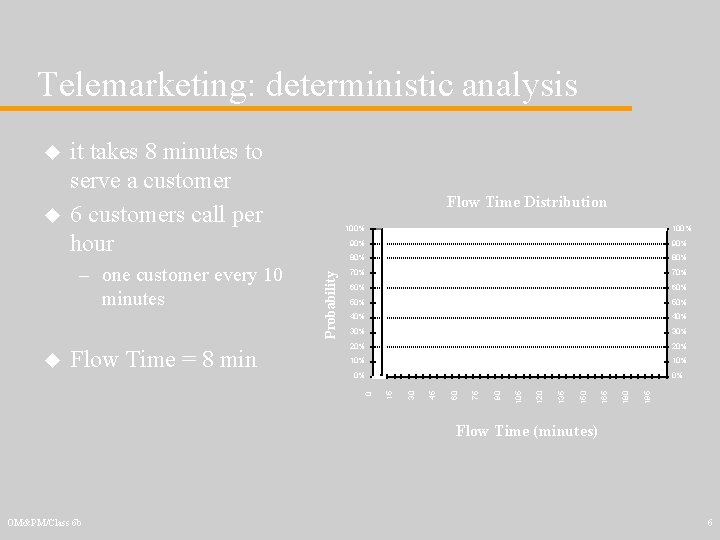
Telemarketing: deterministic analysis 30% 20% 10% 0% 0% 195 40% 180 50% 40% 165 50% 150 60% 135 60% 120 70% 105 80% 70% 90 80% 75 90% 60 90% 45 Flow Time = 8 min 100% 0 u 100% 30 – one customer every 10 minutes Flow Time Distribution 15 u it takes 8 minutes to serve a customer 6 customers call per hour Probability u Flow Time (minutes) OM&PM/Class 6 b 6
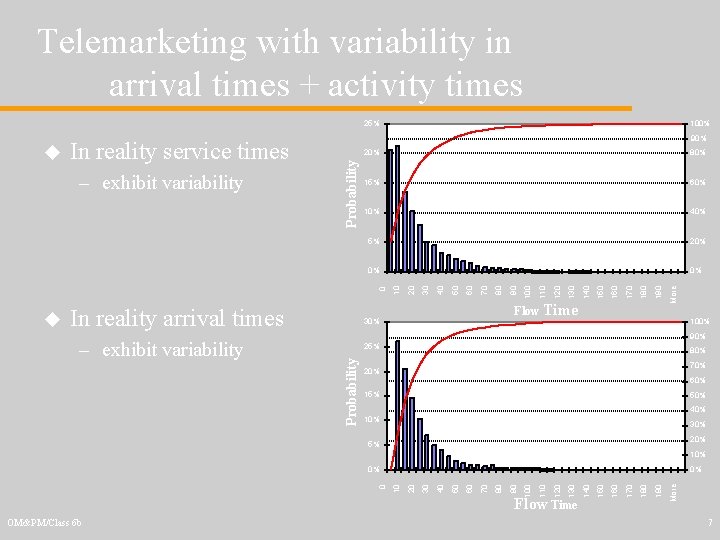
Telemarketing with variability in arrival times + activity times 80% 15% 60% 10% 40% 5% 20% 0% 0% In reality arrival times – exhibit variability 190 More 180 170 160 150 140 130 120 110 90 100 80 70 50 60 40 30 Flow Time 30% 100% 90% 25% Probability u 20 0 – exhibit variability 20% 10 In reality service times 100% 90% Probability u 25% 80% 70% 20% 60% 15% 50% 40% 10% 30% 20% 5% 10% OM&PM/Class 6 b 190 More 180 170 160 150 Flow Time 140 130 120 110 90 100 80 70 50 60 40 30 20 0 0% 10 0% 7
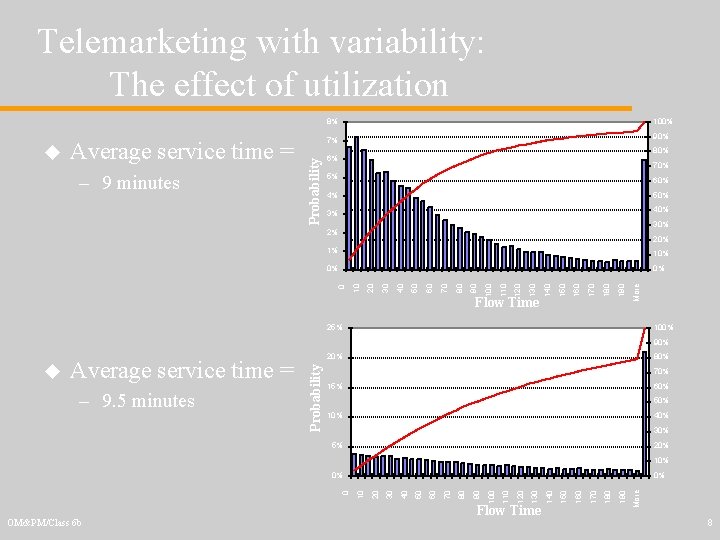
u Average service time = – 9 minutes Probability Telemarketing with variability: The effect of utilization 8% 100% 7% 90% 80% 6% 70% 5% 60% 4% 50% 3% 40% 30% 2% 20% More 190 180 170 160 150 Flow Time 140 130 120 110 90 100 80 70 60 50 40 30 20 0% 10 10% 0% 0 1% 25% 100% 90% Average service time = – 9. 5 minutes Probability u 20% 80% 70% 15% 60% 50% 10% 40% 30% 5% 20% 10% OM&PM/Class 6 b More 190 180 170 160 150 Flow Time 140 130 120 110 100 90 80 70 60 50 40 30 20 0% 10 0 0% 8
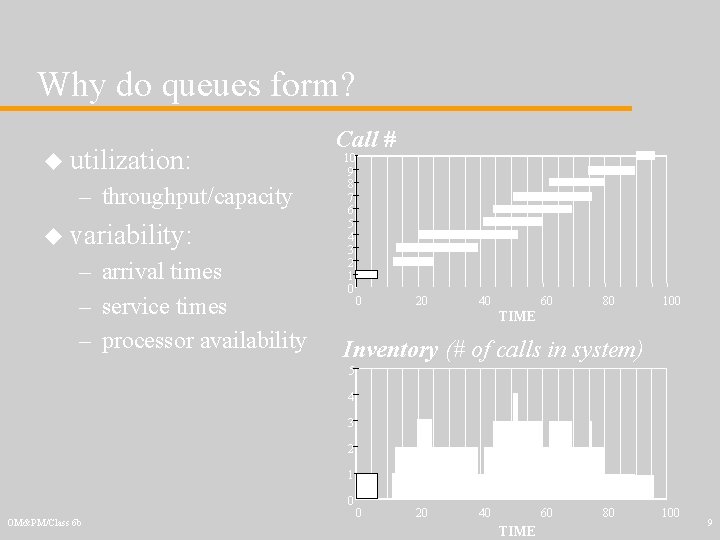
Why do queues form? u utilization: – throughput/capacity u variability: – arrival times – service times – processor availability Call # 10 9 8 7 6 5 4 3 2 1 0 0 20 40 60 80 100 TIME Inventory (# of calls in system) 5 4 3 2 1 0 OM&PM/Class 6 b 0 20 40 60 TIME 80 100 9
Cycle Times in White Collar Processes OM&PM/Class 6 b 10
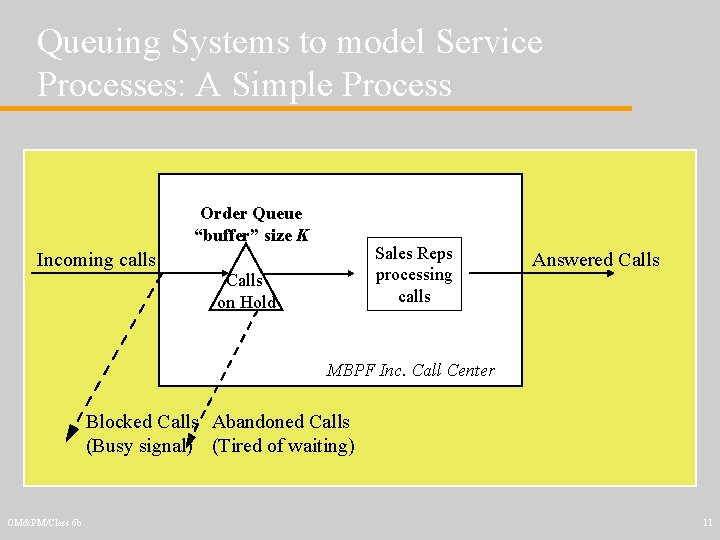
Queuing Systems to model Service Processes: A Simple Process Order Queue “buffer” size K Incoming calls Sales Reps processing calls Calls on Hold Answered Calls MBPF Inc. Call Center Blocked Calls Abandoned Calls (Busy signal) (Tired of waiting) OM&PM/Class 6 b 11
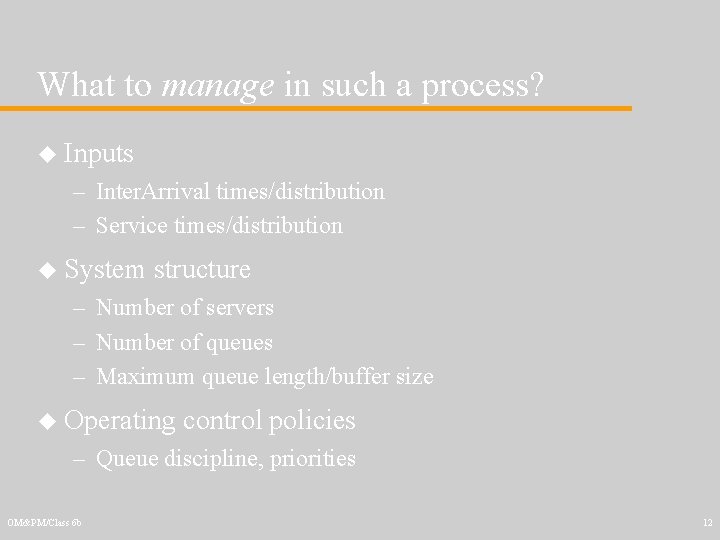
What to manage in such a process? u Inputs – Inter. Arrival times/distribution – Service times/distribution u System structure – Number of servers – Number of queues – Maximum queue length/buffer size u Operating control policies – Queue discipline, priorities OM&PM/Class 6 b 12
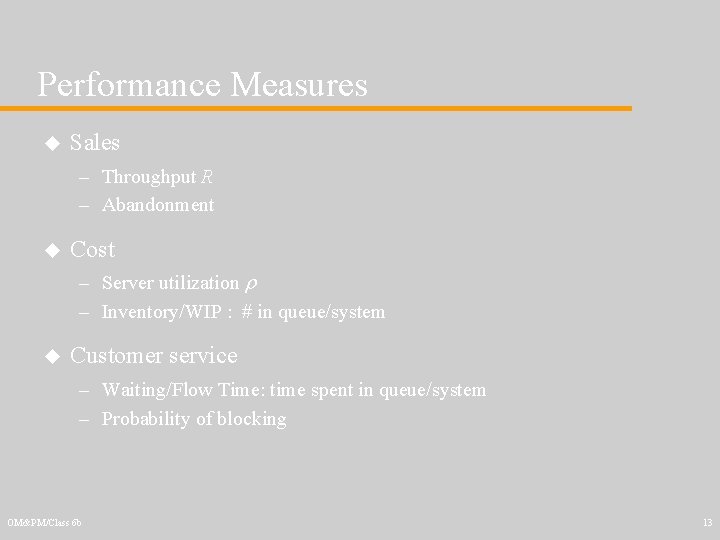
Performance Measures u Sales – Throughput R – Abandonment u Cost – Server utilization r – Inventory/WIP : # in queue/system u Customer service – Waiting/Flow Time: time spent in queue/system – Probability of blocking OM&PM/Class 6 b 13
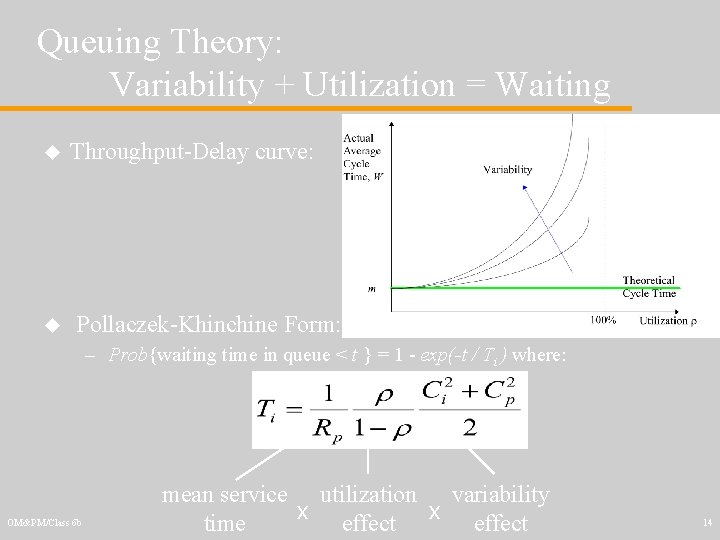
Queuing Theory: Variability + Utilization = Waiting u u Throughput-Delay curve: Pollaczek-Khinchine Form: – Prob{waiting time in queue < t } = 1 - exp(-t / Ti ) where: OM&PM/Class 6 b mean service utilization variability x x time effect 14
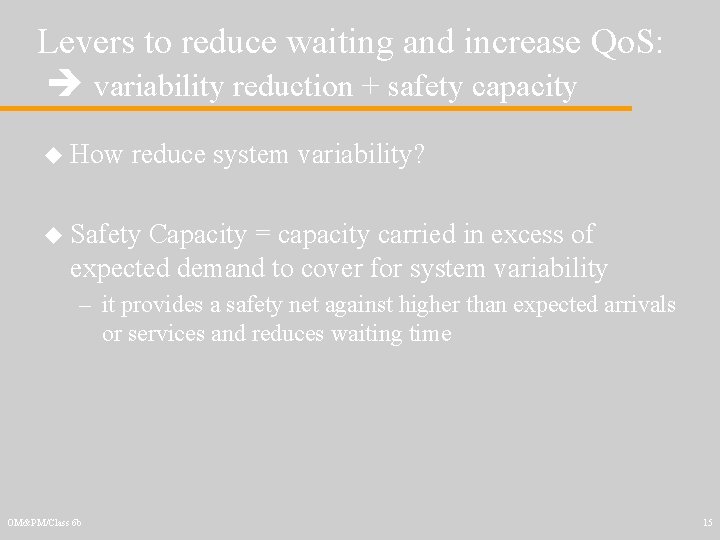
Levers to reduce waiting and increase Qo. S: variability reduction + safety capacity u How reduce system variability? u Safety Capacity = capacity carried in excess of expected demand to cover for system variability – it provides a safety net against higher than expected arrivals or services and reduces waiting time OM&PM/Class 6 b 15
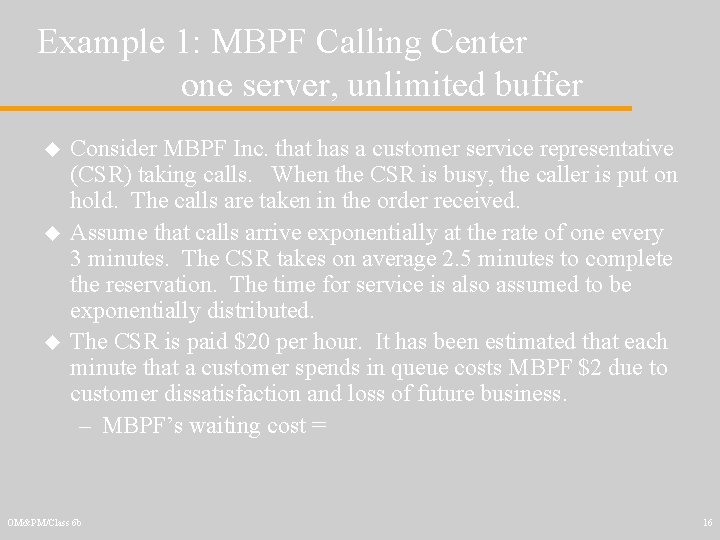
Example 1: MBPF Calling Center one server, unlimited buffer u u u Consider MBPF Inc. that has a customer service representative (CSR) taking calls. When the CSR is busy, the caller is put on hold. The calls are taken in the order received. Assume that calls arrive exponentially at the rate of one every 3 minutes. The CSR takes on average 2. 5 minutes to complete the reservation. The time for service is also assumed to be exponentially distributed. The CSR is paid $20 per hour. It has been estimated that each minute that a customer spends in queue costs MBPF $2 due to customer dissatisfaction and loss of future business. – MBPF’s waiting cost = OM&PM/Class 6 b 16
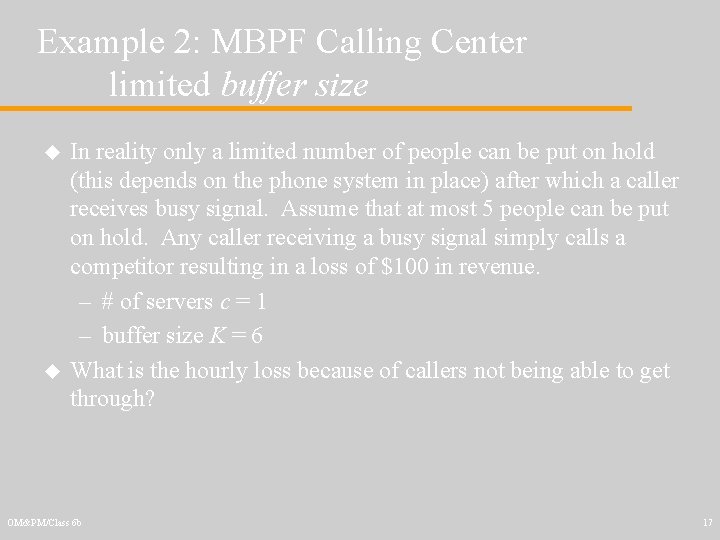
Example 2: MBPF Calling Center limited buffer size u u In reality only a limited number of people can be put on hold (this depends on the phone system in place) after which a caller receives busy signal. Assume that at most 5 people can be put on hold. Any caller receiving a busy signal simply calls a competitor resulting in a loss of $100 in revenue. – # of servers c = 1 – buffer size K = 6 What is the hourly loss because of callers not being able to get through? OM&PM/Class 6 b 17
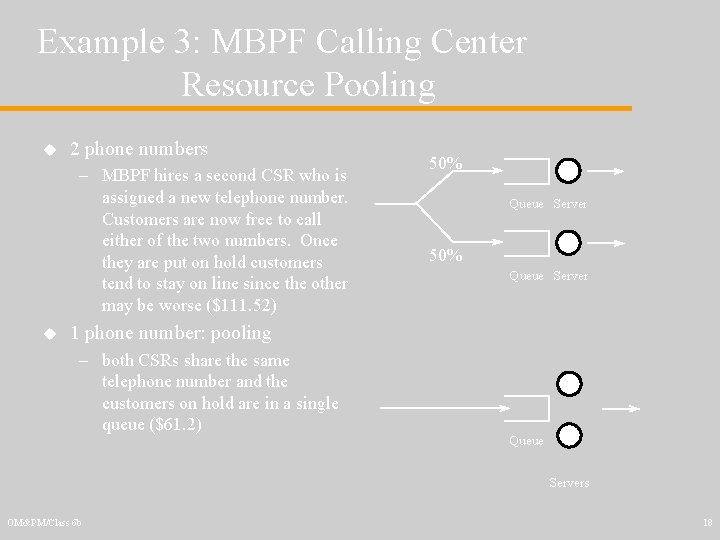
Example 3: MBPF Calling Center Resource Pooling u 2 phone numbers – MBPF hires a second CSR who is assigned a new telephone number. Customers are now free to call either of the two numbers. Once they are put on hold customers tend to stay on line since the other may be worse ($111. 52) u 50% Queue Server 1 phone number: pooling – both CSRs share the same telephone number and the customers on hold are in a single queue ($61. 2) Queue Servers OM&PM/Class 6 b 18
Example 4: MBPF Calling Center Staffing u Assume that the MBPF call center has a total of 6 lines. With all other data as in Example 2, what is the optimal number of CSRs that MBPF should staff the call center with? – c=3 OM&PM/Class 6 b 19
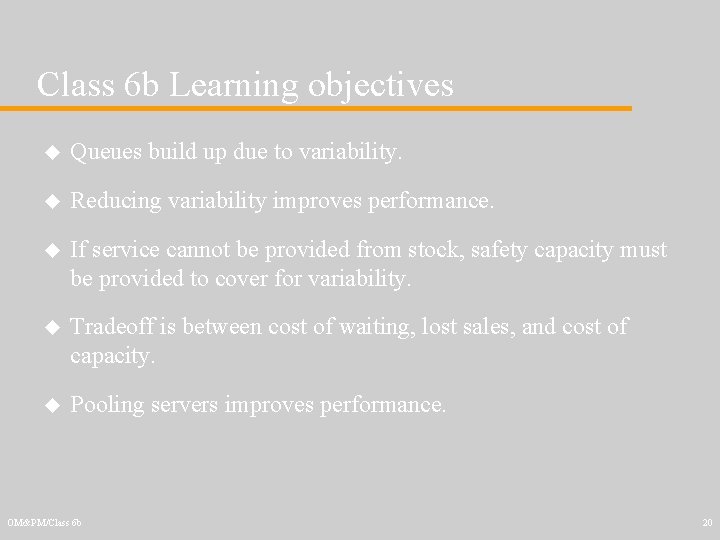
Class 6 b Learning objectives u Queues build up due to variability. u Reducing variability improves performance. u If service cannot be provided from stock, safety capacity must be provided to cover for variability. u Tradeoff is between cost of waiting, lost sales, and cost of capacity. u Pooling servers improves performance. OM&PM/Class 6 b 20
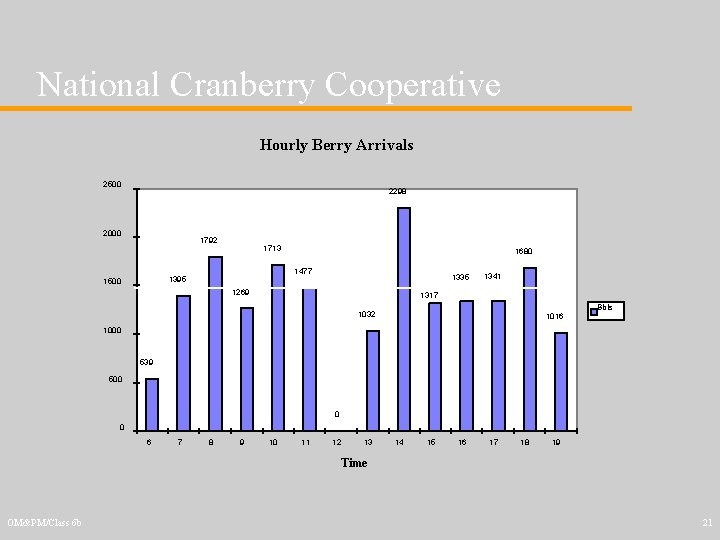
National Cranberry Cooperative Hourly Berry Arrivals 2500 2298 2000 1792 1713 1477 1395 1500 1680 1335 1269 1341 1317 1032 1016 Bbls 1000 539 500 0 0 6 7 8 9 10 11 12 13 14 15 16 17 18 19 Time OM&PM/Class 6 b 21
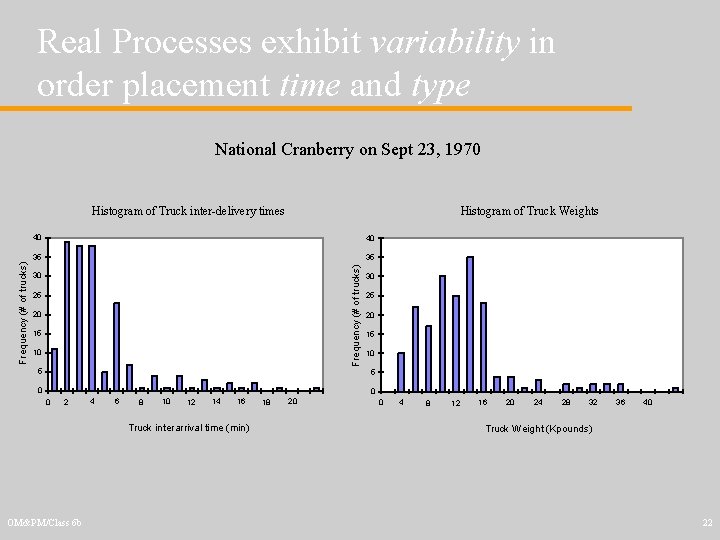
Real Processes exhibit variability in order placement time and type National Cranberry on Sept 23, 1970 Histogram of Truck Weights 40 40 35 35 Frequency (# of trucks) Histogram of Truck inter-delivery times 30 25 20 15 10 5 0 0 0 2 4 6 8 10 12 14 16 Truck interarrival time (min) OM&PM/Class 6 b 18 20 0 4 8 12 16 20 24 28 32 36 40 Truck Weight (Kpounds) 22