
Operations Management Lecture 7 Linear Programming Power Point

- Slides: 31
Operations Management Lecture 7 Linear Programming Power. Point presentation to accompany Heizer/Render Principles of Operations Management, 7 e Operations Management, 9 e
Recap þ Implications of Quality tools and Problem solving þ Check Sheets þ Scatter Diagrams þ Cause-and-Effect Diagrams þ Pareto Charts þ Flowcharts þ Histograms þ Statistical Process Control (SPC)
Outline þ Linear Programming þ Requirements of a Linear Programming Problem þ Maximization Problems þ Minimization Problems þ Linear Programming Methods Ø Graphical Method Ø Simplex Method (will do later)
Outline – Continued þ Formulating Linear Programming Problems þ Shader Electronics Example þ Graphical Solution to a Linear Programming Problem þ Graphical Representation of Constraints þ Iso-Profit Line Solution Method þ Corner-Point Solution Method
Outline – Continued þ Linear Programming Applications þ Production-Mix Example þ Diet Problem Example þ Labor Scheduling Example
Learning Objectives When you complete this module you should be able to: 1. Formulate linear programming models, including an objective function and constraints 2. Graphically solve an LP problem with the iso-profit line method 3. Graphically solve an LP problem with the corner-point method
Linear Programming þ A mathematical technique to allocate limited resources to achieve an objective þ linear programming (LP) is a technique for optimization of a linear objective function, subject to linear equality and linear inequality constraints.
Linear Programming Linear programming determines the way to achieve the best outcome (such as maximum profit or minimum cost) in a given mathematical model and given some list of requirements represented as linear equations. þ It is one of more powerful technique for managerial decisions
Linear Programming • A Linear Programming model seeks to maximize or minimize a linear function, subject to a set of linear constraints. • The linear model consists of the following components: A set of decision variables. An objective function. A set of constraints
Linear Programming þ Will find the minimum or maximum value of the objective þ Guarantees the optimal solution to the model formulated
LP Applications 1. Scheduling school buses to minimize total distance traveled 2. Allocating police patrol units to high crime areas in order to minimize response time 3. Scheduling tellers at banks so that needs are met during each hour of the day while minimizing the total cost of labor
LP Applications 4. Selecting the product mix in a factory to make best use of machine- and labor-hours available while maximizing the firm’s profit 5. Picking blends of raw materials in feed mills to produce finished feed combinations at minimum costs 6. Determining the distribution system that will minimize total shipping cost
LP Applications 7. Developing a production schedule that will satisfy future demands for a firm’s product and at the same time minimize total production and inventory costs
Requirements of an LP Problem 1. There should be an objective function to maximize or minimize some quantity (usually profit or cost) 2. The restrictions or constraints are present which limit the ability to achieve objective
Requirements of an LP Problem 3. There must be alternative courses of action from which to choose 4. The objective and constraints in linear programming problems must be expressible in terms of linear equations or inequalities
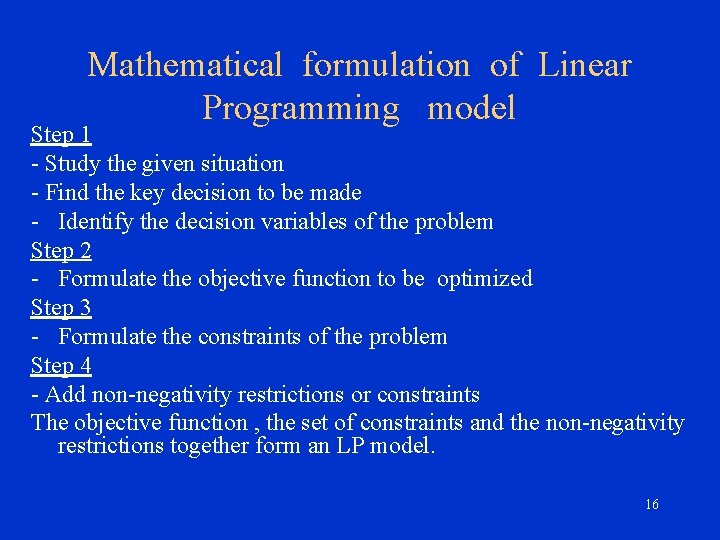
Mathematical formulation of Linear Programming model Step 1 - Study the given situation - Find the key decision to be made - Identify the decision variables of the problem Step 2 - Formulate the objective function to be optimized Step 3 - Formulate the constraints of the problem Step 4 - Add non-negativity restrictions or constraints The objective function , the set of constraints and the non-negativity restrictions together form an LP model. 16
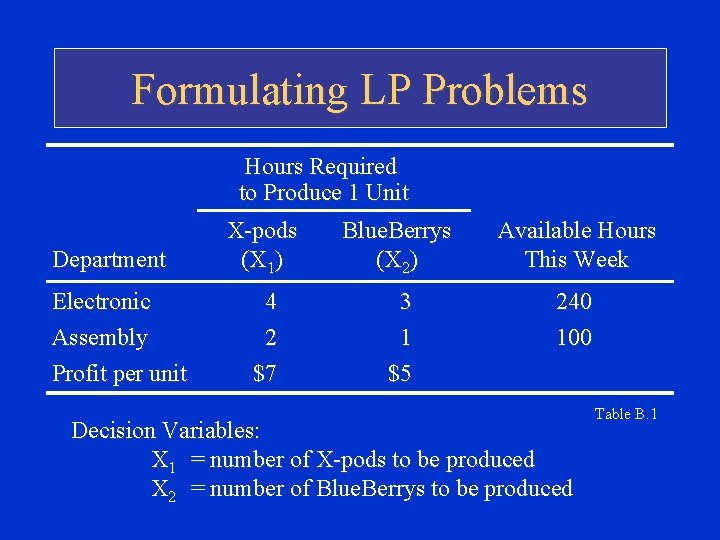
Formulating LP Problems The product-mix problem at Shader Electronics þ Two products 1. Shader X-pod, a portable music player 2. Shader Blue. Berry, an internet-connected color telephone þ Determine the mix of products that will produce the maximum profit
Formulating LP Problems Hours Required to Produce 1 Unit Department Electronic Assembly Profit per unit X-pods (X 1) Blue. Berrys (X 2) Available Hours This Week 4 2 $7 3 1 $5 240 100 Decision Variables: X 1 = number of X-pods to be produced X 2 = number of Blue. Berrys to be produced Table B. 1
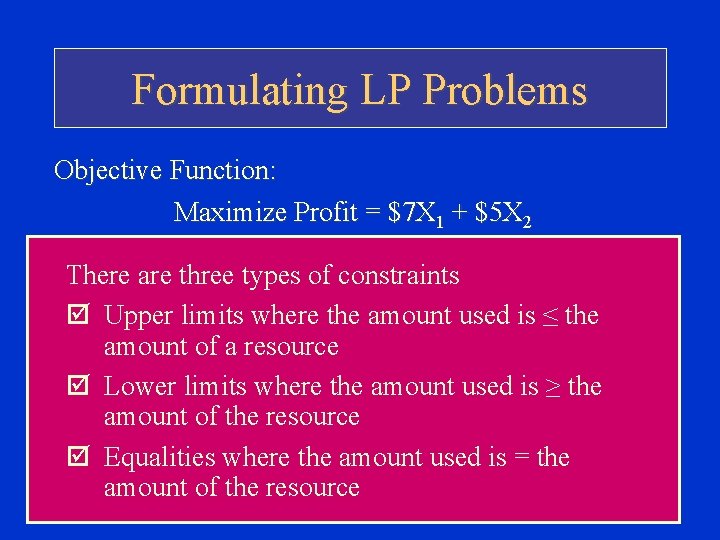
Formulating LP Problems Objective Function: Maximize Profit = $7 X 1 + $5 X 2 There are three types of constraints þ Upper limits where the amount used is ≤ the amount of a resource þ Lower limits where the amount used is ≥ the amount of the resource þ Equalities where the amount used is = the amount of the resource
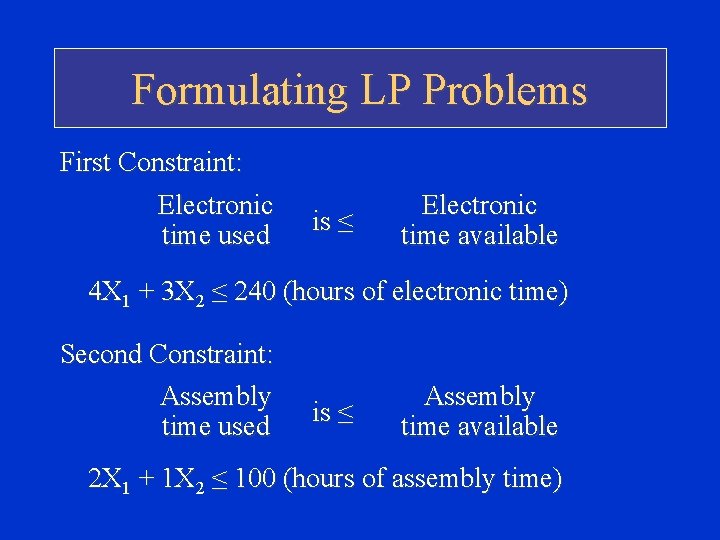
Formulating LP Problems First Constraint: Electronic time used is ≤ Electronic time available 4 X 1 + 3 X 2 ≤ 240 (hours of electronic time) Second Constraint: Assembly time used is ≤ Assembly time available 2 X 1 + 1 X 2 ≤ 100 (hours of assembly time)
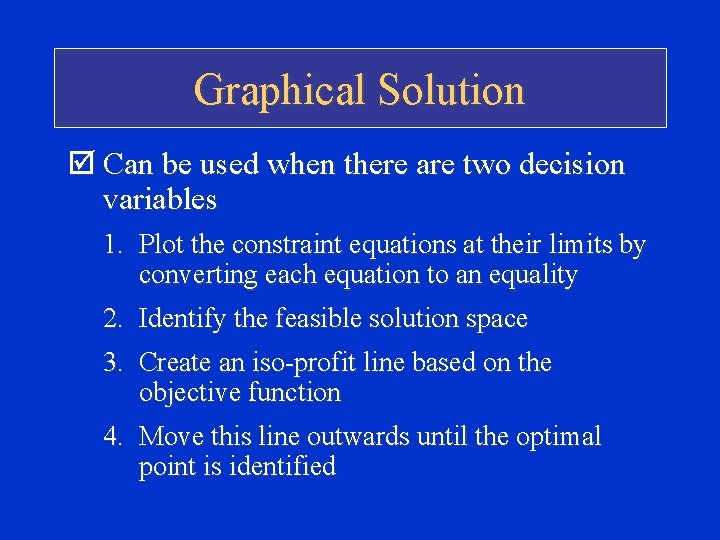
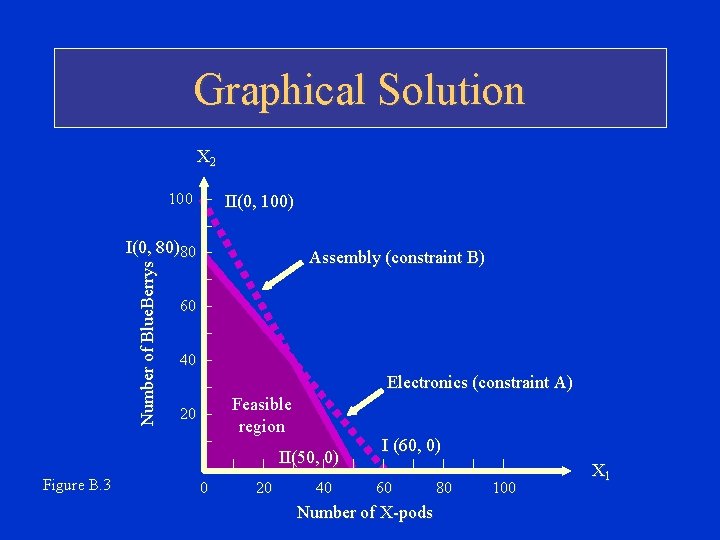
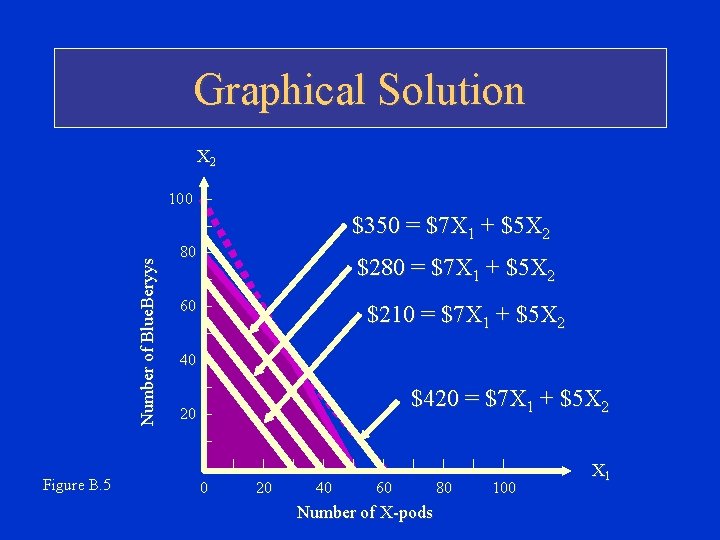
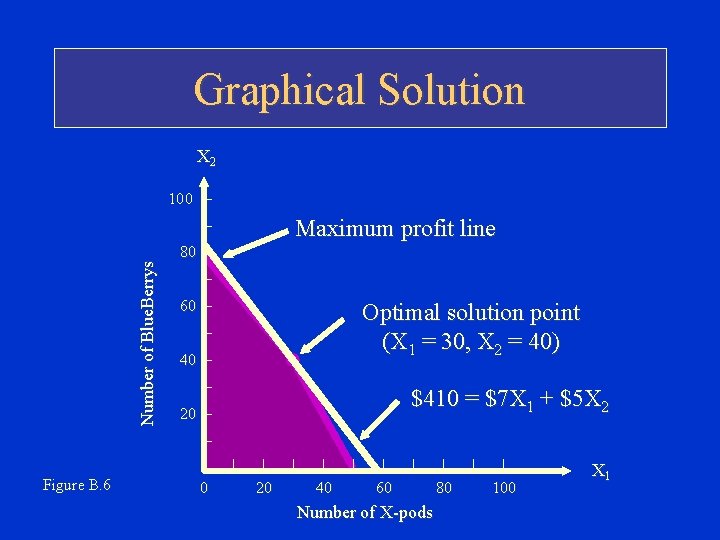
Graphical Solution þ Can be used when there are two decision variables 1. Plot the constraint equations at their limits by converting each equation to an equality 2. Identify the feasible solution space 3. Create an iso-profit line based on the objective function 4. Move this line outwards until the optimal point is identified
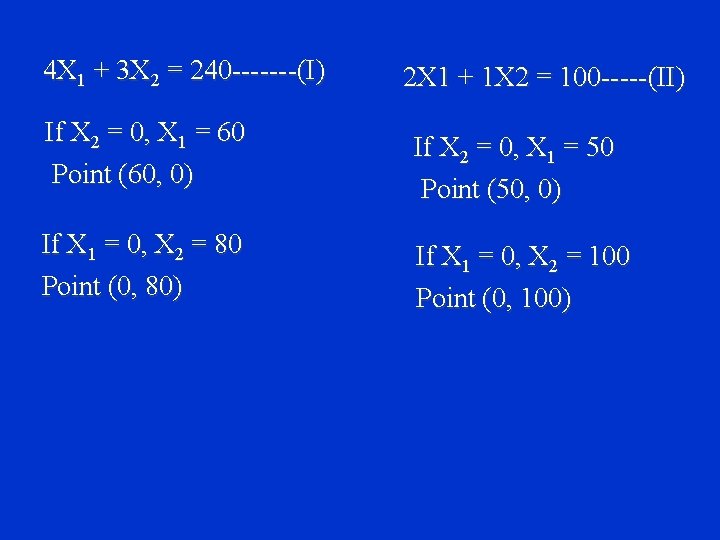
4 X 1 + 3 X 2 = 240 -------(I) If X 2 = 0, X 1 = 60 Point (60, 0) If X 1 = 0, X 2 = 80 Point (0, 80) 2 X 1 + 1 X 2 = 100 -----(II) If X 2 = 0, X 1 = 50 Point (50, 0) If X 1 = 0, X 2 = 100 Point (0, 100)
Graphical Solution X 2 100 – II(0, 100) – Number of Blue. Berrys I(0, 80)80 – – 60 – – 40 – – 20 – – Figure B. 3 Assembly (constraint B) |– 0 Electronics (constraint A) Feasible region | | II(50, | |0) | 20 40 I (60, 0) | 60 | Number of X-pods | 80 | | 100 X 1
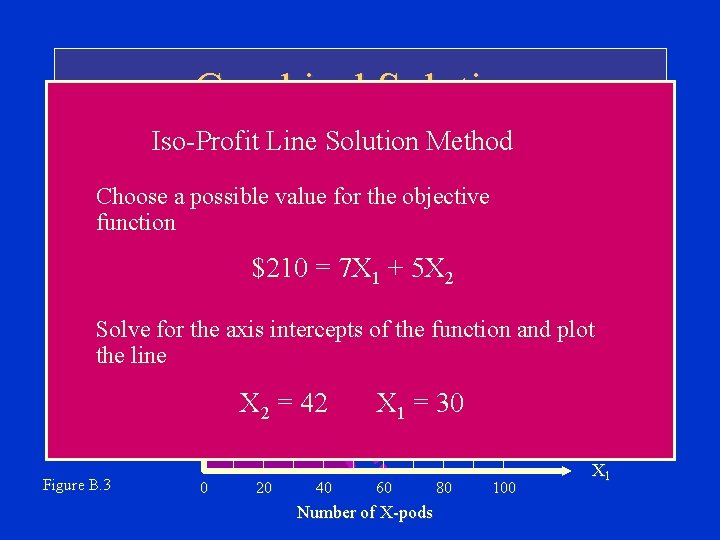
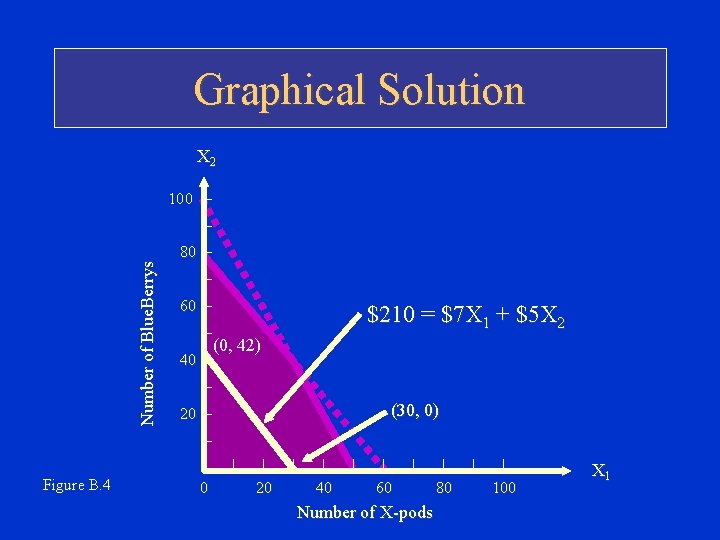
Graphical Solution Iso-Profit Line Solution Method X 2 Number of Watch TVs Choose 100 a possible value for the objective – function – 80 – Assembly (constraint B) $210 = 7 X 1 + 5 X 2 – 60 – Solve for the – axis intercepts of the function and plot the line 40 – – 20 – – Figure B. 3 |– 0 Feasible X 2 = region | | 20 | Electronics (constraint A) 42 | 40 X 1 = 30 | | 60 | Number of X-pods | 80 | | 100 X 1
Graphical Solution X 2 100 – Number of Blue. Berrys – 80 – – 60 – – 40 – $210 = $7 X 1 + $5 X 2 (0, 42) – (30, 0) 20 – – Figure B. 4 |– 0 | | 20 | | 40 | | 60 | Number of X-pods | 80 | | 100 X 1
Graphical Solution X 2 100 – $350 = $7 X 1 + $5 X 2 Number of Blue. Beryys – 80 – $280 = $7 X 1 + $5 X 2 – 60 – $210 = $7 X 1 + $5 X 2 – 40 – – $420 = $7 X 1 + $5 X 2 20 – – Figure B. 5 |– 0 | | 20 | | 40 | | 60 | Number of X-pods | 80 | | 100 X 1
Graphical Solution X 2 100 – Maximum profit line Number of Blue. Berrys – 80 – – 60 – Optimal solution point (X 1 = 30, X 2 = 40) – 40 – – $410 = $7 X 1 + $5 X 2 20 – – Figure B. 6 |– 0 | | 20 | | 40 | | 60 | Number of X-pods | 80 | | 100 X 1
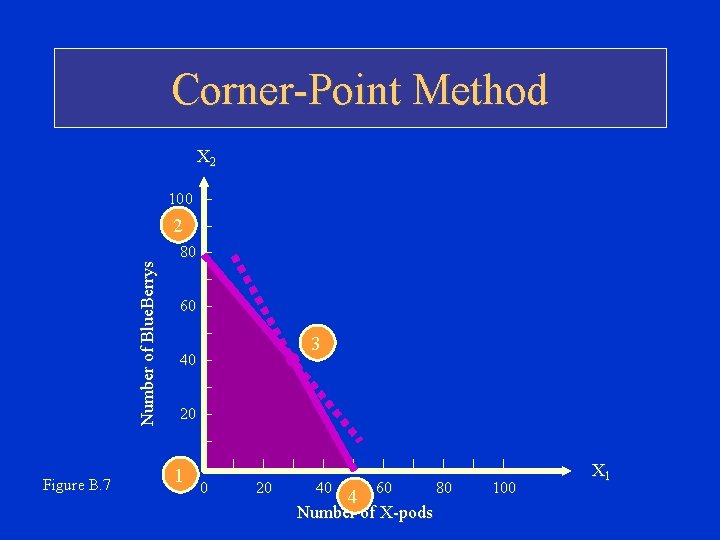
Corner-Point Method X 2 100 – Number of Blue. Berrys 2 – 80 – – 60 – – 3 40 – – 20 – – Figure B. 7 1 |– 0 | | 20 | | 40 | 4 | 60 | Number of X-pods | 80 | | 100 X 1
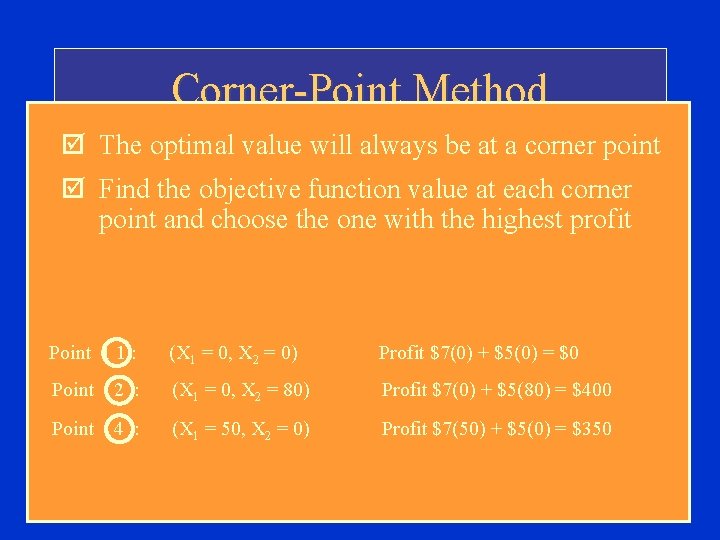
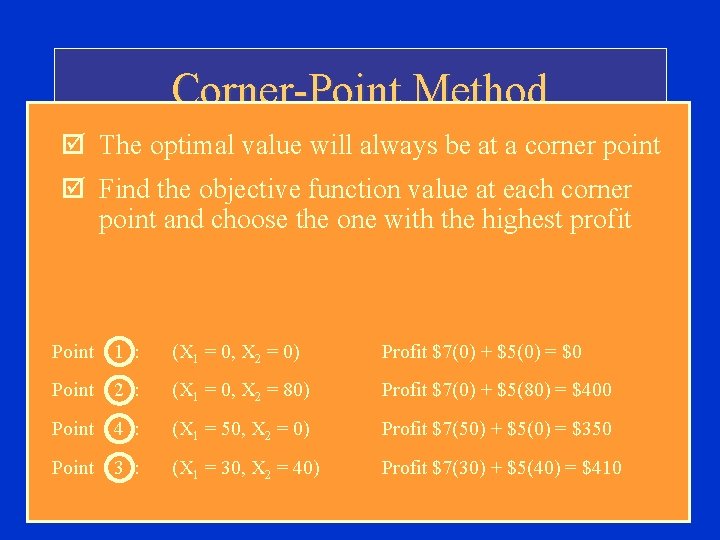
Corner-Point Method þ The optimal value will always be at a corner point þ Find the objective function value at each corner point and choose the one with the highest profit Point 1 1 : (X 1 = 0, X 2 = 0) Profit $7(0) + $5(0) = $0 Point 2 : (X 1 = 0, X 2 = 80) Profit $7(0) + $5(80) = $400 Point 4 : (X 1 = 50, X 2 = 0) Profit $7(50) + $5(0) = $350
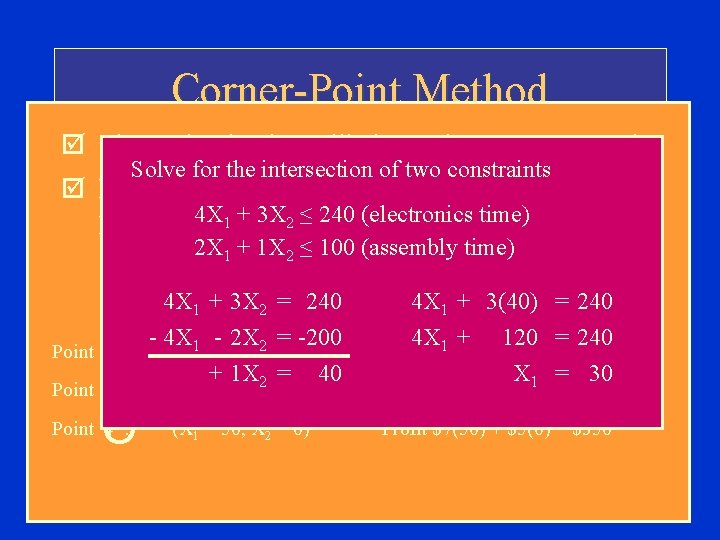
Corner-Point Method þ The optimal value will always be at a corner point Solve for the intersection of two constraints þ Find the objective function value at each corner ≤ 240 (electronics 1 + 3 X 2 the point and 4 Xchoose one with the time) highest profit 2 X 1 + 1 X 2 ≤ 100 (assembly time) 4 X 1 + 3 X 2 = 240 - 4 X 1 - 2 X 2 = -200 Point 1 : (X 1 = 0, X 2 = 0) + 1 X 2 = 40 4 X 1 + 3(40) = 240 4 X 1 + 120 = 240 Profit $7(0) + $5(0) = $0 X 1 = 30 Point 2 : (X 1 = 0, X 2 = 80) Profit $7(0) + $5(80) = $400 Point 4 : (X 1 = 50, X 2 = 0) Profit $7(50) + $5(0) = $350
Corner-Point Method þ The optimal value will always be at a corner point þ Find the objective function value at each corner point and choose the one with the highest profit Point 1 : (X 1 = 0, X 2 = 0) Profit $7(0) + $5(0) = $0 Point 2 : (X 1 = 0, X 2 = 80) Profit $7(0) + $5(80) = $400 Point 4 : (X 1 = 50, X 2 = 0) Profit $7(50) + $5(0) = $350 Point 3 : (X 1 = 30, X 2 = 40) Profit $7(30) + $5(40) = $410