
Operations Management Chapter 16 JIT and Lean Operations
- Slides: 62
Operations Management Chapter 16 – JIT and Lean Operations Power. Point presentation to accompany Heizer/Render Principles of Operations Management, 7 e Operations Management, 9 e © 2008 Prentice Hall, Inc. 16 –
Outline þ Global Company Profile: Toyota Motor Corporation þ Just-in-Time, the Toyota Production System, and Lean Operations þ Eliminate Waste þ Remove Variability þ Improve Throughput © 2008 Prentice Hall, Inc. 16 – 2
Outline – Continued þ Just-in-Time þ JIT Partnerships þ Concerns of Suppliers þ JIT Layout þ Distance Reduction þ Increased Flexibility þ Impact on Employees þ Reduced Space and Inventory © 2008 Prentice Hall, Inc. 16 – 3
Outline – Continued þ JIT Inventory þ Reduce Variability þ Reduce Inventory þ Reduce Lot Sizes þ Reduce Setup Costs þ JIT Scheduling þ Level Schedules þ Kanban © 2008 Prentice Hall, Inc. 16 – 4
Outline – Continued þ JIT Quality þ Toyota Production System þ Continuous Improvement þ Respect for People þ Standard Work Practices þ Lean Operations þ Building a Lean Organization þ Lean Operations in Services © 2008 Prentice Hall, Inc. 16 – 5
Learning Objectives When you complete this chapter you should be able to: 1. Define just-in-time, TPS, and lean operations 2. Define the seven wastes and the 5 Ss 3. Explain JIT partnerships 4. Determine optimal setup time © 2008 Prentice Hall, Inc. 16 – 6
Learning Objectives When you complete this chapter you should be able to: 5. Define kanban 6. Compute the required number of kanbans 7. Explain the principles of the Toyota Production System © 2008 Prentice Hall, Inc. 16 – 7
Toyota Motor Corporation þ Largest vehicle manufacturer in the world with annual sales of over 9 million vehicles þ Success due to two techniques, JIT and TPS þ Continual problem solving is central to JIT þ Eliminating excess inventory makes problems immediately evident © 2008 Prentice Hall, Inc. 16 – 8
Toyota Motor Corporation þ Central to TPS is a continuing effort to produce products under ideal conditions þ Respect for people is fundamental þ Small building but high levels of production þ Subassemblies are transferred to the assembly line on a JIT basis þ High quality and low assembly time per vehicle © 2008 Prentice Hall, Inc. 16 – 9
Just-In-Time, TPS, and Lean Operations þ JIT is a philosophy of continuous and forced problem solving via a focus on throughput and reduced inventory þ TPS emphasizes continuous improvement, respect for people, and standard work practices þ Lean production supplies the customer with their exact wants when the customer wants it without waste © 2008 Prentice Hall, Inc. 16 – 10
Just-In-Time, TPS, and Lean Operations þ JIT emphasizes forced problem solving þ TPS emphasizes employee learning and empowerment in an assembly-line environment þ Lean operations emphasize understanding the customer © 2008 Prentice Hall, Inc. 16 – 11
Eliminate Waste þ Waste is anything that does not add value from the customer point of view þ Storage, inspection, delay, waiting in queues, and defective products do not add value and are 100% waste © 2008 Prentice Hall, Inc. 16 – 12
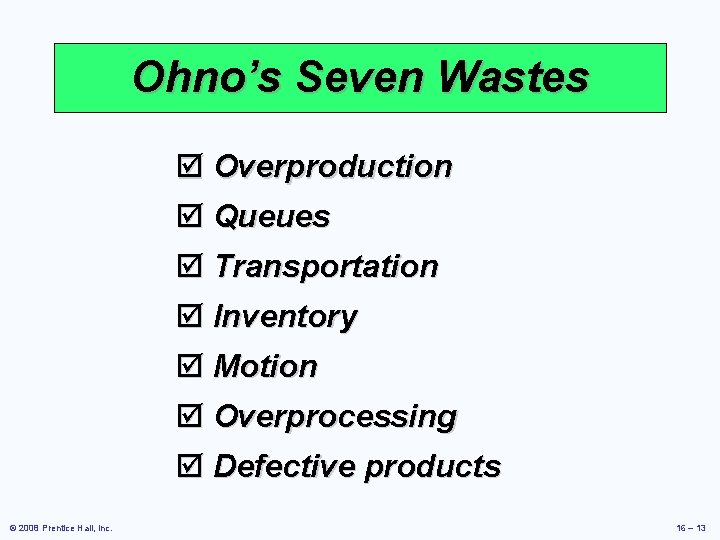
Ohno’s Seven Wastes þ Overproduction þ Queues þ Transportation þ Inventory þ Motion þ Overprocessing þ Defective products © 2008 Prentice Hall, Inc. 16 – 13
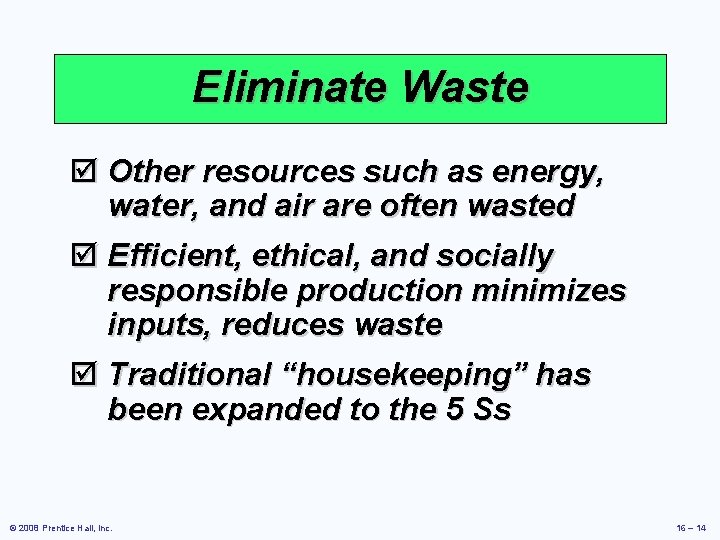
Eliminate Waste þ Other resources such as energy, water, and air are often wasted þ Efficient, ethical, and socially responsible production minimizes inputs, reduces waste þ Traditional “housekeeping” has been expanded to the 5 Ss © 2008 Prentice Hall, Inc. 16 – 14
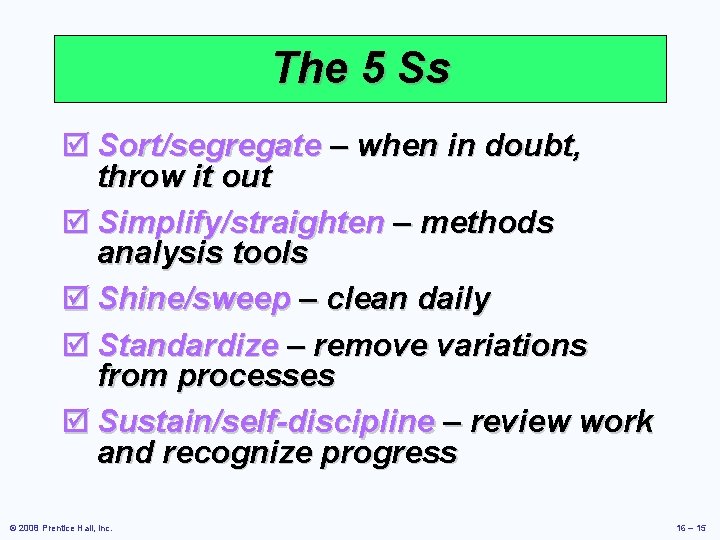
The 5 Ss þ Sort/segregate – when in doubt, throw it out þ Simplify/straighten – methods analysis tools þ Shine/sweep – clean daily þ Standardize – remove variations from processes þ Sustain/self-discipline – review work and recognize progress © 2008 Prentice Hall, Inc. 16 – 15
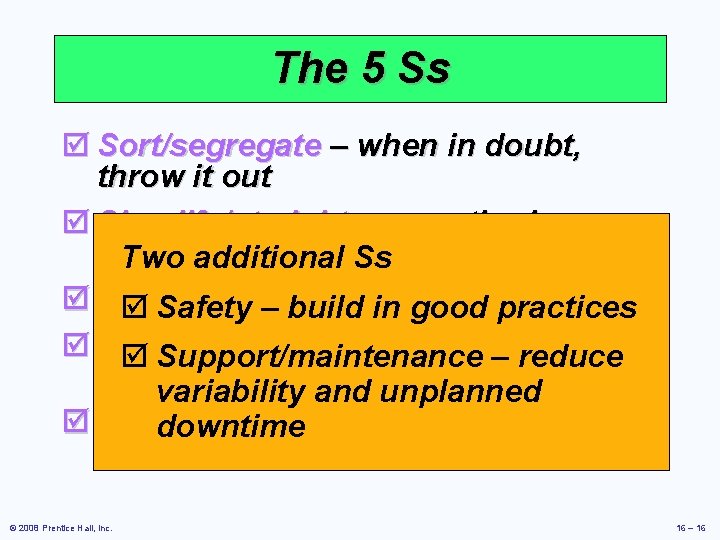
The 5 Ss þ Sort/segregate – when in doubt, throw it out þ Simplify/straighten – methods analysis tools Ss Two additional þ Shine/sweep – clean daily practices þ Safety – build in good þ Standardize – remove variations þ Support/maintenance – reduce fromvariability processes and unplanned þ Sustain/self-discipline – review work downtime and recognize progress © 2008 Prentice Hall, Inc. 16 – 16
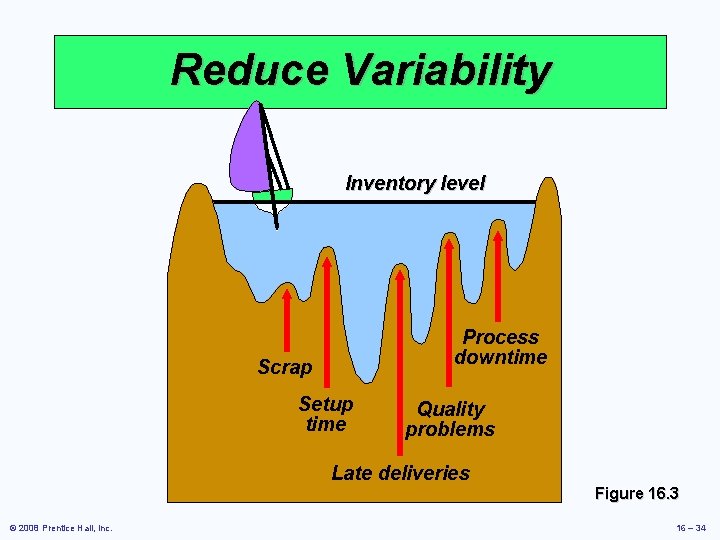
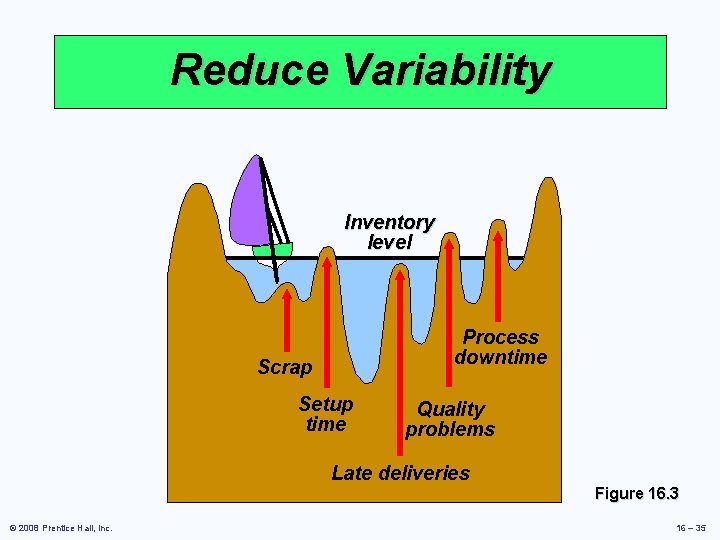
Remove Variability þ JIT systems require managers to reduce variability caused by both internal and external factors þ Variability is any deviation from the optimum process þ Inventory hides variability þ Less variability results in less waste © 2008 Prentice Hall, Inc. 16 – 17
Sources of Variability 1. Incomplete or inaccurate drawings or specifications 2. Poor production processes resulting in incorrect quantities, late, or non-conforming units 3. Unknown customer demands © 2008 Prentice Hall, Inc. 16 – 18
Sources of Variability 1. Incomplete or inaccurate drawings or specifications 2. Poor production processes resulting in incorrect quantities, late, or non-conformingnunits ory t n e v i d n a s l T I o J o t h t e o v i t B c e f f 3. Unknown customer demands e e r s of tion a e s u a reduc c g n i y f i t n e d in i ty i l i b a i r a v © 2008 Prentice Hall, Inc. 16 – 19
Improve Throughput þ The time it takes to move an order from receipt to delivery þ The time between the arrival of raw materials and the shipping of the finished order is called manufacturing cycle time þ A pull system increases throughput © 2008 Prentice Hall, Inc. 16 – 20
Improve Throughput þ By pulling material in small lots, inventory cushions are removed, exposing problems and emphasizing continual improvement þ Manufacturing cycle time is reduced þ Push systems dump orders on the downstream stations regardless of the need © 2008 Prentice Hall, Inc. 16 – 21
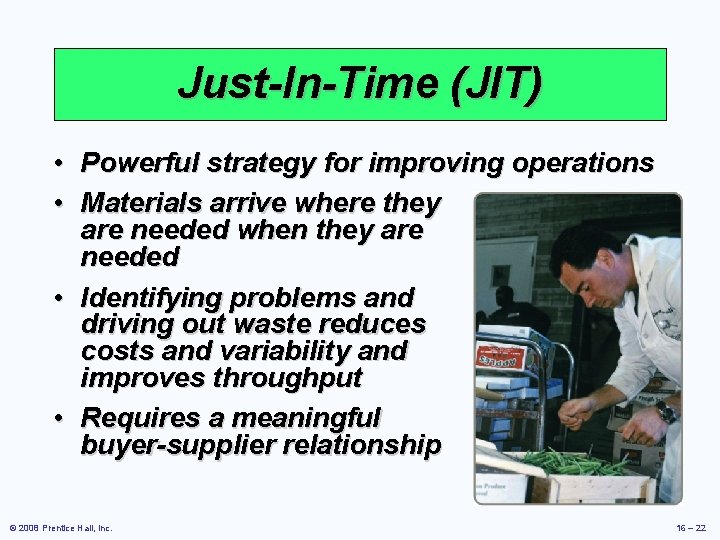
Just-In-Time (JIT) • Powerful strategy for improving operations • Materials arrive where they are needed when they are needed • Identifying problems and driving out waste reduces costs and variability and improves throughput • Requires a meaningful buyer-supplier relationship © 2008 Prentice Hall, Inc. 16 – 22
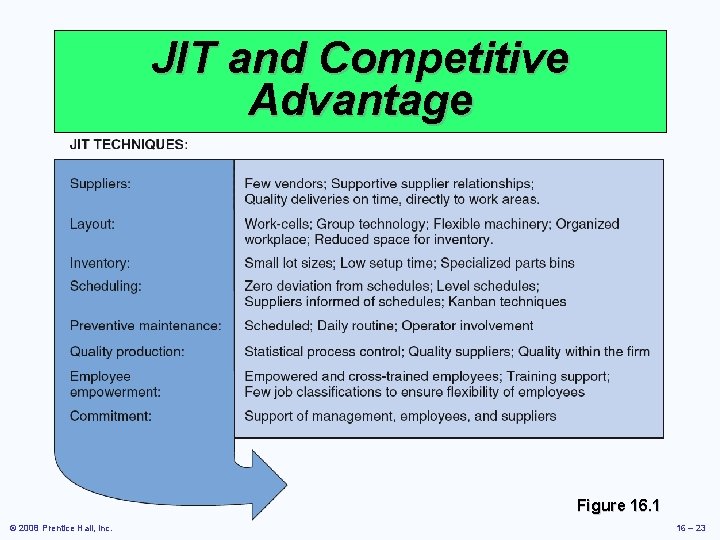
JIT and Competitive Advantage Figure 16. 1 © 2008 Prentice Hall, Inc. 16 – 23
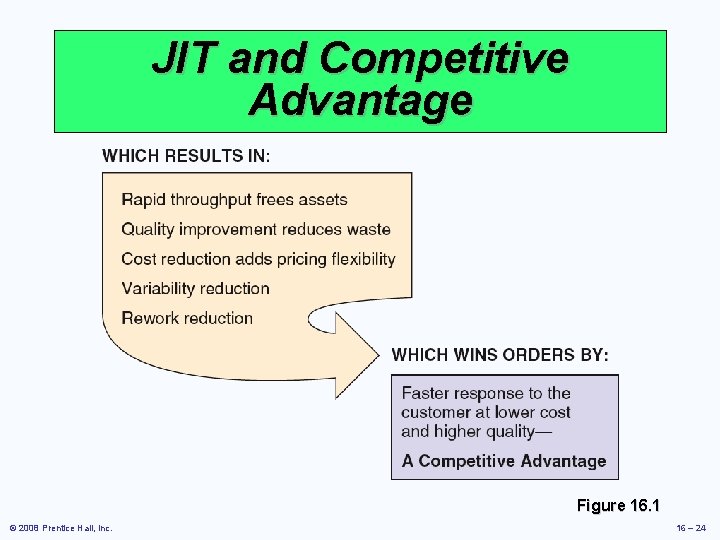
JIT and Competitive Advantage Figure 16. 1 © 2008 Prentice Hall, Inc. 16 – 24
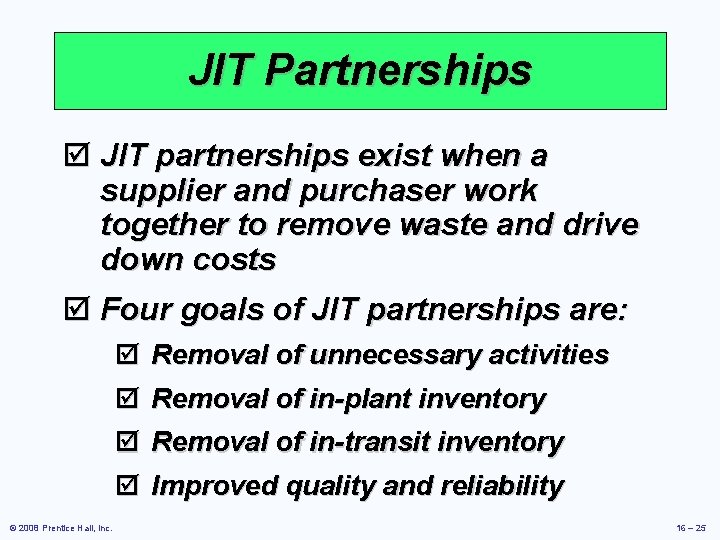
JIT Partnerships þ JIT partnerships exist when a supplier and purchaser work together to remove waste and drive down costs þ Four goals of JIT partnerships are: þ Removal of unnecessary activities þ Removal of in-plant inventory þ Removal of in-transit inventory þ Improved quality and reliability © 2008 Prentice Hall, Inc. 16 – 25
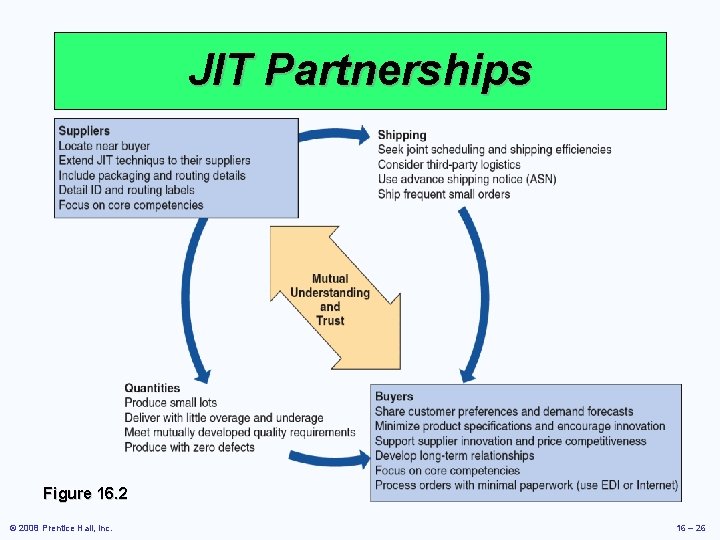
JIT Partnerships Figure 16. 2 © 2008 Prentice Hall, Inc. 16 – 26
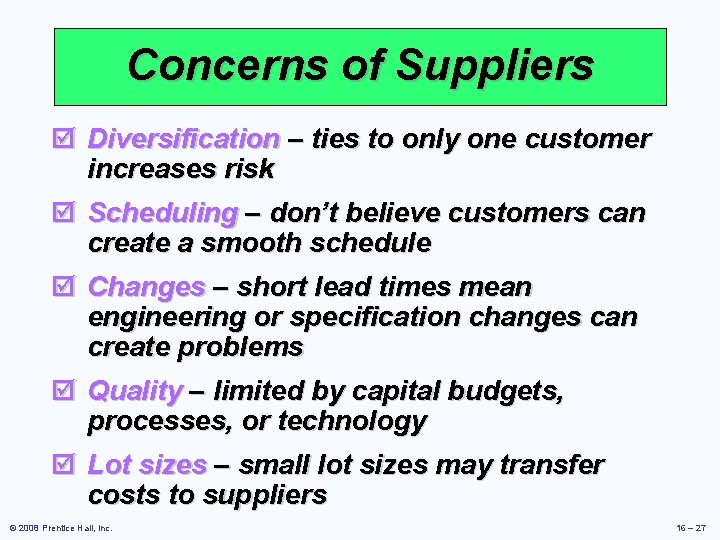
Concerns of Suppliers þ Diversification – ties to only one customer increases risk þ Scheduling – don’t believe customers can create a smooth schedule þ Changes – short lead times mean engineering or specification changes can create problems þ Quality – limited by capital budgets, processes, or technology þ Lot sizes – small lot sizes may transfer costs to suppliers © 2008 Prentice Hall, Inc. 16 – 27
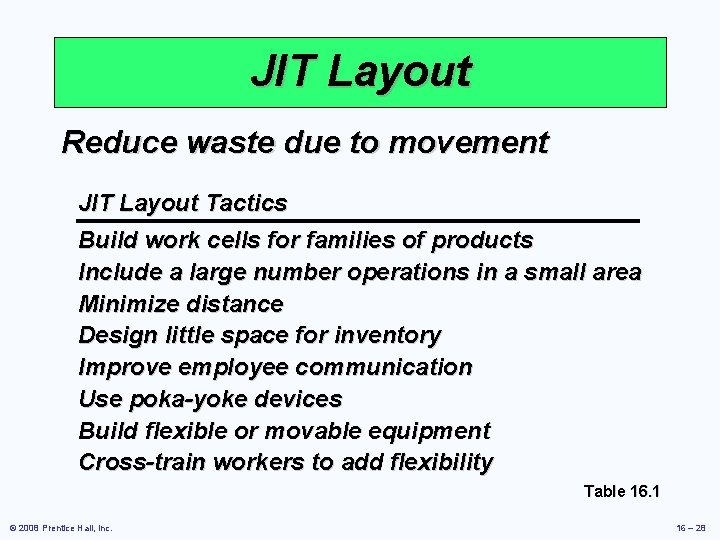
JIT Layout Reduce waste due to movement JIT Layout Tactics Build work cells for families of products Include a large number operations in a small area Minimize distance Design little space for inventory Improve employee communication Use poka-yoke devices Build flexible or movable equipment Cross-train workers to add flexibility Table 16. 1 © 2008 Prentice Hall, Inc. 16 – 28
Distance Reduction þ Large lots and long production lines with single-purpose machinery are being replaced by smaller flexible cells þ Often U-shaped for shorter paths and improved communication þ Often using group technology concepts © 2008 Prentice Hall, Inc. 16 –
Increased Flexibility þ Cells designed to be rearranged as volume or designs change þ Applicable in office environments as well as production settings þ Facilitates both product and process improvement © 2008 Prentice Hall, Inc. 16 – 30
Impact on Employees þ Employees are cross trained for flexibility and efficiency þ Improved communications facilitate the passing on of important information about the process þ With little or no inventory buffer, getting it right the first time is critical © 2008 Prentice Hall, Inc. 16 – 31
Reduced Space and Inventory þ With reduced space, inventory must be in very small lots þ Units are always moving because there is no storage © 2008 Prentice Hall, Inc. 16 – 32
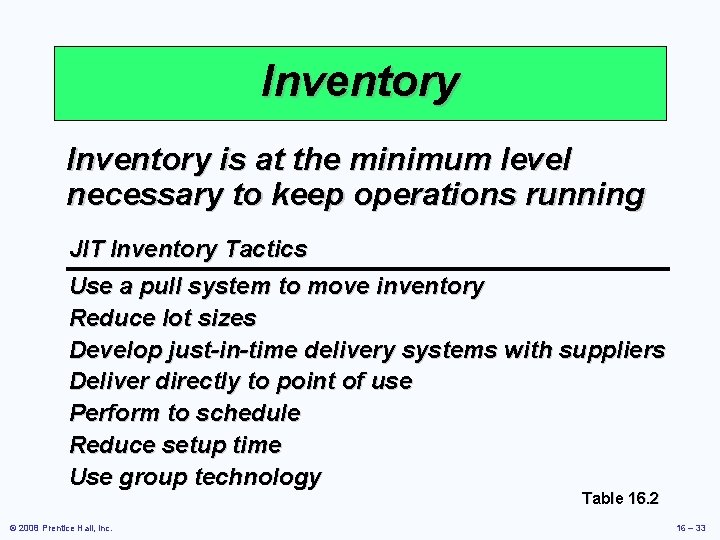
Inventory is at the minimum level necessary to keep operations running JIT Inventory Tactics Use a pull system to move inventory Reduce lot sizes Develop just-in-time delivery systems with suppliers Deliver directly to point of use Perform to schedule Reduce setup time Use group technology Table 16. 2 © 2008 Prentice Hall, Inc. 16 – 33
Reduce Variability Inventory level Process downtime Scrap Setup time Quality problems Late deliveries Figure 16. 3 © 2008 Prentice Hall, Inc. 16 – 34
Reduce Variability Inventory level Process downtime Scrap Setup time Quality problems Late deliveries Figure 16. 3 © 2008 Prentice Hall, Inc. 16 – 35
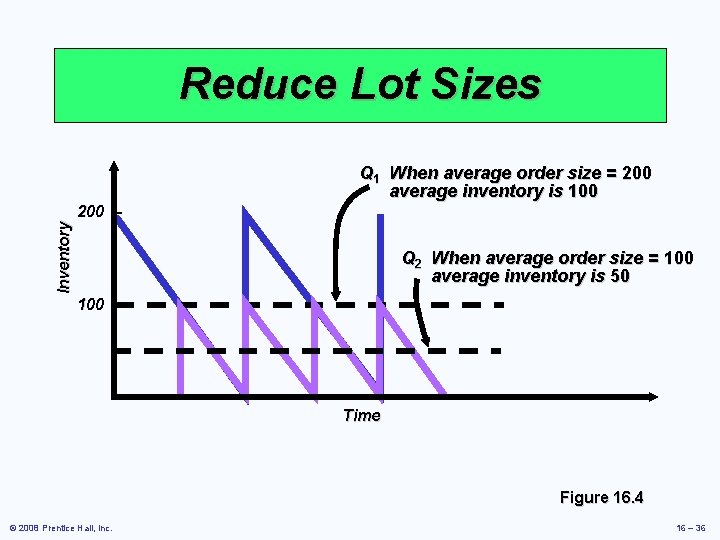
Reduce Lot Sizes Q 1 When average order size = 200 average inventory is 100 Inventory 200 – Q 2 When average order size = 100 average inventory is 50 100 – Time Figure 16. 4 © 2008 Prentice Hall, Inc. 16 – 36
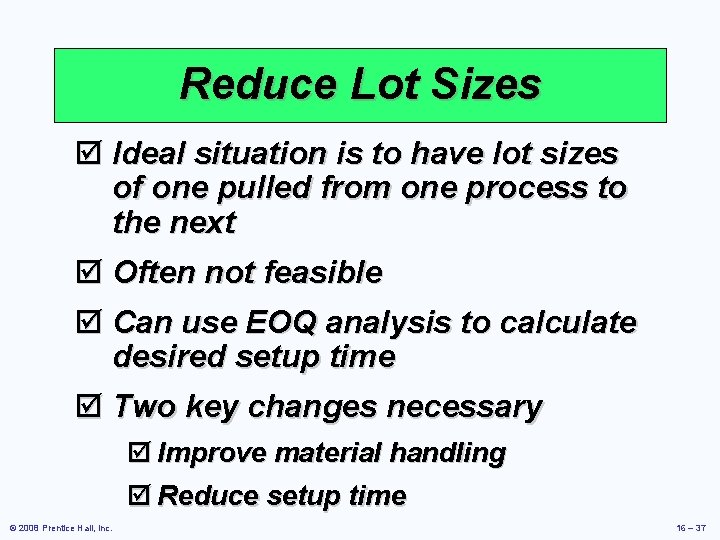
Reduce Lot Sizes þ Ideal situation is to have lot sizes of one pulled from one process to the next þ Often not feasible þ Can use EOQ analysis to calculate desired setup time þ Two key changes necessary þ Improve material handling þ Reduce setup time © 2008 Prentice Hall, Inc. 16 – 37
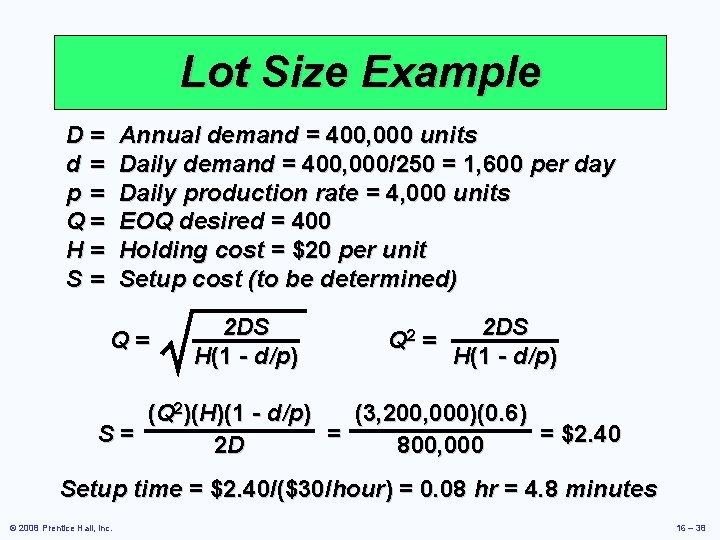
Lot Size Example D= d= p= Q= H= S= Annual demand = 400, 000 units Daily demand = 400, 000/250 = 1, 600 per day Daily production rate = 4, 000 units EOQ desired = 400 Holding cost = $20 per unit Setup cost (to be determined) Q= 2 DS H(1 - d/p) Q 2 2 DS = H(1 - d/p) (Q 2)(H)(1 - d/p) (3, 200, 000)(0. 6) S= = = $2. 40 2 D 800, 000 Setup time = $2. 40/($30/hour) = 0. 08 hr = 4. 8 minutes © 2008 Prentice Hall, Inc. 16 – 38
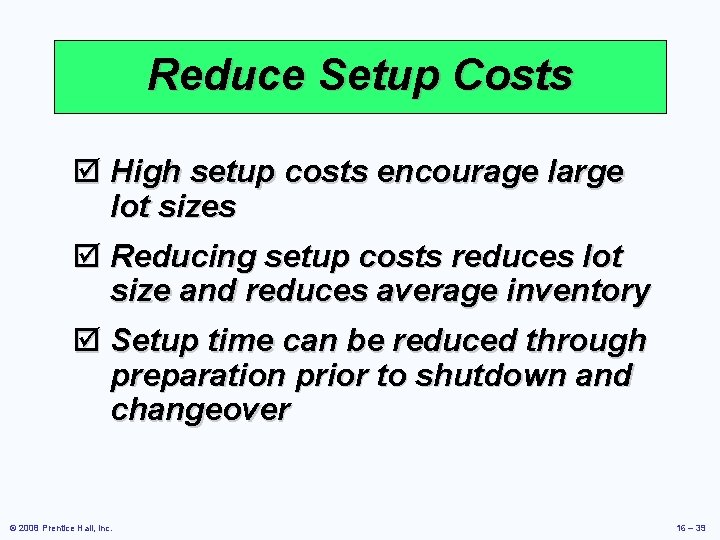
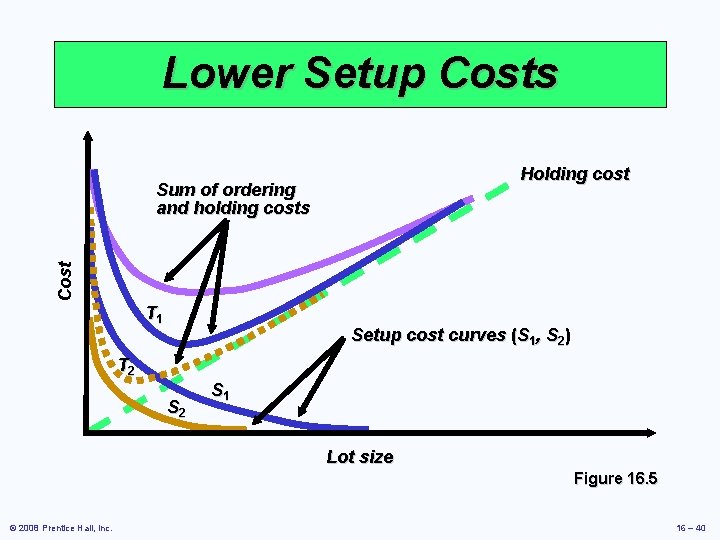
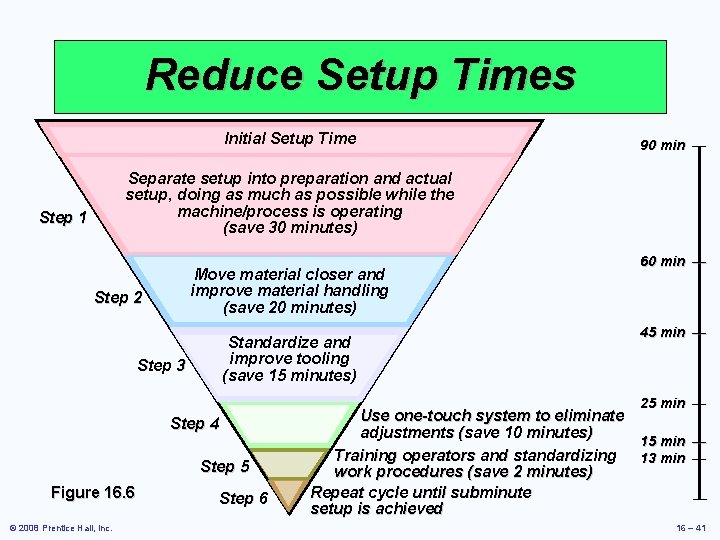
Reduce Setup Costs þ High setup costs encourage large lot sizes þ Reducing setup costs reduces lot size and reduces average inventory þ Setup time can be reduced through preparation prior to shutdown and changeover © 2008 Prentice Hall, Inc. 16 – 39
Lower Setup Costs Holding cost Cost Sum of ordering and holding costs T 1 Setup cost curves (S 1, S 2) T 2 S 1 Lot size Figure 16. 5 © 2008 Prentice Hall, Inc. 16 – 40
Reduce Setup Times Initial Setup Time 90 min — Separate setup into preparation and actual setup, doing as much as possible while the machine/process is operating (save 30 minutes) Step 1 Move material closer and improve material handling (save 20 minutes) Step 2 Standardize and improve tooling (save 15 minutes) Step 3 Step 4 Step 5 Figure 16. 6 © 2008 Prentice Hall, Inc. Step 6 Use one-touch system to eliminate adjustments (save 10 minutes) Training operators and standardizing work procedures (save 2 minutes) Repeat cycle until subminute setup is achieved 60 min — 45 min — 25 min — 13 min — — 16 – 41
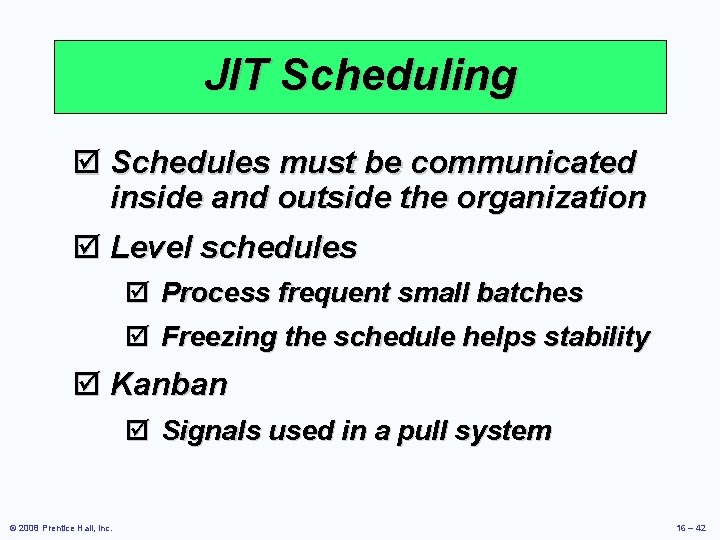
JIT Scheduling þ Schedules must be communicated inside and outside the organization þ Level schedules þ Process frequent small batches þ Freezing the schedule helps stability þ Kanban þ Signals used in a pull system © 2008 Prentice Hall, Inc. 16 – 42
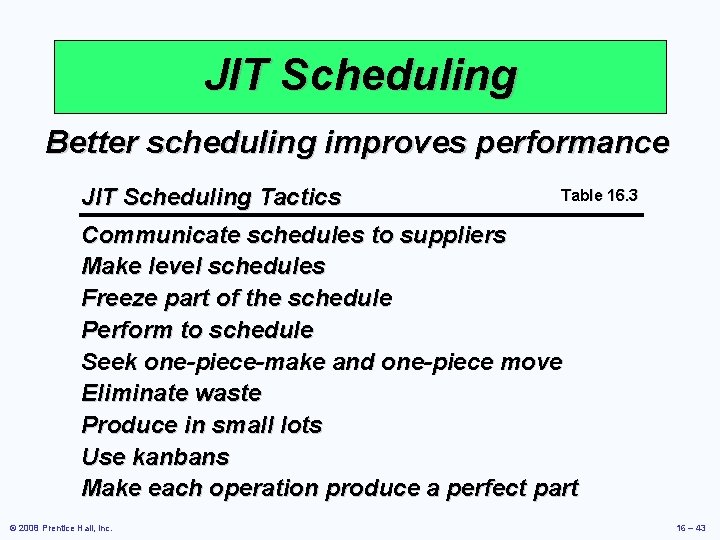
JIT Scheduling Better scheduling improves performance JIT Scheduling Tactics Table 16. 3 Communicate schedules to suppliers Make level schedules Freeze part of the schedule Perform to schedule Seek one-piece-make and one-piece move Eliminate waste Produce in small lots Use kanbans Make each operation produce a perfect part © 2008 Prentice Hall, Inc. 16 – 43
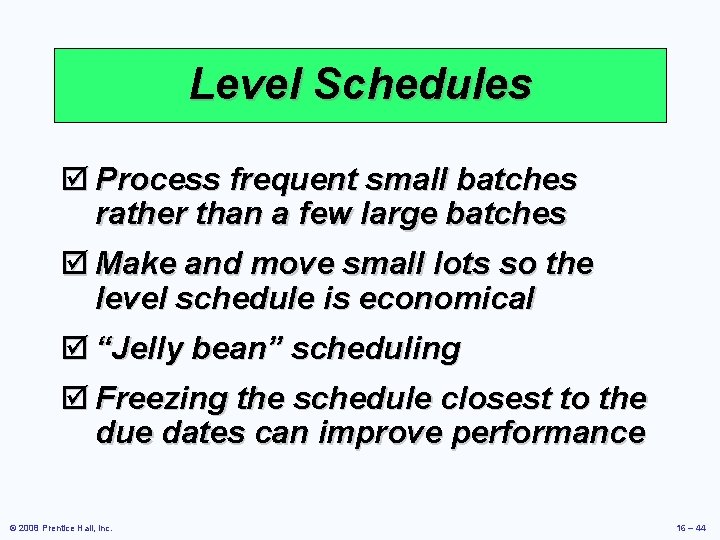
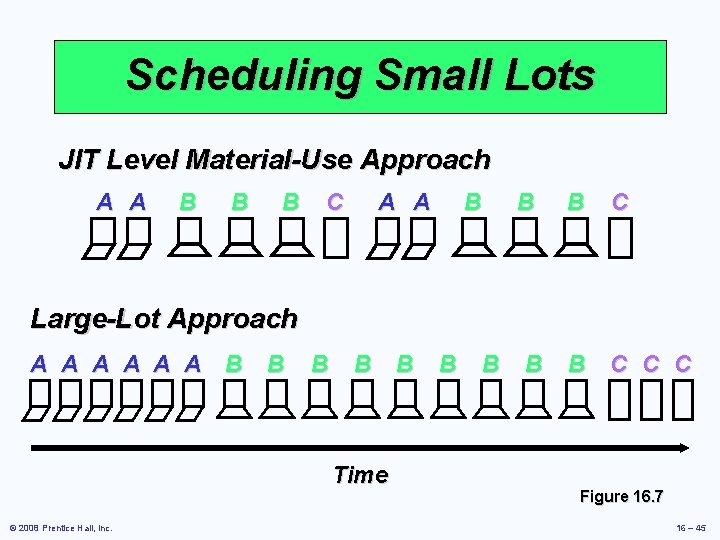
Level Schedules þ Process frequent small batches rather than a few large batches þ Make and move small lots so the level schedule is economical þ “Jelly bean” scheduling þ Freezing the schedule closest to the due dates can improve performance © 2008 Prentice Hall, Inc. 16 – 44
Scheduling Small Lots JIT Level Material-Use Approach A A B B B C Large-Lot Approach A A A B B B Time © 2008 Prentice Hall, Inc. B B C C C Figure 16. 7 16 – 45
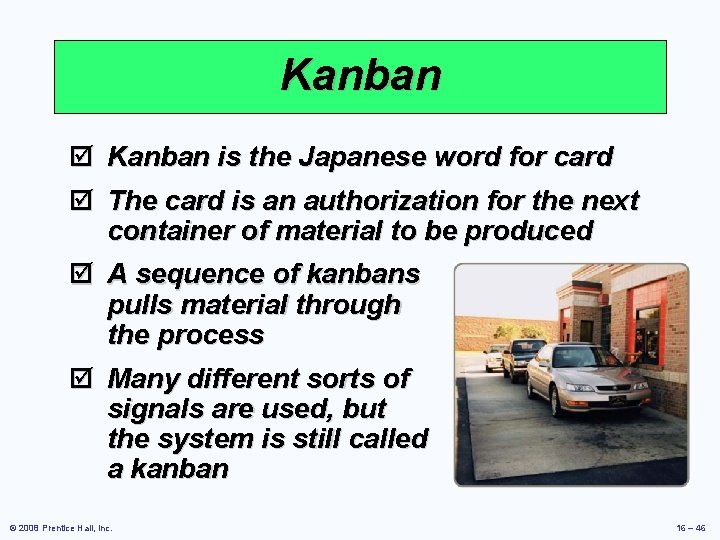
Kanban þ Kanban is the Japanese word for card þ The card is an authorization for the next container of material to be produced þ A sequence of kanbans pulls material through the process þ Many different sorts of signals are used, but the system is still called a kanban © 2008 Prentice Hall, Inc. 16 – 46
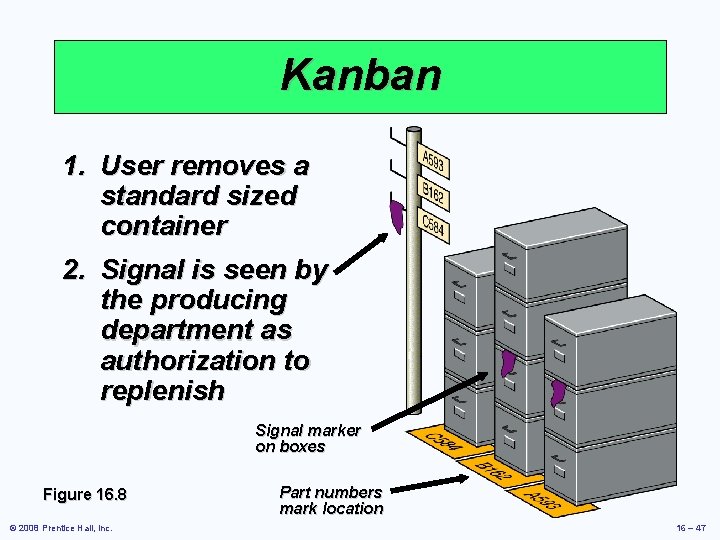
Kanban 1. User removes a standard sized container 2. Signal is seen by the producing department as authorization to replenish Signal marker on boxes Figure 16. 8 © 2008 Prentice Hall, Inc. Part numbers mark location 16 – 47
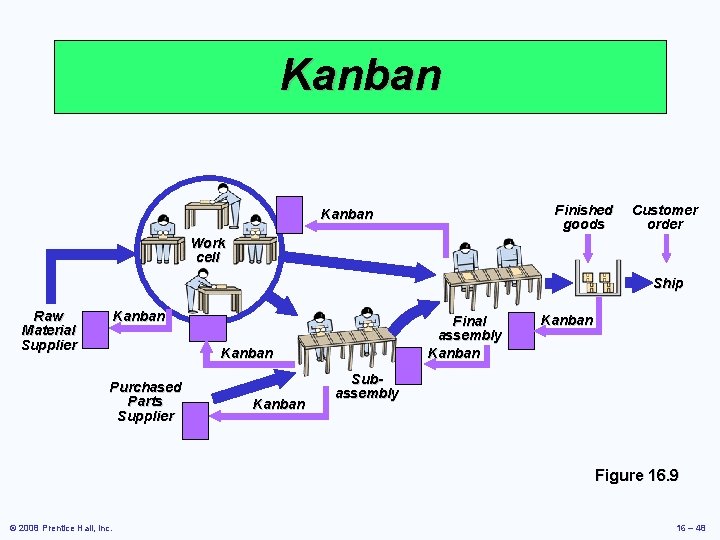
Kanban Finished goods Kanban Customer order Work cell Ship Raw Material Supplier Kanban Final assembly Kanban Purchased Parts Supplier Kanban Subassembly Figure 16. 9 © 2008 Prentice Hall, Inc. 16 – 48
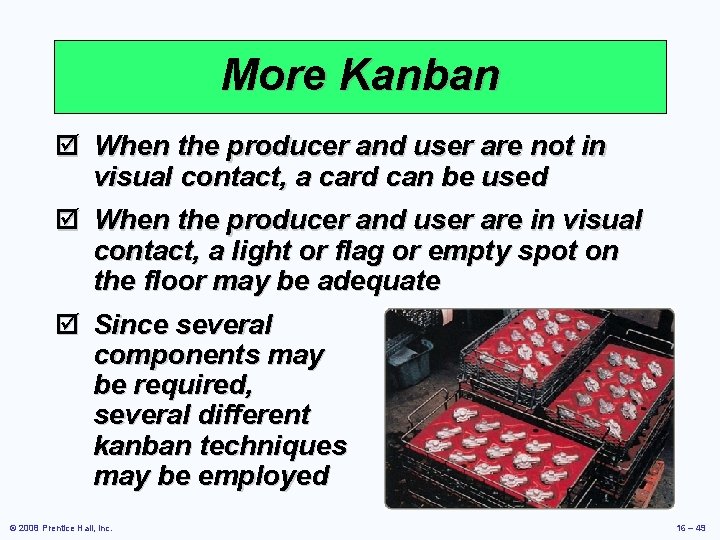
More Kanban þ When the producer and user are not in visual contact, a card can be used þ When the producer and user are in visual contact, a light or flag or empty spot on the floor may be adequate þ Since several components may be required, several different kanban techniques may be employed © 2008 Prentice Hall, Inc. 16 – 49
More Kanban þ Usually each card controls a specific quantity or parts þ Multiple card systems may be used if there are several components or different lot sizes þ In an MRP system, the schedule can be thought of as a build authorization and the kanban a type of pull system that initiates actual production © 2008 Prentice Hall, Inc. 16 – 50
More Kanban þ Kanban cards provide a direct control and limit on the amount of work-inprocess between cells þ If there is an immediate storage area, a two-card system can be used with one card circulating between the user and storage area and the other between the storage area and the producer © 2008 Prentice Hall, Inc. 16 – 51
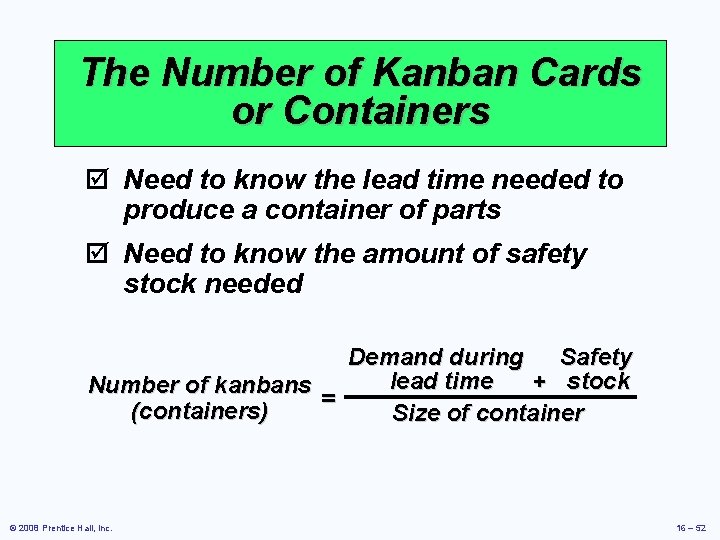
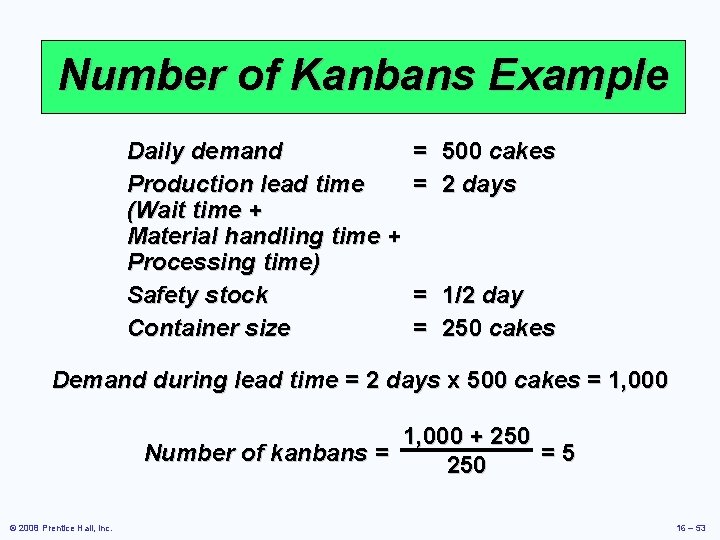
The Number of Kanban Cards or Containers þ Need to know the lead time needed to produce a container of parts þ Need to know the amount of safety stock needed Demand during Safety lead time + stock Number of kanbans = (containers) Size of container © 2008 Prentice Hall, Inc. 16 – 52
Number of Kanbans Example Daily demand Production lead time (Wait time + Material handling time + Processing time) Safety stock Container size = 500 cakes = 2 days = 1/2 day = 250 cakes Demand during lead time = 2 days x 500 cakes = 1, 000 + 250 Number of kanbans = =5 250 © 2008 Prentice Hall, Inc. 16 – 53
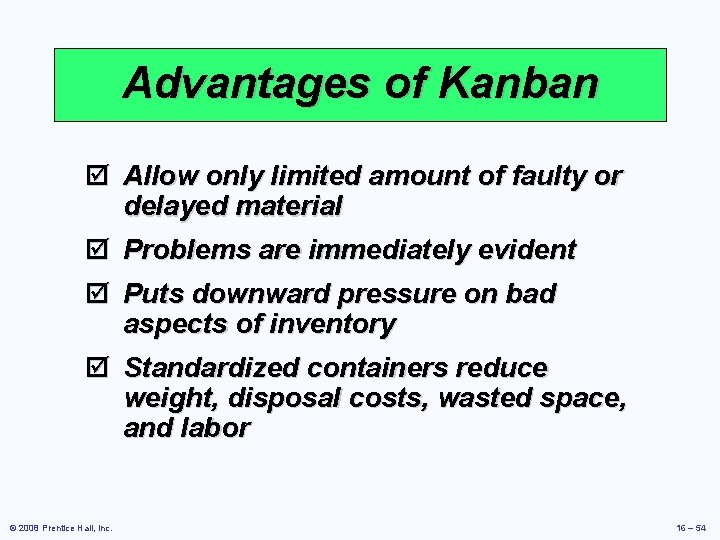
Advantages of Kanban þ Allow only limited amount of faulty or delayed material þ Problems are immediately evident þ Puts downward pressure on bad aspects of inventory þ Standardized containers reduce weight, disposal costs, wasted space, and labor © 2008 Prentice Hall, Inc. 16 – 54
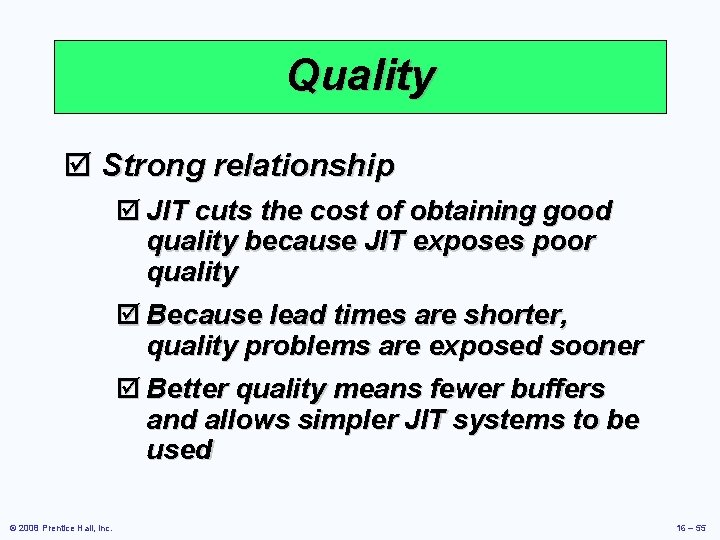
Quality þ Strong relationship þ JIT cuts the cost of obtaining good quality because JIT exposes poor quality þ Because lead times are shorter, quality problems are exposed sooner þ Better quality means fewer buffers and allows simpler JIT systems to be used © 2008 Prentice Hall, Inc. 16 – 55
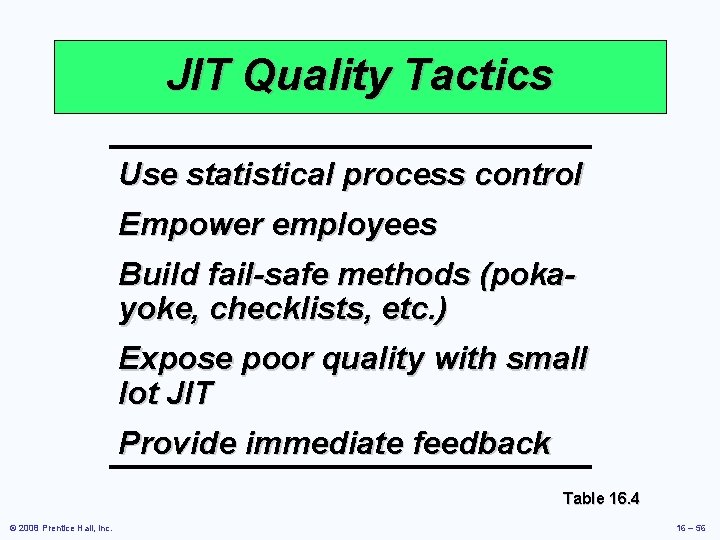
JIT Quality Tactics Use statistical process control Empower employees Build fail-safe methods (pokayoke, checklists, etc. ) Expose poor quality with small lot JIT Provide immediate feedback Table 16. 4 © 2008 Prentice Hall, Inc. 16 – 56
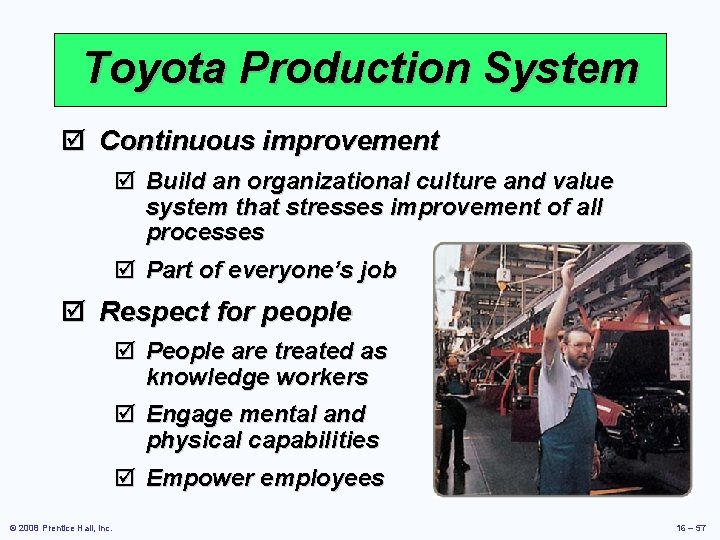
Toyota Production System þ Continuous improvement þ Build an organizational culture and value system that stresses improvement of all processes þ Part of everyone’s job þ Respect for people þ People are treated as knowledge workers þ Engage mental and physical capabilities þ Empower employees © 2008 Prentice Hall, Inc. 16 – 57
Toyota Production System þ Standard work practice þ Work shall be completely specified as to content, sequence, timing, and outcome þ Internal and external customer-supplier connection are direct þ Product and service flows must be simple and direct þ Any improvement must be made in accordance with the scientific method at the lowest possible level of the organization © 2008 Prentice Hall, Inc. 16 – 58
Lean Operations þ Different from JIT in that it is externally focused on the customer þ Starts with understanding what the customer wants þ Optimize the entire process from the customer’s perspective © 2008 Prentice Hall, Inc. 16 – 59
Building a Lean Organization þ Transitioning to a lean system can be difficult þ Lean systems tend to have the following attributes þ Use JIT techniques þ Build systems that help employees produce perfect parts þ Reduce space requirements © 2008 Prentice Hall, Inc. 16 – 60
Building a Lean Organization þ Develop partnerships with suppliers þ Educate suppliers þ Eliminate all but value-added activities þ Develop employees þ Make jobs challenging þ Build worker flexibility © 2008 Prentice Hall, Inc. 16 – 61
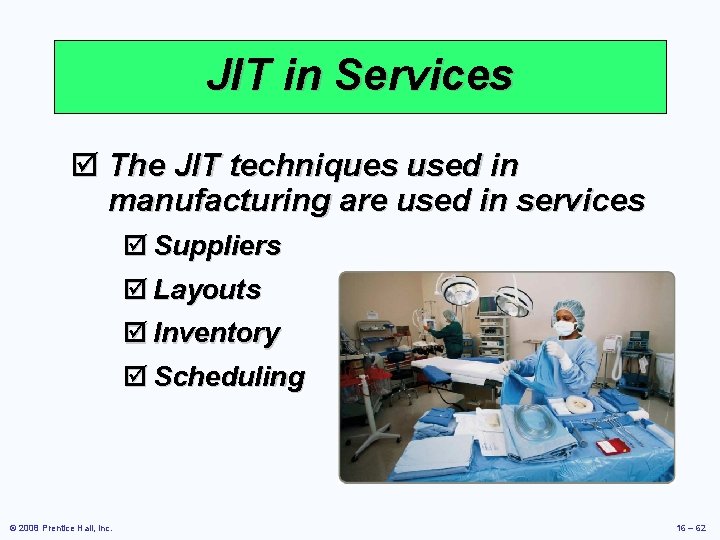
JIT in Services þ The JIT techniques used in manufacturing are used in services þ Suppliers þ Layouts þ Inventory þ Scheduling © 2008 Prentice Hall, Inc. 16 – 62