
Operations Management Chapter 13 Aggregate Planning Power Point



- Slides: 43
Operations Management Chapter 13 – Aggregate Planning Power. Point presentation to accompany Heizer/Render Principles of Operations Management, 7 e Operations Management, 9 e © 2008 Prentice Hall, Inc. 13 – 1
Aggregate Planning Determine the quantity and timing of production for the immediate future þ Objective is to minimize cost over the planning period by adjusting þ Production rates þ Labor levels þ Inventory levels þ Overtime work þ Subcontracting rates © 2008 Prentice Hall, Inc. 13 – 2
Aggregate Planning Required for aggregate planning þ A logical overall unit for measuring sales and output þ A forecast of demand for an intermediate planning period in these aggregate terms þ A method for determining costs þ A model that combines forecasts and costs so that scheduling decisions can be made for the planning period © 2008 Prentice Hall, Inc. 13 – 3
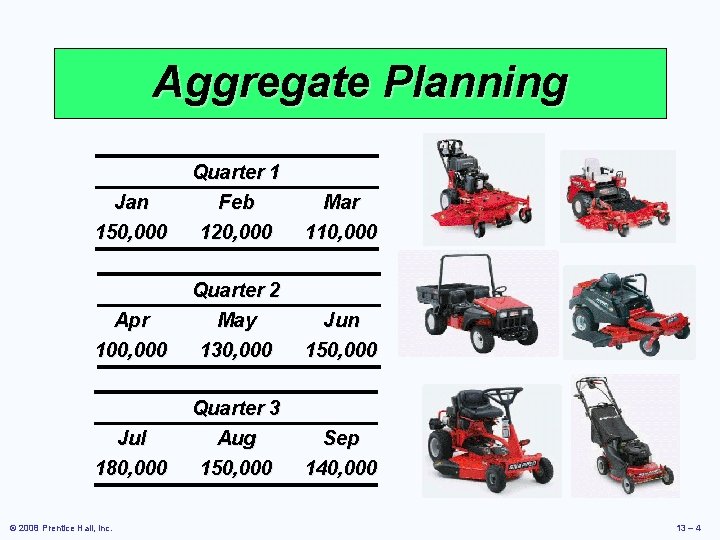
Aggregate Planning Jan 150, 000 Quarter 1 Feb 120, 000 Mar 110, 000 Apr 100, 000 Quarter 2 May 130, 000 Jun 150, 000 Jul 180, 000 Quarter 3 Aug 150, 000 Sep 140, 000 © 2008 Prentice Hall, Inc. 13 – 4
Aggregate Planning þ Part of a larger production planning system þ Disaggregation breaks the plan down into greater detail þ Disaggregation results in a master production schedule © 2008 Prentice Hall, Inc. 13 – 5
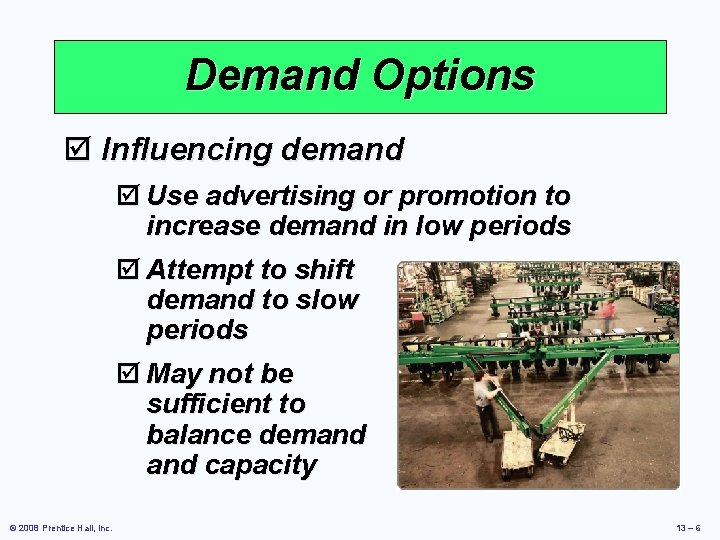
Demand Options þ Influencing demand þ Use advertising or promotion to increase demand in low periods þ Attempt to shift demand to slow periods þ May not be sufficient to balance demand capacity © 2008 Prentice Hall, Inc. 13 – 6
Demand Options þ Back ordering during highdemand periods þ Requires customers to wait for an order without loss of goodwill or the order þ Most effective when there are few if any substitutes for the product or service þ Often results in lost sales © 2008 Prentice Hall, Inc. 13 – 7
Demand Options þ Counterseasonal product and service mixing þ Develop a product mix of counterseasonal items þ May lead to products or services outside the company’s areas of expertise © 2008 Prentice Hall, Inc. 13 – 8
Capacity Options þ Changing inventory levels þ Increase inventory in low demand periods to meet high demand in the future þ Increases costs associated with storage, insurance, handling, obsolescence, and capital investment 15% to 40% þ Shortages can mean lost sales due to long lead times and poor customer service © 2008 Prentice Hall, Inc. 13 – 9
Capacity Options þ Varying workforce size by hiring or layoffs þ Match production rate to demand þ Training and separation costs for hiring and laying off workers þ New workers may have lower productivity þ Laying off workers may lower morale and productivity © 2008 Prentice Hall, Inc. 13 – 10
Capacity Options þ Varying production rate through overtime or idle time þ Allows constant workforce þ May be difficult to meet large increases in demand þ Overtime can be costly and may drive down productivity þ Absorbing idle time may be difficult © 2008 Prentice Hall, Inc. 13 – 11
Capacity Options þ Subcontracting þ Temporary measure during periods of peak demand þ May be costly þ Assuring quality and timely delivery may be difficult þ Exposes your customers to a possible competitor © 2008 Prentice Hall, Inc. 13 – 12
Capacity Options þ Using part-time workers þ Useful for filling unskilled or low skilled positions, especially in services © 2008 Prentice Hall, Inc. 13 – 13
Develop a Plan: Strategies þ Chase strategy þ Match output rates to demand forecast for each period þ Vary workforce levels or vary production rate þ Favored by many service organizations © 2008 Prentice Hall, Inc. 13 – 14
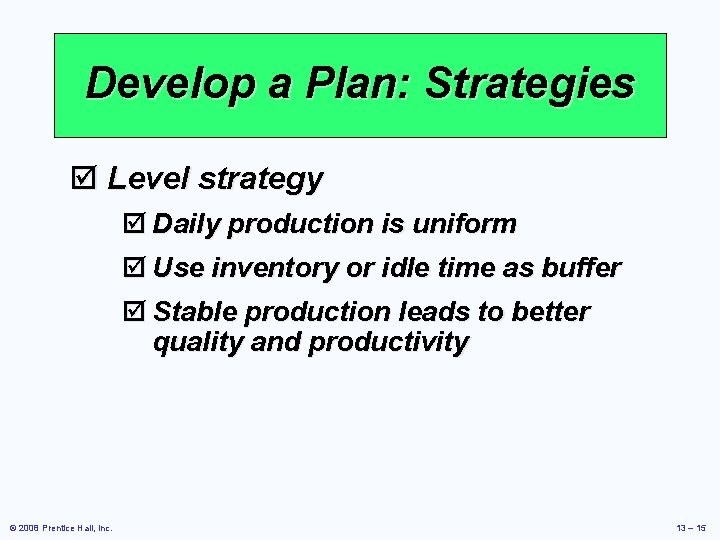
Develop a Plan: Strategies þ Level strategy þ Daily production is uniform þ Use inventory or idle time as buffer þ Stable production leads to better quality and productivity © 2008 Prentice Hall, Inc. 13 – 15
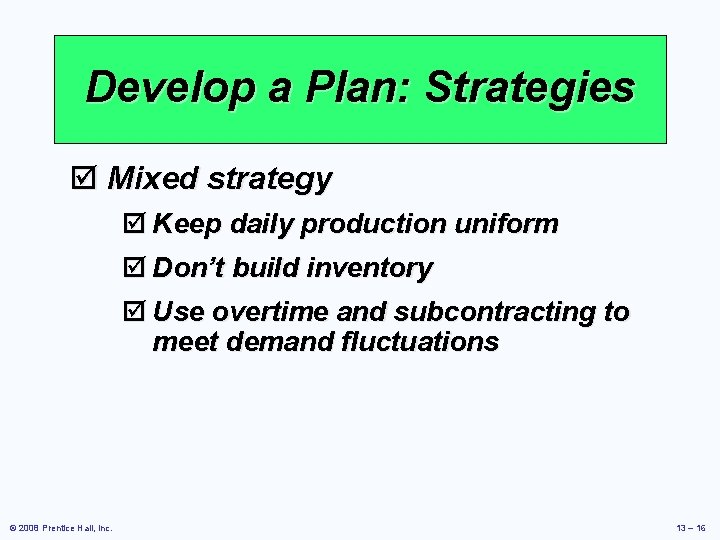
Develop a Plan: Strategies þ Mixed strategy þ Keep daily production uniform þ Don’t build inventory þ Use overtime and subcontracting to meet demand fluctuations © 2008 Prentice Hall, Inc. 13 – 16
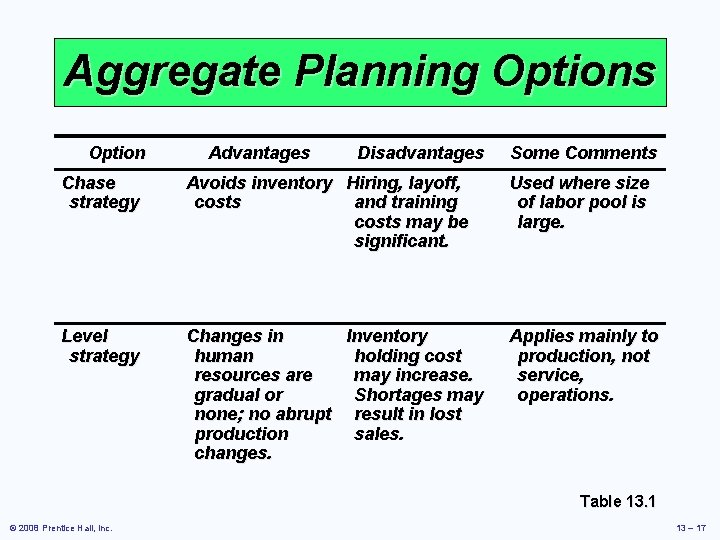
Aggregate Planning Options Option Advantages Disadvantages Some Comments Chase strategy Avoids inventory Hiring, layoff, costs and training costs may be significant. Used where size of labor pool is large. Level strategy Changes in Inventory human holding cost resources are may increase. gradual or Shortages may none; no abrupt result in lost production sales. changes. Applies mainly to production, not service, operations. Table 13. 1 © 2008 Prentice Hall, Inc. 13 – 17
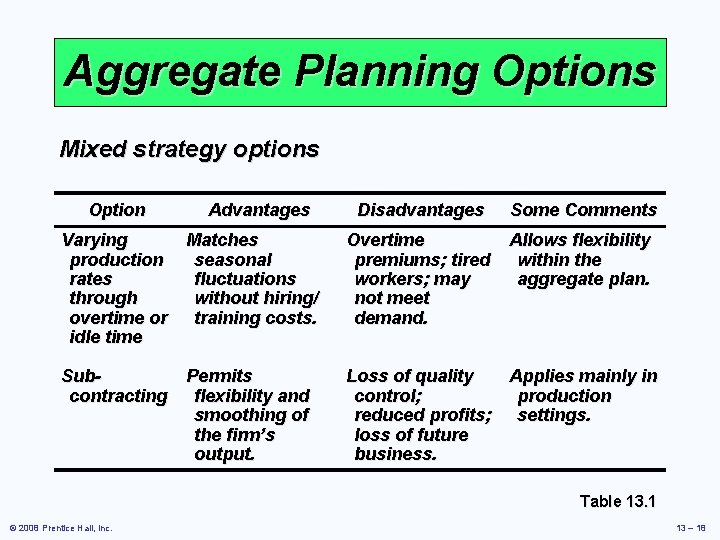
Aggregate Planning Options Mixed strategy options Option Advantages Disadvantages Some Comments Allows flexibility within the aggregate plan. Varying production rates through overtime or idle time Matches seasonal fluctuations without hiring/ training costs. Overtime premiums; tired workers; may not meet demand. Subcontracting Permits flexibility and smoothing of the firm’s output. Loss of quality Applies mainly in control; production reduced profits; settings. loss of future business. Table 13. 1 © 2008 Prentice Hall, Inc. 13 – 18
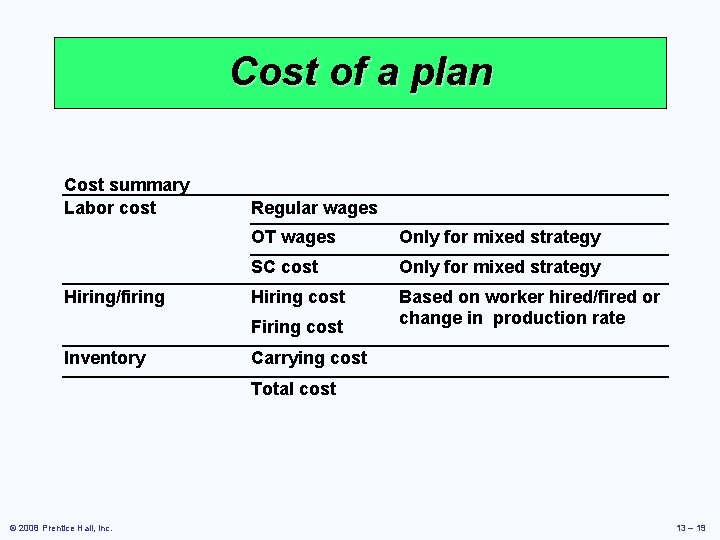
Cost of a plan Cost summary Labor cost Hiring/firing Regular wages OT wages Only for mixed strategy SC cost Only for mixed strategy Hiring cost Based on worker hired/fired or change in production rate Firing cost Inventory Carrying cost Total cost © 2008 Prentice Hall, Inc. 13 – 19
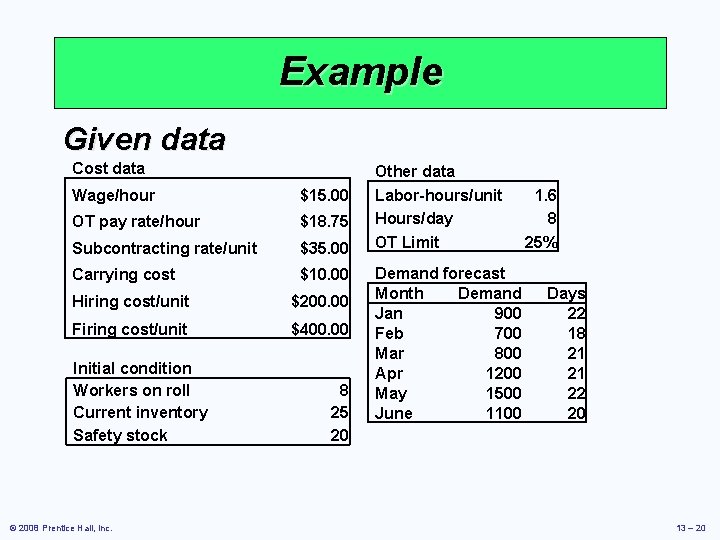
Example Given data Cost data Other data Wage/hour $15. 00 OT pay rate/hour $18. 75 Labor-hours/unit Hours/day Subcontracting rate/unit $35. 00 OT Limit Carrying cost $10. 00 Demand forecast Month Demand Jan 900 Feb 700 Mar 800 Apr 1200 May 1500 June 1100 Hiring cost/unit $200. 00 Firing cost/unit $400. 00 Initial condition Workers on roll Current inventory Safety stock © 2008 Prentice Hall, Inc. 8 25 20 1. 6 8 25% Days 22 18 21 21 22 20 13 – 20
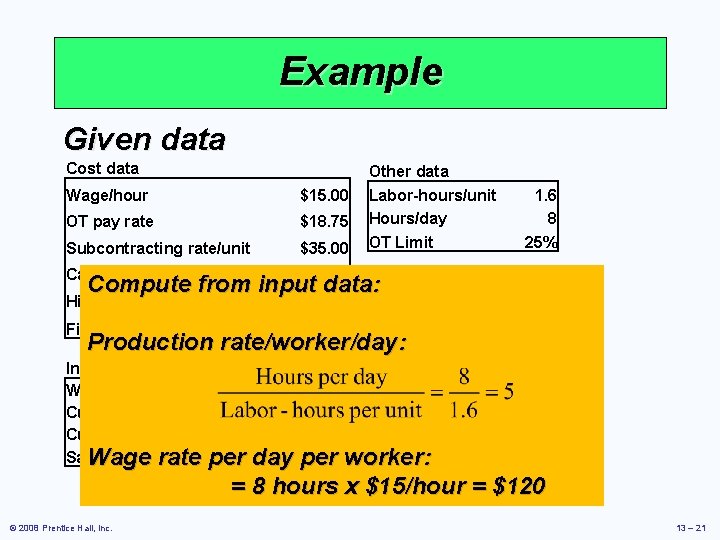
Example Given data Cost data Other data Wage/hour $15. 00 OT pay rate $18. 75 Labor-hours/unit Hours/day Subcontracting rate/unit $35. 00 OT Limit 1. 6 8 25% Demand forecast Compute from input data: Month Demand Hiring cost/unit $200. 00 Jan 900 Firing cost/unit $400. 00 Feb 700 Production rate/worker/day: Mar 800 Initial condition Apr 1200 Workers on roll 8 May 1500 Current production rate 40 June 1100 Current inventory 25 Safety stock Wage rate per day per 20 worker: Carrying cost $10. 00 Days 22 18 21 21 22 20 = 8 hours x $15/hour = $120 © 2008 Prentice Hall, Inc. 13 – 21
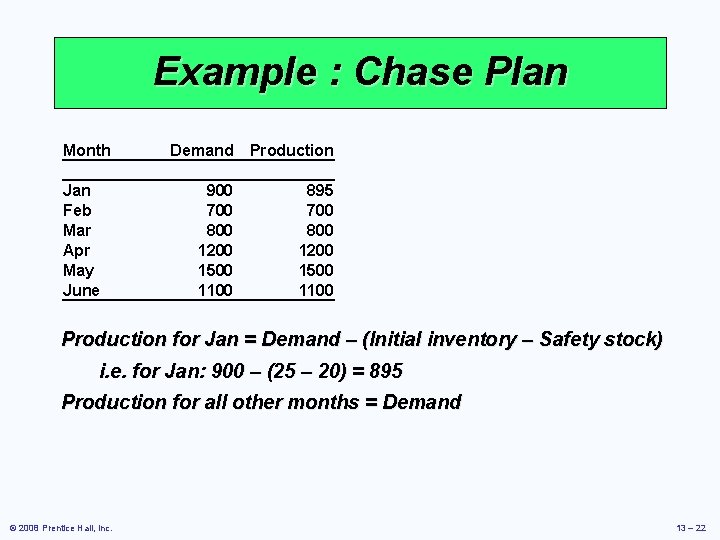
Example : Chase Plan Month Jan Feb Mar Apr May June Demand Production 900 700 800 1200 1500 1100 895 700 800 1200 1500 1100 Production for Jan = Demand – (Initial inventory – Safety stock) i. e. for Jan: 900 – (25 – 20) = 895 Production for all other months = Demand © 2008 Prentice Hall, Inc. 13 – 22
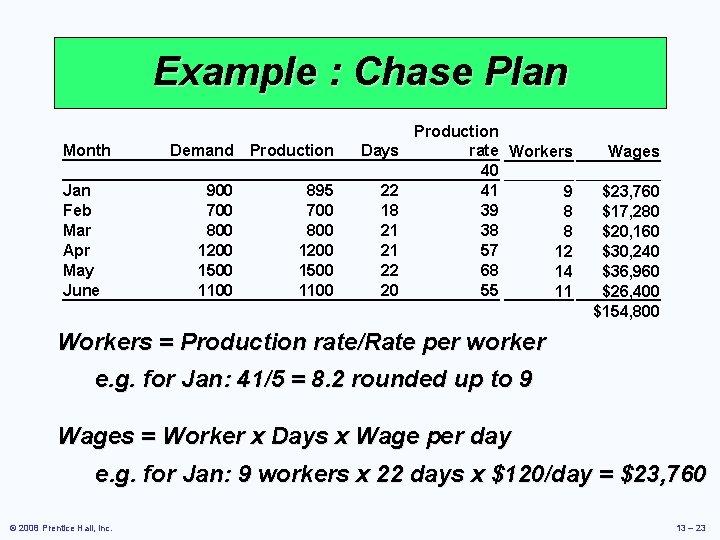
Example : Chase Plan Month Jan Feb Mar Apr May June Demand Production Days 900 700 800 1200 1500 1100 895 700 800 1200 1500 1100 22 18 21 21 22 20 Production rate Workers 40 41 9 39 8 38 8 57 12 68 14 55 11 Wages $23, 760 $17, 280 $20, 160 $30, 240 $36, 960 $26, 400 $154, 800 Workers = Production rate/Rate per worker e. g. for Jan: 41/5 = 8. 2 rounded up to 9 Wages = Worker x Days x Wage per day e. g. for Jan: 9 workers x 22 days x $120/day = $23, 760 © 2008 Prentice Hall, Inc. 13 – 23
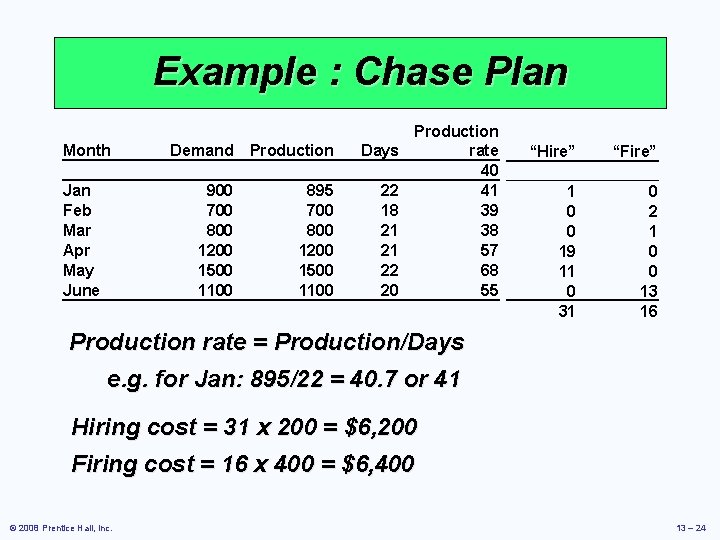
Example : Chase Plan Month Jan Feb Mar Apr May June Demand 900 700 800 1200 1500 1100 Production 895 700 800 1200 1500 1100 Days 22 18 21 21 22 20 Production rate 40 41 39 38 57 68 55 “Hire” “Fire” 1 0 0 19 11 0 31 0 2 1 0 0 13 16 Production rate = Production/Days e. g. for Jan: 895/22 = 40. 7 or 41 Hiring cost = 31 x 200 = $6, 200 Firing cost = 16 x 400 = $6, 400 © 2008 Prentice Hall, Inc. 13 – 24
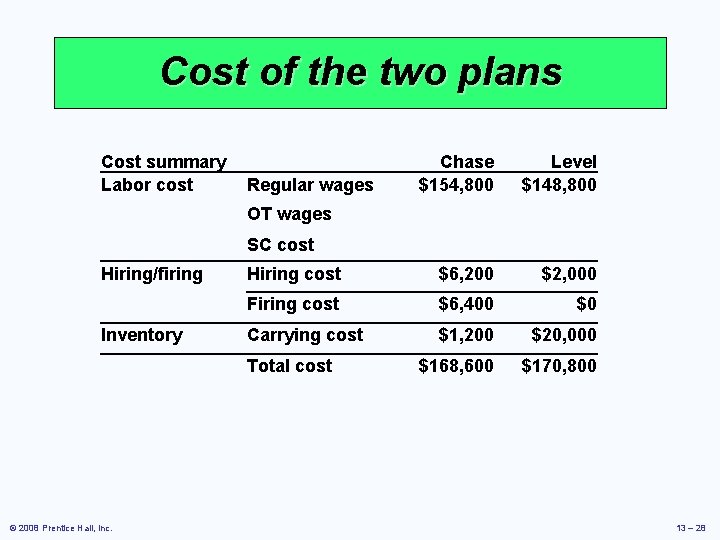
Cost of Chase plan Cost summary Labor cost Regular wages $154, 800 OT wages SC cost Hiring/firing Inventory Hiring cost $6, 200 Firing cost $6, 400 Carrying cost $1, 200 Total cost $168, 600 Carrying cost = 20 units safety stock x 6 months x $10 = $1, 200 © 2008 Prentice Hall, Inc. 13 – 25
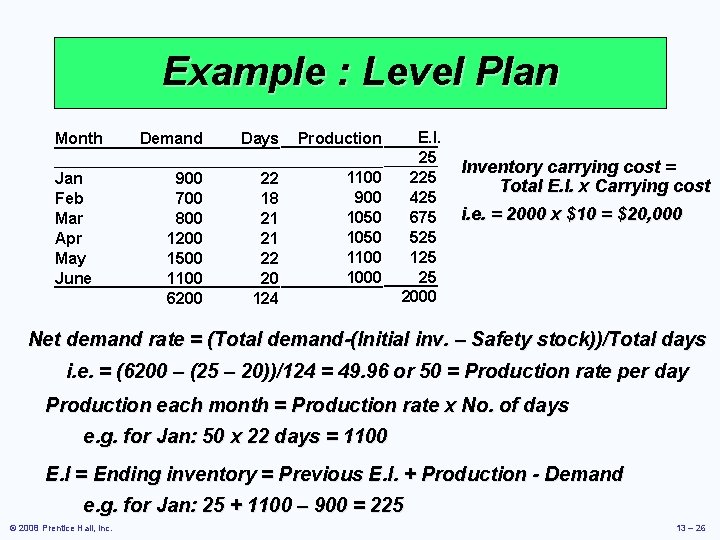
Example : Level Plan Month Jan Feb Mar Apr May June Demand 900 700 800 1200 1500 1100 6200 Production Days 22 18 21 21 22 20 124 1100 900 1050 1100 1000 E. I. 25 225 425 675 525 125 25 2000 Inventory carrying cost = Total E. I. x Carrying cost i. e. = 2000 x $10 = $20, 000 Net demand rate = (Total demand-(Initial inv. – Safety stock))/Total days i. e. = (6200 – (25 – 20))/124 = 49. 96 or 50 = Production rate per day Production each month = Production rate x No. of days e. g. for Jan: 50 x 22 days = 1100 E. I = Ending inventory = Previous E. I. + Production - Demand e. g. for Jan: 25 + 1100 – 900 = 225 © 2008 Prentice Hall, Inc. 13 – 26
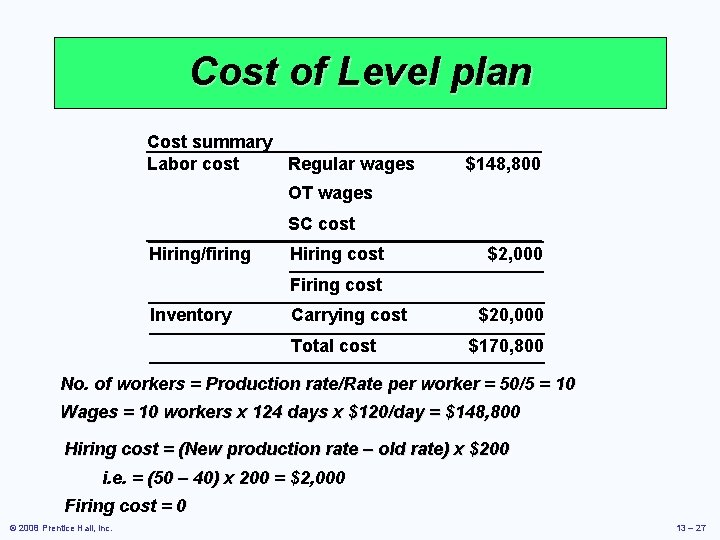
Cost of Level plan Cost summary Labor cost Regular wages $148, 800 OT wages SC cost Hiring/firing Hiring cost $2, 000 Firing cost Inventory Carrying cost Total cost $20, 000 $170, 800 No. of workers = Production rate/Rate per worker = 50/5 = 10 Wages = 10 workers x 124 days x $120/day = $148, 800 Hiring cost = (New production rate – old rate) x $200 i. e. = (50 – 40) x 200 = $2, 000 Firing cost = 0 © 2008 Prentice Hall, Inc. 13 – 27
Cost of the two plans Cost summary Labor cost Chase $154, 800 Level $148, 800 Hiring cost $6, 200 $2, 000 Firing cost $6, 400 $0 Carrying cost $1, 200 $20, 000 $168, 600 $170, 800 Regular wages OT wages SC cost Hiring/firing Inventory Total cost © 2008 Prentice Hall, Inc. 13 – 28
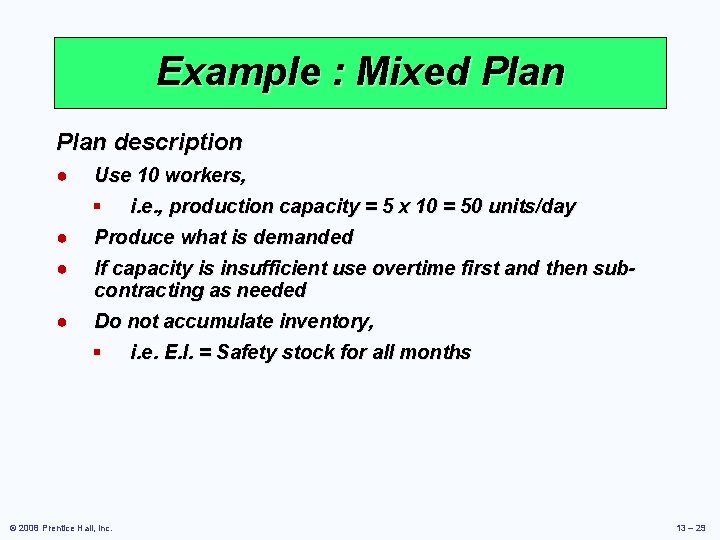
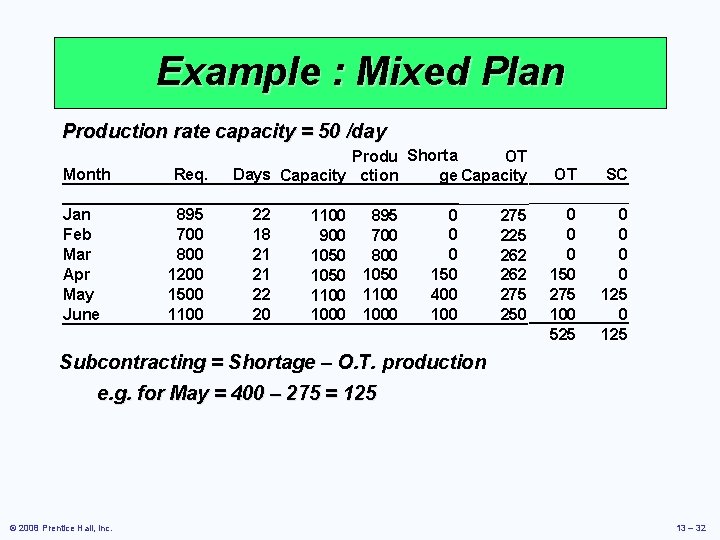
Example : Mixed Plan description ● ● Use 10 workers, § i. e. , production capacity = 5 x 10 = 50 units/day Produce what is demanded If capacity is insufficient use overtime first and then subcontracting as needed Do not accumulate inventory, § © 2008 Prentice Hall, Inc. i. e. E. I. = Safety stock for all months 13 – 29
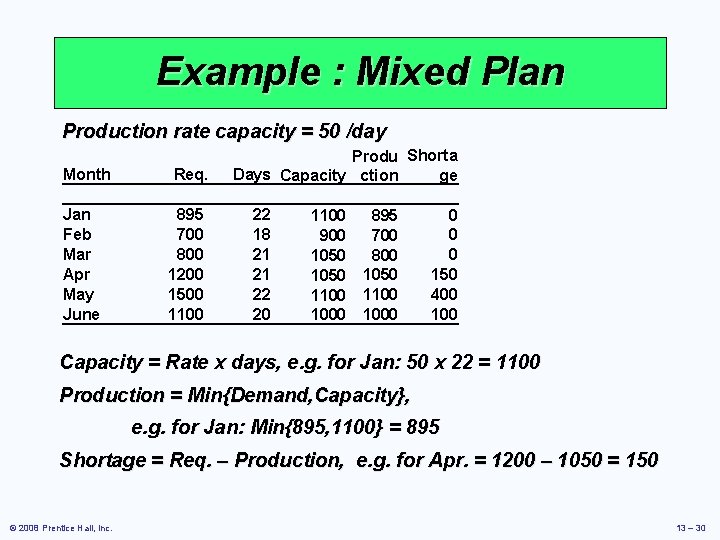
Example : Mixed Plan Production rate capacity = 50 /day Month Jan Feb Mar Apr May June Req. 895 700 800 1200 1500 1100 Produ Shorta Days Capacity ction ge 22 18 21 21 22 20 1100 900 1050 1100 1000 895 700 800 1050 1100 1000 0 150 400 100 Capacity = Rate x days, e. g. for Jan: 50 x 22 = 1100 Production = Min{Demand, Capacity}, e. g. for Jan: Min{895, 1100} = 895 Shortage = Req. – Production, e. g. for Apr. = 1200 – 1050 = 150 © 2008 Prentice Hall, Inc. 13 – 30
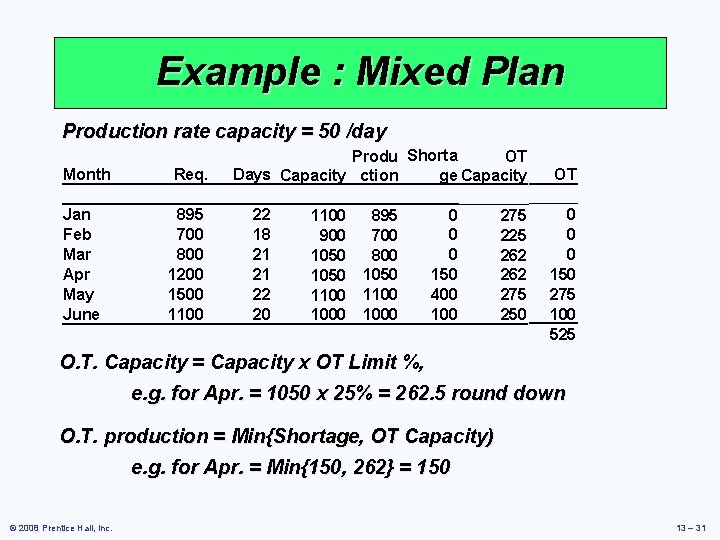
Example : Mixed Plan Production rate capacity = 50 /day Month Jan Feb Mar Apr May June Req. Days 895 700 800 1200 1500 1100 22 18 21 21 22 20 Produ Shorta OT OT ge Capacity ction 0 0 895 275 1100 0 0 700 225 900 0 0 800 262 1050 150 262 150 1050 400 275 1100 100 250 1000 525 O. T. Capacity = Capacity x OT Limit %, e. g. for Apr. = 1050 x 25% = 262. 5 round down O. T. production = Min{Shortage, OT Capacity) e. g. for Apr. = Min{150, 262} = 150 © 2008 Prentice Hall, Inc. 13 – 31
Example : Mixed Plan Production rate capacity = 50 /day Month Jan Feb Mar Apr May June Req. Days 895 700 800 1200 1500 1100 22 18 21 21 22 20 Produ Shorta OT OT ge Capacity ction 0 0 895 275 1100 0 0 700 225 900 0 0 800 262 1050 150 262 150 1050 400 275 1100 100 250 1000 525 SC 0 0 125 Subcontracting = Shortage – O. T. production e. g. for May = 400 – 275 = 125 © 2008 Prentice Hall, Inc. 13 – 32
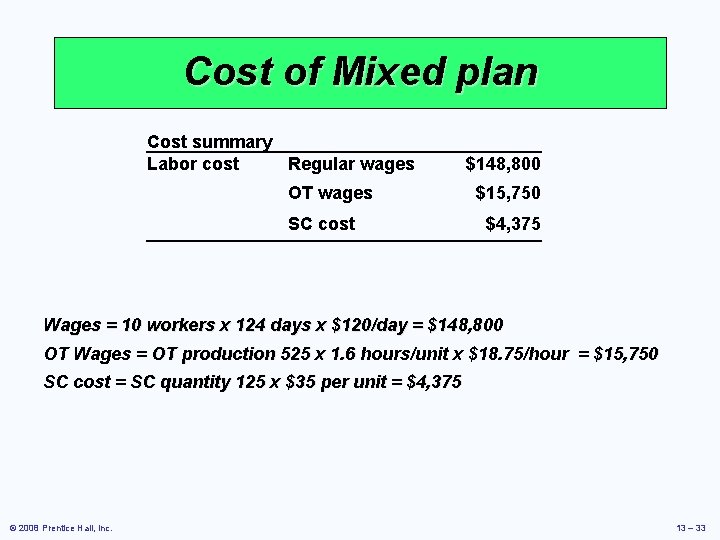
Cost of Mixed plan Cost summary Labor cost Regular wages OT wages SC cost $148, 800 $15, 750 $4, 375 Wages = 10 workers x 124 days x $120/day = $148, 800 OT Wages = OT production 525 x 1. 6 hours/unit x $18. 75/hour = $15, 750 SC cost = SC quantity 125 x $35 per unit = $4, 375 © 2008 Prentice Hall, Inc. 13 – 33
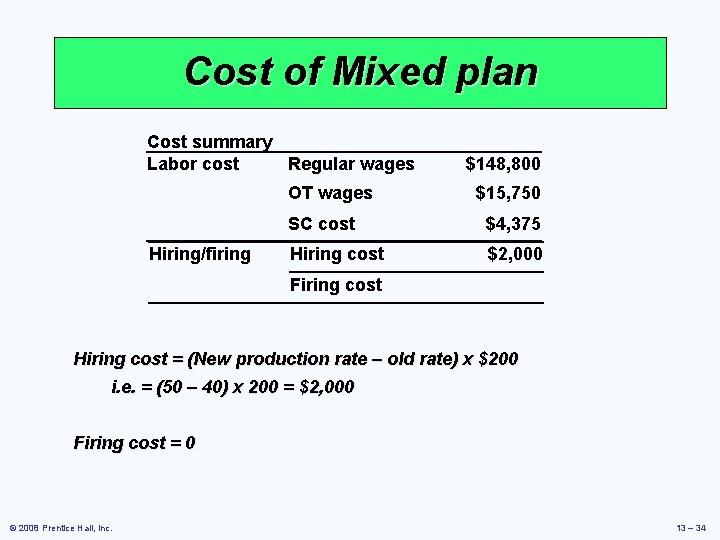
Cost of Mixed plan Cost summary Labor cost Regular wages OT wages Hiring/firing $148, 800 $15, 750 SC cost $4, 375 Hiring cost $2, 000 Firing cost Hiring cost = (New production rate – old rate) x $200 i. e. = (50 – 40) x 200 = $2, 000 Firing cost = 0 © 2008 Prentice Hall, Inc. 13 – 34
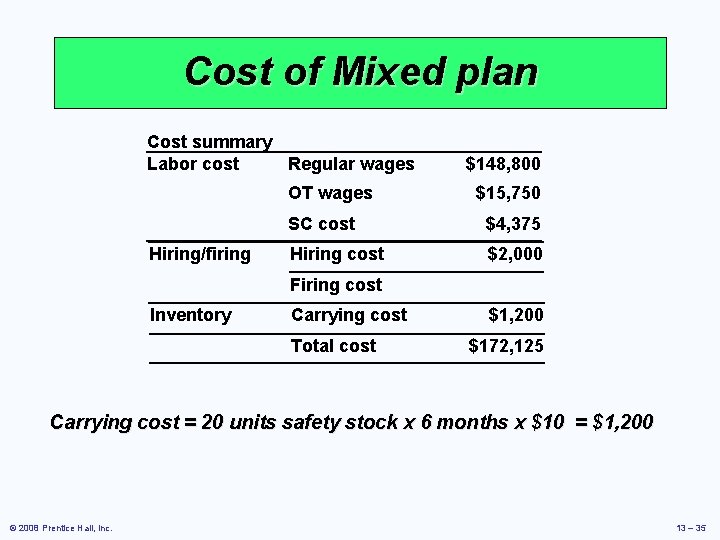
Cost of Mixed plan Cost summary Labor cost Regular wages OT wages Hiring/firing $148, 800 $15, 750 SC cost $4, 375 Hiring cost $2, 000 Firing cost Inventory Carrying cost Total cost $1, 200 $172, 125 Carrying cost = 20 units safety stock x 6 months x $10 = $1, 200 © 2008 Prentice Hall, Inc. 13 – 35
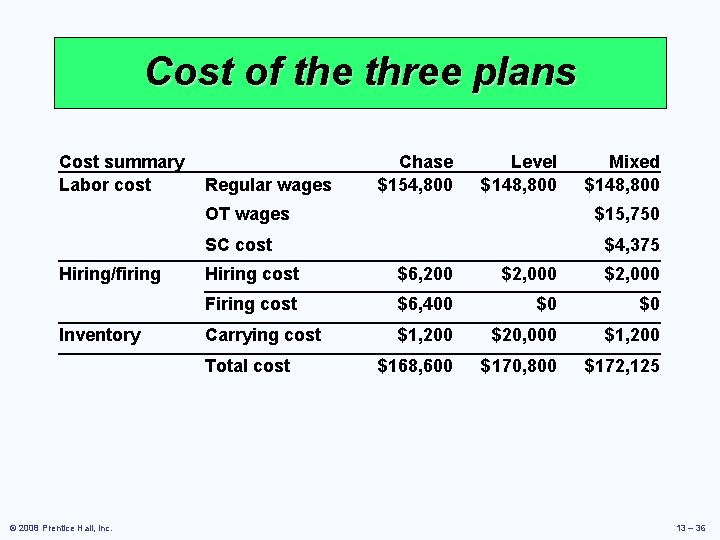
Cost of the three plans Cost summary Labor cost Regular wages Chase $154, 800 Level $148, 800 OT wages $15, 750 SC cost Hiring/firing Inventory $4, 375 Hiring cost $6, 200 $2, 000 Firing cost $6, 400 $0 $0 Carrying cost $1, 200 $20, 000 $1, 200 $168, 600 $170, 800 $172, 125 Total cost © 2008 Prentice Hall, Inc. Mixed $148, 800 13 – 36
Transportation Method Skip Use Excel Solver © 2008 Prentice Hall, Inc. 13 – 37
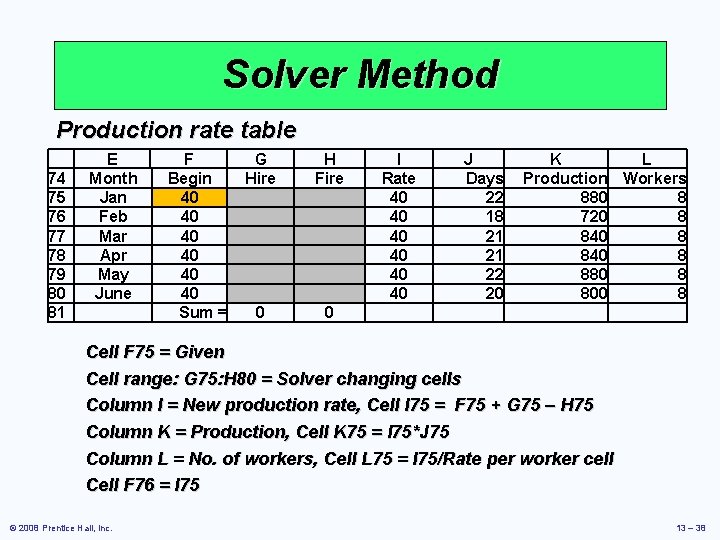
Solver Method Production rate table 74 75 76 77 78 79 80 81 E Month Jan Feb Mar Apr May June F Begin 40 40 40 Sum = G Hire 0 H Fire 0 I Rate 40 40 40 J Days 22 18 21 21 22 20 K L Production Workers 880 8 720 8 840 8 880 8 800 8 Cell F 75 = Given Cell range: G 75: H 80 = Solver changing cells Column I = New production rate, Cell I 75 = F 75 + G 75 – H 75 Column K = Production, Cell K 75 = I 75*J 75 Column L = No. of workers, Cell L 75 = I 75/Rate per worker cell Cell F 76 = I 75 © 2008 Prentice Hall, Inc. 13 – 38
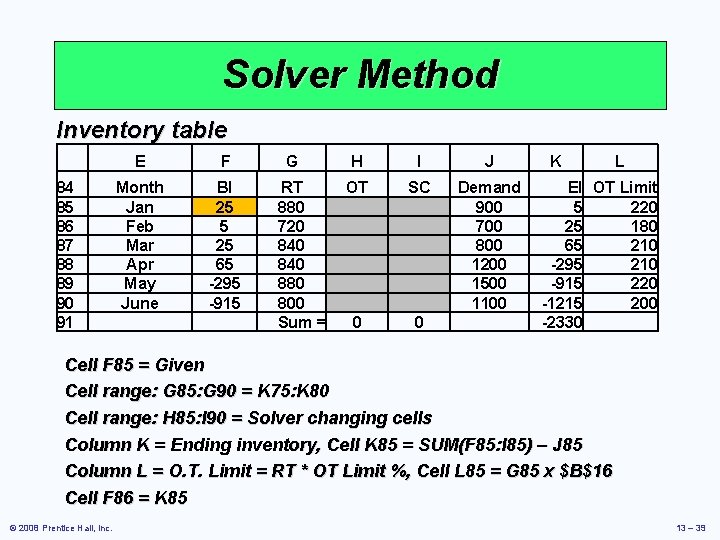
Solver Method Inventory table 84 85 86 87 88 89 90 91 E F Month Jan Feb Mar Apr May June BI 25 5 25 65 -295 -915 G H RT OT 880 720 840 880 800 Sum = 0 I J SC 0 Demand 900 700 800 1200 1500 1100 K L EI OT Limit 5 220 25 180 65 210 -295 210 -915 220 -1215 200 -2330 Cell F 85 = Given Cell range: G 85: G 90 = K 75: K 80 Cell range: H 85: I 90 = Solver changing cells Column K = Ending inventory, Cell K 85 = SUM(F 85: I 85) – J 85 Column L = O. T. Limit = RT * OT Limit %, Cell L 85 = G 85 x $B$16 Cell F 86 = K 85 © 2008 Prentice Hall, Inc. 13 – 39
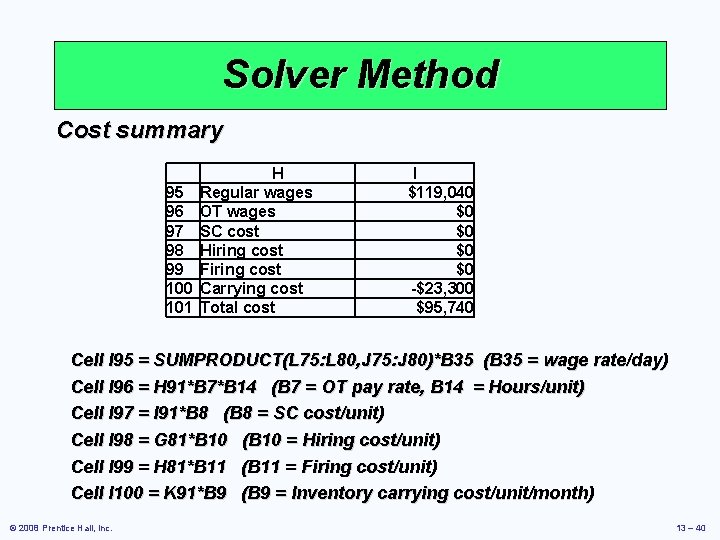
Solver Method Cost summary 95 96 97 98 99 100 101 H Regular wages OT wages SC cost Hiring cost Firing cost Carrying cost Total cost I $119, 040 $0 $0 -$23, 300 $95, 740 Cell I 95 = SUMPRODUCT(L 75: L 80, J 75: J 80)*B 35 (B 35 = wage rate/day) Cell I 96 = H 91*B 7*B 14 (B 7 = OT pay rate, B 14 = Hours/unit) Cell I 97 = I 91*B 8 (B 8 = SC cost/unit) Cell I 98 = G 81*B 10 (B 10 = Hiring cost/unit) Cell I 99 = H 81*B 11 (B 11 = Firing cost/unit) Cell I 100 = K 91*B 9 (B 9 = Inventory carrying cost/unit/month) © 2008 Prentice Hall, Inc. 13 – 40
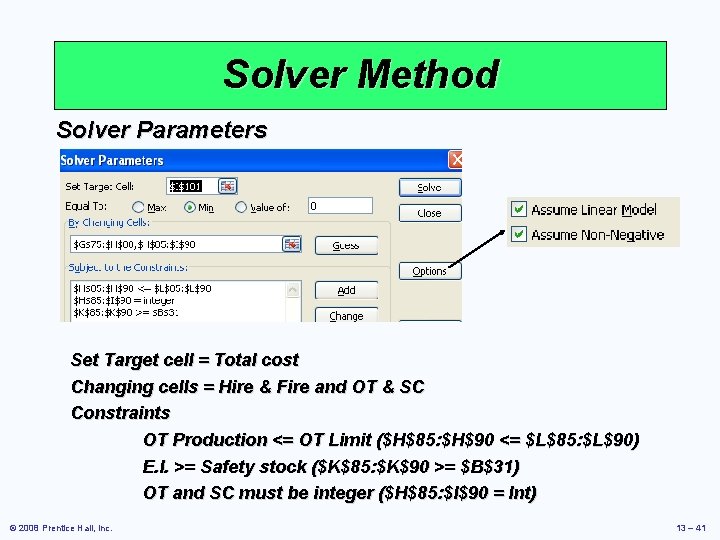
Solver Method Solver Parameters Set Target cell = Total cost Changing cells = Hire & Fire and OT & SC Constraints OT Production <= OT Limit ($H$85: $H$90 <= $L$85: $L$90) E. I. >= Safety stock ($K$85: $K$90 >= $B$31) OT and SC must be integer ($H$85: $I$90 = Int) © 2008 Prentice Hall, Inc. 13 – 41
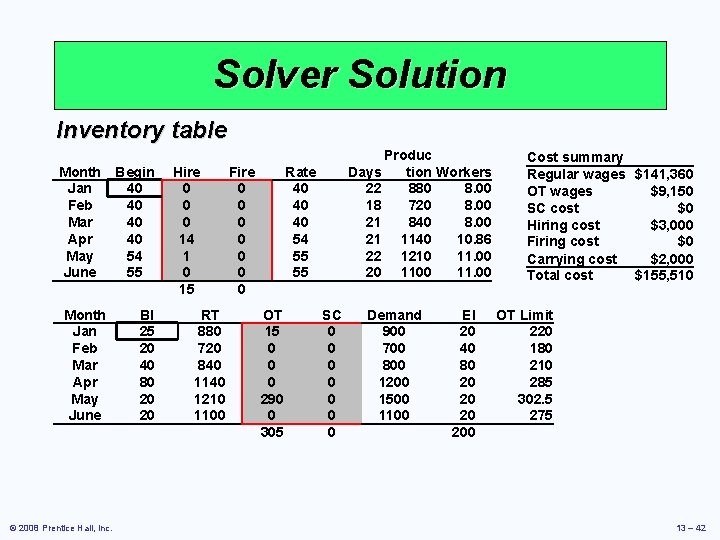
Solver Solution Inventory table Month Jan Feb Mar Apr May June © 2008 Prentice Hall, Inc. Begin 40 40 54 55 BI 25 20 40 80 20 20 Hire 0 0 0 14 1 0 15 RT 880 720 840 1140 1210 1100 Fire 0 0 0 0 Produc Days tion Workers 22 880 8. 00 18 720 8. 00 21 840 8. 00 21 1140 10. 86 22 1210 11. 00 20 1100 11. 00 Rate 40 40 40 54 55 55 OT 15 0 0 0 290 0 305 SC 0 0 0 0 Demand 900 700 800 1200 1500 1100 EI 20 40 80 20 200 Cost summary Regular wages $141, 360 OT wages $9, 150 SC cost $0 Hiring cost $3, 000 Firing cost $0 Carrying cost $2, 000 Total cost $155, 510 OT Limit 220 180 210 285 302. 5 275 13 – 42
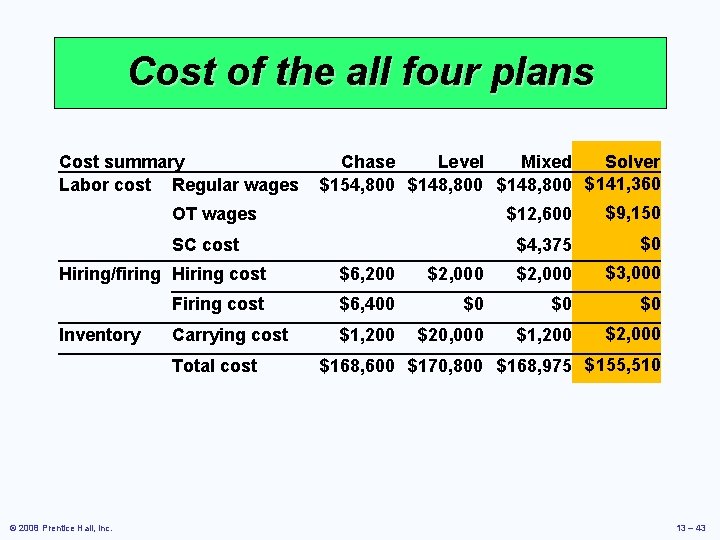
Cost of the all four plans Cost summary Labor cost Regular wages Chase Level Mixed Solver $154, 800 $148, 800 $141, 360 OT wages SC cost $12, 600 $9, 150 $4, 375 $0 Hiring/firing Hiring cost $6, 200 $2, 000 $3, 000 Firing cost $6, 400 $0 $0 $0 Carrying cost $1, 200 $20, 000 $1, 200 $2, 000 Inventory Total cost © 2008 Prentice Hall, Inc. $168, 600 $170, 800 $168, 975 $155, 510 13 – 43