
Operations Management Capacity Planning 2006 Prentice Hall Inc
- Slides: 36
Operations Management Capacity Planning © 2006 Prentice Hall, Inc. © 2006 Prentice S 7 – 1
Capacity þ The throughput, or the number of units a facility can hold, receive, store, or produce in a period of time þ Determines fixed costs þ Determines if demand will be satisfied þ Three time horizons © 2006 Prentice Hall, Inc. S 7 – 2
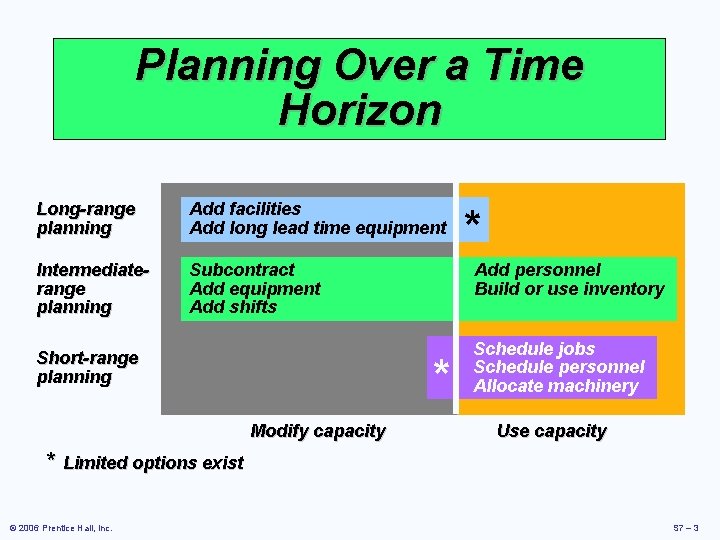
Planning Over a Time Horizon Long-range planning Add facilities Add long lead time equipment Intermediaterange planning Subcontract Add equipment Add shifts Short-range planning Add personnel Build or use inventory * Modify capacity * Schedule jobs Schedule personnel Allocate machinery Use capacity * Limited options exist © 2006 Prentice Hall, Inc. S 7 – 3
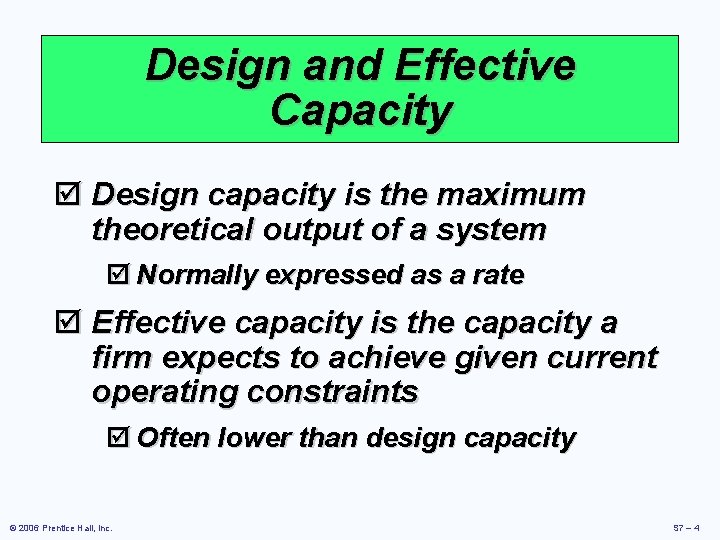
Design and Effective Capacity þ Design capacity is the maximum theoretical output of a system þ Normally expressed as a rate þ Effective capacity is the capacity a firm expects to achieve given current operating constraints þ Often lower than design capacity © 2006 Prentice Hall, Inc. S 7 – 4
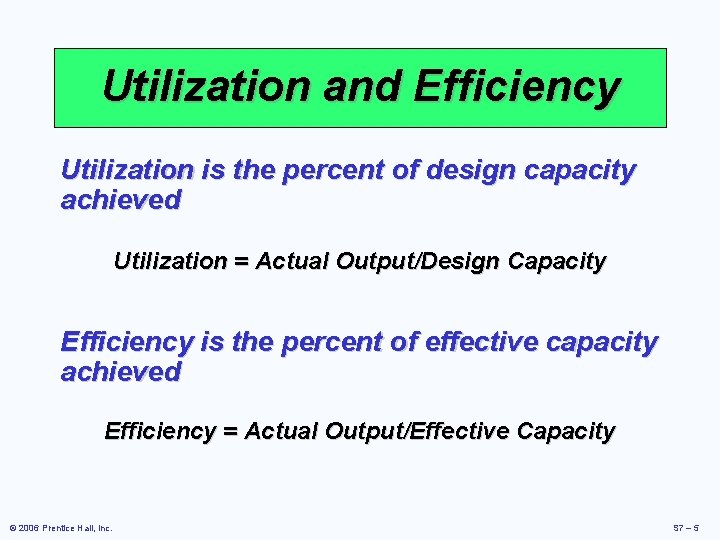
Utilization and Efficiency Utilization is the percent of design capacity achieved Utilization = Actual Output/Design Capacity Efficiency is the percent of effective capacity achieved Efficiency = Actual Output/Effective Capacity © 2006 Prentice Hall, Inc. S 7 – 5
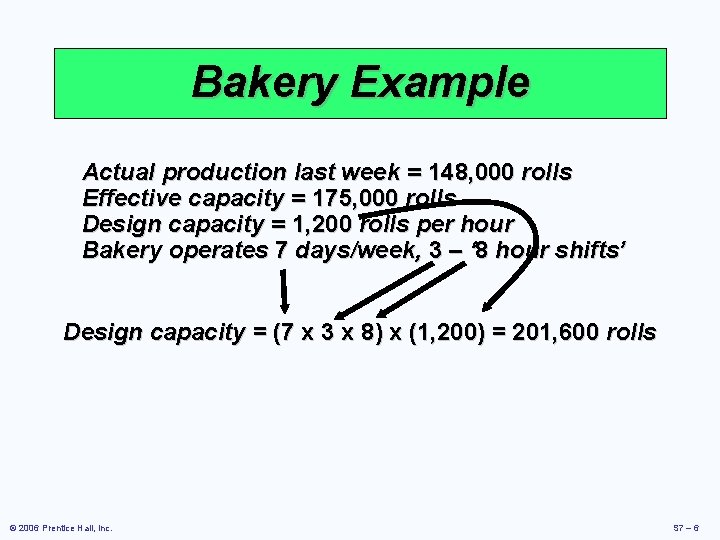
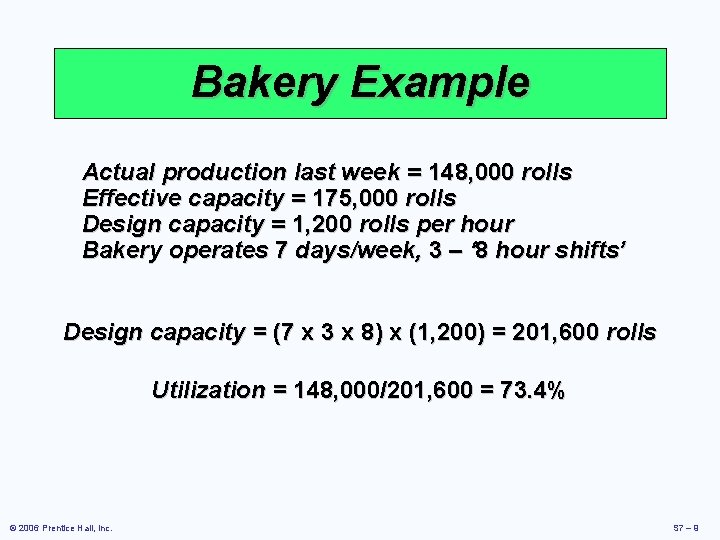
Bakery Example Actual production last week = 148, 000 rolls Effective capacity = 175, 000 rolls Design capacity = 1, 200 rolls per hour Bakery operates 7 days/week, 3 – ‘ 8 hour shifts’ Design capacity = (7 x 3 x 8) x (1, 200) = 201, 600 rolls © 2006 Prentice Hall, Inc. S 7 – 6
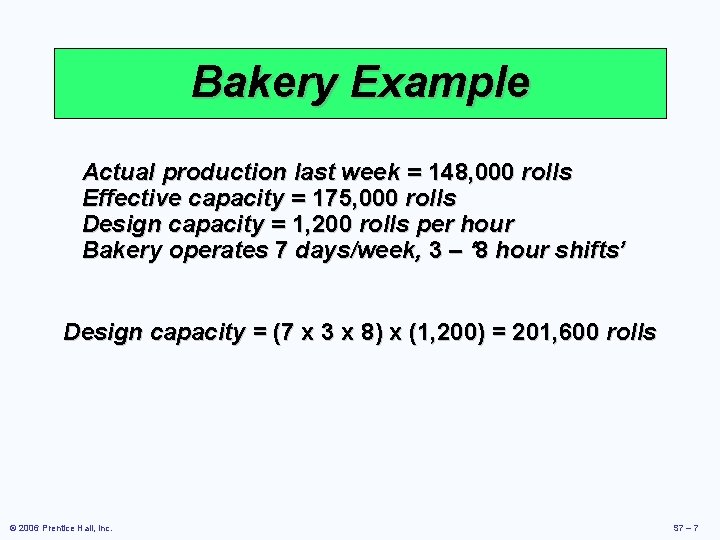
Bakery Example Actual production last week = 148, 000 rolls Effective capacity = 175, 000 rolls Design capacity = 1, 200 rolls per hour Bakery operates 7 days/week, 3 – ‘ 8 hour shifts’ Design capacity = (7 x 3 x 8) x (1, 200) = 201, 600 rolls © 2006 Prentice Hall, Inc. S 7 – 7
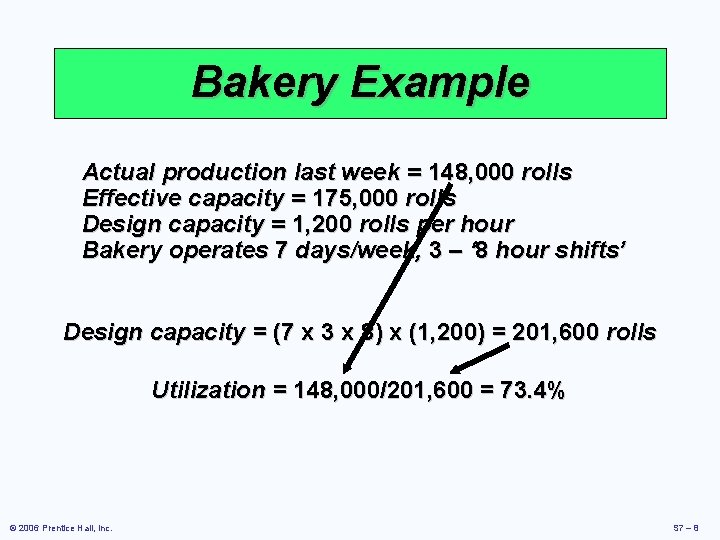
Bakery Example Actual production last week = 148, 000 rolls Effective capacity = 175, 000 rolls Design capacity = 1, 200 rolls per hour Bakery operates 7 days/week, 3 – ‘ 8 hour shifts’ Design capacity = (7 x 3 x 8) x (1, 200) = 201, 600 rolls Utilization = 148, 000/201, 600 = 73. 4% © 2006 Prentice Hall, Inc. S 7 – 8
Bakery Example Actual production last week = 148, 000 rolls Effective capacity = 175, 000 rolls Design capacity = 1, 200 rolls per hour Bakery operates 7 days/week, 3 – ‘ 8 hour shifts’ Design capacity = (7 x 3 x 8) x (1, 200) = 201, 600 rolls Utilization = 148, 000/201, 600 = 73. 4% © 2006 Prentice Hall, Inc. S 7 – 9
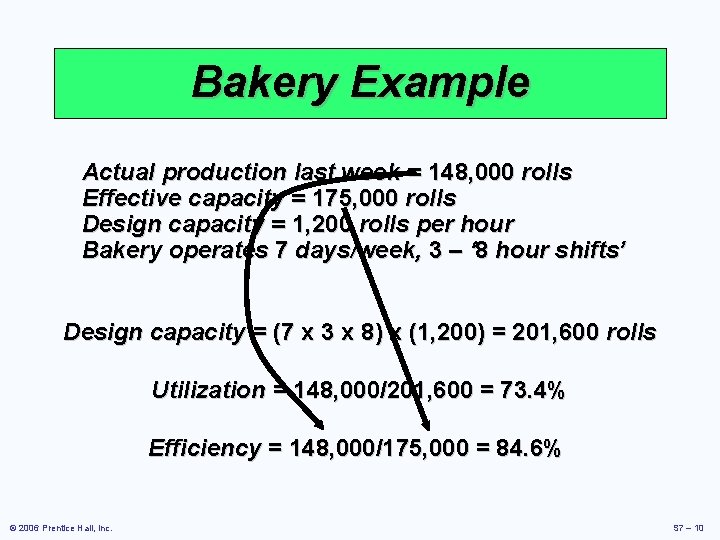
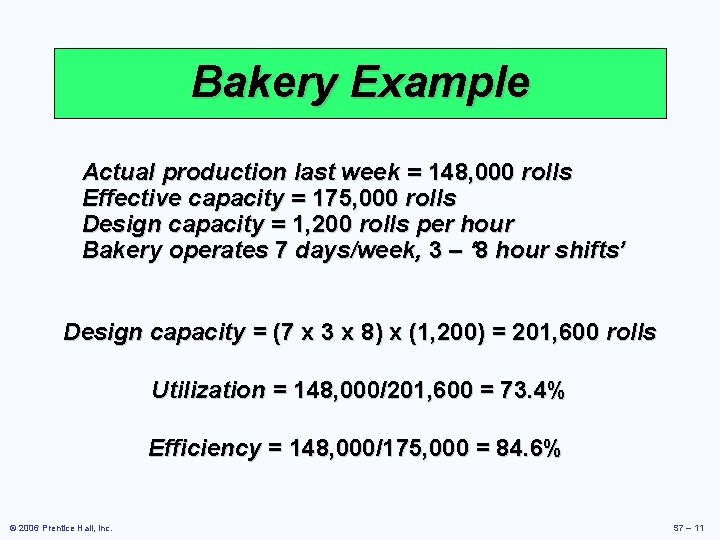
Bakery Example Actual production last week = 148, 000 rolls Effective capacity = 175, 000 rolls Design capacity = 1, 200 rolls per hour Bakery operates 7 days/week, 3 – ‘ 8 hour shifts’ Design capacity = (7 x 3 x 8) x (1, 200) = 201, 600 rolls Utilization = 148, 000/201, 600 = 73. 4% Efficiency = 148, 000/175, 000 = 84. 6% © 2006 Prentice Hall, Inc. S 7 – 10
Bakery Example Actual production last week = 148, 000 rolls Effective capacity = 175, 000 rolls Design capacity = 1, 200 rolls per hour Bakery operates 7 days/week, 3 – ‘ 8 hour shifts’ Design capacity = (7 x 3 x 8) x (1, 200) = 201, 600 rolls Utilization = 148, 000/201, 600 = 73. 4% Efficiency = 148, 000/175, 000 = 84. 6% © 2006 Prentice Hall, Inc. S 7 – 11
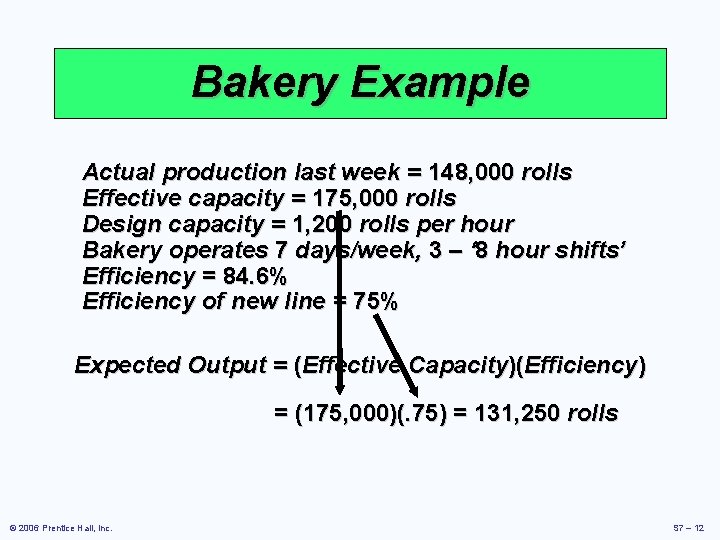
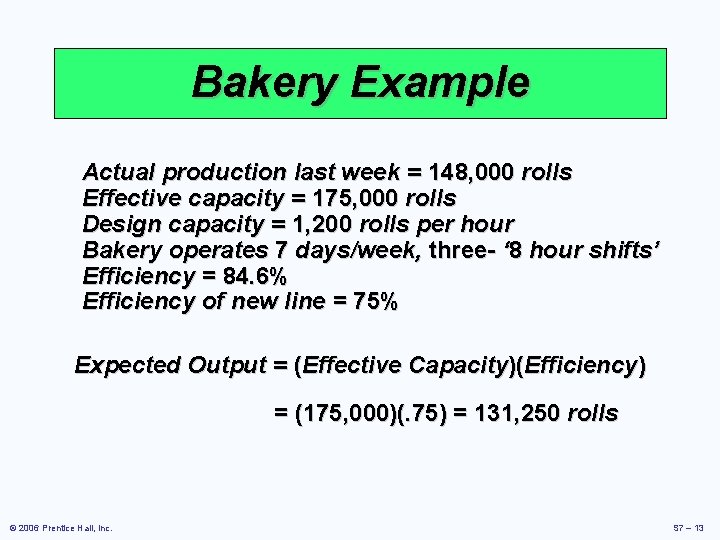
Bakery Example Actual production last week = 148, 000 rolls Effective capacity = 175, 000 rolls Design capacity = 1, 200 rolls per hour Bakery operates 7 days/week, 3 – ‘ 8 hour shifts’ Efficiency = 84. 6% Efficiency of new line = 75% Expected Output = (Effective Capacity)(Efficiency) = (175, 000)(. 75) = 131, 250 rolls © 2006 Prentice Hall, Inc. S 7 – 12
Bakery Example Actual production last week = 148, 000 rolls Effective capacity = 175, 000 rolls Design capacity = 1, 200 rolls per hour Bakery operates 7 days/week, three- ‘ 8 hour shifts’ Efficiency = 84. 6% Efficiency of new line = 75% Expected Output = (Effective Capacity)(Efficiency) = (175, 000)(. 75) = 131, 250 rolls © 2006 Prentice Hall, Inc. S 7 – 13
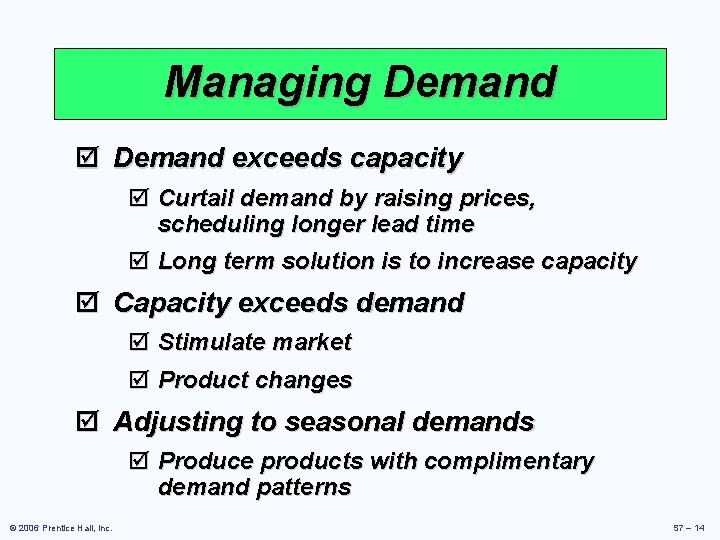
Managing Demand þ Demand exceeds capacity þ Curtail demand by raising prices, scheduling longer lead time þ Long term solution is to increase capacity þ Capacity exceeds demand þ Stimulate market þ Product changes þ Adjusting to seasonal demands þ Produce products with complimentary demand patterns © 2006 Prentice Hall, Inc. S 7 – 14
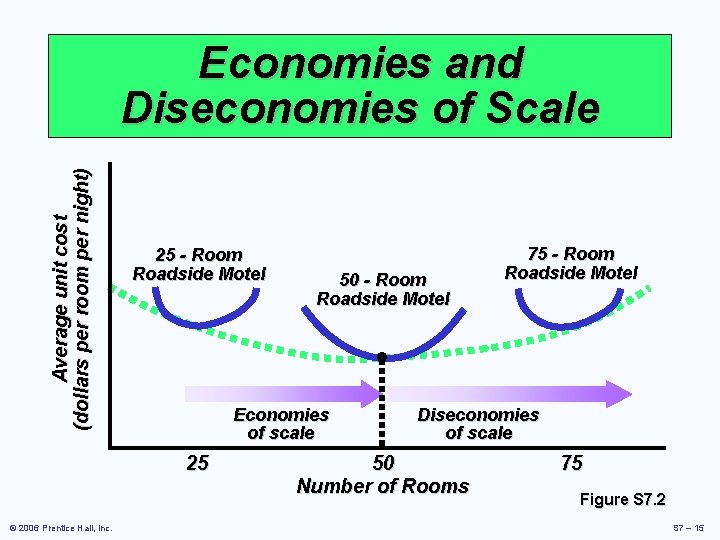
Average unit cost (dollars per room per night) Economies and Diseconomies of Scale 25 - Room Roadside Motel Economies of scale 25 © 2006 Prentice Hall, Inc. 50 - Room Roadside Motel 75 - Room Roadside Motel Diseconomies of scale 50 Number of Rooms 75 Figure S 7. 2 S 7 – 15
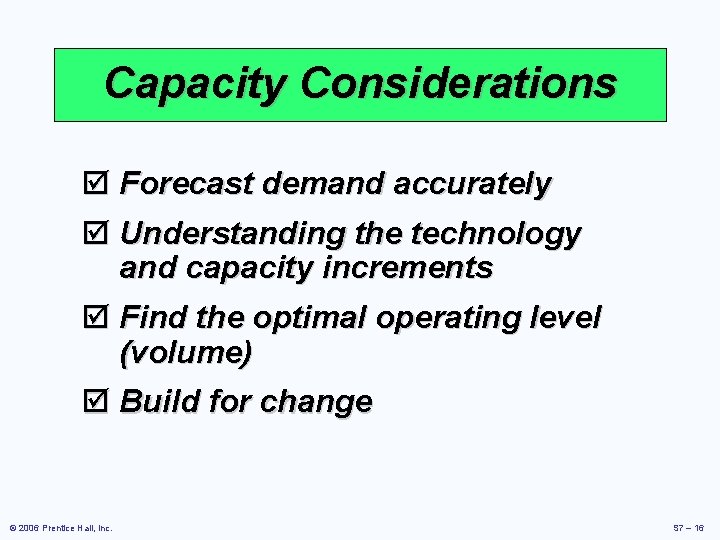
Capacity Considerations þ Forecast demand accurately þ Understanding the technology and capacity increments þ Find the optimal operating level (volume) þ Build for change © 2006 Prentice Hall, Inc. S 7 – 16
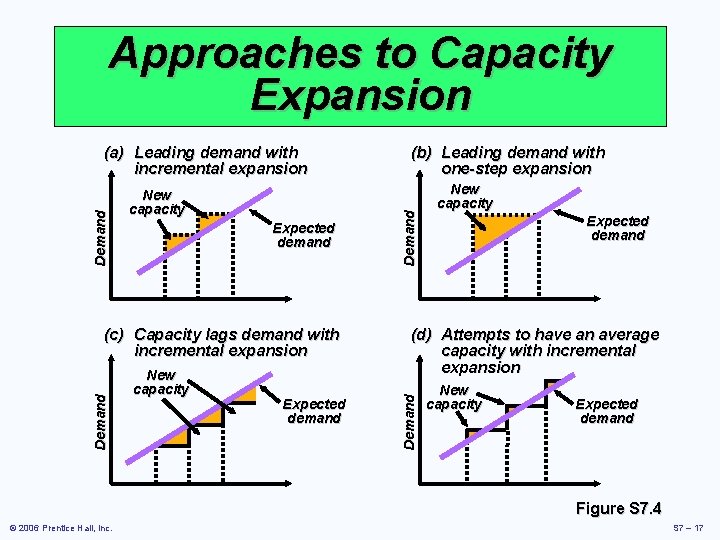
Approaches to Capacity Expansion Expected demand Demand (c) Capacity lags demand with incremental expansion New capacity Expected demand Demand New capacity (b) Leading demand with one-step expansion New capacity Expected demand (d) Attempts to have an average capacity with incremental expansion Demand (a) Leading demand with incremental expansion New capacity Expected demand Figure S 7. 4 © 2006 Prentice Hall, Inc. S 7 – 17
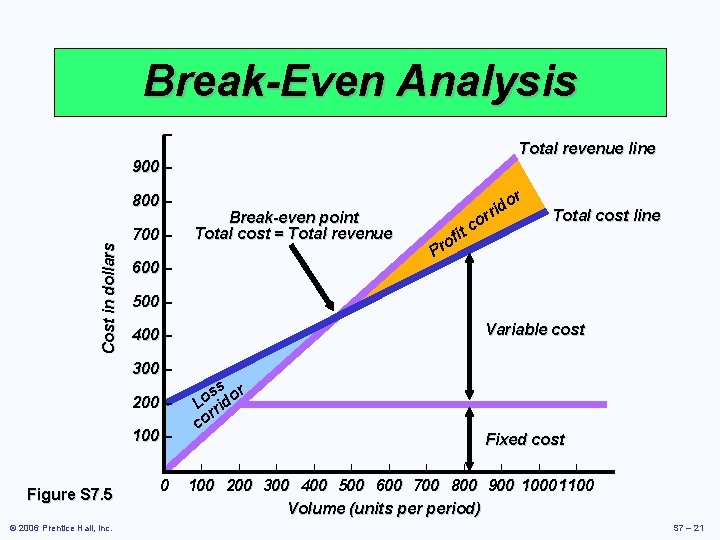
Break-Even Analysis þ Technique for evaluating process and equipment alternatives þ Objective is to find the point in dollars and units at which cost equals revenue þ Requires estimation of fixed costs, variable costs, and revenue © 2006 Prentice Hall, Inc. S 7 – 18
Break-Even Analysis þ Fixed costs are costs that continue even if no units are produced þ Depreciation, taxes, debt, mortgage payments þ Variable costs are costs that vary with the volume of units produced þ Labor, materials, portion of utilities þ Contribution is the difference between selling price and variable cost © 2006 Prentice Hall, Inc. S 7 – 19
Break-Even Analysis Assumptions þ Costs and revenue are linear functions þ Generally not the case in the real world þ We actually know these costs þ Very difficult to accomplish þ There is no time value of money © 2006 Prentice Hall, Inc. S 7 – 20
Break-Even Analysis – Total revenue line 900 – Cost in dollars 800 – 700 – r Break-even point Total cost = Total revenue 600 – do i r r o c t i of Total cost line Pr 500 – Variable cost 400 – 300 – 200 – 100 – ss or o L rid r co Fixed cost | | | – 0 100 200 300 400 500 600 700 800 900 1000 1100 Volume (units period) | Figure S 7. 5 © 2006 Prentice Hall, Inc. S 7 – 21
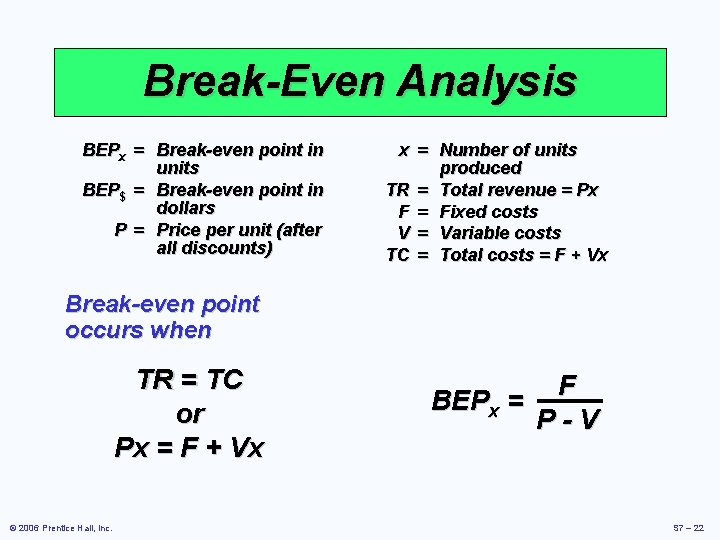
Break-Even Analysis BEPx = Break-even point in units BEP$ = Break-even point in dollars P = Price per unit (after all discounts) x = Number of units produced TR = Total revenue = Px F = Fixed costs V = Variable costs TC = Total costs = F + Vx Break-even point occurs when TR = TC or Px = F + Vx © 2006 Prentice Hall, Inc. F BEPx = P-V S 7 – 22
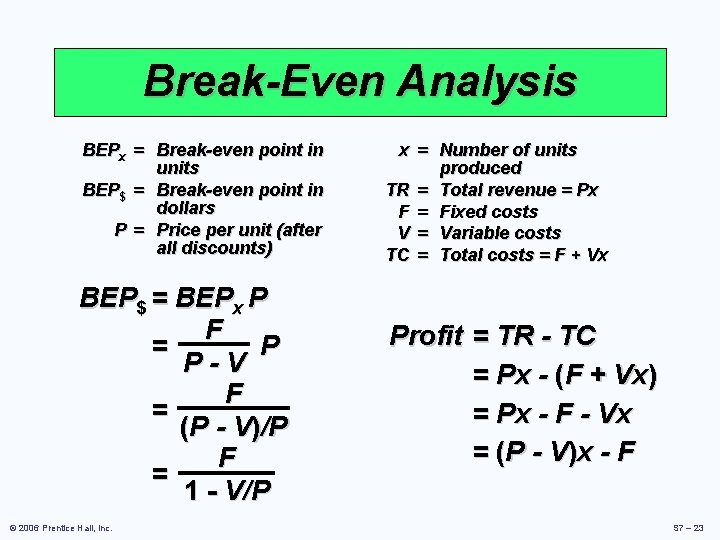
Break-Even Analysis BEPx = Break-even point in units BEP$ = Break-even point in dollars P = Price per unit (after all discounts) x = Number of units produced TR = Total revenue = Px F = Fixed costs V = Variable costs TC = Total costs = F + Vx BEP$ = BEPx P F = P P-V F = (P - V)/P F = 1 - V/P Profit = TR - TC = Px - (F + Vx) = Px - F - Vx = (P - V )x - F © 2006 Prentice Hall, Inc. S 7 – 23
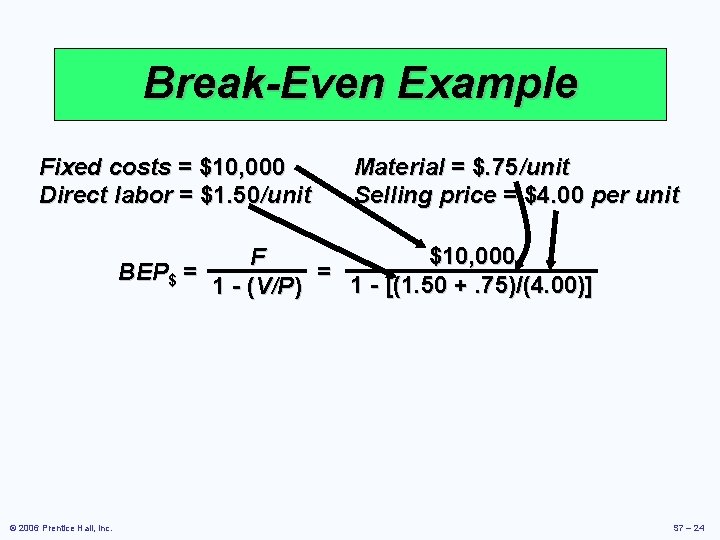
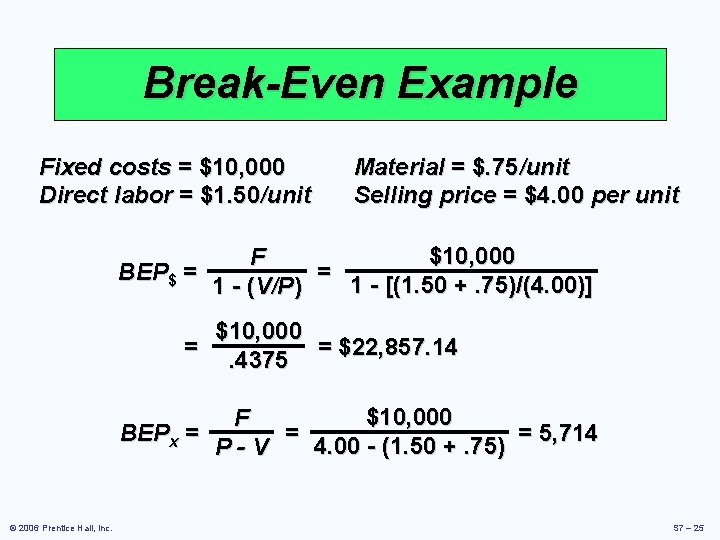
Break-Even Example Fixed costs = $10, 000 Direct labor = $1. 50/unit Material = $. 75/unit Selling price = $4. 00 per unit $10, 000 F BEP$ = = 1 - [(1. 50 +. 75)/(4. 00)] 1 - (V/P) © 2006 Prentice Hall, Inc. S 7 – 24
Break-Even Example Fixed costs = $10, 000 Direct labor = $1. 50/unit Material = $. 75/unit Selling price = $4. 00 per unit $10, 000 F BEP$ = = 1 - [(1. 50 +. 75)/(4. 00)] 1 - (V/P) $10, 000 = = $22, 857. 14. 4375 $10, 000 F BEPx = = = 5, 714 4. 00 - (1. 50 +. 75) P-V © 2006 Prentice Hall, Inc. S 7 – 25
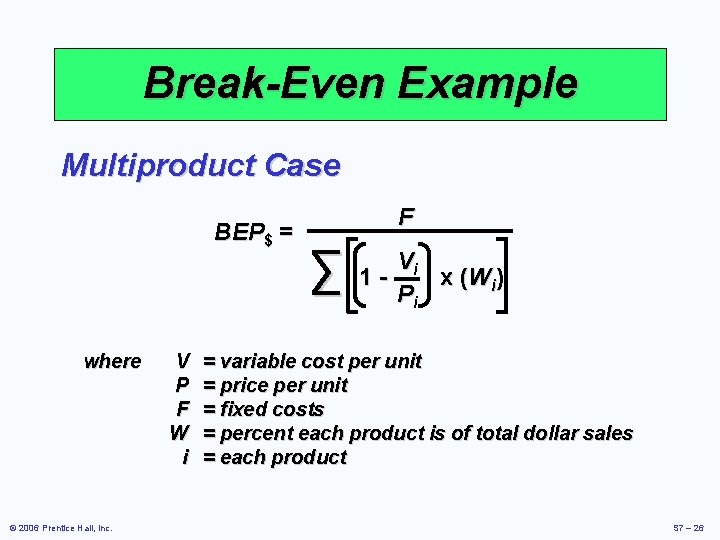
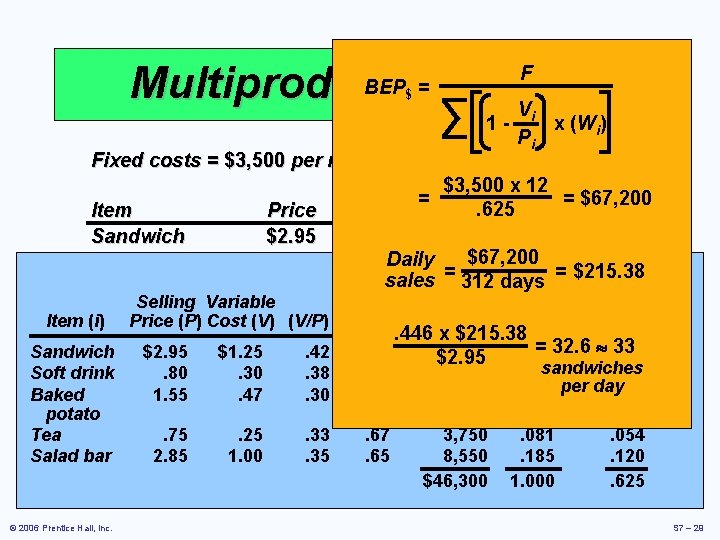
Break-Even Example Multiproduct Case BEP$ = where © 2006 Prentice Hall, Inc. V P F W i F ∑ Vi 1 x ( W i) Pi = variable cost per unit = price per unit = fixed costs = percent each product is of total dollar sales = each product S 7 – 26
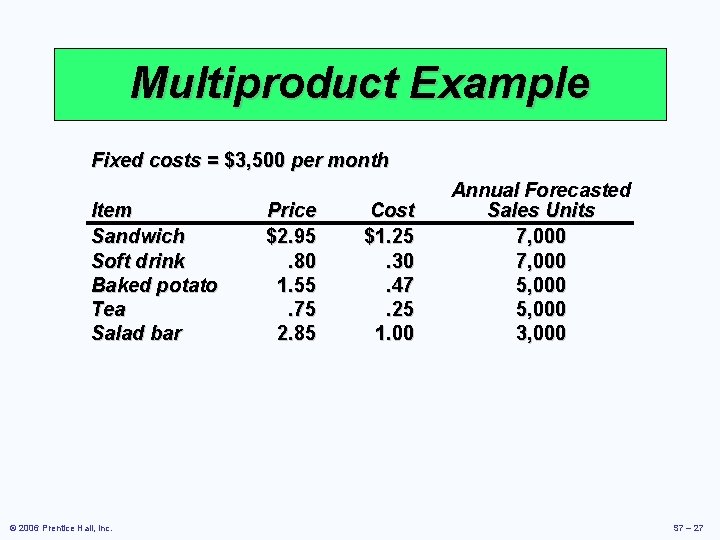
Multiproduct Example Fixed costs = $3, 500 per month Item Sandwich Soft drink Baked potato Tea Salad bar © 2006 Prentice Hall, Inc. Price $2. 95. 80 1. 55. 75 2. 85 Cost $1. 25. 30. 47. 25 1. 00 Annual Forecasted Sales Units 7, 000 5, 000 3, 000 S 7 – 27
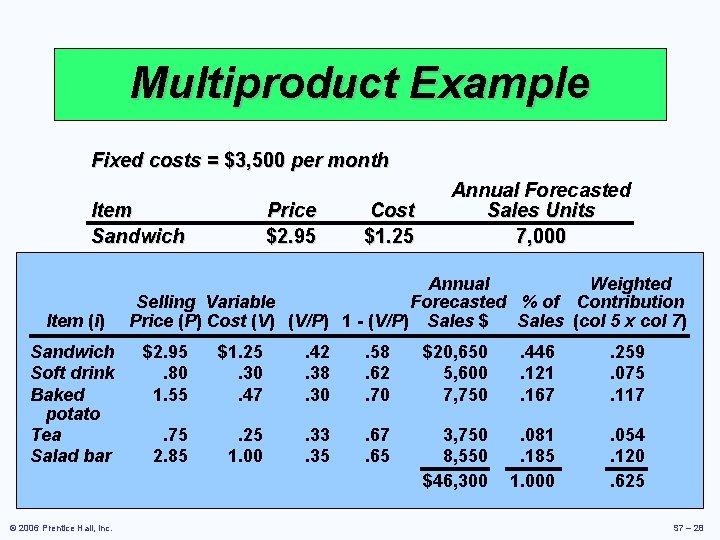
Multiproduct Example Fixed costs = $3, 500 per month Annual Forecasted Item Price Cost Sales Units Sandwich $2. 95 $1. 25 7, 000 Soft drink. 80. 30 7, 000 Baked potato 1. 55. 47 Annual 5, 000 Weighted % of Contribution Tea Selling Variable. 75. 25 Forecasted 5, 000 Item (i) Price (P) Cost (V) (V/P) 1 - (V/P) Sales $ Sales (col 5 x col 7) Salad bar 2. 85 1. 00 3, 000 Sandwich Soft drink Baked potato Tea Salad bar © 2006 Prentice Hall, Inc. $2. 95. 80 1. 55 $1. 25. 30. 47 . 42. 38. 30 . 58. 62. 70 $20, 650 5, 600 7, 750 . 446. 121. 167 . 259. 075. 117 . 75 2. 85 . 25 1. 00 . 33. 35 . 67. 65 3, 750 8, 550 $46, 300 . 081. 185 1. 000 . 054. 120. 625 S 7 – 28
BEP Example = Multiproduct ∑ 1 - VP x (W ) F $ i i Fixed costs = $3, 500 per month i $3, 500 x Forecasted 12 Annual = = $67, 200. 625 Item Price Cost Sales Units Sandwich $2. 95 $1. 25 7, 000 $67, 200 Daily Soft drink. 80. 30 7, 000 = = $215. 38 sales 312 days Baked potato 1. 55. 47 Annual 5, 000 Weighted % of Contribution Tea Selling Variable. 75. 25 Forecasted 5, 000 Item (i) Price (P) Cost (V) (V/P) 1 - (V/P) Sales $ Sales (col 5 x col 7) Salad bar 2. 85 1. 00 3, 000. 446 x $215. 38 = 32. 6 . 259 33 Sandwich $2. 95 $1. 25. 42. 58 $20, 650. 446 $2. 95 Soft drink Baked potato Tea Salad bar © 2006 Prentice Hall, Inc. . 80 1. 55 . 30. 47 . 38. 30 . 62. 70 5, 600 7, 750 . 75 2. 85 . 25 1. 00 . 33. 35 . 67. 65 3, 750 8, 550 $46, 300 sandwiches. 121. 075. 167 per day. 117 . 081. 185 1. 000 . 054. 120. 625 S 7 – 29
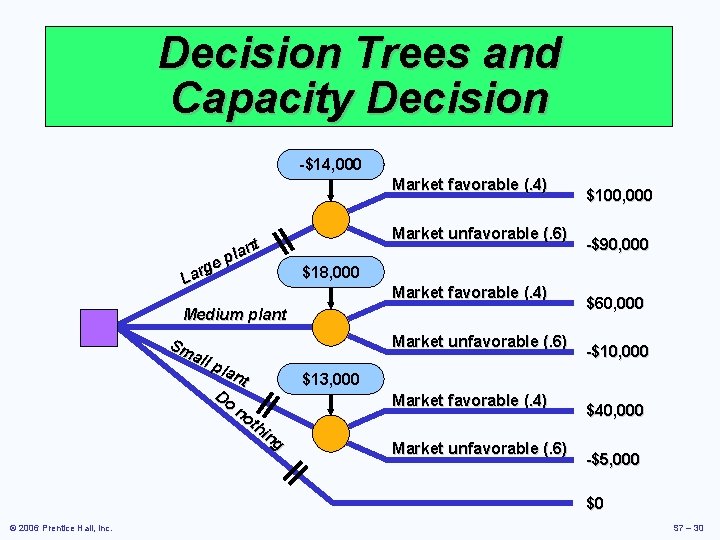
Decision Trees and Capacity Decision -$14, 000 Market favorable (. 4) nt a l ep g r La Market unfavorable (. 6) -$90, 000 $18, 000 Market favorable (. 4) Medium plant Sm all pla nt Do no th in g $100, 000 Market unfavorable (. 6) $60, 000 -$10, 000 $13, 000 Market favorable (. 4) Market unfavorable (. 6) $40, 000 -$5, 000 $0 © 2006 Prentice Hall, Inc. S 7 – 30
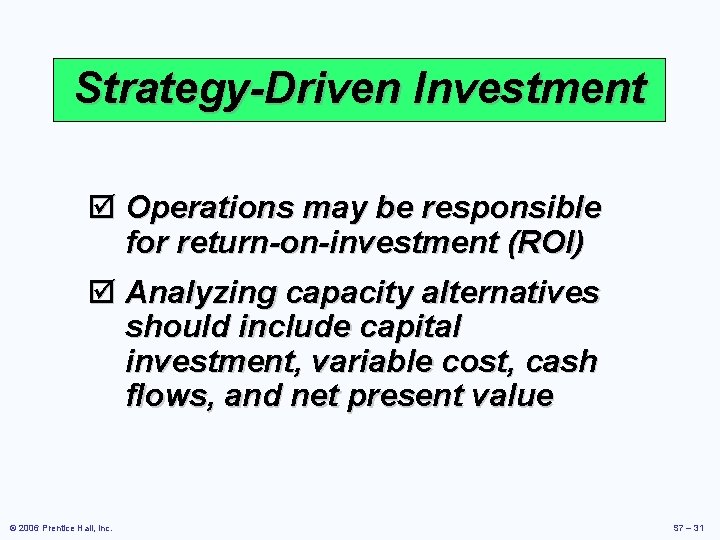
Strategy-Driven Investment þ Operations may be responsible for return-on-investment (ROI) þ Analyzing capacity alternatives should include capital investment, variable cost, cash flows, and net present value © 2006 Prentice Hall, Inc. S 7 – 31
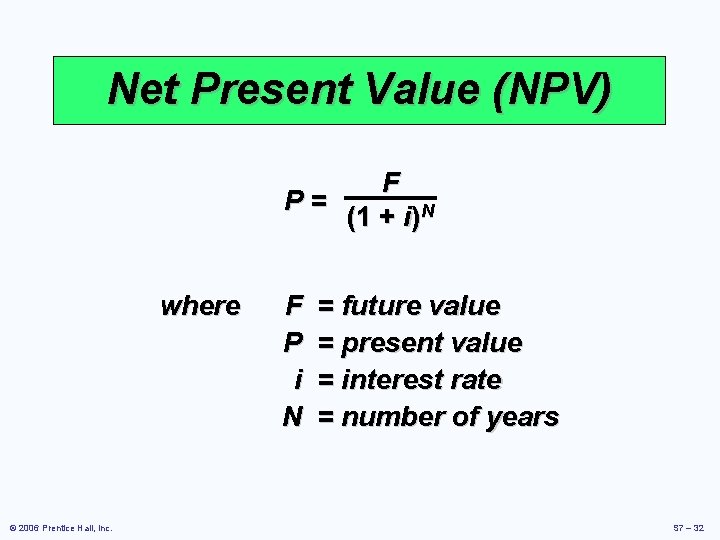
Net Present Value (NPV) F P= (1 + i)N where © 2006 Prentice Hall, Inc. F P i N = future value = present value = interest rate = number of years S 7 – 32
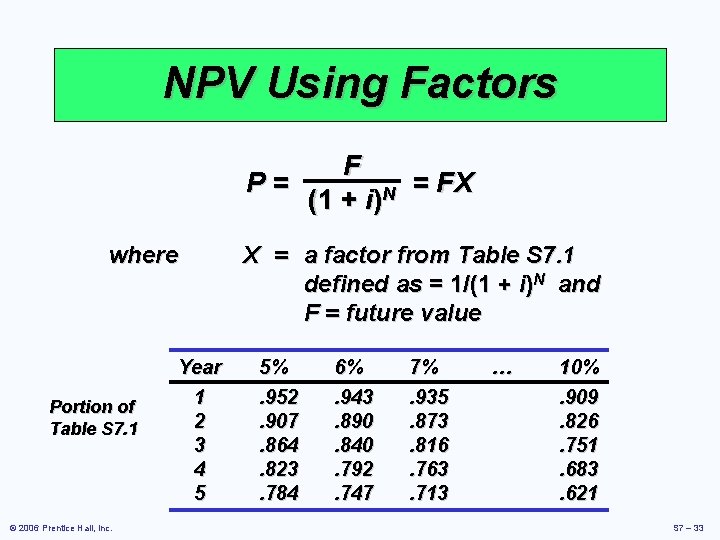
NPV Using Factors F P= = FX N (1 + i) where Portion of Table S 7. 1 © 2006 Prentice Hall, Inc. Year 1 2 3 4 5 X = a factor from Table S 7. 1 defined as = 1/(1 + i)N and F = future value 5%. 952. 907. 864. 823. 784 6%. 943. 890. 840. 792. 747 7%. 935. 873. 816. 763. 713 … 10%. 909. 826. 751. 683. 621 S 7 – 33
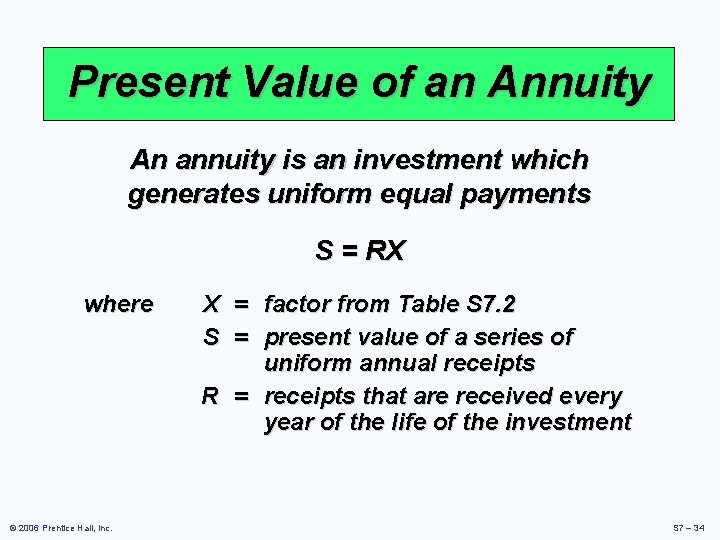
Present Value of an Annuity An annuity is an investment which generates uniform equal payments S = RX where © 2006 Prentice Hall, Inc. X = factor from Table S 7. 2 S = present value of a series of uniform annual receipts R = receipts that are received every year of the life of the investment S 7 – 34
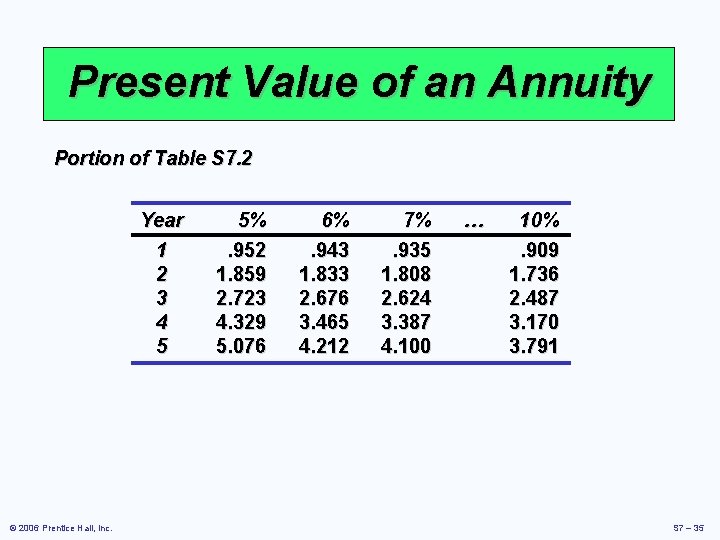
Present Value of an Annuity Portion of Table S 7. 2 Year 1 2 3 4 5 © 2006 Prentice Hall, Inc. 5%. 952 1. 859 2. 723 4. 329 5. 076 6%. 943 1. 833 2. 676 3. 465 4. 212 7%. 935 1. 808 2. 624 3. 387 4. 100 … 10%. 909 1. 736 2. 487 3. 170 3. 791 S 7 – 35
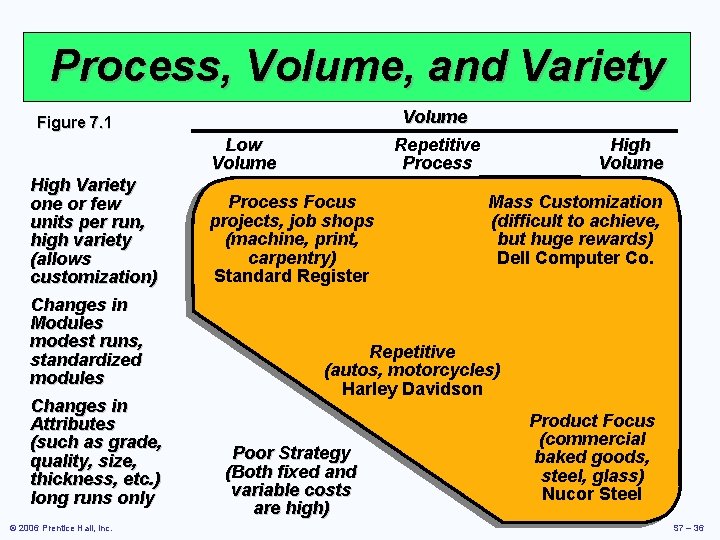
Process, Volume, and Variety Volume Repetitive Process Figure 7. 1 Low Volume High Variety one or few units per run, high variety (allows customization) Changes in Modules modest runs, standardized modules Changes in Attributes (such as grade, quality, size, thickness, etc. ) long runs only © 2006 Prentice Hall, Inc. Process Focus projects, job shops (machine, print, carpentry) Standard Register High Volume Mass Customization (difficult to achieve, but huge rewards) Dell Computer Co. Repetitive (autos, motorcycles) Harley Davidson Poor Strategy (Both fixed and variable costs are high) Product Focus (commercial baked goods, steel, glass) Nucor Steel S 7 – 36