
Operations and Services Improvement Process OSIP 101 6205
- Slides: 15
Operations and Services Improvement Process (OSIP) 101 6/2/05 1
What is OSIP? ü OSIP is the NWS requirements-based management process (RMP) approved by the Corporate Board in June ’ 05. ü OSIP is a standard, systematic, and disciplined process for evaluating needs/opportunities… o captures requirements o develops solutions o prioritizes resources ü OSIP is managed by a working group comprised of OST, OCWWS, OHD, OOS, CIO, CFO, Regions, and NCEP. ü OSIP is structured so that needs throughout the NWS can be identified and solutions to those needs can be found based on requirements; ensuring that solutions meet these requirements. 2
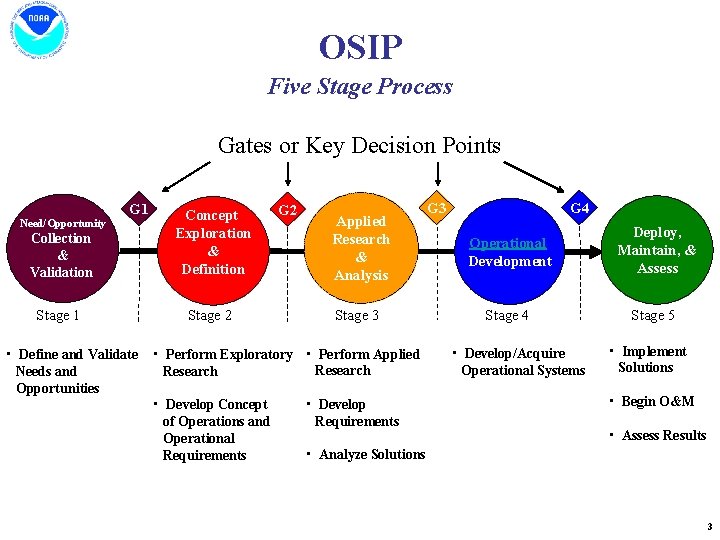
OSIP Five Stage Process Gates or Key Decision Points G 1 Collection & Validation Concept Exploration & Definition Stage 1 Stage 2 Need/Opportunity • Define and Validate Needs and Opportunities G 2 Applied Research & Analysis Stage 3 • Perform Exploratory • Perform Applied Research • Develop Concept of Operations and Operational Requirements • Develop Requirements G 4 G 3 Operational Development Deploy, Maintain, & Assess Stage 4 Stage 5 • Develop/Acquire Operational Systems • Implement Solutions • Begin O&M • Assess Results • Analyze Solutions 3
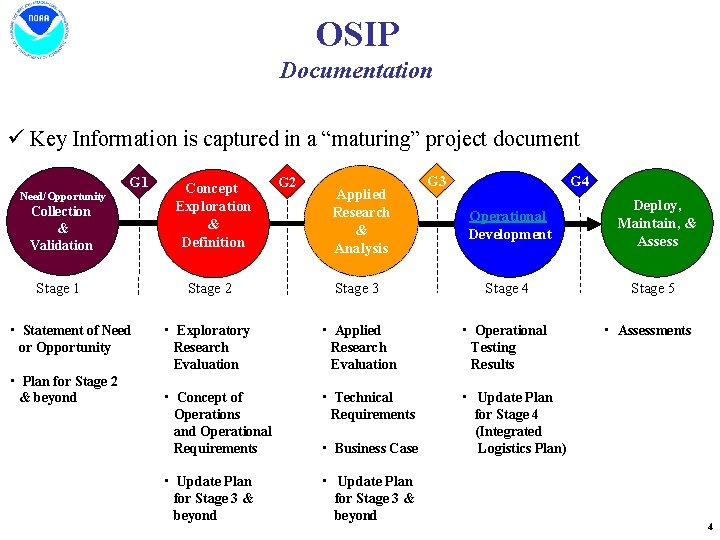
OSIP Documentation ü Key Information is captured in a “maturing” project document G 1 Collection & Validation Concept Exploration & Definition Stage 1 Stage 2 Need/Opportunity • Statement of Need or Opportunity • Plan for Stage 2 & beyond G 2 Applied Research & Analysis G 4 G 3 Operational Development Deploy, Maintain, & Assess Stage 3 Stage 4 Stage 5 • Exploratory Research Evaluation • Applied Research Evaluation • Operational Testing Results • Concept of Operations and Operational Requirements • Technical Requirements • Update Plan for Stage 4 (Integrated Logistics Plan) • Update Plan for Stage 3 & beyond • Business Case • Assessments 4
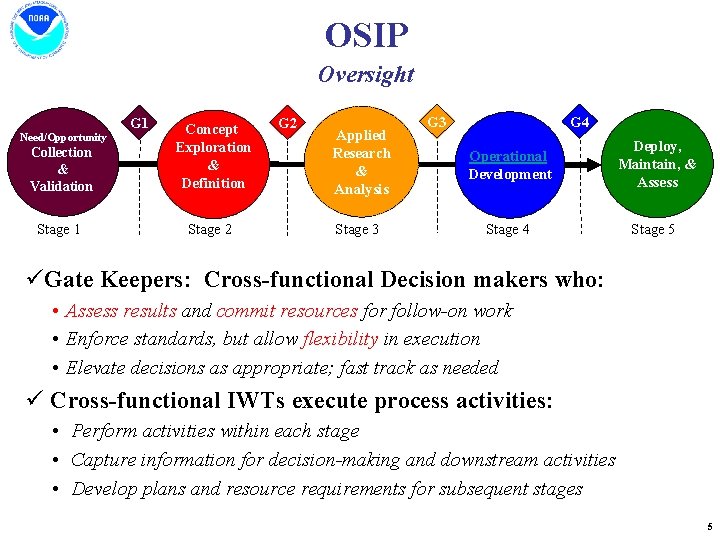
OSIP Oversight G 1 Collection & Validation Concept Exploration & Definition Stage 1 Stage 2 Need/Opportunity G 2 Applied Research & Analysis Stage 3 G 4 G 3 Operational Development Deploy, Maintain, & Assess Stage 4 Stage 5 üGate Keepers: Cross-functional Decision makers who: • Assess results and commit resources for follow-on work • Enforce standards, but allow flexibility in execution • Elevate decisions as appropriate; fast track as needed ü Cross-functional IWTs execute process activities: • Perform activities within each stage • Capture information for decision-making and downstream activities • Develop plans and resource requirements for subsequent stages 5
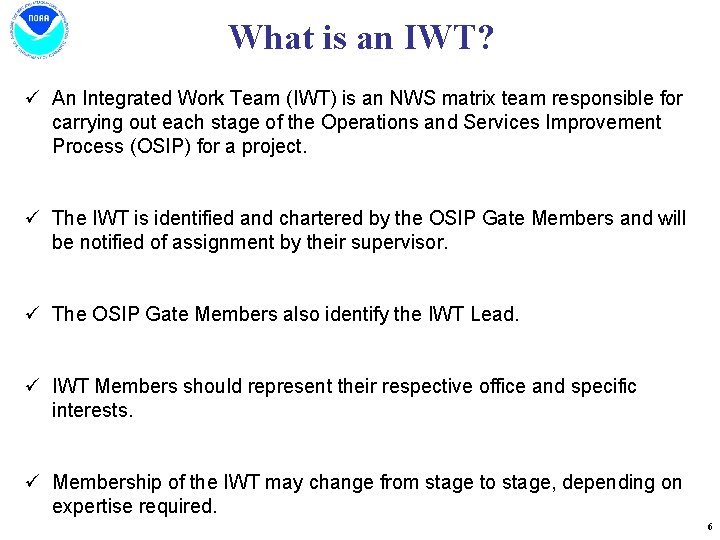
What is an IWT? ü An Integrated Work Team (IWT) is an NWS matrix team responsible for carrying out each stage of the Operations and Services Improvement Process (OSIP) for a project. ü The IWT is identified and chartered by the OSIP Gate Members and will be notified of assignment by their supervisor. ü The OSIP Gate Members also identify the IWT Lead. ü IWT Members should represent their respective office and specific interests. ü Membership of the IWT may change from stage to stage, depending on expertise required. 6
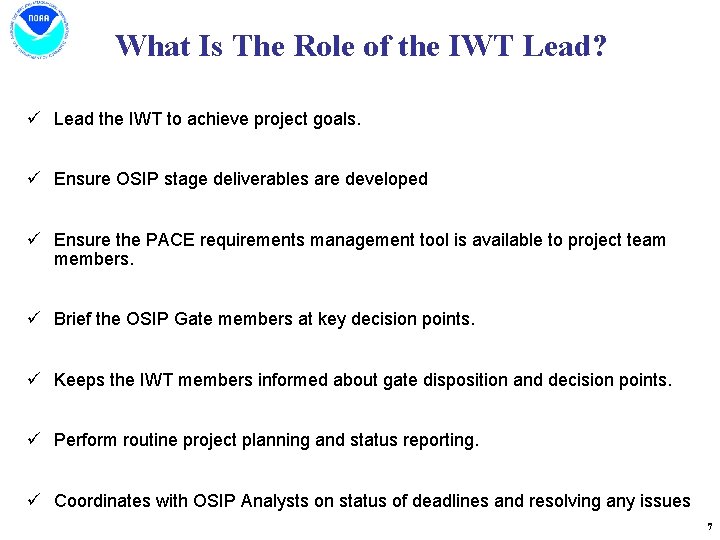
What Is The Role of the IWT Lead? ü Lead the IWT to achieve project goals. ü Ensure OSIP stage deliverables are developed ü Ensure the PACE requirements management tool is available to project team members. ü Brief the OSIP Gate members at key decision points. ü Keeps the IWT members informed about gate disposition and decision points. ü Perform routine project planning and status reporting. ü Coordinates with OSIP Analysts on status of deadlines and resolving any issues 7
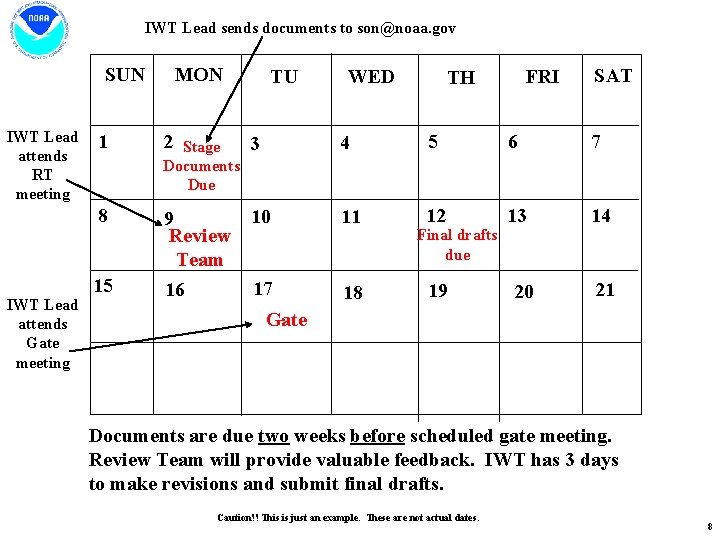
IWT Lead sends documents to son@noaa. gov MON SUN IWT Lead attends RT meeting IWT Lead attends Gate meeting TU 1 2 8 10 9 Review Team 17 16 15 Stage Documents Due 3 WED FRI TH SAT 4 5 6 7 11 12 13 14 18 Final drafts due 19 20 21 Gate Documents are due two weeks before scheduled gate meeting. Review Team will provide valuable feedback. IWT has 3 days to make revisions and submit final drafts. Caution!! This is just an example. These are not actual dates. 8
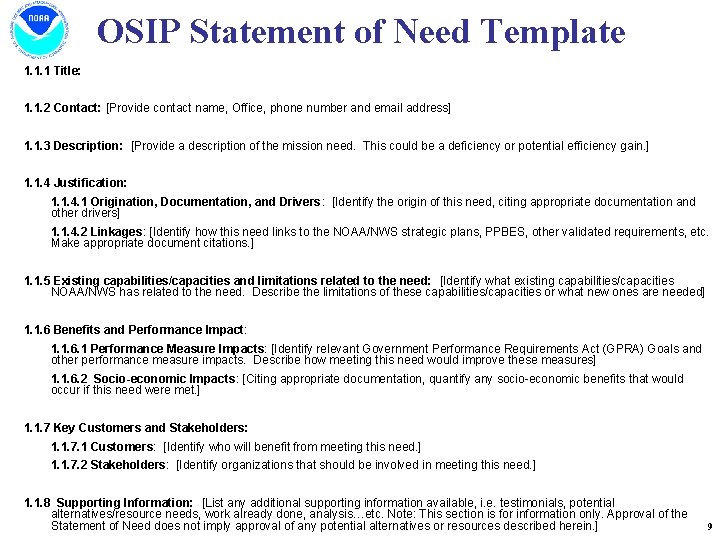
OSIP Statement of Need Template 1. 1. 1 Title: 1. 1. 2 Contact: [Provide contact name, Office, phone number and email address] 1. 1. 3 Description: [Provide a description of the mission need. This could be a deficiency or potential efficiency gain. ] 1. 1. 4 Justification: 1. 1. 4. 1 Origination, Documentation, and Drivers: [Identify the origin of this need, citing appropriate documentation and other drivers] 1. 1. 4. 2 Linkages: [Identify how this need links to the NOAA/NWS strategic plans, PPBES, other validated requirements, etc. Make appropriate document citations. ] 1. 1. 5 Existing capabilities/capacities and limitations related to the need: [Identify what existing capabilities/capacities NOAA/NWS has related to the need. Describe the limitations of these capabilities/capacities or what new ones are needed] 1. 1. 6 Benefits and Performance Impact: 1. 1. 6. 1 Performance Measure Impacts: [Identify relevant Government Performance Requirements Act (GPRA) Goals and other performance measure impacts. Describe how meeting this need would improve these measures] 1. 1. 6. 2 Socio-economic Impacts: [Citing appropriate documentation, quantify any socio-economic benefits that would occur if this need were met. ] 1. 1. 7 Key Customers and Stakeholders: 1. 1. 7. 1 Customers: [Identify who will benefit from meeting this need. ] 1. 1. 7. 2 Stakeholders: [Identify organizations that should be involved in meeting this need. ] 1. 1. 8 Supporting Information: [List any additional supporting information available, i. e. testimonials, potential alternatives/resource needs, work already done, analysis…etc. Note: This section is for information only. Approval of the Statement of Need does not imply approval of any potential alternatives or resources described herein. ] 9
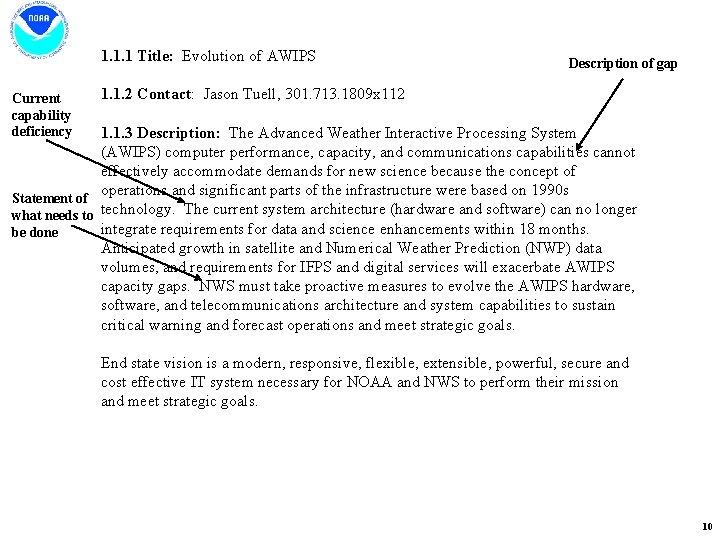
1. 1. 1 Title: Evolution of AWIPS Description of gap 1. 1. 2 Contact: Jason Tuell, 301. 713. 1809 x 112 1. 1. 3 Description: The Advanced Weather Interactive Processing System (AWIPS) computer performance, capacity, and communications capabilities cannot effectively accommodate demands for new science because the concept of operations and significant parts of the infrastructure were based on 1990 s Statement of what needs to technology. The current system architecture (hardware and software) can no longer integrate requirements for data and science enhancements within 18 months. be done Anticipated growth in satellite and Numerical Weather Prediction (NWP) data volumes, and requirements for IFPS and digital services will exacerbate AWIPS capacity gaps. NWS must take proactive measures to evolve the AWIPS hardware, software, and telecommunications architecture and system capabilities to sustain critical warning and forecast operations and meet strategic goals. End state vision is a modern, responsive, flexible, extensible, powerful, secure and cost effective IT system necessary for NOAA and NWS to perform their mission and meet strategic goals. Current capability deficiency 10
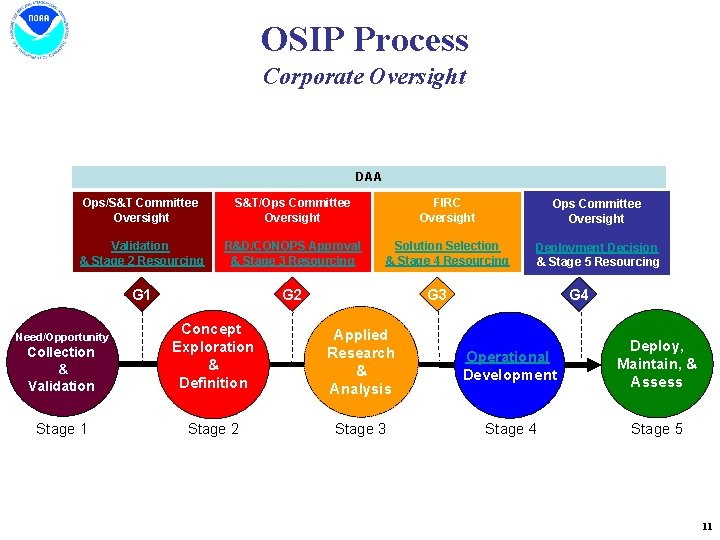
OSIP Process Corporate Oversight DAA Ops/S&T Committee Oversight S&T/Ops Committee Oversight FIRC Oversight Ops Committee Oversight Validation & Stage 2 Resourcing R&D/CONOPS Approval & Stage 3 Resourcing Solution Selection & Stage 4 Resourcing Deployment Decision & Stage 5 Resourcing G 1 G 2 G 3 G 4 Collection & Validation Concept Exploration & Definition Applied Research & Analysis Operational Development Deploy, Maintain, & Assess Stage 1 Stage 2 Stage 3 Stage 4 Stage 5 Need/Opportunity 11
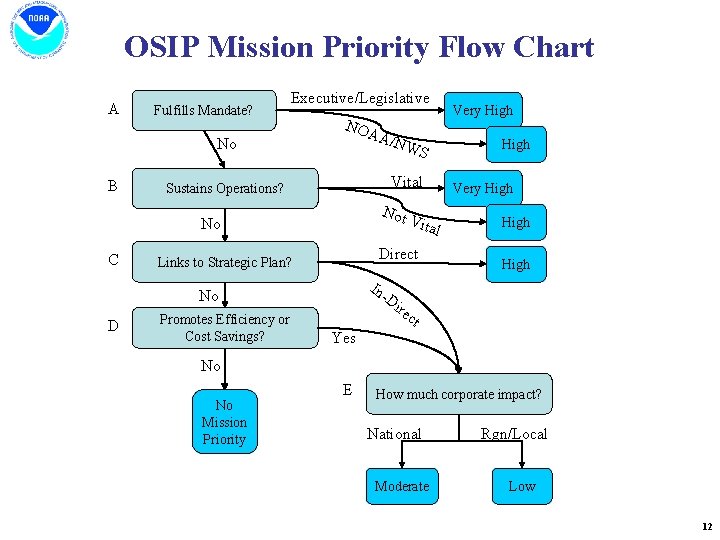
OSIP Mission Priority Flow Chart A Fulfills Mandate? Executive/Legislative No B NOA A/N W Vital Not Promotes Efficiency or Cost Savings? al Direct Links to Strategic Plan? In High -D No D Very High Vit No C High S Sustains Operations? Very High ire c t Yes No No Mission Priority E How much corporate impact? National Moderate Rgn/Local Low 12
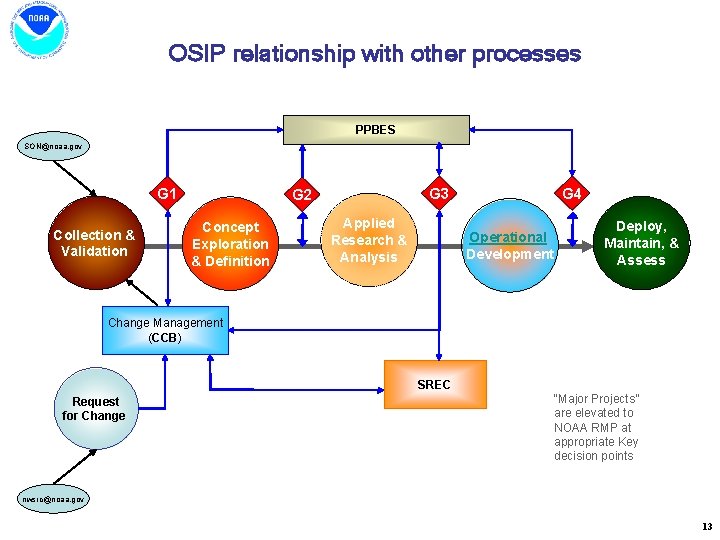
OSIP relationship with other processes PPBES SON@noaa. gov G 1 Collection & Validation Concept Exploration & Definition G 4 G 3 G 2 Applied Research & Analysis Operational Development Deploy, Maintain, & Assess Change Management (CCB) SREC Request for Change “Major Projects” are elevated to NOAA RMP at appropriate Key decision points nwsrc@noaa. gov 13
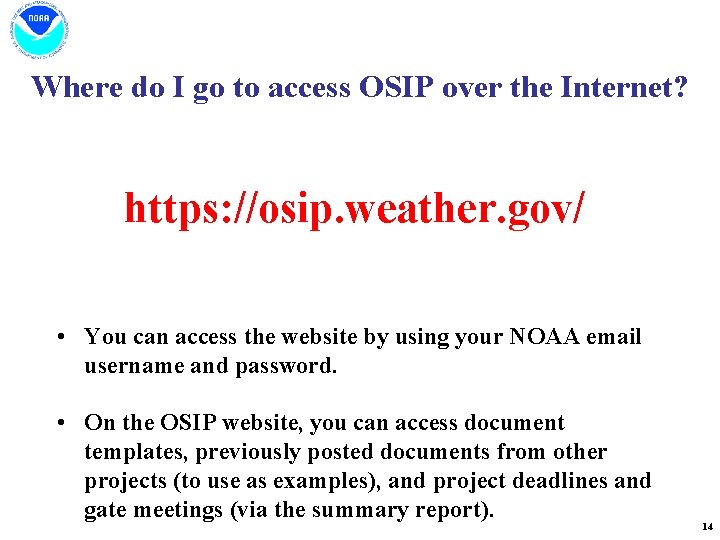
Where do I go to access OSIP over the Internet? https: //osip. weather. gov/ • You can access the website by using your NOAA email username and password. • On the OSIP website, you can access document templates, previously posted documents from other projects (to use as examples), and project deadlines and gate meetings (via the summary report). 14
Who can help me if I have further questions about OSIP or regarding required documents and deadlines? ü OSIP contacts available for support include: o Carlos Diaz (OCWWS) o John Parein (OCWWS) o Suzanne Lenihan (OST) o Douglas Hilderbrand (OST) o Cindy Woods (OST) o Dwayne Johnson (OST) 15