
Operations and performance of the Resistive Plate Chambers
Operations and performance of the Resistive Plate Chambers detector supplying the first Level trigger in the barrel muon spectrometer of the ATLAS Experiment. Riccardo de Asmundis Istituto Nazionale di fisica nucleare, Sezione di Napoli, on behalf the ATLAS Muon Community 14 -10 -2009 Riccardo de Asmundis 1
Outline ü The RPC as detectors for the level-1 Muon trigger in the barrel region: structure and technical's ü Data analysis for Cosmics Rays and results for RPC detector ü Level-1 trigger timing and performances ü Detector Control System and monitoring software status ü Conclusions 14 -10 -2009 Riccardo de Asmundis 2
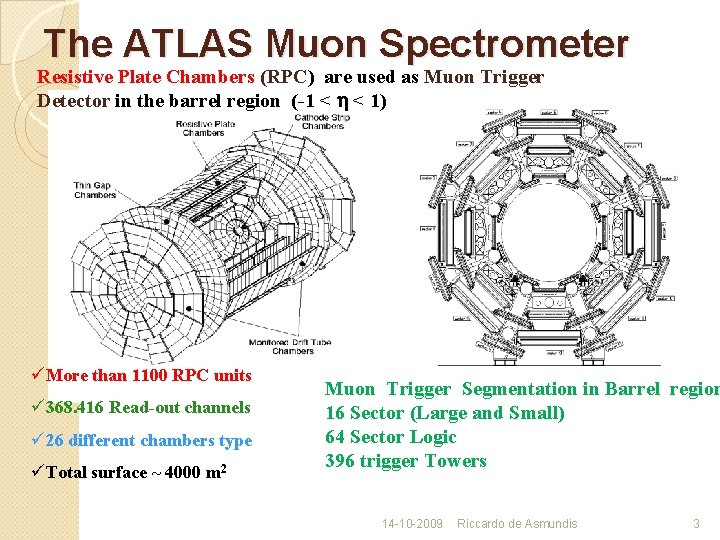
The ATLAS Muon Spectrometer Resistive Plate Chambers (RPC) are used as Muon Trigger Detector in the barrel region (-1 < h < 1) üMore than 1100 RPC units ü 368. 416 Read-out channels ü 26 different chambers type üTotal surface ~ 4000 m 2 Muon Trigger Segmentation in Barrel region 16 Sector (Large and Small) 64 Sector Logic 396 trigger Towers 14 -10 -2009 Riccardo de Asmundis 3

The ATLAS Resistive Plate Chambers Gaseous detector, operated at atmospheric pressure ATLAS RPC works in saturated avalanche regime. Each unit contains 2 layers of gas volume. 2 mm gas gap, bakelite resistivity ~ 1 -4 x 1010 cm h and f read-out copper strips panels, pitch ranging from 26. 4 to 37 mm Main ATLAS RPC tasks: • Good time resolution for bunch-crossing identification (~ 1 ns). • High rate capability to sustain the high background level. • 2 nd-coordinate measurement with a 5 -10 mm resolution 14 -10 -2009 Riccardo de Asmundis 4

Some technicalities on the gas system � The gas is supplied thanks to a complex distribution system which provides to: • Produce the mixture as a fraction of the total available flow • Introduce moisture in a controlled way (ab. 40% rel. ) • Circulate the mixture • Filters and purifiers the mixture in several stages • 15 cubic meter of plant • • Volume exchange in the detectors: every 2. 5 hours 1 hour Provide for a complete online monitor � Gas mixture is: C 2 H 2 F 4 94. 7% - C 4 H 10 5% - SF 6 0. 3% Pump module Humidifier Exhaust Mixer Some data: • Recirculation 5 m 3/h; fresh IN 0. 5 m 3/h (10%, can be reduced) 14 -10 -2009 Riccardo de Asmundis 5
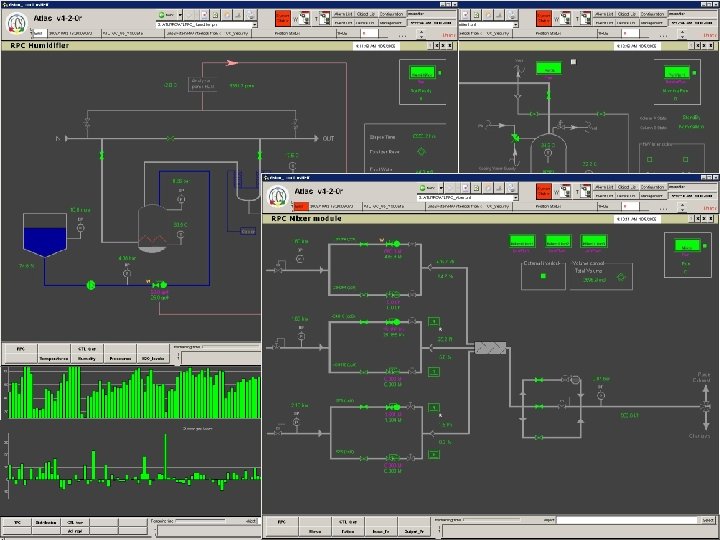
Gas system: the monitor 14 -10 -2009 Riccardo de Asmundis 6

Example of an analytical Report Gas quality: the analysis station �Gas Chromatographic station • Fresh gas mixture used as reference • Calibration by external standard • Air contamination within 0. 1 % due to small loss in the system • Ready for studies once the beam (and irradiation) are ON ◦ GC Perkin-Elmer Clarus 500 ◦ Two analytical columns for deep air separation (N 2 -O 2) ◦ Multi-port valve to select the sample (all significant points) ◦ PC controlled ◦ Continuously running 14 -10 -2009 Riccardo de Asmundis 7
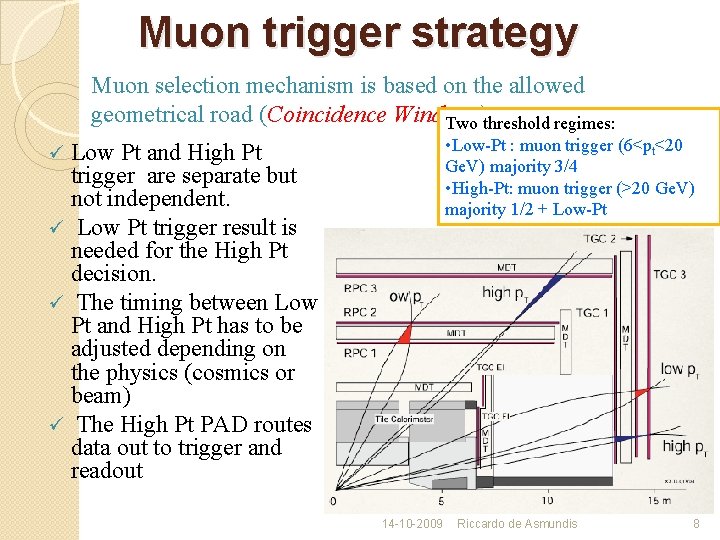
Muon trigger strategy Muon selection mechanism is based on the allowed geometrical road (Coincidence Windows) Two threshold regimes: • Low-Pt : muon trigger (6<pt<20 Ge. V) majority 3/4 • High-Pt: muon trigger (>20 Ge. V) majority 1/2 + Low-Pt Low Pt and High Pt trigger are separate but not independent. ü Low Pt trigger result is needed for the High Pt decision. ü The timing between Low Pt and High Pt has to be adjusted depending on the physics (cosmics or beam) ü The High Pt PAD routes data out to trigger and readout ü 14 -10 -2009 Riccardo de Asmundis 8
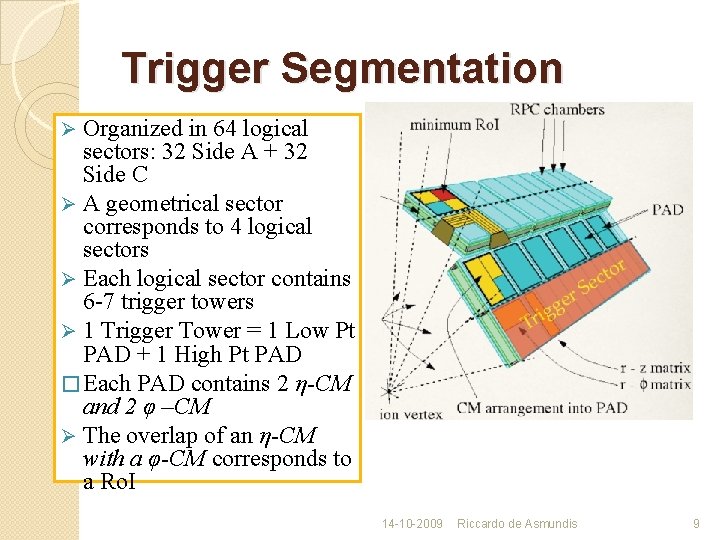
Trigger Segmentation Organized in 64 logical sectors: 32 Side A + 32 Side C Ø A geometrical sector corresponds to 4 logical sectors Ø Each logical sector contains 6 -7 trigger towers Ø 1 Trigger Tower = 1 Low Pt PAD + 1 High Pt PAD � Each PAD contains 2 η-CM and 2 φ –CM Ø The overlap of an η-CM with a φ-CM corresponds to a Ro. I Ø 14 -10 -2009 Riccardo de Asmundis 9
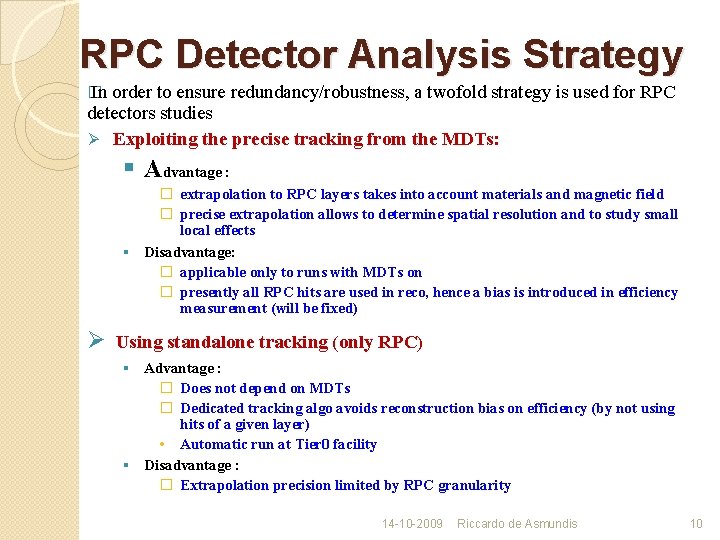
RPC Detector Analysis Strategy � In order to ensure redundancy/robustness, a twofold strategy is used for RPC detectors studies Ø Exploiting the precise tracking from the MDTs: § Advantage : � extrapolation to RPC layers takes into account materials and magnetic field � precise extrapolation allows to determine spatial resolution and to study small local effects § Disadvantage: � applicable only to runs with MDTs on � presently all RPC hits are used in reco, hence a bias is introduced in efficiency measurement (will be fixed) Ø Using standalone tracking (only RPC) § Advantage : � Does not depend on MDTs � Dedicated tracking algo avoids reconstruction bias on efficiency (by not using hits of a given layer) • Automatic run at Tier 0 facility § Disadvantage : � Extrapolation precision limited by RPC granularity 14 -10 -2009 Riccardo de Asmundis 10
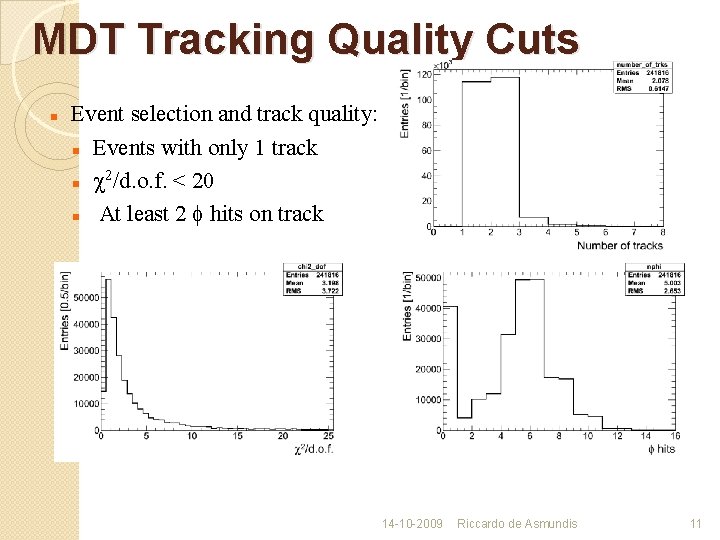
MDT Tracking Quality Cuts Event selection and track quality: Events with only 1 track 2 c /d. o. f. < 20 At least 2 f hits on track 14 -10 -2009 Riccardo de Asmundis 11
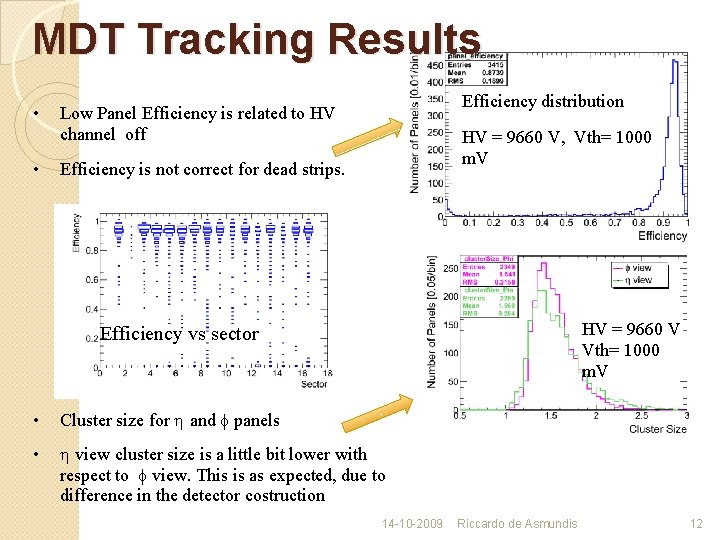
MDT Tracking Results • • Efficiency distribution Low Panel Efficiency is related to HV channel off HV = 9660 V, Vth= 1000 m. V Efficiency is not correct for dead strips. HV = 9660 V Vth= 1000 m. V Efficiency vs sector • Cluster size for h and f panels • h view cluster size is a little bit lower with respect to f view. This is as expected, due to difference in the detector costruction 14 -10 -2009 Riccardo de Asmundis 12
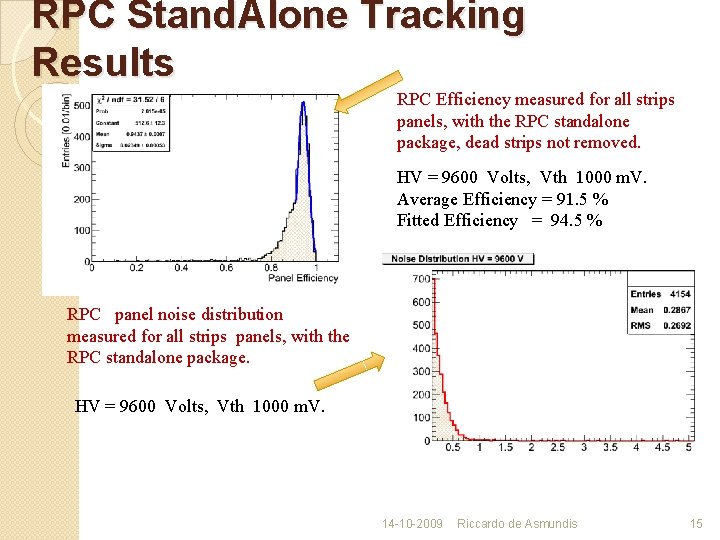
RPC Stand. Alone Tracking Results RPC Efficiency measured for all strips panels, with the RPC standalone package, dead strips not removed. HV = 9600 Volts, Vth 1000 m. V. Average Efficiency = 91. 5 % Fitted Efficiency = 94. 5 % RPC panel noise distribution measured for all strips panels, with the RPC standalone package. HV = 9600 Volts, Vth 1000 m. V. 14 -10 -2009 Riccardo de Asmundis 15
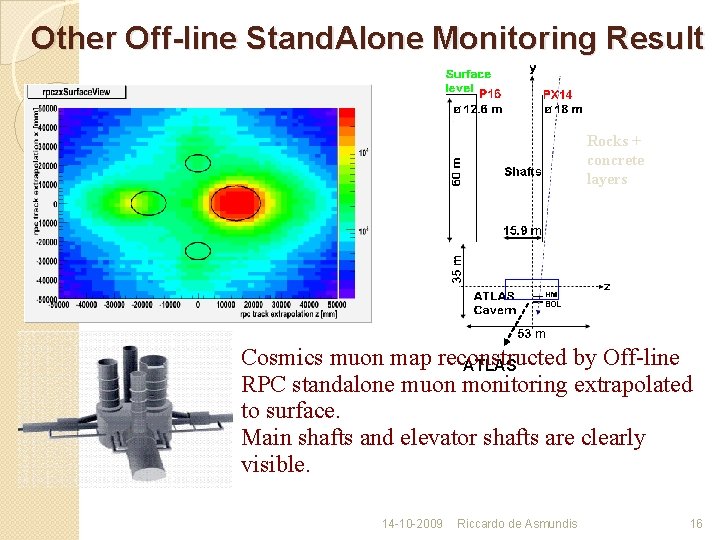
Other Off-line Stand. Alone Monitoring Result Rocks + concrete layers Cosmics muon map reconstructed by Off-line ATLAS RPC standalone muon monitoring extrapolated to surface. Main shafts and elevator shafts are clearly visible. 14 -10 -2009 Riccardo de Asmundis 16
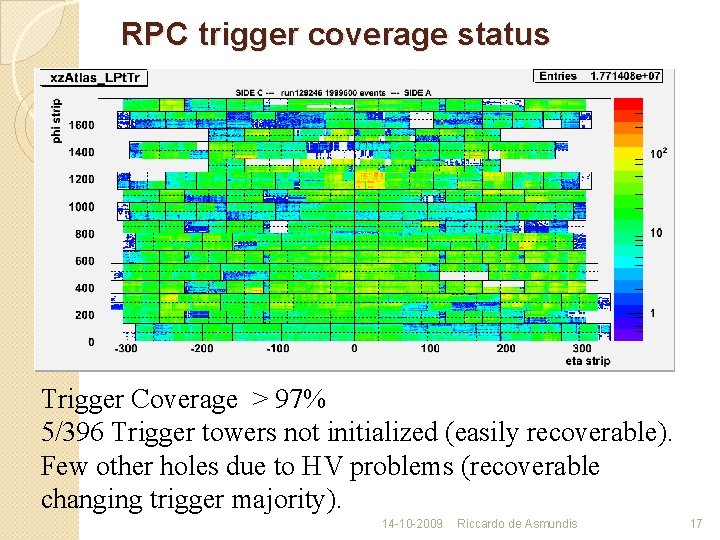
RPC trigger coverage status Trigger Coverage > 97% 5/396 Trigger towers not initialized (easily recoverable). Few other holes due to HV problems (recoverable changing trigger majority). 14 -10 -2009 Riccardo de Asmundis 17
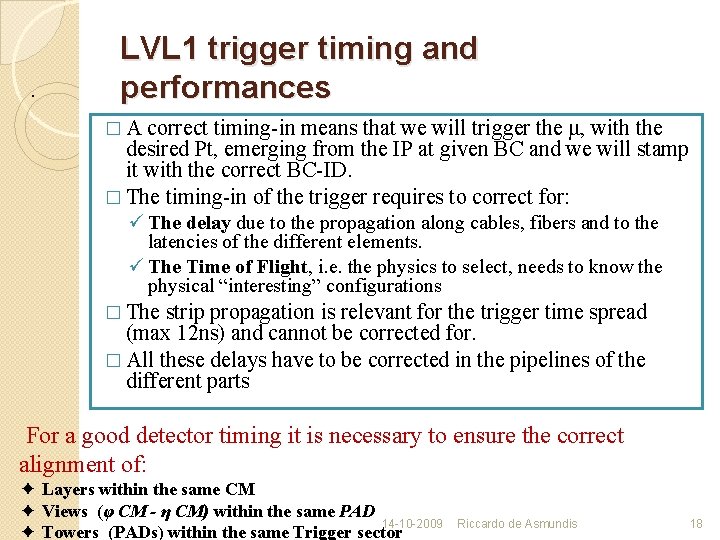
. LVL 1 trigger timing and performances �A correct timing-in means that we will trigger the μ, with the desired Pt, emerging from the IP at given BC and we will stamp it with the correct BC-ID. � The timing-in of the trigger requires to correct for: ü The delay due to the propagation along cables, fibers and to the latencies of the different elements. ü The Time of Flight, i. e. the physics to select, needs to know the physical “interesting” configurations � The strip propagation is relevant for the trigger time spread (max 12 ns) and cannot be corrected for. � All these delays have to be corrected in the pipelines of the different parts For a good detector timing it is necessary to ensure the correct alignment of: ✦ Layers within the same CM ✦ Views (φ CM - η CM) within the same PAD 14 -10 -2009 ✦ Towers (PADs) within the same Trigger sector Riccardo de Asmundis 18
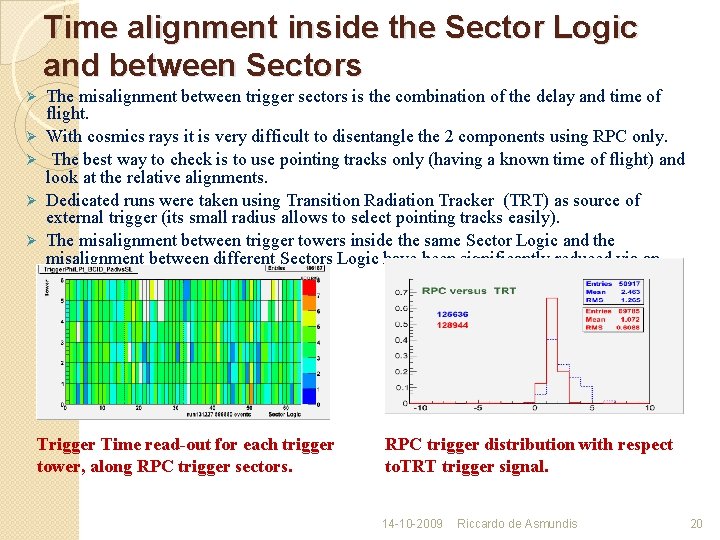
Time alignment inside the Sector Logic and between Sectors Ø Ø Ø The misalignment between trigger sectors is the combination of the delay and time of flight. With cosmics rays it is very difficult to disentangle the 2 components using RPC only. The best way to check is to use pointing tracks only (having a known time of flight) and look at the relative alignments. Dedicated runs were taken using Transition Radiation Tracker (TRT) as source of external trigger (its small radius allows to select pointing tracks easily). The misalignment between trigger towers inside the same Sector Logic and the misalignment between different Sectors Logic have been significantly reduced via an iterative procedure. Trigger Time read-out for each trigger tower, along RPC trigger sectors. RPC trigger distribution with respect to. TRT trigger signal. 14 -10 -2009 Riccardo de Asmundis 20
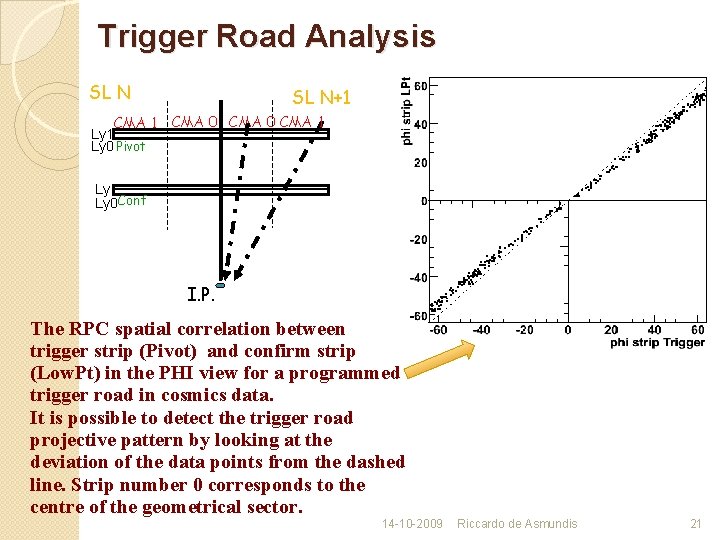
Trigger Road Analysis SL N+1 CMA 0 CMA 1 Ly 0 Pivot Ly 1 Ly 0 Conf I. P. The RPC spatial correlation between trigger strip (Pivot) and confirm strip (Low. Pt) in the PHI view for a programmed trigger road in cosmics data. It is possible to detect the trigger road projective pattern by looking at the deviation of the data points from the dashed line. Strip number 0 corresponds to the centre of the geometrical sector. 14 -10 -2009 Riccardo de Asmundis 21
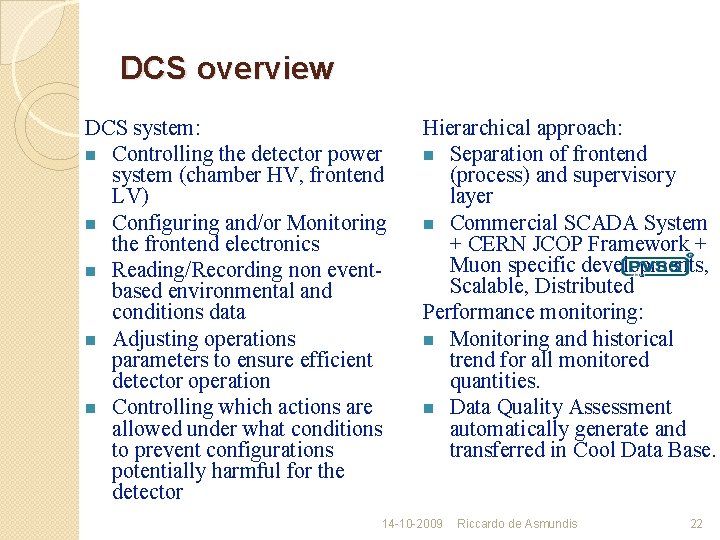
DCS overview DCS system: Controlling the detector power system (chamber HV, frontend LV) Configuring and/or Monitoring the frontend electronics Reading/Recording non eventbased environmental and conditions data Adjusting operations parameters to ensure efficient detector operation Controlling which actions are allowed under what conditions to prevent configurations potentially harmful for the detector Hierarchical approach: Separation of frontend (process) and supervisory layer Commercial SCADA System + CERN JCOP Framework + Muon specific developments, Scalable, Distributed Performance monitoring: Monitoring and historical trend for all monitored quantities. Data Quality Assessment automatically generate and transferred in Cool Data Base. 14 -10 -2009 Riccardo de Asmundis 22
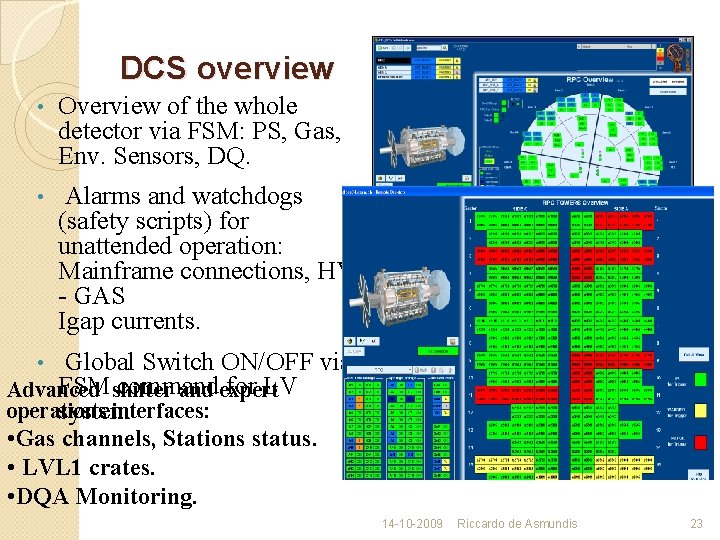
DCS overview • Overview of the whole detector via FSM: PS, Gas, Env. Sensors, DQ. • Alarms and watchdogs (safety scripts) for unattended operation: Mainframe connections, HV - GAS Igap currents. • Global Switch ON/OFF FSM shifter command for LV Advanced and expert operations interfaces: system via • Gas channels, Stations status. • LVL 1 crates. • DQA Monitoring. 14 -10 -2009 Riccardo de Asmundis 23
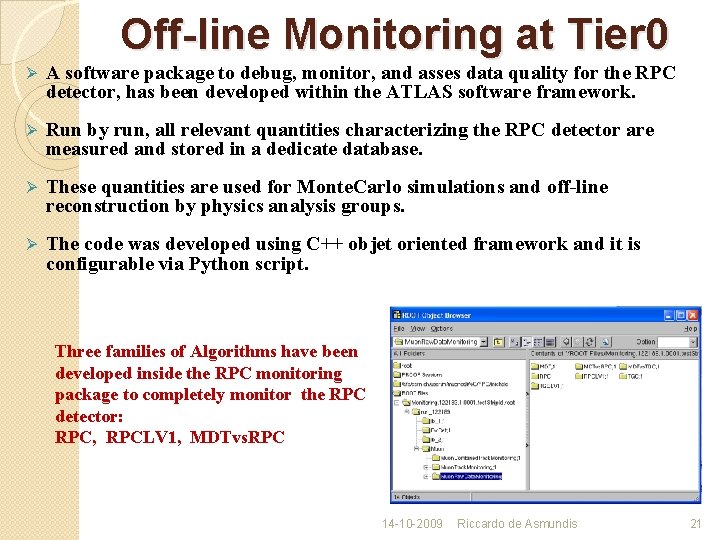
Off-line Monitoring at Tier 0 Ø A software package to debug, monitor, and asses data quality for the RPC detector, has been developed within the ATLAS software framework. Ø Run by run, all relevant quantities characterizing the RPC detector are measured and stored in a dedicate database. Ø These quantities are used for Monte. Carlo simulations and off-line reconstruction by physics analysis groups. Ø The code was developed using C++ objet oriented framework and it is configurable via Python script. Three families of Algorithms have been developed inside the RPC monitoring package to completely monitor the RPC detector: RPC, RPCLV 1, MDTvs. RPC 14 -10 -2009 Riccardo de Asmundis 21
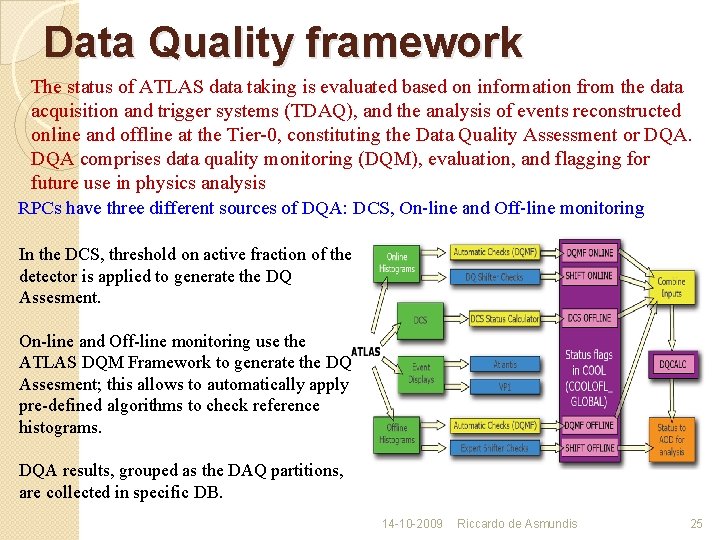
Data Quality framework The status of ATLAS data taking is evaluated based on information from the data acquisition and trigger systems (TDAQ), and the analysis of events reconstructed online and offline at the Tier-0, constituting the Data Quality Assessment or DQA comprises data quality monitoring (DQM), evaluation, and flagging for future use in physics analysis RPCs have three different sources of DQA: DCS, On-line and Off-line monitoring In the DCS, threshold on active fraction of the detector is applied to generate the DQ Assesment. On-line and Off-line monitoring use the ATLAS DQM Framework to generate the DQ Assesment; this allows to automatically apply pre-defined algorithms to check reference histograms. DQA results, grouped as the DAQ partitions, are collected in specific DB. 14 -10 -2009 Riccardo de Asmundis 25
Conclusions § § § RPC detectors have been installed and commissioned since long time. A constant activity is in act to keep track and maintain the reliability of the detectors. Long time Cosmic Data Taking allowed to perform a complete detector characterization. Two different Off-line strategies of performance analysis has been developed to assure a complete characterization. Offline RPC monitoring is fully integrated in the ATLAS Software Framework, and the Data. Quality Offline is totally based on RPC off-line monitoring performed at Tier 0 level. Detector behavior during the runs is fully monitored via DCS system. 14 -10 -2009 Riccardo de Asmundis 26
- Slides: 23