
Operations and Maintenance Planning Your name and contact
- Slides: 47
Operations and Maintenance Planning Your name and contact info
Acknowledgement: n EPA National Priority Area 1: Training and Technical Assistance for Small Public Water Systems to Achieve and Maintain Compliance with the SDWA, EPA Grant – X 6 -83560701
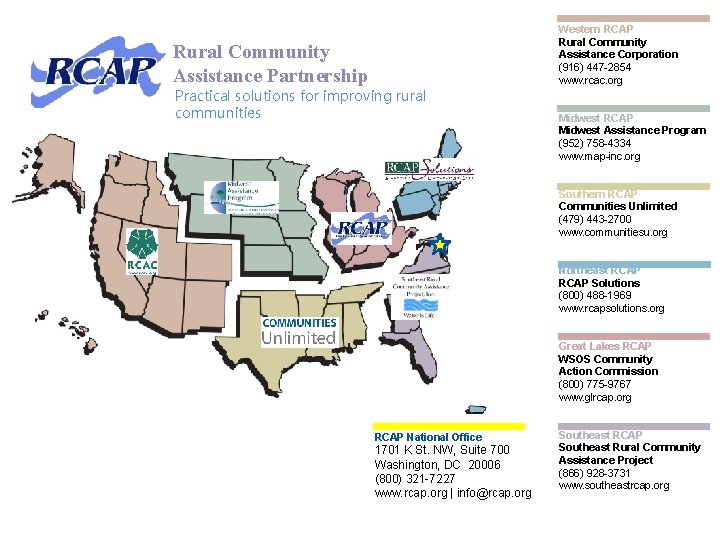
Western RCAP Rural Community Assistance Corporation (916) 447 -2854 www. rcac. org Rural Community Assistance Partnership Practical solutions for improving rural communities Midwest RCAP Midwest Assistance Program (952) 758 -4334 www. map-inc. org Southern RCAP Communities Unlimited (479) 443 -2700 www. communitiesu. org Northeast RCAP Solutions (800) 488 -1969 www. rcapsolutions. org Great Lakes RCAP WSOS Community Action Commission (800) 775 -9767 www. glrcap. org RCAP National Office 1701 K St. NW, Suite 700 Washington, DC 20006 (800) 321 -7227 www. rcap. org | info@rcap. org Southeast RCAP Southeast Rural Community Assistance Project (866) 928 -3731 www. southeastrcap. org
Why develop an O&M plan? Scenario 1 - You go on vacation (you don’t have a cell phone), the chlorinator goes down …
n Scenario 2 – You measure chlorine residual, and something seems off. . .
n Scenario 3 – You have a main break and go to shut off a valve, but can’t operate the valve
Why do you need an O&M plan? n Knowledge retention –information documented n Consistency – Procedures are done the same way and repeatable n Data and records – Information for diagnosing and trouble shooting n Sustainability – Short and long term activities to maintain your facility
Required? n O+M plans are required by some states n Delegation of tasks – Operating procedures are needed before you can delegate a task n Sanitary surveys often looks for an operating procedure (minor deficiency)
Questions n Is an O&M plan required for your facility? n Do you have an O&M Plan? ¨ Was your O+M plan developed by your staff or an outside consultant? ¨ When was the last time the O+M plan revised?
What’s the difference between Operations, maintenance, repair n Operations – Running the system n Maintenance – Keeping the system in working conditions n Repair (major/minor) – Fixing when its broken
What gets done? n When you are time limited, what gets done? ¨ Routine ¨ Repair operations (major/minor) ¨ Preventative maintenance
Operational modes n Routine ¨ Daily, weekly, monthly, quarterly, annually tasks n Preventative maintenance n Seasonal (or other significant demand changes) n Emergency
So what should go into an O&M plan? * Requirements vary by state, so be sure to identify your state requirements
So what should go into an O&M plan? 1. 2. 3. 4. General system overview Contact Lists Process descriptions (source, treatment, distribution) Operations
Other components that can be include or stand-alone n n n Emergency response plans Monitoring plan Communications plan Safety plan Asset management plan * Check with your primacy agency
Overview of plan components
1. General system information n n n System Name PWSID # Location/ Address Date Prepared Date to be updated Owner (contact info) Operator in Responsible Charge n n n System type (CWS, NTNC, TNC) Population Served Production Volume ¨ Average ¨ Peak capacity ¨ Minimum flow
2. Contact lists n n Utility Contacts Regulatory Emergency Vendors and supplies
3. Process descriptions n Develop a high level description of your facility ¨ Source, n Treatment, Distribution, Storage Have system/ process maps
Sources n Identify all sources n Location n ID# n Gage level/ Critical level n Characteristics
Treatment n Identify processes and develop a process flow diagram.
Treatment process documentation ¨ Equipment ¨ Corrective ¨ Start-up maintenance ¨ Spare parts ¨ Monitoring/ process control ¨ Record keeping ¨ Normal operation ¨ Shut-down ¨ Preventive maintenance
Distribution n Map of the distribution system ¨ Entry point ¨ Sampling sites Description of key components ¨ Pipe diameter, materials ¨ Valves, hydrants, booster stations, PRVs ¨ Critical facilities Preventative maintenance
Storage n Identify all storage facilities n Inspection frequency and checklists n Critical levels
Activity n Select one area (source, treatment, distribution, storage) n Draw the area and select one process n Describe how you operate this process ¨ Start-up/ shut down ¨ Monitor how it works ¨ Routine, long-term maintenance
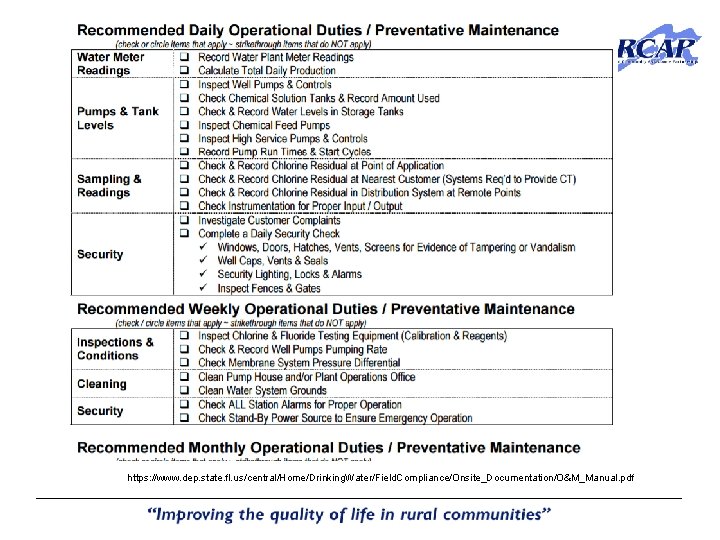
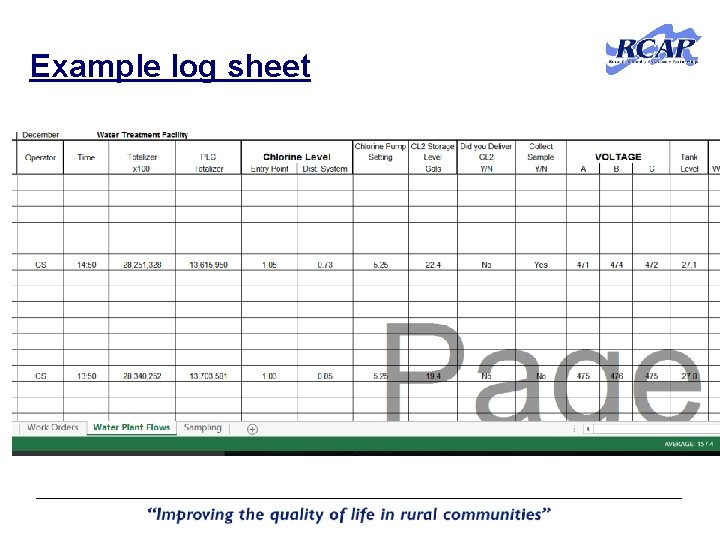
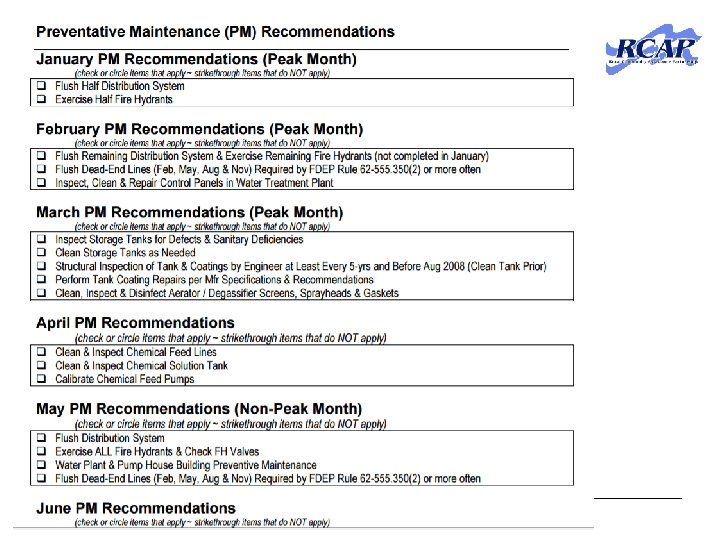
4. Operations of key processes n Operator rounds ¨ Operations logs/ checklists ¨ Daily, weekly, monthly, quarterly, annually n Preventative maintenance logs n Standard operating procedures (SOPs)
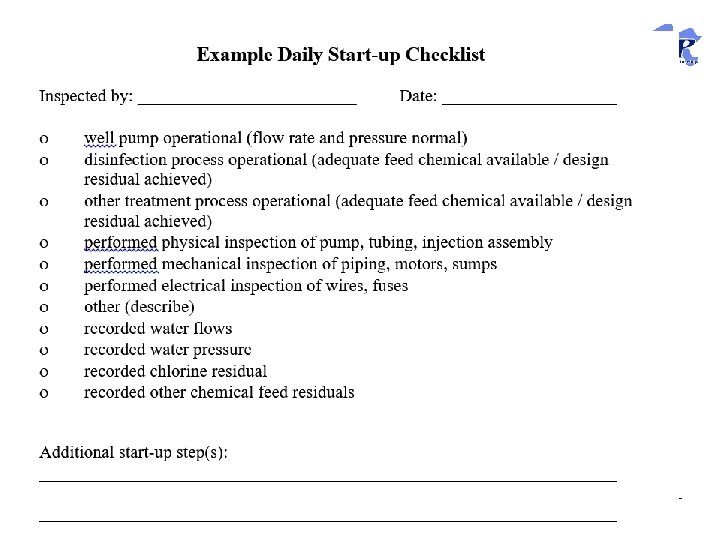
Develop a checklist or tool that works for you
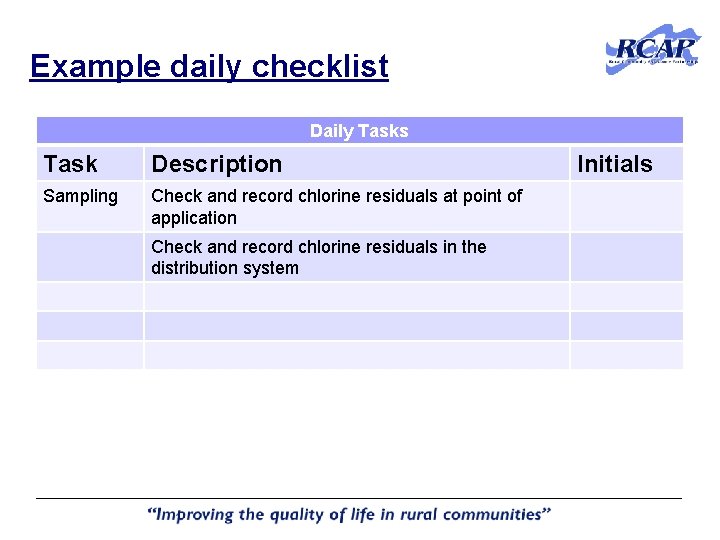
Example daily checklist Daily Tasks Task Description Sampling Check and record chlorine residuals at point of application Check and record chlorine residuals in the distribution system Initials
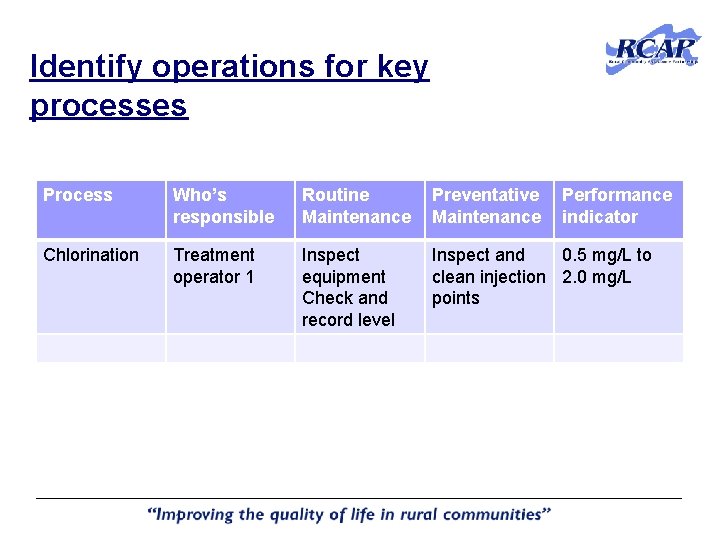
Identify operations for key processes Process Who’s responsible Routine Maintenance Preventative Maintenance Performance indicator Chlorination Treatment operator 1 Inspect equipment Check and record level Inspect and 0. 5 mg/L to clean injection 2. 0 mg/L points
https: //www. dep. state. fl. us/central/Home/Drinking. Water/Field. Compliance/Onsite_Documentation/O&M_Manual. pdf
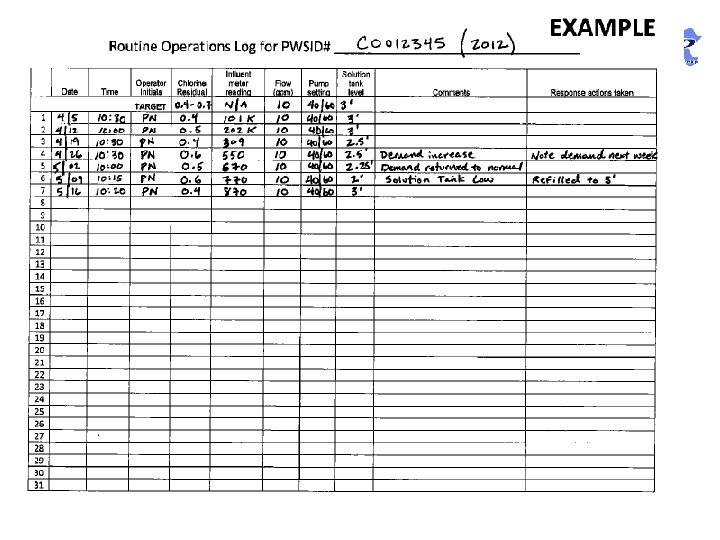
Example log sheet
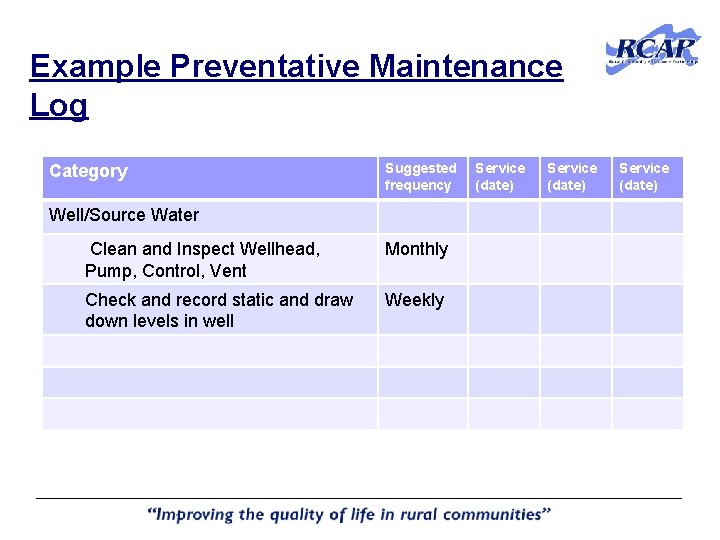
Example Preventative Maintenance Log Category Suggested frequency Well/Source Water Clean and Inspect Wellhead, Pump, Control, Vent Monthly Check and record static and draw down levels in well Weekly Service (date)
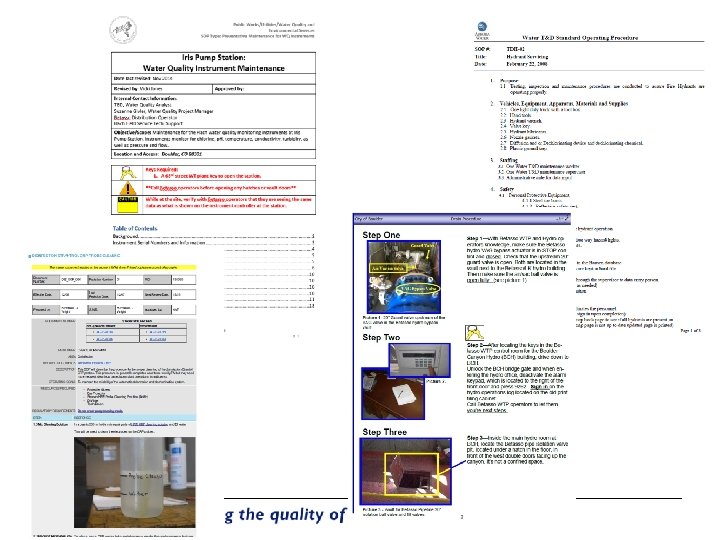
Standard operating procedures
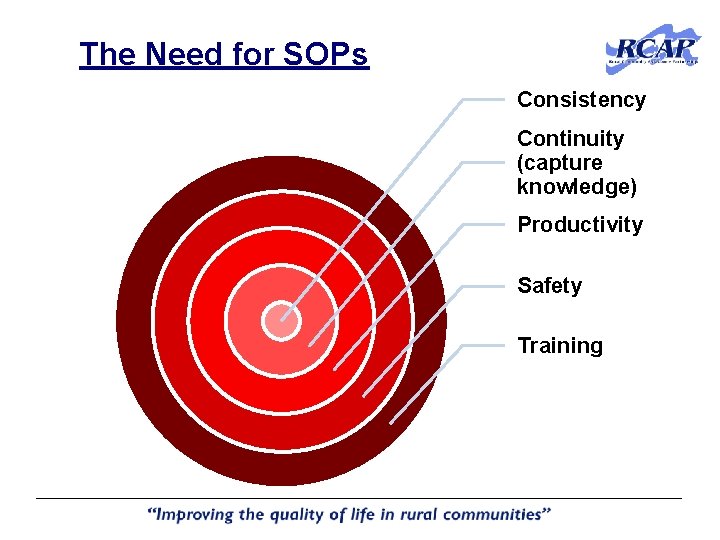
The Need for SOPs Consistency Continuity (capture knowledge) Productivity Safety Training
What SOPs are needed n Tasks that are performed routinely (Save time, money) n Tasks that are performed by more than one operator (consistency) n By one person (knowledge retention)
n Tasks that are performed infrequently (Don’t forget how to do an annual tasks) n Critical/ high consequence tasks (safety, protect public health)
1. SOP Templates n Required information n Sometimes required n Nice to have n Don’t include n Innovative formats?
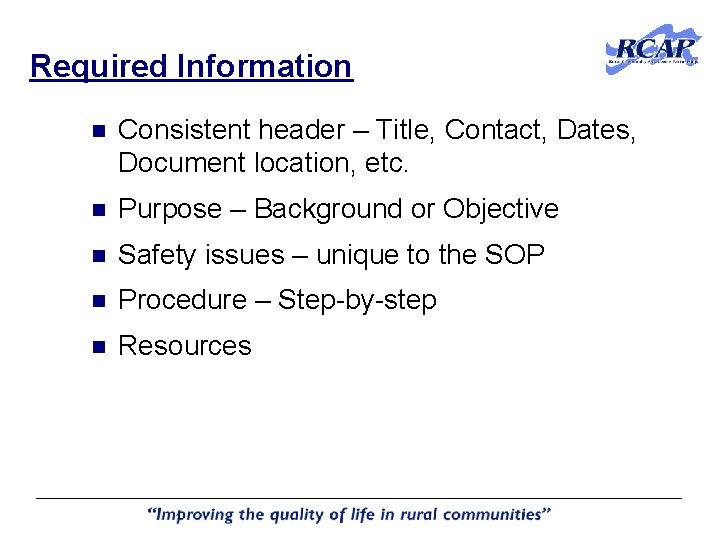
Required Information n Consistent header – Title, Contact, Dates, Document location, etc. n Purpose – Background or Objective n Safety issues – unique to the SOP n Procedure – Step-by-step n Resources
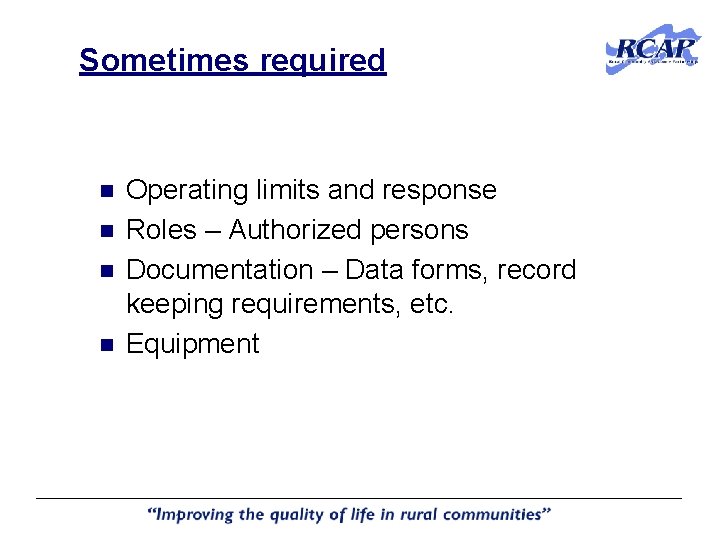
Sometimes required n n Operating limits and response Roles – Authorized persons Documentation – Data forms, record keeping requirements, etc. Equipment
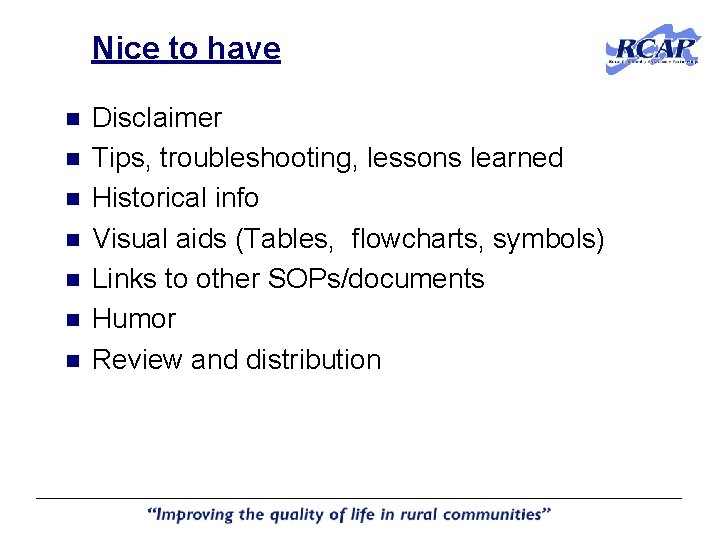
Nice to have n n n n Disclaimer Tips, troubleshooting, lessons learned Historical info Visual aids (Tables, flowcharts, symbols) Links to other SOPs/documents Humor Review and distribution
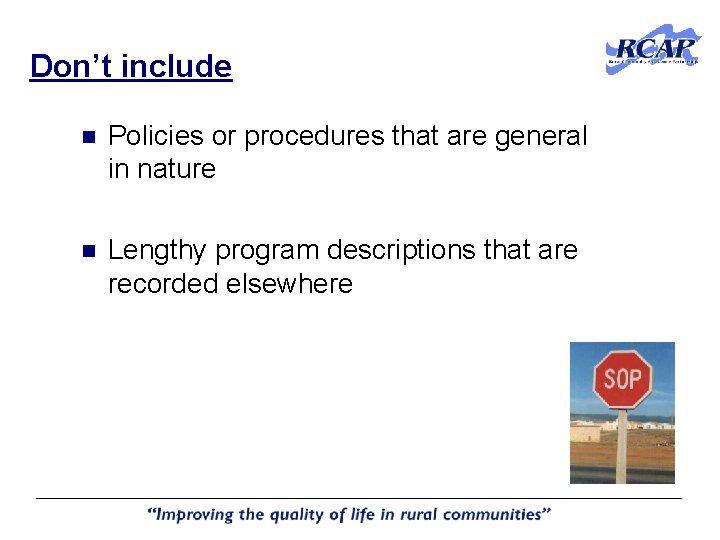
Don’t include n Policies or procedures that are general in nature n Lengthy program descriptions that are recorded elsewhere
Other components that can be included in your O&M plan or stand-alone
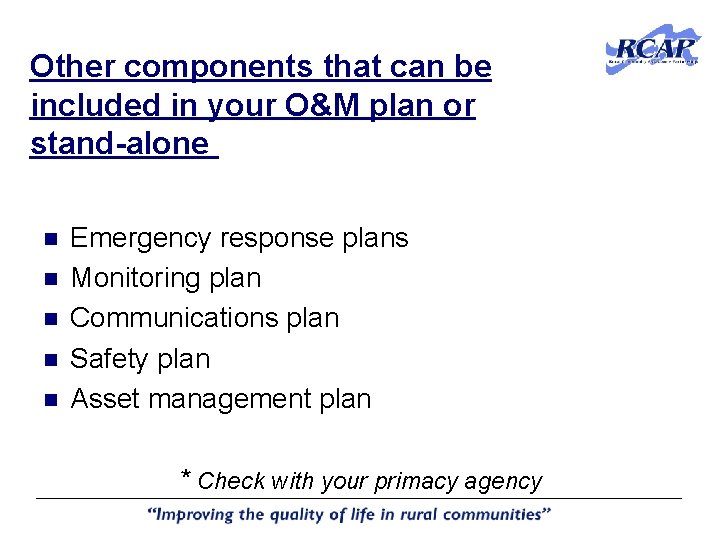
Other components that can be included in your O&M plan or stand-alone n n n Emergency response plans Monitoring plan Communications plan Safety plan Asset management plan * Check with your primacy agency