
Operations analysis Location analysis Subjective Evaluation Operations Analysis
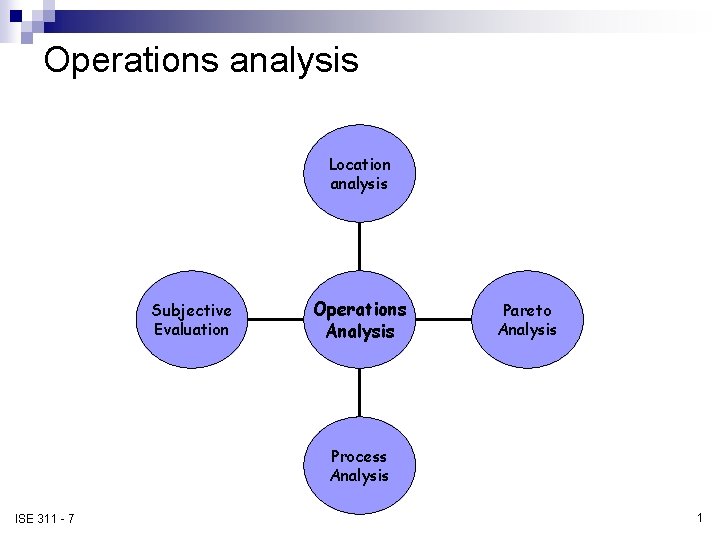
Operations analysis Location analysis Subjective Evaluation Operations Analysis Pareto Analysis Process Analysis ISE 311 - 7 1

Location analysis n Location of One Item ¨ Example: Locating printer, scanner, & copier station in a department. B 2 1 4 3 5 A n Systematic Layout of Multiple Items ¨ ISE 311 - 7 See pp. 90 -93 2
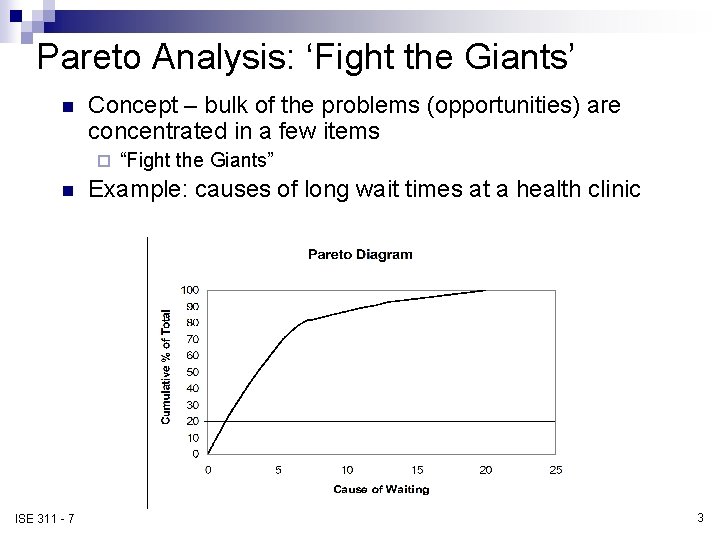
Pareto Analysis: ‘Fight the Giants’ n Concept – bulk of the problems (opportunities) are concentrated in a few items ¨ n ISE 311 - 7 “Fight the Giants” Example: causes of long wait times at a health clinic 3
Process analysis n n Overview of the process Identify opportunities for improvement Useful communication tool Major types ¨ Process n n n chart single object / person (Ergo) assembly process multi-activity chart (Ergo) ¨ Flow diagram (Ergo, Visio) ¨ Fish (Ishikawa) diagram (Visio) ¨ Decision structure table ISE 311 - 7 4
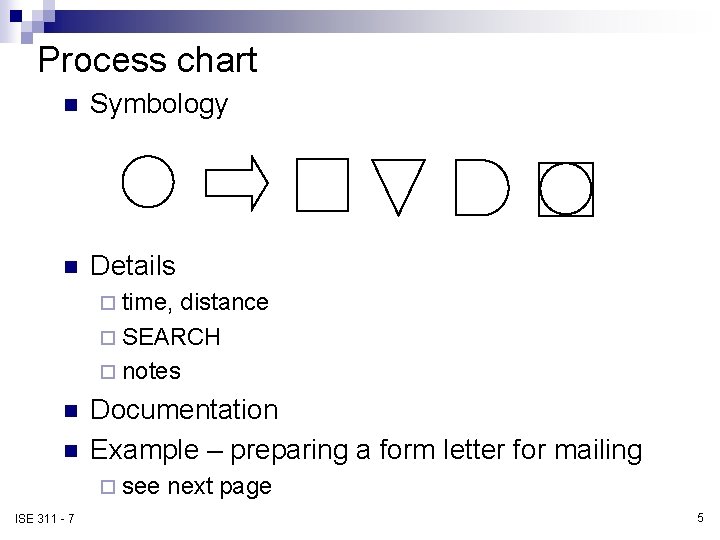
Process chart n Symbology n Details ¨ time, distance ¨ SEARCH ¨ notes n n Documentation Example – preparing a form letter for mailing ¨ see ISE 311 - 7 next page 5

In Ergo … ISE 311 - 7 6
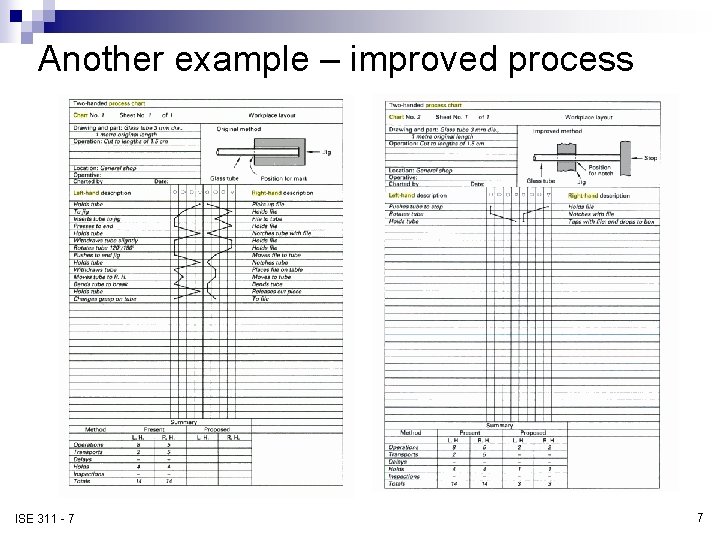
Another example – improved process ISE 311 - 7 7
Flow diagram n n ISE 311 - 7 Usually combined with process chart to visualize physical space. Example: Preparation and gathering for a design team meeting. (See next page. ) 8

ISE 311 - 7 9
Other process charts n Assembly process charts show relationships among components, how several processes interact ¨ useful for methods analysis ¨ identify delays, storage problems ¨ example, pg. 97 ¨ n Multi-activity chart ‘gang chart’, ‘man-machine’ chart, ‘left-hand right hand’ chart ¨ common, scaled time axis n n identify idle time, unbalanced operations opportunities for ¨ ¨ ISE 311 - 7 job sharing double tooling kitting examples, pg. 99 10

Fish diagrams n n aka, Ishikawa diagram, Cause & Effect diagram Useful for brainstorming, identify opportunities to improve ‘Head’ of the fish is the problem or desired effect ‘Skeleton’ identifies potential causes ¨ 4 M’s – manpower, machines, methods, materials ¨ 4 P’s – policies, procedures, people, plant ISE 311 - 7 11

Example n ISE 311 - 7 Improve design team meeting productivity 12

Subjective evaluation n Borg Vote – Rating of Perceived Exertion (RPE) ¨ multiply ISE 311 - 7 by 10 to estimate heart rate. 6 7 8 9 10 Very, very light 11 12 13 Fairly light 14 15 16 17 18 19 20 Hard Very light Somewhat hard Very hard How you feel when lying in bed or sitting in a chair relaxed. Little or no effort. Target range: How you should feel with exercise or activity How you felt with the hardest work you have ever done. Very, very hard Don't work this hard! 13

Subjective evaluation n Body discomfort map ¨ Body ISE 311 - 7 portions 14
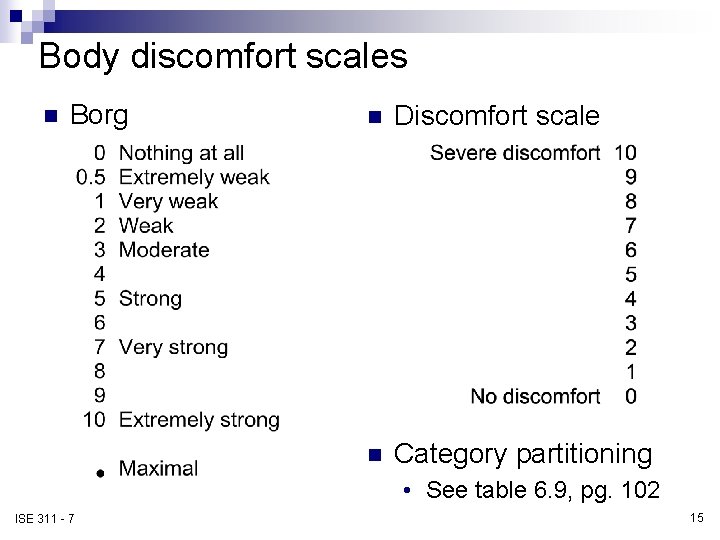
Body discomfort scales n Borg n Discomfort scale n Category partitioning • See table 6. 9, pg. 102 ISE 311 - 7 15
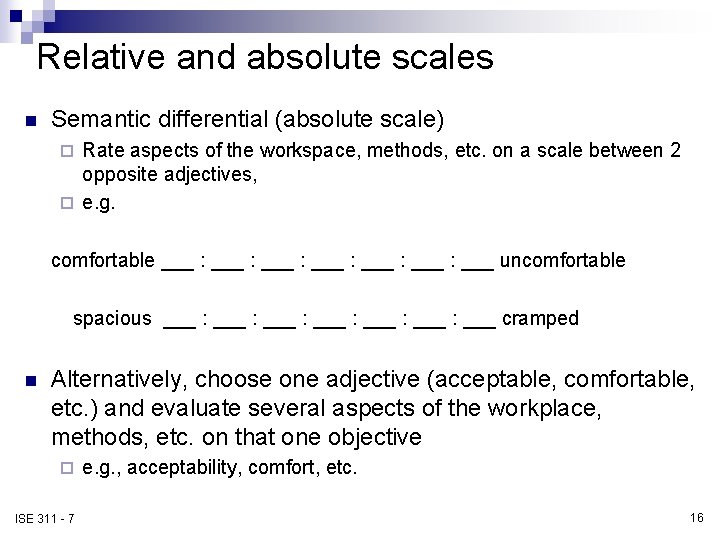
Relative and absolute scales n Semantic differential (absolute scale) Rate aspects of the workspace, methods, etc. on a scale between 2 opposite adjectives, ¨ e. g. ¨ comfortable ___ : ___ : ___ uncomfortable spacious ___ : ___ : ___ cramped n Alternatively, choose one adjective (acceptable, comfortable, etc. ) and evaluate several aspects of the workplace, methods, etc. on that one objective ¨ ISE 311 - 7 e. g. , acceptability, comfort, etc. 16
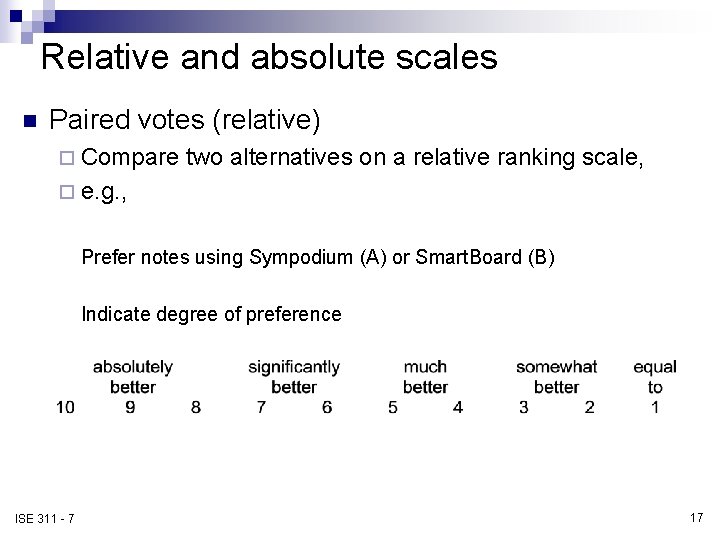
Relative and absolute scales n Paired votes (relative) ¨ Compare two alternatives on a relative ranking scale, ¨ e. g. , Prefer notes using Sympodium (A) or Smart. Board (B) Indicate degree of preference ISE 311 - 7 17
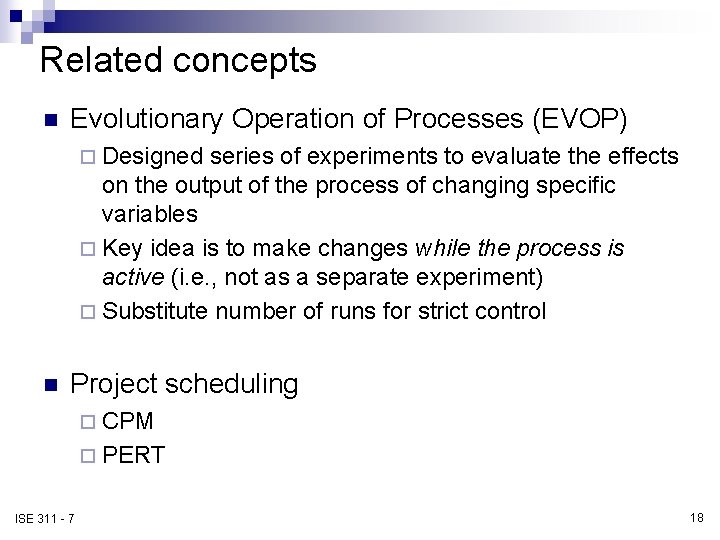
Related concepts n Evolutionary Operation of Processes (EVOP) ¨ Designed series of experiments to evaluate the effects on the output of the process of changing specific variables ¨ Key idea is to make changes while the process is active (i. e. , not as a separate experiment) ¨ Substitute number of runs for strict control n Project scheduling ¨ CPM ¨ PERT ISE 311 - 7 18
- Slides: 18