
Operationalizing Demand Forecasts in the Warehouse DAN LI



- Slides: 20
Operationalizing Demand Forecasts in the Warehouse DAN LI AND KD KIM MAY 21, 2015 MASSACHUSETTS INSTITUTE OF TECHNOLOGY (MIT)
Source: Pixgood. com Source: lamag. com Source: NY Times
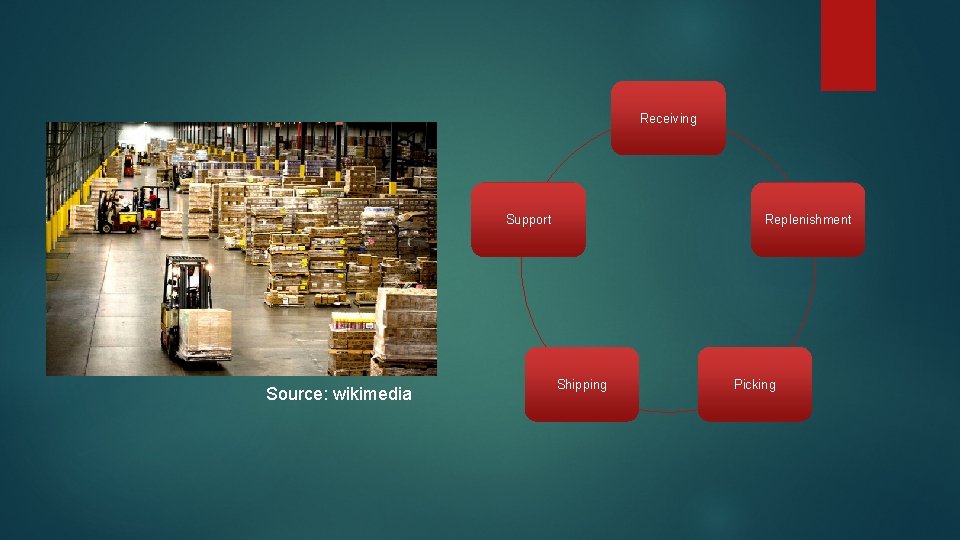
Receiving Support Source: wikimedia Replenishment Shipping Picking
Can we use Demand Forecasts to Predict Warehouse Activities?
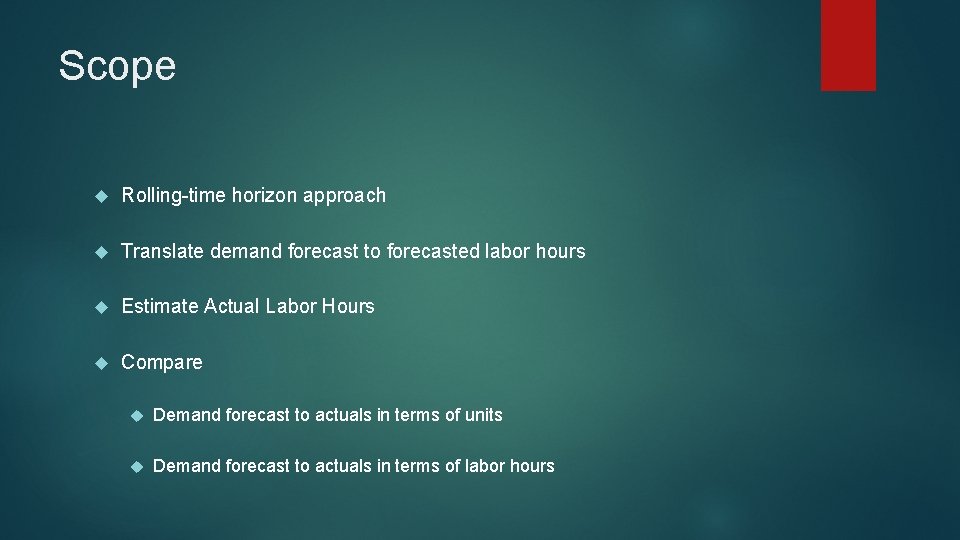
Scope Rolling-time horizon approach Translate demand forecast to forecasted labor hours Estimate Actual Labor Hours Compare Demand forecast to actuals in terms of units Demand forecast to actuals in terms of labor hours
Collected Data Picking Activity – most labor intensive Single DC Laundry (full case) and Allergen Reducers (split case) Three forecast files that each span 20 weeks 7 weeks of actual picking data
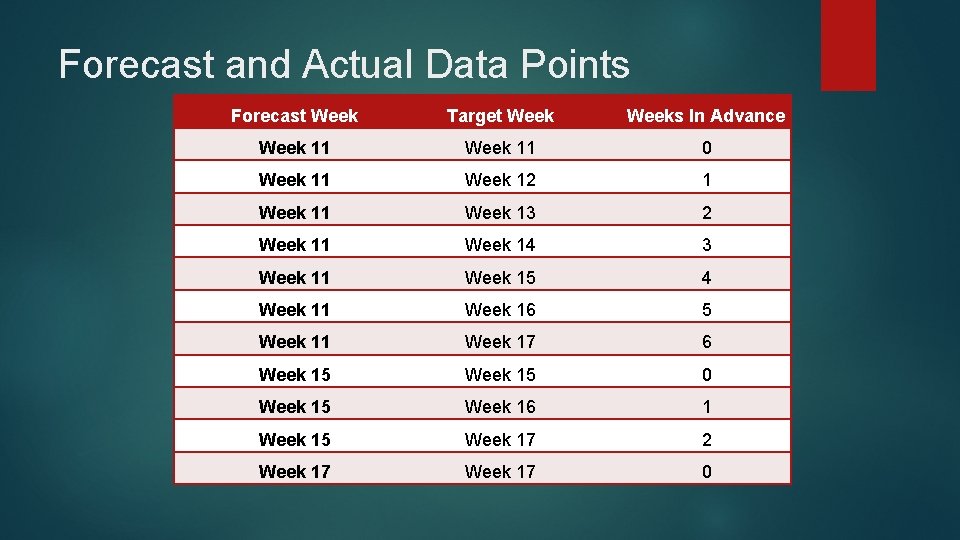
Forecast and Actual Data Points Forecast Week Target Weeks In Advance Week 11 0 Week 11 Week 12 1 Week 13 2 Week 11 Week 14 3 Week 11 Week 15 4 Week 11 Week 16 5 Week 11 Week 17 6 Week 15 0 Week 15 Week 16 1 Week 15 Week 17 2 Week 17 0
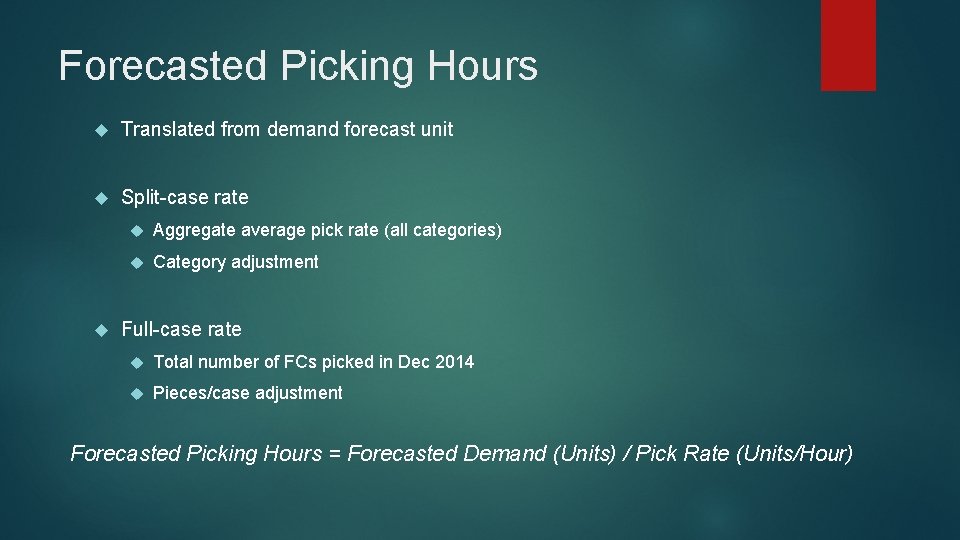
Forecasted Picking Hours Translated from demand forecast unit Split-case rate Aggregate average pick rate (all categories) Category adjustment Full-case rate Total number of FCs picked in Dec 2014 Pieces/case adjustment Forecasted Picking Hours = Forecasted Demand (Units) / Pick Rate (Units/Hour)
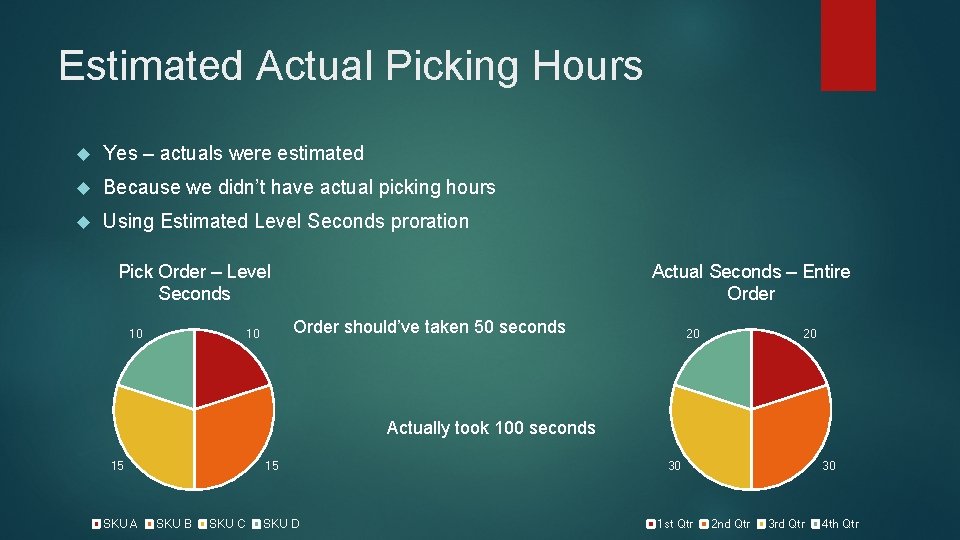
Estimated Actual Picking Hours Yes – actuals were estimated Because we didn’t have actual picking hours Using Estimated Level Seconds proration Pick Order – Level Seconds 10 Actual Seconds – Entire Order should’ve taken 50 seconds 10 20 20 Actually took 100 seconds 15 SKU A 15 SKU B SKU C SKU D 30 1 st Qtr 30 2 nd Qtr 3 rd Qtr 4 th Qtr
Scope Rolling-time horizon approach Translate demand forecast to forecasted labor hours Estimate Actual Labor Hours Compare Demand forecast to actuals in terms of units Demand forecast to actuals in terms of labor hours
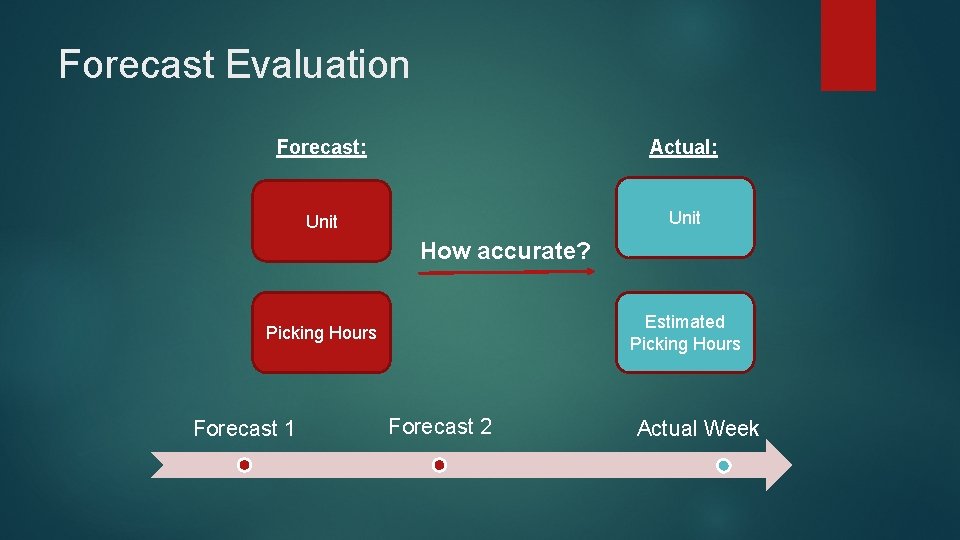
Forecast Evaluation Forecast: Actual: Unit How accurate? Estimated Picking Hours Forecast 1 Forecast 2 Actual Week
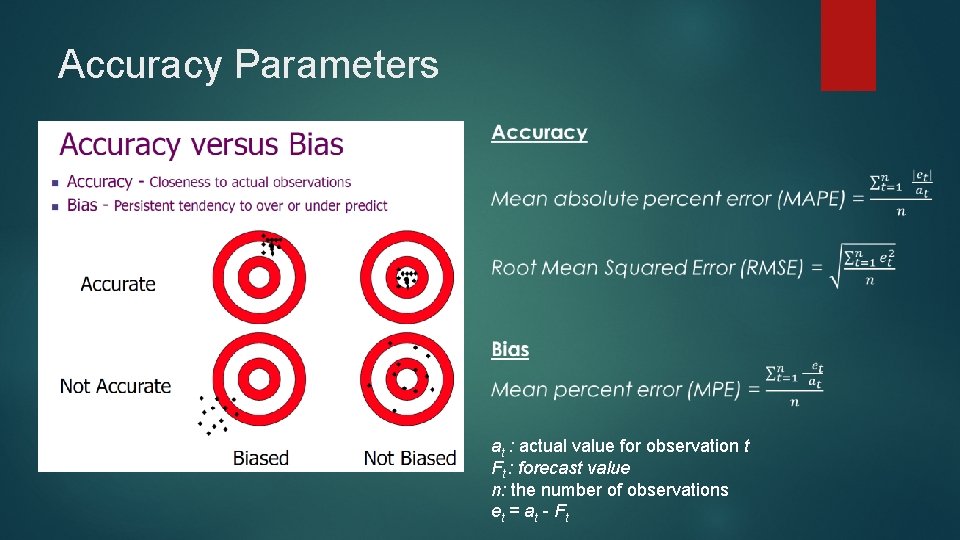
Accuracy Parameters at : actual value for observation t Ft : forecast value n: the number of observations et = at - F t
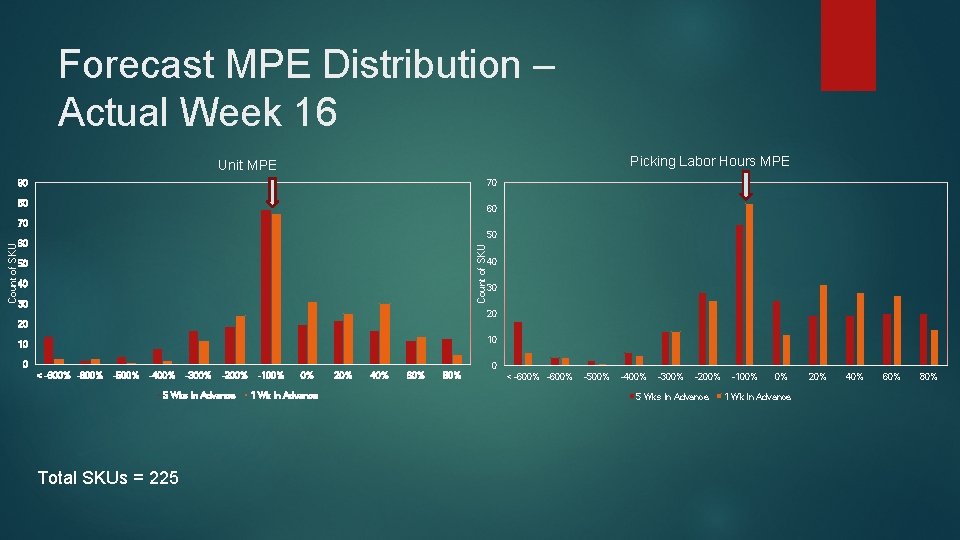
Forecast MPE Distribution – Actual Week 16 Picking Labor Hours MPE Unit MPE 90 70 80 60 50 60 Count of SKU 70 50 40 30 20 20 10 10 0 < -600% -500% -400% -300% -200% 5 Wks In Advance Total SKUs = 225 -100% 0% 1 Wk In Advance 20% 40% 60% 80% 0 < -600% -500% -400% -300% -200% 5 Wks In Advance -100% 0% 1 Wk In Advance 20% 40% 60% 80%
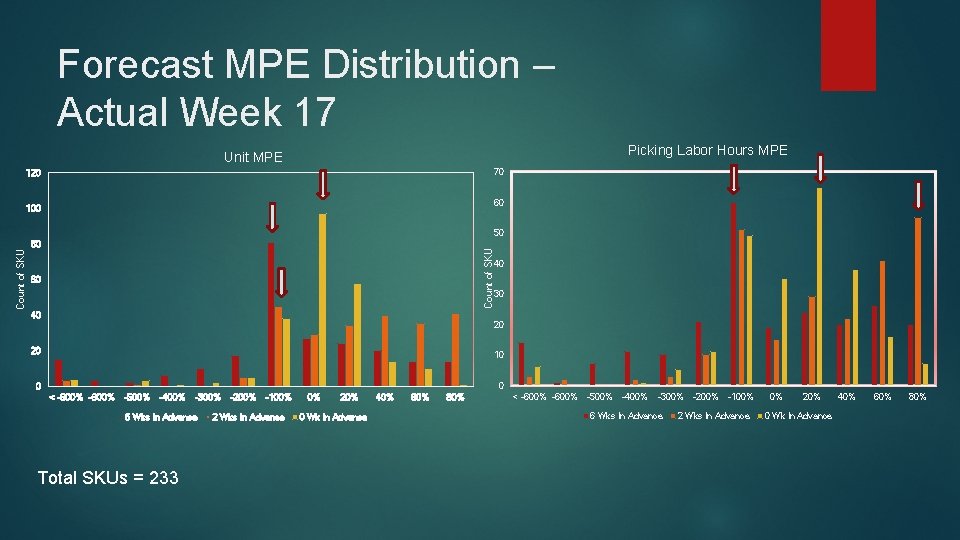
Forecast MPE Distribution – Actual Week 17 Picking Labor Hours MPE Unit MPE 70 120 60 100 Count of SKU 50 80 60 40 40 30 20 20 10 0 0 < -600% -500% -400% -300% 6 Wks In Advance Total SKUs = 233 -200% -100% 2 Wks In Advance 0% 20% 0 Wk In Advance 40% 60% 80% < -600% -500% -400% -300% 6 Wks In Advance -200% -100% 2 Wks In Advance 0% 20% 0 Wk In Advance 40% 60% 80%
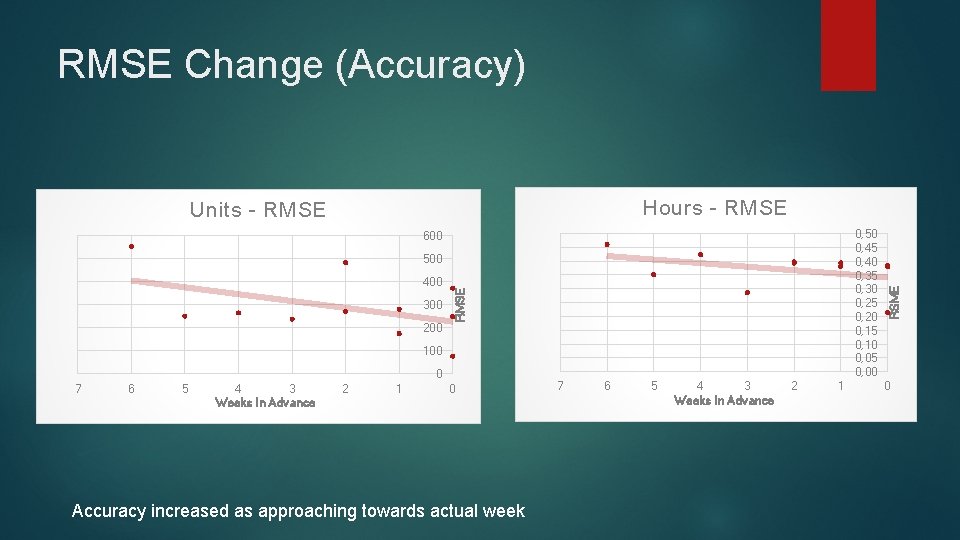
RMSE Change (Accuracy) 0, 50 0, 45 0, 40 0, 35 0, 30 0, 25 0, 20 0, 15 0, 10 0, 05 0, 00 600 400 300 200 RMSE 500 100 0 7 6 5 4 3 Weeks In Advance 2 1 0 Accuracy increased as approaching towards actual week 7 6 5 4 3 Weeks In Advance 2 1 RSME Hours - RMSE Units - RMSE 0
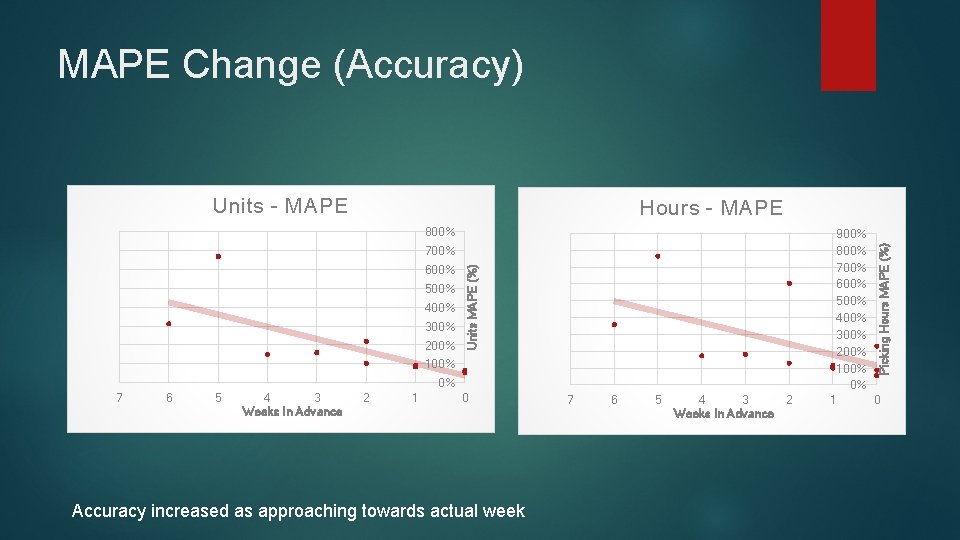
MAPE Change (Accuracy) Units - MAPE Hours - MAPE 500% 400% 300% 200% Units MAPE (%) 700% 600% 100% 0% 7 6 5 4 3 Weeks In Advance 2 1 0 Accuracy increased as approaching towards actual week 900% 800% 700% 600% 500% 400% 300% 200% 100% 0% 1 0 Picking Hours MAPE (%) 800% 7 6 5 4 3 Weeks In Advance 2
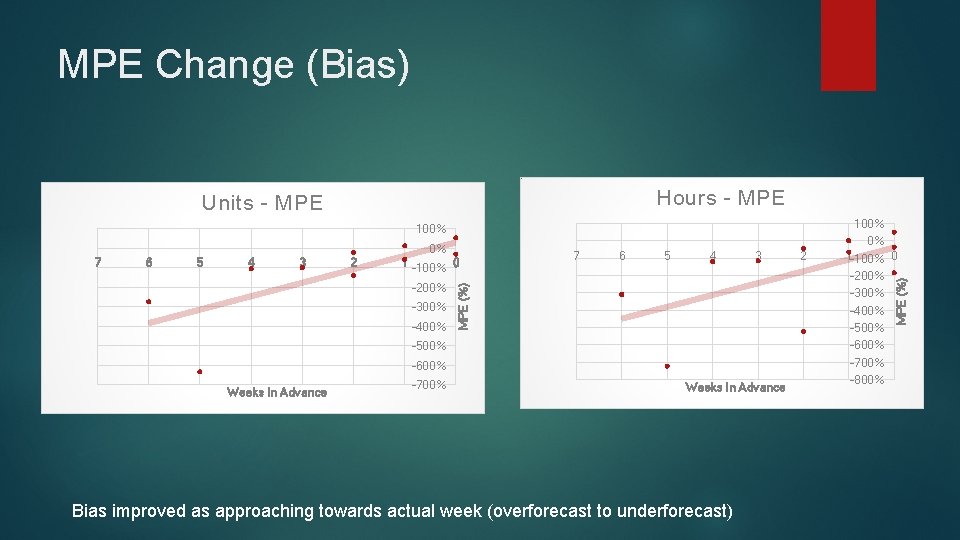
MPE Change (Bias) Hours - MPE Units - MPE 100% 5 4 3 2 0% 1 -100% 0 -200% -300% -400% 7 6 5 4 3 -500% -600% Weeks In Advance -700% 2 MPE (%) 6 MPE (%) 7 100% 0% 1 -100% 0 -200% -300% -400% -500% -600% -700% -800% Weeks In Advance Bias improved as approaching towards actual week (overforecast to underforecast)
Summary • The appropriateness of utilizing demand forecasts to predict warehouse picking improves as we approached to the actual week. • A thorough examination of the warehouse activities to identify the root cause accounting for the deviation between the forecast and the actual. Limitations • Data Availability • Capture of accurate labor hour data
Acknowledgement MIT Team: Dr. Bruce Arntzen Dr. Stephen C Graves Sponsor Company
Q&A