
Operationalizing Behavioral Theory for m Health Dynamics Context

Operationalizing Behavioral Theory for m. Health: Dynamics, Context, and Personalization Donna Spruijt-Metz, Pedja Klasnja, Benjamin Marlin, Eric Hekler, Daniel Rivera, Misha Pavel
Behavioral Problem: Physical Activity • Goal: Behavior Assessment and Intervention: Increasing physical activity and decreasing sedentary behavior • Measurement: A micro-randomized trial (MRT) of a multi-component, multi-timescale, adaptive m. Health intervention (Heart. Steps, PI Klasnja) • Theoretical Framework, Self-Determination Theory • MRT design enables causal modeling of multiple constructs in context and through time. • Focuses on key mechanisms of change: goal-setting, planning, motivation, salience.

Data Collection: App The Heart. Steps App collects an array of passively sensed and self-reported measures. Time Scales Minute Intraday • Steps and activity level from Fit. Bit Versa • GPS Location (Home, Work, Other) Calendar state (free/busy) • Temperature, precipitation Daily • Daily EMA (e. g. busyness, affect) Weekly • Weekly goal setting and EMA (e. g. Enjoyment, social support, motivation) Baseline • Demographics, technology use, activity choice index, personality traits, IPAQ, conscientiousness
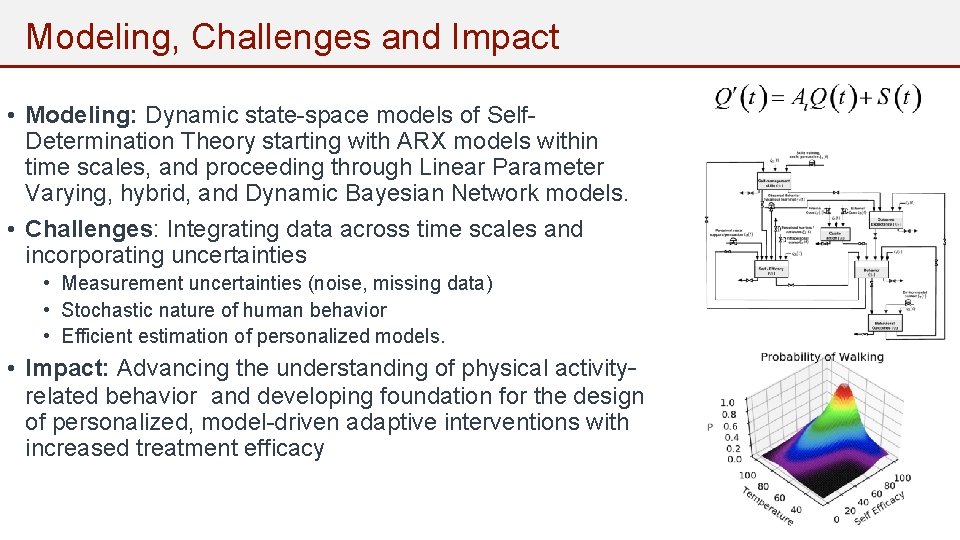
Modeling, Challenges and Impact • Modeling: Dynamic state-space models of Self. Determination Theory starting with ARX models within time scales, and proceeding through Linear Parameter Varying, hybrid, and Dynamic Bayesian Network models. • Challenges: Integrating data across time scales and incorporating uncertainties • Measurement uncertainties (noise, missing data) • Stochastic nature of human behavior • Efficient estimation of personalized models. • Impact: Advancing the understanding of physical activity– related behavior and developing foundation for the design of personalized, model-driven adaptive interventions with increased treatment efficacy
- Slides: 4