
Operationalization of the IASC framework in the Horn
- Slides: 18
Operationalization of the IASC framework in the Horn of Africa Re. DSS Solutions Framework A rapid analytical and adaptive tool to inform joint analysis and collective outcomes
Overview of content q. Re. DSS Solutions Framework q. Solutions framework tools q. Application of the framework q. Key challenges q. Emerging lessons learned
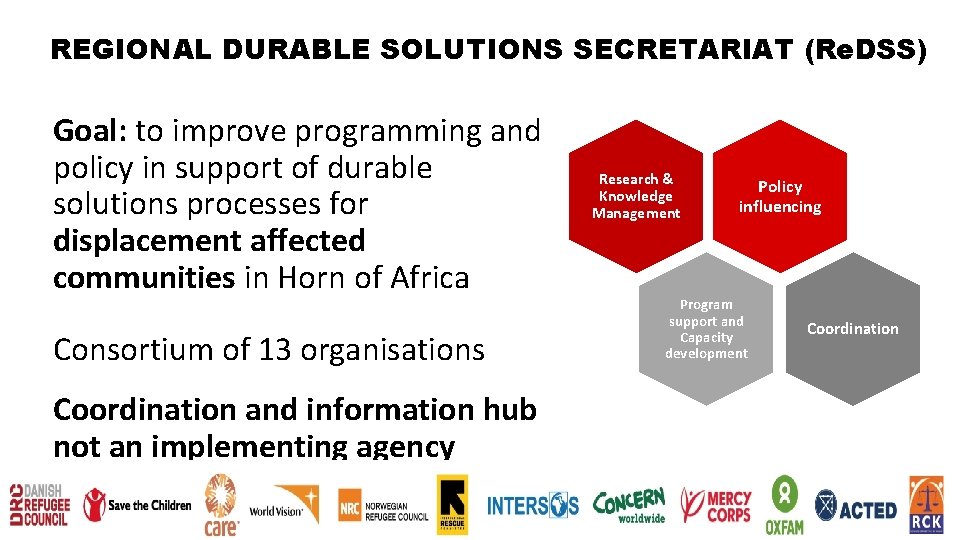
REGIONAL DURABLE SOLUTIONS SECRETARIAT (Re. DSS) Goal: to improve programming and policy in support of durable solutions processes for displacement affected communities in Horn of Africa Research & Knowledge Management Program support and Capacity development Consortium of 13 organisations Coordination and information hub not an implementing agency Policy influencing Coordination
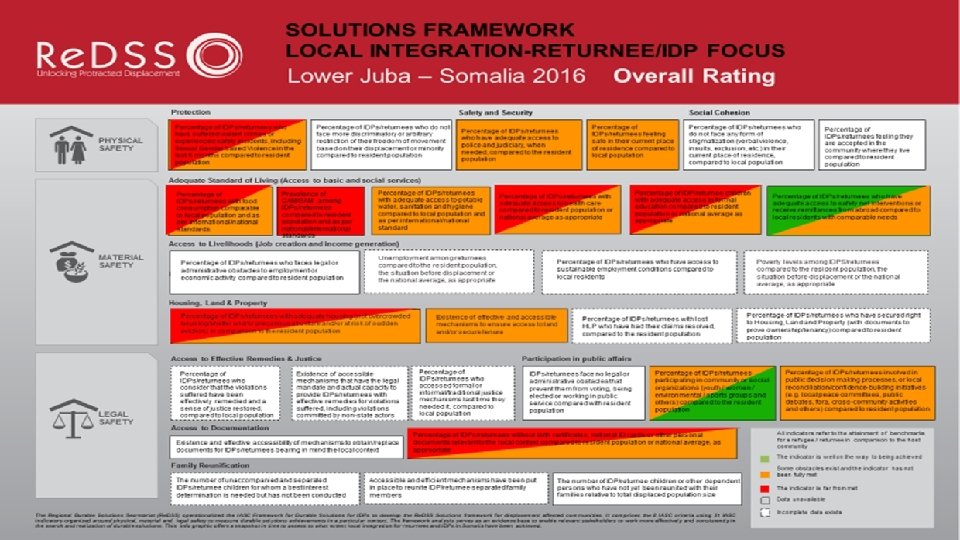
A Framework to measure progress towards durable solutions • A practical, easy-to-use rapid and adaptive analytical tool with a simple visual • It is used as part of a solutions analysis process, which enables users to answer the following questions: • What are the barriers/opportunities for durable solutions? • To what extent have durable solutions been achieved? • What changes to policy and practice are required to advance progress towards durable solutions? • Where to focus and prioritize investments based on gaps and challenges identified? • Can be used by practitioners and policy-makers to tailor programming and policies according to a common logical framework around solutions and based on a collective analysis (humanitarian and development, government, etc)
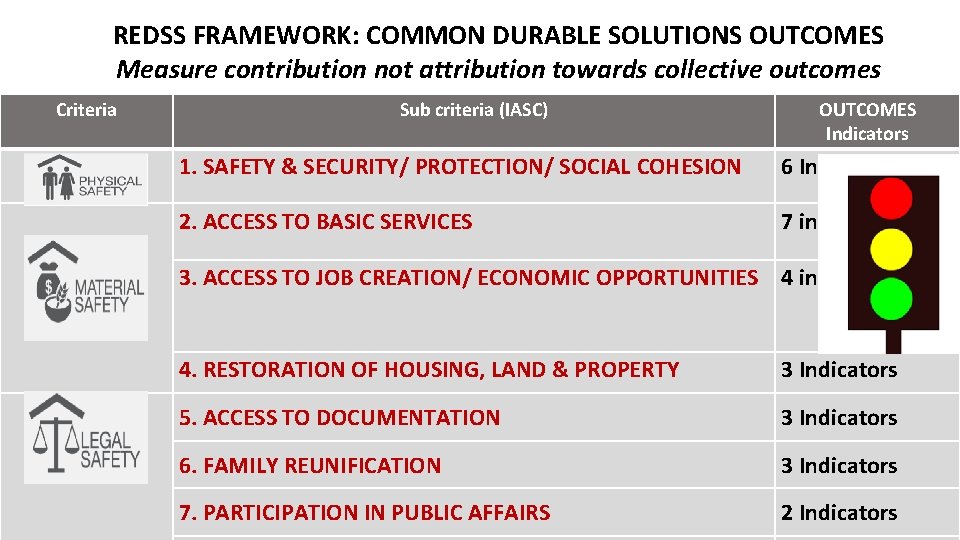
REDSS FRAMEWORK: COMMON DURABLE SOLUTIONS OUTCOMES Measure contribution not attribution towards collective outcomes Criteria Sub criteria (IASC) OUTCOMES Indicators 1. SAFETY & SECURITY/ PROTECTION/ SOCIAL COHESION 6 Indicators 2. ACCESS TO BASIC SERVICES 7 indicators 3. ACCESS TO JOB CREATION/ ECONOMIC OPPORTUNITIES 4 indicators 4. RESTORATION OF HOUSING, LAND & PROPERTY 3 Indicators 5. ACCESS TO DOCUMENTATION 3 Indicators 6. FAMILY REUNIFICATION 3 Indicators 7. PARTICIPATION IN PUBLIC AFFAIRS 2 Indicators
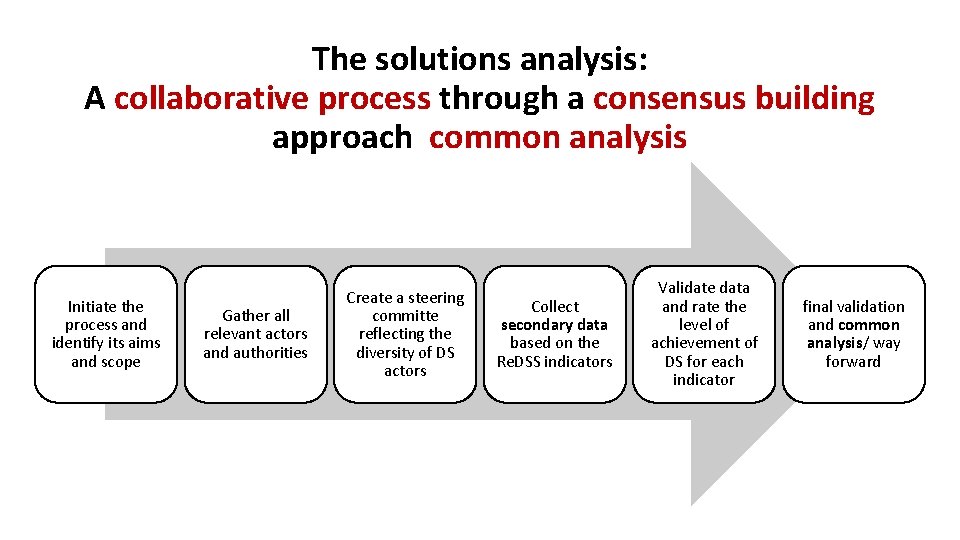
The solutions analysis: A collaborative process through a consensus building approach common analysis Initiate the process and identify its aims and scope Gather all relevant actors and authorities Create a steering committe reflecting the diversity of DS actors Collect secondary data based on the Re. DSS indicators Validate data and rate the level of achievement of DS for each indicator final validation and common analysis/ way forward
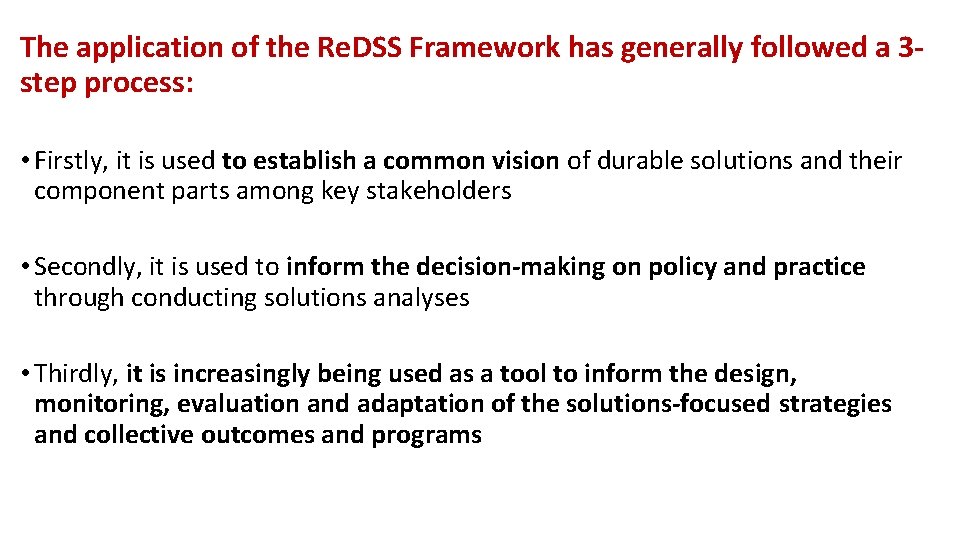
The application of the Re. DSS Framework has generally followed a 3 step process: • Firstly, it is used to establish a common vision of durable solutions and their component parts among key stakeholders • Secondly, it is used to inform the decision-making on policy and practice through conducting solutions analyses • Thirdly, it is increasingly being used as a tool to inform the design, monitoring, evaluation and adaptation of the solutions-focused strategies and collective outcomes and programs
Re. DSS Durable Solutions Framework guidance package 1. Guidance manual: outlines how to conduct a solutions analysis based on • a thorough environmental analysis • a criteria and indicator analysis using the Re. DSS solutions framework 2. Programming guide: outlines how to design solutions oriented programs and interventions that address the gaps identified in a solutions analysis and to develop collective outcomes http: //regionaldss. org/index. php/capacity-development/solutions-framework-tools/
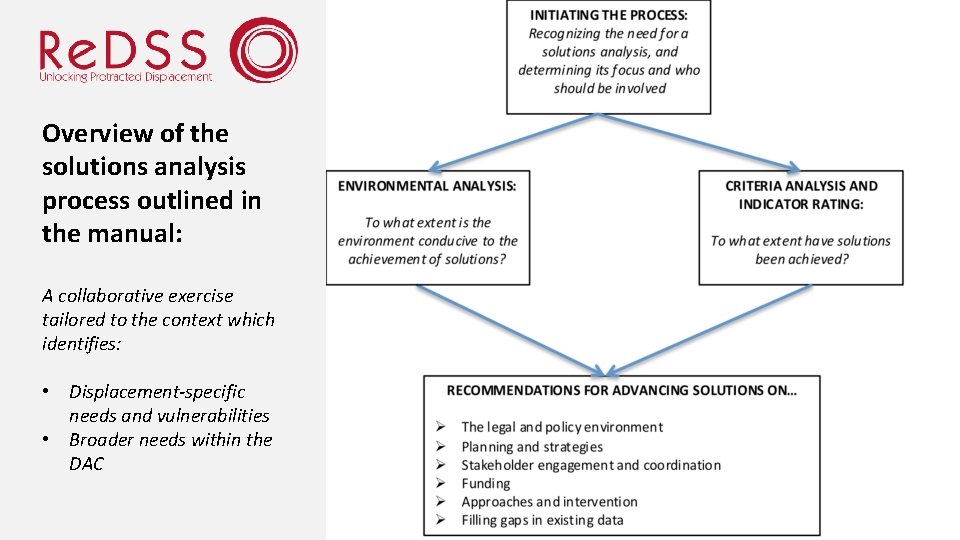
Overview of the solutions analysis process outlined in the manual: A collaborative exercise tailored to the context which identifies: • Displacement-specific needs and vulnerabilities • Broader needs within the DAC
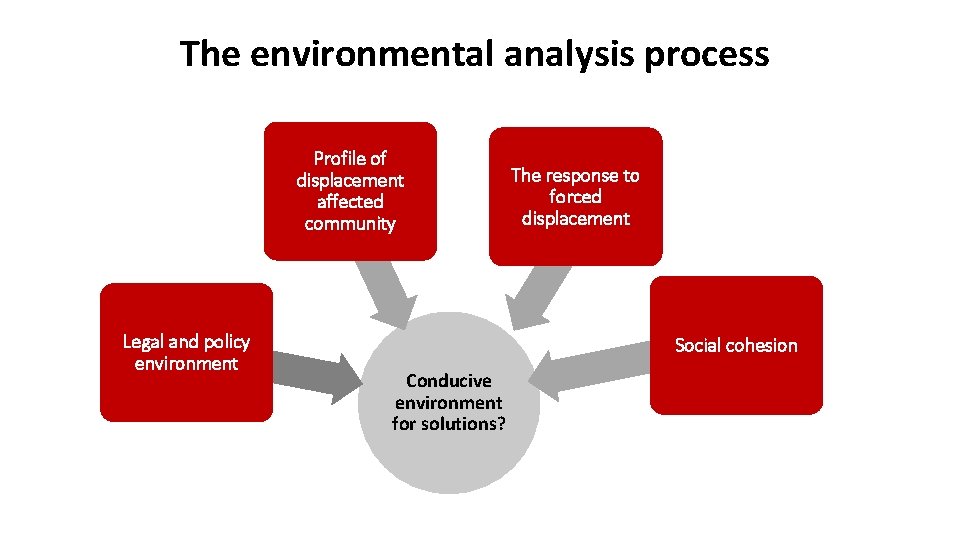
The environmental analysis process Profile of displacement affected community Legal and policy environment The response to forced displacement Social cohesion Conducive environment for solutions?
The manual is accompanied by a brief programming guide- “Designing solutions-oriented programs” • Core elements of solutions-oriented programs • Incorporating a solutions focus into assessments • Solutions outcomes, indicators and illustrative activities
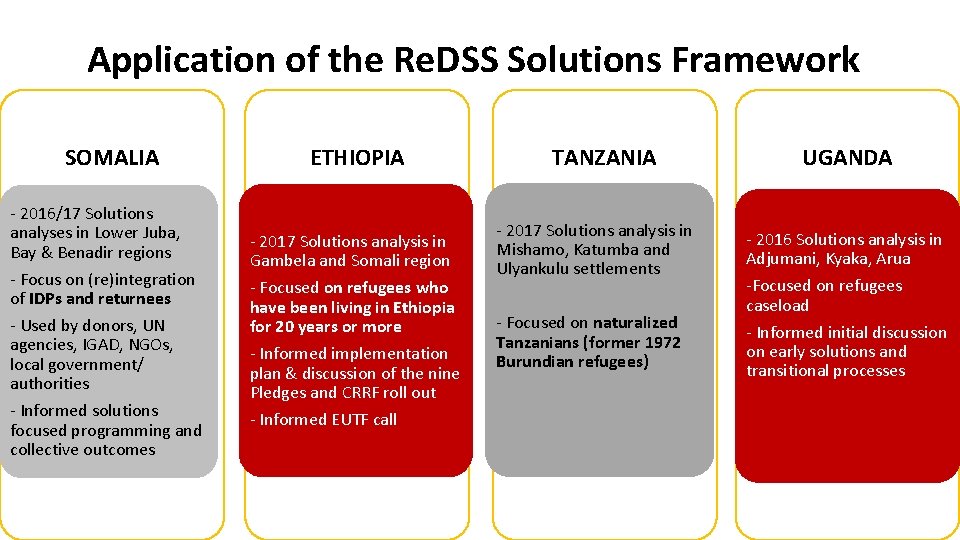
Application of the Re. DSS Solutions Framework SOMALIA ETHIOPIA - 2016/17 Solutions analyses in Lower Juba, Bay & Benadir regions - Focus on (re)integration of IDPs and returnees - Used by donors, UN agencies, IGAD, NGOs, local government/ authorities - Informed solutions focused programming and collective outcomes - 2017 Solutions analysis in Gambela and Somali region - Focused on refugees who have been living in Ethiopia for 20 years or more - Informed implementation plan & discussion of the nine Pledges and CRRF roll out - Informed EUTF call TANZANIA - 2017 Solutions analysis in Mishamo, Katumba and Ulyankulu settlements - Focused on naturalized Tanzanians (former 1972 Burundian refugees) UGANDA - 2016 Solutions analysis in Adjumani, Kyaka, Arua -Focused on refugees caseload - Informed initial discussion on early solutions and transitional processes
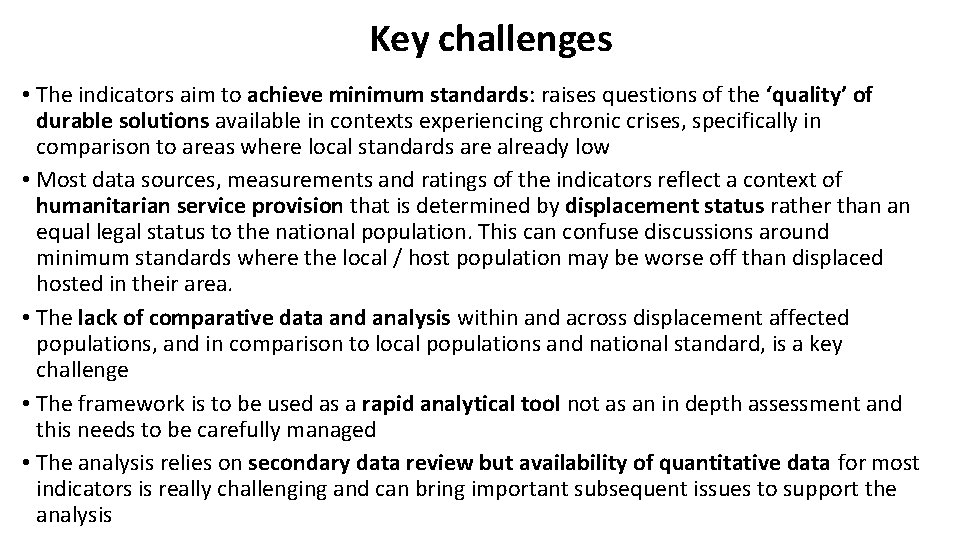
Key challenges • The indicators aim to achieve minimum standards: raises questions of the ‘quality’ of durable solutions available in contexts experiencing chronic crises, specifically in comparison to areas where local standards are already low • Most data sources, measurements and ratings of the indicators reflect a context of humanitarian service provision that is determined by displacement status rather than an equal legal status to the national population. This can confuse discussions around minimum standards where the local / host population may be worse off than displaced hosted in their area. • The lack of comparative data and analysis within and across displacement affected populations, and in comparison to local populations and national standard, is a key challenge • The framework is to be used as a rapid analytical tool not as an in depth assessment and this needs to be carefully managed • The analysis relies on secondary data review but availability of quantitative data for most indicators is really challenging and can bring important subsequent issues to support the analysis
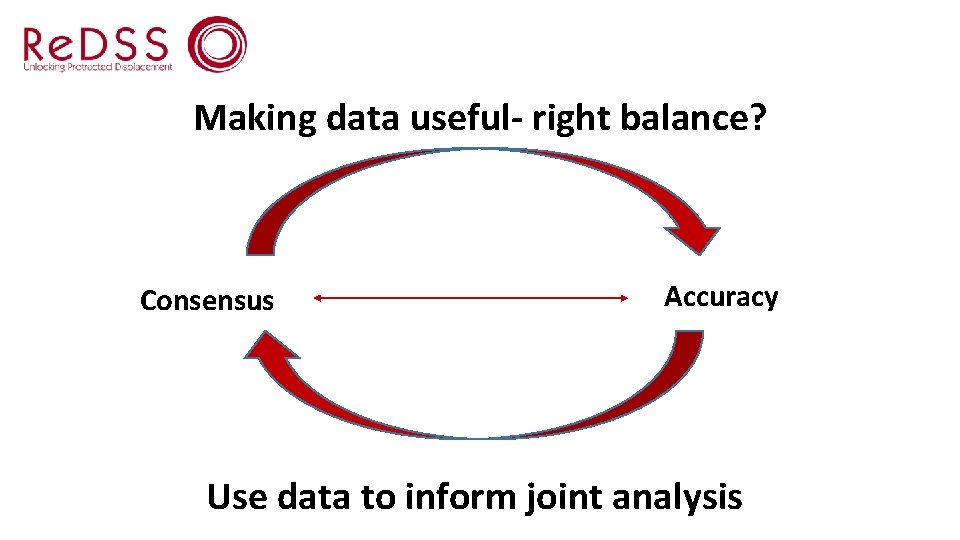
Making data useful- right balance? Consensus Accuracy Use data to inform joint analysis
Re. DSS Solutions Dashboard All solutions analyses are publicly available on the Re. DSS online solutions dashboard which allows users to filter information to inform their own analyses: § To access the solutions dashboard: http: //redss. onalabs. org/ § For the help guide/ tutorial: http: //redss-helpsite. onalabs. org/
Emerging lessons learned • Re. DSS Framework can be used to develop outcome indicators to measure the extent to which solutions have been achieved • Re. DSS framework can, and should, provide a foundation for solutions analyses processes • Re. DSS solutions analysis process always needs to be tailored to each displacement context • Re. DSS solutions analysis process must be collaborative, meaningfully engaging a wide range of stakeholders • Re. DSS solutions analysis process does not need to be expensive • Re. DSS Framework can also be operationalized to inform solutions-oriented programming and strategies
For more information q Re. DSS website (www. regionaldss. org) q Social media - Twitter account (Re. DSS_HOAY) q Bi- monthly newsletter – Subscribe on our website q Re. DSS Secretariat contact: Aude Galli- a. galli@regionaldss. org