
Operational Semantics Mooly Sagiv Reference Semantics with Applications
![[x 3] int fact(int x) { int z, y; z = 1; [x 3,](https://slidetodoc.com/presentation_image_h2/3d713af6aadecb08af58c44caf3be573/image-5.jpg "[x 3] int fact(int x) { int z, y; z = 1; [x 3,")
![Example State Manipulations u [x 1, y 7, z 16] y = u [x](https://slidetodoc.com/presentation_image_h2/3d713af6aadecb08af58c44caf3be573/image-15.jpg "Example State Manipulations u [x 1, y 7, z 16] y = u [x")
![Natural Semantics for While [ass ] <x : = a, s> s[x ns axioms](https://slidetodoc.com/presentation_image_h2/3d713af6aadecb08af58c44caf3be573/image-23.jpg "Natural Semantics for While [ass ] <x : = a, s> s[x ns axioms")
![Natural Semantics for While (More rules) [whileffns] <while b do S, s> s [whilettns]](https://slidetodoc.com/presentation_image_h2/3d713af6aadecb08af58c44caf3be573/image-24.jpg "Natural Semantics for While (More rules) [whileffns] <while b do S, s> s [whilettns]")
![The While Programming Language with Non-Determinism Natural Semantics [or 1 ns] <S 1 ,](https://slidetodoc.com/presentation_image_h2/3d713af6aadecb08af58c44caf3be573/image-36.jpg "The While Programming Language with Non-Determinism Natural Semantics [or 1 ns] <S 1 ,")
- Slides: 43
Operational Semantics Mooly Sagiv Reference: Semantics with Applications Chapter 2 H. Nielson and F. Nielson http: //www. daimi. au. dk/~bra 8130/Wiley_book/wiley. html 1
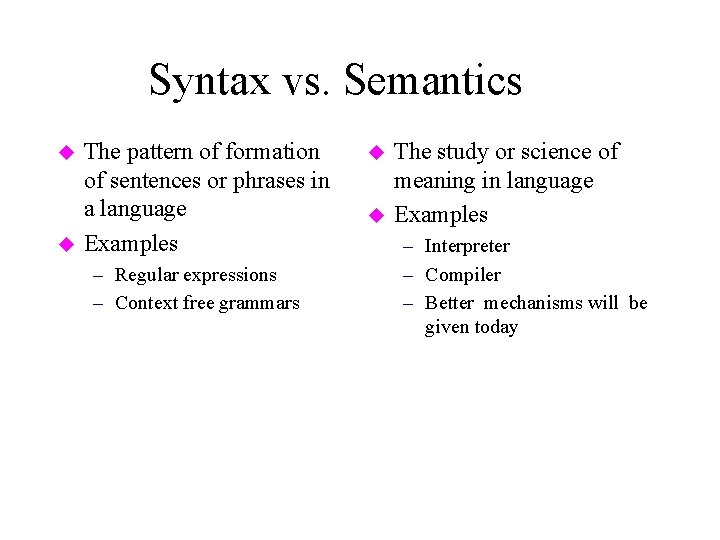
Syntax vs. Semantics u u The pattern of formation of sentences or phrases in a language Examples – Regular expressions – Context free grammars u u The study or science of meaning in language Examples – Interpreter – Compiler – Better mechanisms will be given today
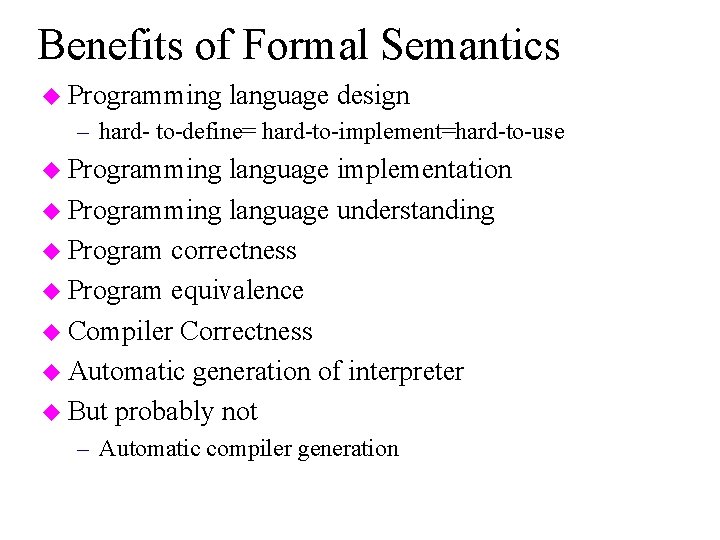
Benefits of Formal Semantics u Programming language design – hard- to-define= hard-to-implement=hard-to-use u Programming language implementation u Programming language understanding u Program correctness u Program equivalence u Compiler Correctness u Automatic generation of interpreter u But probably not – Automatic compiler generation
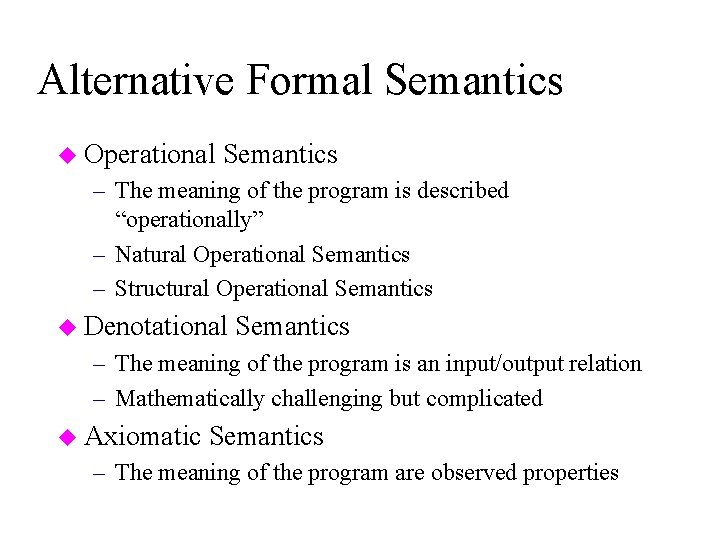
Alternative Formal Semantics u Operational Semantics – The meaning of the program is described “operationally” – Natural Operational Semantics – Structural Operational Semantics u Denotational Semantics – The meaning of the program is an input/output relation – Mathematically challenging but complicated u Axiomatic Semantics – The meaning of the program are observed properties
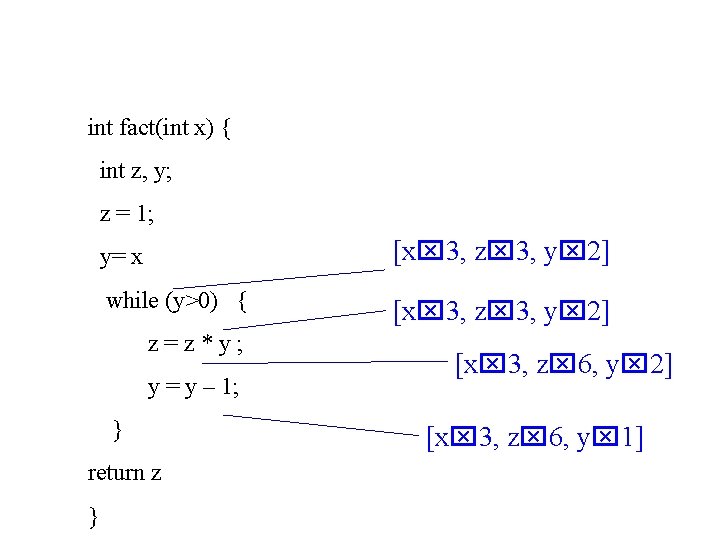
[x 3] int fact(int x) { int z, y; z = 1; [x 3, z 1, y ] [x 3, z 1, y 3] y= x while (y>0) { z=z*y; y = y – 1; } return z } [x 3, z , y ] [x 3, z 1, y 3] [x 3, z 3, y 2]
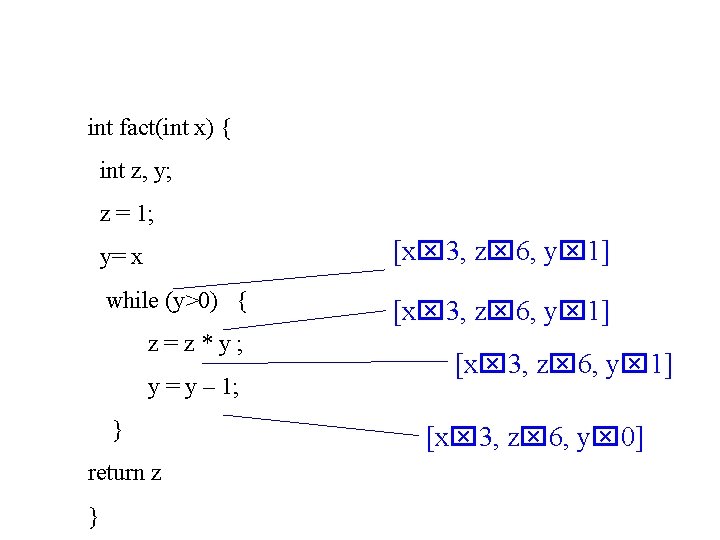
int fact(int x) { int z, y; z = 1; y= x [x 3, z 3, y 2] while (y>0) { [x 3, z 3, y 2] z=z*y; y = y – 1; } return z } [x 3, z 6, y 2] [x 3, z 6, y 1]
int fact(int x) { int z, y; z = 1; y= x [x 3, z 6, y 1] while (y>0) { [x 3, z 6, y 1] z=z*y; y = y – 1; } return z } [x 3, z 6, y 1] [x 3, z 6, y 0]
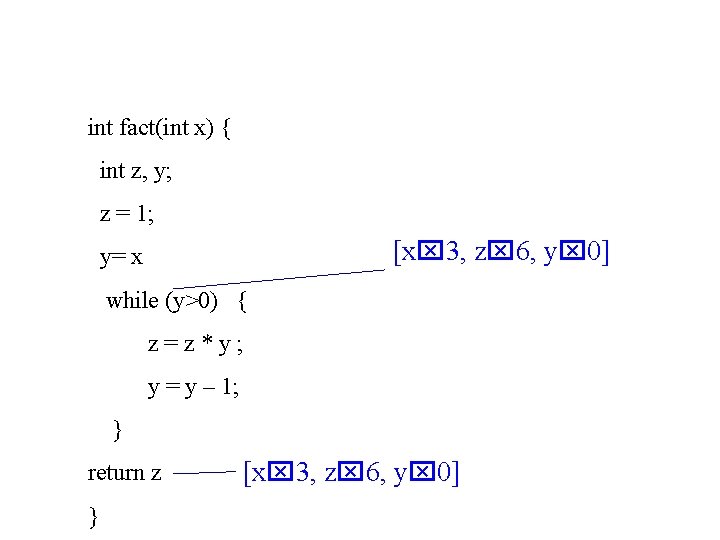
int fact(int x) { int z, y; z = 1; [x 3, z 6, y 0] y= x while (y>0) { z=z*y; y = y – 1; } return z } [x 3, z 6, y 0]
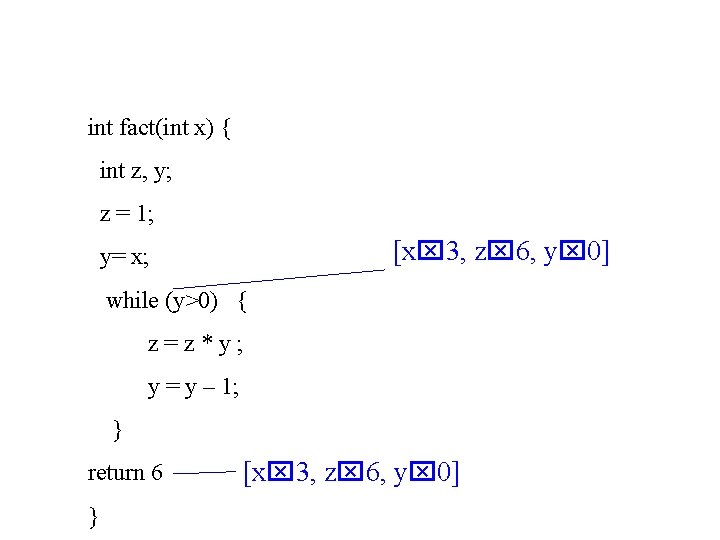
int fact(int x) { int z, y; z = 1; [x 3, z 6, y 0] y= x; while (y>0) { z=z*y; y = y – 1; } return 6 } [x 3, z 6, y 0]
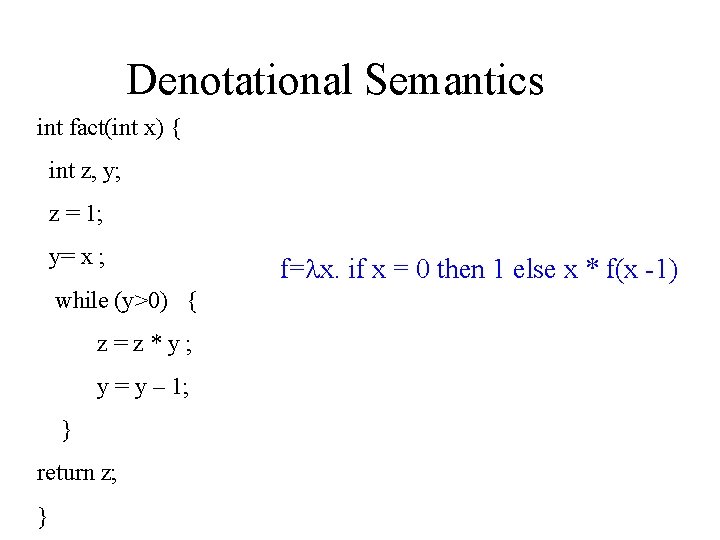
Denotational Semantics int fact(int x) { int z, y; z = 1; y= x ; while (y>0) { z=z*y; y = y – 1; } return z; } f= x. if x = 0 then 1 else x * f(x -1)
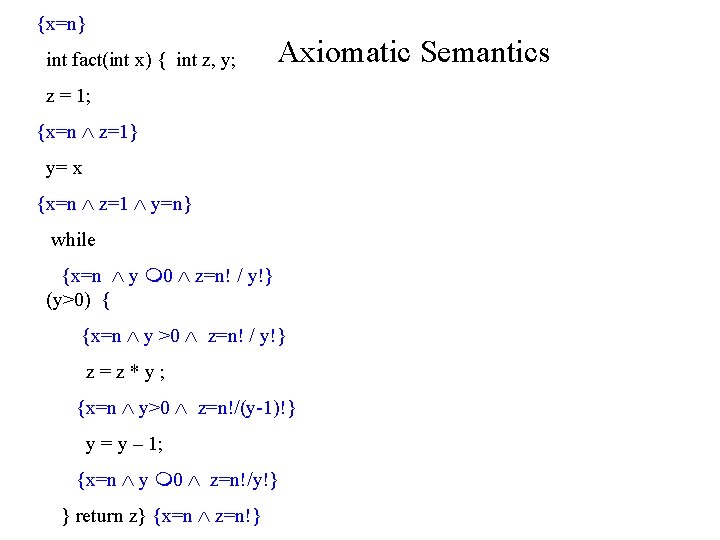
{x=n} int fact(int x) { int z, y; Axiomatic Semantics z = 1; {x=n z=1} y= x {x=n z=1 y=n} while {x=n y 0 z=n! / y!} (y>0) { {x=n y >0 z=n! / y!} z=z*y; {x=n y>0 z=n!/(y-1)!} y = y – 1; {x=n y 0 z=n!/y!} } return z} {x=n z=n!}
Operational Semantics Natural Semantics 13
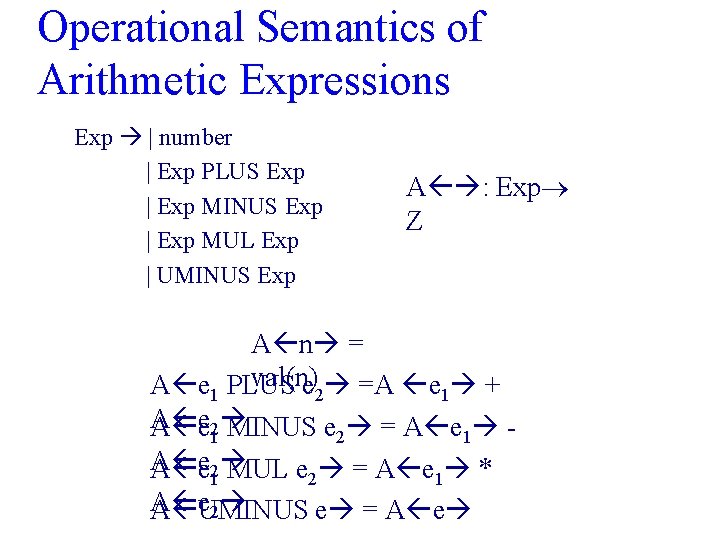
Operational Semantics of Arithmetic Expressions Exp | number | Exp PLUS Exp | Exp MINUS Exp | Exp MUL Exp | UMINUS Exp A : Exp Z A n = val(n) A e 1 PLUS e 2 =A e 1 + A e 21 MINUS e 2 = A e 1 A e 21 MUL e 2 = A e 1 * A e 2 A UMINUS e = A e
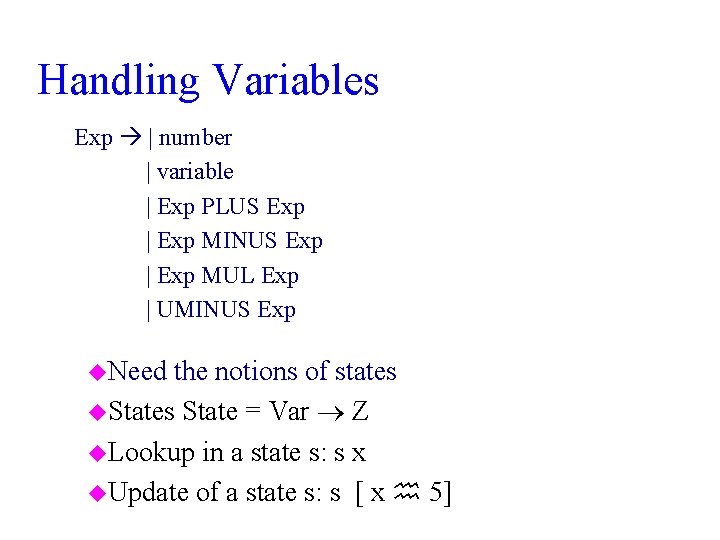
Handling Variables Exp | number | variable | Exp PLUS Exp | Exp MINUS Exp | Exp MUL Exp | UMINUS Exp u. Need the notions of states u. States State = Var Z u. Lookup in a state s: s x u. Update of a state s: s [ x 5]
Example State Manipulations u [x 1, y 7, z 16] y = u [x 1, y 7, z 16] t = u [x 1, y 7, z 16][x 5] x = u [x 1, y 7, z 16][x 5] y =
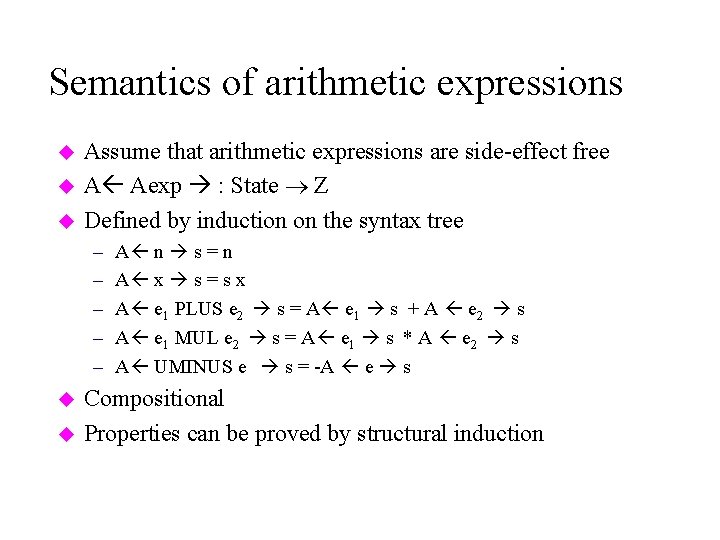
Semantics of arithmetic expressions u u u Assume that arithmetic expressions are side-effect free A Aexp : State Z Defined by induction on the syntax tree – – – u u A n s = n A x s = s x A e 1 PLUS e 2 s = A e 1 s + A e 2 s A e 1 MUL e 2 s = A e 1 s * A e 2 s A UMINUS e s = -A e s Compositional Properties can be proved by structural induction
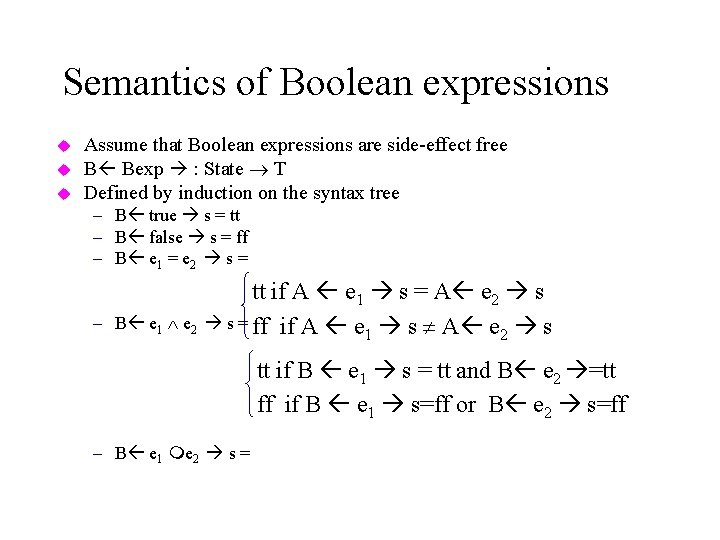
Semantics of Boolean expressions u u u Assume that Boolean expressions are side-effect free B Bexp : State T Defined by induction on the syntax tree – B true s = tt – B false s = ff – B e 1 = e 2 s = – B e 1 e 2 tt if A e 1 s = A e 2 s s = ff if A e s A e s 1 2 tt if B e 1 s = tt and B e 2 =tt ff if B e 1 s=ff or B e 2 s=ff – B e 1 e 2 s =
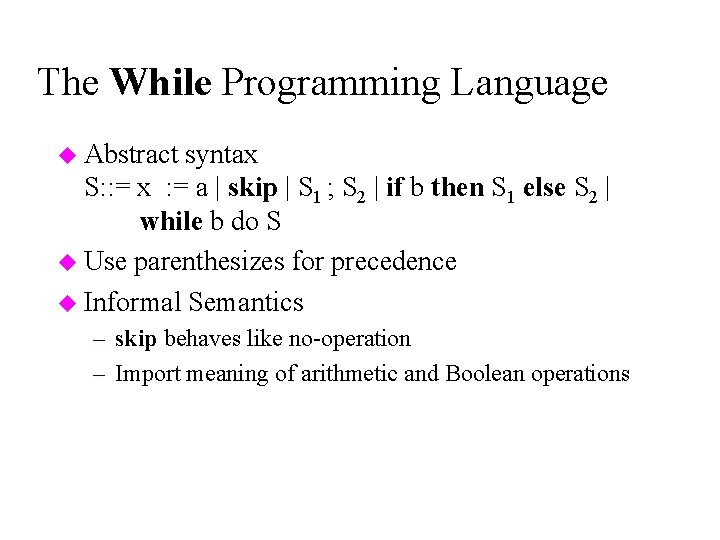
The While Programming Language u Abstract syntax S: : = x : = a | skip | S 1 ; S 2 | if b then S 1 else S 2 | while b do S u Use parenthesizes for precedence u Informal Semantics – skip behaves like no-operation – Import meaning of arithmetic and Boolean operations
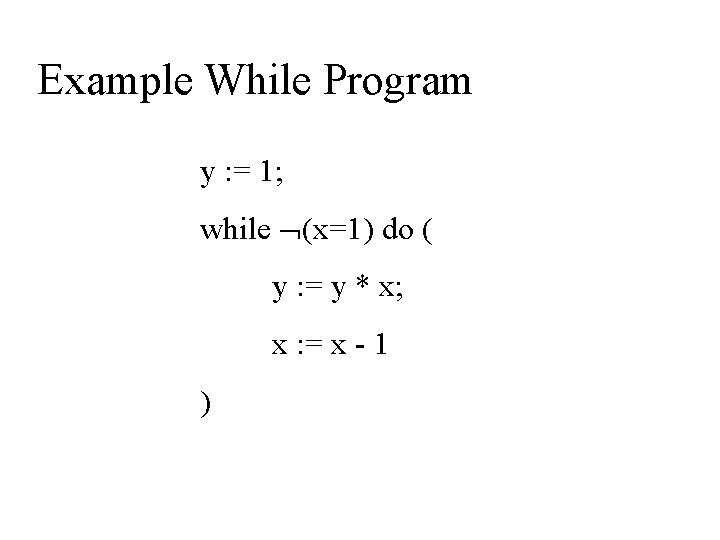
Example While Program y : = 1; while (x=1) do ( y : = y * x; x : = x - 1 )
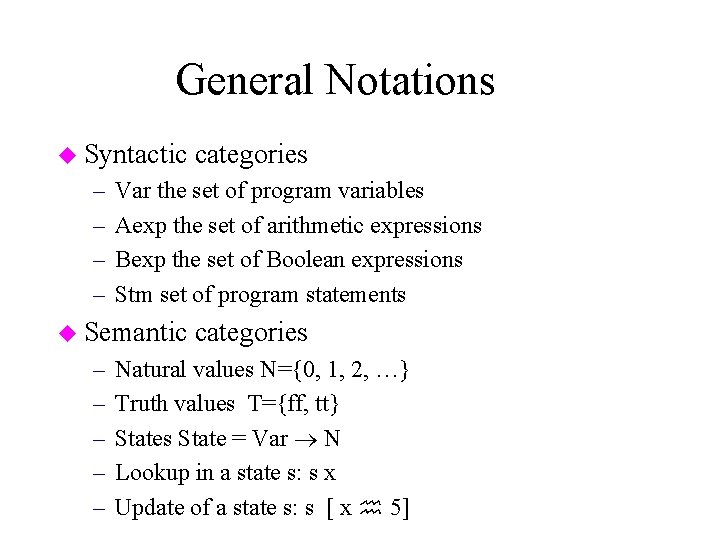
General Notations u Syntactic – – Var the set of program variables Aexp the set of arithmetic expressions Bexp the set of Boolean expressions Stm set of program statements u Semantic – – – categories Natural values N={0, 1, 2, …} Truth values T={ff, tt} States State = Var N Lookup in a state s: s x Update of a state s: s [ x 5]
Natural Operational Semantics u Describe the “overall” effect of program constructs u Ignores non terminating computations
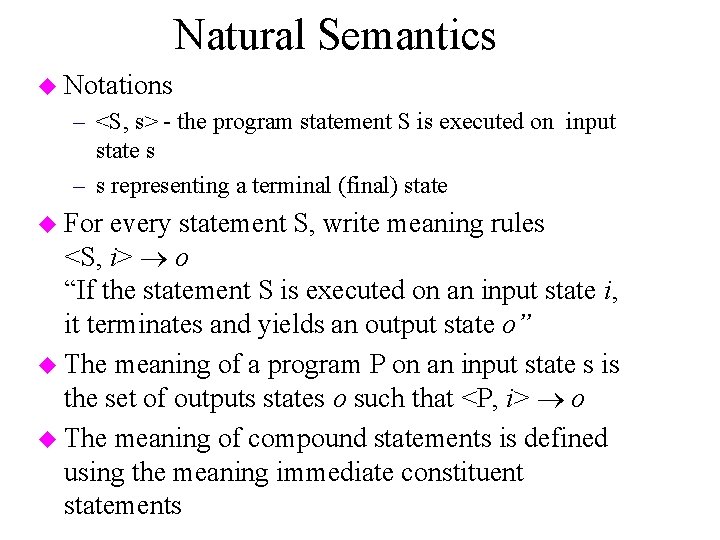
Natural Semantics u Notations – <S, s> - the program statement S is executed on input state s – s representing a terminal (final) state u For every statement S, write meaning rules <S, i> o “If the statement S is executed on an input state i, it terminates and yields an output state o” u The meaning of a program P on an input state s is the set of outputs states o such that <P, i> o u The meaning of compound statements is defined using the meaning immediate constituent statements
Natural Semantics for While [ass ] <x : = a, s> s[x ns axioms rules A a s] [skipns] <skip, s> s [compns] <S 1 , s> s’, <S 2, s’> s’’ <S 1; S 2, s> s’’ [ifttns] <S 1 , s> s’ <if b then S 1 else S 2, s> s’ [ifffns] <S 2 , s> s’ <if b then S 1 else S 2, s> s’ if B b s=tt if B b s=ff
Natural Semantics for While (More rules) [whileffns] <while b do S, s> s [whilettns] <S , s> s’, <while b do S, s’> s’’ <while b do S, s> s’’ if B b s=ff if B b s=tt
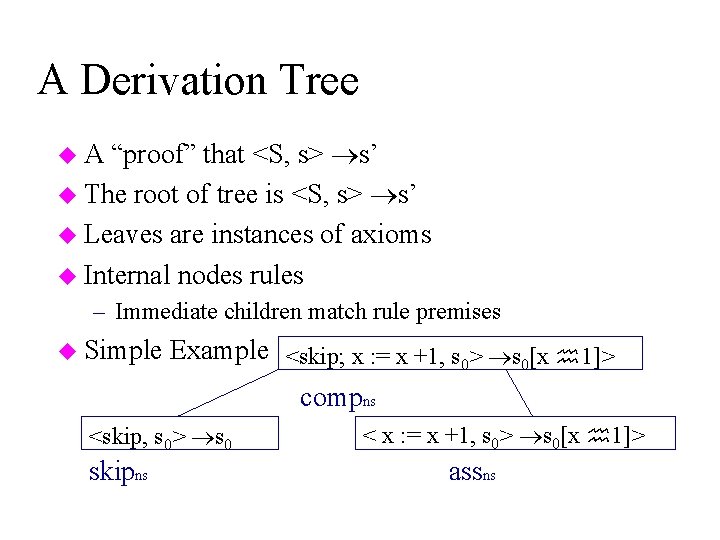
A Derivation Tree “proof” that <S, s> s’ u The root of tree is <S, s> s’ u Leaves are instances of axioms u Internal nodes rules u. A – Immediate children match rule premises u Simple Example <skip; x : = x +1, s 0> s 0[x 1]> compns <skip, s 0> s 0 skipns < x : = x +1, s 0> s 0[x 1]> assns
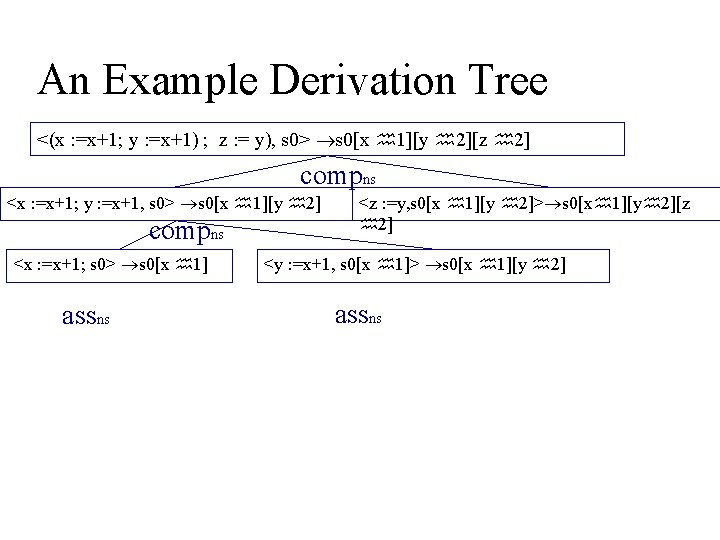
An Example Derivation Tree <(x : =x+1; y : =x+1) ; z : = y), s 0> s 0[x 1][y 2][z 2] compns <x : =x+1; y : =x+1, s 0> s 0[x 1][y 2] compns <x : =x+1; s 0> s 0[x 1] assns <z : =y, s 0[x 1][y 2]> s 0[x 1][y 2][z 2] <y : =x+1, s 0[x 1]> s 0[x 1][y 2] assns
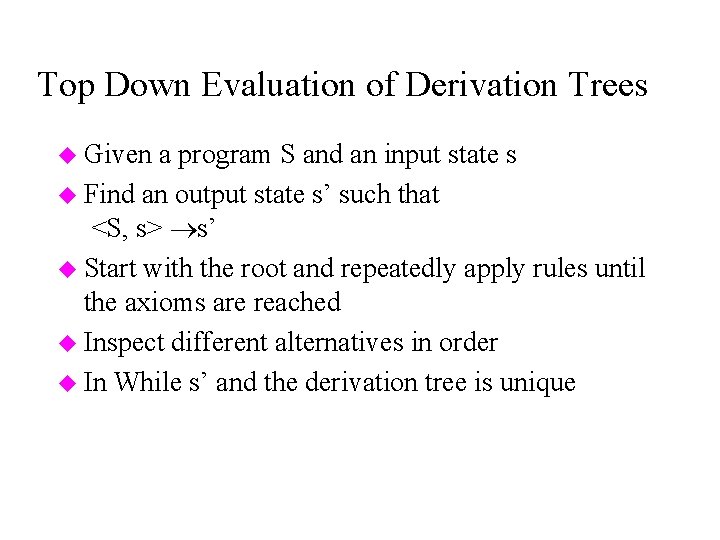
Top Down Evaluation of Derivation Trees u Given a program S and an input state s u Find an output state s’ such that <S, s> s’ u Start with the root and repeatedly apply rules until the axioms are reached u Inspect different alternatives in order u In While s’ and the derivation tree is unique
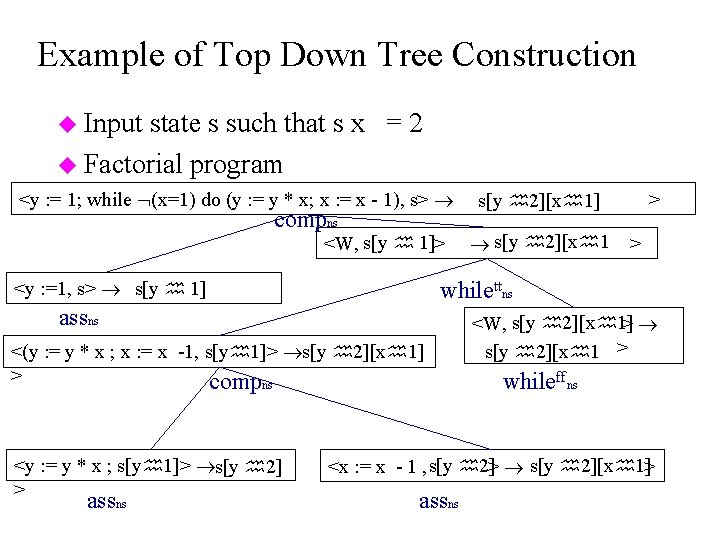
Example of Top Down Tree Construction u Input state s such that s x = 2 u Factorial program <y : = 1; while (x=1) do (y : = y * x; x : = x - 1), s> compns <W, s[y 1]> <y : =1, s> s[y 1] <(y : = y * x ; x : = x -1, s[y 1]> s[y 2][x 1] > compns assns s[y 2][x 1 > whilettns assns <y : = y * x ; s[y 1]> s[y 2] > > s[y 2][x 1] <W, s[y 2][x 1] > s[y 2][x 1 > whileffns <x : = x - 1 , s[y 2]> s[y 2][x 1]> assns
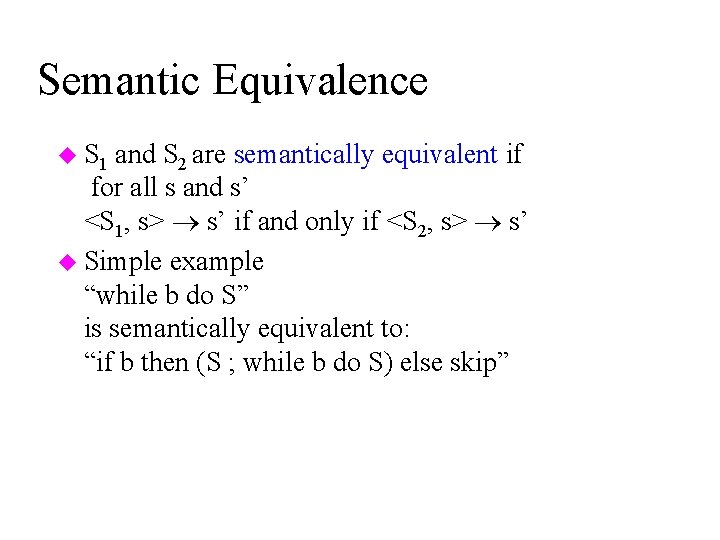
Semantic Equivalence u S 1 and S 2 are semantically equivalent if for all s and s’ <S 1, s> s’ if and only if <S 2, s> s’ u Simple example “while b do S” is semantically equivalent to: “if b then (S ; while b do S) else skip”
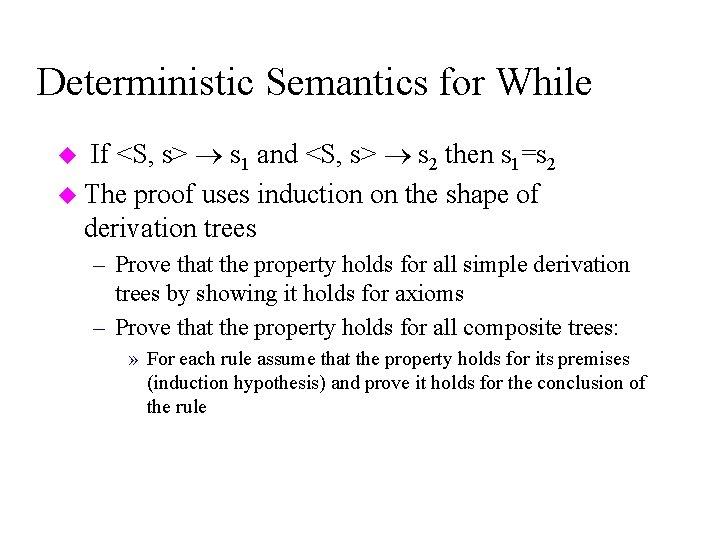
Deterministic Semantics for While If <S, s> s 1 and <S, s> s 2 then s 1=s 2 u The proof uses induction on the shape of derivation trees u – Prove that the property holds for all simple derivation trees by showing it holds for axioms – Prove that the property holds for all composite trees: » For each rule assume that the property holds for its premises (induction hypothesis) and prove it holds for the conclusion of the rule
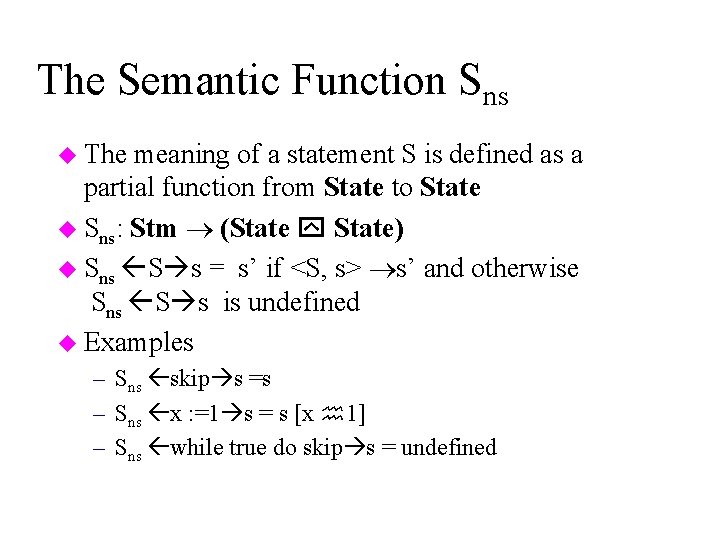
The Semantic Function Sns u The meaning of a statement S is defined as a partial function from State to State u Sns: Stm (State State) u Sns S s = s’ if <S, s> s’ and otherwise Sns S s is undefined u Examples – Sns skip s =s – Sns x : =1 s = s [x 1] – Sns while true do skip s = undefined
Extensions to While u Abort statement (like C exit w/o return value) u Non determinism u Parallelism u Local Variables u Procedures – Static Scope – Dynamic scope
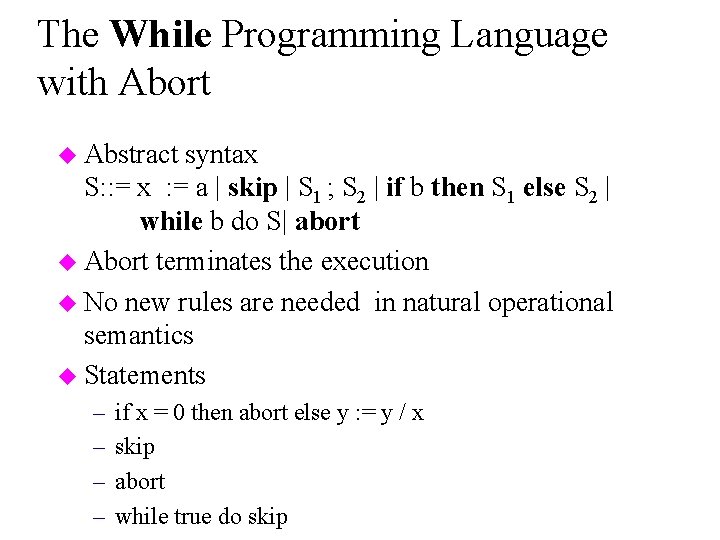
The While Programming Language with Abort u Abstract syntax S: : = x : = a | skip | S 1 ; S 2 | if b then S 1 else S 2 | while b do S| abort u Abort terminates the execution u No new rules are needed in natural operational semantics u Statements – – if x = 0 then abort else y : = y / x skip abort while true do skip
Conclusion u The natural semantics cannot distinguish between looping and abnormal termination (unless the states are modified)
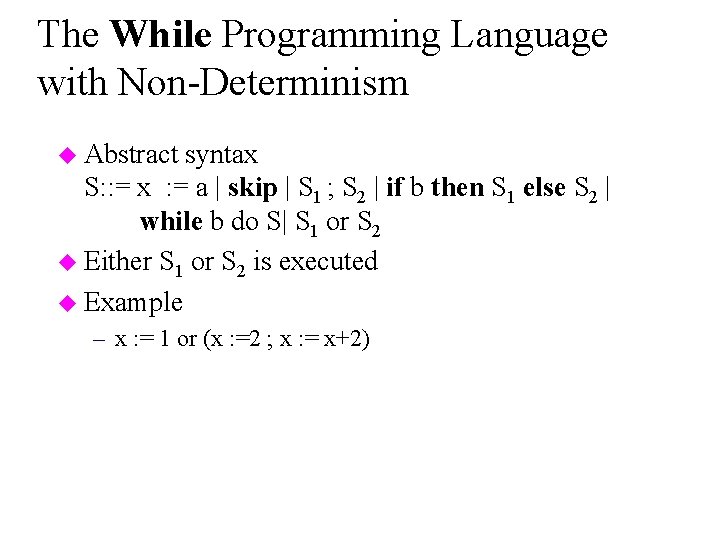
The While Programming Language with Non-Determinism u Abstract syntax S: : = x : = a | skip | S 1 ; S 2 | if b then S 1 else S 2 | while b do S| S 1 or S 2 u Either S 1 or S 2 is executed u Example – x : = 1 or (x : =2 ; x : = x+2)
The While Programming Language with Non-Determinism Natural Semantics [or 1 ns] <S 1 , s> s’ <S 1 or S 2, s> s’ [or 2 ns] <S 2 , s> s’ <S 1 or S 2, s> s’
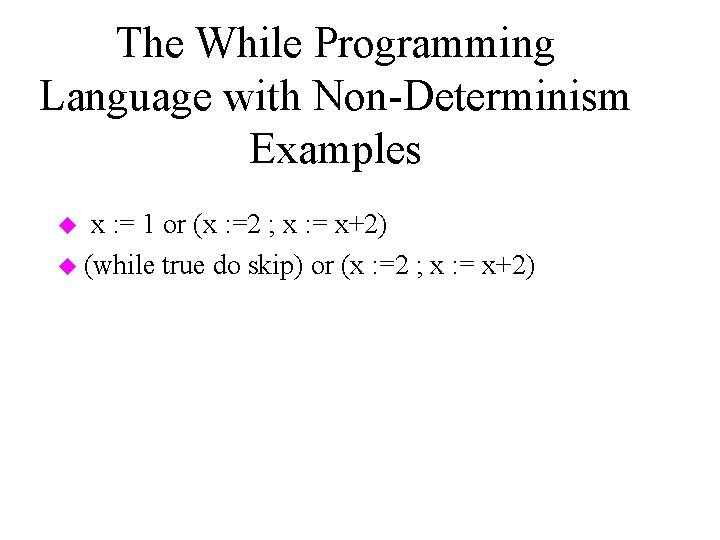
The While Programming Language with Non-Determinism Examples x : = 1 or (x : =2 ; x : = x+2) u (while true do skip) or (x : =2 ; x : = x+2) u
Conclusion u In the natural semantics non-determinism will suppress looping if possible (mnemonic)
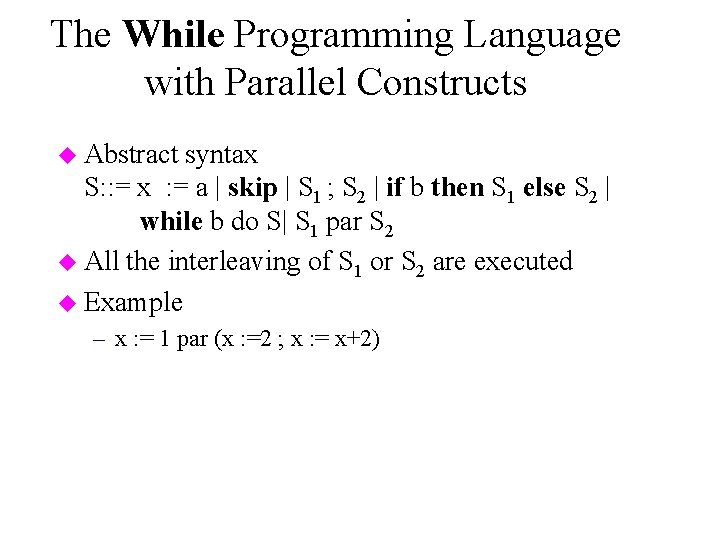
The While Programming Language with Parallel Constructs u Abstract syntax S: : = x : = a | skip | S 1 ; S 2 | if b then S 1 else S 2 | while b do S| S 1 par S 2 u All the interleaving of S 1 or S 2 are executed u Example – x : = 1 par (x : =2 ; x : = x+2)
Conclusion u In the natural semantics immediate constituent is an atomic entity so we cannot express interleaving of computations
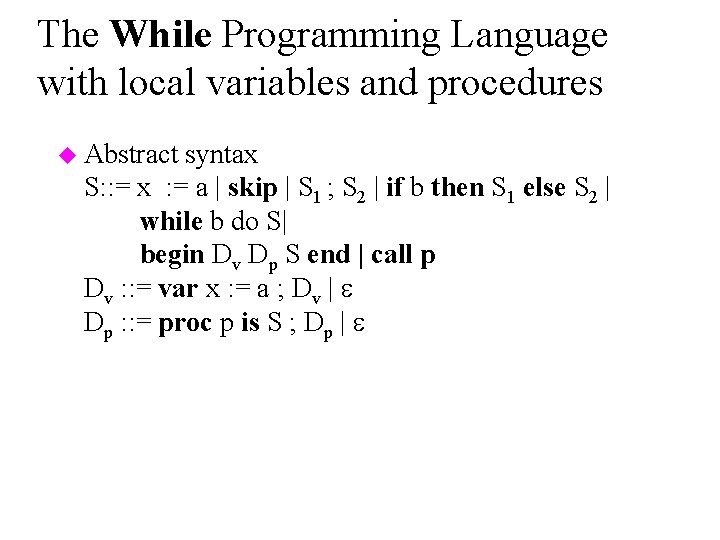
The While Programming Language with local variables and procedures u Abstract syntax S: : = x : = a | skip | S 1 ; S 2 | if b then S 1 else S 2 | while b do S| begin Dv Dp S end | call p Dv : : = var x : = a ; Dv | Dp : : = proc p is S ; Dp |
Conclusions Local Variables u The natural semantics can “remember” local states
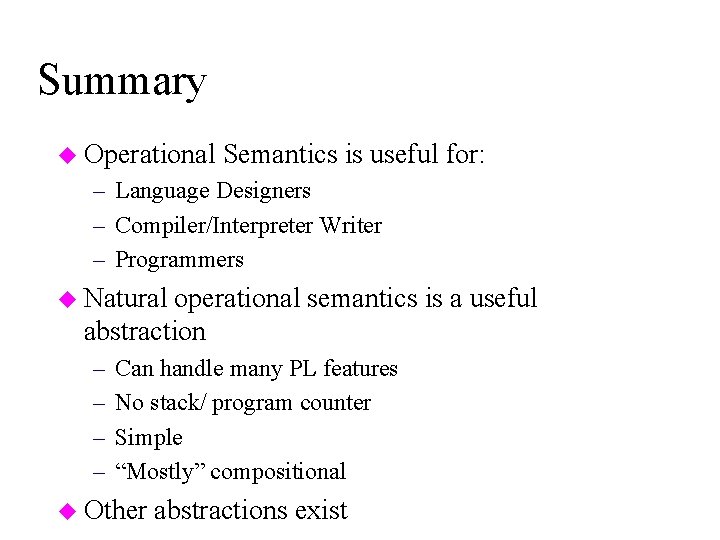
Summary u Operational Semantics is useful for: – Language Designers – Compiler/Interpreter Writer – Programmers u Natural operational semantics is a useful abstraction – – Can handle many PL features No stack/ program counter Simple “Mostly” compositional u Other abstractions exist