
Operational Context and Use Case Focus Group Use
- Slides: 43
Operational Context and Use Case Focus Group Use Case April 25, 2019 Federal Aviation Administration
Agenda • Document Delivery Schedule • Meteorological Use Case Document – Closeout • Aeronautical Use Case Document – Storyboard Operational Context / Use Case Focus Group April 25, 2019 Federal Aviation Administration 2
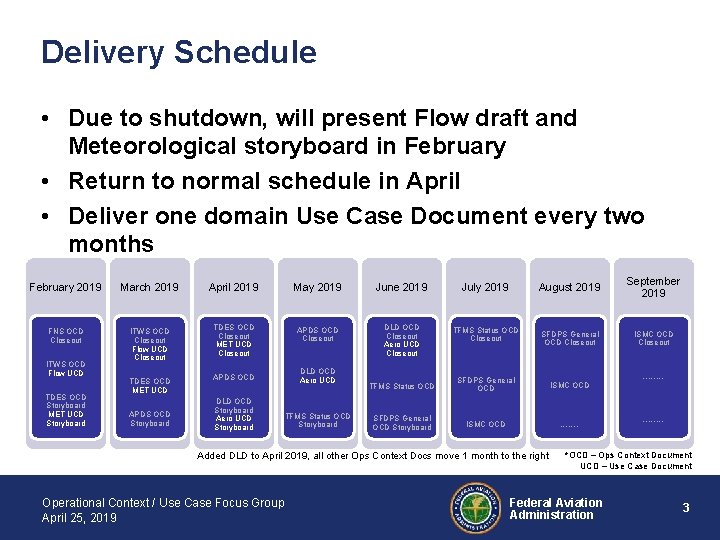
Delivery Schedule • Due to shutdown, will present Flow draft and Meteorological storyboard in February • Return to normal schedule in April • Deliver one domain Use Case Document every two months February 2019 March 2019 FNS OCD Closeout ITWS OCD Closeout Flow UCD Closeout ITWS OCD Flow UCD TDES OCD Storyboard MET UCD Storyboard TDES OCD MET UCD APDS OCD Storyboard April 2019 May 2019 June 2019 July 2019 TDES OCD Closeout MET UCD Closeout APDS OCD Closeout DLD OCD Closeout Aero UCD Closeout TFMS Status OCD Closeout APDS OCD DLD OCD Aero UCD DLD OCD Storyboard Aero UCD Storyboard TFMS Status OCD Storyboard August 2019 September 2019 SFDPS General OCD Closeout ISMC OCD Closeout TFMS Status OCD SFDPS General OCD ISMC OCD SFDPS General OCD Storyboard ISMC OCD ------- Added DLD to April 2019, all other Ops Context Docs move 1 month to the right Operational Context / Use Case Focus Group April 25, 2019 -------- *OCD – Ops Context Document UCD – Use Case Document Federal Aviation Administration 3
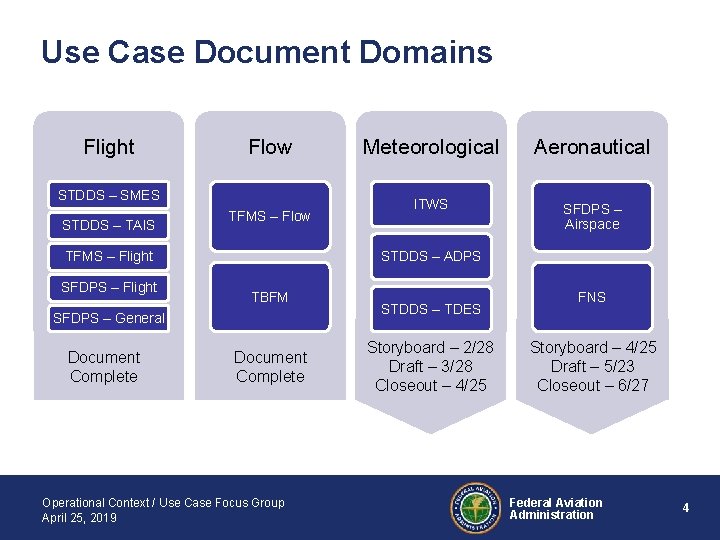
Use Case Document Domains Flight Flow STDDS – SMES STDDS – TAIS TFMS – Flow TBFM SFDPS – General Document Complete Aeronautical ITWS SFDPS – Airspace STDDS – ADPS TFMS – Flight SFDPS – Flight Meteorological Document Complete Operational Context / Use Case Focus Group April 25, 2019 STDDS – TDES Storyboard – 2/28 Draft – 3/28 Closeout – 4/25 FNS Storyboard – 4/25 Draft – 5/23 Closeout – 6/27 Federal Aviation Administration 4
Closeout METEOROLOGICAL USE CASE Operational Context / Use Case Focus Group April 25, 2019 Federal Aviation Administration 5
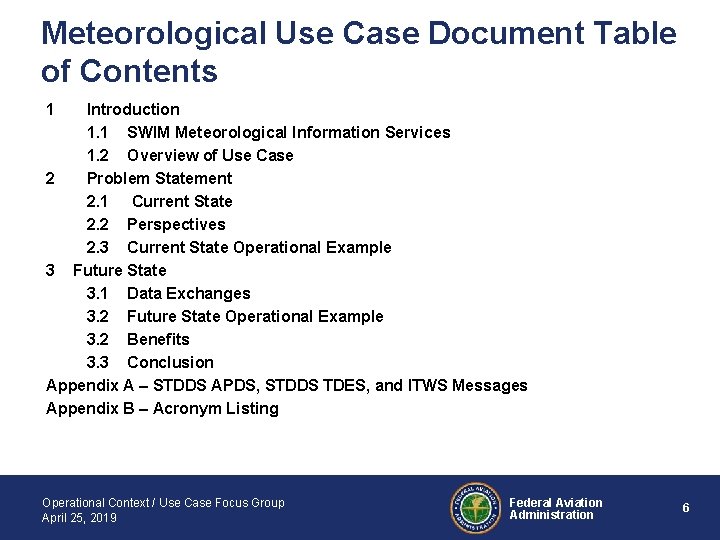
Meteorological Use Case Document Table of Contents 1 Introduction 1. 1 SWIM Meteorological Information Services 1. 2 Overview of Use Case 2 Problem Statement 2. 1 Current State 2. 2 Perspectives 2. 3 Current State Operational Example 3 Future State 3. 1 Data Exchanges 3. 2 Future State Operational Example 3. 2 Benefits 3. 3 Conclusion Appendix A – STDDS APDS, STDDS TDES, and ITWS Messages Appendix B – Acronym Listing Operational Context / Use Case Focus Group April 25, 2019 Federal Aviation Administration 6
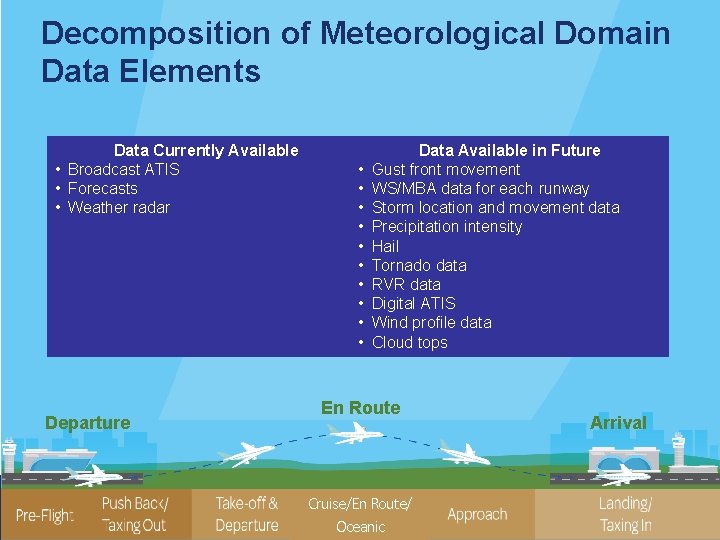
Decomposition of Meteorological Domain Data Elements Data Currently Available • Broadcast ATIS • Forecasts • Weather radar Departure Operational Context / Use Case Focus Group April 25, 2019 • • • Data Available in Future Gust front movement WS/MBA data for each runway Storm location and movement data Precipitation intensity Hail Tornado data RVR data Digital ATIS Wind profile data Cloud tops En Route Cruise/En Route/ Oceanic Arrival Federal Aviation Administration 7
Feedback • Editorial changes only • Final version posted to SWIFT website Operational Context / Use Case Focus Group April 25, 2019 Federal Aviation Administration 8
Storyboard AERONAUTICAL USE CASE Operational Context / Use Case Focus Group April 25, 2019 Federal Aviation Administration 9
Introduction • • • Airspace constraints and NOTAM data are critical to stakeholders Possessing current and accurate airspace/NOTAM data is necessary Acquiring usable airspace/NOTAM data can be challenging Data changes frequently, making data freshness a challenge Message formats make it difficult to determine which flights are impacted Uncertainty about airspace/NOTAM data creates operational problems – Flights are unnecessarily routed around Special Activity Airspace (SAA) that is inactive – Flights are tactically rerouted after departure to avoid SAA – Last minute airspace/NOTAM changes cause safety concerns for flight crews • An improved method of sharing airspace/FNS data is needed Operational Context / Use Case Focus Group April 25, 2019 Federal Aviation Administration 10
Problem Statement • Acquiring accurate and fresh airspace/NOTAM data is difficult for AUs – Occasionally SAA is published as active during specific times, yet is never activated – Some SAA is managed by NOTAM but often NOTAMs are not current – Military airspace is often restricted, but is not actually being used – SAA can become active after a flight departs, causing an unplanned reroute – Airspace/NOTAMS change frequently, causing difficulties accessing fresh data • AUs do not have clear understanding of airspace/NOTAM data – Awareness of airspace/NOTAM data is difficult due to volume of data and accessibility – Creates safety/efficiency concerns – Flight planning and management become more difficult – Flights must be re-routed tactically, creating problems for AUs and ATC – Flights are often re-routed unnecessarily • Better methods of managing airspace/FNS data are needed Operational Context / Use Case Focus Group April 25, 2019 Federal Aviation Administration 11
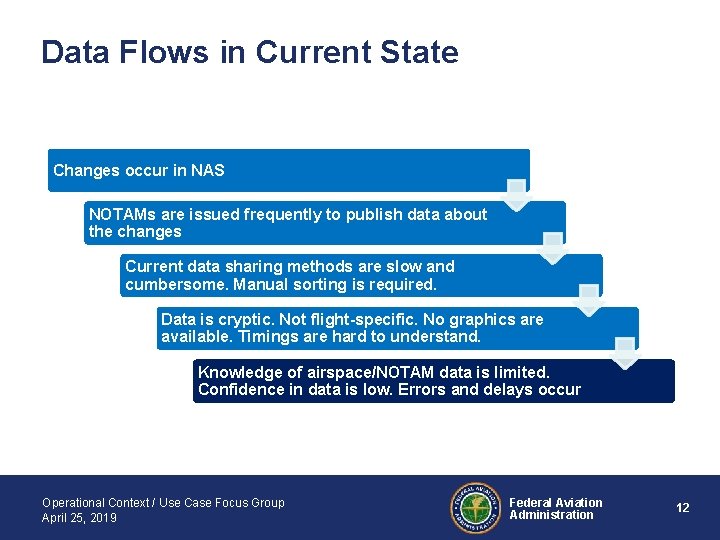
Data Flows in Current State Changes occur in NAS NOTAMs are issued frequently to publish data about the changes Current data sharing methods are slow and cumbersome. Manual sorting is required. Data is cryptic. Not flight-specific. No graphics are available. Timings are hard to understand. Knowledge of airspace/NOTAM data is limited. Confidence in data is low. Errors and delays occur Operational Context / Use Case Focus Group April 25, 2019 Federal Aviation Administration 12
Overview of Use Case • AUs must understand airspace constraints and NOTAMS • Thorough flight planning – including understanding NOTAMs and airspace constraints – is critical • Much data is available • Accessing pertinent and timely data is currently a challenge • The lack of knowledge about airspace constraints or NOTAM activities may result in: – – – Increased Risk Incident Safety concerns Less efficient flight Violation of a FAR Operational Context / Use Case Focus Group April 25, 2019 Federal Aviation Administration 13
Aeronautical SWIM Services • SWIM Flight Data Publication Service (SFDPS) Airspace data – – Special Activity Airspace (SAA) Prohibited areas: Areas where flight is prohibited. Restricted Areas: Areas where flight access is sometimes restricted. Temporary Flight Restrictions (TFR) Areas: Flights are limited due to VIP movement, security • Federal NOTAM System (FNS) NOTAM Distribution Service (NDS) – NOTAMs are notices about information essential to flight operations – Disseminate changes about facilities, services, procedures, or hazards in the NAS – Data is transitory-not known far enough in advance to be published by other means Operational Context / Use Case Focus Group April 25, 2019 Federal Aviation Administration 14
Departure Operations in Current State • Before departure, flight crews are given several pages of NOTAMS • Flight crew must manually sort through data • Flight crews have too much data and insufficient clarity – Cryptic language makes understanding difficult – Absence of graphics makes understanding location of constraints and obstacles difficult – Timings are difficult to determine • Results in flight crews having limited understanding of impacts • Vendor-provided products may provide some NOTAMs visually, but solutions are incomplete Operational Context / Use Case Focus Group April 25, 2019 Federal Aviation Administration 15
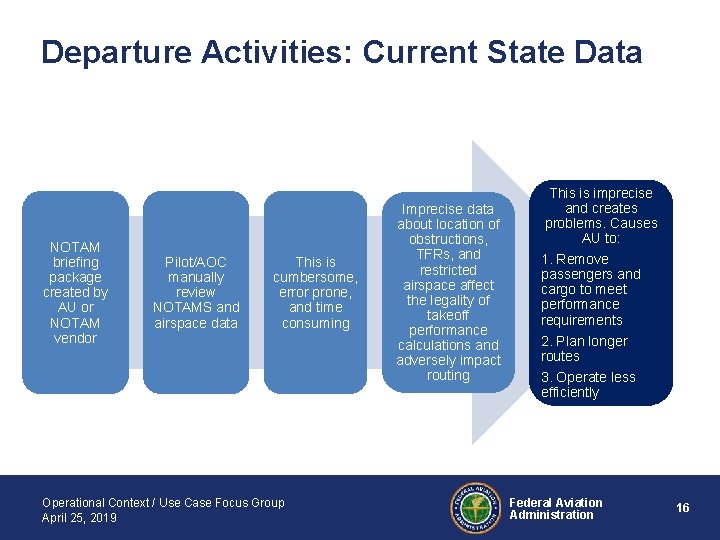
Departure Activities: Current State Data NOTAM briefing package created by AU or NOTAM vendor Pilot/AOC manually review NOTAMS and airspace data This is cumbersome, error prone, and time consuming Operational Context / Use Case Focus Group April 25, 2019 Imprecise data about location of obstructions, TFRs, and restricted airspace affect the legality of takeoff performance calculations and adversely impact routing This is imprecise and creates problems. Causes AU to: 1. Remove passengers and cargo to meet performance requirements 2. Plan longer routes 3. Operate less efficiently Federal Aviation Administration 16
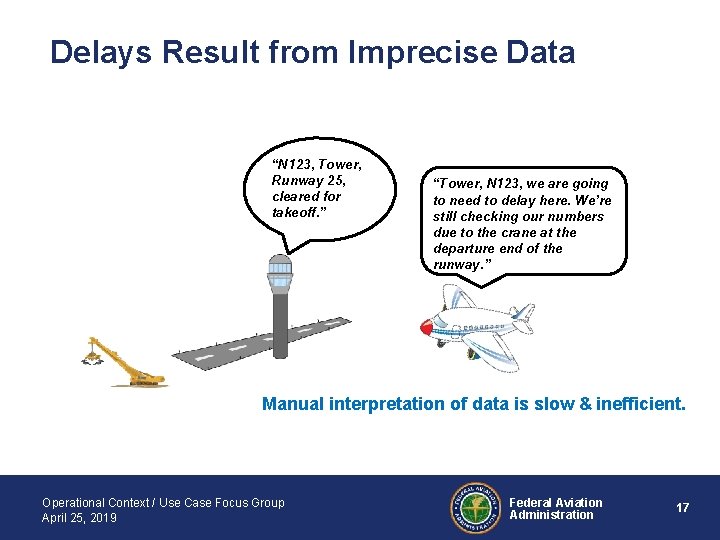
Delays Result from Imprecise Data “N 123, Tower, Runway 25, cleared for takeoff. ” “Tower, N 123, we are going to need to delay here. We’re still checking our numbers due to the crane at the departure end of the runway. ” Manual interpretation of data is slow & inefficient. Operational Context / Use Case Focus Group April 25, 2019 Federal Aviation Administration 17
En Route Operations in Current State • Sometimes SAA is activated or deactivated without AU knowledge • If SAA is activated and AU is unaware, tactical reroutes occur • If planned SAA activity is cancelled, stakeholders could benefit by flying more efficient routes, but often are unaware • Either situation has negative impact on regulatory compliance and efficiency – Unplanned or unnecessary deviations around airspace – Use of less efficient arrival or departure routes – Increased flight crew and controller workload at critical times Operational Context / Use Case Focus Group April 25, 2019 Federal Aviation Administration 18
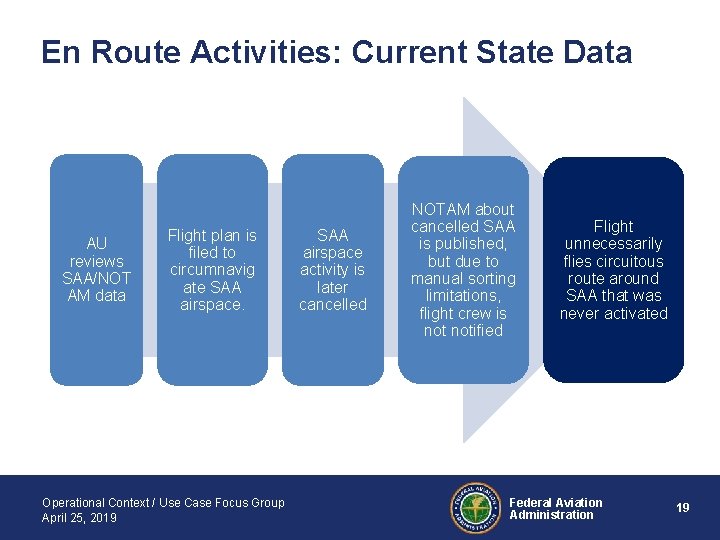
En Route Activities: Current State Data AU reviews SAA/NOT AM data Flight plan is filed to circumnavig ate SAA airspace. Operational Context / Use Case Focus Group April 25, 2019 SAA airspace activity is later cancelled NOTAM about cancelled SAA is published, but due to manual sorting limitations, flight crew is notified Flight unnecessarily flies circuitous route around SAA that was never activated Federal Aviation Administration 19
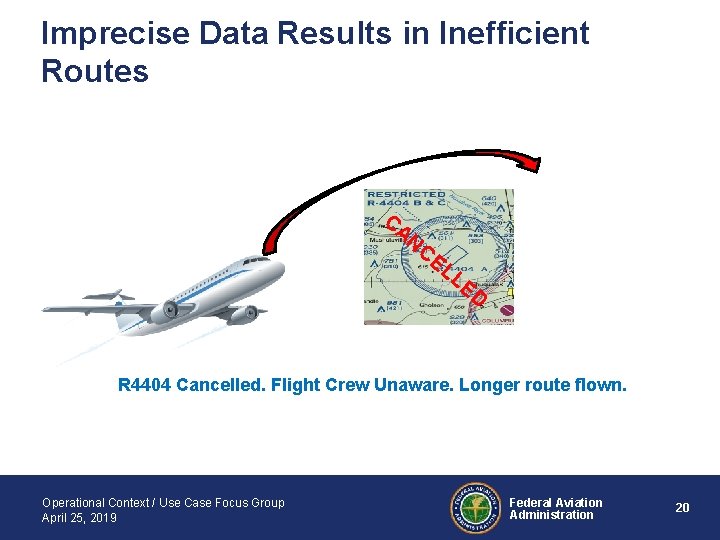
Imprecise Data Results in Inefficient Routes CA NC EL LE D R 4404 Cancelled. Flight Crew Unaware. Longer route flown. Operational Context / Use Case Focus Group April 25, 2019 Federal Aviation Administration 20
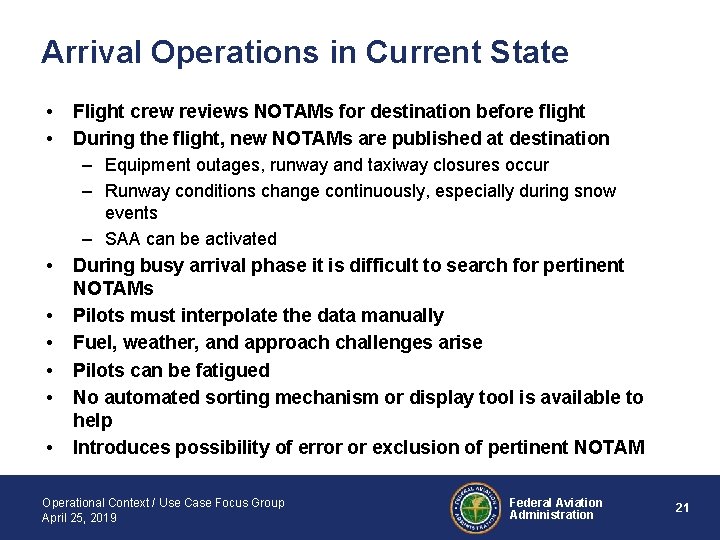
Arrival Operations in Current State • • Flight crew reviews NOTAMs for destination before flight During the flight, new NOTAMs are published at destination – Equipment outages, runway and taxiway closures occur – Runway conditions change continuously, especially during snow events – SAA can be activated • • • During busy arrival phase it is difficult to search for pertinent NOTAMs Pilots must interpolate the data manually Fuel, weather, and approach challenges arise Pilots can be fatigued No automated sorting mechanism or display tool is available to help Introduces possibility of error or exclusion of pertinent NOTAM Operational Context / Use Case Focus Group April 25, 2019 Federal Aviation Administration 21
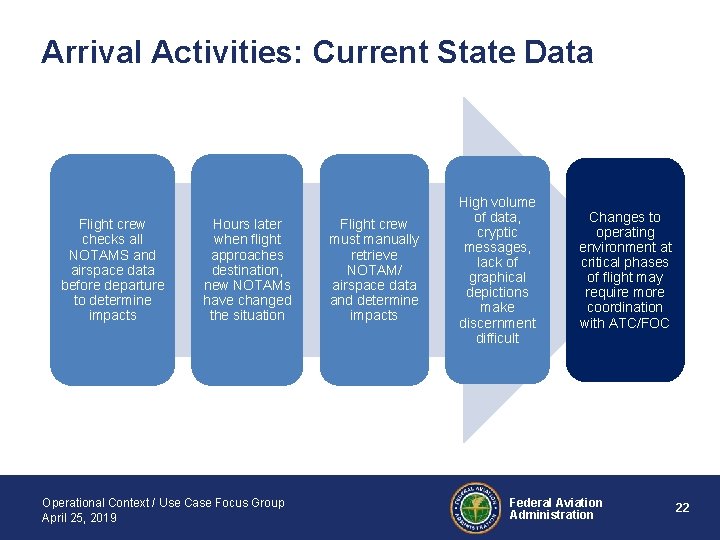
Arrival Activities: Current State Data Flight crew checks all NOTAMS and airspace data before departure to determine impacts Hours later when flight approaches destination, new NOTAMs have changed the situation Operational Context / Use Case Focus Group April 25, 2019 Flight crew must manually retrieve NOTAM/ airspace data and determine impacts High volume of data, cryptic messages, lack of graphical depictions make discernment difficult Changes to operating environment at critical phases of flight may require more coordination with ATC/FOC Federal Aviation Administration 22
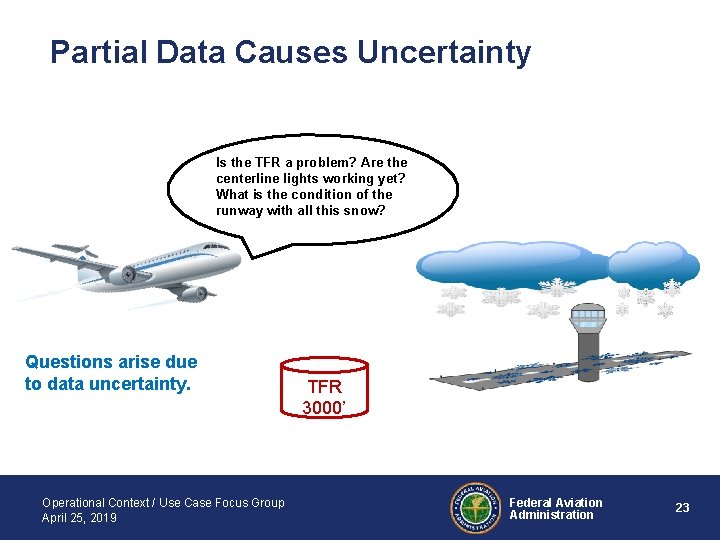
Partial Data Causes Uncertainty Is the TFR a problem? Are the centerline lights working yet? What is the condition of the runway with all this snow? Questions arise due to data uncertainty. Operational Context / Use Case Focus Group April 25, 2019 TFR 3000’ Federal Aviation Administration 23
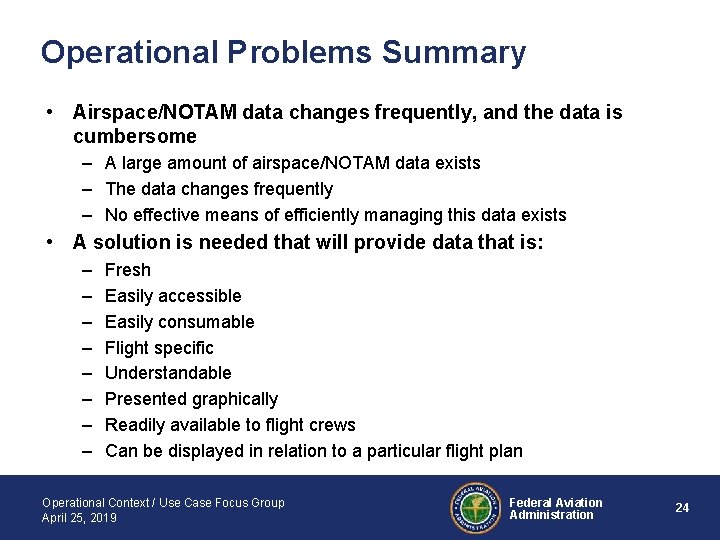
Operational Problems Summary • Airspace/NOTAM data changes frequently, and the data is cumbersome – A large amount of airspace/NOTAM data exists – The data changes frequently – No effective means of efficiently managing this data exists • A solution is needed that will provide data that is: – – – – Fresh Easily accessible Easily consumable Flight specific Understandable Presented graphically Readily available to flight crews Can be displayed in relation to a particular flight plan Operational Context / Use Case Focus Group April 25, 2019 Federal Aviation Administration 24
Overview of Future State Operations • Stakeholders will access SFDPS airspace/FNS data via SWIM • Airspace/FNS data will be shared in a machine-readable format • Stakeholders will receive current and planned activities and changes • Access to schedules, locations, boundaries will be improved • Graphical depictions of impacts will enhance understanding • AUs can determine the status, timing and impacts in all phases of flight • Flight crews will have access via EFB application • Situational awareness will increase with less uncertainty • AUs will be able to devise more effective solutions • Fewer tactical interventions will be needed Operational Context / Use Case Focus Group April 25, 2019 Federal Aviation Administration 25
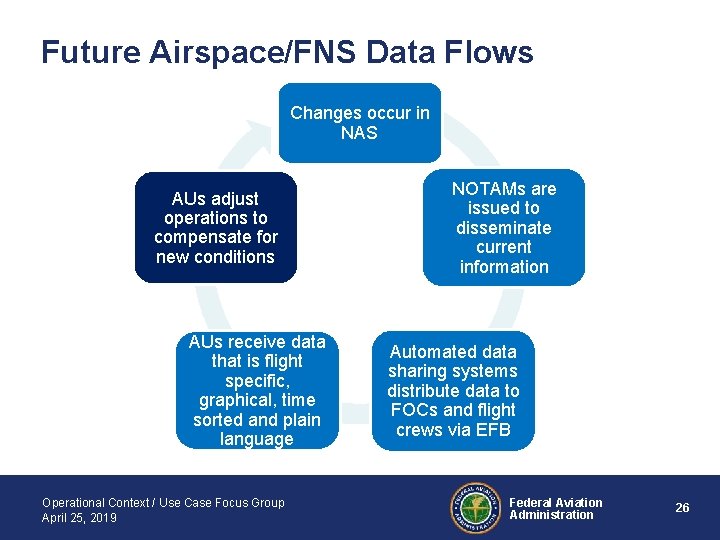
Future Airspace/FNS Data Flows Changes occur in NAS AUs adjust operations to compensate for new conditions AUs receive data that is flight specific, graphical, time sorted and plain language Operational Context / Use Case Focus Group April 25, 2019 NOTAMs are issued to disseminate current information Automated data sharing systems distribute data to FOCs and flight crews via EFB Federal Aviation Administration 26
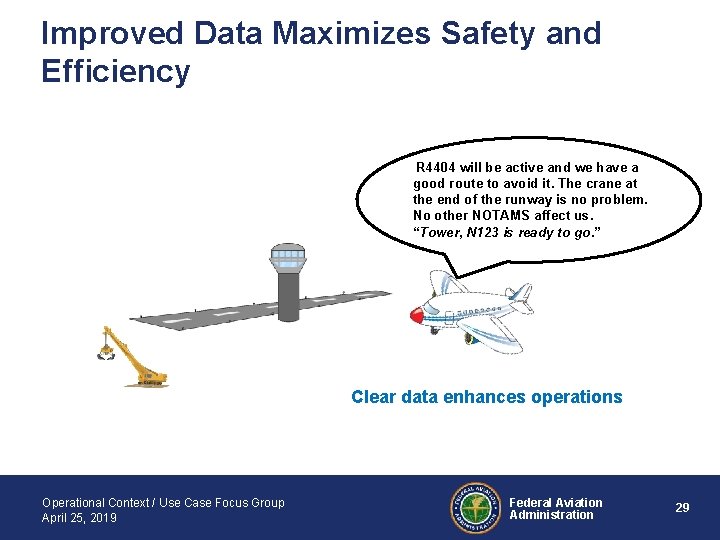
Departure Operations in Future State • Before flight, airspace/FNS data presented to AOC and flight crew on EFB • Data is flight-specific and sorted for relevance • Textual descriptions are in plain language • Graphic depictions are displayed for easier understanding • Activation times are coded for easy understanding • Locations of obstacles are plainly displayed • No plotting is required • No manual calculation of times is required • Confidence in having thorough airspace/FNS understanding goes up • Flight planning is simplified and more efficient • Routes are appropriate for situation Operational Context / Use Case Focus Group April 25, 2019 Federal Aviation Administration 27
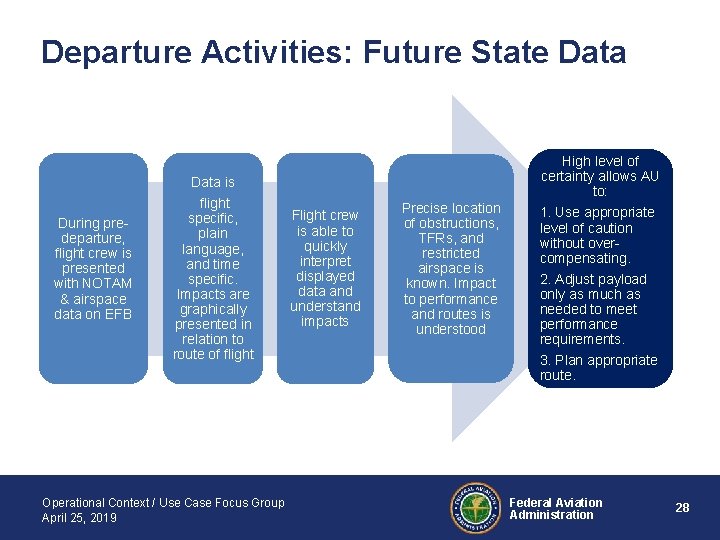
Departure Activities: Future State Data High level of certainty allows AU to: Data is During predeparture, flight crew is presented with NOTAM & airspace data on EFB flight specific, plain language, and time specific. Impacts are graphically presented in relation to route of flight Operational Context / Use Case Focus Group April 25, 2019 Flight crew is able to quickly interpret displayed data and understand impacts Precise location of obstructions, TFRs, and restricted airspace is known. Impact to performance and routes is understood 1. Use appropriate level of caution without overcompensating. 2. Adjust payload only as much as needed to meet performance requirements. 3. Plan appropriate route. Federal Aviation Administration 28
Improved Data Maximizes Safety and Efficiency R 4404 will be active and we have a good route to avoid it. The crane at the end of the runway is no problem. No other NOTAMS affect us. “Tower, N 123 is ready to go. ” Clear data enhances operations Operational Context / Use Case Focus Group April 25, 2019 Federal Aviation Administration 29
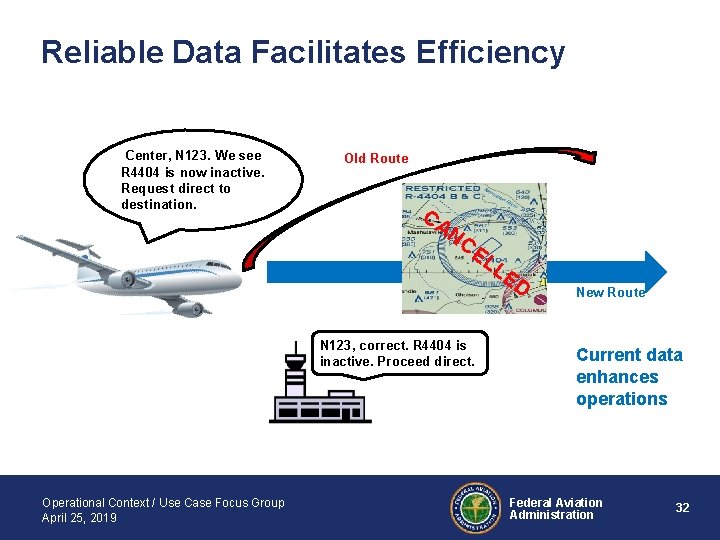
En Route Operations in Future State • As flight progresses, airspace/FNS data is continuously monitored by automated system • Alerting mechanisms will notify pilot of changes on EFB • Enroute and destination conditions will be monitored • Current activities and changes will be displayed on moving map display • More time available to understand impacts and devise solutions Operational Context / Use Case Focus Group April 25, 2019 Federal Aviation Administration 30
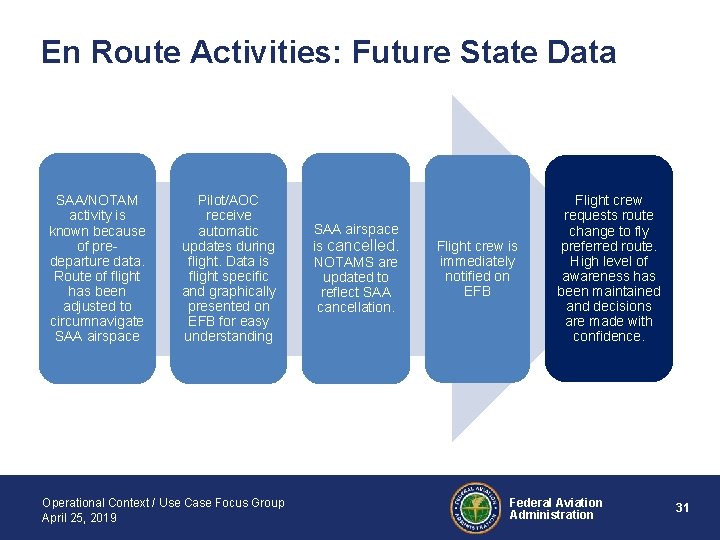
En Route Activities: Future State Data SAA/NOTAM activity is known because of predeparture data. Route of flight has been adjusted to circumnavigate SAA airspace Pilot/AOC receive automatic updates during flight. Data is flight specific and graphically presented on EFB for easy understanding Operational Context / Use Case Focus Group April 25, 2019 SAA airspace is cancelled. NOTAMS are updated to reflect SAA cancellation. Flight crew is immediately notified on EFB Flight crew requests route change to fly preferred route. High level of awareness has been maintained and decisions are made with confidence. Federal Aviation Administration 31
Reliable Data Facilitates Efficiency Center, N 123. We see R 4404 is now inactive. Request direct to destination. Old Route CA NC EL LE D N 123, correct. R 4404 is inactive. Proceed direct. Operational Context / Use Case Focus Group April 25, 2019 New Route Current data enhances operations Federal Aviation Administration 32
Arrival Operations in Future State • During a flight, NOTAMs change • Equipment outages, runway and taxiway closures occur • Runway conditions change often, especially during snow events. • Flight crews will have sorted airspace/FNS data available on EFB • Configurable alerts on EFB will notify flight crews of changes • Airspace/FNS data will be presented graphically to aid understanding • Pertinent times will be displayed • Reduces heads-down time in cockpit • Ensures pilots have current data • Improves confidence Operational Context / Use Case Focus Group April 25, 2019 Federal Aviation Administration 33
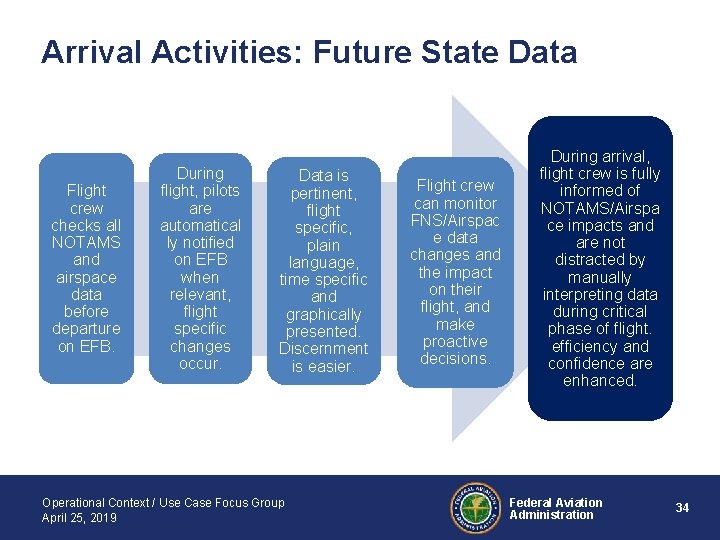
Arrival Activities: Future State Data Flight crew checks all NOTAMS and airspace data before departure on EFB. During flight, pilots are automatical ly notified on EFB when relevant, flight specific changes occur. Data is pertinent, flight specific, plain language, time specific and graphically presented. Discernment is easier. Operational Context / Use Case Focus Group April 25, 2019 Flight crew can monitor FNS/Airspac e data changes and the impact on their flight, and make proactive decisions. During arrival, flight crew is fully informed of NOTAMS/Airspa ce impacts and are not distracted by manually interpreting data during critical phase of flight. efficiency and confidence are enhanced. Federal Aviation Administration 34
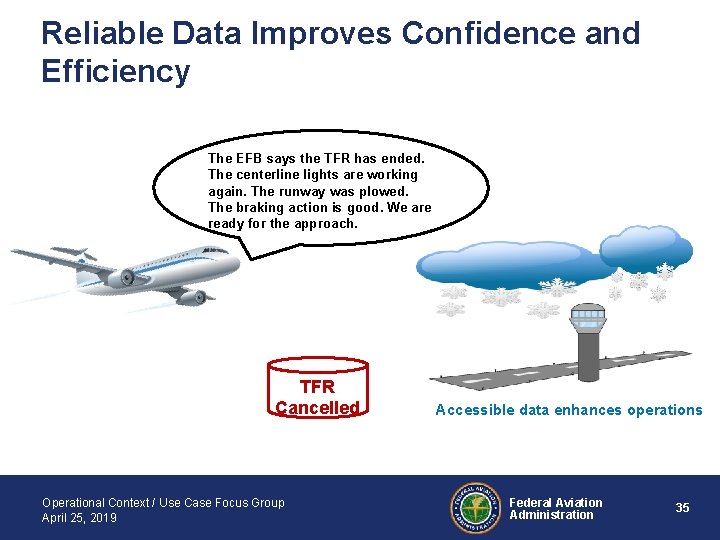
Reliable Data Improves Confidence and Efficiency The EFB says the TFR has ended. The centerline lights are working again. The runway was plowed. The braking action is good. We are ready for the approach. TFR Cancelled Operational Context / Use Case Focus Group April 25, 2019 Accessible data enhances operations Federal Aviation Administration 35
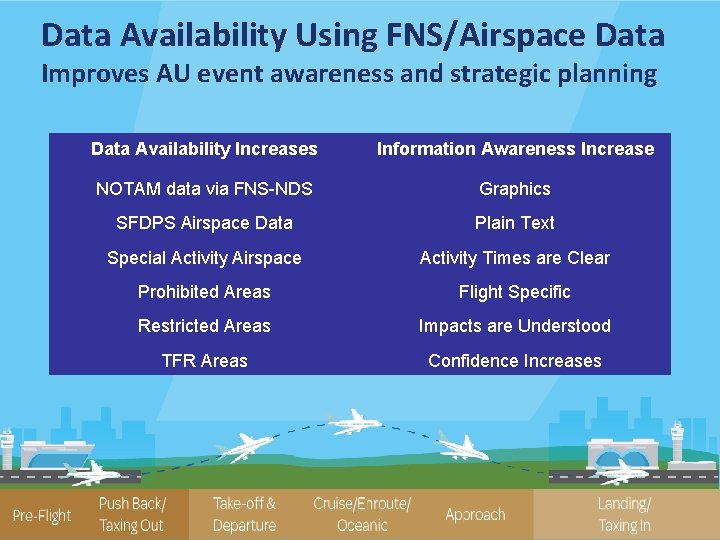
Data Availability Using FNS/Airspace Data Improves AU event awareness and strategic planning Data Availability Increases Information Awareness Increase NOTAM data via FNS-NDS Graphics SFDPS Airspace Data Plain Text Special Activity Airspace Activity Times are Clear Prohibited Areas Flight Specific Restricted Areas Impacts are Understood TFR Areas Confidence Increases Operational Context / Use Case Focus Group April 25, 2019 Federal Aviation Administration 36
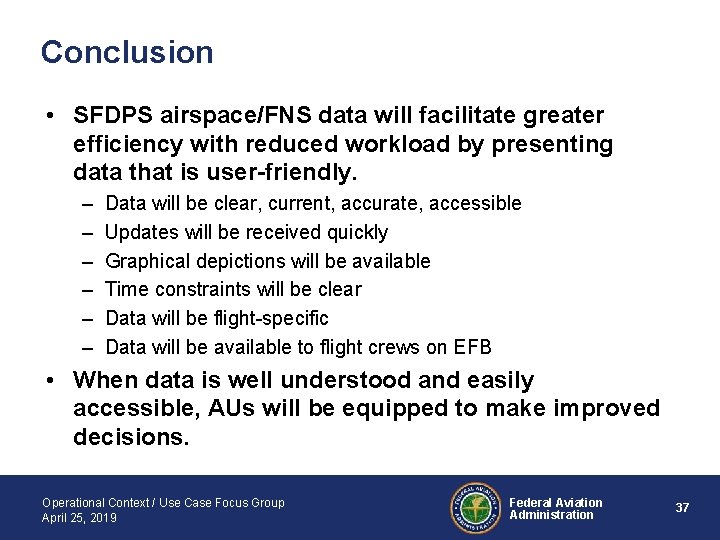
Conclusion • SFDPS airspace/FNS data will facilitate greater efficiency with reduced workload by presenting data that is user-friendly. – – – Data will be clear, current, accurate, accessible Updates will be received quickly Graphical depictions will be available Time constraints will be clear Data will be flight-specific Data will be available to flight crews on EFB • When data is well understood and easily accessible, AUs will be equipped to make improved decisions. Operational Context / Use Case Focus Group April 25, 2019 Federal Aviation Administration 37
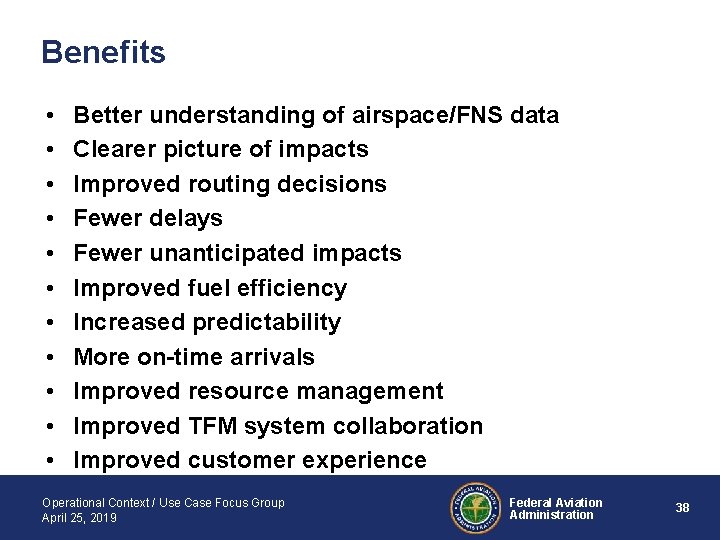
Benefits • • • Better understanding of airspace/FNS data Clearer picture of impacts Improved routing decisions Fewer delays Fewer unanticipated impacts Improved fuel efficiency Increased predictability More on-time arrivals Improved resource management Improved TFM system collaboration Improved customer experience Operational Context / Use Case Focus Group April 25, 2019 Federal Aviation Administration 38
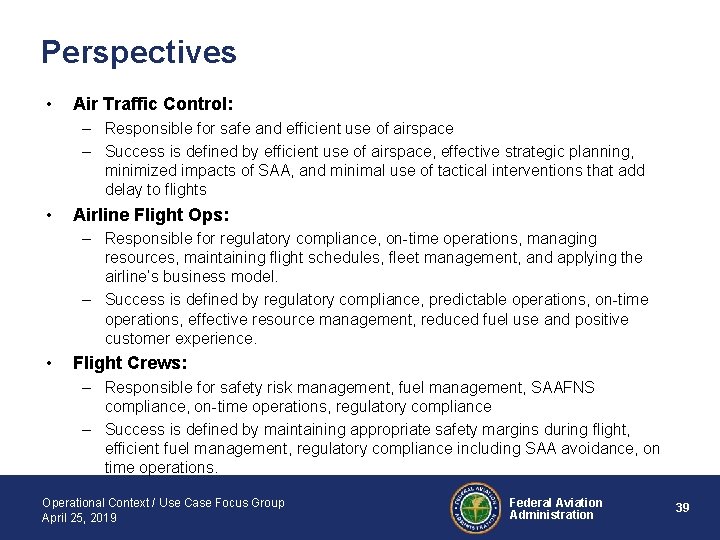
Perspectives • Air Traffic Control: – Responsible for safe and efficient use of airspace – Success is defined by efficient use of airspace, effective strategic planning, minimized impacts of SAA, and minimal use of tactical interventions that add delay to flights • Airline Flight Ops: – Responsible for regulatory compliance, on-time operations, managing resources, maintaining flight schedules, fleet management, and applying the airline’s business model. – Success is defined by regulatory compliance, predictable operations, on-time operations, effective resource management, reduced fuel use and positive customer experience. • Flight Crews: – Responsible for safety risk management, fuel management, SAAFNS compliance, on-time operations, regulatory compliance – Success is defined by maintaining appropriate safety margins during flight, efficient fuel management, regulatory compliance including SAA avoidance, on time operations. Operational Context / Use Case Focus Group April 25, 2019 Federal Aviation Administration 39
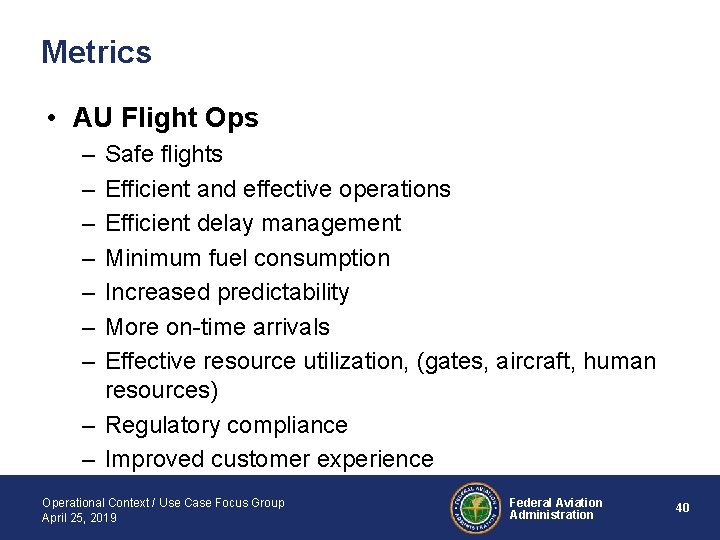
Metrics • AU Flight Ops – – – – Safe flights Efficient and effective operations Efficient delay management Minimum fuel consumption Increased predictability More on-time arrivals Effective resource utilization, (gates, aircraft, human resources) – Regulatory compliance – Improved customer experience Operational Context / Use Case Focus Group April 25, 2019 Federal Aviation Administration 40
Metrics • Flight Crews – – – – Improved awareness of airspace/FNS data High level of confidence in data Improved safety risk management Regulatory compliance Efficient routings Minimum fuel consumption On-time operations Improved customer experience Operational Context / Use Case Focus Group April 25, 2019 Federal Aviation Administration 41
Metrics • Air Traffic Control – – – – Safer flight operations Maximum airspace usage Minimum impacts from SAA/NOTAMs Fewer tactical interventions needed Effective traffic management initiatives Effective delay management Effective collaboration with AUs Operational Context / Use Case Focus Group April 25, 2019 Federal Aviation Administration 42
References • SWIFT Focus Group Website – http: //connect. lstechllc. com/index. cfm/main/opconfocusgroup • Meteorological Use Case Document v 1. 0 – Final – http: //connect. lstechllc. com/files/SWIM%20 Meteorological%20 Use%20 Case%20 v 1. 0_2019_04_2 4_Final. docx • Next meeting is scheduled for May 23, 2019 – the day after the SWIFT – Suggest moving this date 1 week later to May 30, 2019 – Will present Aeronautical Use Case – Please have Aeronautical SMEs available for comment • Contacts – Jay Zimmer (jay. zimmer@lstechllc. com) – Felisa White (felisa. white@faa. gov) Operational Context / Use Case Focus Group April 25, 2019 Federal Aviation Administration 43