
Operational Amplifier opamp Opamp is an integrated circuit


- Slides: 31
Operational Amplifier (op-amp) • Op-amp is an integrated circuit that contains about 20 transistors together with resistors and capacitors & encapsulated • Operational Amplifier - An operational amplifier (op amp) is a high gain differential amplifier with nearly ideal external characteristics. Internally the op amp is constructed using many transistors. norashikin/op-amp/group 3 1
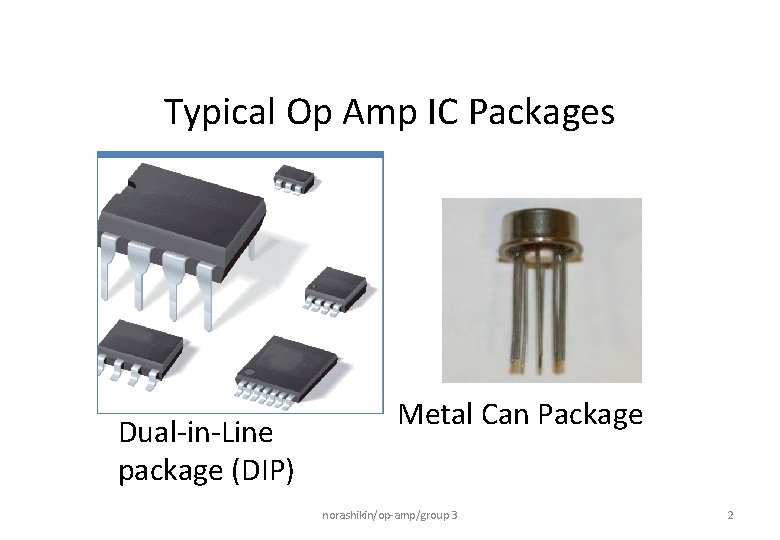
Typical Op Amp IC Packages Dual-in-Line package (DIP) Metal Can Package norashikin/op-amp/group 3 2
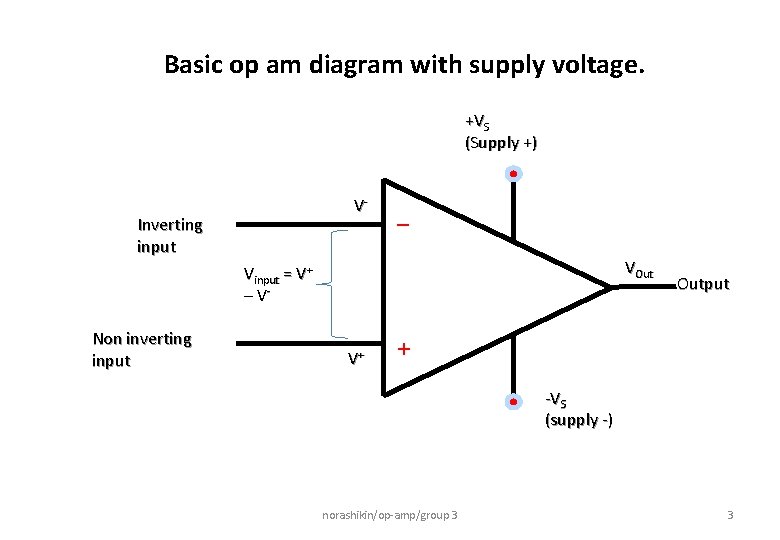
Basic op am diagram with supply voltage. +VS (Supply +) V- Inverting input _ VOut Vinput = V+ – VNon inverting input V+ Output + -VS (supply -) norashikin/op-amp/group 3 3
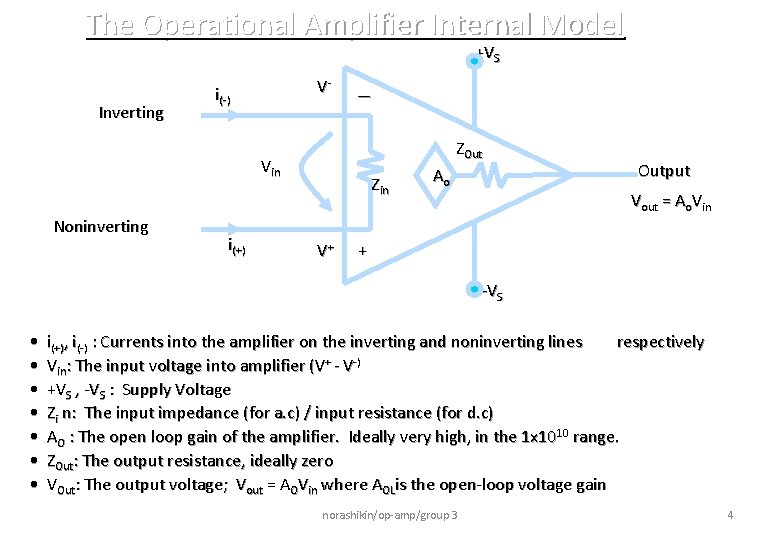
The Operational Amplifier Internal Model +VS Inverting V- i(-) _ ZOut Vin Noninverting i(+) Zin V+ Ao Output Vout = Ao. Vin + -VS • • i(+), i(-) : Currents into the amplifier on the inverting and noninverting lines respectively Vin: The input voltage into amplifier (V+ - V-) +VS , -VS : Supply Voltage Zi n: The input impedance (for a. c) / input resistance (for d. c) AO : The open loop gain of the amplifier. Ideally very high, in the 1 x 10¹⁰ range. ZOut: The output resistance, ideally zero VOut: The output voltage; Vout = AOVin where AOLis the open-loop voltage gain norashikin/op-amp/group 3 4
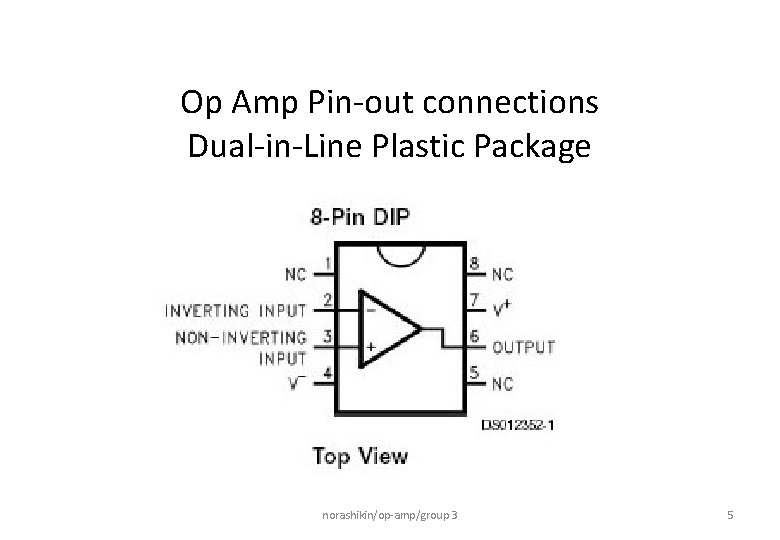
Op Amp Pin-out connections Dual-in-Line Plastic Package norashikin/op-amp/group 3 5
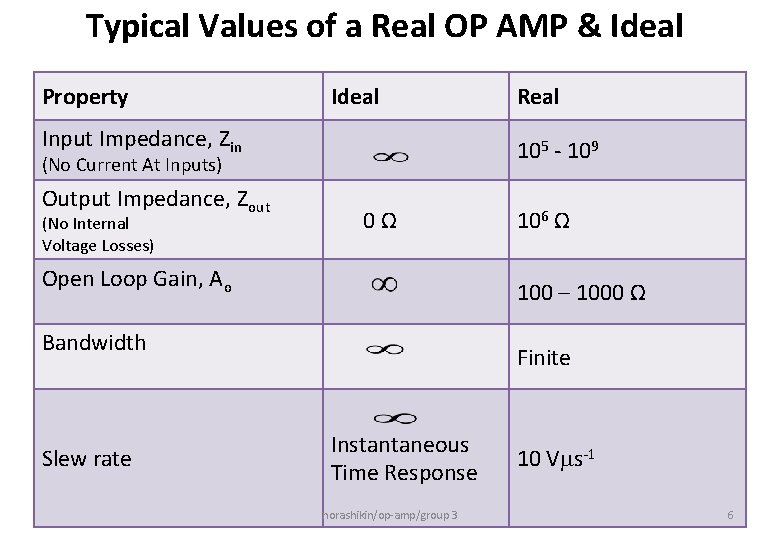
Typical Values of a Real OP AMP & Ideal Property Ideal Input Impedance, Zin 105 - 109 (No Current At Inputs) Output Impedance, Zout (No Internal Voltage Losses) 0Ω Open Loop Gain, Ao 106 Ω 100 – 1000 Ω Bandwidth Slew rate Real Finite Instantaneous Time Response norashikin/op-amp/group 3 10 Vms-1 6
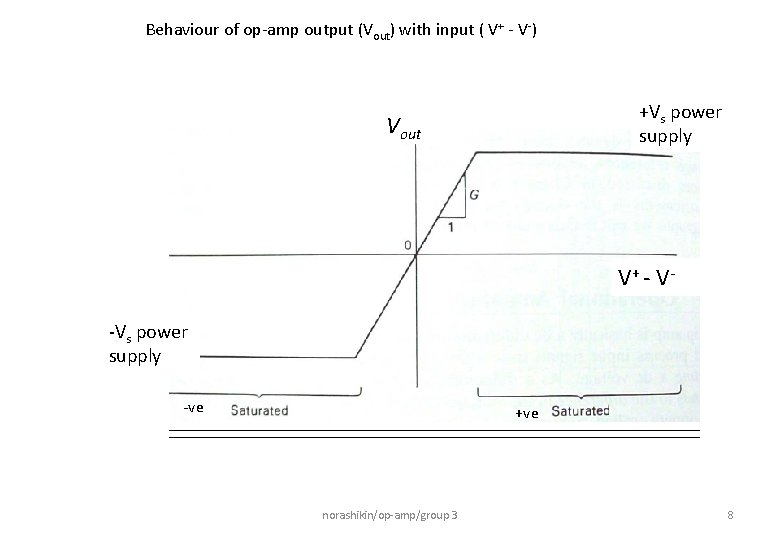
Op-Amp Saturation • In spite of the huge gain, the maximum or minimum output is still limited by the input power. • When the op-amp is at the maximum or minimum extreme, it is said to be saturated • Ideally, the saturation points for an op-amp are equal to the power voltages, in reality they are 1 -2 volts less. norashikin/op-amp/group 3 7
Behaviour of op-amp output (Vout) with input ( V+ - V-) +Vs power supply Vout V+ - V -Vs power supply -ve +ve norashikin/op-amp/group 3 8
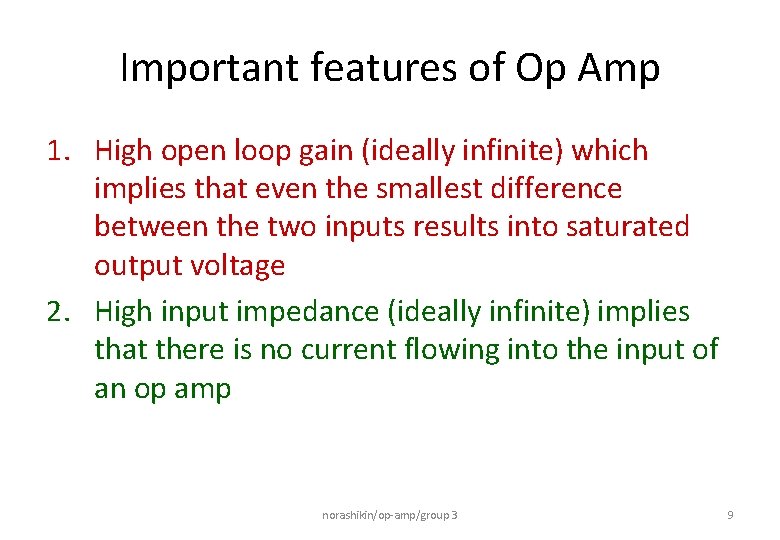
Important features of Op Amp 1. High open loop gain (ideally infinite) which implies that even the smallest difference between the two inputs results into saturated output voltage 2. High input impedance (ideally infinite) implies that there is no current flowing into the input of an op amp norashikin/op-amp/group 3 9
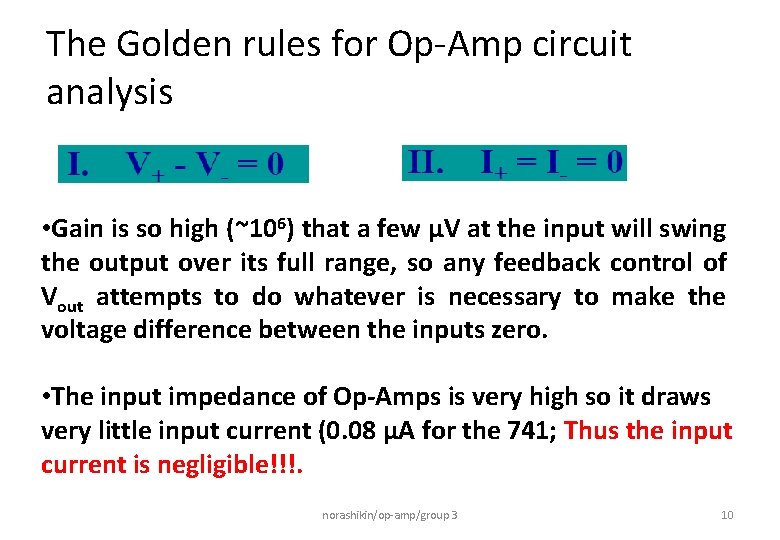
The Golden rules for Op-Amp circuit analysis • Gain is so high (~106) that a few μV at the input will swing the output over its full range, so any feedback control of Vout attempts to do whatever is necessary to make the voltage difference between the inputs zero. • The input impedance of Op-Amps is very high so it draws very little input current (0. 08 μA for the 741; Thus the input current is negligible!!!. norashikin/op-amp/group 3 10
Virtual Ground 1. These two conditions give rise to VIRTUAL GROUND, where the voltages at both the inputs are maintained at exactly same level. V+ = V 2. To achieve this condition, a feedback circuit between the output and the inverting input terminal of the op amp is necessary. 3. This results into many applications of op amp, which qualify it to be OPERATIONAL: adder, subtractor, multiplier, divider etc. norashikin/op-amp/group 3 11
Feedback • Is a process whereby a fraction of the output of any devices is fed back to the input, so as to in control of the devices, usually through resistors norashikin/op-amp/group 3 12
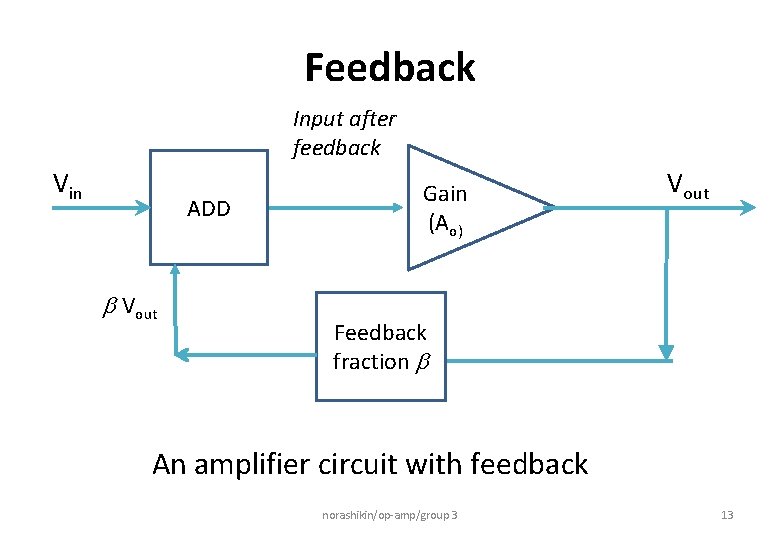
Feedback Input after feedback Vin ADD b Vout Gain (Ao) Vout Feedback fraction b An amplifier circuit with feedback norashikin/op-amp/group 3 13
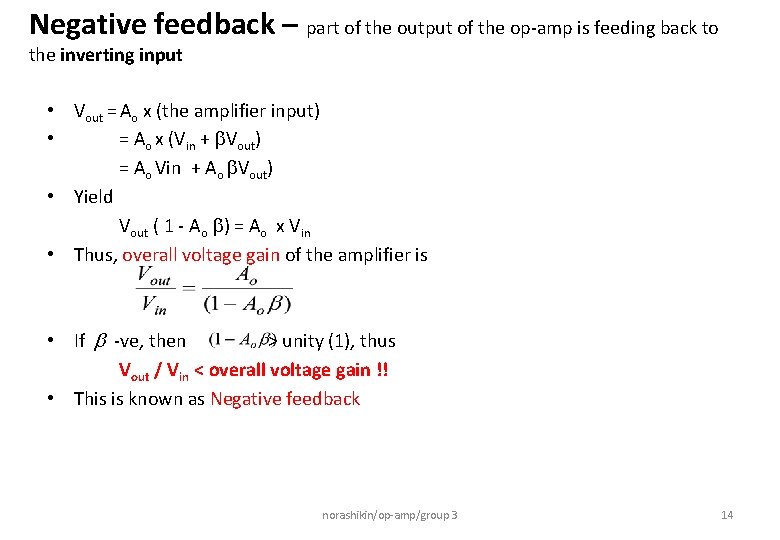
Negative feedback – part of the output of the op-amp is feeding back to the inverting input • Vout = Ao x (the amplifier input) • = Ao x (Vin + b. Vout) = Ao Vin + Ao b. Vout) • Yield Vout ( 1 - Ao b) = Ao x Vin • Thus, overall voltage gain of the amplifier is • If b -ve, then > unity (1), thus Vout / Vin < overall voltage gain !! • This is known as Negative feedback norashikin/op-amp/group 3 14
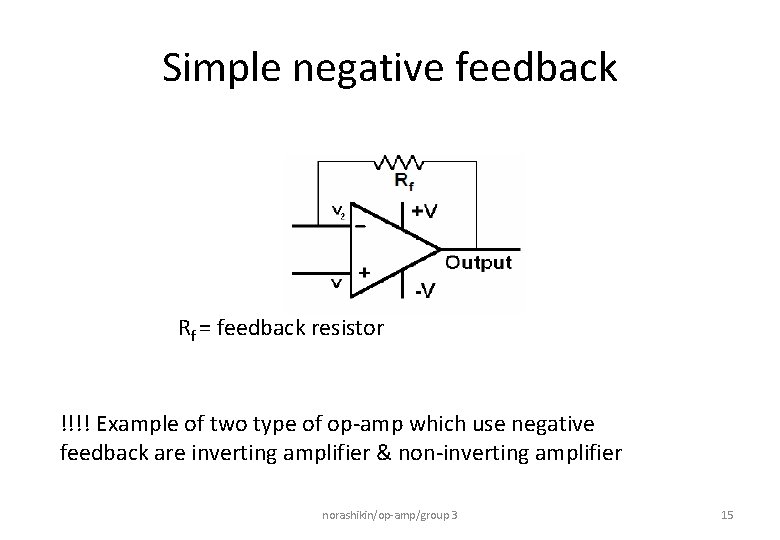
Simple negative feedback Rf = feedback resistor !!!! Example of two type of op-amp which use negative feedback are inverting amplifier & non-inverting amplifier norashikin/op-amp/group 3 15
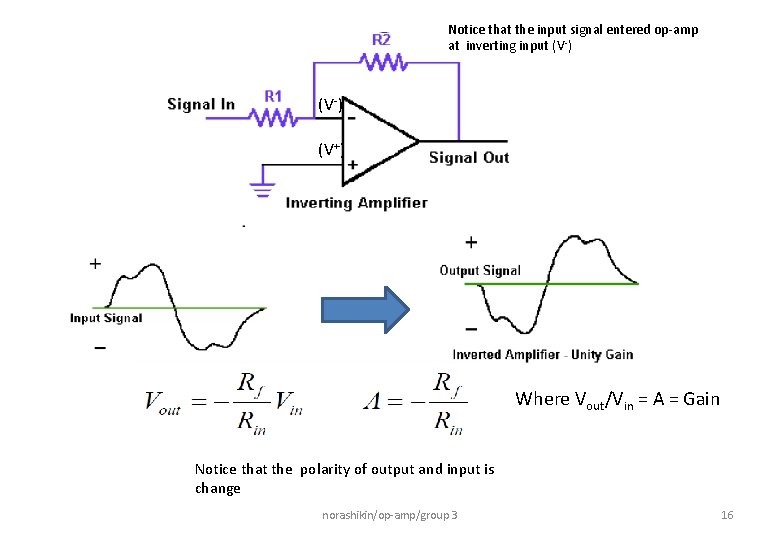
Notice that the input signal entered op-amp at inverting input (V-) (V+) Where Vout/Vin = A = Gain Notice that the polarity of output and input is change norashikin/op-amp/group 3 16
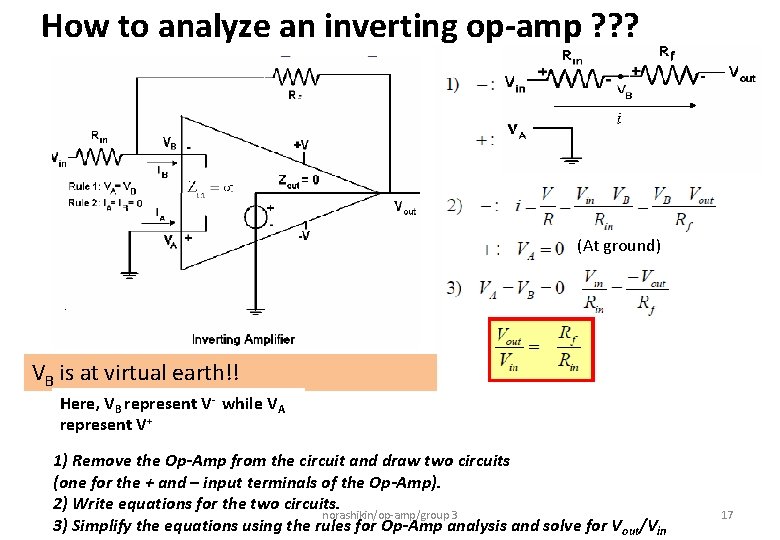
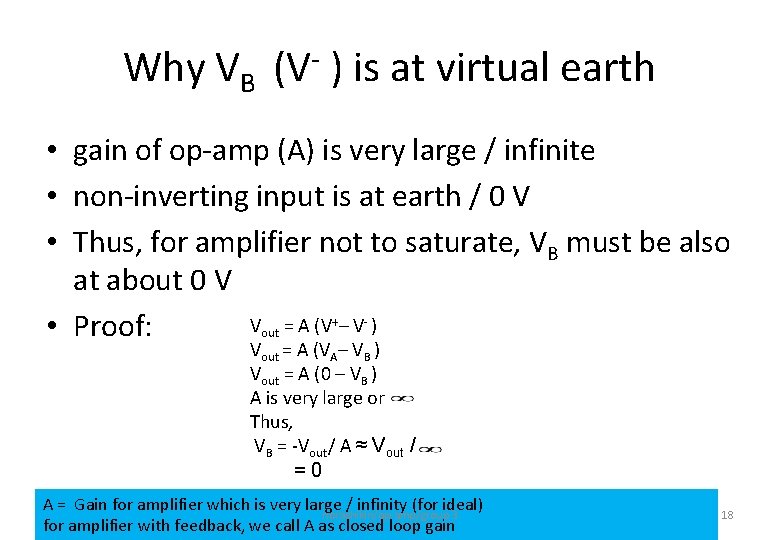
How to analyze an inverting op-amp ? ? ? (At ground) VB is at virtual earth!! Here, VB represent V- while VA represent V+ 1) Remove the Op-Amp from the circuit and draw two circuits (one for the + and – input terminals of the Op-Amp). 2) Write equations for the two circuits. norashikin/op-amp/group 3 3) Simplify the equations using the rules for Op-Amp analysis and solve for Vout/Vin 17
Why VB (V- ) is at virtual earth • gain of op-amp (A) is very large / infinite • non-inverting input is at earth / 0 V • Thus, for amplifier not to saturate, VB must be also at about 0 V Vout = A (V+– V- ) • Proof: Vout = A (VA– VB ) Vout = A (0 – VB ) A is very large or Thus, VB = -Vout/ A ≈ Vout / =0 A = Gain for amplifier which is very large / infinity (for ideal) norashikin/op-amp/group 3 for amplifier with feedback, we call A as closed loop gain 18
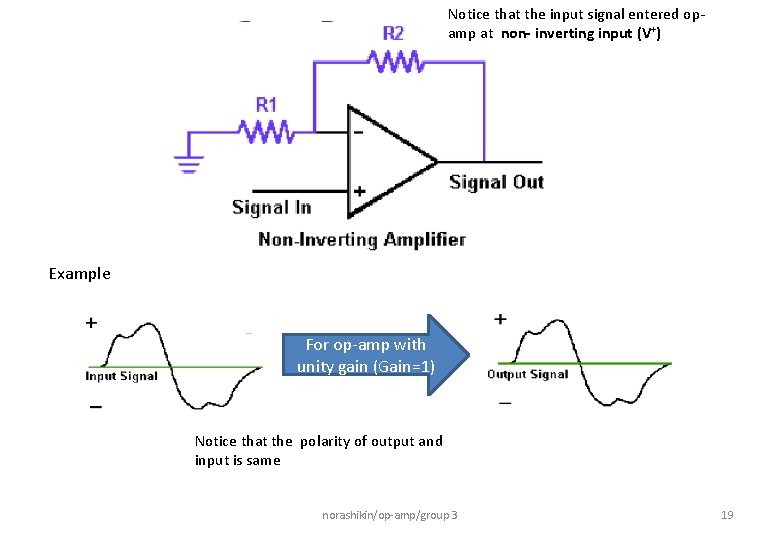
Notice that the input signal entered opamp at non- inverting input (V+) Example For op-amp with unity gain (Gain=1) Notice that the polarity of output and input is same norashikin/op-amp/group 3 19
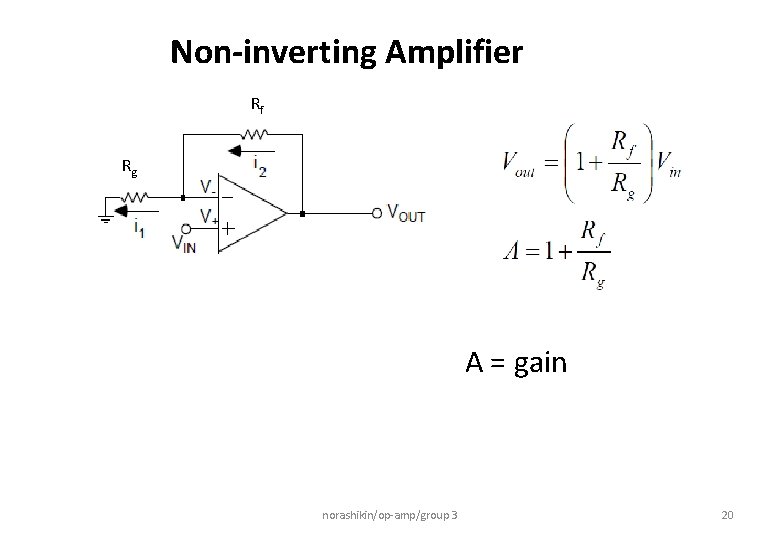
Non-inverting Amplifier Rf Rg A = gain norashikin/op-amp/group 3 20
Negative feedback defeat the object of amplifier? So What? ? Benefits of negative feedback • Increased bandwidth • Less distortion of the output • Greater stability norashikin/op-amp/group 3 21
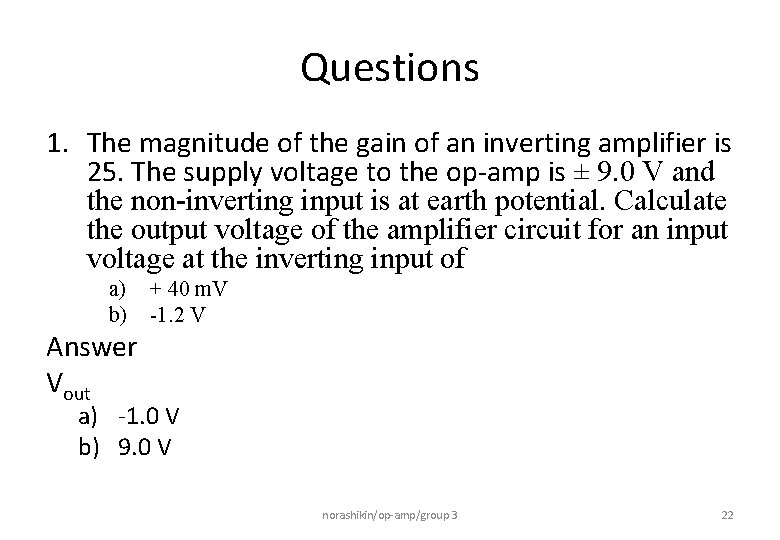
Questions 1. The magnitude of the gain of an inverting amplifier is 25. The supply voltage to the op-amp is ± 9. 0 V and the non-inverting input is at earth potential. Calculate the output voltage of the amplifier circuit for an input voltage at the inverting input of a) + 40 m. V b) -1. 2 V Answer Vout a) -1. 0 V b) 9. 0 V norashikin/op-amp/group 3 22
Output devices • Processing unit (op-amp) produces an output voltage • This voltage is connected across some form of resistor, a current flow in from the op-amp to the resistor • Iout ≤ 25 m. A (avoid op-amp from destroyed) • This resistor also acts as a protector to op-amp from being damaged norashikin/op-amp/group 3 23
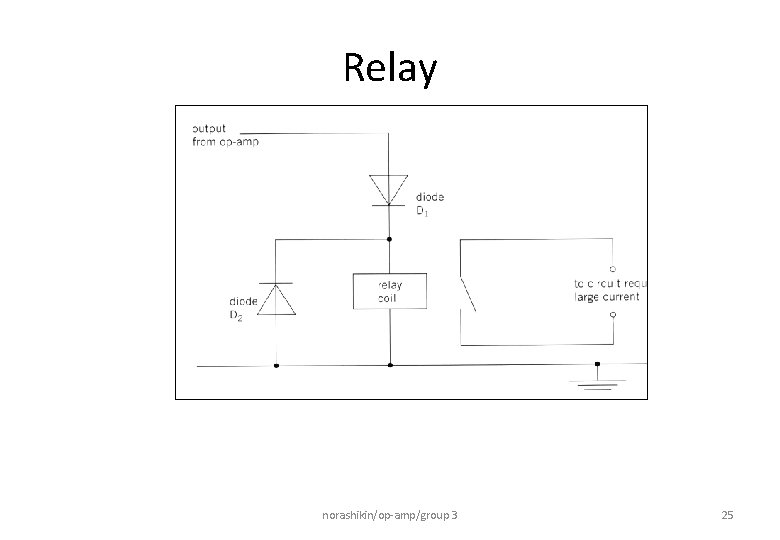
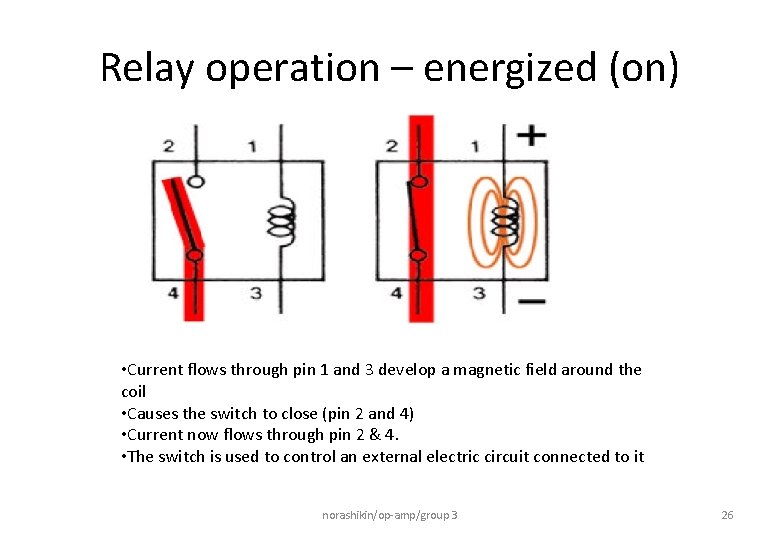
Relay • Relay = electromagnetic switch • When current passes through the coil of electromagnet, the electromagnet operates a switch • This switch is used to switch on/ off a much larger current connected norashikin/op-amp/group 3 24
Relay norashikin/op-amp/group 3 25
Relay operation – energized (on) • Current flows through pin 1 and 3 develop a magnetic field around the coil • Causes the switch to close (pin 2 and 4) • Current now flows through pin 2 & 4. • The switch is used to control an external electric circuit connected to it norashikin/op-amp/group 3 26
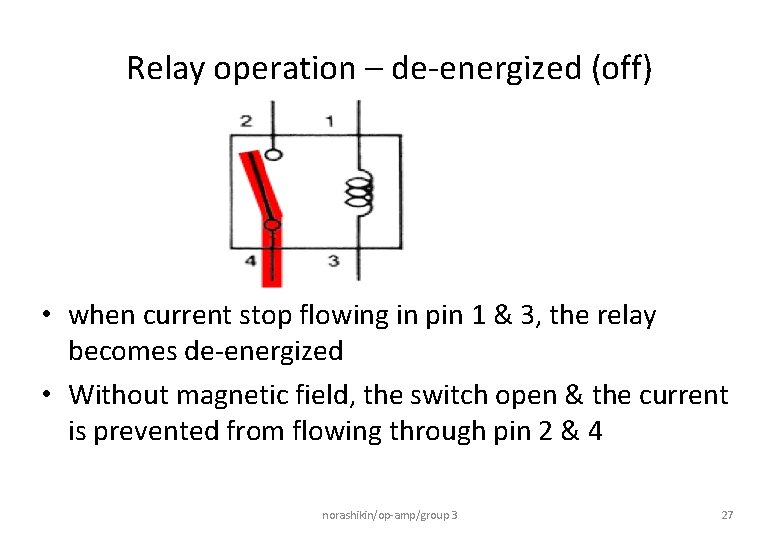
Relay operation – de-energized (off) • when current stop flowing in pin 1 & 3, the relay becomes de-energized • Without magnetic field, the switch open & the current is prevented from flowing through pin 2 & 4 norashikin/op-amp/group 3 27
Relay on open switch üWhen switch is open, current stops flowing through the control circuit coil üThe magnetic field around the coil cannot be maintained üAs the magnetic field collapses across the coil, it induces a voltage into itself, creating a reverse polarity voltage of several hundred volts. üThis induces voltage is e. m. f üThis e. m. f could be large enough to damage the op-amp üThus, a diode is connected across the coil to protect the opamp from this e. m. f norashikin/op-amp/group 3 28
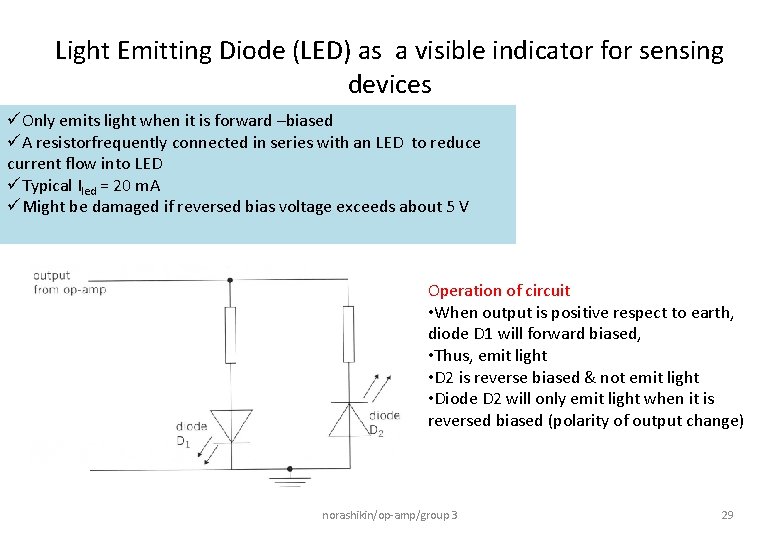
Light Emitting Diode (LED) as a visible indicator for sensing devices üOnly emits light when it is forward –biased üA resistorfrequently connected in series with an LED to reduce current flow into LED üTypical Iled = 20 m. A üMight be damaged if reversed bias voltage exceeds about 5 V Operation of circuit • When output is positive respect to earth, diode D 1 will forward biased, • Thus, emit light • D 2 is reverse biased & not emit light • Diode D 2 will only emit light when it is reversed biased (polarity of output change) norashikin/op-amp/group 3 29
Digital & analogue meters as output devices • LED - may used to indicate the polarity of an output/ used when an op-amp saturates (as such op-amp as a comparator) • When does not saturate, the output can be used to indicate magnitude of whatever is being sensed (as such –level of fuel in tank) • A digital and analogue voltmeter can be connected between the op-amp output & earth will indicate output voltage of an op-amp norashikin/op-amp/group 3 30
Exercises/tutorial 1. 2. 3. 4. Page 398 – exam style questions (please submit) Tutorial 1 Tutorial 2 Past year questions norashikin/op-amp/group 3 31