
Operation Barbarossa Siege of Leningrad Battle of Stalingrad
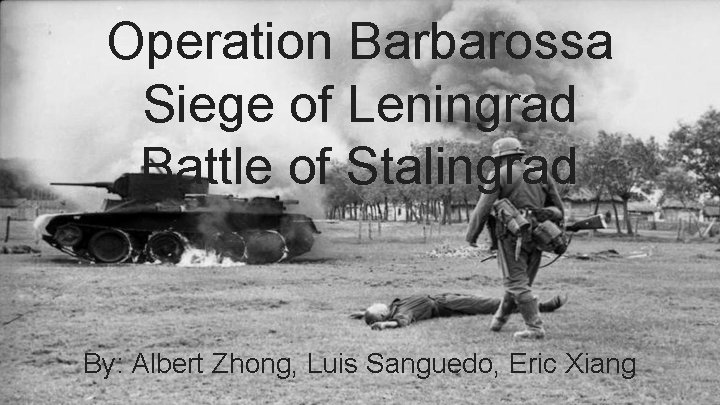
Operation Barbarossa Siege of Leningrad Battle of Stalingrad By: Albert Zhong, Luis Sanguedo, Eric Xiang
Thesis Overconfident from victories on the Western Front and sensing Soviet weakness, Hitler launched Operation Barbarossa to finally carry out his Generalplan Ost of eastward expansion. He would secure the Ukrainian farmlands and Caucasian oilfields: highly valuable resources to the sustain Reich. While Germany enjoyed initial success, the USSR was ultimately able to out-produce and out-number the Nazis during the cold Russian winter. The major cities of Leningrad, Moscow, and Stalingrad did not fall. This was the pivotal turning point of WW 2: the USSR successfully held on the previous invincible German armies, and eventually pushed them all the way back to Berlin, thus ending the war.
Prelude to War Germany had just enjoyed great success against the Allies, Finland held off the Soviets well → Hitler becomes confident for another push Peace with the USSR could not last… Nazism fundamentally required a war in the east: Generalplan Ost demanded an eastward expansion to seize the Ukrainian farmlands The Slavs were seen as racially inferior, and needed to be replaced with German colonists Hitler desperately needed the rich Caucasian oilfields to fuel his war machine The USSR was relatively unprepared, Stalin didn’t believe that Hitler would turn on him this early

"You only have to kick in the door and the whole rotten structure will come crashing down. "
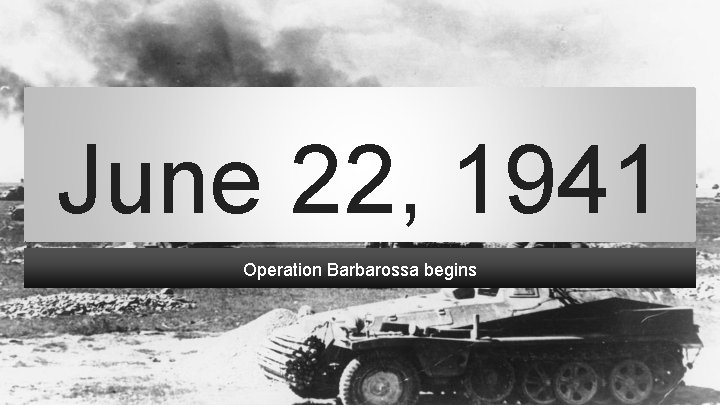
June 22, 1941 Operation Barbarossa begins
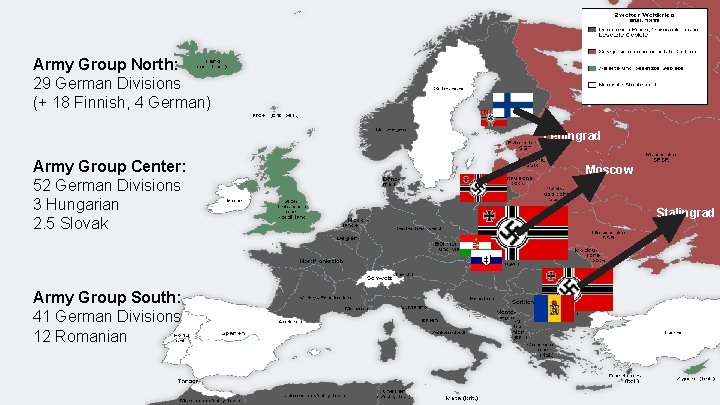
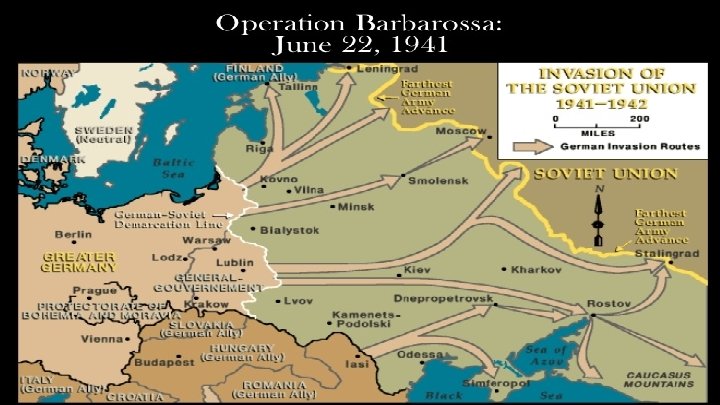
Army Group North: 29 German Divisions (+ 18 Finnish, 4 German) Leningrad Army Group Center: 52 German Divisions 3 Hungarian 2. 5 Slovak Army Group South: 41 German Divisions 12 Romanian Moscow Stalingrad
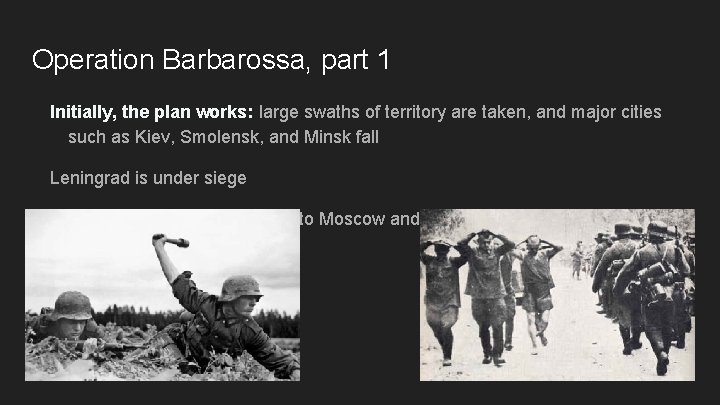
Operation Barbarossa, part 1 Initially, the plan works: large swaths of territory are taken, and major cities such as Kiev, Smolensk, and Minsk fall Leningrad is under siege Germans are ready to march into Moscow and Stalingrad
Operation Barbarossa, part 2 However, the USSR wasn’t ready to give up so easily Stalin launches a massive program to mobilize troops and haul industry to the Urals and get them pumping out tanks The USSR’s size allows them to throw huge amounts of men and weapons at the German threat The infamous Russian winter and scorched-earth policy force the Nazis into an unwinnable attrition war This is the crucial turning point for WW 2: Hitler fails to stomp the
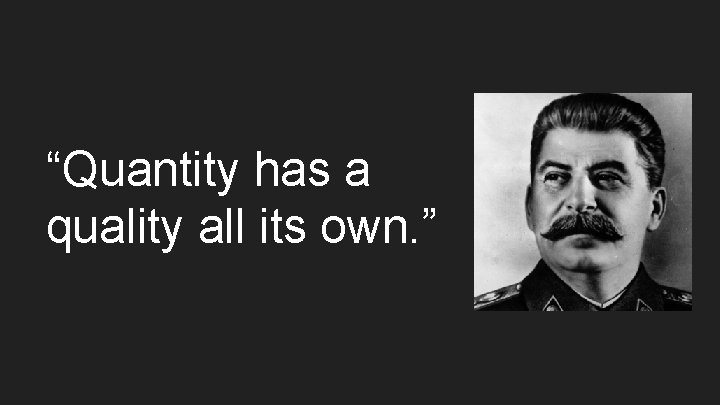
“Quantity has a quality all its own. ”
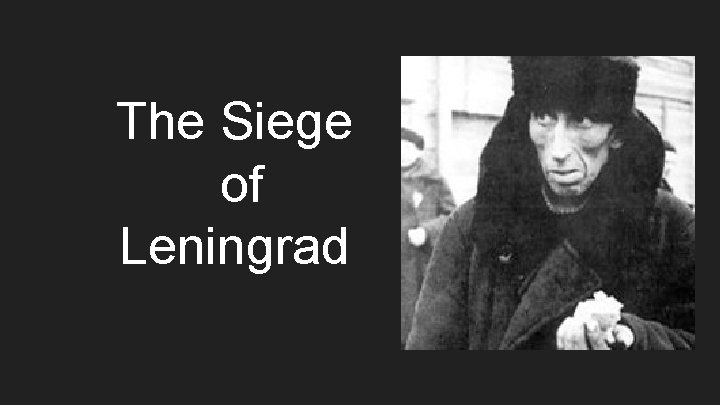
The Siege of Leningrad
Basic Facts: One of Operation Barbarossa’s main goals The loss of Stalingrad would be a major blow to the Soviet Union’s Northern Front vs. Germany’s A. G. N. & Finland’s F. D. F. September 8 th, 1941 - January 18 th, 1943, ~900 days Over 1 million civilian casualties
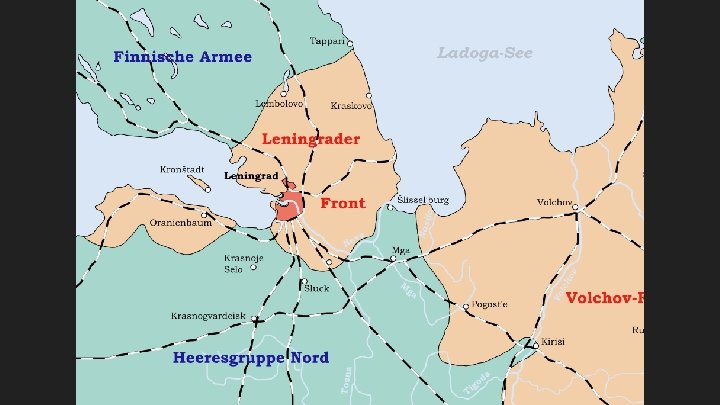
Timeline 1941 August 20 – September 8: Artillery bombardments of Leningrad hit industries, schools, hospitals and civilian houses. September 8: Land encirclement of Leningrad is completed when the German forces reach the shores of Lake Ladoga September 15: von Leeb has to remove the 4 th Panzer Group from the front lines and transfer it to Army Group Center for the Moscow offensive. 1942 June–September: New German railway-mounted artillery bombards Leningrad August 9: The Symphony No. 7 "Leningrad" by Dmitri Shostakovich was performed in the city. August 27: The Soviet Union’s Sinyavino Offense clashes with Germany’s Operation Nordlicht 1943 January 12: Soviet Union initiates their Operation Iskra January 14: Leningrad-Novgorod offensive is put into effect January 18: Siege is officially announced lifted
Russia Fights Back Sinyavino Offensive: August 27, 1942 Stopped Operation Nordlicht First introduction of the Tiger Tanks Operation Iskra: January 12, 1943 Able to overpower German defenses Acquired a land corridor Leningrad-Novgorod Offensive: ● January 14 th, 1944 ● Able to reacquire railroads. ● Expelled troops German troops from Leningrad Oblast
Life During the Siege Horrible conditions: Frozen water pipes denied drinking water Frozen earth didn’t permit the burial of the dead and caused the accumulation of dead bodies The city's population of dogs, cats, horses, rats and crows disappeared as they became the main course on many dinner tables Women were so run down that they stopped menstruating Evidence of cannibalism Cannibalism is not very effective, an average human only has 38% of their body being pure muscle. Also, compared to livestock, their caloric value is significantly lower.
Results “Leningrad was the first city that Hitler failed to take, and that its fall would have given him the Soviet Union’s biggest arms manufacturers, shipyards and steelworks, linked his armies with Finland’s, and allowed him to cut the railway lines carrying Allied aid from the Arctic ports of Archangel and Murmansk” Weakened Germany’s forces substantially Hurt his further advances towards Moscow Germany: 579, 000 casualties Soviet Union: 3, 400, 000 military + 1, 032, 000 civilian casualties
The Battle of Stalingrad “Mini”-thesis: After Operation Barbarossa’s virtually uninhibited advance, in a reckless show of egocentric jingoism, Hitler directed the Heer to capture Stalingrad fueled by his unrelenting desire to ridicule Comrade Stalin. However, Stalingrad was not nearly as important as Moscow or Leningrad from a military perspective for its lack of geographical significance. Hitler’s imprudent concentration of valuable resources far from the Oberkommando’s true strategic objective stretched protection of supply lines which allowed Russia to flank and capture the Germans, marking the first victory for Russia on the Ostfront and Germany’s last battle without a loss, effectively changing the course of the war to end all wars-again.
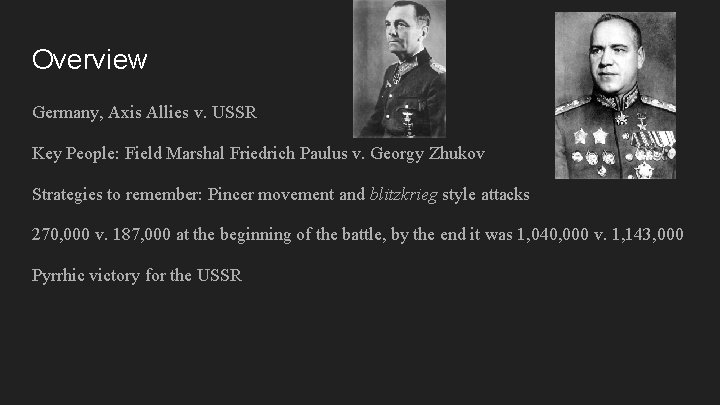
Overview Germany, Axis Allies v. USSR Key People: Field Marshal Friedrich Paulus v. Georgy Zhukov Strategies to remember: Pincer movement and blitzkrieg style attacks 270, 000 v. 187, 000 at the beginning of the battle, by the end it was 1, 040, 000 v. 1, 143, 000 Pyrrhic victory for the USSR

Military Strategy “The tables were turned when Hitler set in motion one of the bitterest conflicts of the 20 th century - the Battle of Stalingrad. In the spring of 1942, he launched a two-pronged attack in what he believed would be his final offensive in the East. ” “One set of troops headed towards Baku and its rich oil resources, whilst a second group pushed towards Stalingrad and the Volga. After more than a year of bitter defeats, the Soviet army was exhausted and demoralised, but it started to employ a new tactic - the fighting retreat - which put a strain on German supply lines. Soviet soldiers were no longer instructed by their generals to stand their ground at all costs. Instead they retreated - to avoid capture and continue fighting. ” “The ferocity of the (Russians’) fighting at Stalingrad shocked the Germans, who were used to the relative ease of their Blitzkrieg tactics”
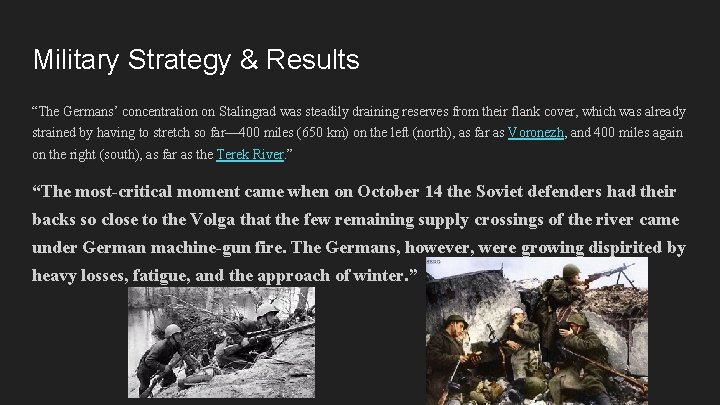
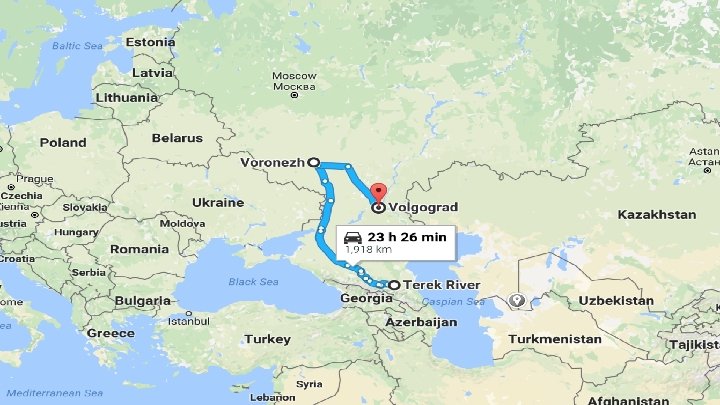
Military Strategy & Results “The Germans’ concentration on Stalingrad was steadily draining reserves from their flank cover, which was already strained by having to stretch so far— 400 miles (650 km) on the left (north), as far as Voronezh, and 400 miles again on the right (south), as far as the Terek River. ” “The most-critical moment came when on October 14 the Soviet defenders had their backs so close to the Volga that the few remaining supply crossings of the river came under German machine-gun fire. The Germans, however, were growing dispirited by heavy losses, fatigue, and the approach of winter. ”
Lack of German Panache and Hitler’s Mistakes “The vastness of Russia devours us”, wrote Field Marshal von Rundstedt to his wife just after his armies successfully completed the Uman encirclement. The moods of German commanders had started to swing between selfcongratulation and unease. They were conquering huge territories, yet the horizon seemed just as limitless. The Red Army had lost over two million men, yet more Soviet armies appeared. ” “Moscow was not only the capital of the Soviet Union, it was also a major centre for communications and armaments industry. An attack on it would also draw in surviving Soviet armies to their final destruction. The Fürher, however, kept his generals in order by exploiting their rivalries and disagreements… Yet his instinct to avoid the road to Moscow was partly a superstitious avoidance of Napoleon’s footsteps. ” “The military authorities were concerned that soldiers going home on leave would demoralize the home population with horror stories of the Ostfront. ‘You are under military law’ ran the forceful reminder, ‘and you are still subject to punishment. Don’t speak about your weapons, tactics or losses. Don’t speak about bad rations or injustice. The intelligence service of the enemy is ready to exploit it. ”
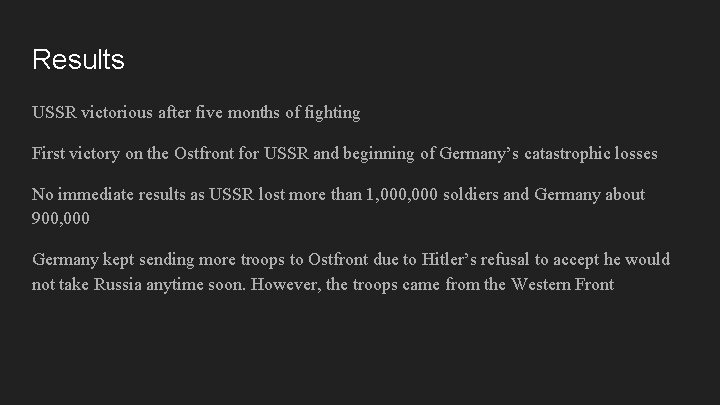
Results USSR victorious after five months of fighting First victory on the Ostfront for USSR and beginning of Germany’s catastrophic losses No immediate results as USSR lost more than 1, 000 soldiers and Germany about 900, 000 Germany kept sending more troops to Ostfront due to Hitler’s refusal to accept he would not take Russia anytime soon. However, the troops came from the Western Front
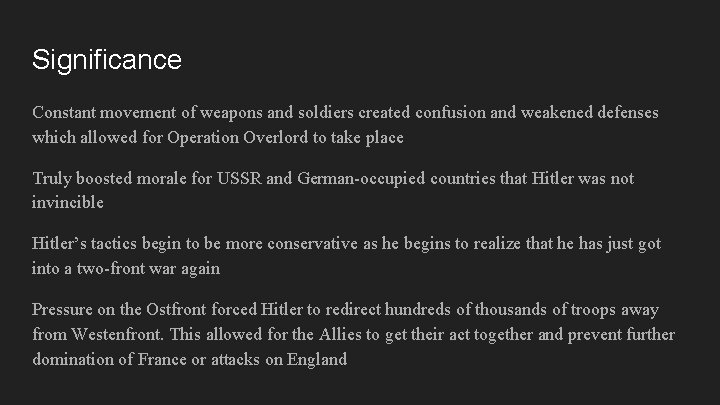
Significance Constant movement of weapons and soldiers created confusion and weakened defenses which allowed for Operation Overlord to take place Truly boosted morale for USSR and German-occupied countries that Hitler was not invincible Hitler’s tactics begin to be more conservative as he begins to realize that he has just got into a two-front war again Pressure on the Ostfront forced Hitler to redirect hundreds of thousands of troops away from Westenfront. This allowed for the Allies to get their act together and prevent further domination of France or attacks on England

Recap https: //www. youtube. com/watch? v=b. CQBSf 1 rb 7 o
Works Cited “Battle of Stalingrad. ” Wikipedia, Wikimedia Foundation, 19 Apr. 2017, en. wikipedia. org/wiki/Battle_of_Stalingrad. “BBC - History - World Wars: Hitler's Invasion of Russia in World War Two. ” BBC News, BBC, www. bbc. co. uk/history/worldwars/wwtwo/hitler_russia_invasion_01. shtml. Beevor, Antony. Stalingrad. NY, NY: Penguin, 1999. Print "Beginning of the Siege of Leningrad: The Fatal Mistake by Hitler. " To Discover Russia. N. p. , 11 Nov. 2015. Web. 21 Apr. 2017. Chen, Peter C. “Operation Barbarossa. ” World War II Database, ww 2 db. com/battle_spec. php? battle_id=121. “GENERALPLAN OST. ” WORLD FUTURE FUND, www. worldfuturefund. org/wffmaster/Reading/GPO/Generalplanostnew. htm. Klang, Mathias. “‘Quantity Has a Quality All Its Own. ’” Klangable, 16 Sept. 2016, klangable. com/blog/quantity-has-a-quality-all-its-own/. "Operation Barbarossa. " World History: The Modern Era, ABC-CLIO, 2017, worldhistory. abc-clio. com/Search/Display/309859. Sass, Erik. “Operation Barbarossa: The Biggest Military Adventure in History. ” Mental Floss, 21 June 2011, mentalfloss. com/article/28033/operation-barbarossa-biggest-military-adventure-history. "The Siege and Battle of Leningrad: Effects and Impact for the War on the Eastern Front, Post-1943. " WORLD WAR II HISTORY. N. p. , 24 Nov. 2012. Web. 21 Apr. 2017. "The Siege of Leningrad. " Eyewitness to History. N. p. , n. d. Web. 21 Apr. 2017. "Timeline of the Siege of Leningrad (September 8 th, 1941 - January 27 th, 1944). "WW 2 - Timeline of Events. N. p. , n. d. Web. 21 Apr. 2017. “World War 2 Quotes. ” Second World War History, www. secondworldwarhistory. com/ww 2 -quotes. asp.
Images www. galleryhip. com www. vintag. es. com www. google. com/maps https: //cdn. theatlantic. com/assets/media/img/photo/2011/07/world-war-ii-operationbarbarossa/w 01_01268 -36/main_1200. jpg https: //media 1. britannica. com/eb-media/58/129958 -004 -C 9 B 8 B 89 D. jpg http: //www. worldatwarmagazine. com/waw/wp-content/uploads/2015/05/Barbarossa. jpg https: //en. wikipedia. org/wiki/Operation_Barbarossa#/media/File: Europe_before_Operation_Barbarossa, _1 941_(in_German). png https: //ichef. bbci. co. uk/news/624/cpsprodpb/C 18 B/production/_87974594_32 be 803 c-efcf-47 ef-9 a 17197106074016. jpg
- Slides: 29