
Operation Barbarossa Battle of Stalingrad Siege of Leningrad
Operation Barbarossa Battle of Stalingrad Siege of Leningrad Largest Invasion in Human History AS, & KH
Thesis Operation Barbarossa, in 1941 was one of the largest modern day military operations, ending in the tactical German failures at Leningrad and Stalingrad, sparking the turning point of the war and ending the German dream of Lebensraum alongside highlighting the Russian’s resilience and their idea of selfsacrifice.
Hitler’s Reasons Hitler invaded the USSR for 4 main reasons 1. Hitler hated the Bolsheviks(Hartman 19) 2. Eliminate Britain allies(Jones 119) 3. Gain resources and land(Lebensraum)(Roberts 144) 4. The Russian were a weak and easy target
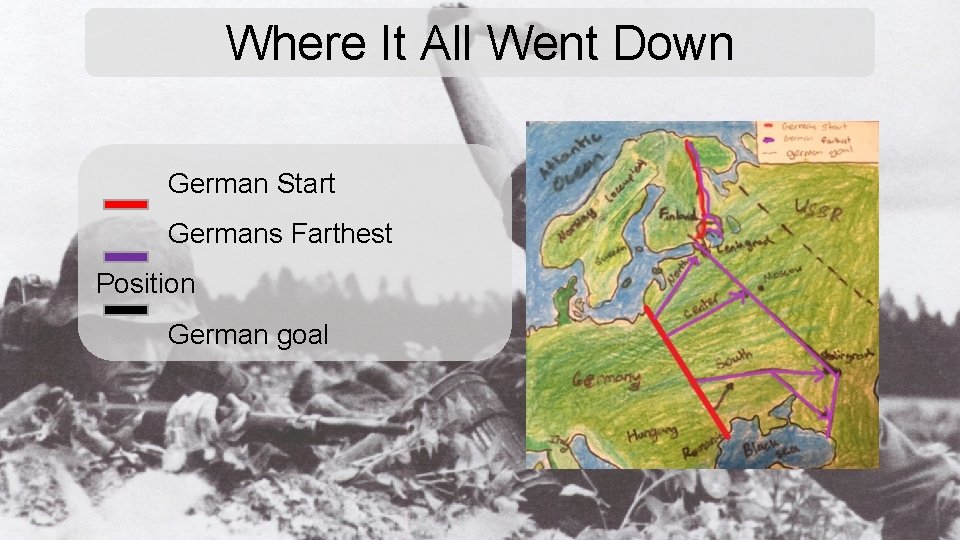
Where It All Went Down German Start Germans Farthest Position German goal
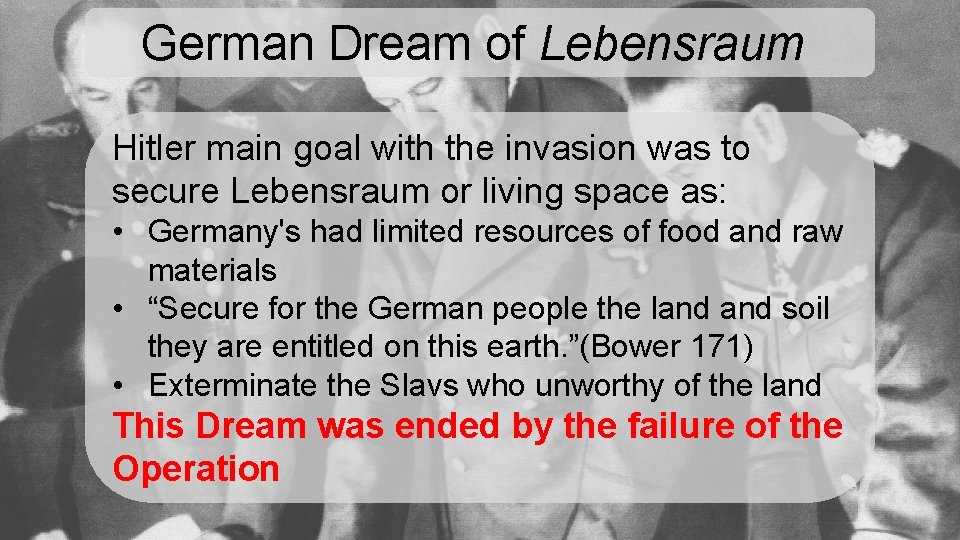
German Dream of Lebensraum Hitler main goal with the invasion was to secure Lebensraum or living space as: • Germany's had limited resources of food and raw materials • “Secure for the German people the land soil they are entitled on this earth. ”(Bower 171) • Exterminate the Slavs who unworthy of the land This Dream was ended by the failure of the Operation
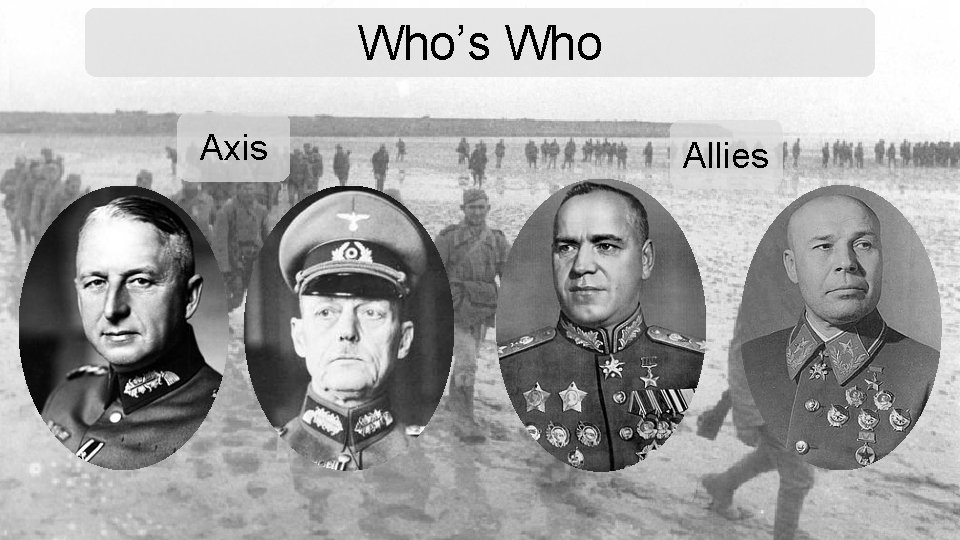
Who’s Who Axis Allies
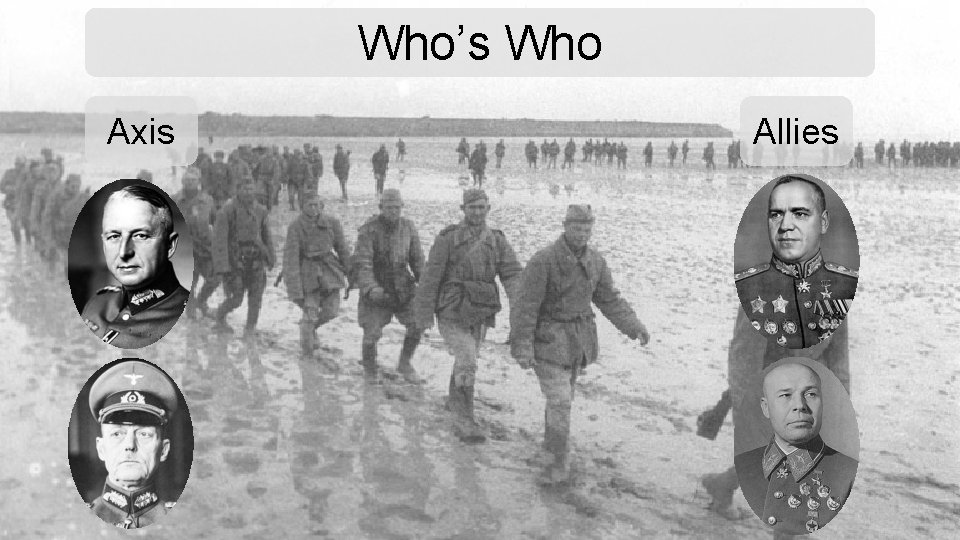
Who’s Who Axis Allies
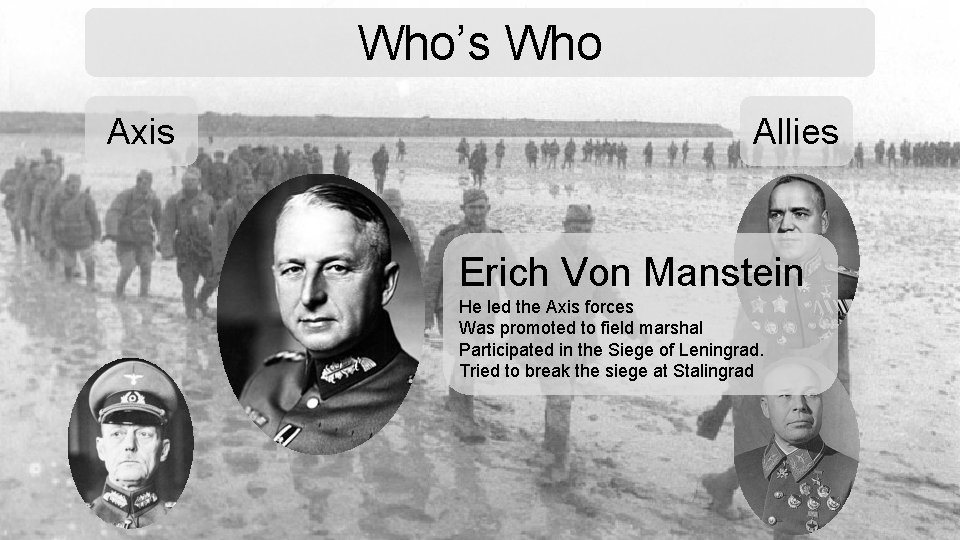
Who’s Who Axis Allies Erich Von Manstein He led the Axis forces Was promoted to field marshal Participated in the Siege of Leningrad. Tried to break the siege at Stalingrad
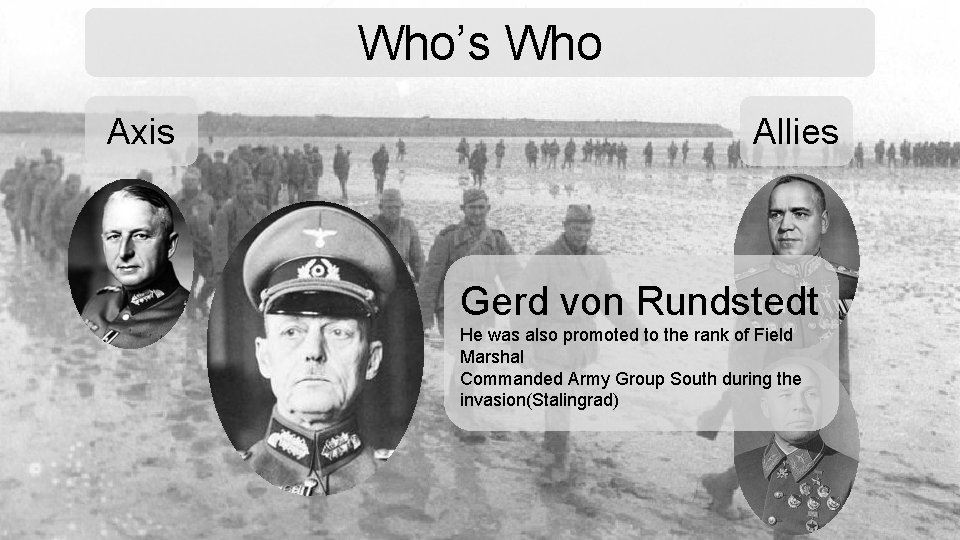
Who’s Who Axis Allies Gerd von Rundstedt He was also promoted to the rank of Field Marshal Commanded Army Group South during the invasion(Stalingrad)
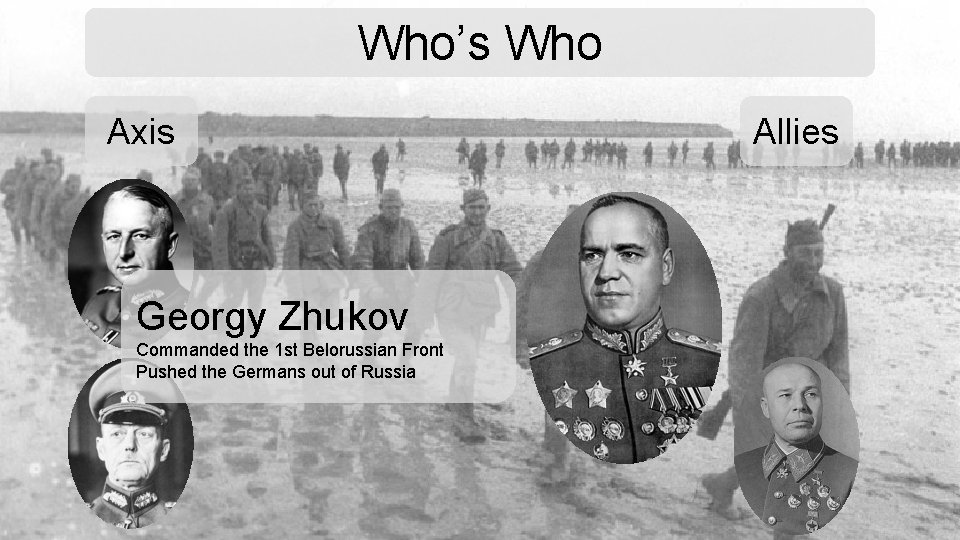
Who’s Who Axis Georgy Zhukov Commanded the 1 st Belorussian Front Pushed the Germans out of Russia Allies
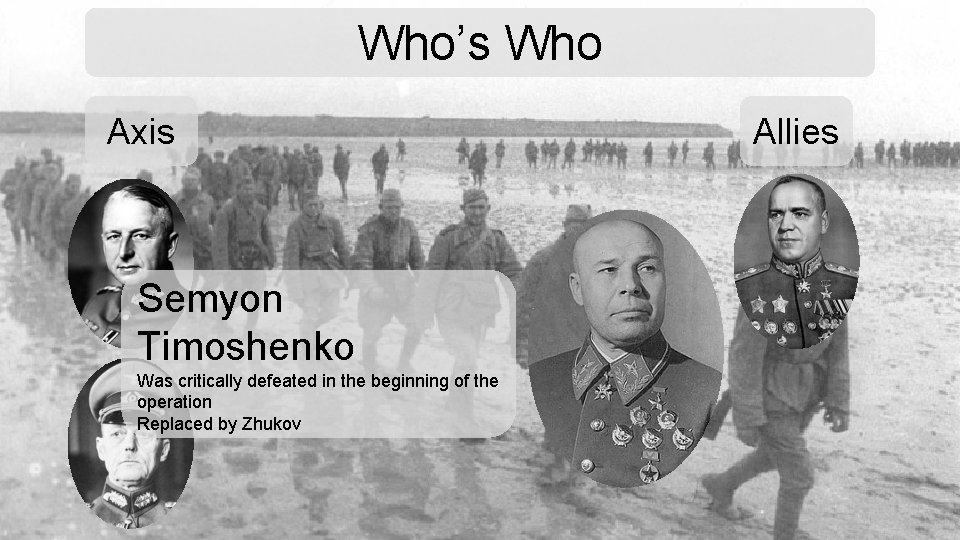
Who’s Who Axis Semyon Timoshenko Was critically defeated in the beginning of the operation Replaced by Zhukov Allies
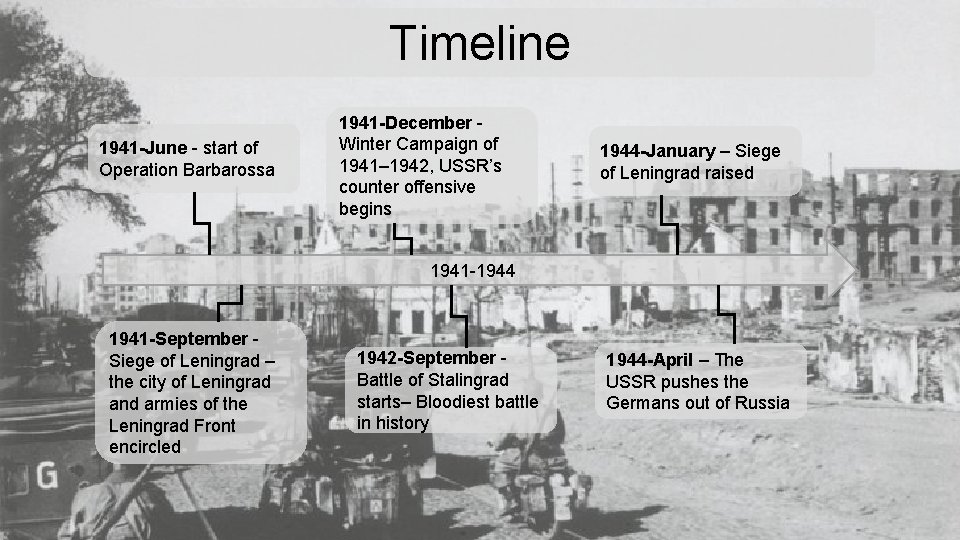
Timeline 1941 -June - start of Operation Barbarossa 1941 -December Winter Campaign of 1941– 1942, USSR’s counter offensive begins 1944 -January – Siege of Leningrad raised 1941 -1944 1941 -September Siege of Leningrad – the city of Leningrad and armies of the Leningrad Front encircled 1942 -September Battle of Stalingrad starts– Bloodiest battle in history 1944 -April – The USSR pushes the Germans out of Russia
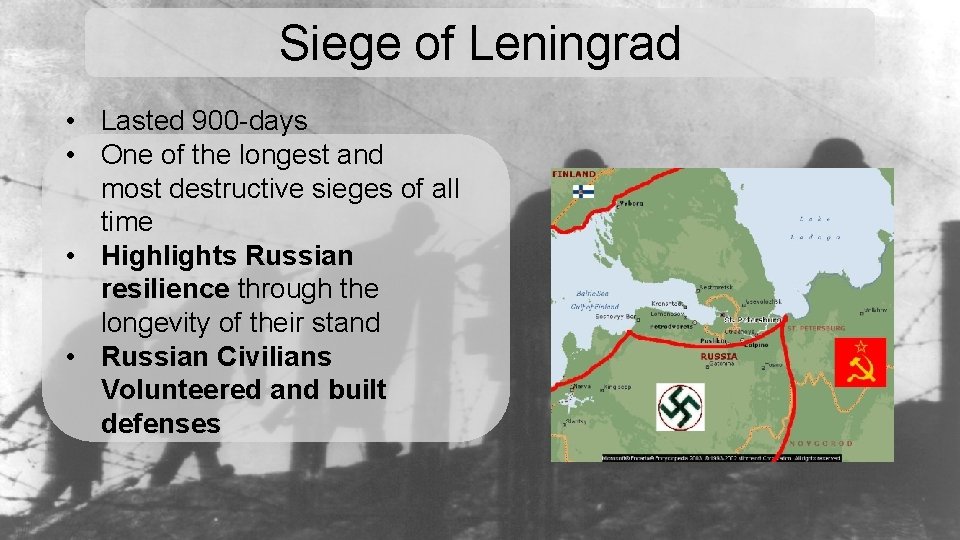
Siege of Leningrad • Lasted 900 -days • One of the longest and most destructive sieges of all time • Highlights Russian resilience through the longevity of their stand • Russian Civilians Volunteered and built defenses
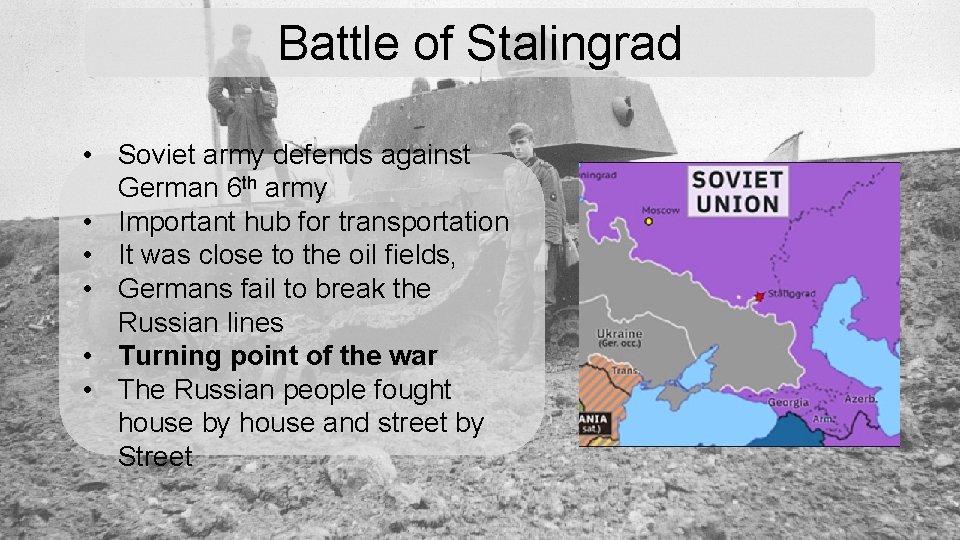
Battle of Stalingrad • Soviet army defends against German 6 th army • Important hub for transportation • It was close to the oil fields, • Germans fail to break the Russian lines • Turning point of the war • The Russian people fought house by house and street by Street
Overall effect on the War Over 1 million Germans and 5 million Soviets died Germans lose many key member of their army 600, 000 square mile taken in 4 months Turning the tide of the war towards the Allies side
Thesis Operation Barbarossa, in 1941 was one of the largest modern day military operations, ending in the tactical German failures at Leningrad and Stalingrad, sparking the turning point of the war and ending the German dream of Lebensraum alongside highlighting the Russian’s resilience and their idea of selfsacrifice.
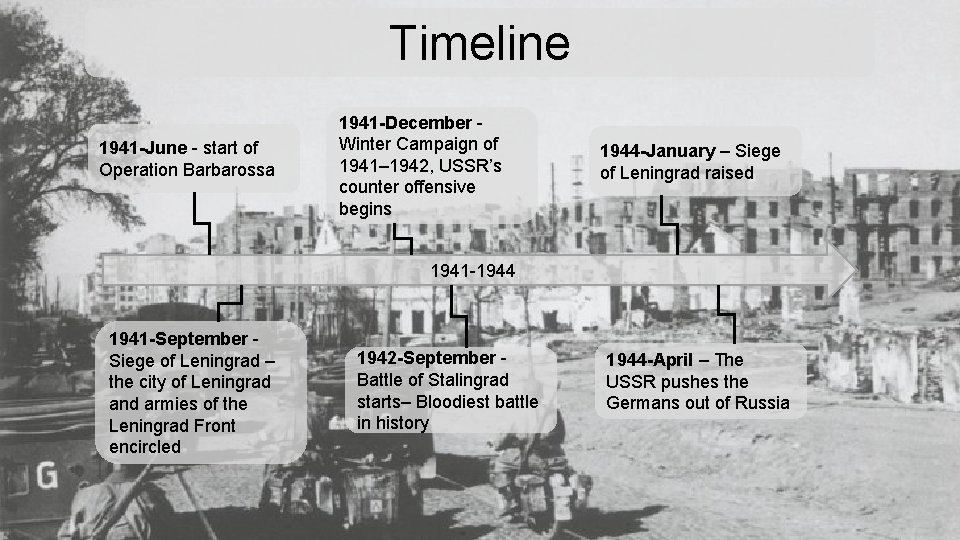
Timeline 1941 -June - start of Operation Barbarossa 1941 -December Winter Campaign of 1941– 1942, USSR’s counter offensive begins 1944 -January – Siege of Leningrad raised 1941 -1944 1941 -September Siege of Leningrad – the city of Leningrad and armies of the Leningrad Front encircled 1942 -September Battle of Stalingrad starts– Bloodiest battle in history 1944 -April – The USSR pushes the Germans out of Russia
Review 1) Manstein 2) Rundstedt 3)Zhukov 1) By implementing General Plan Ost and taking over the bloodlands by invading the Soviet Union and exterminating the Slavs that lived there. 2)Stalingrad was the turning point of the War 3)The Russian Resolve and the will of the people turned the war in the favor of the Russians
Works Cited Beevor, Antony. Stalingrad: the Fateful Siege: 1942 -1943. The Easton Press, 2004. Britannica, The Editors of Encyclopaedia. “Siege of Leningrad. ” Encyclopædia Britannica, Inc. , 1 Sept. 2018, www. britannica. com/event/Siege-of-Leningrad. HARTMANN, CHRISTIAN. OPERATION BARBAROSSA: Nazi Germany's War in the East, 1941 -1945. OXFORD UNIV PRESS, 2018. DUGARM, A. DELANO. "Operation Barbarossa. " Encyclopedia of Russian History, edited by James R. Millar, vol. 3, Macmillan Reference USA, 2004, pp. 1110 -1111. Gale Virtual Reference Library https: //link. galegroup. com/apps/doc/CX 3404100956/GVRL? u=kcls_main&sid=GVRL&xid=86 bf 3 e 08 Frame, Arthur T. "Soviet Union, Invasion of (Operation BARBAROSSA) (June 22, 1941–September 20, 1941). " Germany at War: 400 Years of Military History, edited by David T. Zabecki, vol. 3, ABC-CLIO, 2014, pp. 12161221. Gale Virtual Reference Library, https: //link. galegroup. com/apps/doc/CX 6174900890/GVRL? u=kcls_main&sid=GVRL&xid=3969 c 22 b. Hellbeck, Jochen. Stalingrad: the City That Defeated the Third Reich. Public. Affairs, 2016. Jones, Michael K. Stalingrad: How the Red Army Survived the German Onslaught. Casemate, 2007.
Works Cited Cont. Jones, Michael K. Total War: from Stalingrad to Berlin. John Murray, 2012. Limbach, Raymond. “Battle of Stalingrad. ” Encyclopædia Britannica, Inc. , 18 Jan. 2019, www. britannica. com/event/Battle-of-Stalingrad. “Operation 'Barbarossa' And Germany's Failure In The Soviet Union. ” Imperial War Museums, www. iwm. org. uk/history/operation-barbarossa-and-germanys-failure-in-the-soviet-union. Roberts, Andrew. The Storm of War: a New History of the Second World War. Harper Perennial, 2012. Royde-Smith, John Graham. “Operation Barbarossa. ” Encyclopædia Britannica, Inc. , 15 June 2018, www. britannica. com/event/Operation. Barbarossa. Tumarkin, Nina. "The Great Patriotic War as myth and memory: in Soviet eyes the Second World War is being transformed from heroic farce to grotesque tragedy. " The Atlantic, June 1991, p. 26+. Opposing Viewpoints in Context, https: //link. galegroup. com/apps/doc/A 201491078/OVIC? u=kcls_main&sid=OVIC&xid=28004010 Ziemke, Earl F. , and Magna E. Bauer. Moscow to Stalingrad: Decision in the East. Center of Military History, United States Army, 1987. "Operation Barbarossa. " Europe Since 1914: Encyclopedia of the Age of War and Reconstruction, edited by John Merriman and Jay Winter, vol. 4, Charles Scribner's Sons, 2006, pp. 1923 -1926. Gale Virtual Reference Library, https: //link. galegroup. com/apps/doc/CX 3447000662/GVRL? u=kcls_main&sid=GVRL&xid=2 a 13 c 82 c "Resistance to Nazis. " UXL Protests, Riots, and Rebellions: Civil Unrest in the Modern World, edited by Tracey Vasil Biscontini, vol. 3, UXL, 2018, pp. 585 -615. Opposing Viewpoints in Context, https: //link. galegroup. com/apps/doc/CX 3662400026/OVIC? u=kcls_main&sid=OVIC&xid=3 cd 04586
- Slides: 20