
Operation and Maintenance of Municipal Drainage systems 1

- Slides: 11
Operation and Maintenance of Municipal Drainage systems 1. Components of Drainage System: a. Tertiary Drains (Local Drains) b. Secondary Drains (Collector Drains) c. Primary Drains (Major Drains/Out fall Drains) d. Pumping Stations e. Flood Prevention Structures such as I&D structures/Flap Gates 1
Operation and Maintenance of Municipal Drainage systems 2. Objectives of O&M : a. Drains run freely at all times and flooding problems are minimized b. Effective use is made of available resources (finance, workers and equipment). c. Equipment and facilities operate for the whole of their design life, so ensuring that investments are fully utilized. d. Health and safety hazards to municipal sanitary workers and the General public are minimized. 2
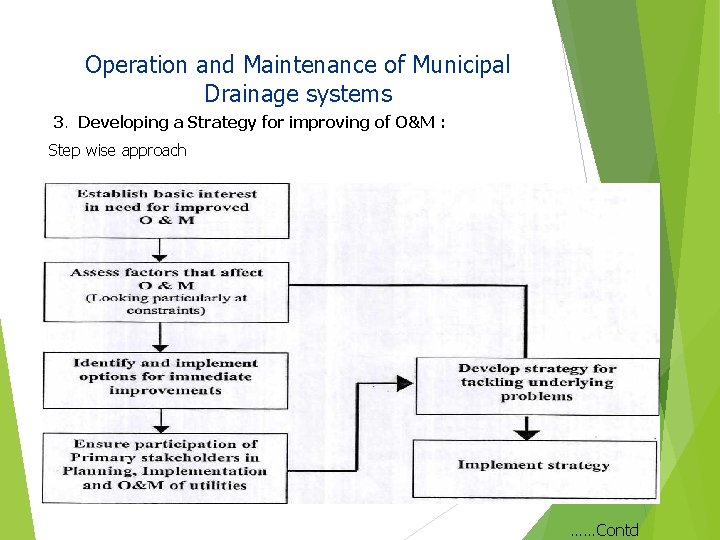
Operation and Maintenance of Municipal Drainage systems 3. Developing a Strategy for improving of O&M : Step wise approach 3 ……Contd
Operation and Maintenance of Municipal Drainage systems a. Start by assessing existing systems, with particular reference to the factors that affect the quality of O&M. b. Develop an immediate action plan (IAP), focusing on actions that are relatively easy to achieve and result in clear cost reductions, improvement in the level of service provided or both. c. Develop a longer-term programme for O&M improvement that includes both: v efforts to overcome constraints; and v more ambitious efforts to tackle basic deficiencies in O&M. 4
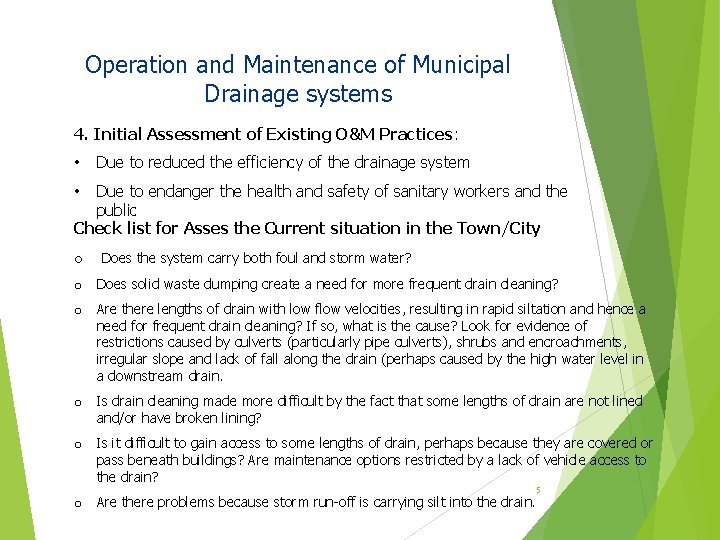
Operation and Maintenance of Municipal Drainage systems 4. Initial Assessment of Existing O&M Practices: • Due to reduced the efficiency of the drainage system Due to endanger the health and safety of sanitary workers and the public Check list for Asses the Current situation in the Town/City • o Does the system carry both foul and storm water? o Does solid waste dumping create a need for more frequent drain cleaning? o Are there lengths of drain with low flow velocities, resulting in rapid siltation and hence a need for frequent drain cleaning? If so, what is the cause? Look for evidence of restrictions caused by culverts (particularly pipe culverts), shrubs and encroachments, irregular slope and lack of fall along the drain (perhaps caused by the high water level in a downstream drain. o Is drain cleaning made more difficult by the fact that some lengths of drain are not lined and/or have broken lining? o Is it difficult to gain access to some lengths of drain, perhaps because they are covered or pass beneath buildings? Are maintenance options restricted by a lack of vehicle access to the drain? 5 o Are there problems because storm run-off is carrying silt into the drain.
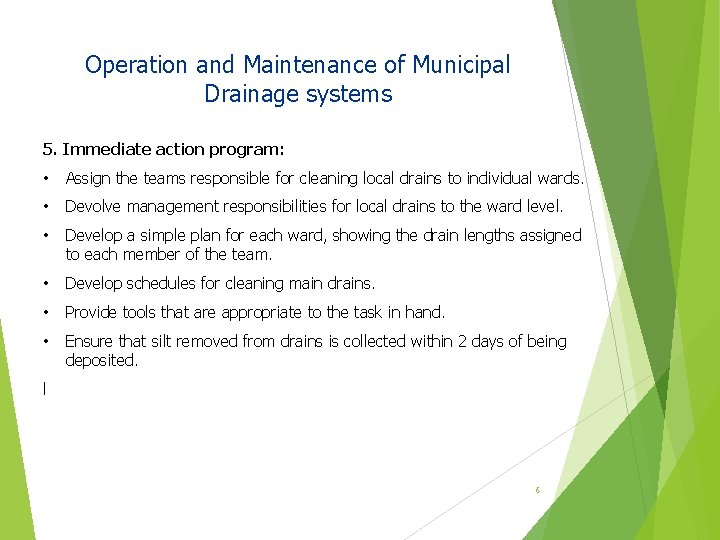
Operation and Maintenance of Municipal Drainage systems 5. Immediate action program: • Assign the teams responsible for cleaning local drains to individual wards. • Devolve management responsibilities for local drains to the ward level. • Develop a simple plan for each ward, showing the drain lengths assigned to each member of the team. • Develop schedules for cleaning main drains. • Provide tools that are appropriate to the task in hand. • Ensure that silt removed from drains is collected within 2 days of being deposited. l 6
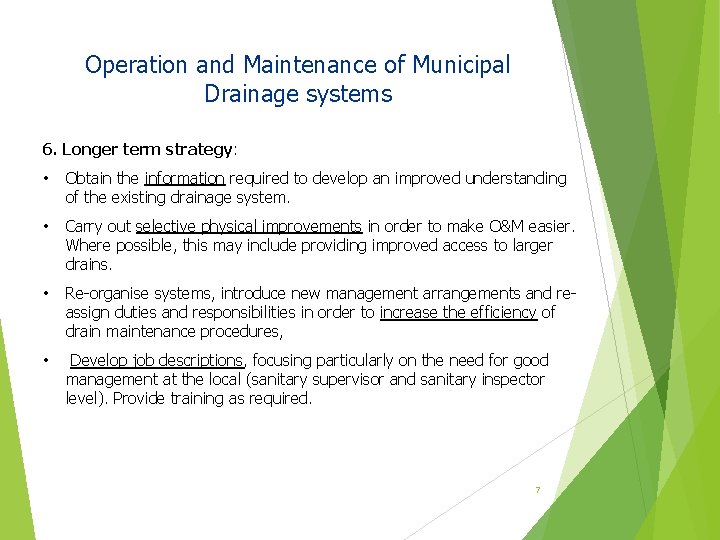
Operation and Maintenance of Municipal Drainage systems 6. Longer term strategy: • Obtain the information required to develop an improved understanding of the existing drainage system. • Carry out selective physical improvements in order to make O&M easier. Where possible, this may include providing improved access to larger drains. • Re-organise systems, introduce new management arrangements and reassign duties and responsibilities in order to increase the efficiency of drain maintenance procedures, • Develop job descriptions, focusing particularly on the need for good management at the local (sanitary supervisor and sanitary inspector level). Provide training as required. 7
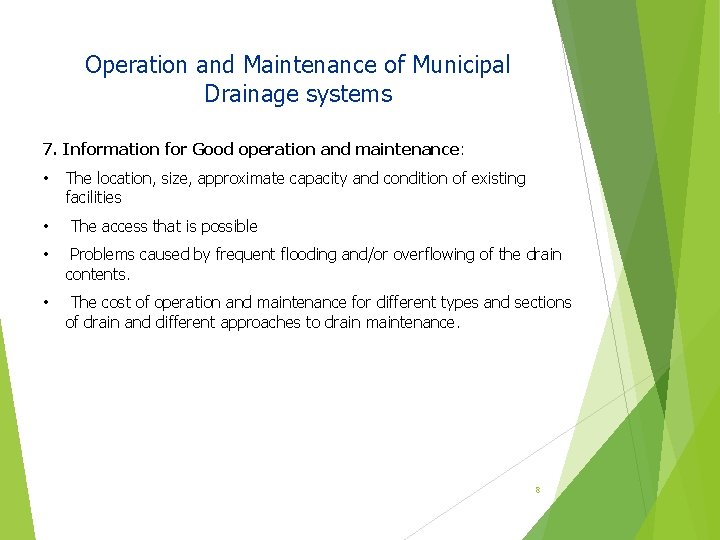
Operation and Maintenance of Municipal Drainage systems 7. Information for Good operation and maintenance: • • The location, size, approximate capacity and condition of existing facilities The access that is possible • Problems caused by frequent flooding and/or overflowing of the drain contents. • The cost of operation and maintenance for different types and sections of drain and different approaches to drain maintenance. 8
Operation and Maintenance of Municipal Drainage systems 8. Developing the information system 1. Identify priority problems 2. Respond to those problems Preparation of Drainage System Plans: • Identify all main drains and plot them on a copy of the base map. Also plot secondary drains that connect to them. • Identify and plot the drainage boundaries between the areas served by these drains. • Identify any obvious problem areas - those where flooding or frequent drain overflows occur. • Carry out level surveys along routes of main drains and secondary drains in order to identify any lengths of drain that have limited falls. • Identify any constrictions caused by culverts and encroachments, any access problems due to the location of the drain or the fact that it is covered. 9
Operation and Maintenance of Municipal Drainage systems 9. Recording information 10. Management information 11. Developing an assets register for drainage 12. Identifying and dealing with physical constraints 13. Developing human and organizational resources 14. Specific training for pump maintenance Improvements in health and safety Developing performance targets for O&M 10
Thank You 11