
Operating Systems Youjip Won 44 Flashbased SSDs Youjip
Operating Systems Youjip Won
44. Flash-based SSDs Youjip Won 2
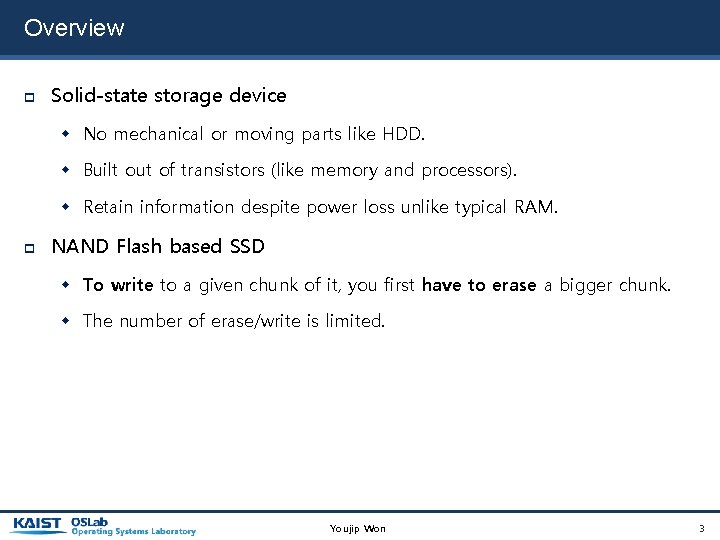
Overview Solid-state storage device No mechanical or moving parts like HDD. Built out of transistors (like memory and processors). Retain information despite power loss unlike typical RAM. NAND Flash based SSD To write to a given chunk of it, you first have to erase a bigger chunk. The number of erase/write is limited. Youjip Won 3

Storing Bit Single-level cell (SLC): a single bit per cell Multi-level cell (MLC): two bits per cell Triple-level cell (TLC): three bits per cell QLC, PLC cell Flash memory Youjip Won 4

Structure of Flash block Page Data area Spare area 5

Structure of Flash SSD Youjip Won 6
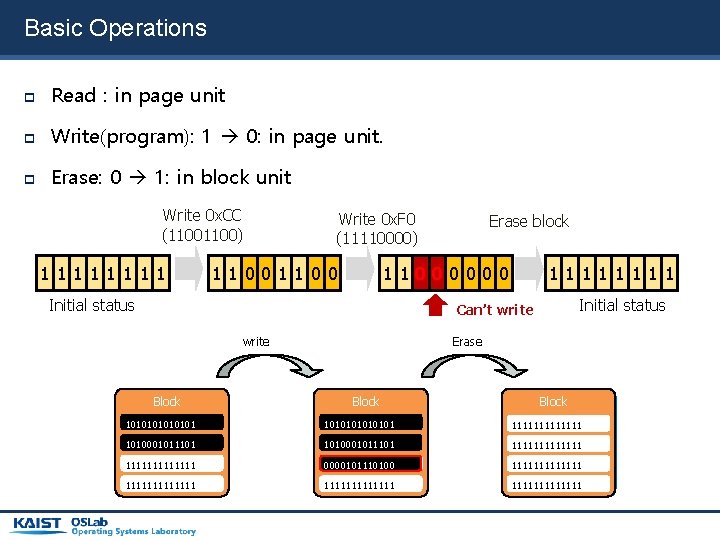
Basic Operations Read : in page unit Write(program): 1 0: in page unit. Erase: 0 1: in block unit Write 0 x. CC (1100) 1111 Write 0 x. F 0 (11110000) 1100 Erase block 1 1000 0 Initial status 1111 Initial status Can’t write Erase write Block 1010101010101 1111111 1010001011101 1111111111111 0000101110100 1111111111111
Reliability of Flash Wear out Flash cells wear out as we program/erase it. Finally the block becomes unusable. Typical erase/wear out cycle MLC-based block: 10, 000 P/E (Program/Erase) SLC-based block: 100, 000 P/E Disturbance When accessing a particular page within a flash, it is possible that some bits get flipped in neighboring pages. It is called read disturbance or program disturbance. Youjip Won 8
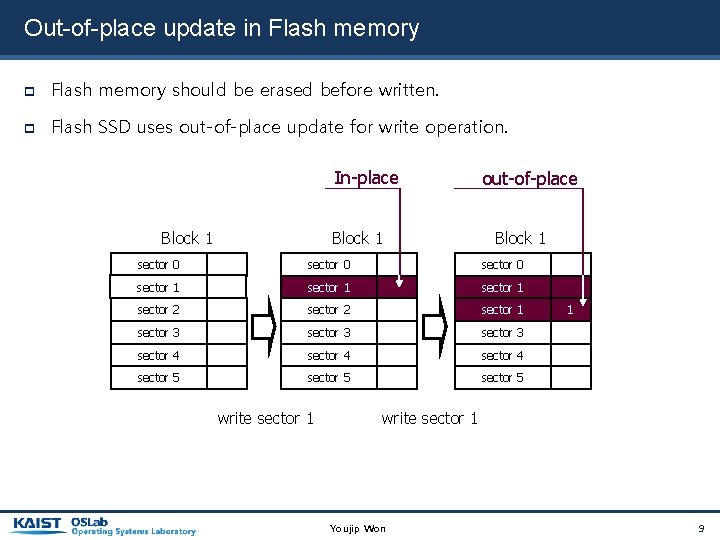
Out-of-place update in Flash memory should be erased before written. Flash SSD uses out-of-place update for write operation. In-place Block 1 out-of-place Block 1 sector 0 sector 1 sector 2 sector 1 2 sector 3 sector 4 sector 5 write sector 1 1 write sector 1 Youjip Won 9
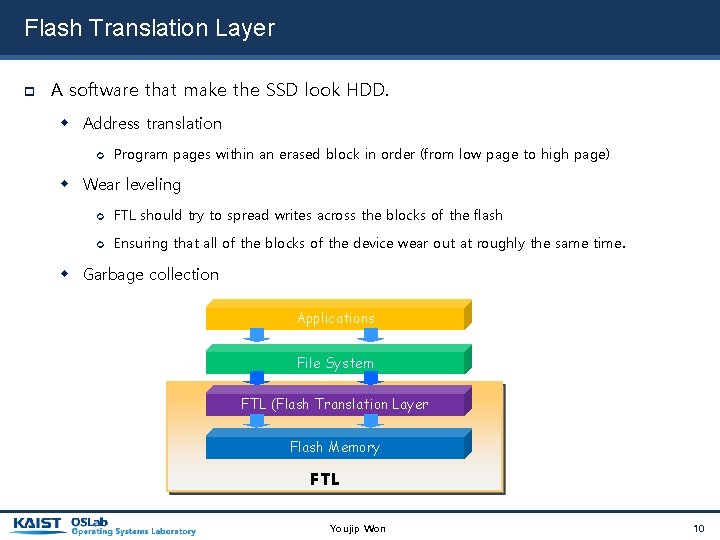
Flash Translation Layer A software that make the SSD look HDD. Address translation Program pages within an erased block in order (from low page to high page) Wear leveling FTL should try to spread writes across the blocks of the flash Ensuring that all of the blocks of the device wear out at roughly the same time. Garbage collection Applications File System FTL (Flash Translation Layer Flash Memory FTL Youjip Won 10
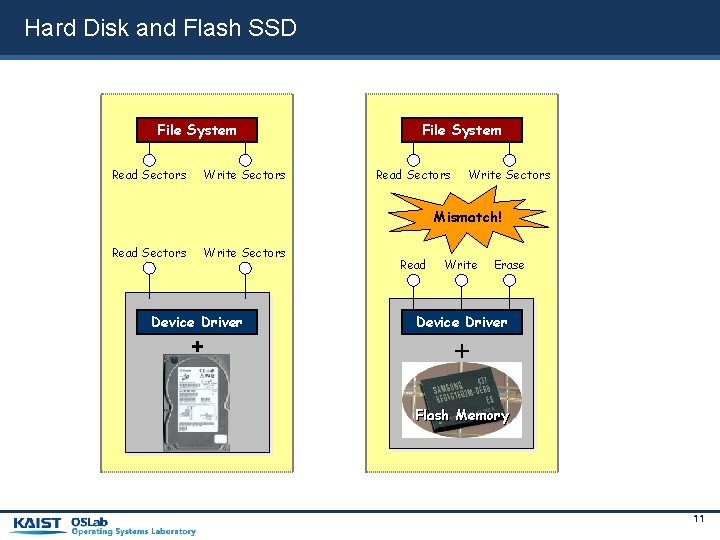
Hard Disk and Flash SSD File System Read Sectors Write Sectors Mismatch! Read Sectors Write Sectors Device Driver + Read Write Erase Device Driver + Flash Memory 11
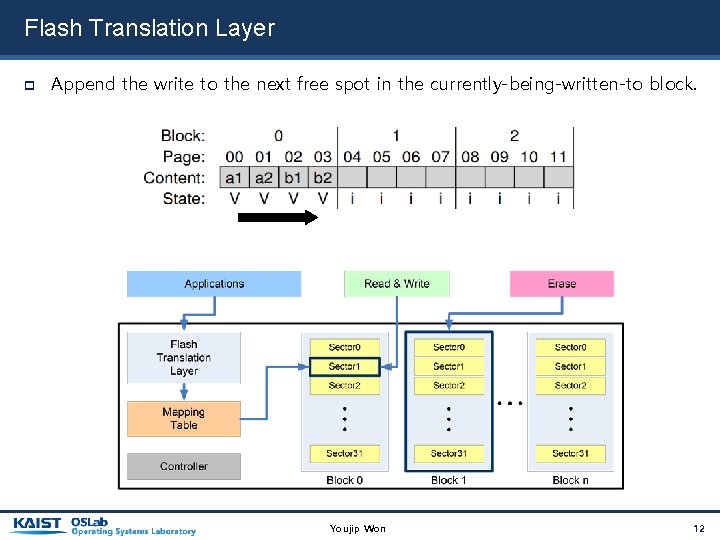
Flash Translation Layer Append the write to the next free spot in the currently-being-written-to block. Youjip Won 12
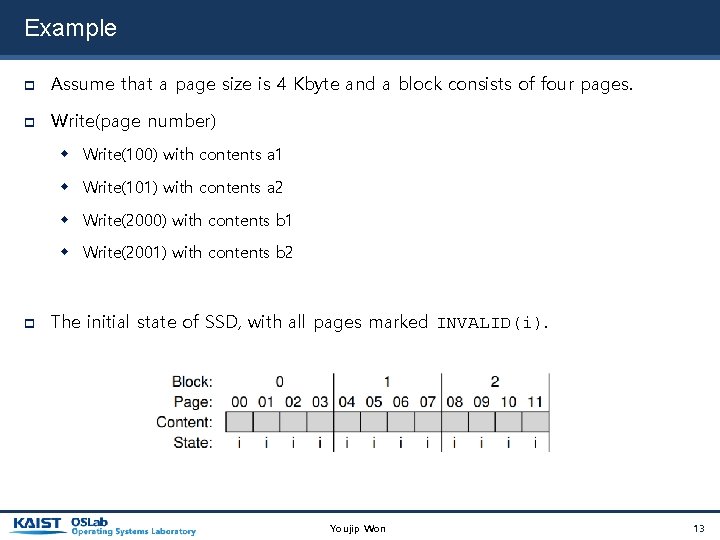
Example Assume that a page size is 4 Kbyte and a block consists of four pages. Write(page number) Write(100) with contents a 1 Write(101) with contents a 2 Write(2000) with contents b 1 Write(2001) with contents b 2 The initial state of SSD, with all pages marked INVALID(i). Youjip Won 13
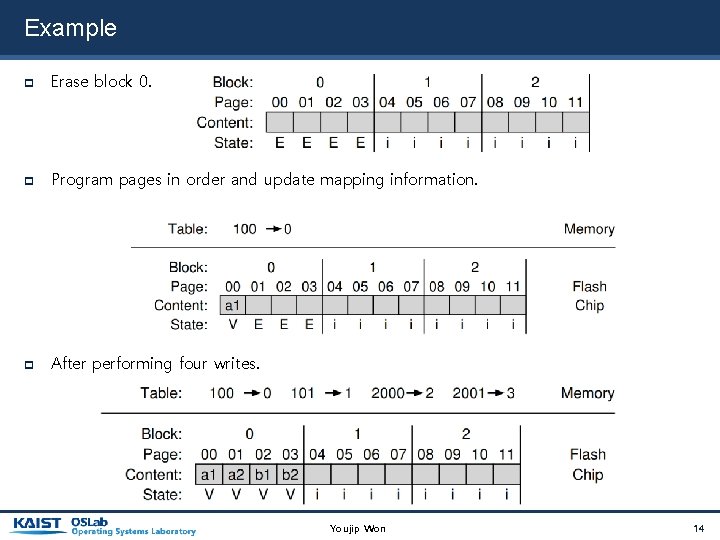
Example Erase block 0. Program pages in order and update mapping information. After performing four writes. Youjip Won 14
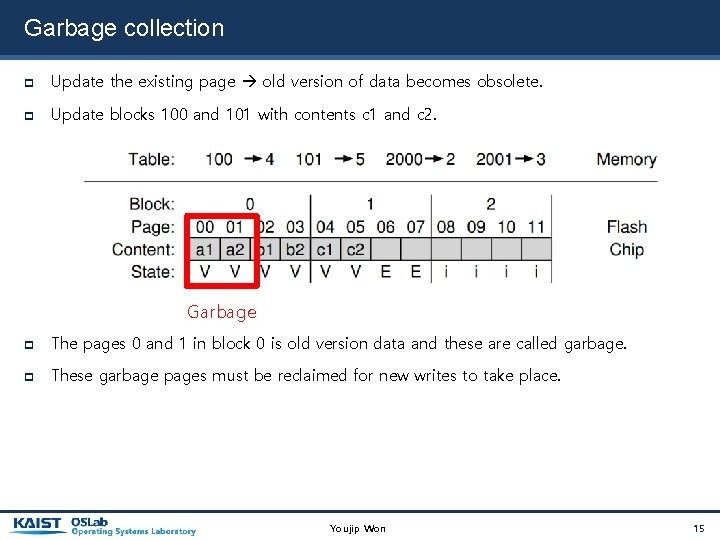
Garbage collection Update the existing page old version of data becomes obsolete. Update blocks 100 and 101 with contents c 1 and c 2. Garbage The pages 0 and 1 in block 0 is old version data and these are called garbage. These garbage pages must be reclaimed for new writes to take place. Youjip Won 15
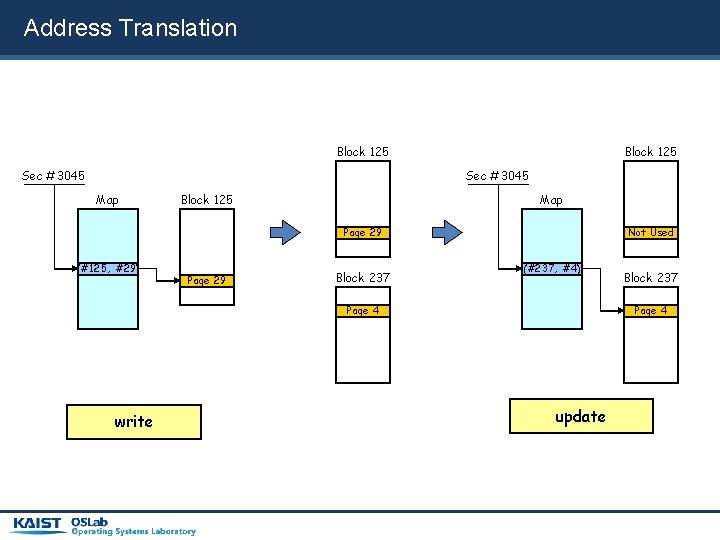
Address Translation Block 125 Sec #3045 Map Block 125 Map Page 29 (#125, #29) Page 29 Block 237 Not Used (#237, #4) Page 4 write Block 237 Page 4 update
Garbage collection the process of finding garbage blocks and reclaiming them. Basic process Find a block that contains one or more garbage pages. Read in the live(non-garbage) pages from that block. Write out those live pages to the next writable pages. Reclaim the entire block for use in writing. Youjip Won 17
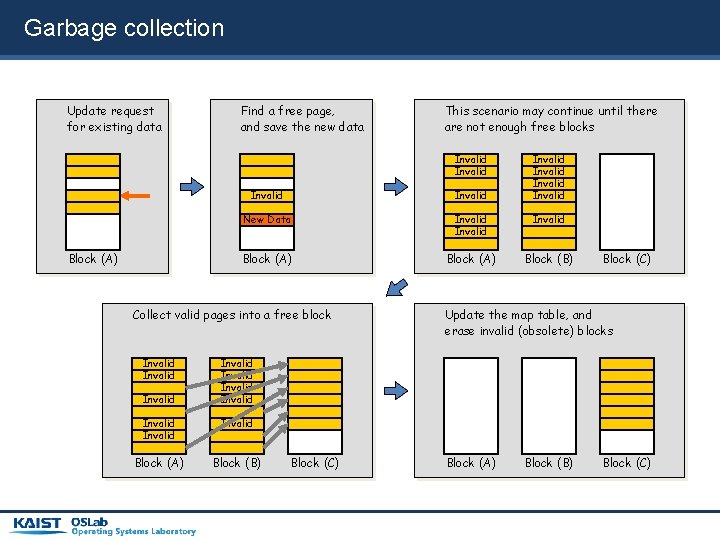
Garbage collection Update request for existing data Find a free page, and save the new data This scenario may continue until there are not enough free blocks Invalid Block (A) Invalid New Data Invalid Block (A) Block (B) Collect valid pages into a free block Invalid Invalid Block (C) Update the map table, and erase invalid (obsolete) blocks Invalid Invalid Block (A) Block (B) Block (C)
Garbage collection is expensive Require reading and rewriting of live data. Ideal garbage collection is reclamation of a block that consists of only dead pages. Cost of Garbage Collection Amount of data blocks that are migrated. Overprovision the device by adding extra flash capacity Cleaning can be delayed. Run the GC in the background. Youjip Won 19
Mapping Table Size of page-level mapping table is too large With a 1 TB SSD with a 4 byte entry per 4 KB page, 1 GB of DRAM is needed for mapping. Some approaches to reduce the costs of mapping Block-based mapping Hybrid mapping Page mapping plus caching Youjip Won 20
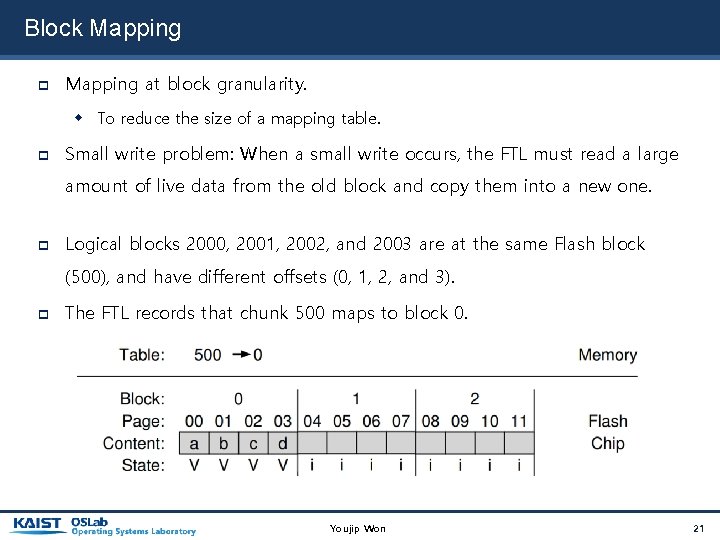
Block Mapping at block granularity. To reduce the size of a mapping table. Small write problem: When a small write occurs, the FTL must read a large amount of live data from the old block and copy them into a new one. Logical blocks 2000, 2001, 2002, and 2003 are at the same Flash block (500), and have different offsets (0, 1, 2, and 3). The FTL records that chunk 500 maps to block 0. Youjip Won 21
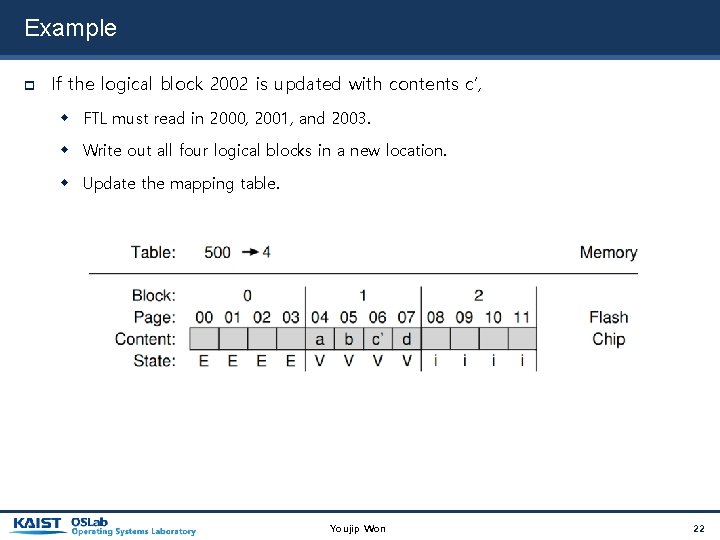
Example If the logical block 2002 is updated with contents c’, FTL must read in 2000, 2001, and 2003. Write out all four logical blocks in a new location. Update the mapping table. Youjip Won 22
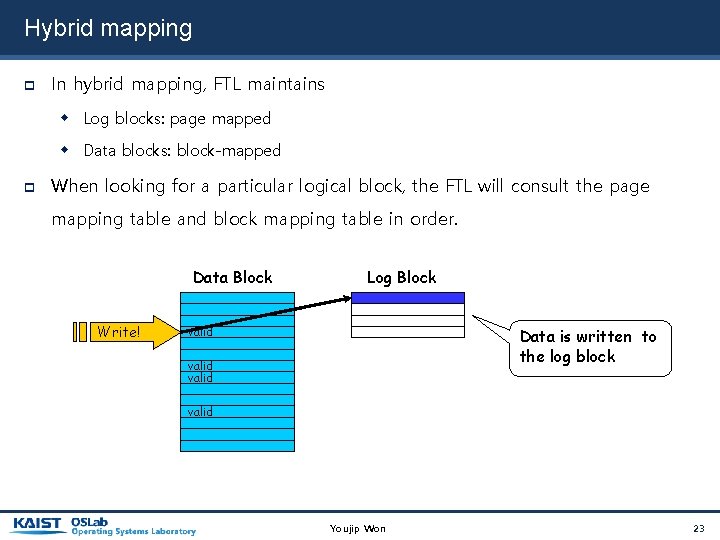
Hybrid mapping In hybrid mapping, FTL maintains Log blocks: page mapped Data blocks: block-mapped When looking for a particular logical block, the FTL will consult the page mapping table and block mapping table in order. Data Block Write! Log Block valid Data is written to the log block valid Youjip Won 23
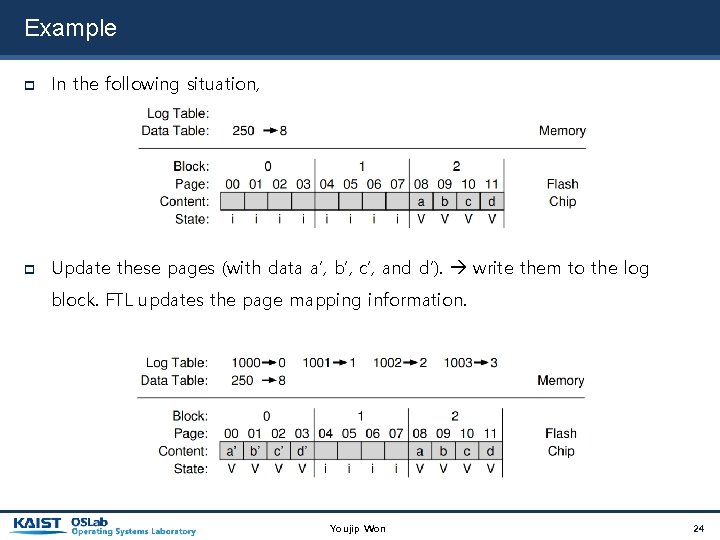
Example In the following situation, Update these pages (with data a’, b’, c’, and d’). write them to the log block. FTL updates the page mapping information. Youjip Won 24
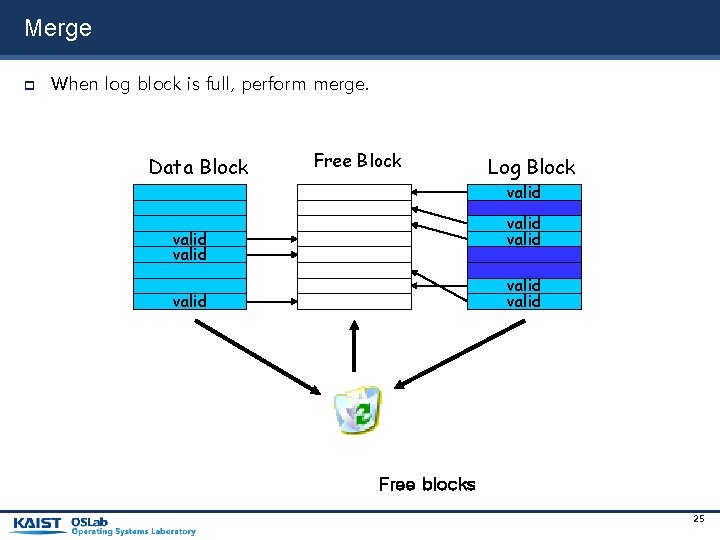
Merge When log block is full, perform merge. Data Block Free Block Log Block valid valid Free blocks 25
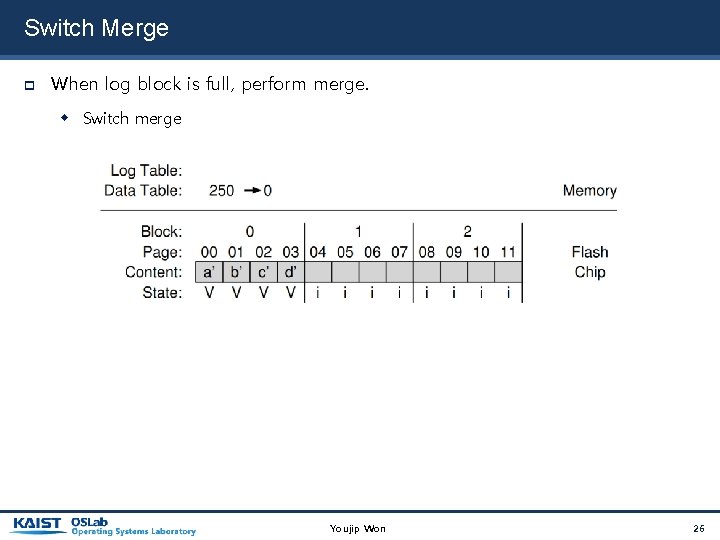
Switch Merge When log block is full, perform merge. Switch merge Youjip Won 26
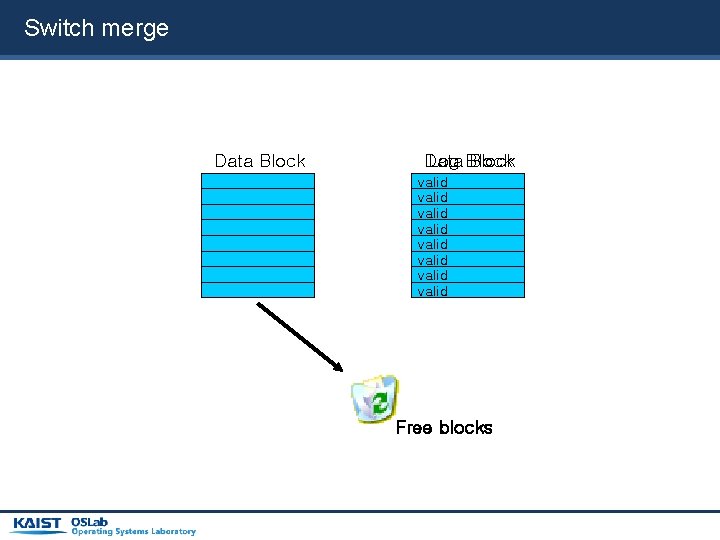
Switch merge Data Block Data Log Block valid valid Free blocks
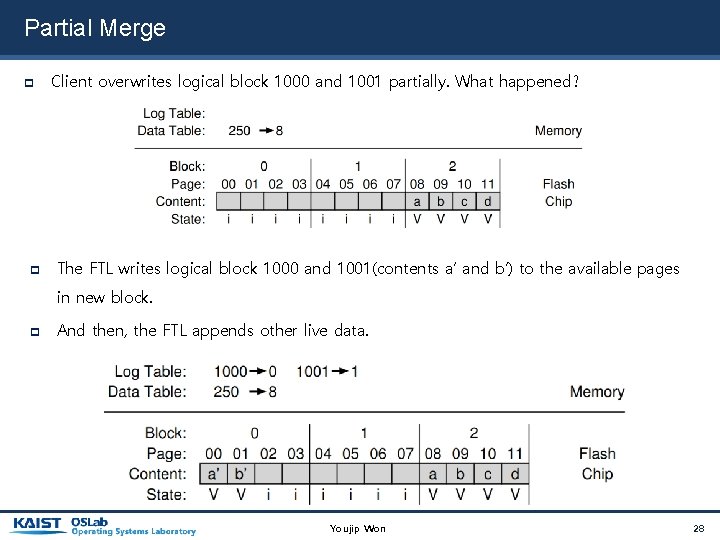
Partial Merge Client overwrites logical block 1000 and 1001 partially. What happened? The FTL writes logical block 1000 and 1001(contents a’ and b’) to the available pages in new block. And then, the FTL appends other live data. Youjip Won 28
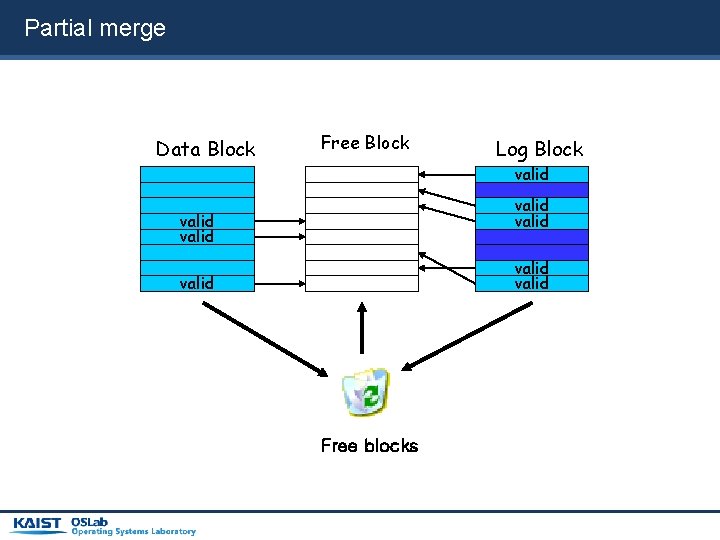
Partial merge Data Block Free Block Log Block valid valid Free blocks

Switch and Merge 30
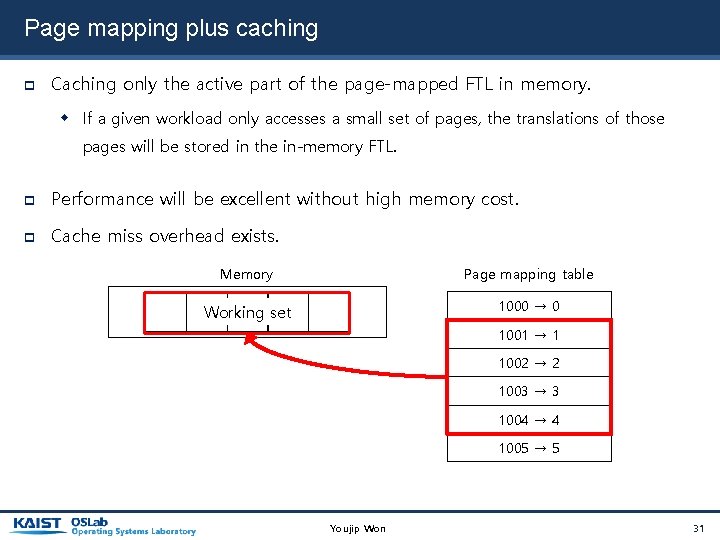
Page mapping plus caching Caching only the active part of the page-mapped FTL in memory. If a given workload only accesses a small set of pages, the translations of those pages will be stored in the in-memory FTL. Performance will be excellent without high memory cost. Cache miss overhead exists. Memory Page mapping table Working set 1000 → 0 1001 → 1 1002 → 2 1003 → 3 1004 → 4 1005 → 5 Youjip Won 31
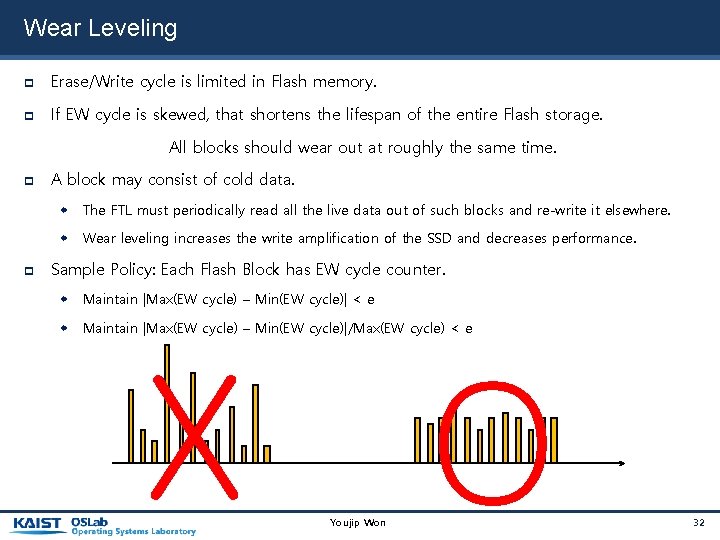
Wear Leveling Erase/Write cycle is limited in Flash memory. If EW cycle is skewed, that shortens the lifespan of the entire Flash storage. All blocks should wear out at roughly the same time. A block may consist of cold data. The FTL must periodically read all the live data out of such blocks and re-write it elsewhere. Wear leveling increases the write amplification of the SSD and decreases performance. Sample Policy: Each Flash Block has EW cycle counter. Maintain |Max(EW cycle) – Min(EW cycle)| < e Maintain |Max(EW cycle) – Min(EW cycle)|/Max(EW cycle) < e X Youjip Won O 32
Summary Flash-based SSDs are becoming a common presence in … laptops, desktops, and servers inside the datacenters. Flash Translation Layer Address Translation Wear Leveling Garbage Collection Youjip Won 33
- Slides: 33