
Operating Systems Youjip Won 32 Common Concurrency Problems
Operating Systems Youjip Won
32. Common Concurrency Problems. Youjip Won 2
Non-Deadlock Bugs Make up a majority of concurrency bugs. Two major types of non deadlock bugs: Atomicity violation Order violation Youjip Won 3
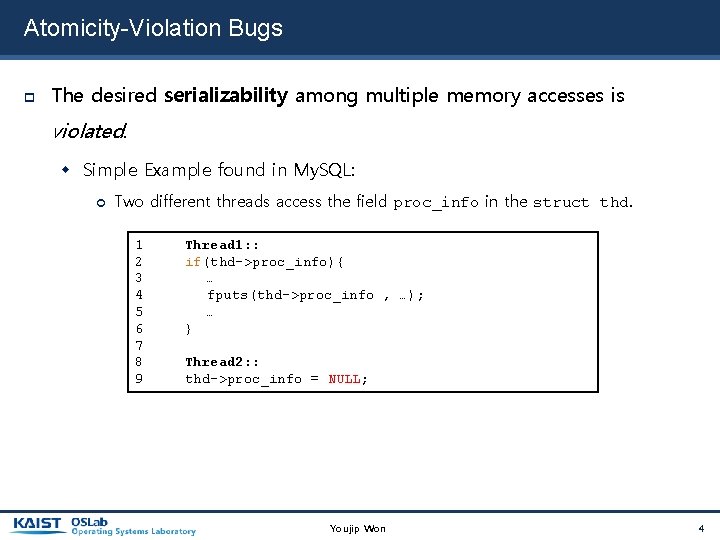
Atomicity-Violation Bugs The desired serializability among multiple memory accesses is violated. Simple Example found in My. SQL: Two different threads access the field proc_info in the struct thd. 1 2 3 4 5 6 7 8 9 Thread 1: : if(thd->proc_info){ … fputs(thd->proc_info , …); … } Thread 2: : thd->proc_info = NULL; Youjip Won 4
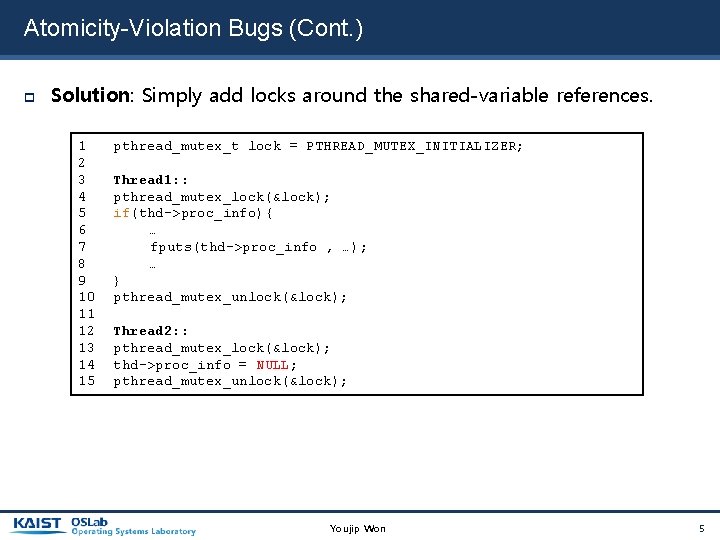
Atomicity-Violation Bugs (Cont. ) Solution: Simply add locks around the shared-variable references. 1 2 3 4 5 6 7 8 9 10 11 12 13 14 15 pthread_mutex_t lock = PTHREAD_MUTEX_INITIALIZER; Thread 1: : pthread_mutex_lock(&lock); if(thd->proc_info){ … fputs(thd->proc_info , …); … } pthread_mutex_unlock(&lock); Thread 2: : pthread_mutex_lock(&lock); thd->proc_info = NULL; pthread_mutex_unlock(&lock); Youjip Won 5
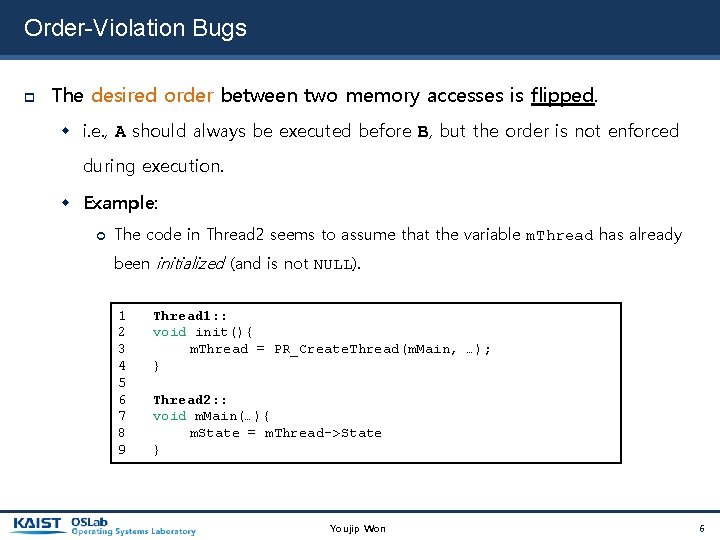
Order-Violation Bugs The desired order between two memory accesses is flipped. i. e. , A should always be executed before B, but the order is not enforced during execution. Example: The code in Thread 2 seems to assume that the variable m. Thread has already been initialized (and is not NULL). 1 2 3 4 5 6 7 8 9 Thread 1: : void init(){ m. Thread = PR_Create. Thread(m. Main, …); } Thread 2: : void m. Main(…){ m. State = m. Thread->State } Youjip Won 6
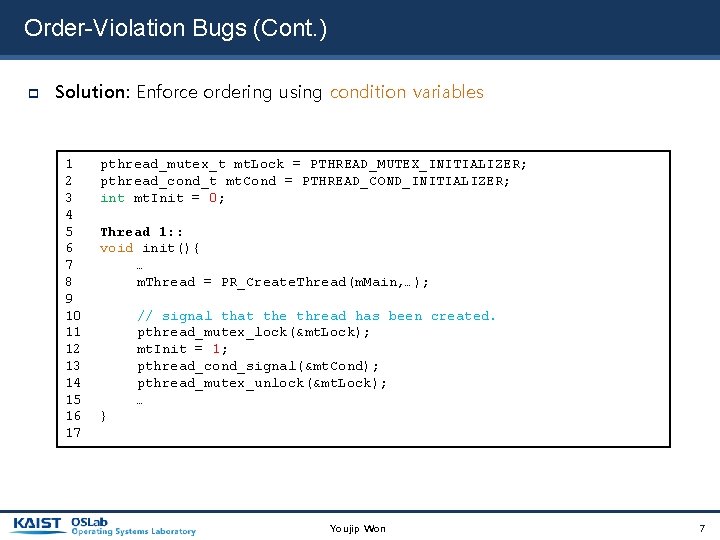
Order-Violation Bugs (Cont. ) Solution: Enforce ordering using condition variables 1 2 3 4 5 6 7 8 9 10 11 12 13 14 15 16 17 pthread_mutex_t mt. Lock = PTHREAD_MUTEX_INITIALIZER; pthread_cond_t mt. Cond = PTHREAD_COND_INITIALIZER; int mt. Init = 0; Thread 1: : void init(){ … m. Thread = PR_Create. Thread(m. Main, …); // signal that the thread has been created. pthread_mutex_lock(&mt. Lock); mt. Init = 1; pthread_cond_signal(&mt. Cond); pthread_mutex_unlock(&mt. Lock); … } Youjip Won 7
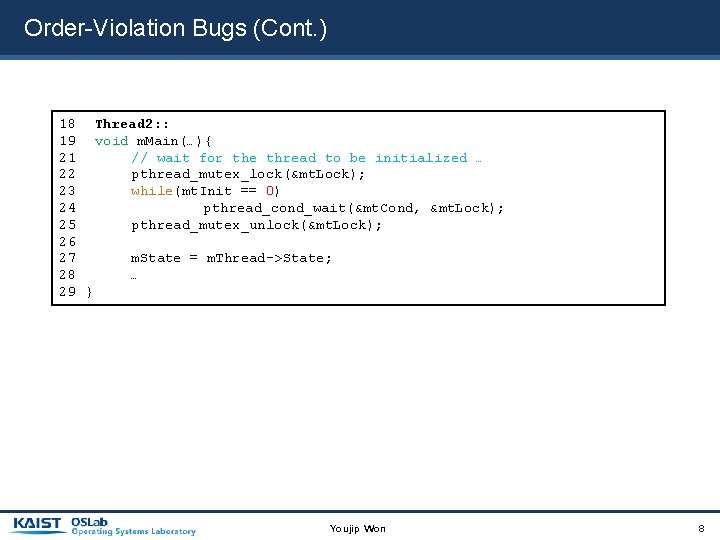
Order-Violation Bugs (Cont. ) 18 Thread 2: : 19 void m. Main(…){ 21 // wait for the thread to be initialized … 22 pthread_mutex_lock(&mt. Lock); 23 while(mt. Init == 0) 24 pthread_cond_wait(&mt. Cond, &mt. Lock); 25 pthread_mutex_unlock(&mt. Lock); 26 27 m. State = m. Thread->State; 28 … 29 } Youjip Won 8
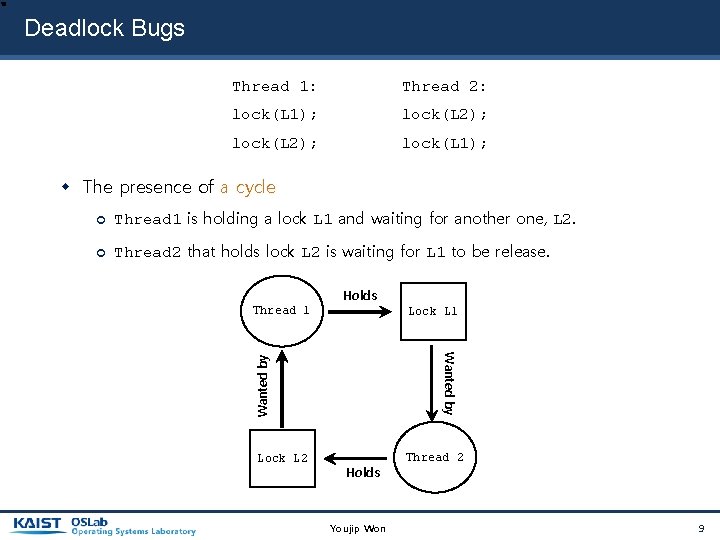
Deadlock Bugs Thread 1: Thread 2: lock(L 1); lock(L 2); lock(L 1); The presence of a cycle Thread 1 is holding a lock L 1 and waiting for another one, L 2. Thread 2 that holds lock L 2 is waiting for L 1 to be release. Holds Thread 1 Lock L 1 Wanted by Lock L 2 Holds Youjip Won Thread 2 9
Why Do Deadlocks Occur? Reason 1: In large code bases, complex dependencies arise between components. Reason 2: Due to the nature of encapsulation Hide details of implementations and make software easier to build in a modular way. Such modularity does not mesh well with locking. Youjip Won 10
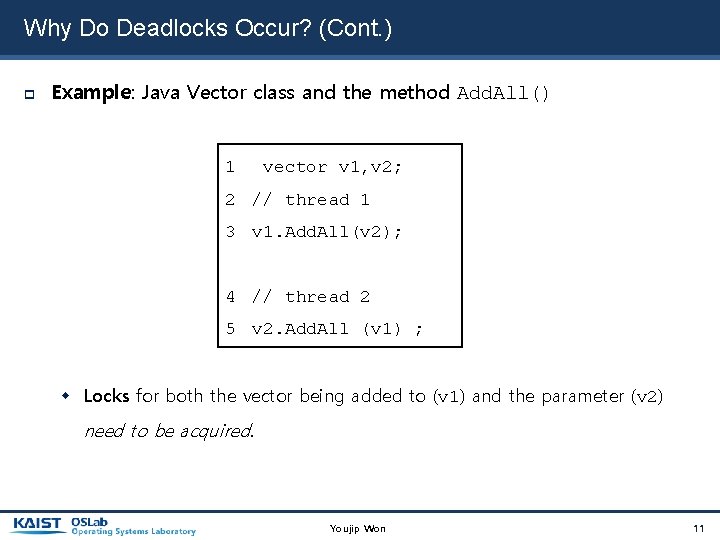
Why Do Deadlocks Occur? (Cont. ) Example: Java Vector class and the method Add. All() 1 vector v 1, v 2; 2 // thread 1 3 v 1. Add. All(v 2); 4 // thread 2 5 v 2. Add. All (v 1) ; Locks for both the vector being added to (v 1) and the parameter (v 2) need to be acquired. Youjip Won 11
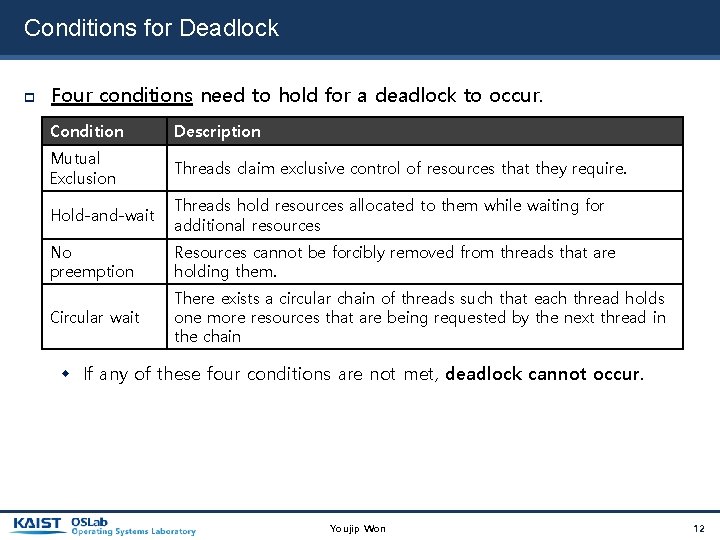
Conditions for Deadlock Four conditions need to hold for a deadlock to occur. Condition Description Mutual Exclusion Threads claim exclusive control of resources that they require. Hold-and-wait Threads hold resources allocated to them while waiting for additional resources No preemption Resources cannot be forcibly removed from threads that are holding them. Circular wait There exists a circular chain of threads such that each thread holds one more resources that are being requested by the next thread in the chain If any of these four conditions are not met, deadlock cannot occur. Youjip Won 12
Prevention – Circular Wait Provide a total ordering on lock acquisition This approach requires careful design of global locking strategies. Example: There are two locks in the system (L 1 and L 2) We can prevent deadlock by always acquiring L 1 before L 2. Youjip Won 13
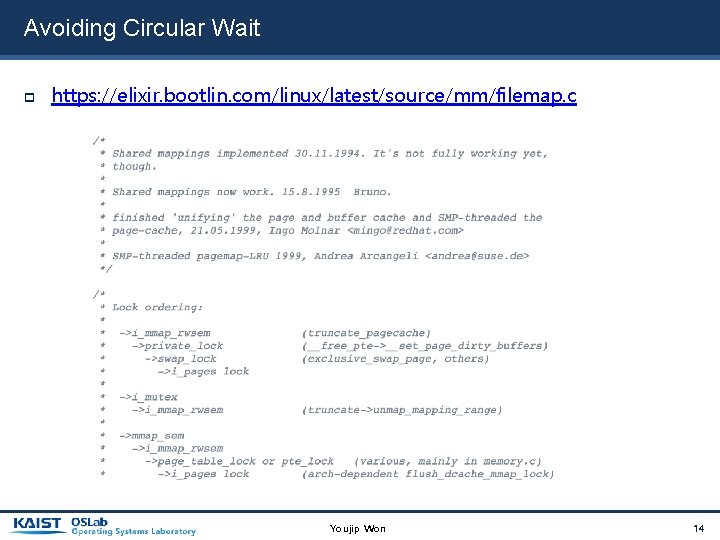
Avoiding Circular Wait https: //elixir. bootlin. com/linux/latest/source/mm/filemap. c Youjip Won 14
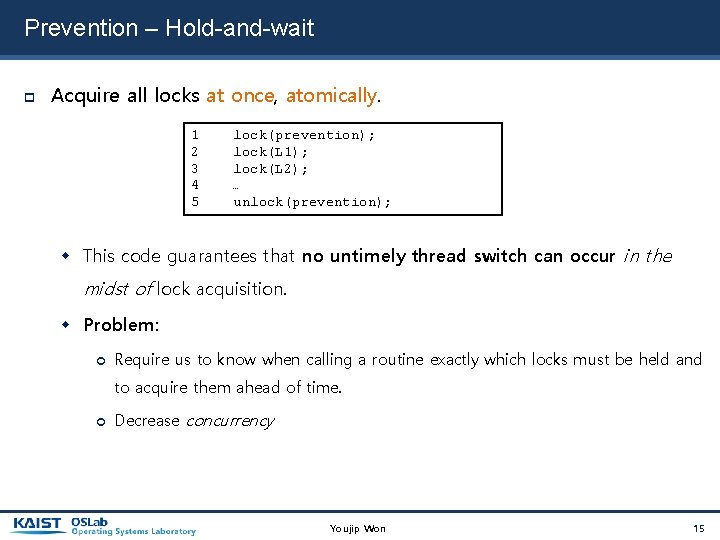
Prevention – Hold-and-wait Acquire all locks at once, atomically. 1 2 3 4 5 lock(prevention); lock(L 1); lock(L 2); … unlock(prevention); This code guarantees that no untimely thread switch can occur in the midst of lock acquisition. Problem: Require us to know when calling a routine exactly which locks must be held and to acquire them ahead of time. Decrease concurrency Youjip Won 15
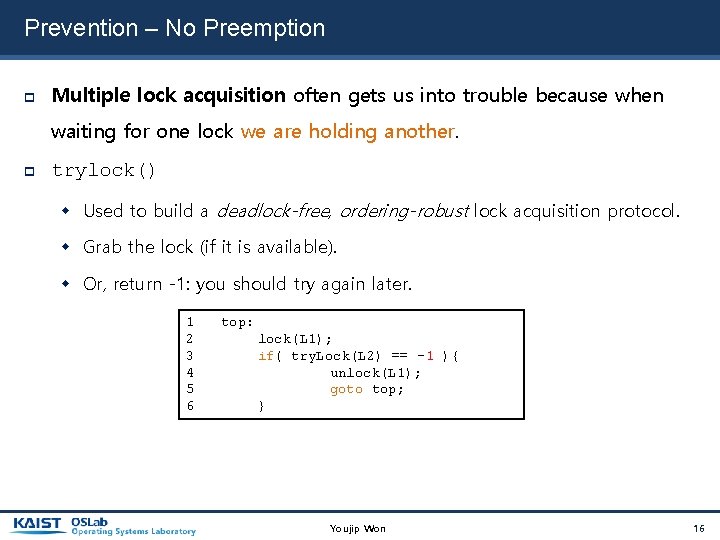
Prevention – No Preemption Multiple lock acquisition often gets us into trouble because when waiting for one lock we are holding another. trylock() Used to build a deadlock-free, ordering-robust lock acquisition protocol. Grab the lock (if it is available). Or, return -1: you should try again later. 1 2 3 4 5 6 top: lock(L 1); if( try. Lock(L 2) == -1 ){ unlock(L 1); goto top; } Youjip Won 16
Prevention – No Preemption (Cont. ) livelock Both systems are running through the code sequence over and over again. Progress is not being made. Solution: Add a random delay before looping back and trying the entire thing over again. Youjip Won 17
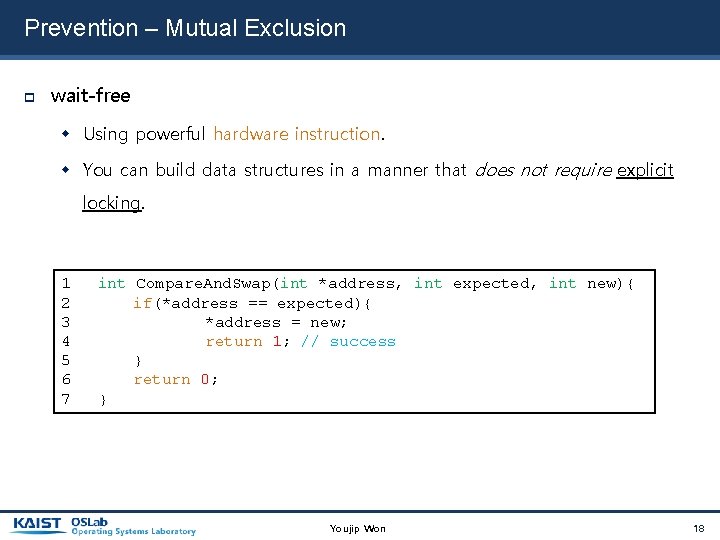
Prevention – Mutual Exclusion wait-free Using powerful hardware instruction. You can build data structures in a manner that does not require explicit locking. 1 2 3 4 5 6 7 int Compare. And. Swap(int *address, int expected, int new){ if(*address == expected){ *address = new; return 1; // success } return 0; } Youjip Won 18
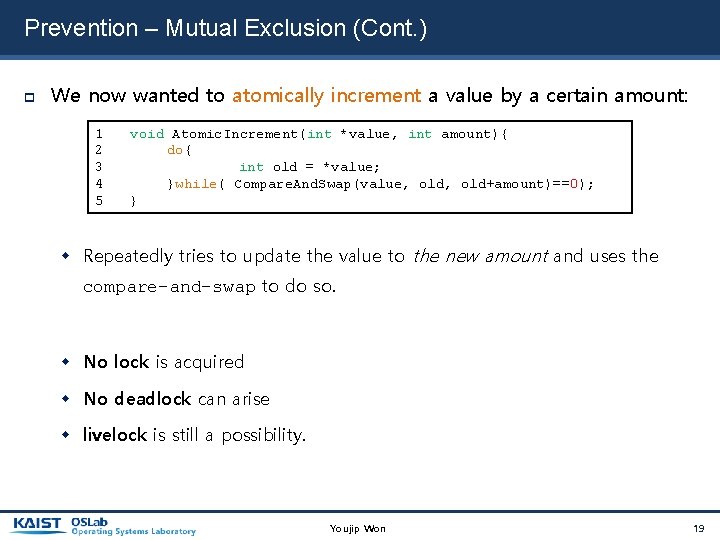
Prevention – Mutual Exclusion (Cont. ) We now wanted to atomically increment a value by a certain amount: 1 2 3 4 5 void Atomic. Increment(int *value, int amount){ do{ int old = *value; }while( Compare. And. Swap(value, old+amount)==0); } Repeatedly tries to update the value to the new amount and uses the compare-and-swap to do so. No lock is acquired No deadlock can arise livelock is still a possibility. Youjip Won 19
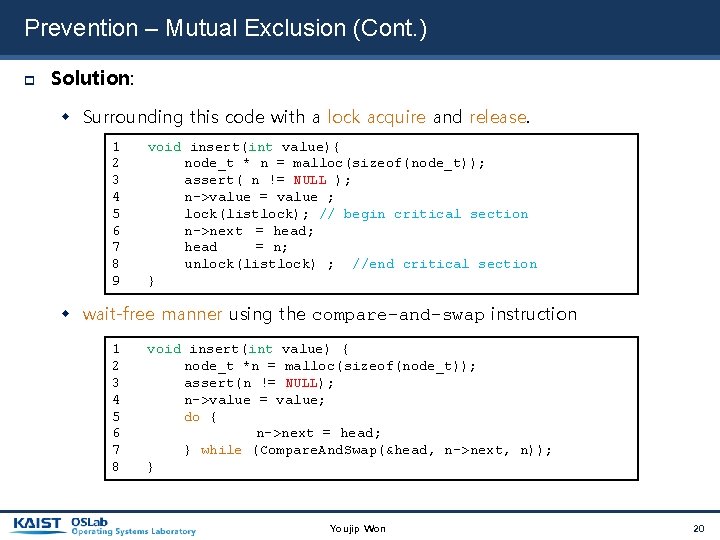
Prevention – Mutual Exclusion (Cont. ) Solution: Surrounding this code with a lock acquire and release. 1 2 3 4 5 6 7 8 9 void insert(int value){ node_t * n = malloc(sizeof(node_t)); assert( n != NULL ); n->value = value ; lock(listlock); // begin critical section n->next = head; head = n; unlock(listlock) ; //end critical section } wait-free manner using the compare-and-swap instruction 1 2 3 4 5 6 7 8 void insert(int value) { node_t *n = malloc(sizeof(node_t)); assert(n != NULL); n->value = value; do { n->next = head; } while (Compare. And. Swap(&head, n->next, n)); } Youjip Won 20
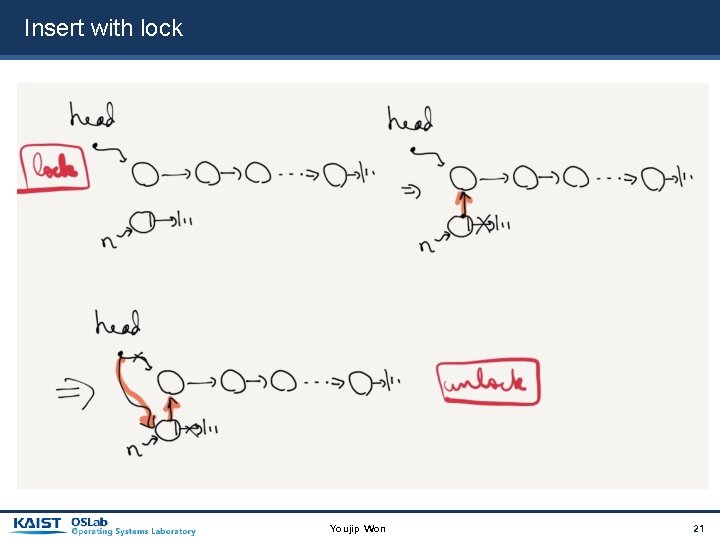
Insert with lock Youjip Won 21
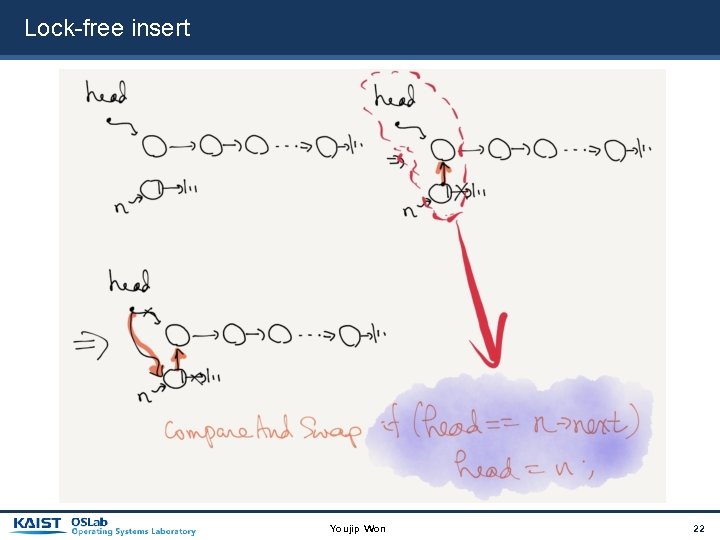
Lock-free insert Youjip Won 22
Deadlock Avoidance via Scheduling Deadlock Avoidance Get the information about the locks various threads might grab during their execution. schedule threads in a way to guarantee no deadlock can occur. In some scenarios, deadlock avoidance is preferable. Problem: Global knowledge is required. Youjip Won 23
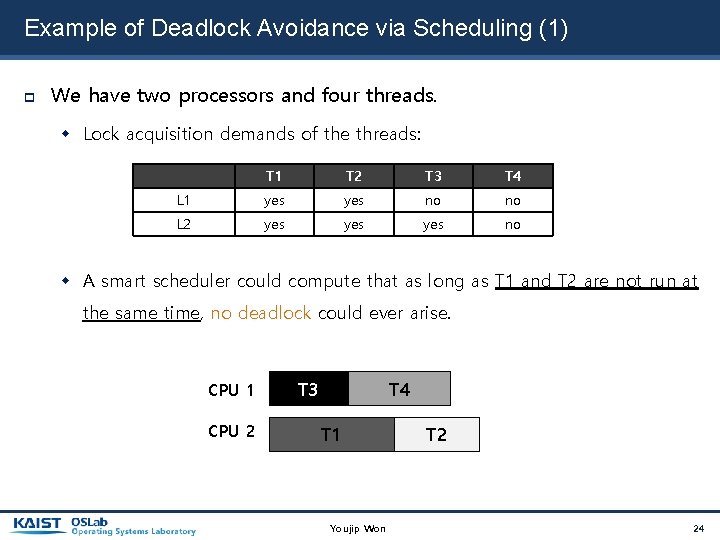
Example of Deadlock Avoidance via Scheduling (1) We have two processors and four threads. Lock acquisition demands of the threads: T 1 T 2 T 3 T 4 L 1 yes no no L 2 yes yes no A smart scheduler could compute that as long as T 1 and T 2 are not run at the same time, no deadlock could ever arise. CPU 1 CPU 2 T 3 T 4 T 1 Youjip Won T 2 24
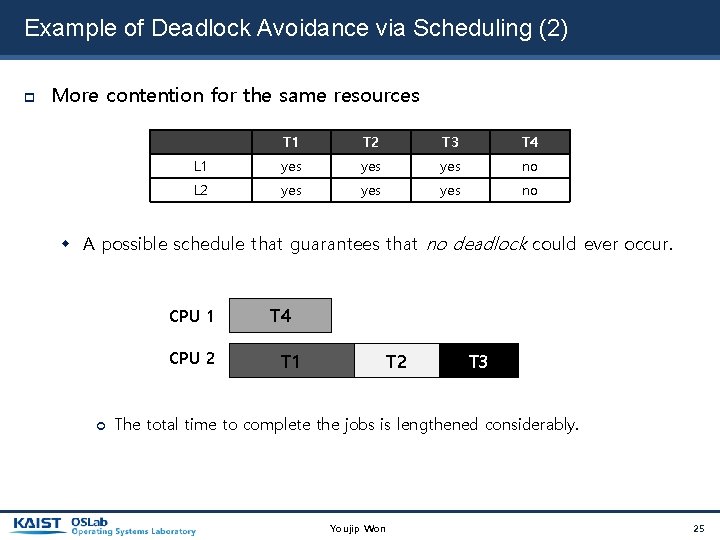
Example of Deadlock Avoidance via Scheduling (2) More contention for the same resources T 1 T 2 T 3 T 4 L 1 yes yes no L 2 yes yes no A possible schedule that guarantees that no deadlock could ever occur. CPU 1 CPU 2 T 4 T 1 T 2 T 3 The total time to complete the jobs is lengthened considerably. Youjip Won 25
Detect and Recover Allow deadlock to occasionally occur and then take some action. Example: if an OS froze, you would reboot it. Many database systems employ deadlock detection and recovery technique. A deadlock detector runs periodically. Building a resource graph and checking it for cycles. In deadlock, the system need to be restarted. Youjip Won 26
Summary Non-deadlocked bugs Atomicity violation Ordering violation Deadlock Enforcing the lock order Lockless mechanism Youjip Won 27
- Slides: 27