
Operating Systems Youjip Won 20 Advanced Page Tables
Operating Systems Youjip Won
20. Advanced Page Tables Youjip Won 2
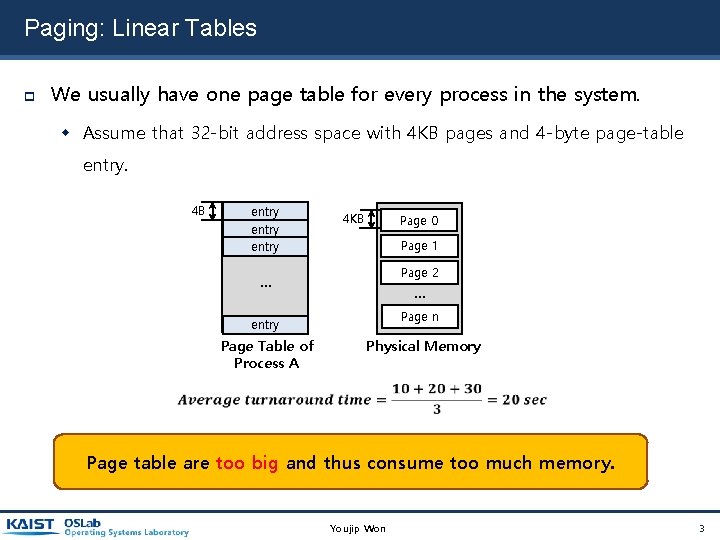
Paging: Linear Tables We usually have one page table for every process in the system. Assume that 32 -bit address space with 4 KB pages and 4 -byte page-table entry. 4 B entry 4 KB Page 0 Page 1 Page 2 … … Page n entry Page Table of Process A Physical Memory Page table are too big and thus consume too much memory. Youjip Won 3
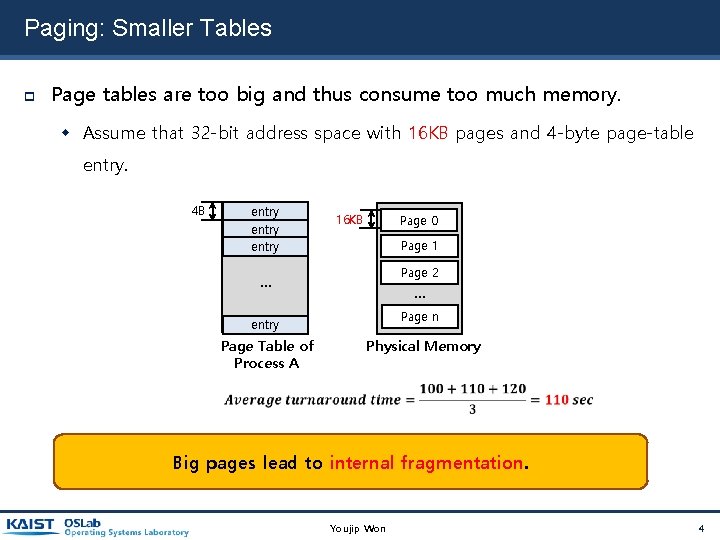
Paging: Smaller Tables Page tables are too big and thus consume too much memory. Assume that 32 -bit address space with 16 KB pages and 4 -byte page-table entry. 4 B entry 16 KB Page 0 Page 1 Page 2 … … Page n entry Page Table of Process A Physical Memory Big pages lead to internal fragmentation. Youjip Won 4
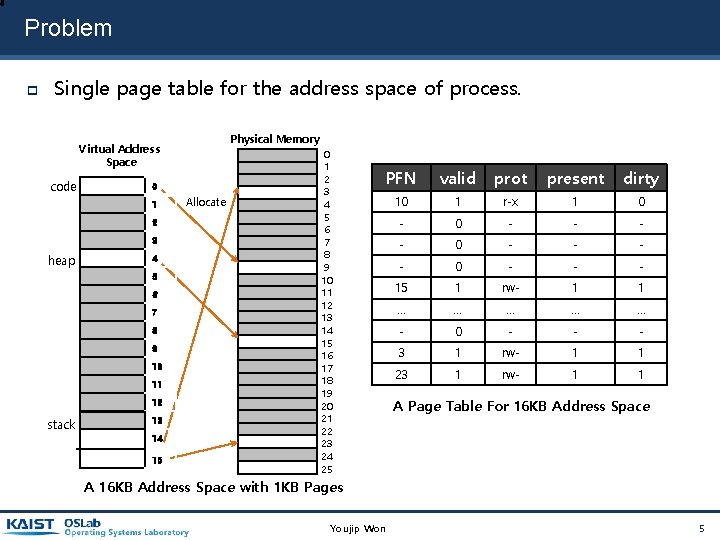
Problem Single page table for the address space of process. Physical Memory Virtual Address Space code 0 1 2 3 heap 4 5 6 7 8 9 10 11 12 stack 13 14 15 Allocate 0 1 2 3 4 5 6 7 8 9 10 11 12 13 14 15 16 17 18 19 20 21 22 23 24 25 PFN valid prot present dirty 10 1 r-x 1 0 - - - - 0 - - - 15 1 rw- 1 1 … … … - 0 - - - 3 1 rw- 1 1 23 1 rw- 1 1 A Page Table For 16 KB Address Space A 16 KB Address Space with 1 KB Pages Youjip Won 5
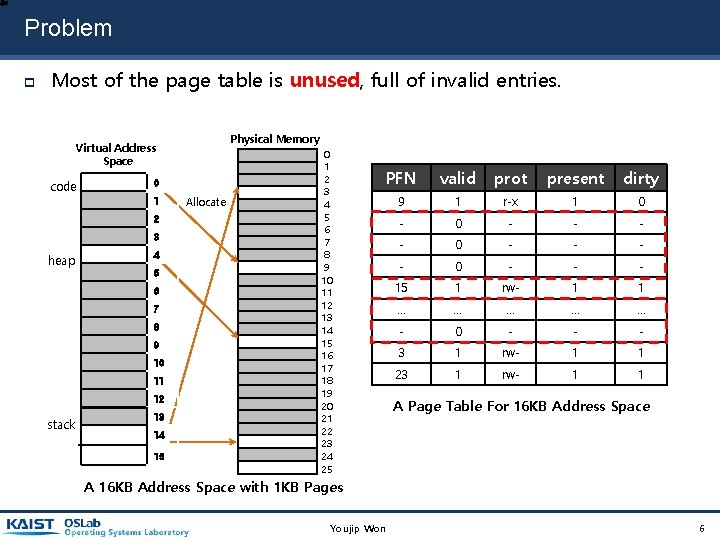
Problem Most of the page table is unused, full of invalid entries. Physical Memory Virtual Address Space code 0 1 2 3 heap 4 5 6 7 8 9 10 11 12 stack 13 14 15 Allocate 0 1 2 3 4 5 6 7 8 9 10 11 12 13 14 15 16 17 18 19 20 21 22 23 24 25 PFN valid prot present dirty 9 1 r-x 1 0 - - - - 0 - - - 15 1 rw- 1 1 … … … - 0 - - - 3 1 rw- 1 1 23 1 rw- 1 1 A Page Table For 16 KB Address Space A 16 KB Address Space with 1 KB Pages Youjip Won 6
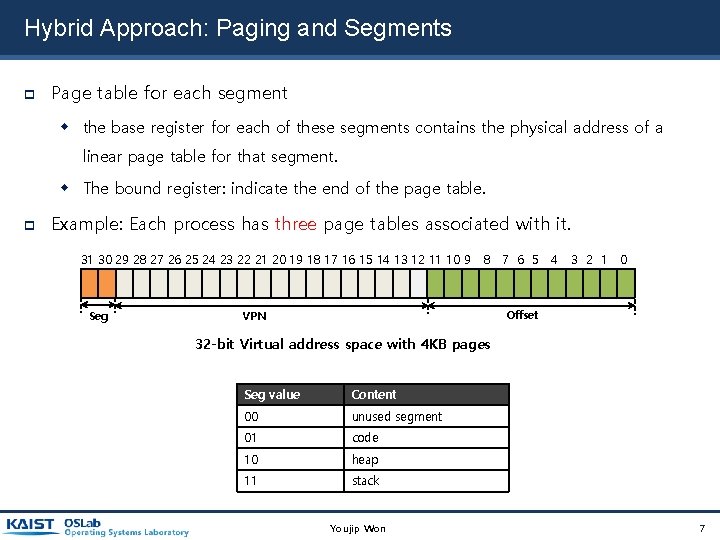
Hybrid Approach: Paging and Segments Page table for each segment the base register for each of these segments contains the physical address of a linear page table for that segment. The bound register: indicate the end of the page table. Example: Each process has three page tables associated with it. 31 30 29 28 27 26 25 24 23 22 21 20 19 18 17 16 15 14 13 12 11 10 9 Seg 8 7 6 5 4 3 2 1 0 Offset VPN 32 -bit Virtual address space with 4 KB pages Seg value Content 00 unused segment 01 code 10 heap 11 stack Youjip Won 7
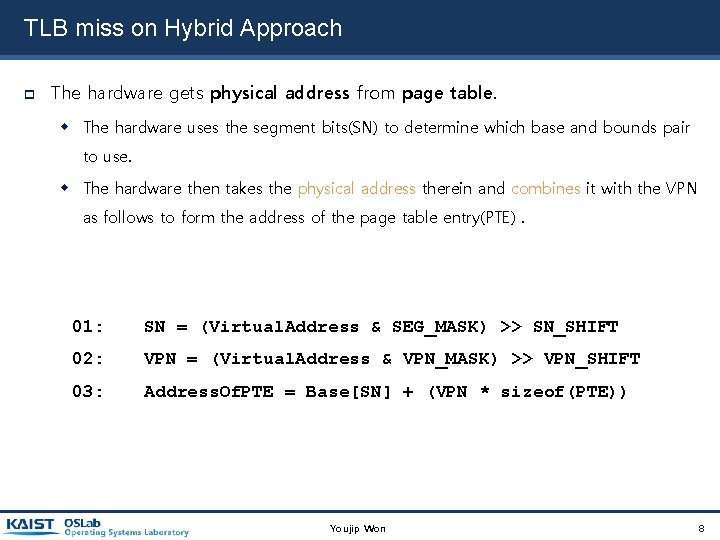
TLB miss on Hybrid Approach The hardware gets physical address from page table. The hardware uses the segment bits(SN) to determine which base and bounds pair to use. The hardware then takes the physical address therein and combines it with the VPN as follows to form the address of the page table entry(PTE). 01: SN = (Virtual. Address & SEG_MASK) >> SN_SHIFT 02: VPN = (Virtual. Address & VPN_MASK) >> VPN_SHIFT 03: Address. Of. PTE = Base[SN] + (VPN * sizeof(PTE)) Youjip Won 8
Problem of Hybrid Approach is not without problems. If we have a large but sparsely-used heap, we can still end up with a lot of page table waste. Causing external fragmentation to arise again. Youjip Won 9
Multi-level Page Tables Turn the linear page table into something like a tree. Chop up the page table into page-sized units. If an entire page of page-table entries is invalid, don’t allocate that page of the page table at all. To track whether a page of the page table is valid, use a new structure, called page directory. Youjip Won 10
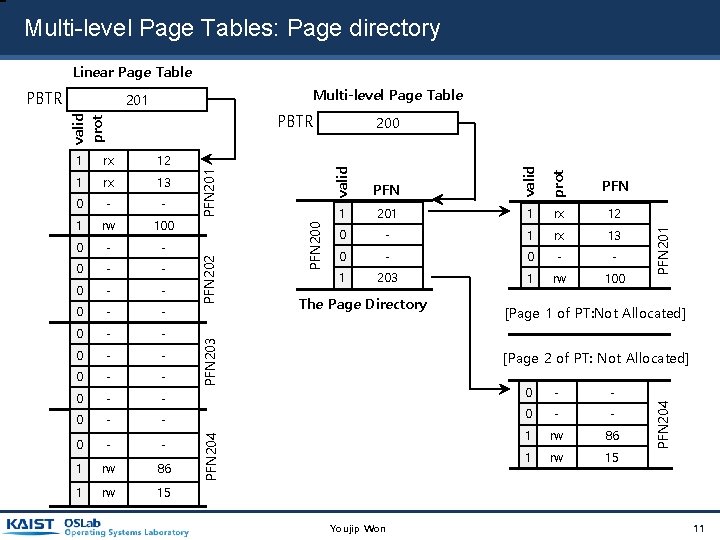
Multi-level Page Tables: Page directory Linear Page Table Multi-level Page Table - - 1 rw 100 0 - - 0 - - 0 - - 1 rw 86 1 rw 15 prot 0 PFN valid PFN 13 valid rx PFN 200 1 PFN 202 12 PFN 1 201 1 rx 12 0 - 1 rx 13 0 - - 1 203 1 rw 100 The Page Directory PFN 203 rx 200 [Page 1 of PT: Not Allocated] [Page 2 of PT: Not Allocated] PFN 204 1 PFN 201 valid prot PBTR PFN 201 Youjip Won 0 - - 1 rw 86 1 rw 15 PFN 204 PBTR 11
Multi-level Page Tables Page Directory The page directory contains one entry per page of the page table. It consists of a number of page directory entries(PDE). PDE has a valid bit and page frame number(PFN). Advantage Only allocates page-table space in proportion to the amount of address space you are using. The OS can grab the next free page when it needs to allocate or grow a page table. Disadvantage Multi-level table is a small example of a time-space trade-off. Complexity. Youjip Won 12
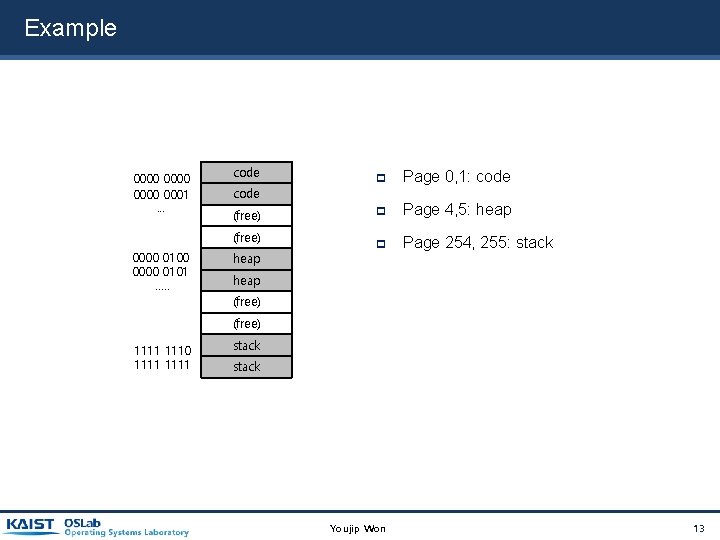
Example 0000 0001. . . code Page 0, 1: code Page 4, 5: heap Page 254, 255: stack code (free) 0000 0100 0000 0101 …. . heap (free) 1111 1110 1111 stack Youjip Won 13
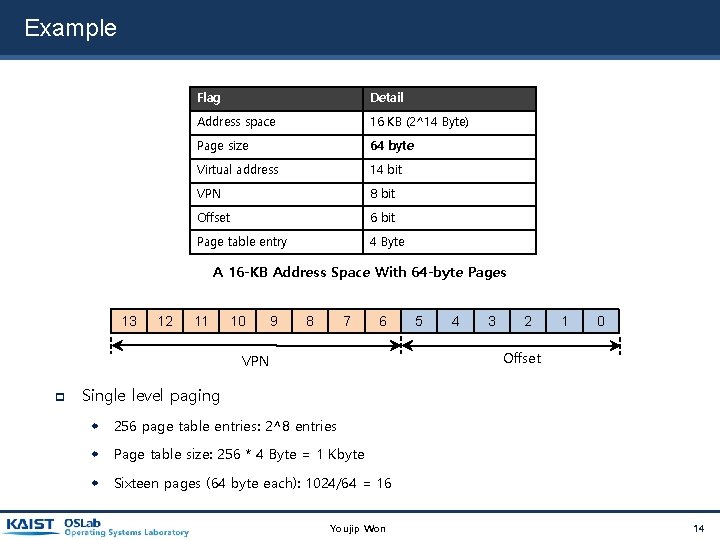
Example Flag Detail Address space 16 KB (2^14 Byte) Page size 64 byte Virtual address 14 bit VPN 8 bit Offset 6 bit Page table entry 4 Byte A 16 -KB Address Space With 64 -byte Pages 13 12 11 10 9 8 7 6 4 3 2 1 0 Offset VPN 5 Single level paging 256 page table entries: 2^8 entries Page table size: 256 * 4 Byte = 1 Kbyte Sixteen pages (64 byte each): 1024/64 = 16 Youjip Won 14
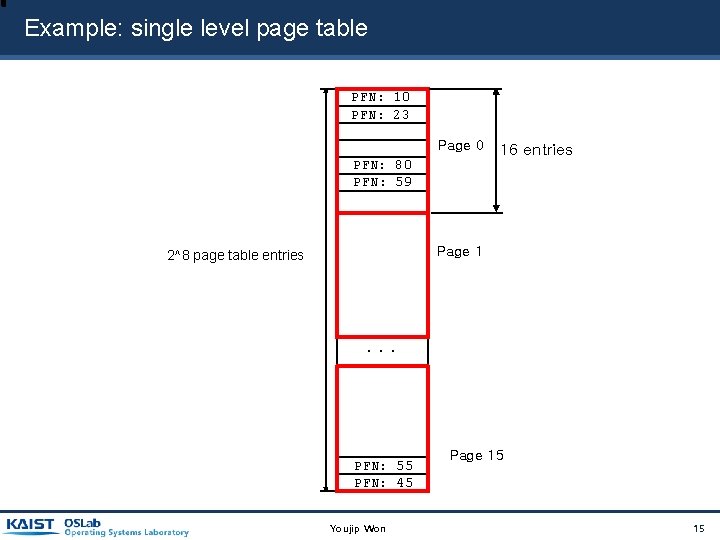
Example: single level page table PFN: 10 PFN: 23 Page 0 PFN: 80 PFN: 59 16 entries Page 1 2^8 page table entries . . . PFN: 55 PFN: 45 Youjip Won Page 15 15
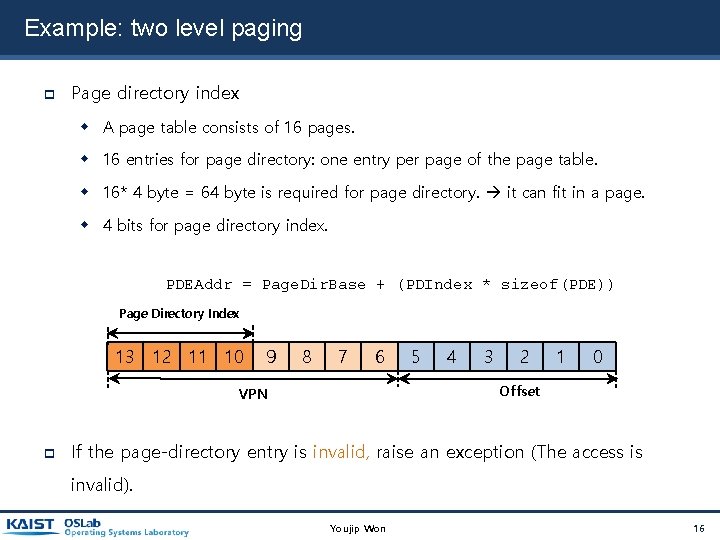
Example: two level paging Page directory index A page table consists of 16 pages. 16 entries for page directory: one entry per page of the page table. 16* 4 byte = 64 byte is required for page directory. it can fit in a page. 4 bits for page directory index. PDEAddr = Page. Dir. Base + (PDIndex * sizeof(PDE)) Page Directory Index 13 12 11 10 9 8 7 6 4 3 2 1 0 Offset VPN 5 If the page-directory entry is invalid, raise an exception (The access is invalid). Youjip Won 16
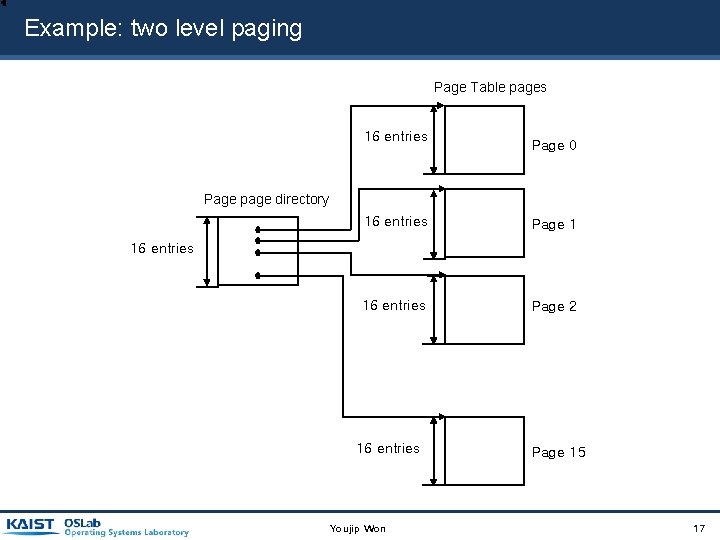
Example: two level paging Page Table pages 16 entries Page 0 Page page directory 16 entries Page 1 16 entries Page 2 16 entries Youjip Won Page 15 17
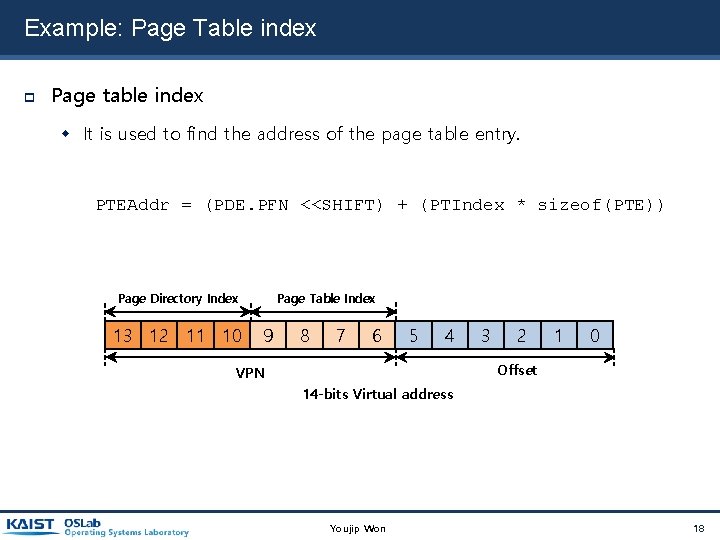
Example: Page Table index Page table index It is used to find the address of the page table entry. PTEAddr = (PDE. PFN <<SHIFT) + (PTIndex * sizeof(PTE)) Page Table Index Page Directory Index 13 12 11 10 9 8 7 6 5 4 3 2 1 0 Offset VPN 14 -bits Virtual address Youjip Won 18
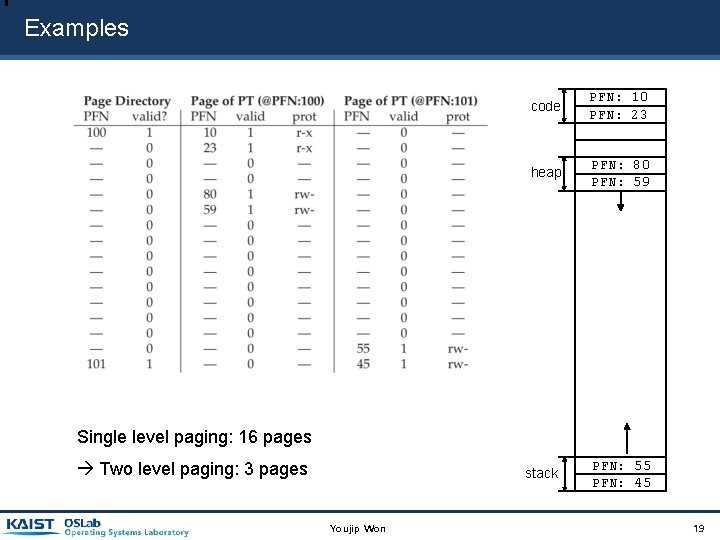
Examples code PFN: 10 PFN: 23 heap PFN: 80 PFN: 59 stack PFN: 55 PFN: 45 Single level paging: 16 pages Two level paging: 3 pages Youjip Won 19
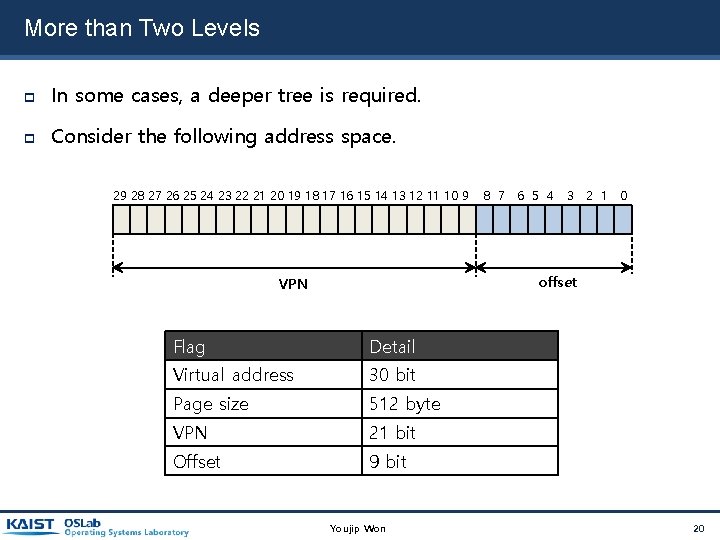
More than Two Levels In some cases, a deeper tree is required. Consider the following address space. 29 28 27 26 25 24 23 22 21 20 19 18 17 16 15 14 13 12 11 10 9 8 7 6 5 4 3 2 1 0 offset VPN Flag Detail Virtual address 30 bit Page size 512 byte VPN 21 bit Offset 9 bit Youjip Won 20
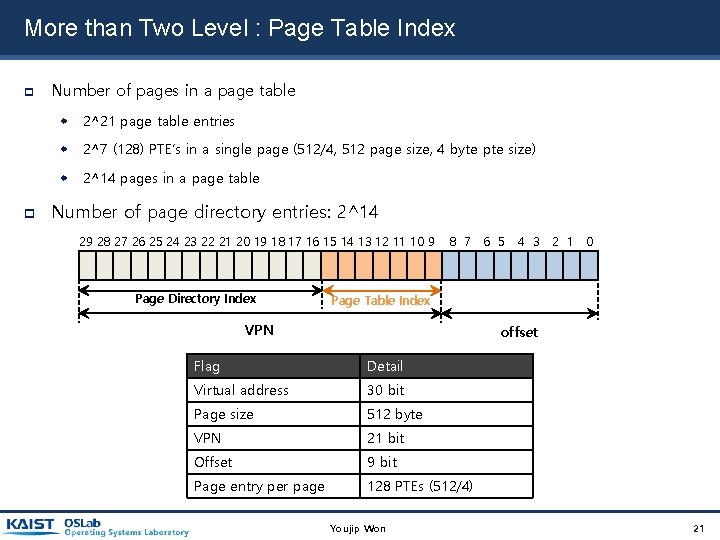
More than Two Level : Page Table Index Number of pages in a page table 2^21 page table entries 2^7 (128) PTE’s in a single page (512/4, 512 page size, 4 byte pte size) 2^14 pages in a page table Number of page directory entries: 2^14 29 28 27 26 25 24 23 22 21 20 19 18 17 16 15 14 13 12 11 10 9 Page Directory Index 8 7 6 5 4 3 2 1 0 Page Table Index VPN offset Flag Detail Virtual address 30 bit Page size 512 byte VPN 21 bit Offset 9 bit Page entry per page 128 PTEs (512/4) Youjip Won 21
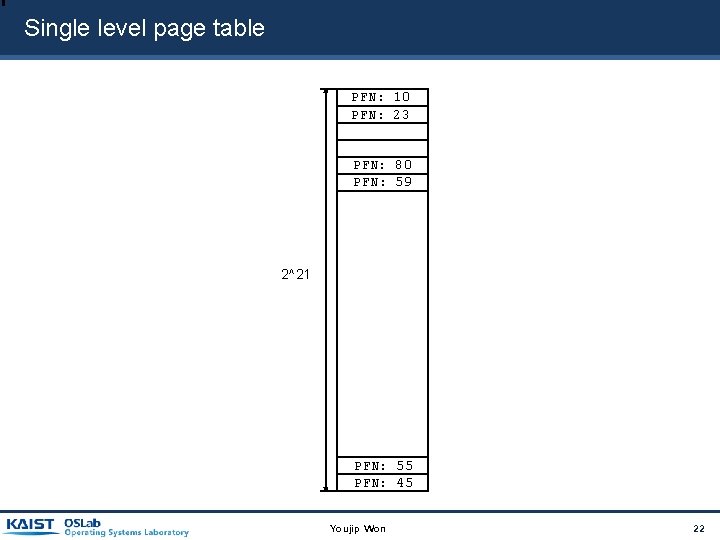
Single level page table PFN: 10 PFN: 23 PFN: 80 PFN: 59 2^21 PFN: 55 PFN: 45 Youjip Won 22
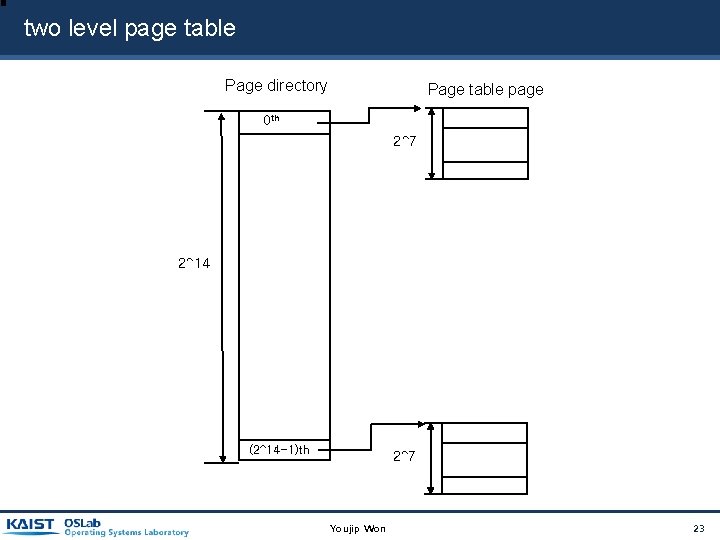
two level page table Page directory Page table page 0 th 2^7 2^14 (2^14 -1)th 2^7 Youjip Won 23
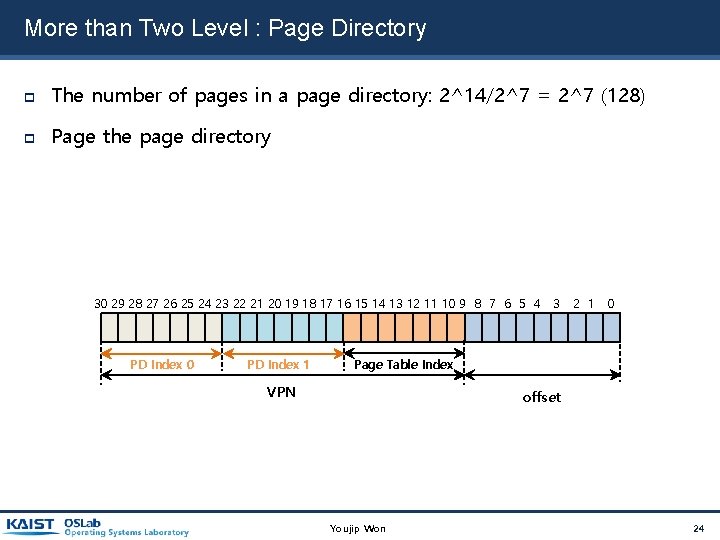
More than Two Level : Page Directory The number of pages in a page directory: 2^14/2^7 = 2^7 (128) Page the page directory 30 29 28 27 26 25 24 23 22 21 20 19 18 17 16 15 14 13 12 11 10 9 8 7 6 5 4 PD Index 0 PD Index 1 3 2 1 0 Page Table Index VPN offset Youjip Won 24
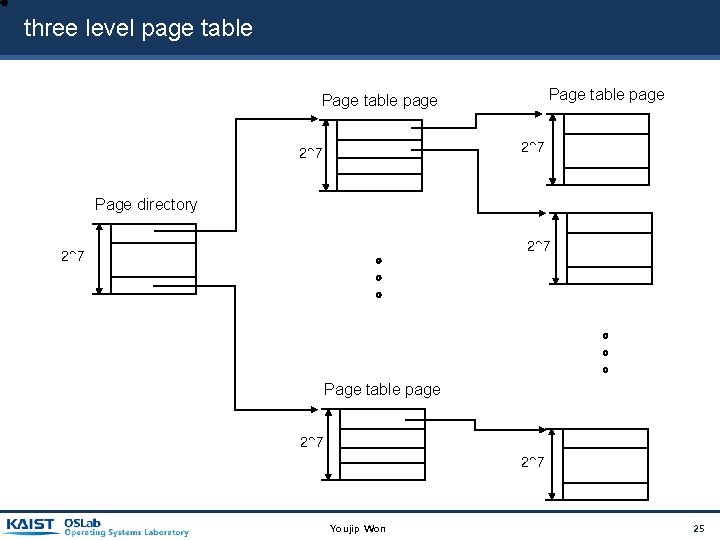
three level page table Page table page 2^7 Page directory 2^7 Page table page 2^7 Youjip Won 25
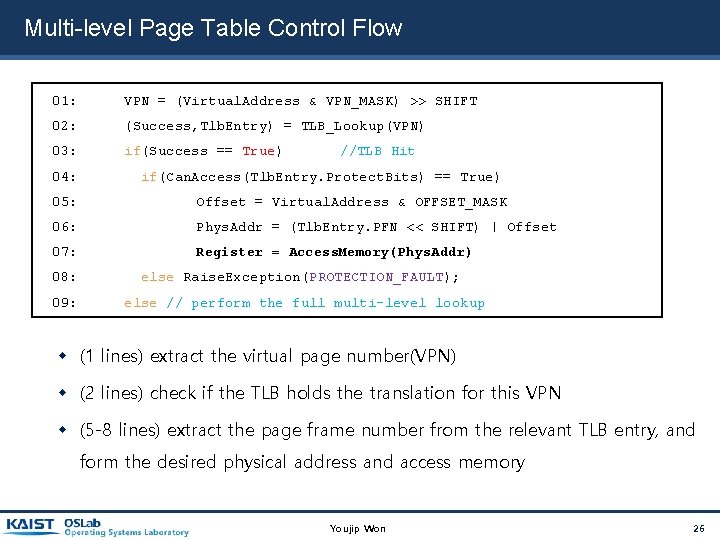
Multi-level Page Table Control Flow 01: VPN = (Virtual. Address & VPN_MASK) >> SHIFT 02: (Success, Tlb. Entry) = TLB_Lookup(VPN) 03: if(Success == True) 04: //TLB Hit if(Can. Access(Tlb. Entry. Protect. Bits) == True) 05: Offset = Virtual. Address & OFFSET_MASK 06: Phys. Addr = (Tlb. Entry. PFN << SHIFT) | Offset 07: Register = Access. Memory(Phys. Addr) 08: else Raise. Exception(PROTECTION_FAULT); 09: else // perform the full multi-level lookup (1 lines) extract the virtual page number(VPN) (2 lines) check if the TLB holds the translation for this VPN (5 -8 lines) extract the page frame number from the relevant TLB entry, and form the desired physical address and access memory Youjip Won 26
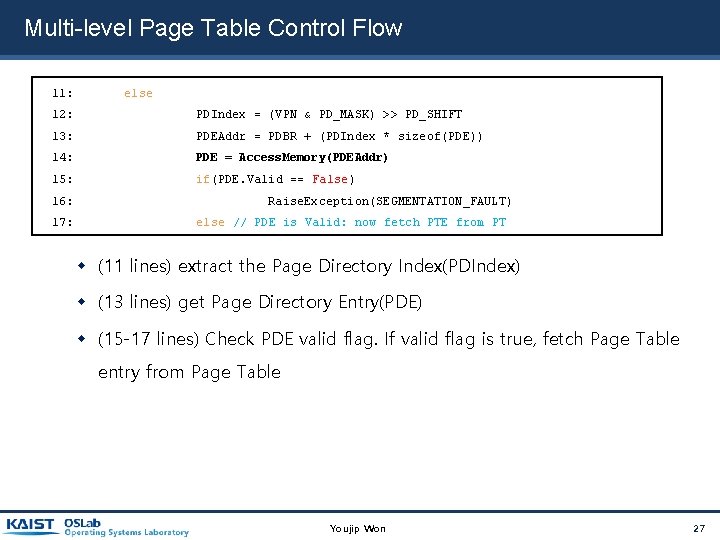
Multi-level Page Table Control Flow 11: else 12: PDIndex = (VPN & PD_MASK) >> PD_SHIFT 13: PDEAddr = PDBR + (PDIndex * sizeof(PDE)) 14: PDE = Access. Memory(PDEAddr) 15: if(PDE. Valid == False) 16: 17: Raise. Exception(SEGMENTATION_FAULT) else // PDE is Valid: now fetch PTE from PT (11 lines) extract the Page Directory Index(PDIndex) (13 lines) get Page Directory Entry(PDE) (15 -17 lines) Check PDE valid flag. If valid flag is true, fetch Page Table entry from Page Table Youjip Won 27
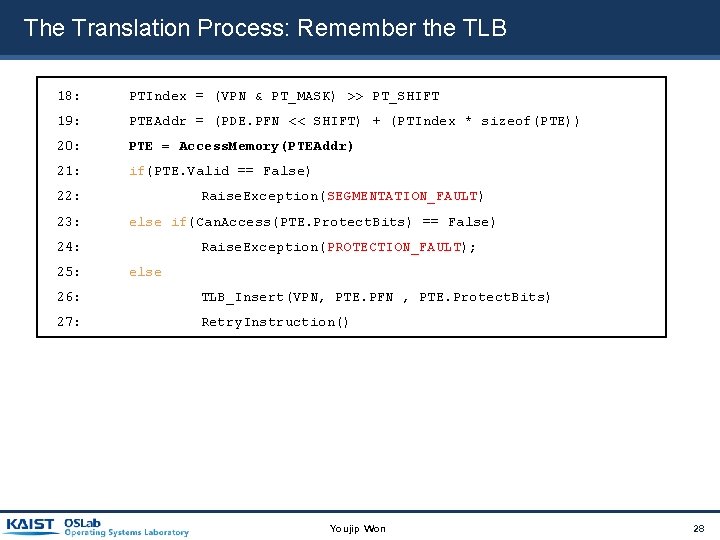
The Translation Process: Remember the TLB 18: PTIndex = (VPN & PT_MASK) >> PT_SHIFT 19: PTEAddr = (PDE. PFN << SHIFT) + (PTIndex * sizeof(PTE)) 20: PTE = Access. Memory(PTEAddr) 21: if(PTE. Valid == False) 22: 23: Raise. Exception(SEGMENTATION_FAULT) else if(Can. Access(PTE. Protect. Bits) == False) 24: 25: Raise. Exception(PROTECTION_FAULT); else 26: TLB_Insert(VPN, PTE. PFN , PTE. Protect. Bits) 27: Retry. Instruction() Youjip Won 28
Inverted Page Tables Keeping a single page table that has an entry for each physical page of the system. The entry tells us which process is using this page, and which virtual page of that process maps to this physical page. Youjip Won 29
Summary Reducing the page table size Per segment page table Multi-level paging Efficient use of memory Severe TLB miss Youjip Won 30
- Slides: 30