
Operating systems vimia 219 Authentication and authorization Tth
- Slides: 34
Operating systems (vimia 219) Authentication and authorization Tóth Dániel, Micskei Zoltán Budapesti Műszaki és Gazdaságtudományi Egyetem Méréstechnika és Információs Rendszerek Tanszék
Security of computer systems § Is it important? § Is it important for everyone? § When is it important? 2
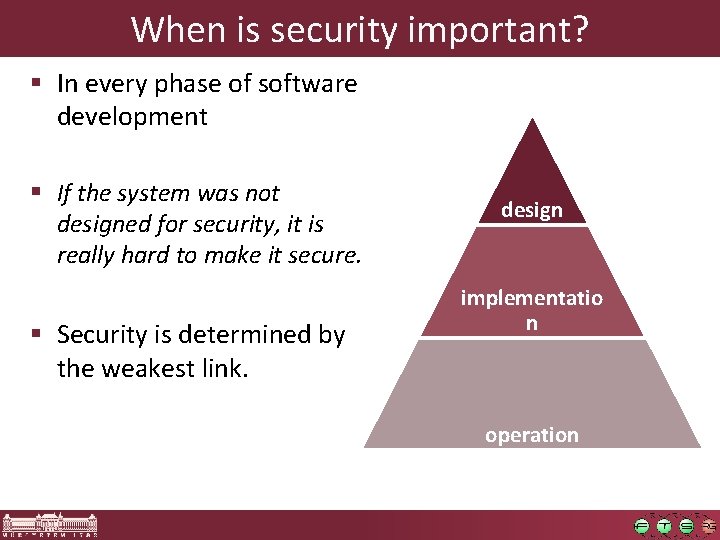
When is security important? § In every phase of software development § If the system was not designed for security, it is really hard to make it secure. § Security is determined by the weakest link. design implementatio n operation
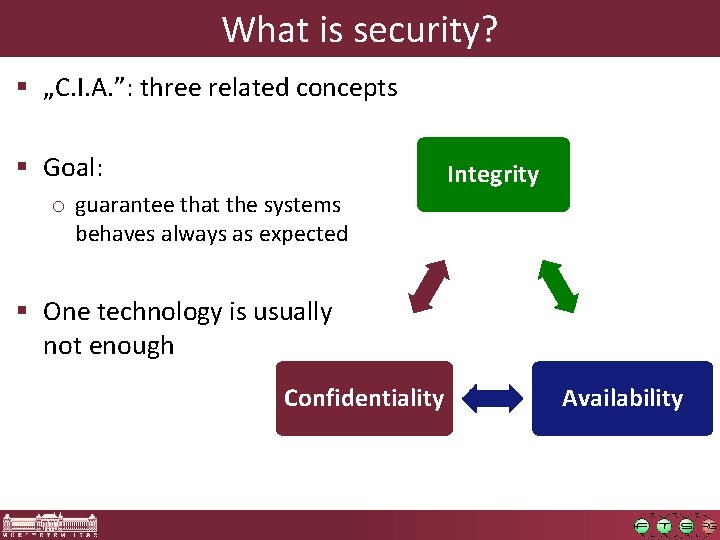
What is security? § „C. I. A. ”: three related concepts § Goal: o guarantee that the systems behaves always as expected Integrity § One technology is usually not enough Confidentiality Availability
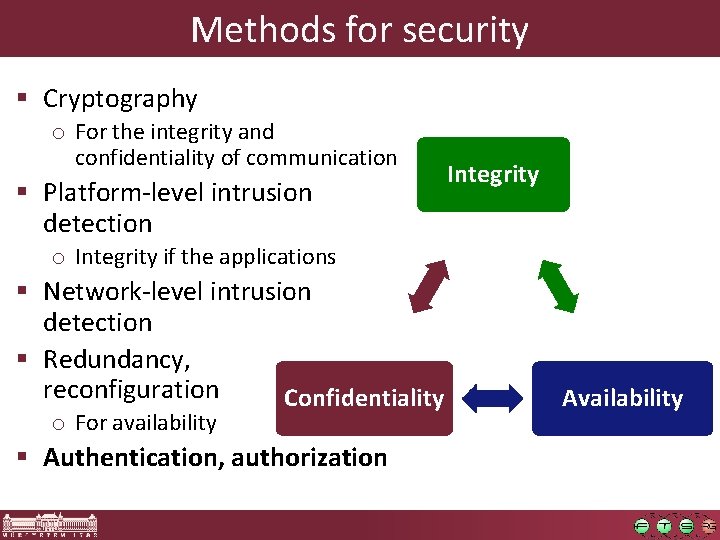
Methods for security § Cryptography o For the integrity and confidentiality of communication § Platform-level intrusion detection Integrity o Integrity if the applications § Network-level intrusion detection § Redundancy, reconfiguration Confidentiality o For availability § Authentication, authorization Availability
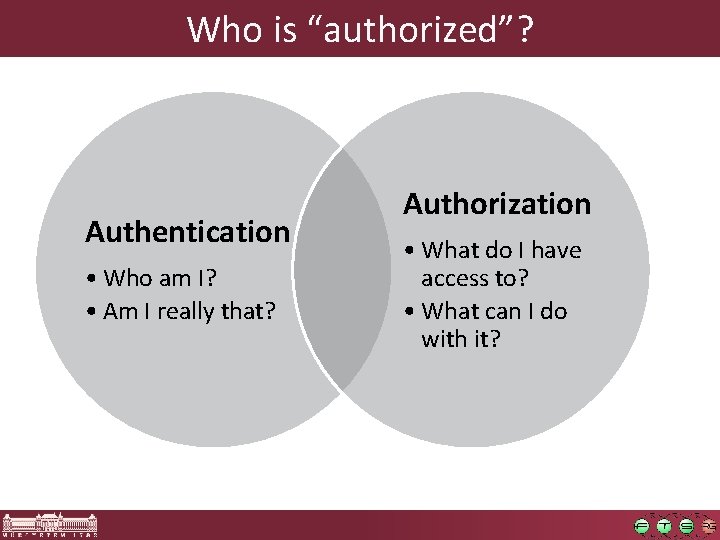
Who is “authorized”? Authentication • Who am I? • Am I really that? Authorization • What do I have access to? • What can I do with it?
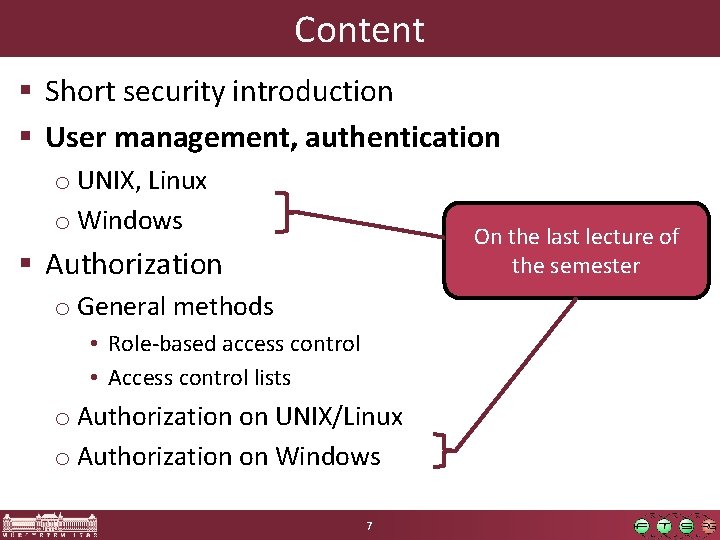
Content § Short security introduction § User management, authentication o UNIX, Linux o Windows On the last lecture of the semester § Authorization o General methods • Role-based access control • Access control lists o Authorization on UNIX/Linux o Authorization on Windows 7
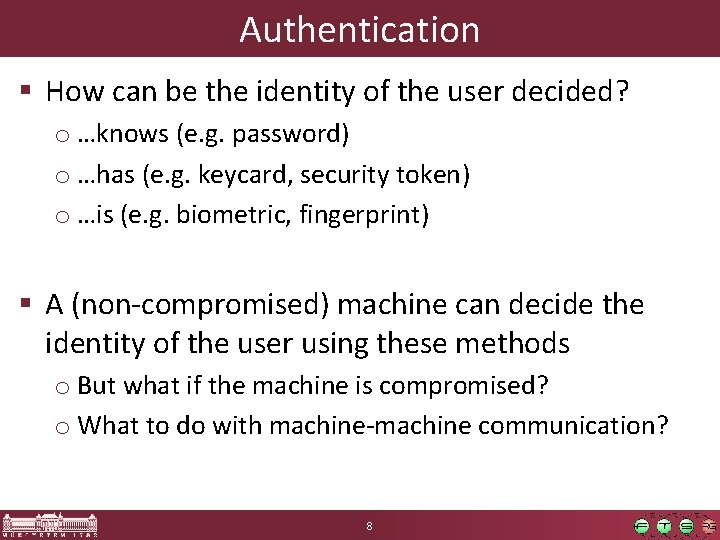
Authentication § How can be the identity of the user decided? o …knows (e. g. password) o …has (e. g. keycard, security token) o …is (e. g. biometric, fingerprint) § A (non-compromised) machine can decide the identity of the user using these methods o But what if the machine is compromised? o What to do with machine-machine communication? 8
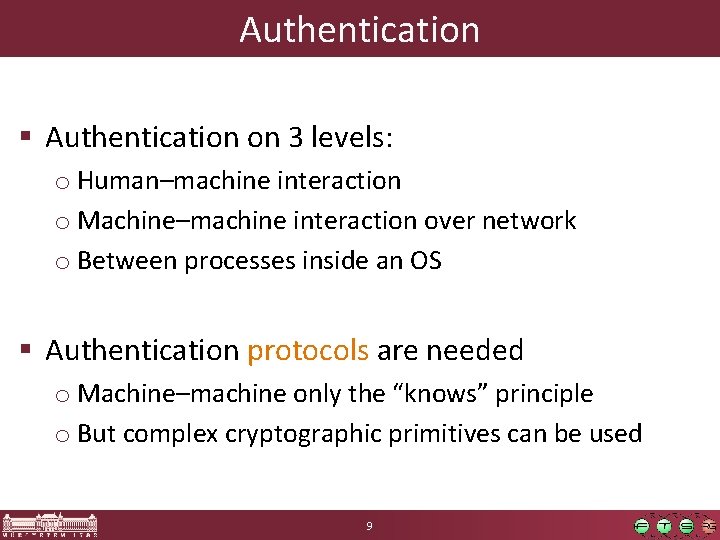
Authentication § Authentication on 3 levels: o Human–machine interaction o Machine–machine interaction over network o Between processes inside an OS § Authentication protocols are needed o Machine–machine only the “knows” principle o But complex cryptographic primitives can be used 9
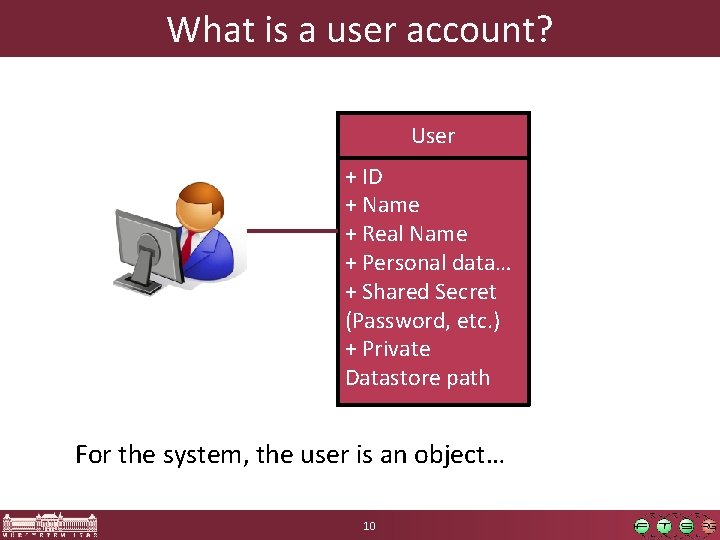
What is a user account? User + ID + Name + Real Name + Personal data… + Shared Secret (Password, etc. ) + Private Datastore path For the system, the user is an object… 10
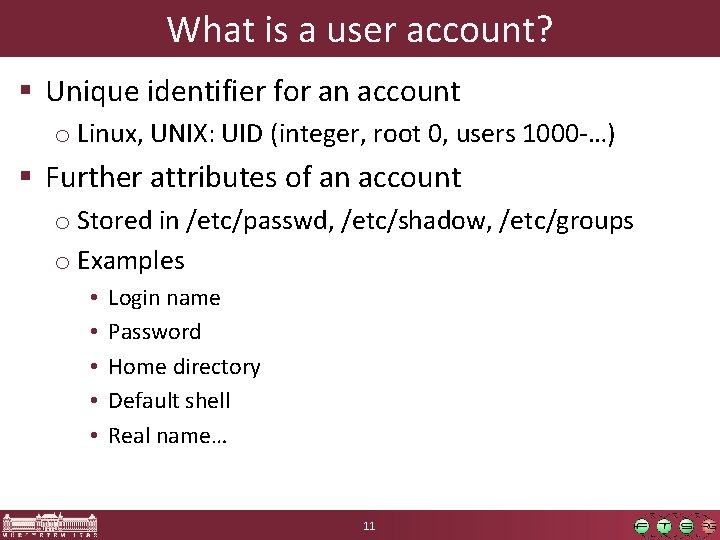
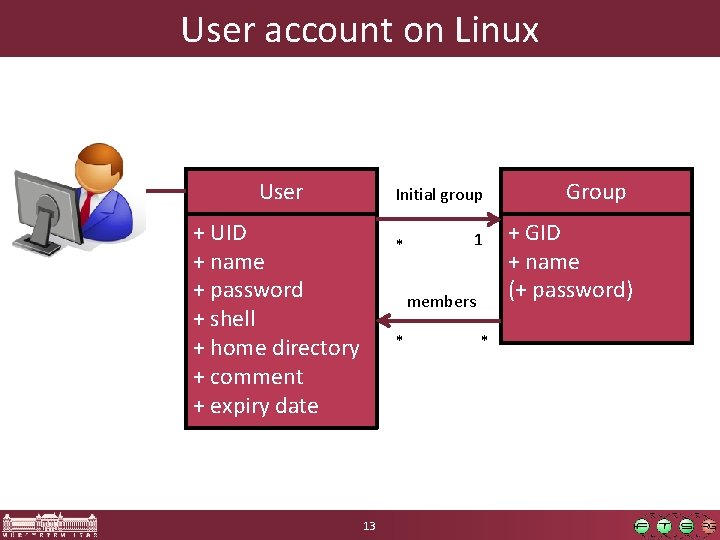
What is a user account? § Unique identifier for an account o Linux, UNIX: UID (integer, root 0, users 1000 -…) § Further attributes of an account o Stored in /etc/passwd, /etc/shadow, /etc/groups o Examples • • • Login name Password Home directory Default shell Real name… 11
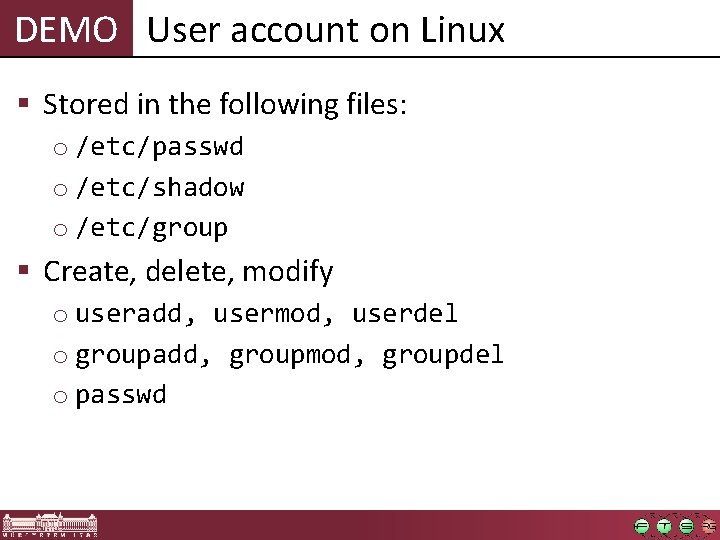
DEMO User account on Linux § Stored in the following files: o /etc/passwd o /etc/shadow o /etc/group § Create, delete, modify o useradd, usermod, userdel o groupadd, groupmod, groupdel o passwd
User account on Linux User Initial group + UID + name + password + shell + home directory + comment + expiry date * 1 members * 13 * Group + GID + name (+ password)
DEMO Process identity § Identifying the identity of a process o ps aux, pstree, /proc/$PID/status § Changing effective user és group runtime o setuid, setgid o su, sudo
Authentication on Linux § Between machines (e. g. ssh) o User name / password o Private / public key o Egyediség? 15
Content § Short security introduction § User management, authentication o UNIX, Linux o Windows § Authorization o General methods • Role-based access control • Access control lists o Authorization on UNIX/Linux o Authorization on Windows 16
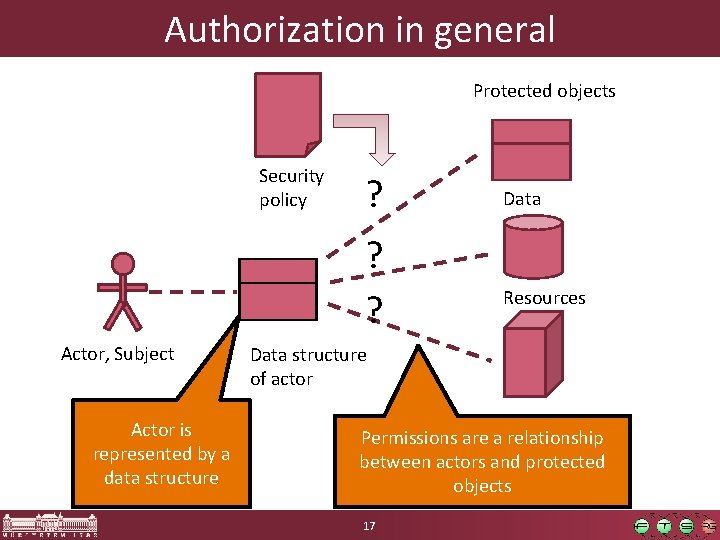
Authorization in general Protected objects Security policy ? ? ? Actor, Subject Actor is represented by a data structure Data Resources Data structure of actor Permissions are a relationship between actors and protected objects 17
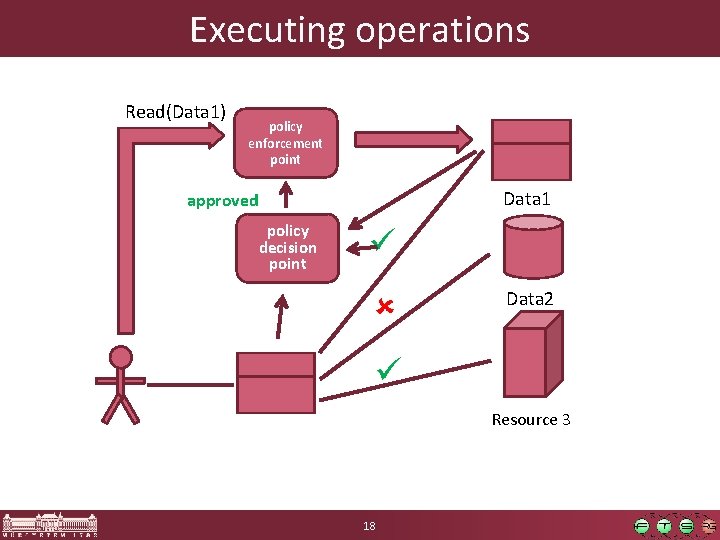
Executing operations Read(Data 1) policy enforcement point Data 1 approved policy decision point Data 2 Resource 3 18
General concepts § Actors initiate operations § The context of the operation includes the identifier of the actor, the protected object and the type of operation § The policy decision component evaluates: o approves or denies the operation § The policy enforcement component assures that the result is enforced 19
Challenges in authorization § There are many actors in the system o Moreover: different systems identify the users differently § There are many protected objects § The whole relationship: o (Actors) X (Objects) X (Types of operation) o This is called access matrix o It is unmanageable, the whole matrix is huge! 20
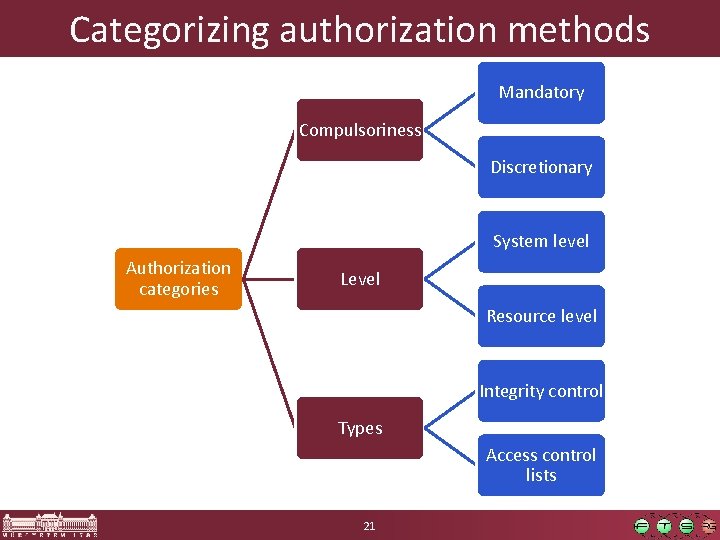
Categorizing authorization methods Mandatory Compulsoriness Discretionary System level Authorization categories Level Resource level Integrity control Types Access control lists 21
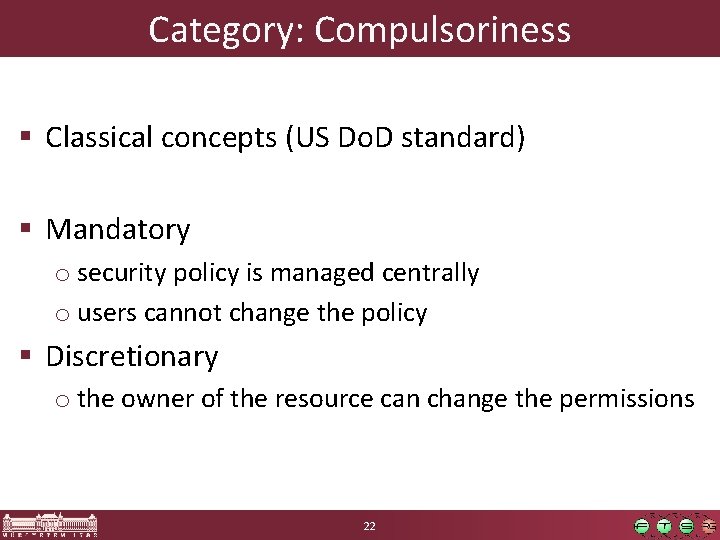
Category: Compulsoriness § Classical concepts (US Do. D standard) § Mandatory o security policy is managed centrally o users cannot change the policy § Discretionary o the owner of the resource can change the permissions 22
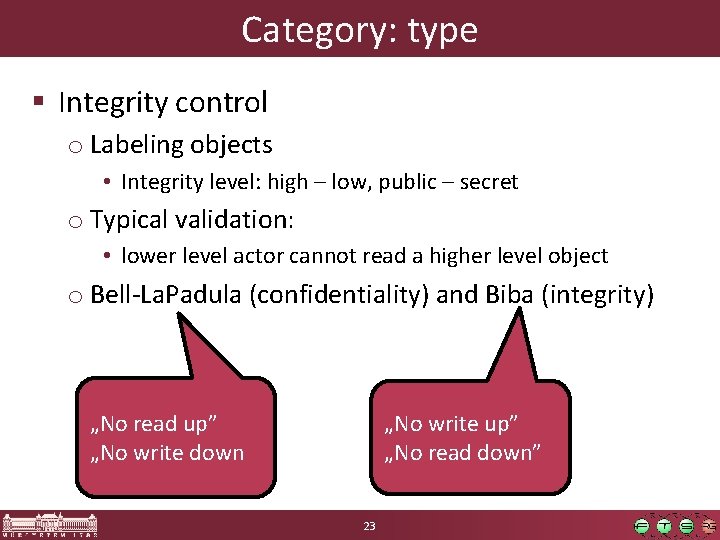
Category: type § Integrity control o Labeling objects • Integrity level: high – low, public – secret o Typical validation: • lower level actor cannot read a higher level object o Bell-La. Padula (confidentiality) and Biba (integrity) „No write up” „No read down” „No read up” „No write down 23
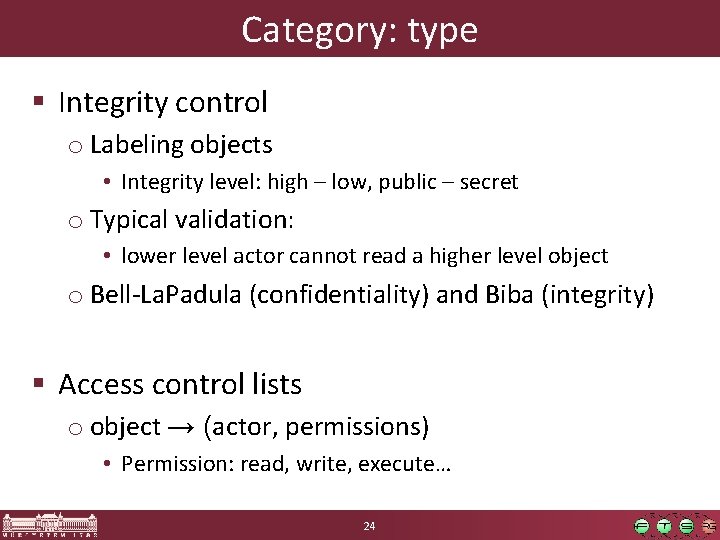
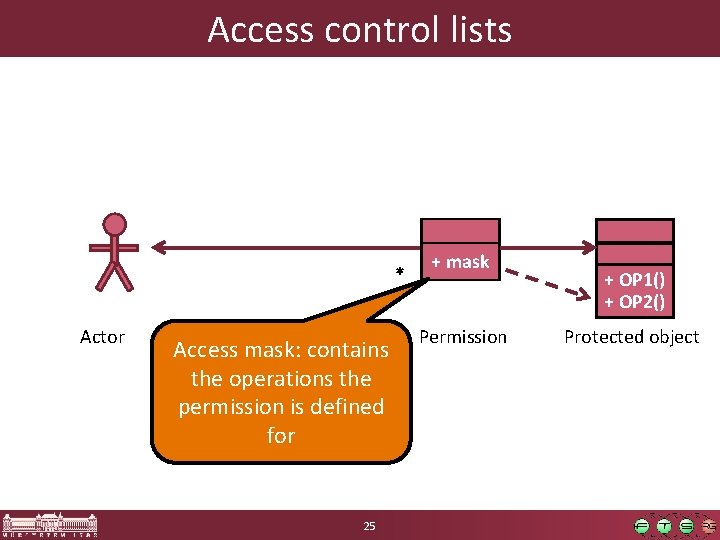
Category: type § Integrity control o Labeling objects • Integrity level: high – low, public – secret o Typical validation: • lower level actor cannot read a higher level object o Bell-La. Padula (confidentiality) and Biba (integrity) § Access control lists o object → (actor, permissions) • Permission: read, write, execute… 24
Access control lists * Actor Access mask: contains the operations the permission is defined for 25 + mask Permission + OP 1() + OP 2() Protected object
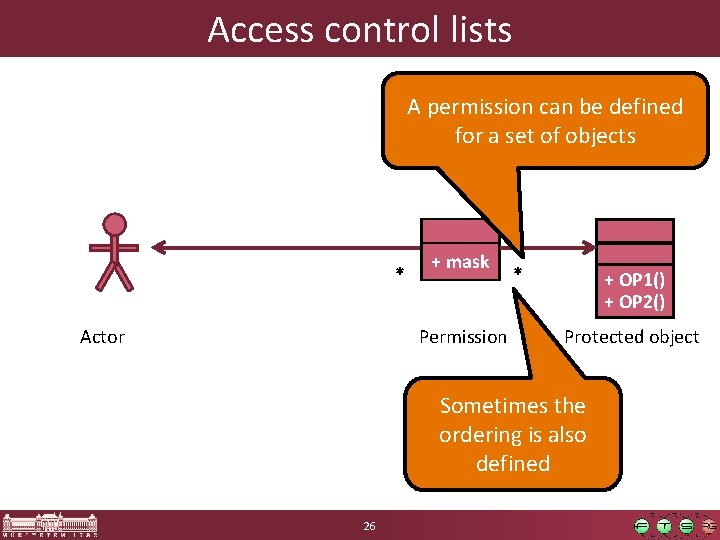
Access control lists A permission can be defined for a set of objects * Actor + mask Permission * + OP 1() + OP 2() Protected object Sometimes the ordering is also defined 26
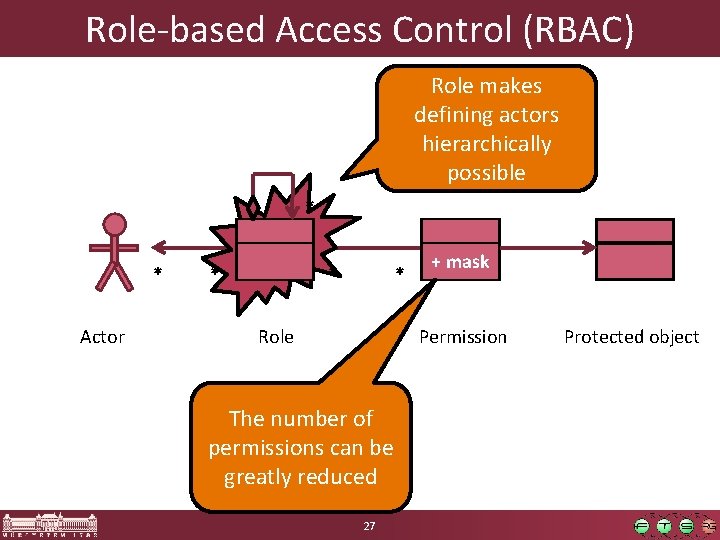
Role-based Access Control (RBAC) Role makes defining actors hierarchically possible * * Actor * * * Role + mask Permission The number of permissions can be greatly reduced 27 Protected object
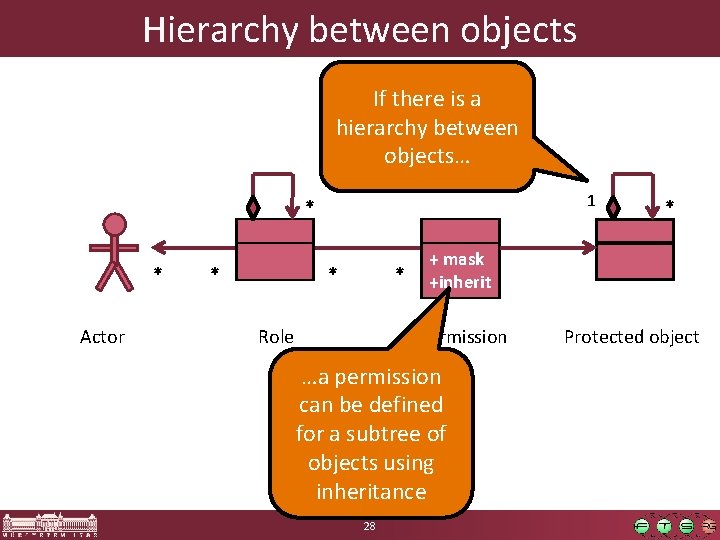
Hierarchy between objects If there is a hierarchy between objects… 1 * * Actor * * * Role + mask +inherit Permission …a permission can be defined for a subtree of objects using inheritance 28 * Protected object
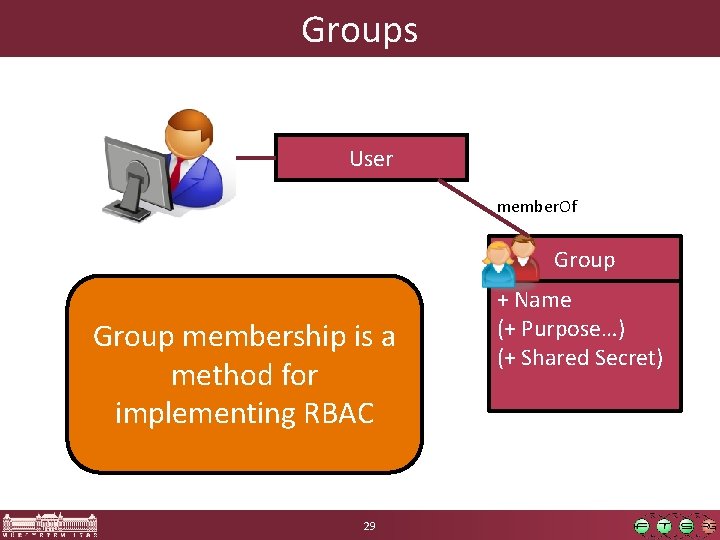
Groups User member. Of Group membership is a method for implementing RBAC 29 + Name (+ Purpose…) (+ Shared Secret)
Content § Short security introduction § User management, authentication o UNIX, Linux o Windows § Authorization o General methods • Role-based access control • Access control lists o Authorization on UNIX/Linux o Authorization on Windows 30
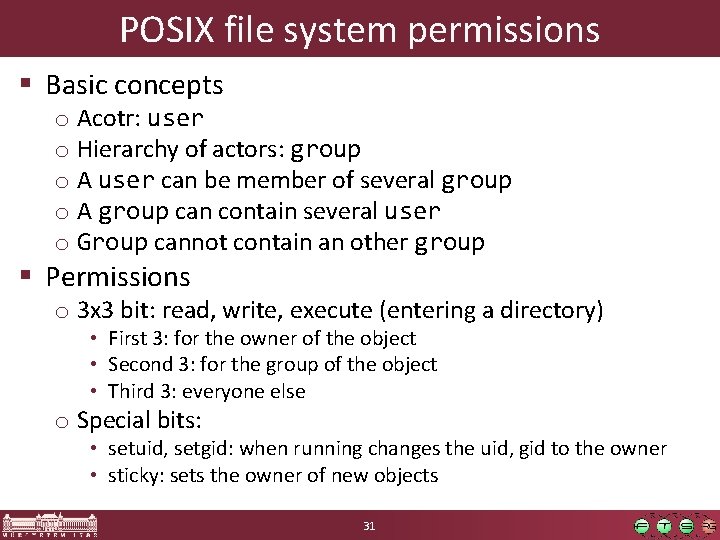
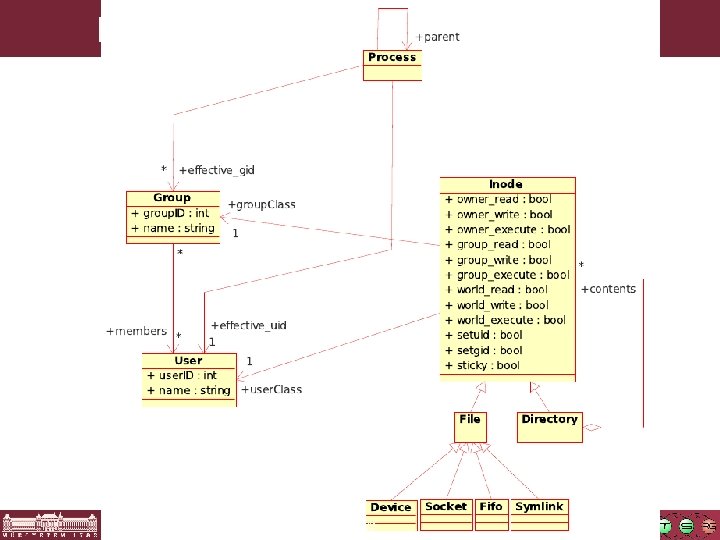
POSIX file system permissions § Basic concepts o Acotr: user o Hierarchy of actors: group o A user can be member of several group o A group can contain several user o Group cannot contain an other group § Permissions o 3 x 3 bit: read, write, execute (entering a directory) • First 3: for the owner of the object • Second 3: for the group of the object • Third 3: everyone else o Special bits: • setuid, setgid: when running changes the uid, gid to the owner • sticky: sets the owner of new objects 31
POSIX fájlrendszer jogosultságok 32
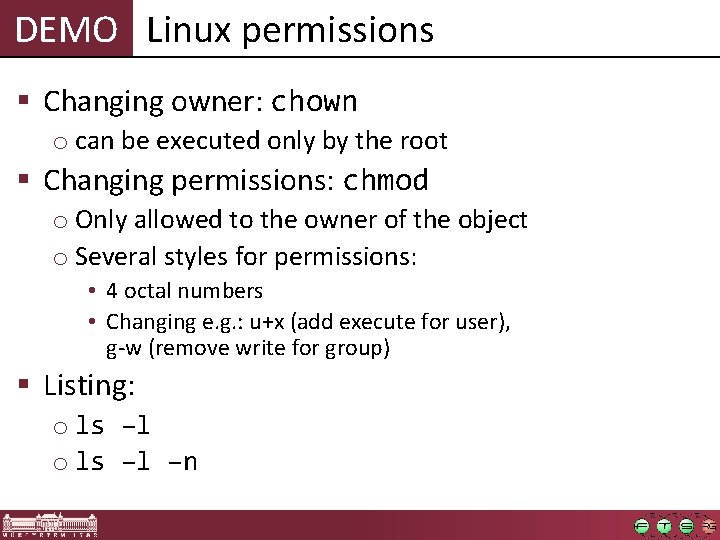
DEMO Linux permissions § Changing owner: chown o can be executed only by the root § Changing permissions: chmod o Only allowed to the owner of the object o Several styles for permissions: • 4 octal numbers • Changing e. g. : u+x (add execute for user), g-w (remove write for group) § Listing: o ls –l –n
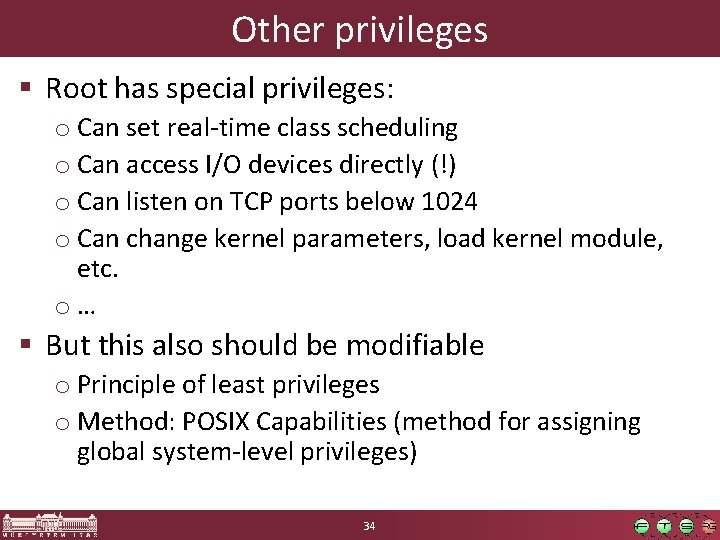
Other privileges § Root has special privileges: o Can set real-time class scheduling o Can access I/O devices directly (!) o Can listen on TCP ports below 1024 o Can change kernel parameters, load kernel module, etc. o… § But this also should be modifiable o Principle of least privileges o Method: POSIX Capabilities (method for assigning global system-level privileges) 34