
Operating Systems Synchronization Solutions A Frank P Weisberg
Operating Systems Synchronization Solutions A. Frank - P. Weisberg
Cooperating Processes • • • 2 Introduction to Cooperating Processes Producer/Consumer Problem The Critical-Section Problem Synchronization Hardware Semaphores A. Frank - P. Weisberg

Synchronization Hardware • Many systems provide hardware support for implementing the critical section code. • All solutions below based on idea of locking: – Protecting critical regions via locks. • Uniprocessors – could disable interrupts: – Currently running code would execute without preemption. – Generally too inefficient on multiprocessor systems: • Operating systems using this are not broadly scalable. • Modern machines provide special atomic (noninterruptible) hardware instructions: 3 – Either test memory word and set value at once. – Or swap contents A. of. Frank two- P. memory words. Weisberg
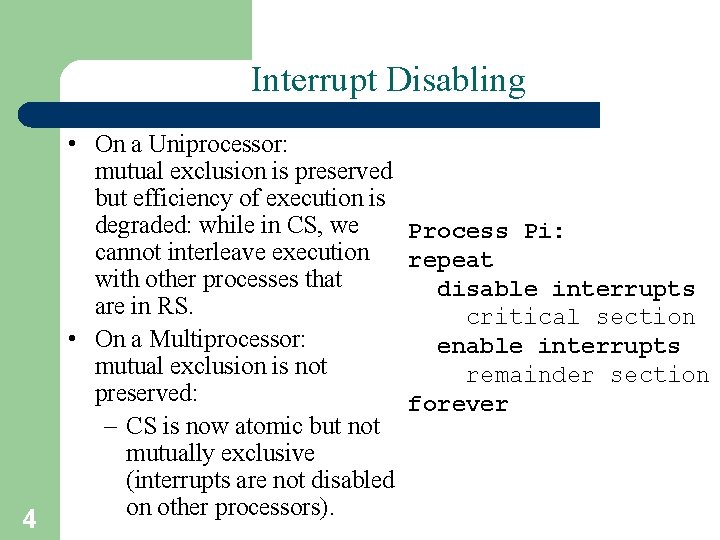
Interrupt Disabling 4 • On a Uniprocessor: mutual exclusion is preserved but efficiency of execution is degraded: while in CS, we Process Pi: cannot interleave execution repeat with other processes that disable interrupts are in RS. critical section • On a Multiprocessor: enable interrupts mutual exclusion is not remainder section preserved: forever – CS is now atomic but not mutually exclusive (interrupts are not disabled on other processors).
Special Machine Instructions • Normally, access to a memory location excludes other access to that same location. • Extension: designers have proposed machines instructions that perform 2 actions atomically (indivisible) on the same memory location (e. g. , reading and writing). • The execution of such an instruction is also mutually exclusive (even on Multiprocessors). 5 A. Frank - P. Weisberg
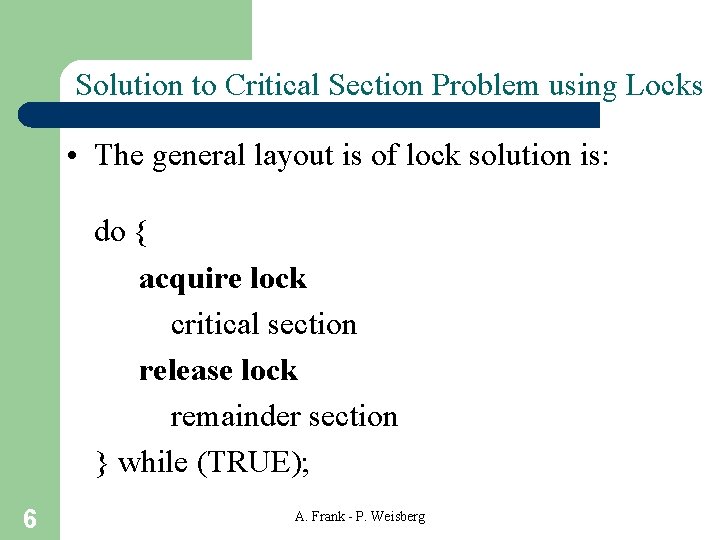
Solution to Critical Section Problem using Locks • The general layout is of lock solution is: do { acquire lock critical section release lock remainder section } while (TRUE); 6 A. Frank - P. Weisberg
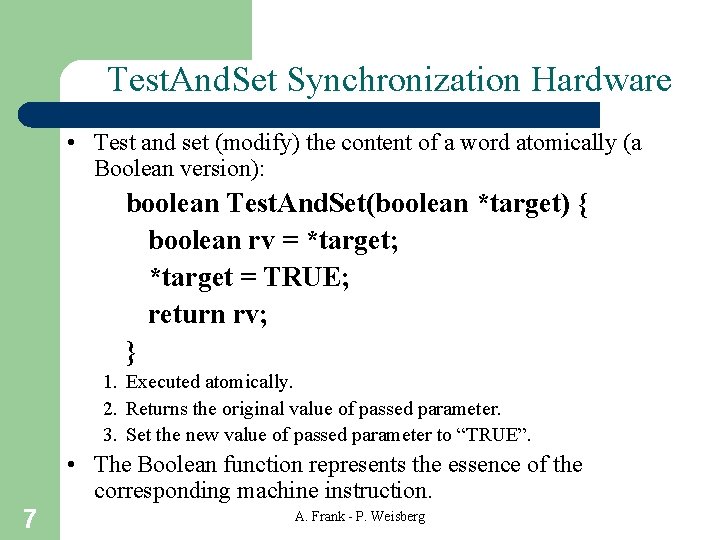
Test. And. Set Synchronization Hardware • Test and set (modify) the content of a word atomically (a Boolean version): boolean Test. And. Set(boolean *target) { boolean rv = *target; *target = TRUE; return rv; } 1. Executed atomically. 2. Returns the original value of passed parameter. 3. Set the new value of passed parameter to “TRUE”. • The Boolean function represents the essence of the corresponding machine instruction. 7 A. Frank - P. Weisberg
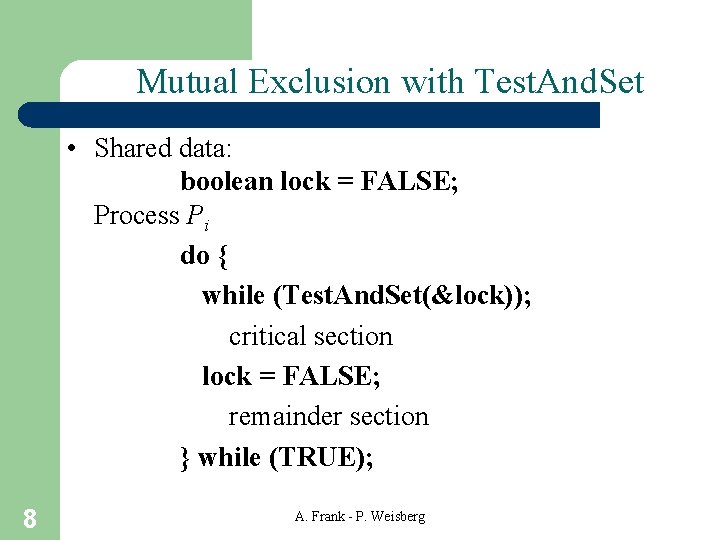
Mutual Exclusion with Test. And. Set • Shared data: boolean lock = FALSE; Process Pi do { while (Test. And. Set(&lock)); critical section lock = FALSE; remainder section } while (TRUE); 8 A. Frank - P. Weisberg
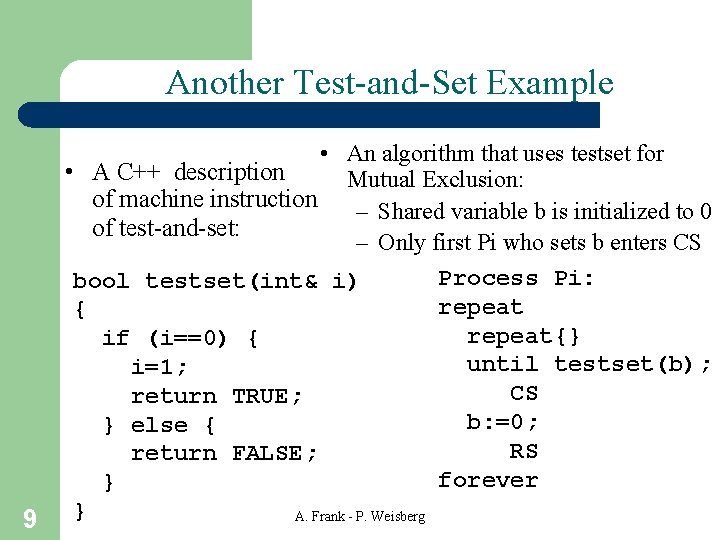
Another Test-and-Set Example 9 • An algorithm that uses testset for • A C++ description Mutual Exclusion: of machine instruction – Shared variable b is initialized to 0 of test-and-set: – Only first Pi who sets b enters CS Process Pi: bool testset(int& i) repeat { repeat{} if (i==0) { until testset(b); i=1; CS return TRUE; b: =0; } else { RS return FALSE; forever } } A. Frank - P. Weisberg
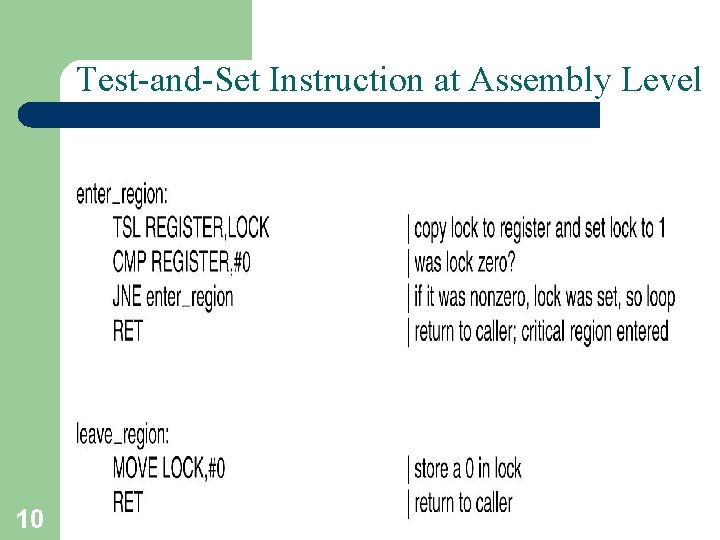
Test-and-Set Instruction at Assembly Level 10 A. Frank - P. Weisberg

Swap Synchronization Hardware • Atomically swap (exchange) two variables: void Swap(boolean *a, boolean *b) { boolean temp = *a; *a = *b; *b = temp; } • The procedure represents the essence of the corresponding machine instruction. 11 A. Frank - P. Weisberg
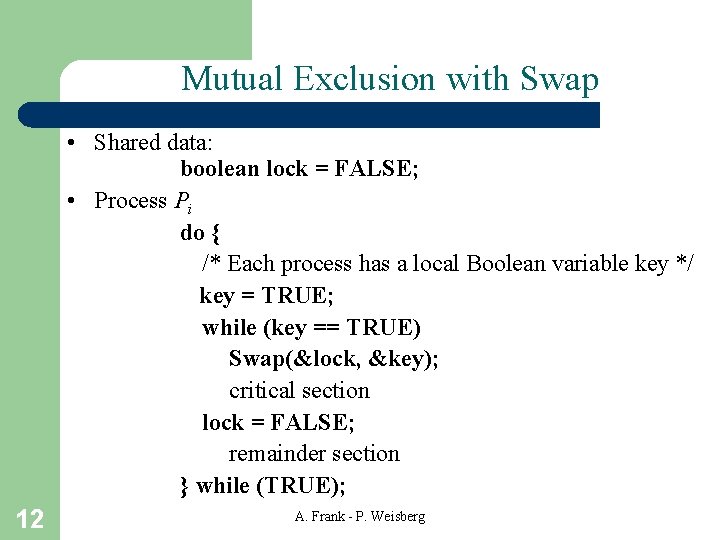
Mutual Exclusion with Swap • Shared data: boolean lock = FALSE; • Process Pi do { /* Each process has a local Boolean variable key */ key = TRUE; while (key == TRUE) Swap(&lock, &key); critical section lock = FALSE; remainder section } while (TRUE); 12 A. Frank - P. Weisberg

Swap instruction at Assembly Level 13 A. Frank - P. Weisberg

Compare and Swap Synchronization Hardware int compare_and_swap(int *value, int expected, int new_value) { int temp = *value; if (*value == expected) *value = new_value; return temp; } 1. Executed atomically. 2. Returns the original value of passed parameter “value”. 3. Set the variable “value” the value of the passed parameter “new_value” but only if “value” ==“expected”. That is, the swap takes place only under this condition. 14 A. Frank - P. Weisberg
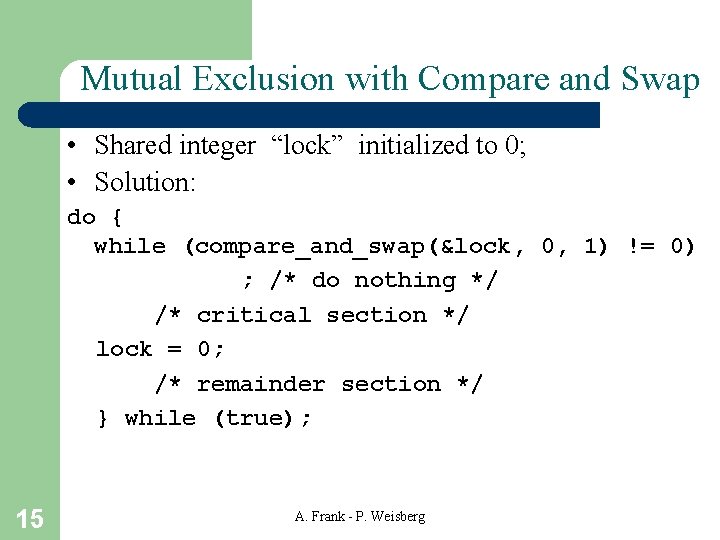
Mutual Exclusion with Compare and Swap • Shared integer “lock” initialized to 0; • Solution: do { while (compare_and_swap(&lock, 0, 1) != 0) ; /* do nothing */ /* critical section */ lock = 0; /* remainder section */ } while (true); 15 A. Frank - P. Weisberg

Disadvantages of Special Machine Instructions • Busy-waiting is employed, thus while a process is waiting for access to a critical section it continues to consume processor time. • No Progress (Starvation) is possible when a process leaves CS and more than one process is waiting. • They can be used to provide mutual exclusion but need to be complemented by other mechanisms to satisfy the bounded waiting requirement of the CS problem. • See next slide for an example. 16 A. Frank - P. Weisberg
![Critical Section Solution with Test. And. Set() • Process Pi do { waiting[i] =](http://slidetodoc.com/presentation_image_h2/4e10be78a878e559f2799f9bd022f74d/image-17.jpg "Critical Section Solution with Test. And. Set() • Process Pi do { waiting[i] =")
Critical Section Solution with Test. And. Set() • Process Pi do { waiting[i] = TRUE; key = TRUE; while (waiting[i] && key) key = Test. And. Set(&lock); waiting[i] = FALSE; critical section j = (i + 1) % n; while ((j != i) && !waiting[j]) j = (j + 1) % n; if (j == i) lock = FALSE; else waiting[j] = FALSE; remainder section 17 } while (TRUE); A. Frank - P. Weisberg

Mutex Locks • Previous solutions are complicated and generally inaccessible to application programmers. • OS designers build software tools to solve critical section problem. • Simplest is mutex lock. • Protect a critical section by first acquire() a lock then release() the lock: – Boolean variable indicating if lock is available or not. • Calls to acquire() and release() must be atomic: – Usually implemented via hardware atomic instructions. • But this solution requires busy waiting: – This lock therefore called a spinlock. 18

acquire() and release() • acquire() { while (!available) ; /* busy wait */ available = false; ; 19 } • release() { available = true; } • do { acquire lock critical section release lock remainder section } while (true);
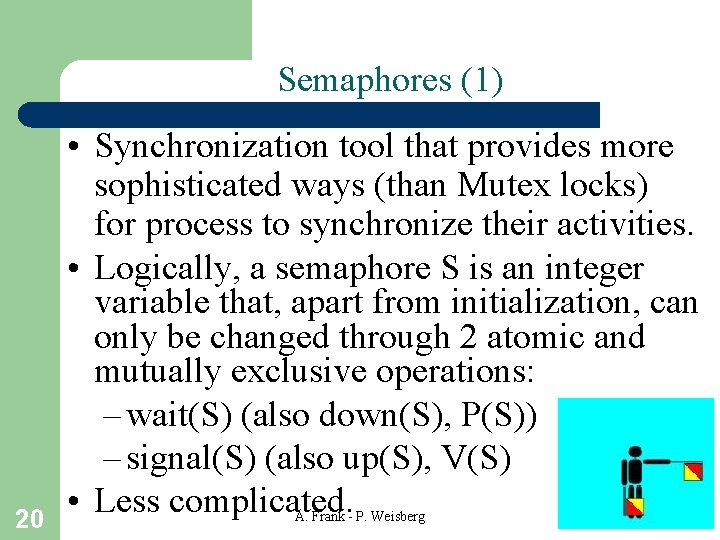
Semaphores (1) 20 • Synchronization tool that provides more sophisticated ways (than Mutex locks) for process to synchronize their activities. • Logically, a semaphore S is an integer variable that, apart from initialization, can only be changed through 2 atomic and mutually exclusive operations: – wait(S) (also down(S), P(S)) – signal(S) (also up(S), V(S) • Less complicated. A. Frank - P. Weisberg

Critical Section of n Processes • Shared data: semaphore mutex; // initiallized to 1 • Process Pi: do { wait(mutex); critical section signal(mutex); remainder section } while (TRUE); 21 A. Frank - P. Weisberg

Semaphores (2) • Access is via two atomic operations: wait (S): while (S <= 0); S--; signal (S): S++; 22 A. Frank - P. Weisberg

Semaphores (3) • Must guarantee that no 2 processes can execute wait() and signal() on the same semaphore at the same time. • Thus, implementation becomes the critical section problem where the wait and signal code are placed in the critical section. – Could now have busy waiting in CS implementation: • But implementation code is short • Little busy waiting if critical section rarely occupied. • Note that applications may spend lots of time in critical sections and therefore this is not a good solution. 23 A. Frank - P. Weisberg

Semaphores (4) 24 • To avoid busy waiting, when a process has to wait, it will be put in a blocked queue of processes waiting for the same event. • Hence, in fact, a semaphore is a record (structure): type semaphore = record count: integer; queue: list of process end; var S: semaphore; • With each semaphore there is an associated waiting queue. • Each entry in a waiting queue has 2 data items: – value (of type integer) – pointer to next record in the list A. Frank - P. Weisberg

Semaphore’s operations • When a process must wait for a semaphore S, it is blocked and put on the semaphore’s queue. • Signal operation removes (assume a fair policy like FIFO) first process from the queue and puts it on list of ready processes. wait(S): S. count--; if (S. count<0) { block this process place this process in S. queue } 25 signal(S): S. count++; if (S. count<=0) { remove a process P from S. queue place this process P on ready list }
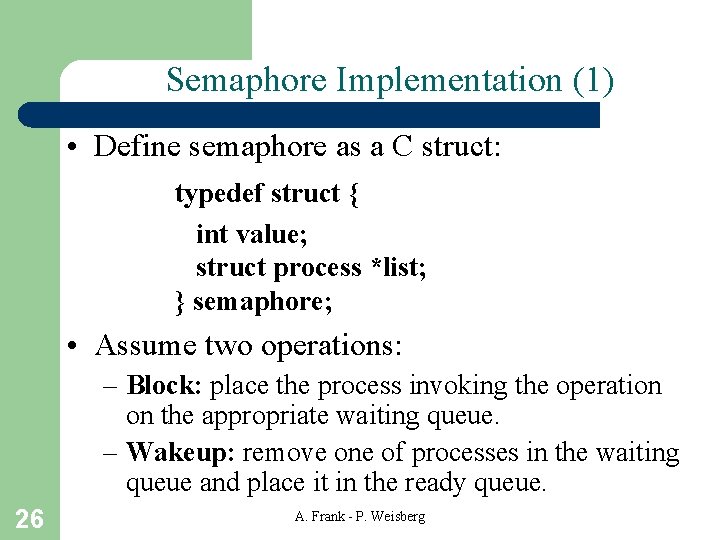
Semaphore Implementation (1) • Define semaphore as a C struct: typedef struct { int value; struct process *list; } semaphore; • Assume two operations: – Block: place the process invoking the operation on the appropriate waiting queue. – Wakeup: remove one of processes in the waiting queue and place it in the ready queue. 26 A. Frank - P. Weisberg

Semaphore Implementation (2) • Semaphore operations now defined as wait (semaphore *S) { S->value--; if (S->value < 0) { add this process to S->list; block(); } } 27 signal (semaphore *S) { S->value++; if (S->value <= 0) { remove a process P from S->list; wakeup(P); } A. Frank - P. Weisberg }
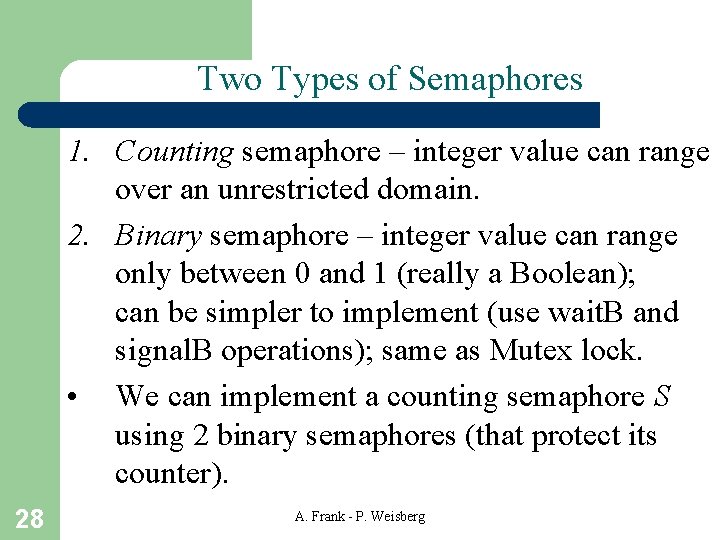
Two Types of Semaphores 1. Counting semaphore – integer value can range over an unrestricted domain. 2. Binary semaphore – integer value can range only between 0 and 1 (really a Boolean); can be simpler to implement (use wait. B and signal. B operations); same as Mutex lock. • We can implement a counting semaphore S using 2 binary semaphores (that protect its counter). 28 A. Frank - P. Weisberg
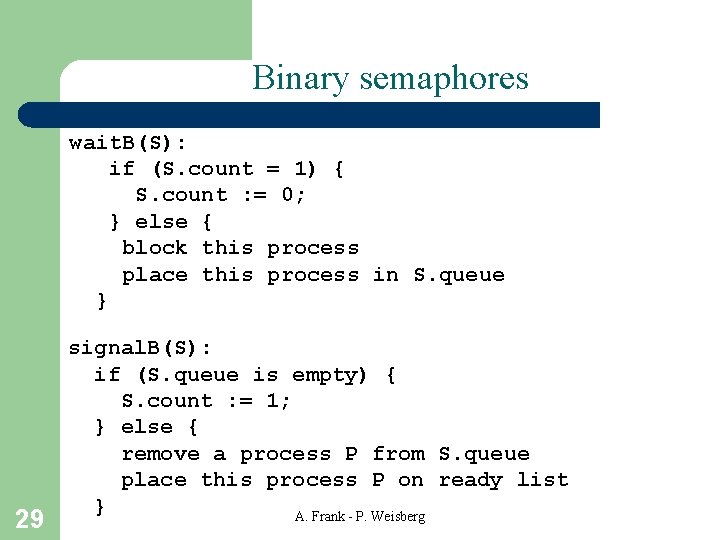
Binary semaphores wait. B(S): if (S. count = 1) { S. count : = 0; } else { block this process place this process in S. queue } 29 signal. B(S): if (S. queue is empty) { S. count : = 1; } else { remove a process P from S. queue place this process P on ready list } A. Frank - P. Weisberg
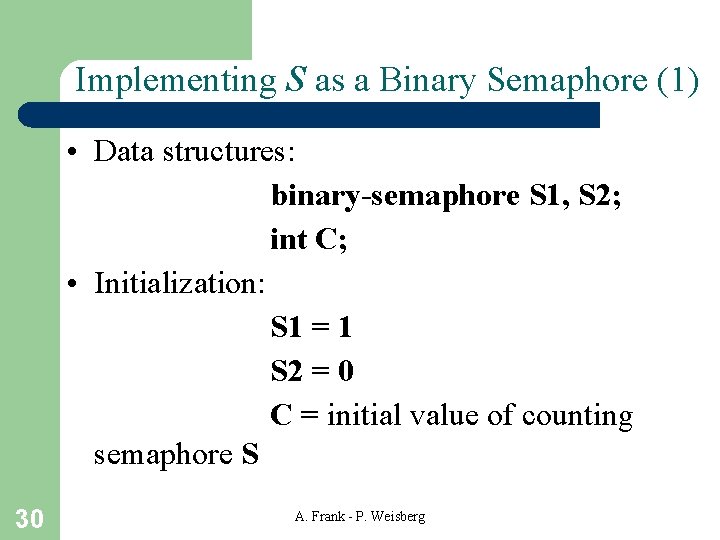
Implementing S as a Binary Semaphore (1) • Data structures: binary-semaphore S 1, S 2; int C; • Initialization: S 1 = 1 S 2 = 0 C = initial value of counting semaphore S 30 A. Frank - P. Weisberg

Implementing S as a Binary Semaphore (2) • wait operation: waitb(S 1); C--; if (C < 0) { signalb(S 1); waitb(S 2); } signalb(S 1); • signal operation: waitb(S 1); C++; if (C <= 0) signalb(S 2); else signalb(S 1); 31 A. Frank - P. Weisberg

Semaphore as a General Synchronization Tool • Execute B in Pj only after A executed in Pi • Use semaphore flag initialized to 0. • Code: Pi Pj A wait(flag) signal(flag) B 32 A. Frank - P. Weisberg
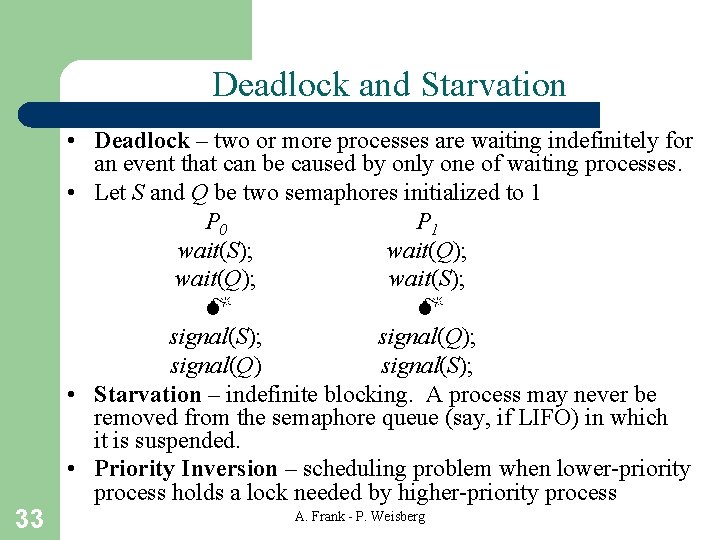
Deadlock and Starvation • Deadlock – two or more processes are waiting indefinitely for an event that can be caused by only one of waiting processes. • Let S and Q be two semaphores initialized to 1 P 0 P 1 wait(S); wait(Q); wait(S); signal(Q); signal(Q) signal(S); • Starvation – indefinite blocking. A process may never be removed from the semaphore queue (say, if LIFO) in which it is suspended. • Priority Inversion – scheduling problem when lower-priority process holds a lock needed by higher-priority process 33 A. Frank - P. Weisberg
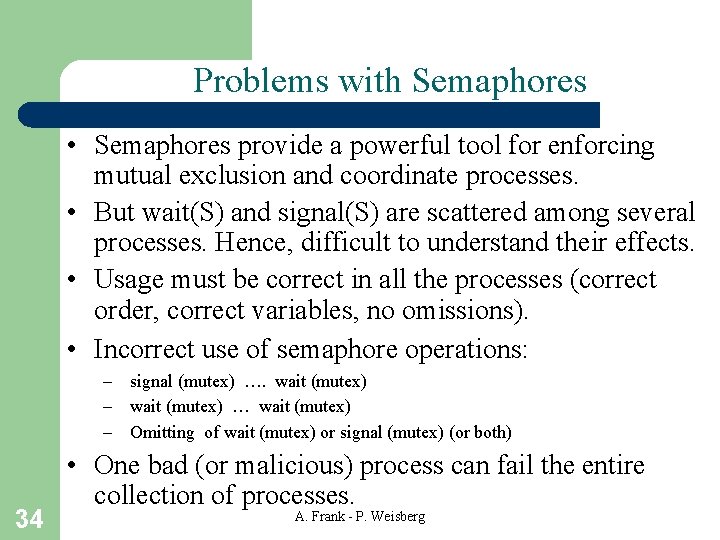
Problems with Semaphores • Semaphores provide a powerful tool for enforcing mutual exclusion and coordinate processes. • But wait(S) and signal(S) are scattered among several processes. Hence, difficult to understand their effects. • Usage must be correct in all the processes (correct order, correct variables, no omissions). • Incorrect use of semaphore operations: – signal (mutex) …. wait (mutex) – wait (mutex) … wait (mutex) – Omitting of wait (mutex) or signal (mutex) (or both) 34 • One bad (or malicious) process can fail the entire collection of processes. A. Frank - P. Weisberg
- Slides: 34