
Operating Systems Processes Synchronization Background Processes can execute
Operating Systems Processes Synchronization
Background • Processes can execute concurrently – May be interrupted at any time, partially completing execution • Concurrent access to shared data may result in data inconsistency • Maintaining data consistency requires mechanisms to ensure the orderly execution of cooperating processes 2 • Illustration of the problem: • Suppose that we wanted to provide a solution to the consumer-producer problem that fills all the buffers. • We can do so by having an integer counter that keeps track of the number of full buffers. • Initially, counter is set to 0. • It is incremented by the producer after it produces a new buffer and is decremented by the consumer after it consumes a buffer.

Process Synchronization A producer process "produces" information "consumed" by a consumer process. item next. Produced; PRODUCER while (TRUE) { while (counter = = BUFFER_SIZE); buffer[in] = next. Produced; in = (in + 1) % BUFFER_SIZE; counter++; } producer 3 consumer The Producer Consumer Problem #define BUFFER_SIZE 10 typedef struct { DATA data; } item; item buffer[BUFFER_SIZE]; int in = 0; int out = 0; int counter = 0; item next. Consumed; CONSUMER while (TRUE) { while (counter = = 0); next. Consumed = buffer[out]; out = (out + 1) % BUFFER_SIZE; counter--; }
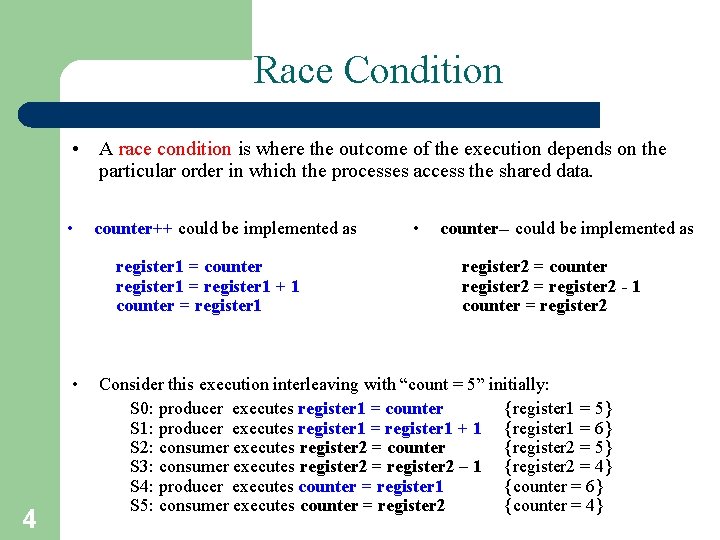
Race Condition • A race condition is where the outcome of the execution depends on the particular order in which the processes access the shared data. • counter++ could be implemented as register 1 = counter register 1 = register 1 + 1 counter = register 1 • 4 • counter-- could be implemented as register 2 = counter register 2 = register 2 - 1 counter = register 2 Consider this execution interleaving with “count = 5” initially: S 0: producer executes register 1 = counter {register 1 = 5} S 1: producer executes register 1 = register 1 + 1 {register 1 = 6} S 2: consumer executes register 2 = counter {register 2 = 5} S 3: consumer executes register 2 = register 2 – 1 {register 2 = 4} S 4: producer executes counter = register 1 {counter = 6} S 5: consumer executes counter = register 2 {counter = 4}
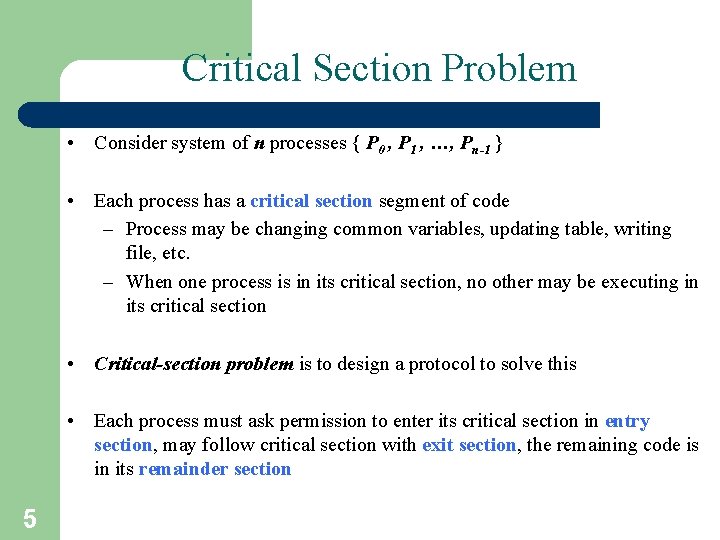
Critical Section Problem • Consider system of n processes { P 0 , P 1 , …, Pn-1 } • Each process has a critical section segment of code – Process may be changing common variables, updating table, writing file, etc. – When one process is in its critical section, no other may be executing in its critical section • Critical-section problem is to design a protocol to solve this • Each process must ask permission to enter its critical section in entry section, may follow critical section with exit section, the remaining code is in its remainder section 5
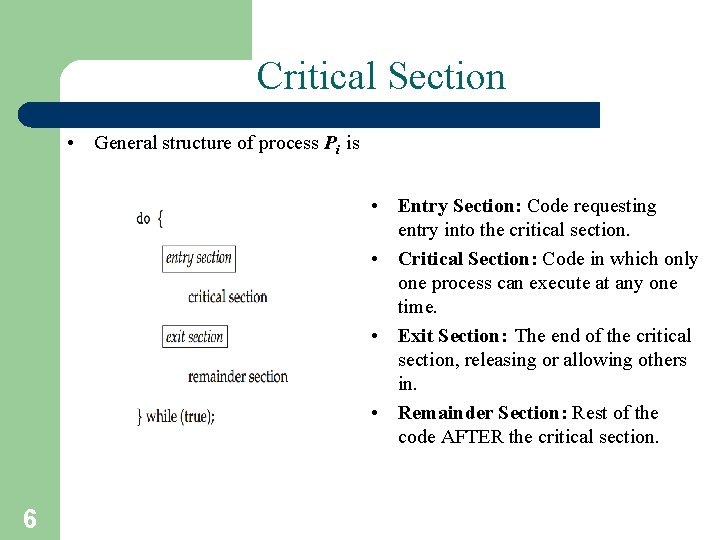
Critical Section • General structure of process Pi is • Entry Section: Code requesting entry into the critical section. • Critical Section: Code in which only one process can execute at any one time. • Exit Section: The end of the critical section, releasing or allowing others in. • Remainder Section: Rest of the code AFTER the critical section. 6

Solution to Critical-Section Problem Solution to the critical section problem must satisfy the following three requirements: 1. Mutual Exclusion - If process Pi is executing in its critical section, then no other processes can be executing in their critical sections 2. Progress - If no process is executing in its critical section and there exist some processes that wish to enter their critical section, then only the processes not in their remainder section can participate in the selection of the process that will enter its critical section next; the selection cannot be postponed indefinitely 7 3. Bounded Waiting - A bound must exist on the number of times that other processes are allowed to enter their critical sections after a process has made a request to enter its critical section and before that request is granted • Assume that each process executes at a nonzero speed • No assumption concerning relative speed of the n processes
Solution to Critical-Section Problem • 8 Two approaches for handling critical sections in OS, depending on if kernel is preemptive or non-preemptive – Preemptive – allows preemption of process when running in kernel mode • Specially difficult in multiprocessor architectures, but it makes the system more responsive – Non-preemptive – runs until exits kernel mode, blocks, or voluntarily yields CPU • Essentially free of race conditions on kernel data structures in kernel mode, since only one active process in the kernel at a time
Types of solutions Software • algorithms Hardware • rely on some special machine instructions Operating System supported solutions • provide some functions and data structures to the programmer to implement a solution 9
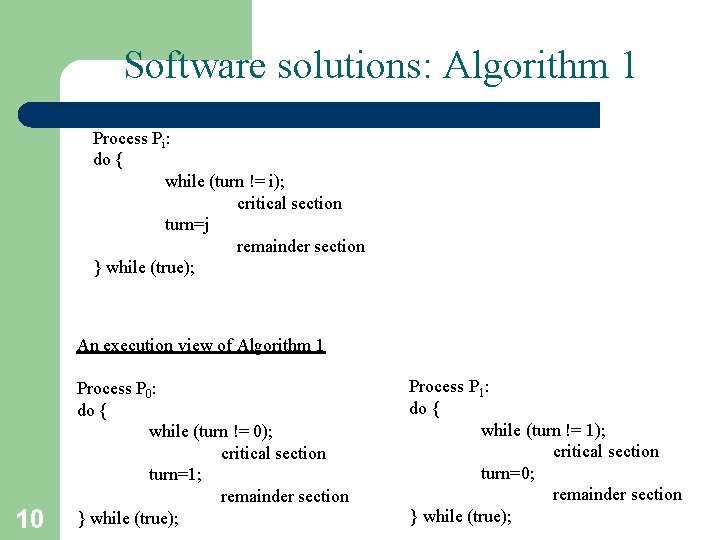
Software solutions: Algorithm 1 Process Pi: do { while (turn != i); critical section turn=j remainder section } while (true); An execution view of Algorithm 1 10 Process P 0: do { while (turn != 0); critical section turn=1; remainder section } while (true); Process P 1: do { while (turn != 1); critical section turn=0; remainder section } while (true);
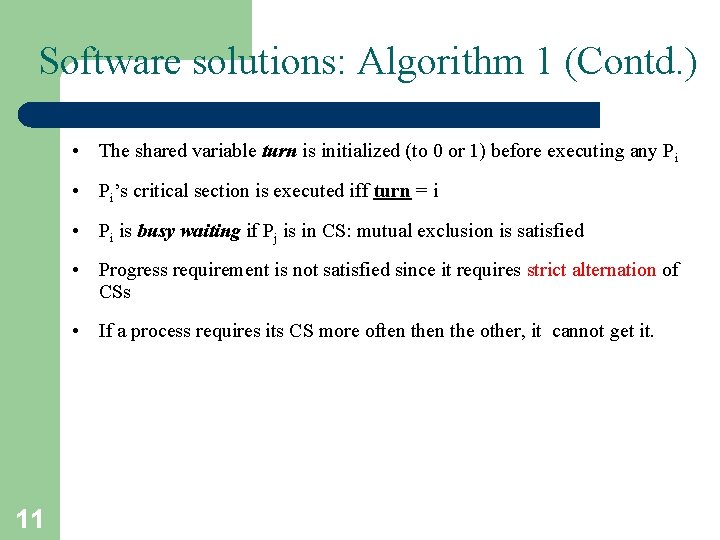
Software solutions: Algorithm 1 (Contd. ) • The shared variable turn is initialized (to 0 or 1) before executing any Pi • Pi’s critical section is executed iff turn = i • Pi is busy waiting if Pj is in CS: mutual exclusion is satisfied • Progress requirement is not satisfied since it requires strict alternation of CSs • If a process requires its CS more often the other, it cannot get it. 11
![Algorithm 2 (Contd…) Process Pi: do { flag[i] = true; while (flag[j]); critical section](http://slidetodoc.com/presentation_image_h2/7b865597f1e6c09f7ac440d27b33928e/image-12.jpg "Algorithm 2 (Contd…) Process Pi: do { flag[i] = true; while (flag[j]); critical section")
Algorithm 2 (Contd…) Process Pi: do { flag[i] = true; while (flag[j]); critical section flag[i] = false; remainder section } while (true); 12 Process P 0: do { flag[0] = true; while (flag[1]); critical section flag[0] = false; remainder section } while (true); Process P 1: do { flag[1] = true; while (flag[0]); critical section flag[1] = false; remainder section } while (true);
![• • 13 Keep 1 Bool variable for each process: flag[0] and flag[1]](http://slidetodoc.com/presentation_image_h2/7b865597f1e6c09f7ac440d27b33928e/image-13.jpg "• • 13 Keep 1 Bool variable for each process: flag[0] and flag[1]")
• • 13 Keep 1 Bool variable for each process: flag[0] and flag[1] Pi signals that it is ready to enter its CS by: flag[i]: =true Mutual Exclusion is satisfied but not the progress requirement If we have the sequence: T 0: flag[0]: =true T 1: flag[1]: =true Both process will wait forever to enter their CS: we have a deadlock
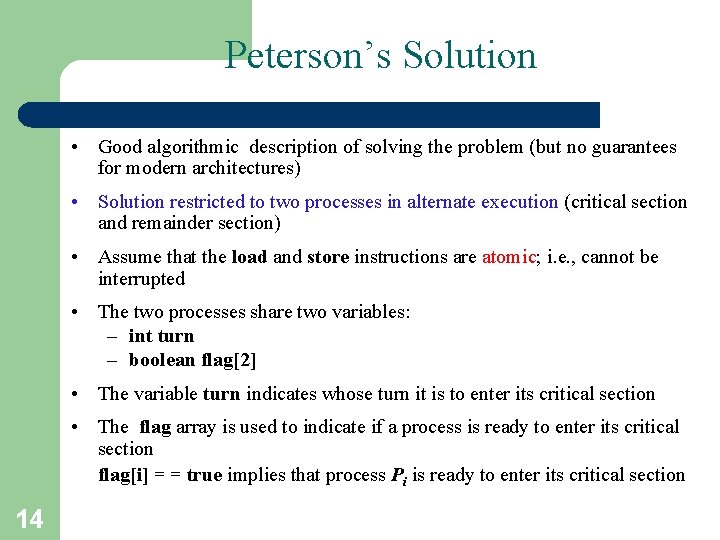
Peterson’s Solution • Good algorithmic description of solving the problem (but no guarantees for modern architectures) • Solution restricted to two processes in alternate execution (critical section and remainder section) • Assume that the load and store instructions are atomic; i. e. , cannot be interrupted • The two processes share two variables: – int turn – boolean flag[2] • The variable turn indicates whose turn it is to enter its critical section • The flag array is used to indicate if a process is ready to enter its critical section flag[i] = = true implies that process Pi is ready to enter its critical section 14
![Algorithm for Process Pi do { flag[i] = true; turn = j; while (flag[j]](http://slidetodoc.com/presentation_image_h2/7b865597f1e6c09f7ac440d27b33928e/image-15.jpg "Algorithm for Process Pi do { flag[i] = true; turn = j; while (flag[j]")
Algorithm for Process Pi do { flag[i] = true; turn = j; while (flag[j] && turn = = j); critical section flag[i] = false; remainder section } while (true); 15 • Provable that i. Mutual exclusion is preserved ii. Progress requirement is satisfied iii. Bounded-waiting requirement is met
![Algorithm for Process Pi • Initialization: flag[0]=flag[1]: =false turn: = 0 or 1 •](http://slidetodoc.com/presentation_image_h2/7b865597f1e6c09f7ac440d27b33928e/image-16.jpg "Algorithm for Process Pi • Initialization: flag[0]=flag[1]: =false turn: = 0 or 1 •")
Algorithm for Process Pi • Initialization: flag[0]=flag[1]: =false turn: = 0 or 1 • Willingness to enter CS specified by flag[i]=true • If both processes attempt to enter their CS simultaneously, only one turn value will last • Exit section: specifies that Pi is unwilling to enter CS 16 Execution view of Algorithm 3 Process P 0: do { flag[0] = true; turn = 1; while (flag[1] && turn = = 1); critical section flag[0] = false; remainder section } while (true); Process P 1: do { flag[1] = true; turn = 0; while (flag[0] && turn = = 0); critical section flag[1] = false; remainder section } while (true);
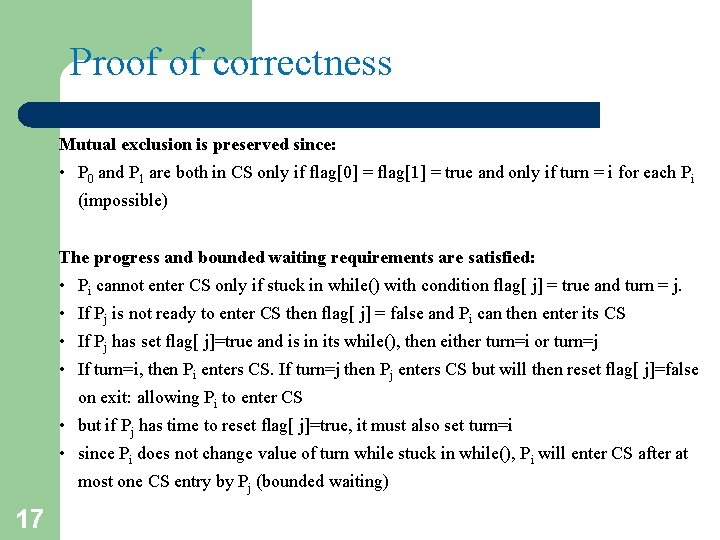
Proof of correctness Mutual exclusion is preserved since: • P 0 and P 1 are both in CS only if flag[0] = flag[1] = true and only if turn = i for each Pi (impossible) The progress and bounded waiting requirements are satisfied: • Pi cannot enter CS only if stuck in while() with condition flag[ j] = true and turn = j. • If Pj is not ready to enter CS then flag[ j] = false and Pi can then enter its CS • If Pj has set flag[ j]=true and is in its while(), then either turn=i or turn=j • If turn=i, then Pi enters CS. If turn=j then Pj enters CS but will then reset flag[ j]=false on exit: allowing Pi to enter CS • but if Pj has time to reset flag[ j]=true, it must also set turn=i • since Pi does not change value of turn while stuck in while(), Pi will enter CS after at most one CS entry by Pj (bounded waiting) 17
Synchronization Hardware • Many systems provide hardware support for critical section code • All solutions below based on idea of locking – Protecting critical regions via locks • Uniprocessors – could disable interrupts – Currently running code would execute without preemption – Generally too inefficient on multiprocessor systems • Operating systems using this not broadly scalable • Modern machines provide special atomic hardware instructions • Atomic = non-interruptible – Either test memory word and set value – Or swap contents of two memory words 18

Solution to Critical-Section Problem Using Locks do { acquire lock critical section release lock remainder section } while (TRUE); 19
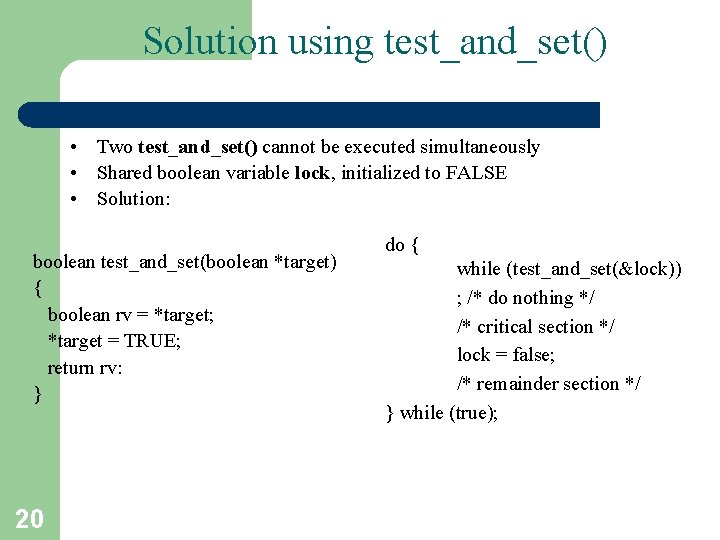
Solution using test_and_set() • Two test_and_set() cannot be executed simultaneously • Shared boolean variable lock, initialized to FALSE • Solution: boolean test_and_set(boolean *target) { boolean rv = *target; *target = TRUE; return rv: } 20 do { while (test_and_set(&lock)) ; /* do nothing */ /* critical section */ lock = false; /* remainder section */ } while (true);
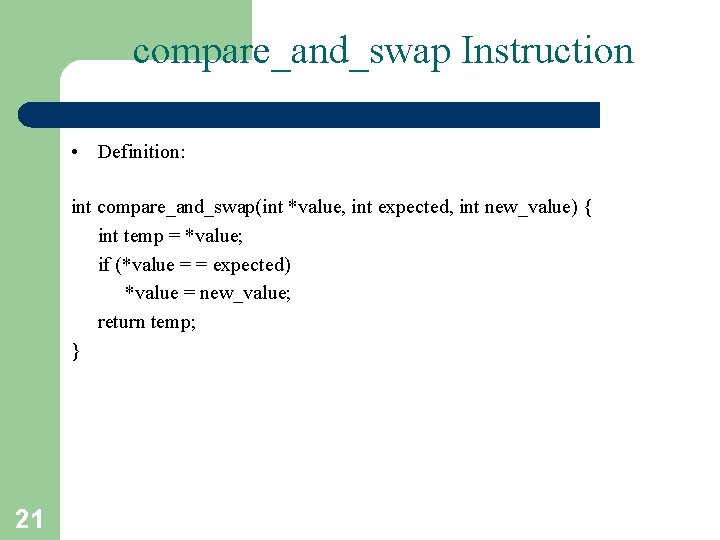
compare_and_swap Instruction • Definition: int compare_and_swap(int *value, int expected, int new_value) { int temp = *value; if (*value = = expected) *value = new_value; return temp; } 21
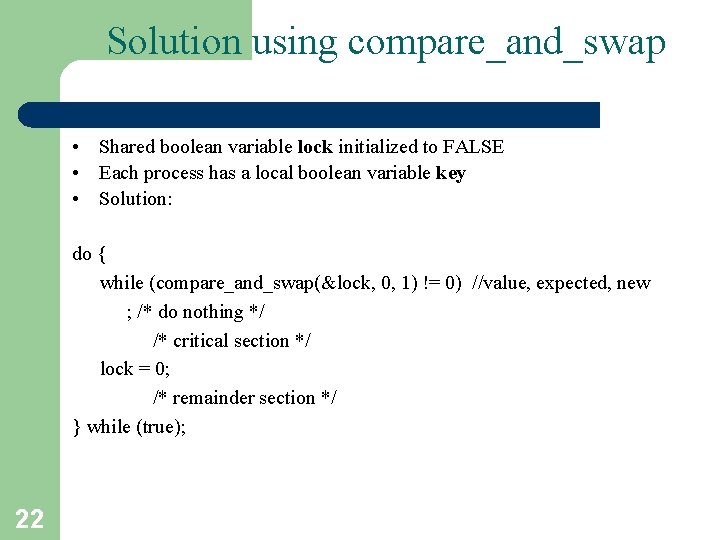
Solution using compare_and_swap • Shared boolean variable lock initialized to FALSE • Each process has a local boolean variable key • Solution: do { while (compare_and_swap(&lock, 0, 1) != 0) //value, expected, new ; /* do nothing */ /* critical section */ lock = 0; /* remainder section */ } while (true); 22
![Bounded-waiting Mutual Exclusion with test_and_set 23 do { waiting[i] = true; key = true;](http://slidetodoc.com/presentation_image_h2/7b865597f1e6c09f7ac440d27b33928e/image-23.jpg "Bounded-waiting Mutual Exclusion with test_and_set 23 do { waiting[i] = true; key = true;")
Bounded-waiting Mutual Exclusion with test_and_set 23 do { waiting[i] = true; key = true; while (waiting[i] && key) key = test_and_set(&lock); //only first lock==false will set key=false waiting[i] = false; /* critical section */ j = (i + 1) % n; //look for the next P[j] waiting: bound-waiting req. while ((j != i) && !waiting[j]) j = (j + 1) % n; if (j = = i) lock = false; else waiting[j] = false; //wakeup only one process P[j] without releasing lock /* remainder section */ } while (true);
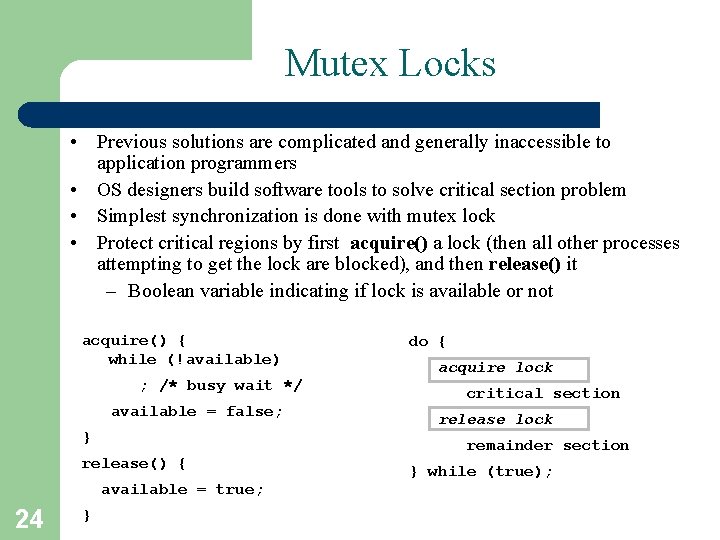
Mutex Locks • Previous solutions are complicated and generally inaccessible to application programmers • OS designers build software tools to solve critical section problem • Simplest synchronization is done with mutex lock • Protect critical regions by first acquire() a lock (then all other processes attempting to get the lock are blocked), and then release() it – Boolean variable indicating if lock is available or not acquire() { while (!available) ; /* busy wait */ available = false; } available = true; } acquire lock critical section release lock remainder section release() { 24 do { } while (true);
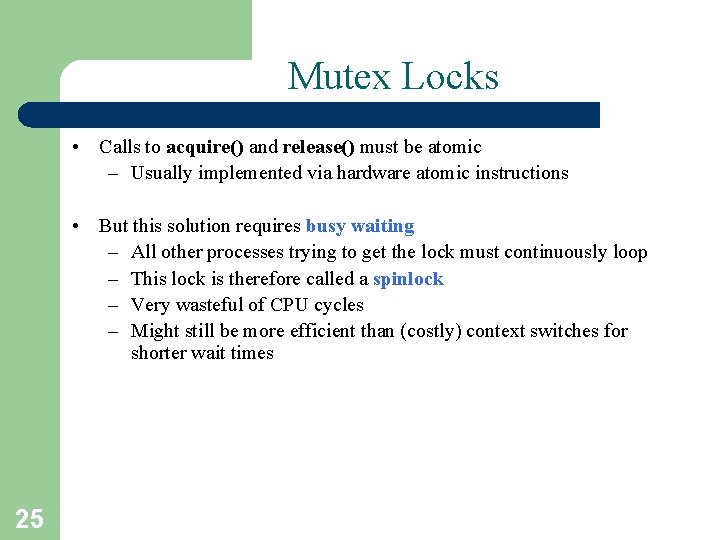
Mutex Locks • Calls to acquire() and release() must be atomic – Usually implemented via hardware atomic instructions • But this solution requires busy waiting – All other processes trying to get the lock must continuously loop – This lock is therefore called a spinlock – Very wasteful of CPU cycles – Might still be more efficient than (costly) context switches for shorter wait times 25
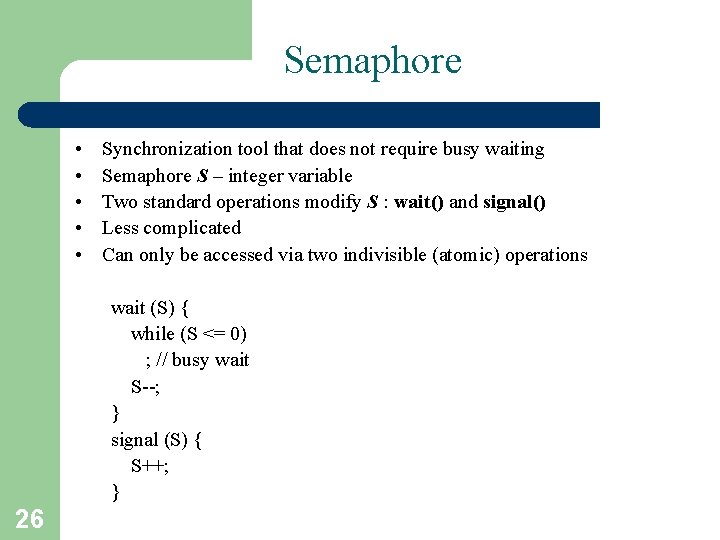
Semaphore • • • Synchronization tool that does not require busy waiting Semaphore S – integer variable Two standard operations modify S : wait() and signal() Less complicated Can only be accessed via two indivisible (atomic) operations wait (S) { while (S <= 0) ; // busy wait S--; } signal (S) { S++; } 26
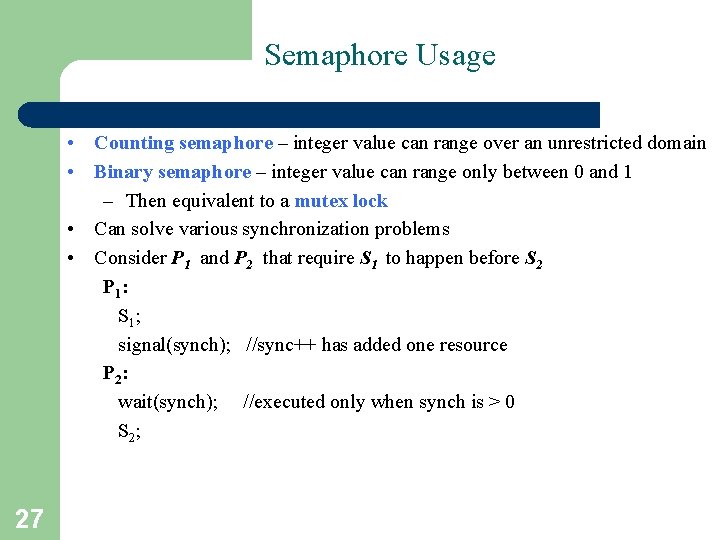
Semaphore Usage • Counting semaphore – integer value can range over an unrestricted domain • Binary semaphore – integer value can range only between 0 and 1 – Then equivalent to a mutex lock • Can solve various synchronization problems • Consider P 1 and P 2 that require S 1 to happen before S 2 P 1 : S 1 ; signal(synch); //sync++ has added one resource P 2 : wait(synch); //executed only when synch is > 0 S 2 ; 27
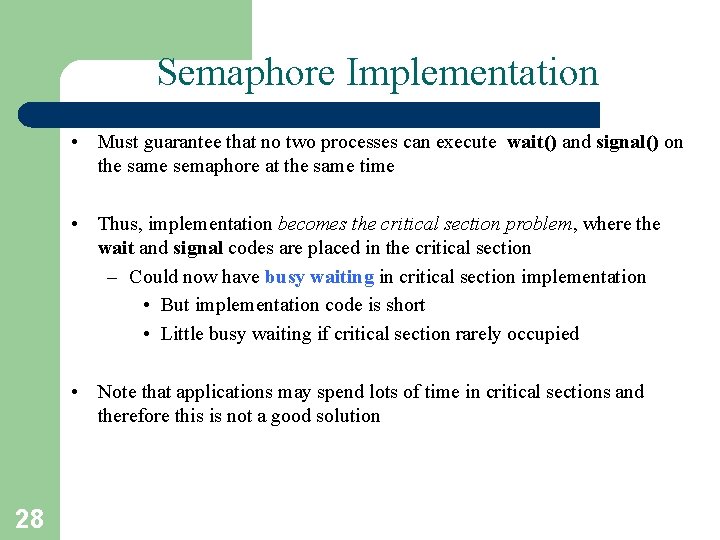
Semaphore Implementation • Must guarantee that no two processes can execute wait() and signal() on the same semaphore at the same time • Thus, implementation becomes the critical section problem, where the wait and signal codes are placed in the critical section – Could now have busy waiting in critical section implementation • But implementation code is short • Little busy waiting if critical section rarely occupied • Note that applications may spend lots of time in critical sections and therefore this is not a good solution 28
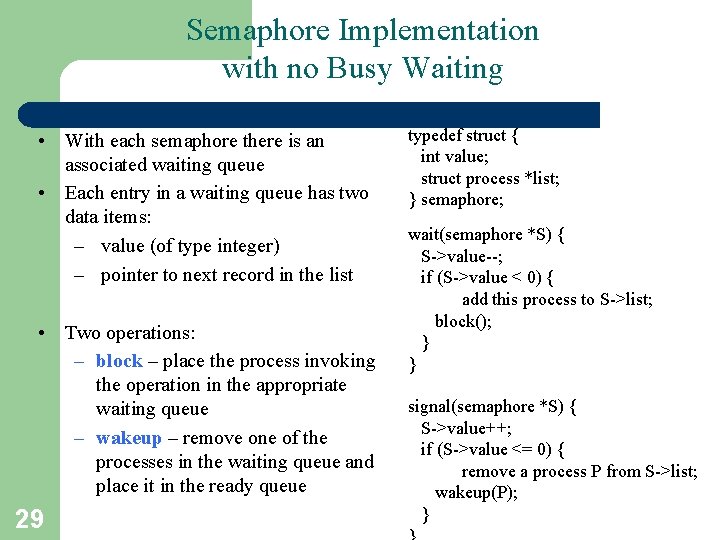
Semaphore Implementation with no Busy Waiting • With each semaphore there is an associated waiting queue • Each entry in a waiting queue has two data items: – value (of type integer) – pointer to next record in the list • Two operations: – block – place the process invoking the operation in the appropriate waiting queue – wakeup – remove one of the processes in the waiting queue and place it in the ready queue 29 typedef struct { int value; struct process *list; } semaphore; wait(semaphore *S) { S->value--; if (S->value < 0) { add this process to S->list; block(); } } signal(semaphore *S) { S->value++; if (S->value <= 0) { remove a process P from S->list; wakeup(P); }
Classical Problems of Synchronization • Classical problems used to test newly-proposed synchronization schemes – Bounded-Buffer Problem – Readers and Writers Problem – Dining-Philosophers Problem 30
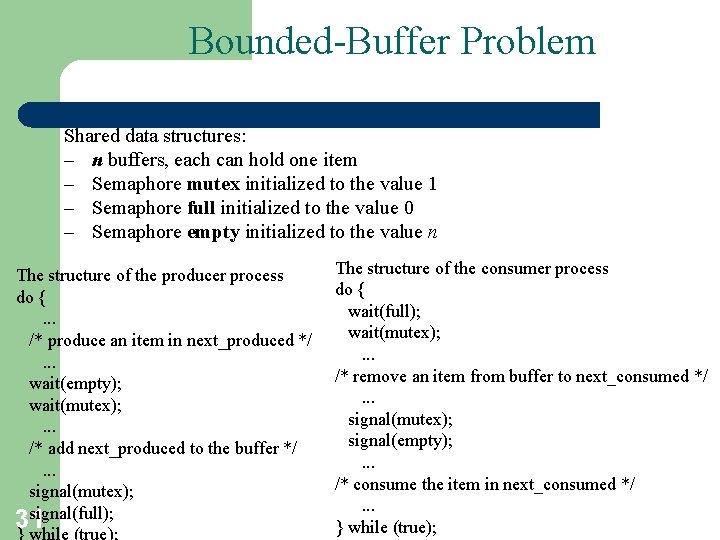
Bounded-Buffer Problem Shared data structures: – n buffers, each can hold one item – Semaphore mutex initialized to the value 1 – Semaphore full initialized to the value 0 – Semaphore empty initialized to the value n The structure of the producer process do {. . . /* produce an item in next_produced */. . . wait(empty); wait(mutex); . . . /* add next_produced to the buffer */. . . signal(mutex); signal(full); 31 The structure of the consumer process do { wait(full); wait(mutex); . . . /* remove an item from buffer to next_consumed */. . . signal(mutex); signal(empty); . . . /* consume the item in next_consumed */. . . } while (true);
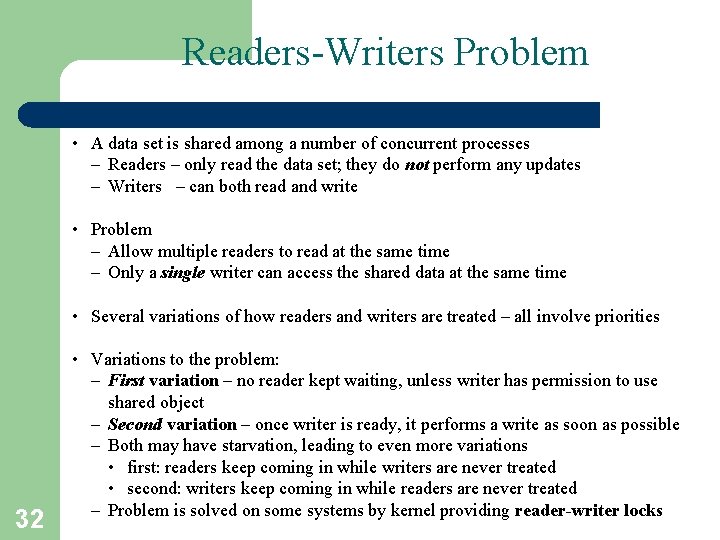
Readers-Writers Problem • A data set is shared among a number of concurrent processes – Readers – only read the data set; they do not perform any updates – Writers – can both read and write • Problem – Allow multiple readers to read at the same time – Only a single writer can access the shared data at the same time • Several variations of how readers and writers are treated – all involve priorities 32 • Variations to the problem: – First variation – no reader kept waiting, unless writer has permission to use shared object – Second variation – once writer is ready, it performs a write as soon as possible – Both may have starvation, leading to even more variations • first: readers keep coming in while writers are never treated • second: writers keep coming in while readers are never treated – Problem is solved on some systems by kernel providing reader-writer locks
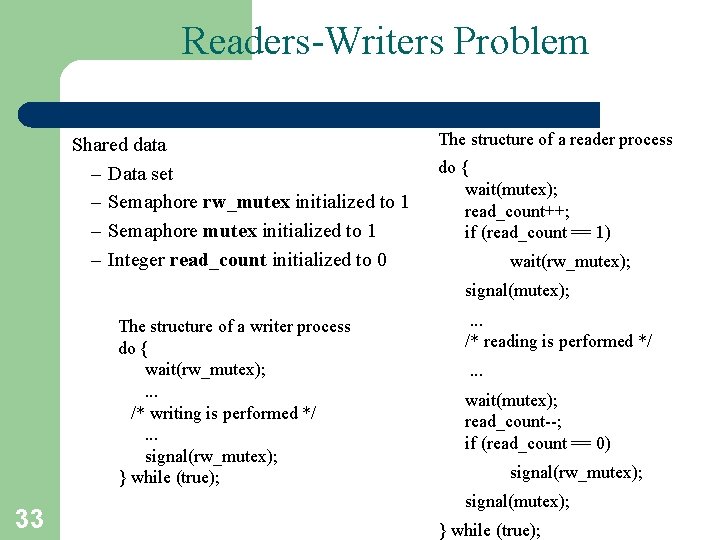
Readers-Writers Problem Shared data – Data set – Semaphore rw_mutex initialized to 1 – Semaphore mutex initialized to 1 – Integer read_count initialized to 0 The structure of a reader process do { wait(mutex); read_count++; if (read_count == 1) wait(rw_mutex); signal(mutex); The structure of a writer process do { wait(rw_mutex); . . . /* writing is performed */. . . signal(rw_mutex); } while (true); 33 . . . /* reading is performed */. . . wait(mutex); read_count--; if (read_count == 0) signal(rw_mutex); signal(mutex); } while (true);
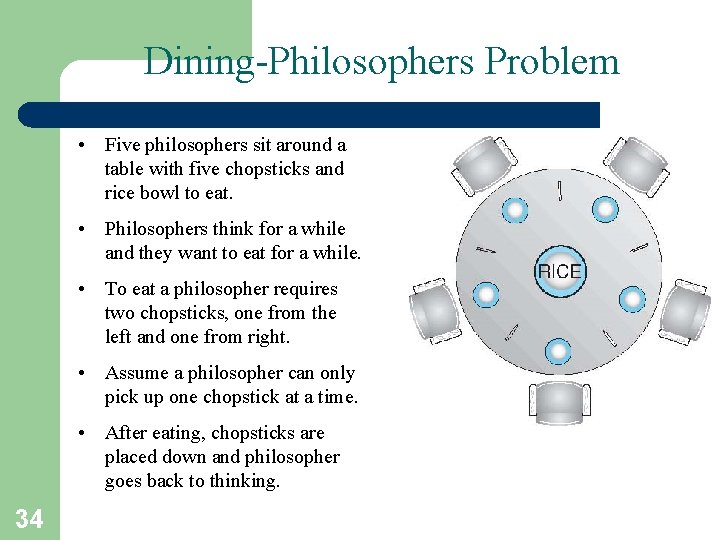
Dining-Philosophers Problem • Five philosophers sit around a table with five chopsticks and rice bowl to eat. • Philosophers think for a while and they want to eat for a while. • To eat a philosopher requires two chopsticks, one from the left and one from right. • Assume a philosopher can only pick up one chopstick at a time. • After eating, chopsticks are placed down and philosopher goes back to thinking. 34
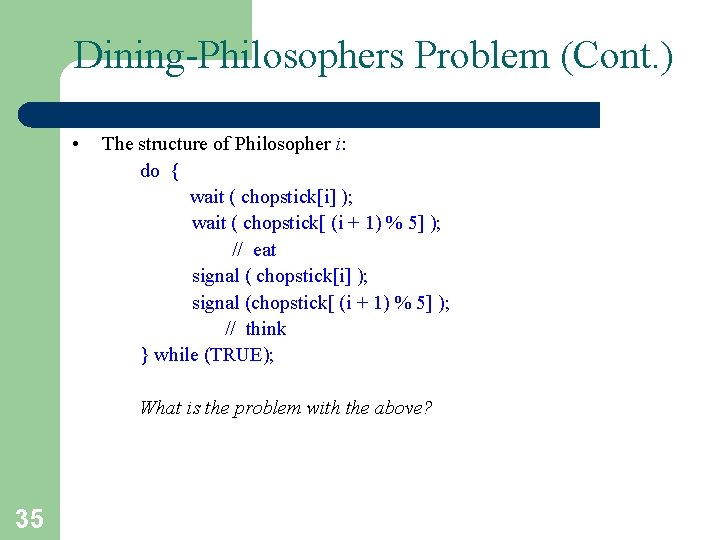
Dining-Philosophers Problem (Cont. ) • The structure of Philosopher i: do { wait ( chopstick[i] ); wait ( chopstick[ (i + 1) % 5] ); // eat signal ( chopstick[i] ); signal (chopstick[ (i + 1) % 5] ); // think } while (TRUE); What is the problem with the above? 35
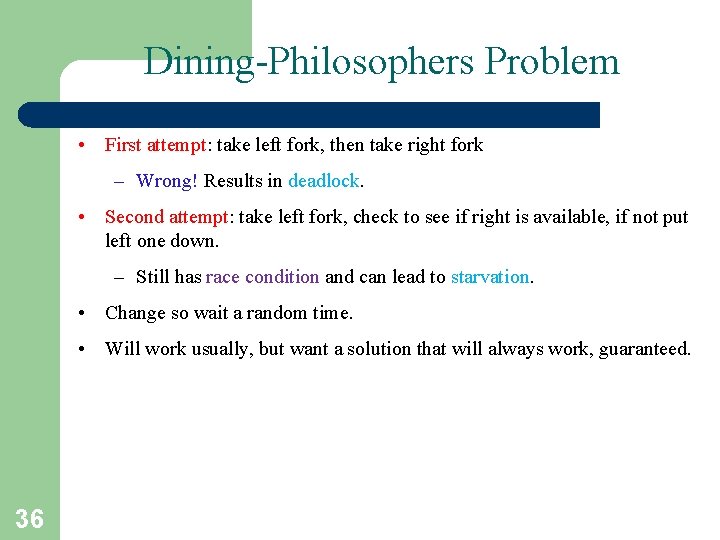
Dining-Philosophers Problem • First attempt: take left fork, then take right fork – Wrong! Results in deadlock. • Second attempt: take left fork, check to see if right is available, if not put left one down. – Still has race condition and can lead to starvation. • Change so wait a random time. • Will work usually, but want a solution that will always work, guaranteed. 36
Dining-Philosophers Problem • Idea #1: Make the two wait operations occur together as an atomic unit (and the two signal operations) – Use another binary semaphore for this • Idea #2: Does it help if one of the neighbors picks their left chopstick first and the other picks their right chopstick first? – Odd philosopher picks left fork followed by right – Even philosopher does vice versa • What is the most # philosophers that can eat simultaneously? 37
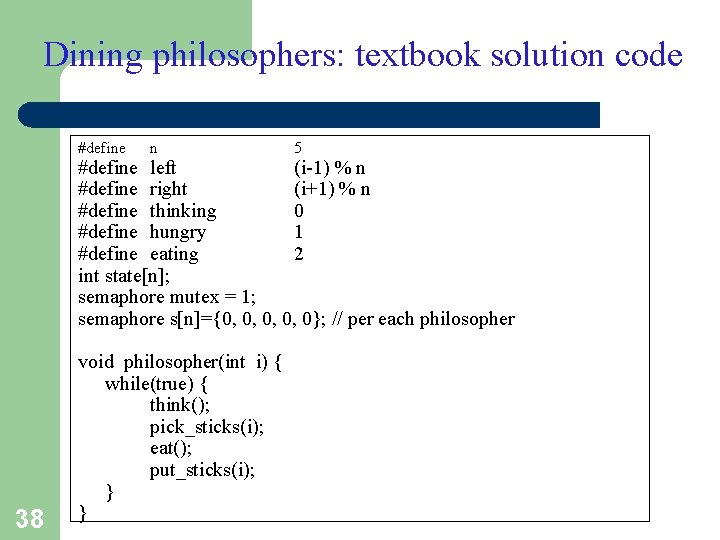
Dining philosophers: textbook solution code #define n 5 #define left (i-1) % n #define right (i+1) % n #define thinking 0 #define hungry 1 #define eating 2 int state[n]; semaphore mutex = 1; semaphore s[n]={0, 0, 0}; // per each philosopher 38 void philosopher(int i) { while(true) { think(); pick_sticks(i); eat(); put_sticks(i); } }
![Dining philosophers: solution code Π void pick_sticks(int i) { wait(mutex); state[i] = hungry; test(i);](http://slidetodoc.com/presentation_image_h2/7b865597f1e6c09f7ac440d27b33928e/image-39.jpg "Dining philosophers: solution code Π void pick_sticks(int i) { wait(mutex); state[i] = hungry; test(i);")
Dining philosophers: solution code Π void pick_sticks(int i) { wait(mutex); state[i] = hungry; test(i); /* try getting 2 forks */ signal(mutex); wait(s[i]); /* block if no forks acquired */ } void put_sticks(int i) { wait(mutex); state[i] = thinking; test(left); test(right); signal(mutex); } void test(int i) { if(state[i] == hungry && state[left] != eating && state[right] != eating) { state[i] = eating; signal(s[i]); } } 39 Is the algorithm deadlock-free? What about starvation?
Synchronization with Semaphores • Semaphores can be used to solve any of the traditional synchronization problems, but suffer from several problems: 1. semaphores are essentially shared global variables 2. there is no connection between the semaphore and the data being controlled by the semaphore 3. Use same mechanism for scheduling and synchronization. 4. they can be accessed from anywhere in the code (global) 5. there is no control or guarantee of proper usage 1. So, semaphores are sometimes hard to use and prone to bugs. 2. One solution is to provide programming language support for synchronization. 40
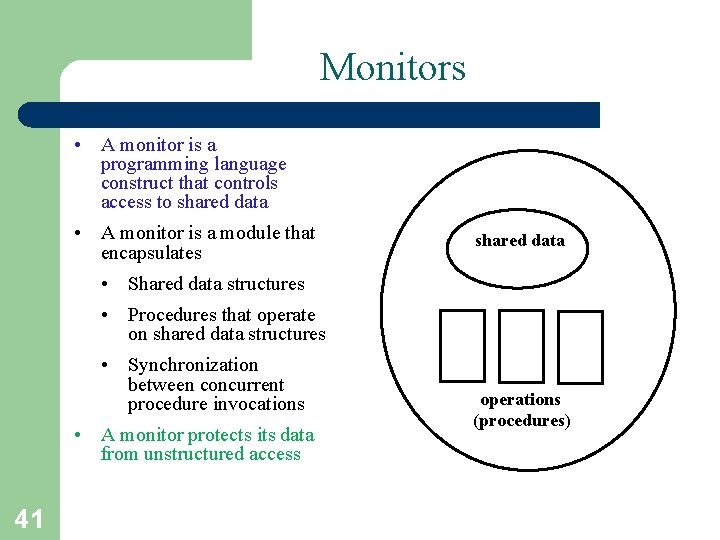
Monitors • A monitor is a programming language construct that controls access to shared data • A monitor is a module that encapsulates shared data • Shared data structures • Procedures that operate on shared data structures • Synchronization between concurrent procedure invocations • A monitor protects its data from unstructured access 41 operations (procedures)
Monitors • A monitor is a set of multiple routines which are protected by a mutual exclusion lock. • None of the routines in the monitor can be executed by a process until that process acquires the lock. • This means that only ONE process can execute within the monitor at a time. • Any other processes must wait for the process that’s currently executing to give up control of the lock. • However, a process can actually suspend itself inside a monitor and then wait for an event to occur. • If this happens, then another process is given the opportunity to enter the monitor. • The process that was suspended will eventually be notified that the event it was waiting for has now occurred, which means it can wake up and reacquire the lock. 42
Monitor Facilities • A monitor guarantees mutual exclusion • only one process can be executing within the monitor at any instant – semaphore implicitly associated with monitor. • if a second process tries to enter a monitor procedure, it blocks until the first has left the monitor – More restrictive than semaphores • easier to use most of the time • Once in the monitor, a process may discover that it cannot continue, and may wish to sleep. Or it may wish to allow a waiting process to continue. • Condition Variables provide synchronization within the monitor so that processes can wait or signal others to continue. 43
Condition Variables • To allow a process to wait within the monitor, a condition variable must be declared, as condition x, y; • Condition variable can only be used with the operations wait() and signal(). – The operation x. wait(); means that the process invoking this operation is suspended until another process invokes x. signal(); – The x. signal() operation resumes exactly one suspended process. If no process is suspended, then the signal() operation has no effect. 44 • Wait() and signal() operations of the monitors are not the same as semaphore wait() and signal() operations!
Condition Variables • Three operations on condition variables – Condition. wait(c) • release monitor lock, wait for someone to signal condition – Condition. signal(c) • wakeup 1 waiting thread – Condition. broadcast(c) • wakeup all waiting threads 45
Basic Ideas • the monitor is controlled by a lock; only 1 process can enter the monitor at a time; others are queued • condition variables provide a way to wait; when a process blocks on a condition variable, it gives up the lock. • a process signals when a resource or condition has become available; this causes a waiting process to resume immediately. • The lock is automatically passed to the waiter; the original process blocks. 46
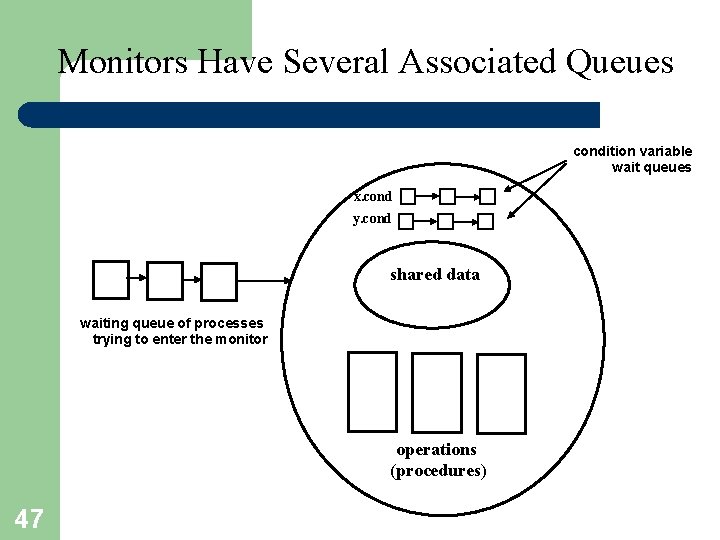
Monitors Have Several Associated Queues condition variable wait queues x. cond y. cond shared data waiting queue of processes trying to enter the monitor operations (procedures) 47
Monitor with Condition Variables • When a process P “signals” to wake up the process Q that was waiting on a condition, potentially both of them can be active. • However, monitor rules require that at most one process can be active within the monitor. Who will go first? • Signal-and-wait: P waits until Q leaves the monitor (or, until Q waits for another condition). • Signal-and-continue: Q waits until P leaves the monitor (or, until P waits for another condition). • Signal-and-leave: P has to leave the monitor after signaling The design decision is different for different programming languages 48
![Solution to Dining Philosophers monitor dp { enum {thinking, hungry, eating} state[5]; condition self[5];](http://slidetodoc.com/presentation_image_h2/7b865597f1e6c09f7ac440d27b33928e/image-49.jpg "Solution to Dining Philosophers monitor dp { enum {thinking, hungry, eating} state[5]; condition self[5];")
Solution to Dining Philosophers monitor dp { enum {thinking, hungry, eating} state[5]; condition self[5]; } initialization_code() { for (int i = 0; i < 5; i++) state[i] = thinking; } 49 void test(int i) { if ((state[(i+4)%5] != eating) && (state[i] = = hungry) && (state[(i+1)%5] != eating) ) { state[i] = eating; self[i]. signal(); } } void pickup(int i) { state[i] = hungry; test(i); if (state[i] != eating) self[i]. wait(); } void putdown(int i) { state[i] = thinking; // test left and right neighbors test((i+4)%5); test((i+1)%5); }
Solution to Dining Philosophers (cont. ) • Each philosopher i invokes the operations pickup() and putdown() in the following sequence: dp. pickup(i); . . . eat. . . dp. putdown(i); • No deadlocks, but starvation is possible 50
Differences between Monitors and Semaphores 51 • Both Monitors and Semaphores are used for the same purpose – process synchronization. • But, monitors are simpler to use than semaphores because they handle all of the details of lock acquisition and release. • An application using semaphores has to release any locks a process has acquired when the application terminates – this must be done by the application itself. • If the application does not do this, then any other process that needs the shared resource will not be able to proceed. • Another difference when using semaphores is that every routine accessing a shared resource has to explicitly acquire a lock before using the resource. • This can be easily forgotten when coding the routines dealing with multithreading. Monitors, unlike semaphores, automatically acquire the necessary locks.
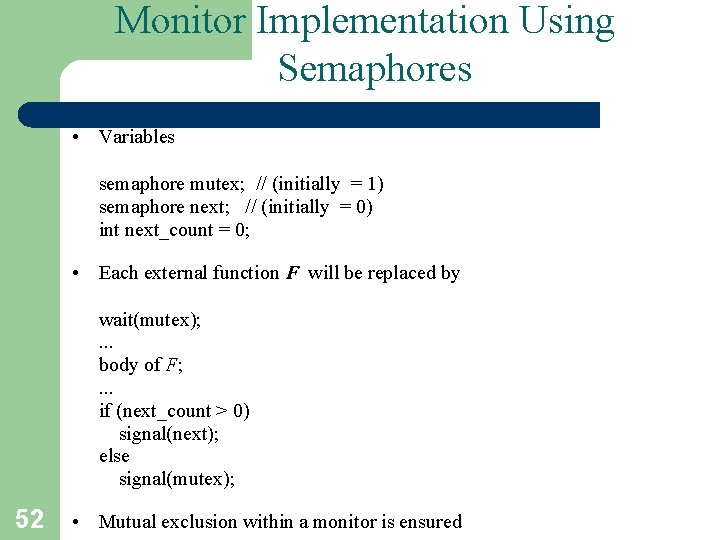
Monitor Implementation Using Semaphores • Variables semaphore mutex; // (initially = 1) semaphore next; // (initially = 0) int next_count = 0; • Each external function F will be replaced by wait(mutex); . . . body of F; . . . if (next_count > 0) signal(next); else signal(mutex); 52 • Mutual exclusion within a monitor is ensured
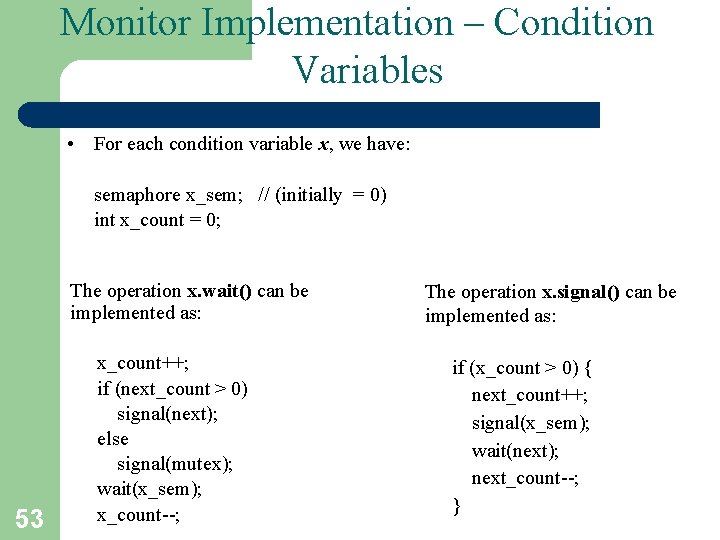
Monitor Implementation – Condition Variables • For each condition variable x, we have: semaphore x_sem; // (initially = 0) int x_count = 0; The operation x. wait() can be implemented as: 53 x_count++; if (next_count > 0) signal(next); else signal(mutex); wait(x_sem); x_count--; The operation x. signal() can be implemented as: if (x_count > 0) { next_count++; signal(x_sem); wait(next); next_count--; }
Resuming Processes within a Monitor • If several processes queued on condition x, and x. signal() executed, which one should be resumed? • First-come, first-served (FCFS) frequently not adequate • conditional-wait construct of the form x. wait(c) – where c is priority number – Process with lowest number (highest priority) is scheduled next – Example of Resource. Allocator, next 54
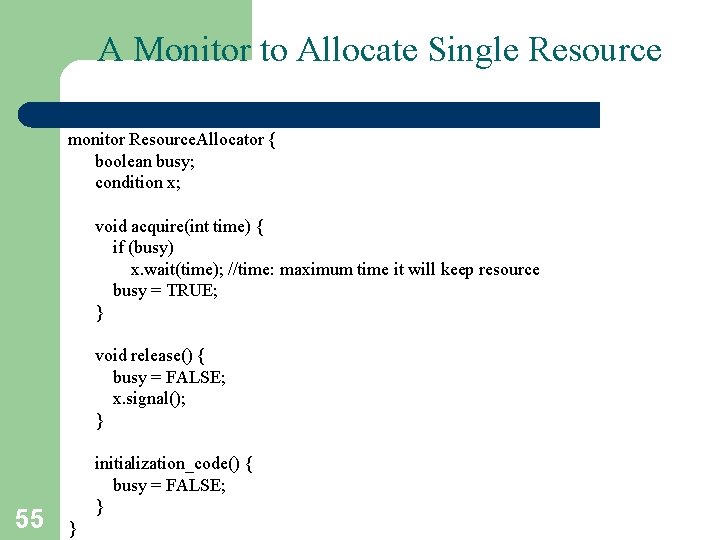
A Monitor to Allocate Single Resource monitor Resource. Allocator { boolean busy; condition x; void acquire(int time) { if (busy) x. wait(time); //time: maximum time it will keep resource busy = TRUE; } void release() { busy = FALSE; x. signal(); } 55 initialization_code() { busy = FALSE; } }
Synchronization Examples • Windows XP • Solaris • Linux • Pthreads 56
Windows XP Synchronization • Uses interrupt masks to protect access to global resources on uniprocessor systems • Uses spinlocks on multiprocessor systems – Spinlocking-thread will never be preempted • Also provides dispatcher objects user-land (outside the kernel) which may act as mutex locks, semaphores, events, and timers – Event acts much like a condition variable (notify thread(s) when condition occurs) – Timer notifies one or more threads when specified amount of time has expired – Dispatcher objects either signaled-state (object available) or non -signaled state (thread will block) 57
Solaris Synchronization • Implements a variety of locks to support multitasking, multithreading (including real-time threads), and multiprocessing • Uses adaptive mutex locks for efficiency when protecting data from short code segments – Starts as a standard semaphore spin-lock – If lock is held, and by a thread running on another CPU, spins – If lock is held by non-run-state thread, block and sleep, waiting for signal of lock being released • Uses condition variables • Uses readers-writers locks when longer sections of code need access to data • Uses turnstiles to order the list of threads waiting to acquire either an adaptive mutex or reader-writer lock – Turnstiles are per-lock-holding-thread, not per-object • Priority-inheritance per-turnstile gives the running thread the highest of the 58
Linux Synchronization • Linux: – Prior to kernel Version 2. 6, disables interrupts to implement short critical sections – Version 2. 6 and later, fully preemptive • Linux provides: – semaphores – spinlocks – reader-writer versions of both • On single-cpu system, spinlocks replaced by enabling and disabling kernel preemption 59
- Slides: 59