
Operating Systems Lecture Notes Deadlocks Matthew Dailey Some
- Slides: 37
Operating Systems Lecture Notes Deadlocks Matthew Dailey Some material © Silberschatz, Galvin, and Gagne, 2002
Deadlocks The threat of deadlocks always exists in complex software systems. Here, we will learn to prevent, avoid, detect, and eliminate deadlocks. Readings: Silberschatz et al. , chapter 8
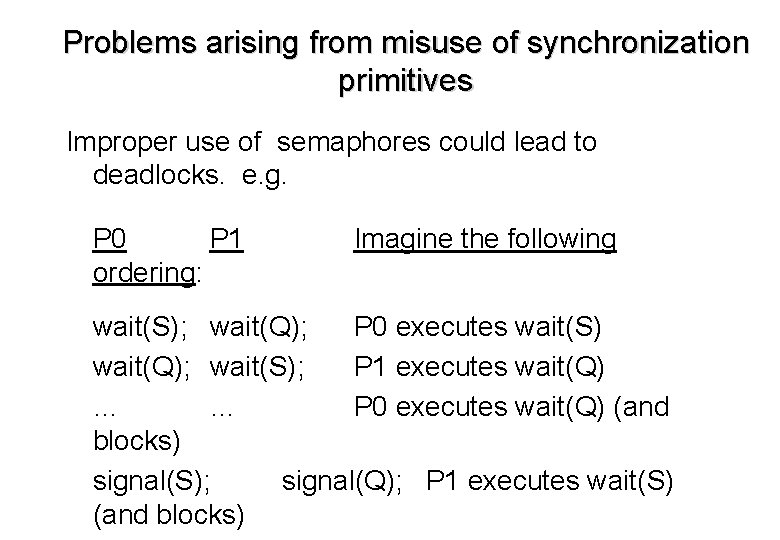
Problems arising from misuse of synchronization primitives Improper use of semaphores could lead to deadlocks. e. g. P 0 P 1 ordering: Imagine the following wait(S); wait(Q); P 0 executes wait(S) wait(Q); wait(S); P 1 executes wait(Q) … … P 0 executes wait(Q) (and blocks) signal(S); signal(Q); P 1 executes wait(S) (and blocks)
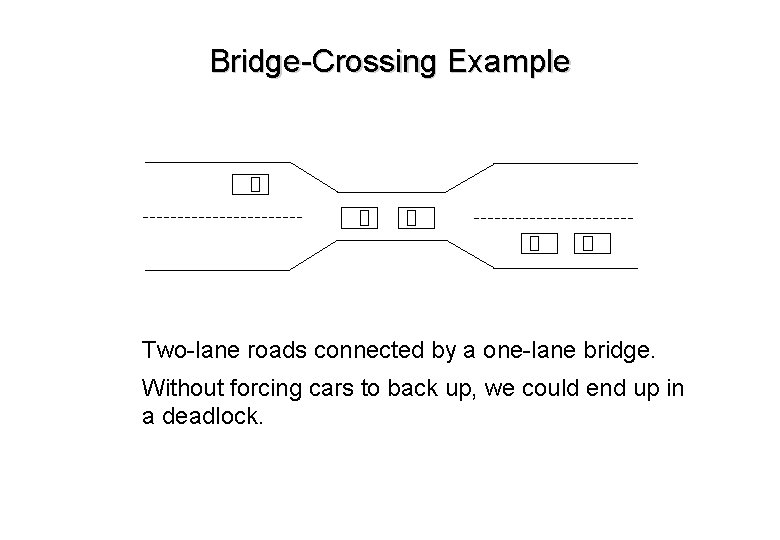
Bridge-Crossing Example Two-lane roads connected by a one-lane bridge. Without forcing cars to back up, we could end up in a deadlock.
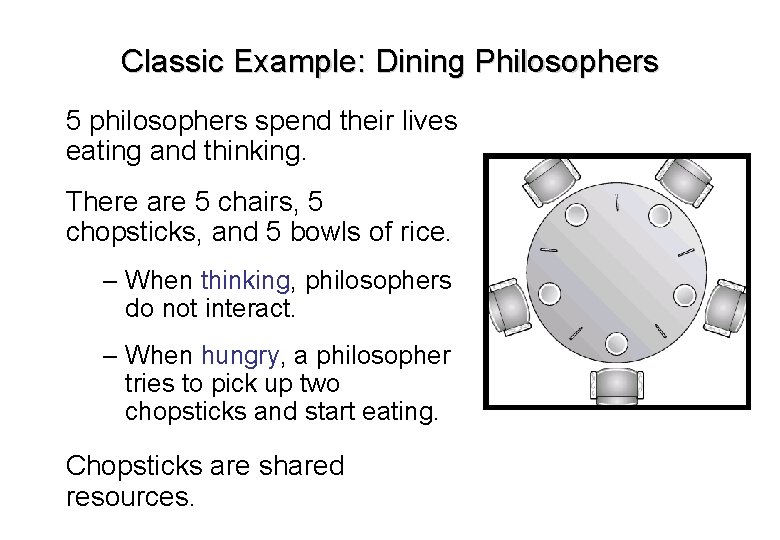
Classic Example: Dining Philosophers 5 philosophers spend their lives eating and thinking. There are 5 chairs, 5 chopsticks, and 5 bowls of rice. – When thinking, philosophers do not interact. – When hungry, a philosopher tries to pick up two chopsticks and start eating. Chopsticks are shared resources.
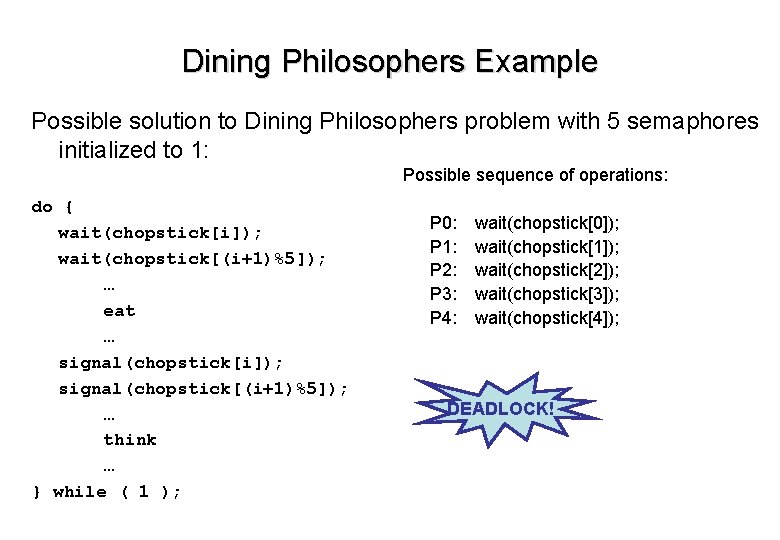
Dining Philosophers Example Possible solution to Dining Philosophers problem with 5 semaphores initialized to 1: Possible sequence of operations: do { wait(chopstick[i]); wait(chopstick[(i+1)%5]); … eat … signal(chopstick[i]); signal(chopstick[(i+1)%5]); … think … } while ( 1 ); P 0: P 1: P 2: P 3: P 4: wait(chopstick[0]); wait(chopstick[1]); wait(chopstick[2]); wait(chopstick[3]); wait(chopstick[4]); DEADLOCK!
Deadlock-Free Dining Philosophers How to prevent deadlock in the semaphore solution? – Allow only 4 philosophers to sit down at one time – Pick up both chopsticks together in a critical section – Asymmetric pickup: some philosophers pick up left first, some pick up right first
Deadlock Analysis: System Model A system contains – Finite set of resources – A set of competing processes Resources: – Partitioned into types – Each type contains some number of identical instances – Examples: memory space, CPU cycles, files, I/O devices Processes do not care which instance of a type they get.
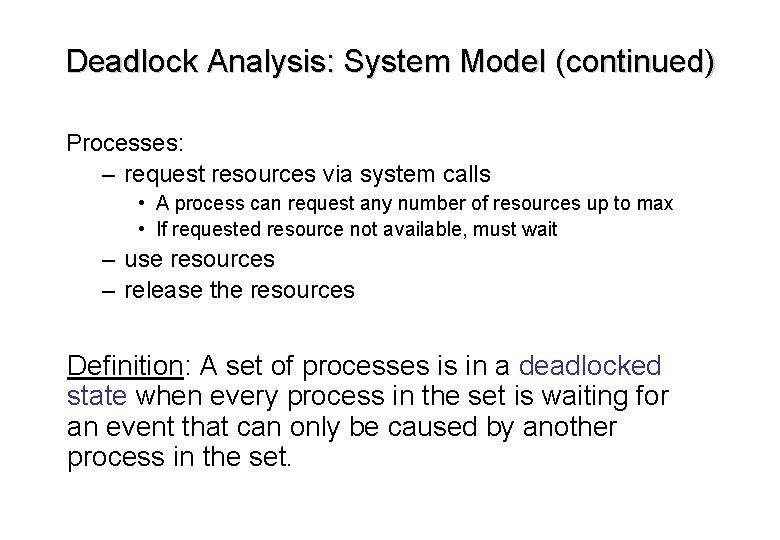
Deadlock Analysis: System Model (continued) Processes: – request resources via system calls • A process can request any number of resources up to max • If requested resource not available, must wait – use resources – release the resources Definition: A set of processes is in a deadlocked state when every process in the set is waiting for an event that can only be caused by another process in the set.
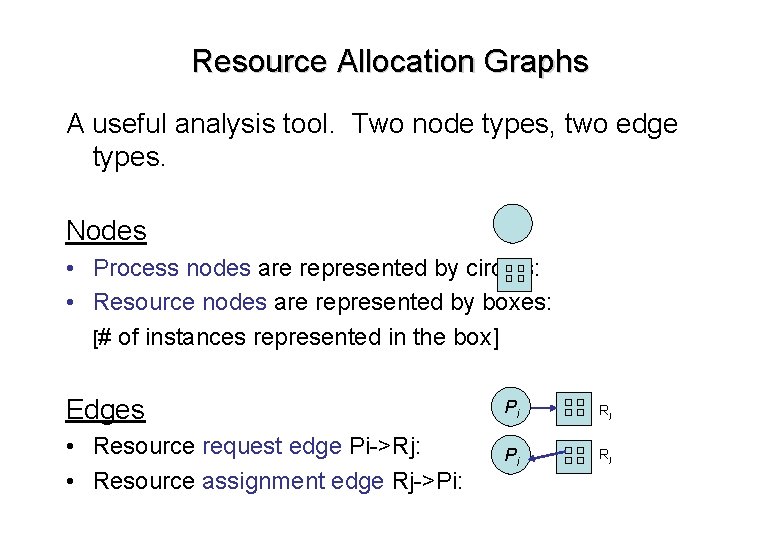
Resource Allocation Graphs A useful analysis tool. Two node types, two edge types. Nodes • Process nodes are represented by circles: • Resource nodes are represented by boxes: [# of instances represented in the box] Edges Pi Rj • Resource request edge Pi->Rj: • Resource assignment edge Rj->Pi: Pi Rj
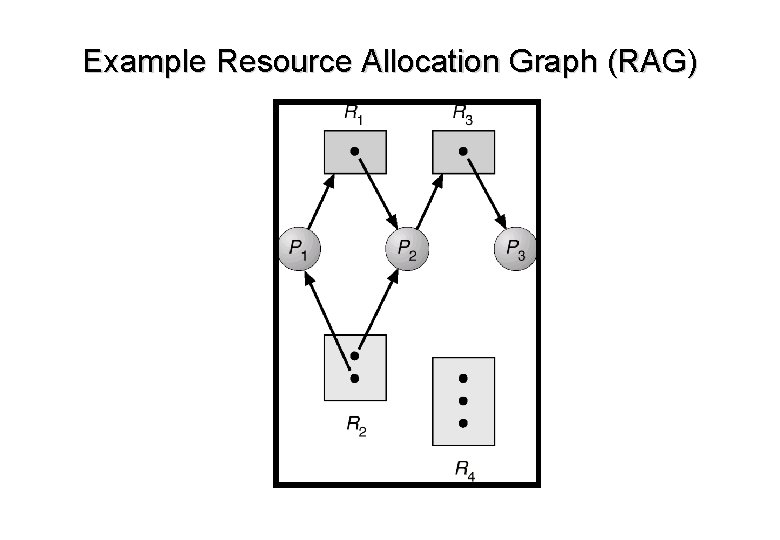
Example Resource Allocation Graph (RAG)
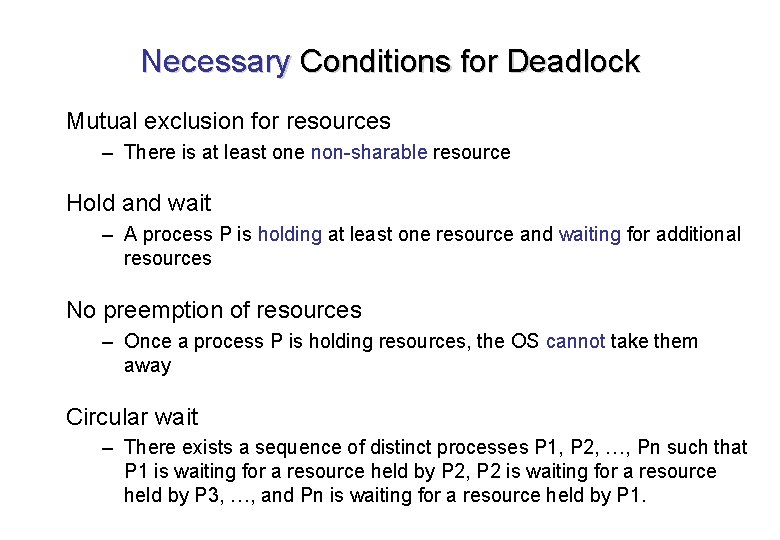
Necessary Conditions for Deadlock Mutual exclusion for resources – There is at least one non-sharable resource Hold and wait – A process P is holding at least one resource and waiting for additional resources No preemption of resources – Once a process P is holding resources, the OS cannot take them away Circular wait – There exists a sequence of distinct processes P 1, P 2, …, Pn such that P 1 is waiting for a resource held by P 2, P 2 is waiting for a resource held by P 3, …, and Pn is waiting for a resource held by P 1.
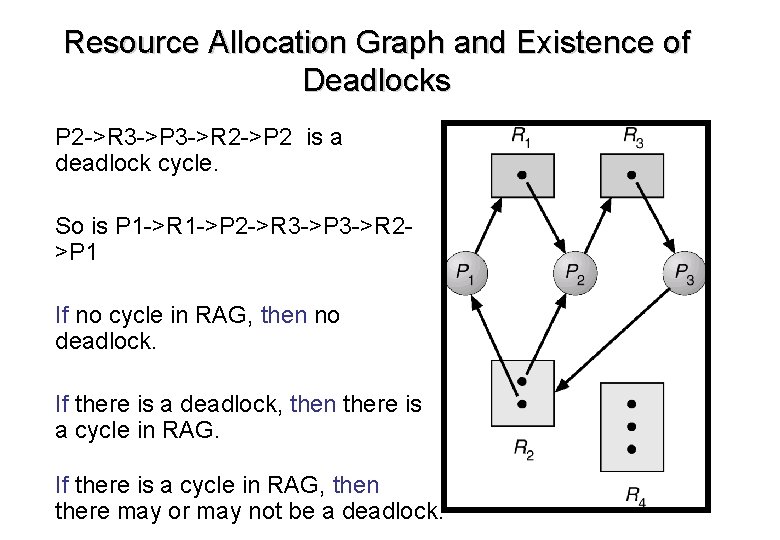
Resource Allocation Graph and Existence of Deadlocks P 2 ->R 3 ->P 3 ->R 2 ->P 2 is a deadlock cycle. So is P 1 ->R 1 ->P 2 ->R 3 ->P 3 ->R 2>P 1 If no cycle in RAG, then no deadlock. If there is a deadlock, then there is a cycle in RAG. If there is a cycle in RAG, then there may or may not be a deadlock.
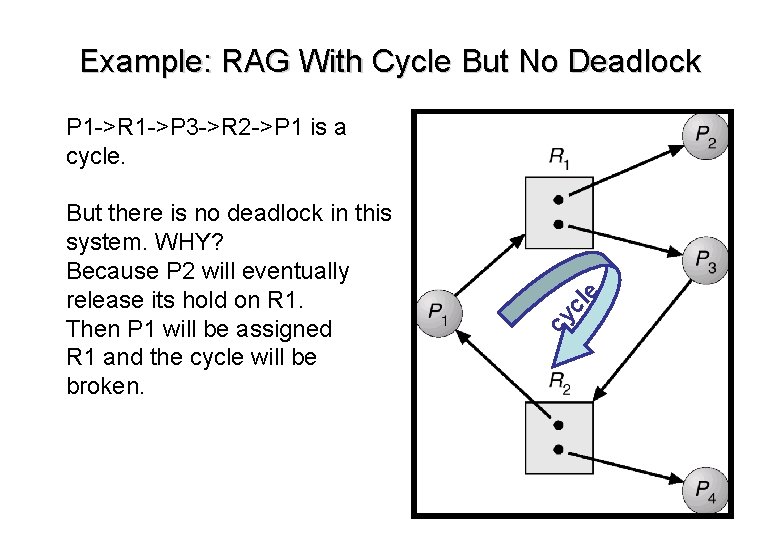
Example: RAG With Cycle But No Deadlock cl cy But there is no deadlock in this system. WHY? Because P 2 will eventually release its hold on R 1. Then P 1 will be assigned R 1 and the cycle will be broken. e P 1 ->R 1 ->P 3 ->R 2 ->P 1 is a cycle.
Deadlock Handling Deadlocks can occur in multitasking systems How do we deal with them? We can – Make sure the system never enters a deadlocked state – Allow deadlocks but detect them and recover from them Most systems problem and leave it to the – Ignore the ignore problemthe altogether user to detect the deadlock and restart their processes.
Deadlock Prevention Take away any one of the necessary conditions Mutual exclusion – Some resources are intrinsically non-sharable. Hold and wait – Force processes to request all resources at startup time – Inefficient and can lead to starvation No preemption – If Pi requesting Rj causes a wait, preempt all other resources held by Pi and make Pi wait for them too – OK for CPU and memory, but difficult for I/O devices Circular wait – Force an enumeration on resources, and force processes to follow the ordering in their requests – Inflexibility for the programmers
Deadlock Prevention Three conditions cannot always be prevented: – Mutual exclusion (some resources not sharable) – Hold and wait (advance allocation is too wasteful) – No preemption (hard to preempt some resource types) Circular wait is easily prevented BUT, – Forcing an ordering on resources is inconvenient – Why should I have to request the tape drive before the printer? Prevention is strict! Deadlock avoidance is less strict.
Deadlock Avoidance The basic idea: – Watch system resource requests – For each request, decide whether granting is “safe” – If safe, grant request – If not safe, force requesting process to wait For single-instance resources, there is a simple Resource Allocation Graph algorithm to determine safety. For multiple-instance resources, use the Banker’s Algorithm
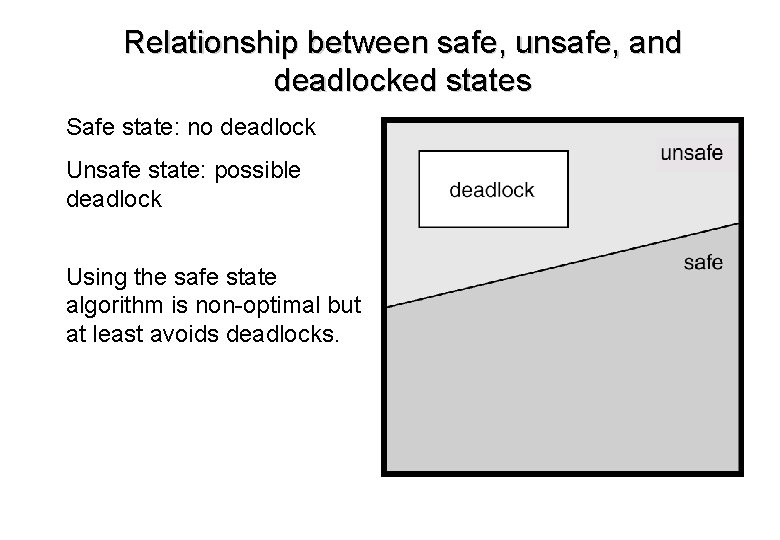
Relationship between safe, unsafe, and deadlocked states Safe state: no deadlock Unsafe state: possible deadlock Using the safe state algorithm is non-optimal but at least avoids deadlocks.
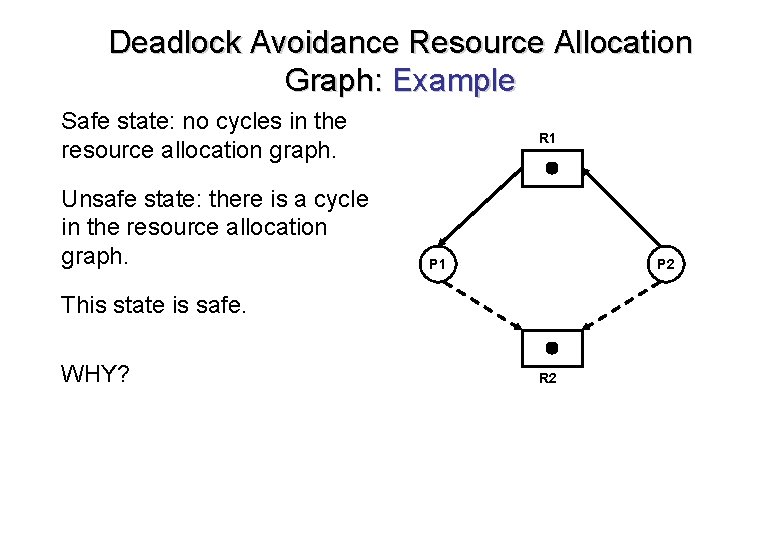
Resource Allocation Graph Algorithm Claim edge Pi->Rj: – Means process Pi may request resource Rj – Represented by a dashed line Algorithm: • When a process requests a resource, claim edges convert to request edges • When Pi releases Rj, the Pi->Rj assignment edge reverts to a claim edge. • All resources must be claimed at startup time.
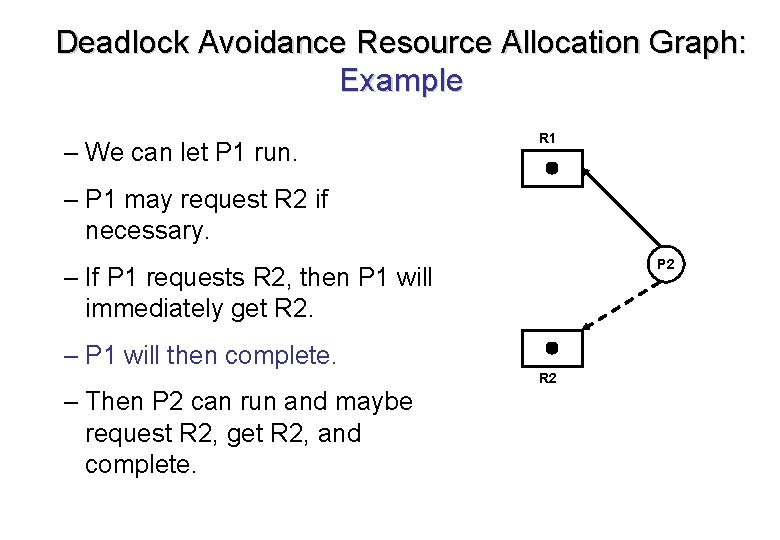
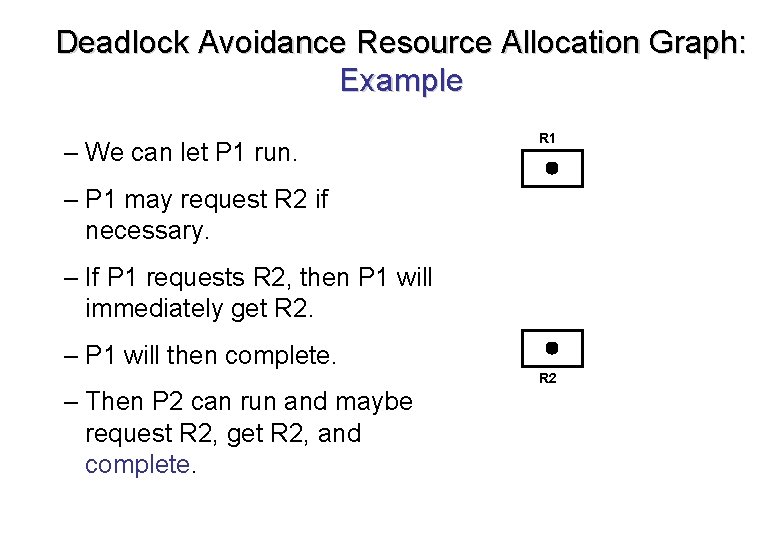
Deadlock Avoidance Resource Allocation Graph: Example Safe state: no cycles in the resource allocation graph. Unsafe state: there is a cycle in the resource allocation graph. R 1 P 2 This state is safe. WHY? R 2
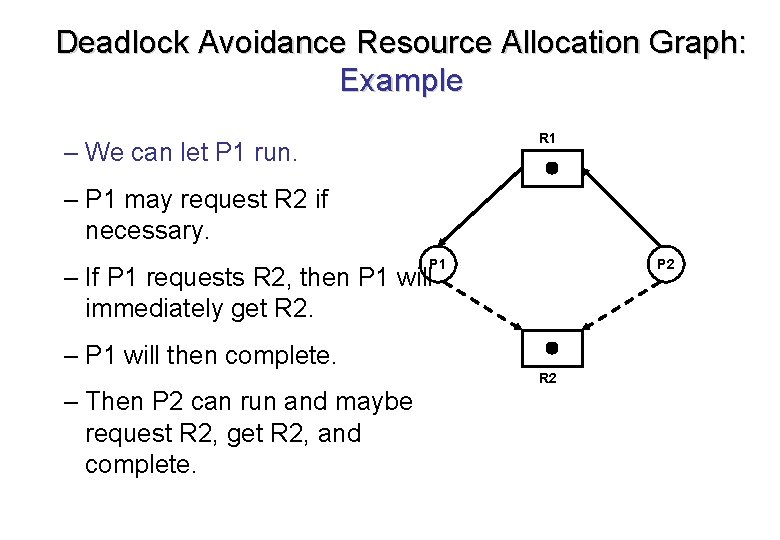
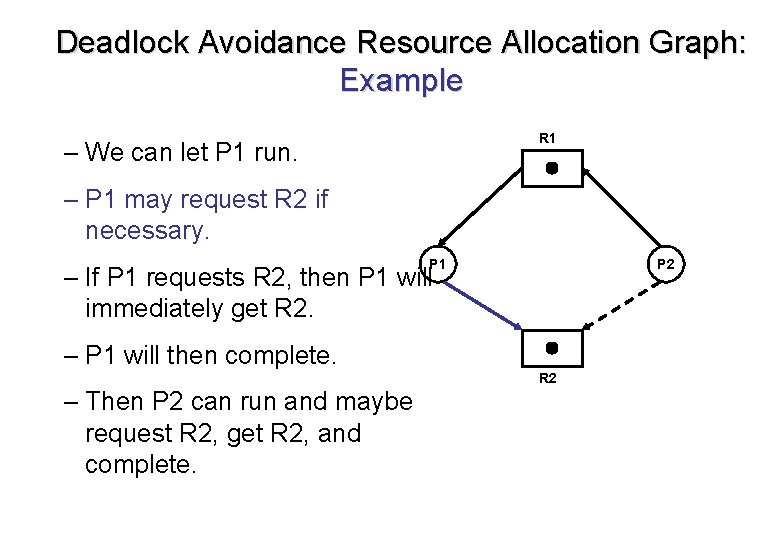
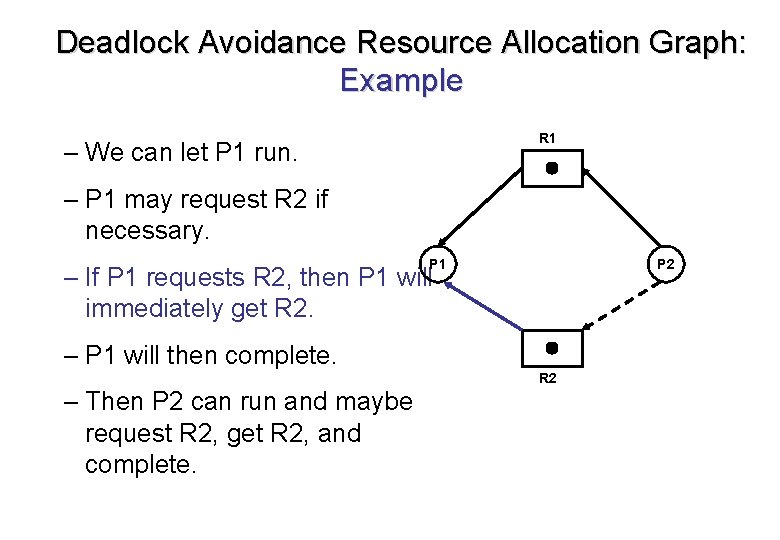
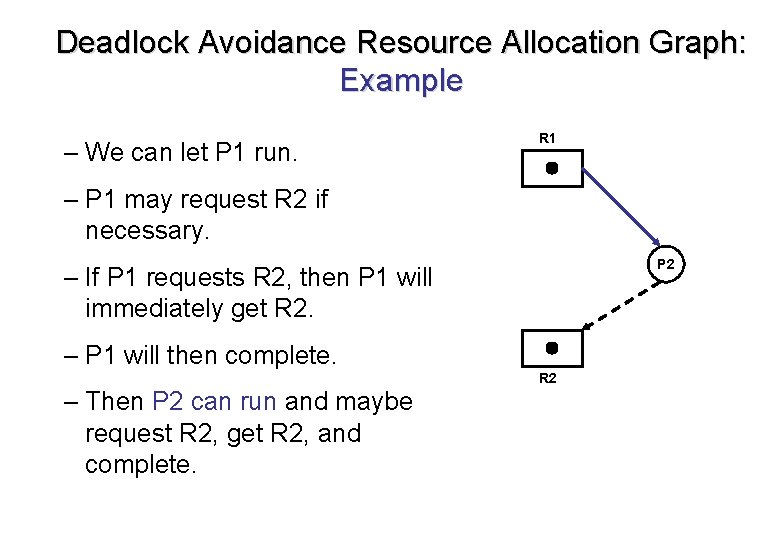
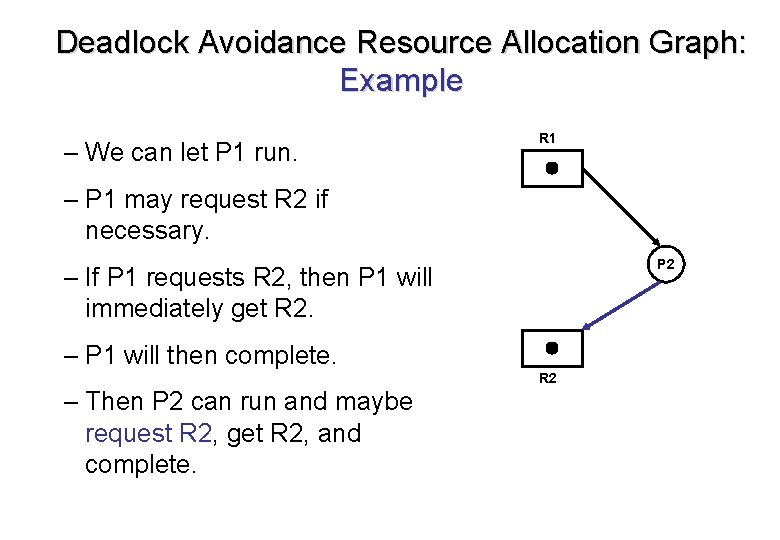
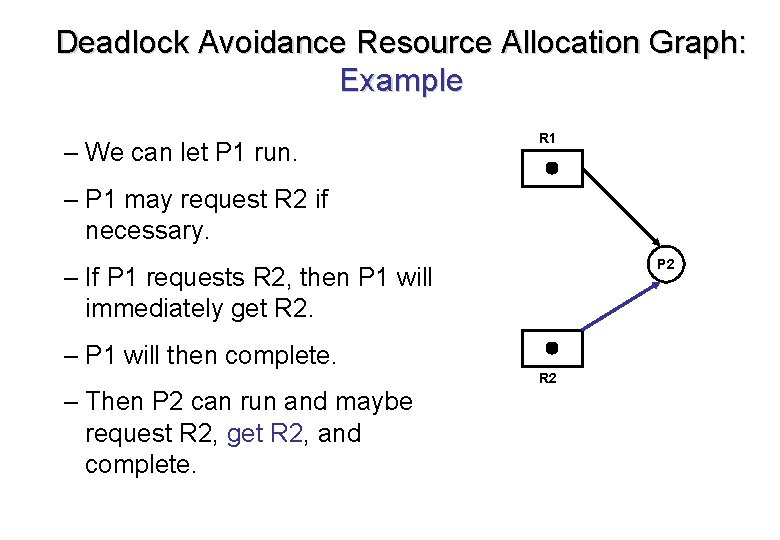
Deadlock Avoidance Resource Allocation Graph: Example R 1 – We can let P 1 run. – P 1 may request R 2 if necessary. P 1 P 2 – If P 1 requests R 2, then P 1 will immediately get R 2. – P 1 will then complete. R 2 – Then P 2 can run and maybe request R 2, get R 2, and complete.
Deadlock Avoidance Resource Allocation Graph: Example R 1 – We can let P 1 run. – P 1 may request R 2 if necessary. P 1 P 2 – If P 1 requests R 2, then P 1 will immediately get R 2. – P 1 will then complete. R 2 – Then P 2 can run and maybe request R 2, get R 2, and complete.
Deadlock Avoidance Resource Allocation Graph: Example R 1 – We can let P 1 run. – P 1 may request R 2 if necessary. P 1 P 2 – If P 1 requests R 2, then P 1 will immediately get R 2. – P 1 will then complete. R 2 – Then P 2 can run and maybe request R 2, get R 2, and complete.
Deadlock Avoidance Resource Allocation Graph: Example – We can let P 1 run. R 1 – P 1 may request R 2 if necessary. P 2 – If P 1 requests R 2, then P 1 will immediately get R 2. – P 1 will then complete. R 2 – Then P 2 can run and maybe request R 2, get R 2, and complete.
Deadlock Avoidance Resource Allocation Graph: Example – We can let P 1 run. R 1 – P 1 may request R 2 if necessary. P 2 – If P 1 requests R 2, then P 1 will immediately get R 2. – P 1 will then complete. R 2 – Then P 2 can run and maybe request R 2, get R 2, and complete.
Deadlock Avoidance Resource Allocation Graph: Example – We can let P 1 run. R 1 – P 1 may request R 2 if necessary. P 2 – If P 1 requests R 2, then P 1 will immediately get R 2. – P 1 will then complete. R 2 – Then P 2 can run and maybe request R 2, get R 2, and complete.
Deadlock Avoidance Resource Allocation Graph: Example – We can let P 1 run. R 1 – P 1 may request R 2 if necessary. P 2 – If P 1 requests R 2, then P 1 will immediately get R 2. – P 1 will then complete. R 2 – Then P 2 can run and maybe request R 2, get R 2, and complete.
Deadlock Avoidance Resource Allocation Graph: Example – We can let P 1 run. R 1 – P 1 may request R 2 if necessary. – If P 1 requests R 2, then P 1 will immediately get R 2. – P 1 will then complete. R 2 – Then P 2 can run and maybe request R 2, get R 2, and complete.
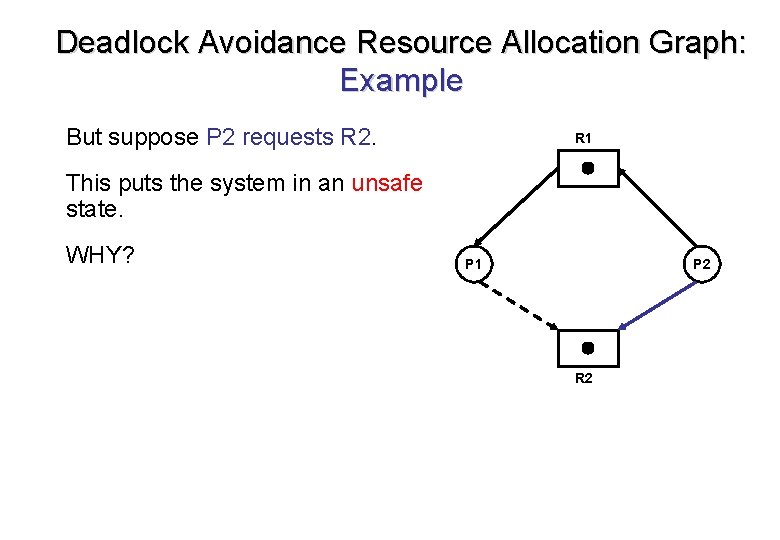
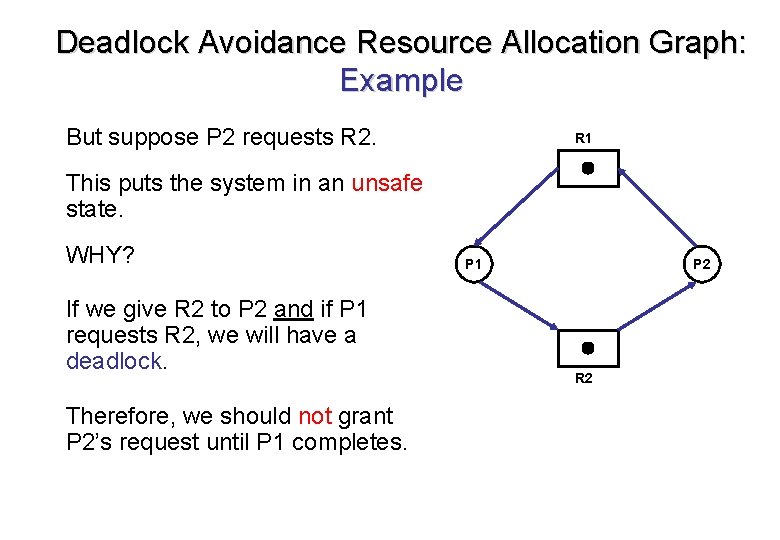
Deadlock Avoidance Resource Allocation Graph: Example But suppose P 2 requests R 2. R 1 This puts the system in an unsafe state. WHY? P 1 P 2 R 2
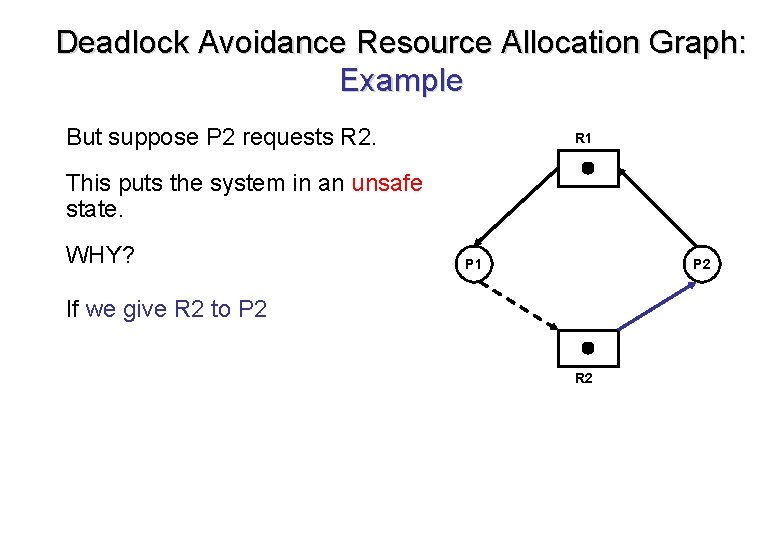
Deadlock Avoidance Resource Allocation Graph: Example But suppose P 2 requests R 2. R 1 This puts the system in an unsafe state. WHY? P 1 P 2 If we give R 2 to P 2 R 2
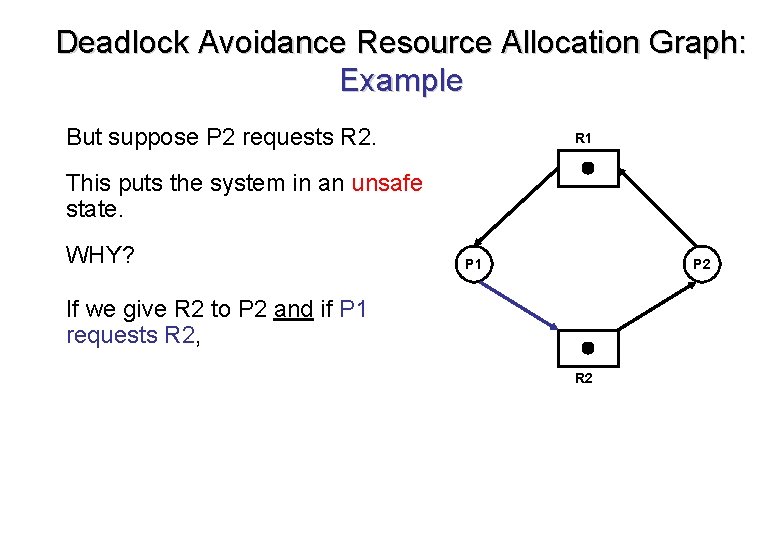
Deadlock Avoidance Resource Allocation Graph: Example But suppose P 2 requests R 2. R 1 This puts the system in an unsafe state. WHY? P 1 P 2 If we give R 2 to P 2 and if P 1 requests R 2, R 2
Deadlock Avoidance Resource Allocation Graph: Example But suppose P 2 requests R 2. R 1 This puts the system in an unsafe state. WHY? If we give R 2 to P 2 and if P 1 requests R 2, we will have a deadlock. Therefore, we should not grant P 2’s request until P 1 completes. P 1 P 2 R 2
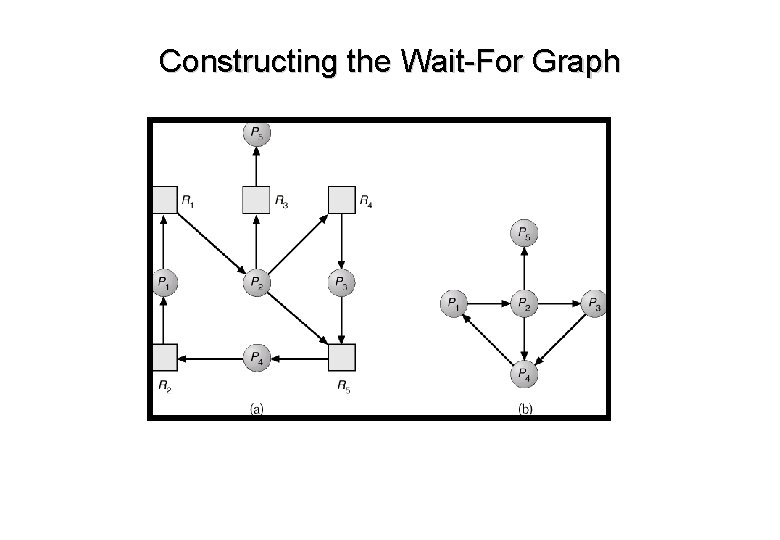
Deadlock Detection and Recovery Deadlock prevention/avoidance is complex and underutilizes resources. Alternative: allow system to deadlock, detect the deadlock, then try to recover. Deadlock detection with single-instance resources: – A simple resource allocation graph algorithm exists – Construct “Wait-for” graph and find cycles Multiple instance resources: – A more complex algorithm is required
Constructing the Wait-For Graph
Recovery Once deadlock is detected, must attempt recovery. Solution 1: Process termination – Abort all processes in the deadlock: costly – Abort one process at a time until deadlock is broken: [This requires a policy for selecting which process to abort. ] Solution 2: Resource preemption – Preempt resources and give to other processes until deadlock is broken
What have we learned? Deadlocks: – How they occur – How to avoid them – How to detect and recover from them