
Operating Systems Lecture 17 Syed Mansoor Sarwar Copyright

- Slides: 16
Operating Systems Lecture 17 Syed Mansoor Sarwar © Copyright Virtual University of Pakistan
Agenda for Today n Review of previous lecture n Multi-level queues scheduling n Multi-level feedback queues scheduling n UNIX System V scheduling n Algorithm evaluation n Recap of lecture 12/2/2020 © Copyright Virtual University of Pakistan
Review of Lecture 16 n Shortest-Job-First is optimal n Round-Robin scheduling n Multi-level queues scheduling 12/2/2020 © Copyright Virtual University of Pakistan
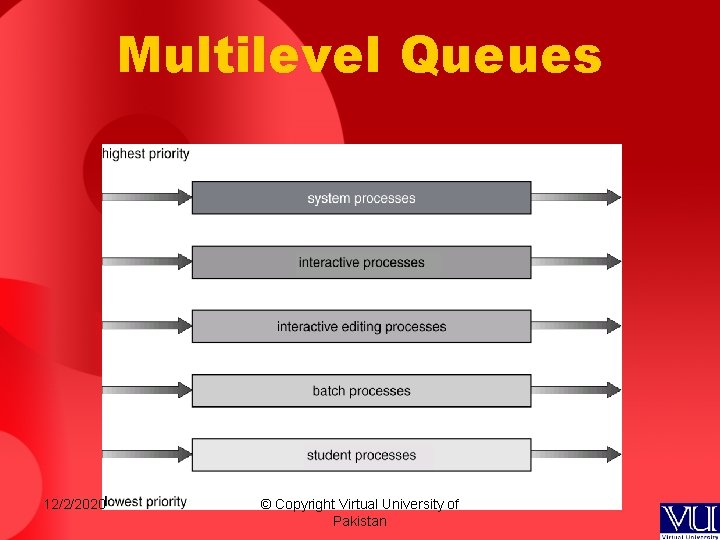
Multilevel Queues 12/2/2020 © Copyright Virtual University of Pakistan
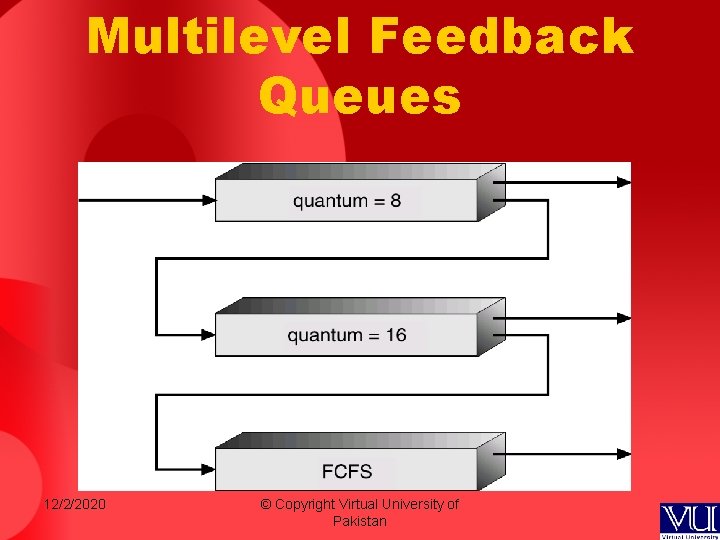
Multilevel Feedback Queues § A process can move between the various queues; aging can be implemented this way. § Multilevel-feedback-queue scheduler defined by the following parameters: § Number of queues § Scheduling algorithms for each queue 12/2/2020 © Copyright Virtual University of Pakistan
Multilevel Feedback Queues § Method used to determine when to upgrade a process § Method used to determine when to demote a process § Method used to determine which queue a process will enter when that process needs service 12/2/2020 © Copyright Virtual University of Pakistan
Multilevel Feedback Queues 12/2/2020 © Copyright Virtual University of Pakistan
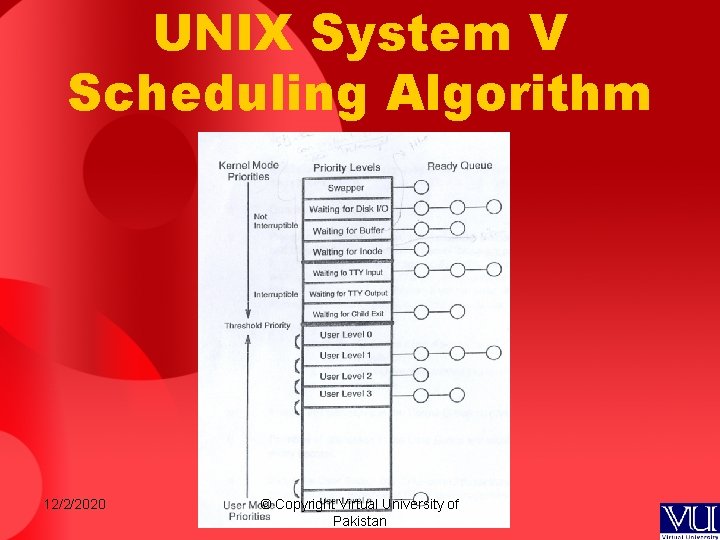
UNIX System V Scheduling Algorithm § Multilevel feedback priority queues with round robin within each queue § Quantum = 1 second § Priorities are divided into two groups/bands: § Kernel Group § User Group 12/2/2020 © Copyright Virtual University of Pakistan
UNIX System V Scheduling Algorithm § Priorities in the Kernel Group are assigned in a manner to minimize bottlenecks: processes waiting in a lower-level routine get higher priorities than those waiting at relatively higher-level routines. 12/2/2020 © Copyright Virtual University of Pakistan
UNIX System V Scheduling Algorithm § In decreasing order of priority, the bands are: § Swapper § Block I/O device control processes § File manipulation § Character I/O device control processes § User processes 12/2/2020 © Copyright Virtual University of Pakistan
UNIX System V Scheduling Algorithm § Priorities of processes in the Kernel Group remain fixed. § Priorities of processes in the User Group are recalculated every second. § Inside the User Group, the CPUbound processes are penalized at the expense of I/O-bound processes 12/2/2020 © Copyright Virtual University of Pakistan
UNIX System V Scheduling Algorithm 12/2/2020 © Copyright Virtual University of Pakistan
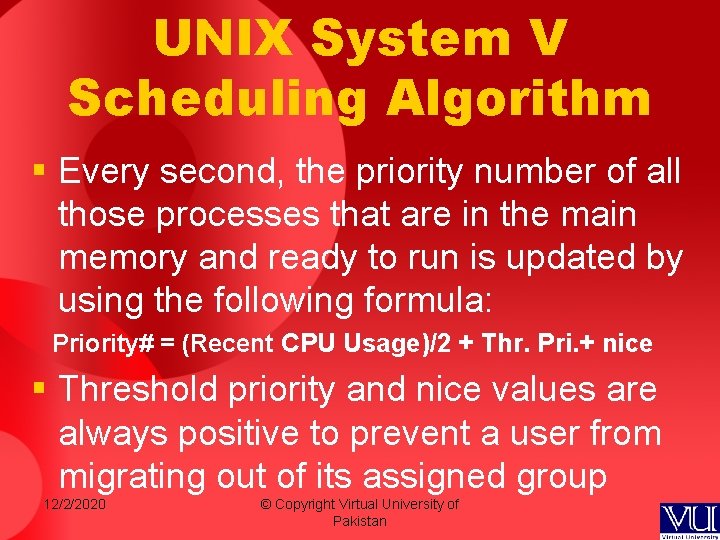
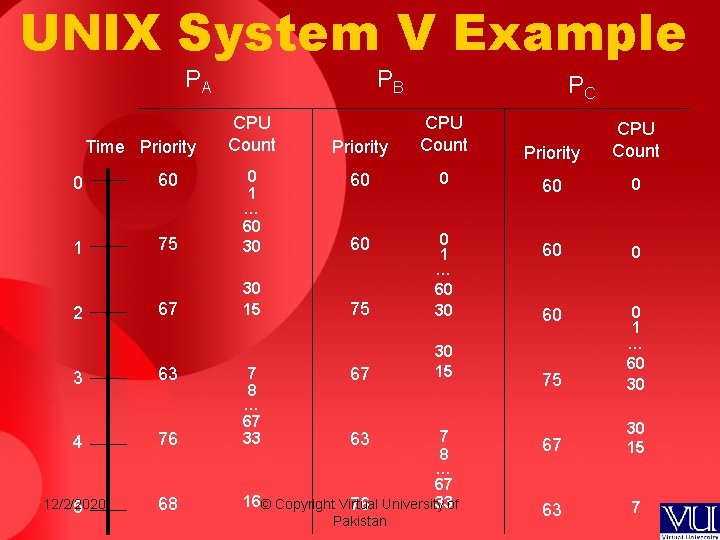
UNIX System V Scheduling Algorithm § The CPU usage of each process is updated every clock tick by the clock ISR. § Every second, a decay function is applied to the CPU usage of each process in the ready queue: Decay (CPU Usage)=(CPU Usage)/2 § Priority number of each process is recomputed every second 12/2/2020 © Copyright Virtual University of Pakistan
UNIX System V Scheduling Algorithm § Every second, the priority number of all those processes that are in the main memory and ready to run is updated by using the following formula: Priority# = (Recent CPU Usage)/2 + Thr. Pri. + nice § Threshold priority and nice values are always positive to prevent a user from migrating out of its assigned group 12/2/2020 © Copyright Virtual University of Pakistan
UNIX System V Example PA Time Priority PB CPU Count 0 60 1 75 0 1 … 60 30 67 30 15 2 3 63 4 76 12/2/2020 5 68 7 8 … 67 33 PC Priority CPU Count 60 0 60 75 0 1 … 60 30 67 30 15 7 8 … 67 16© Copyright Virtual 76 University 33 of 63 Pakistan Priority CPU Count 60 0 60 75 0 1 … 60 30 67 30 15 63 7
Recap of Lecture n Multi-level queues scheduling n Multi-level feedback queues scheduling n UNIX System V scheduling 12/2/2020 © Copyright Virtual University of Pakistan