
Operating Systems Lecture 1 Agenda for Today Introduction
- Slides: 26
Operating Systems Lecture 1
Agenda for Today Introduction and purpose of the course n Organization of a computer system n Purpose of a computer system—setting the stage for OS concepts and principles n Outline of topics to be discussed in the course n What is an operating system? n Recap of the lecture n
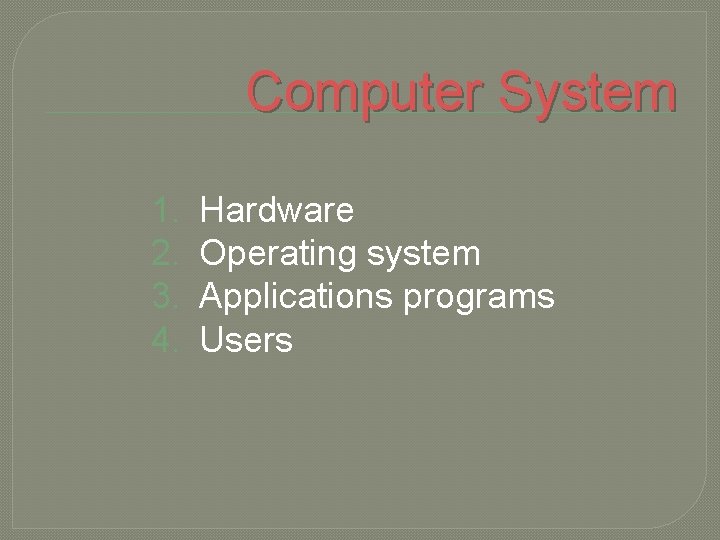
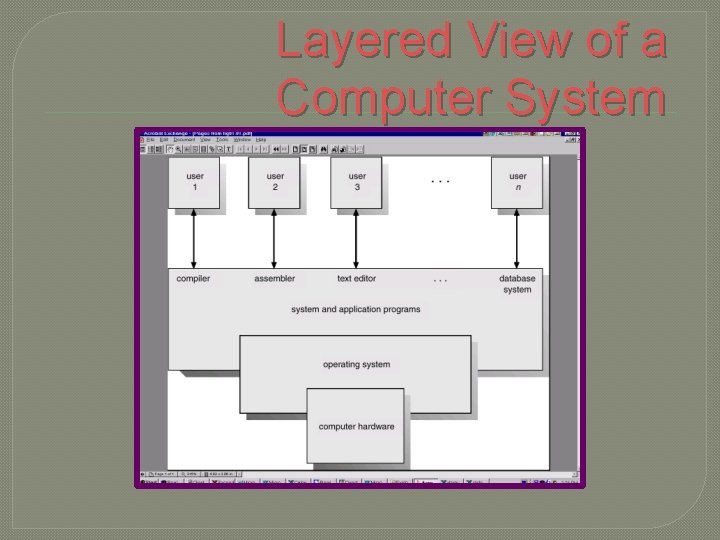
Computer System 1. 2. 3. 4. Hardware Operating system Applications programs Users
Layered View of a Computer System
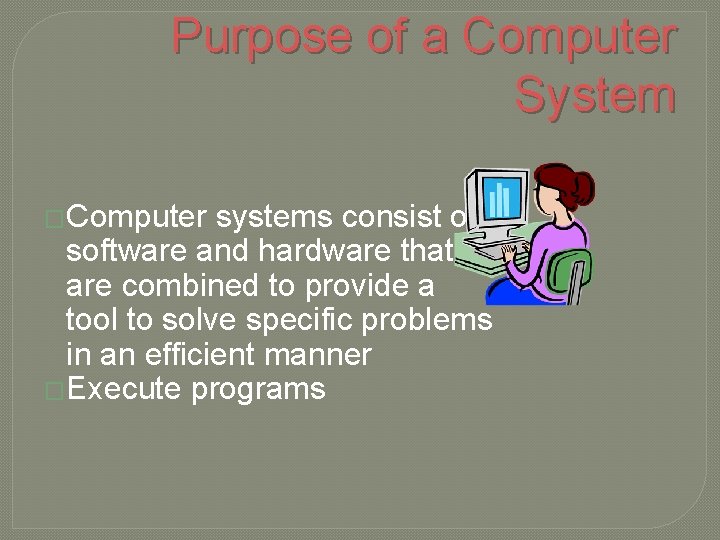
Purpose of a Computer System �Computer systems consist of software and hardware that are combined to provide a tool to solve specific problems in an efficient manner �Execute programs
Computer System Hardware
Course Outline Operating system concepts n Operating system structures n Introduction to UNIX/Linux user interface n Processes and threads—scheduling, concurrency, synchronization, etc. n Deadlocks n Memory management n Virtual memory n File system n Secondary storage management n
Operating System Concepts �Single-user systems �Batch systems �Multiprogrammed systems �Time-sharing systems �Real-time systems �Interrupts, traps, and software interrupts (UNIX signals) �Hardware protection
Operating System Structures �Operating system services �System calls �Semantics of system call execution �Operating system structures (monolithic, microkernel-based, layered, virtual machines, DOS-Windows, UNIX) �System design and implementation
Introduction to UNIX/Linux �Directory structure �Browsing directory structure �Useful commands
Processes �Process concept (process, states, attributes, etc. ) �Process scheduling (scheduler) �Context switching (dispatcher) �Operations on processes (creation, termination, signaling, suspend, foreground, background, etc. ) �Process management in UNIX (fork, wait, exec, exit, etc. )
Processes (continued) �Sample code for UNIX/Linux process management �Cooperating processes �Interprocess communication (IPC) �IPC in UNIX/Linux (pipe, FIFO, socket, message queue, etc. )
Processes (continued) �Communication between UNIX/Linux processes (pipe, mkfifo, read, write, close, etc. ) �Sample code �UNIX/Linux processes (process images, control structures, etc. explained with sample code) �Managing UNIX/Linux processes (ps, top, fg, bg, <Ctrl-Z>, <Ctrl-C>, etc. )
Threads �Thread concept (thread, states, attributes, etc. ) �User- and kernel-level threads �POSIX threads (the pthread library) �Sample code
CPU Scheduling �Basic concepts �Scheduling criteria �Scheduling triggers �Scheduling algorithms �UNIX System V scheduling algorithm �Optimal scheduling �Algorithm evaluation
Process Synchronization �Basic concept �The Critical Section Problem �Solutions for the Critical Section Problem �Software-based solutions—the Bakery Algorithm �Hardware-based solutions �Semaphores �Binary and counting semaphores
Process Synchronization … �Classic problems of synchronization �Deadlocks and starvation �Critical regions �Monitors �Synchronization tools used in Solaris, Linux, and Windows �Deadlocks and starvation �Pthread library functions
Deadlocks �Basic concept �Deadlock characterization �Deadlock handling (prevention, avoidance, detection and recovery) �Banker’s algorithm
�Basic Memory Management concepts �Various techniques for memory management �Logical to physical address translation �Swapping �Contiguous memory allocation: MFT, MVT �External fragmentation �Paging �Hardware support for paging �Internal fragmentation
Memory Management … �Performance of paging �Protection and sharing �Page table issues: Multi-level paging, Hashed page tables, Inverted page tables �Segmentation �Protection and sharing �Segmentation with paging �Intel P 4 example
�Basic Virtual Memory concept �Demand paging �Page fault �Performance of demand paging �Page replacement �Allocation of frames �Thrashing �Operating-system examples �Other considerations (I/O locking, page size, …)
File System Interface �Basic concepts (file attributes, operations, types, structure, etc. ) �Access methods (sequential, random, etc. ) �Directory structure �UNIX/Linux directory structure (links in UNIX) �File system mounting, sharing, and protection �UNIX/Linux examples for sharing and protection, and relevant commands (chmod, ln –s, etc. )
File System Implementation �Basic concepts (overview of disk structure, file structure, boot control block, super block, inode, per process file descriptor table, system-wide open-file table, etc. ) �Directory implementation �Free space management methods �Space Allocation Methods �Time and space performance of allocation methods �Brief introduction to Network File System (NFS)
Mass Storage Structure and Scheduling �Disk structure and scheduling �Disk management (formatting, boot block, bad blocks, etc. ) �Course Recap
What is an Operating System? A program that acts as an intermediary between a user of a computer and the computer hardware—provides the user a simpler (virtual) machine to work with n A program that allocates and deallocates computer system resources in an efficient, fair, and secure manner—a resource manager n
Operating System Goals �Execute user programs and make solving user problems easier. �Make the computer system convenient to use. �Use the computer hardware in an efficient manner.