
Operating Systems Internals and Design Principles Chapter 7


- Slides: 44
Operating Systems: Internals and Design Principles Chapter 7 Memory Management Seventh Edition William Stallings
Definition n Memory management is the process of n n n allocating primary memory to user programs reclaiming that memory when it is no longer needed protecting each user’s memory area from other user programs; i. e. , ensuring that each program only references memory locations that have been allocated to it.
Requirements n In order to manage memory effectively the OS must have n Memory allocation policies n Methods to track the status of memory locations (free or allocated) n Policies for preempting memory from one process to allocate to another
Memory Management
Memory Management Requirements n Memory management is intended to satisfy the following requirements: n Relocation n Protection n Sharing n Logical organization n Physical organization
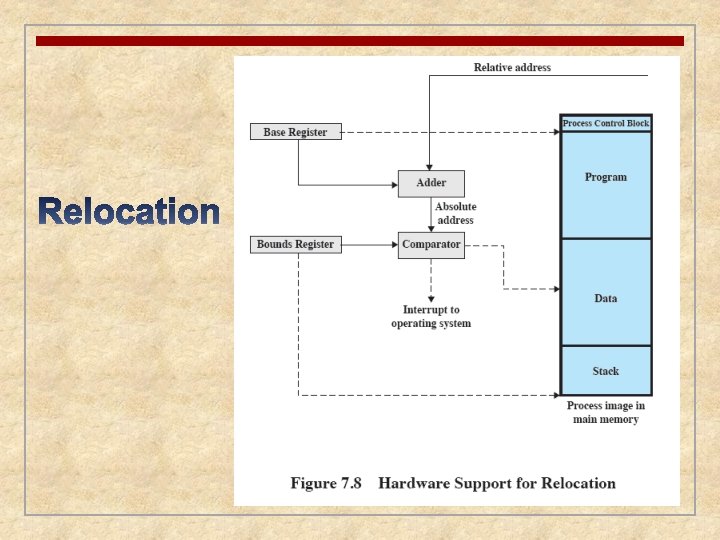
Relocation n Relocation is the process of adjusting program addresses to match the actual physical addresses where the program resides when it executes n Why n is relocation needed? Programmer/translator don’t know which other programs will be memory resident when the program executes
Relocation n Why n n is relocation needed? (continued) Active processes need to be able to be swapped in and out of main memory in order to maximize processor utilization Specifying that a process must be placed in the same memory region when it is swapped back in would be limiting n Consequently it must be possible to adjust addresses whenever a program is loaded.
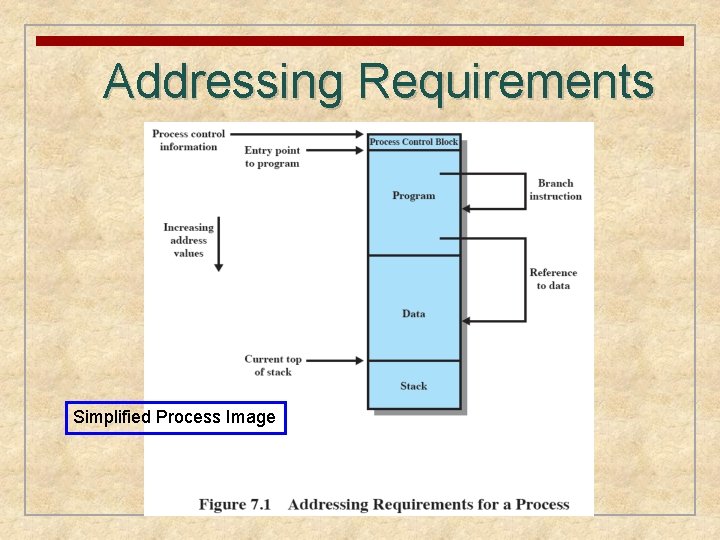
Addressing Requirements Simplified Process Image
Protection n Processes need to acquire permission to reference memory locations for reading or writing purposes n Location of a program in main memory is unpredictable n Memory references generated by a process must be checked at run time n Mechanisms that support relocation also support protection
Sharing n Advantageous to allow each process access to the same copy of the program rather than have their own separate copy n Memory management must allow controlled access to shared areas of memory without compromising protection n Mechanisms used to support relocation support sharing capabilities
Logical Organization n Main memory is organized as a linear (1 -D) address space consisting of a sequence of bytes or words. n Programs aren’t necessarily organized this way Programs are written in modules n • modules can be written and compiled Paging versus segmentation independently • different degrees of protection given to modules (read-only, execute-only) • sharing on a module level corresponds to the user’s way of viewing the problem
Physical Organization n Two-level n n memory for program storage: Disk (slow and cheap) & RAM (fast and more expensive) Main memory is volatile, disk isn’t n User should not have to be responsible for organizing movement of code/data between the two levels.
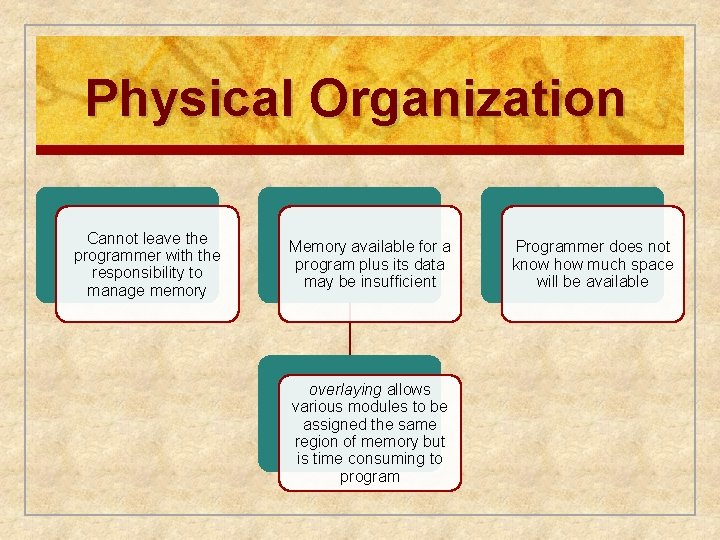
Physical Organization Cannot leave the programmer with the responsibility to manage memory Memory available for a program plus its data may be insufficient overlaying allows various modules to be assigned the same region of memory but is time consuming to program Programmer does not know how much space will be available
Memory Partitioning n n Virtual memory management brings processes into main memory for execution by the processor § involves virtual memory § based on segmentation and paging Partitioned memory management § used in several variations in some now-obsolete operating systems § does not involve virtual memory
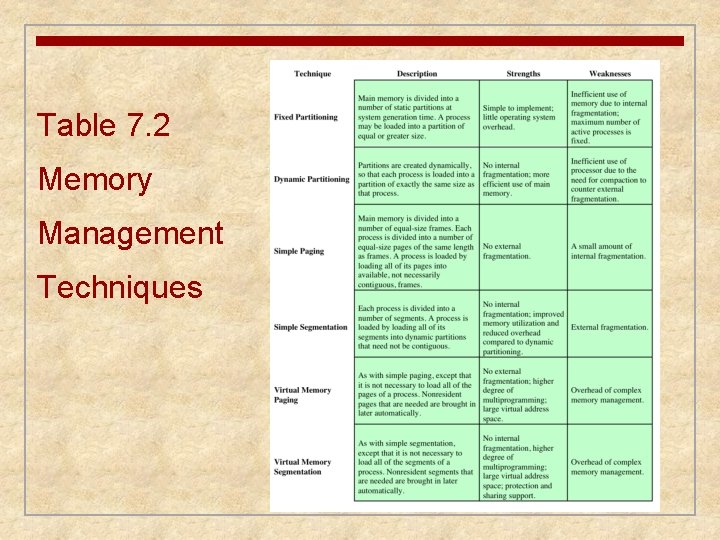
Table 7. 2 Memory Management Techniques
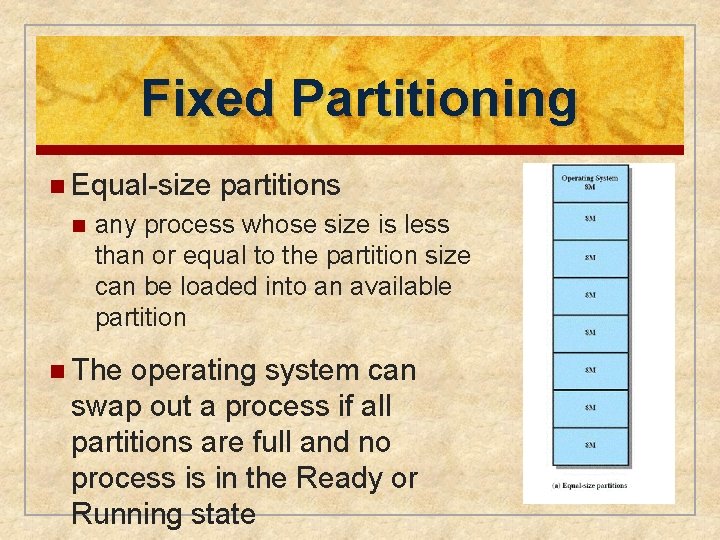
Fixed Partitioning n Equal-size n partitions any process whose size is less than or equal to the partition size can be loaded into an available partition n The operating system can swap out a process if all partitions are full and no process is in the Ready or Running state
n A program may be too big to fit in a partition n program needs to be designed with the use of overlays n Main memory utilization is inefficient n any program, regardless of size, occupies an entire partition n internal fragmentation n wasted space due to the block of data loaded being smaller than the partition
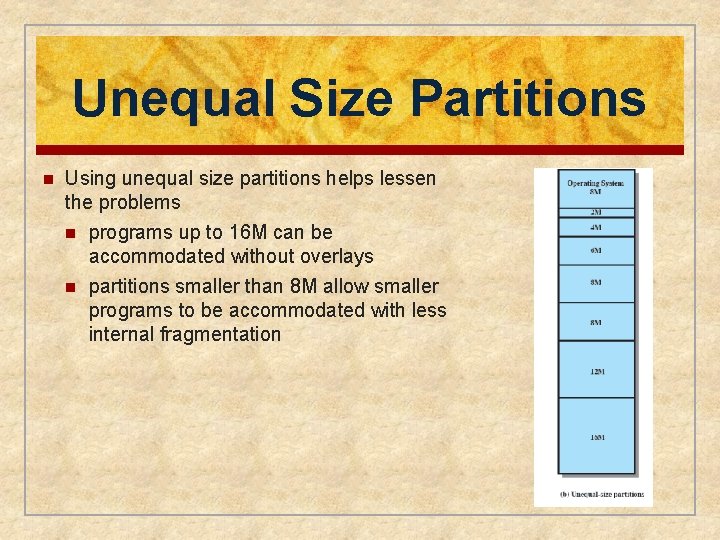
Unequal Size Partitions n Using unequal size partitions helps lessen the problems n n programs up to 16 M can be accommodated without overlays partitions smaller than 8 M allow smaller programs to be accommodated with less internal fragmentation
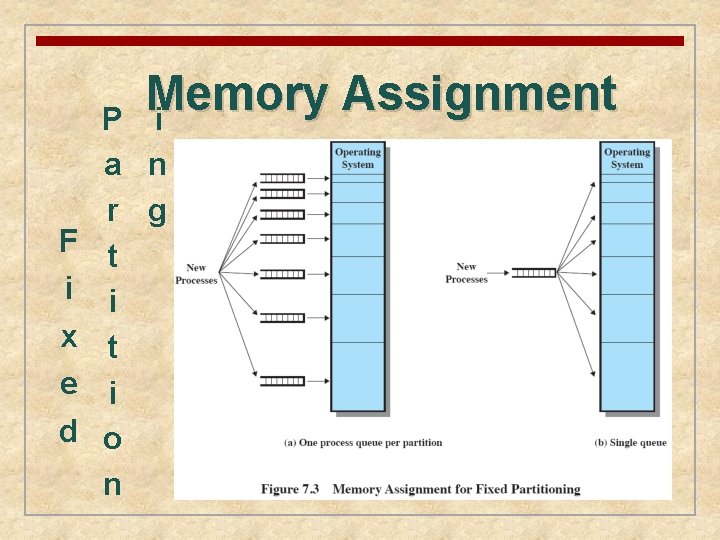
Memory Assignment i F i x e d P a n r g t i o n
n The number of partitions specified at system generation time limits the number of active processes in the system n Small jobs will not utilize partition space efficiently
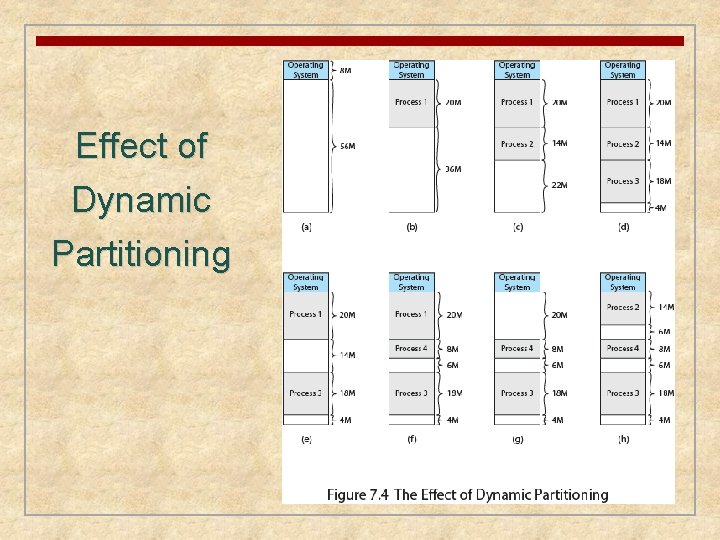
n Partitions are of variable length and number n Process is allocated exactly as much memory as it requires n This technique was used by IBM’s mainframe operating system, OS/MVT
Effect of Dynamic Partitioning
Dynamic Partitioning External Fragmentation • memory becomes more and more fragmented • memory utilization declines Compaction • • technique for overcoming external fragmentation OS shifts processes so that they are contiguous free memory is together in one block time consuming and wastes CPU time
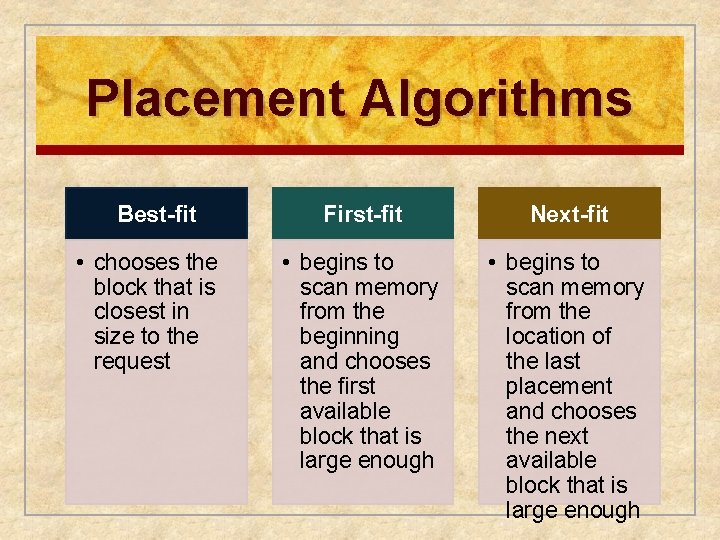
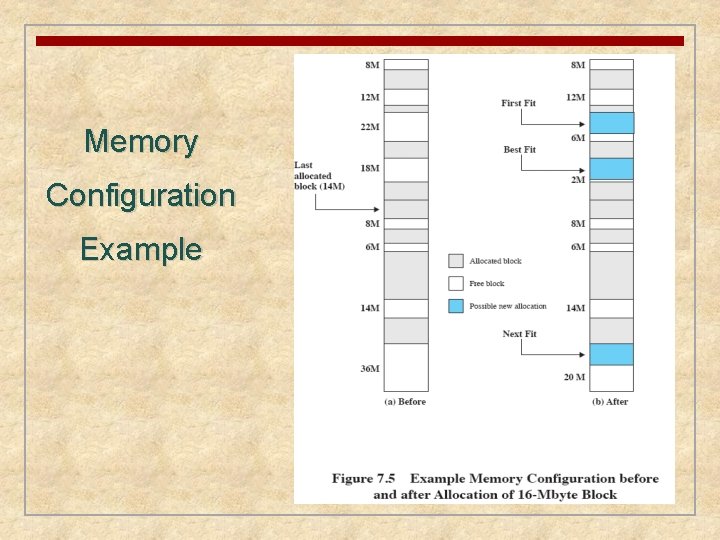
Placement Algorithms Best-fit • chooses the block that is closest in size to the request First-fit Next-fit • begins to scan memory from the beginning and chooses the first available block that is large enough • begins to scan memory from the location of the last placement and chooses the next available block that is large enough
Memory Configuration Example
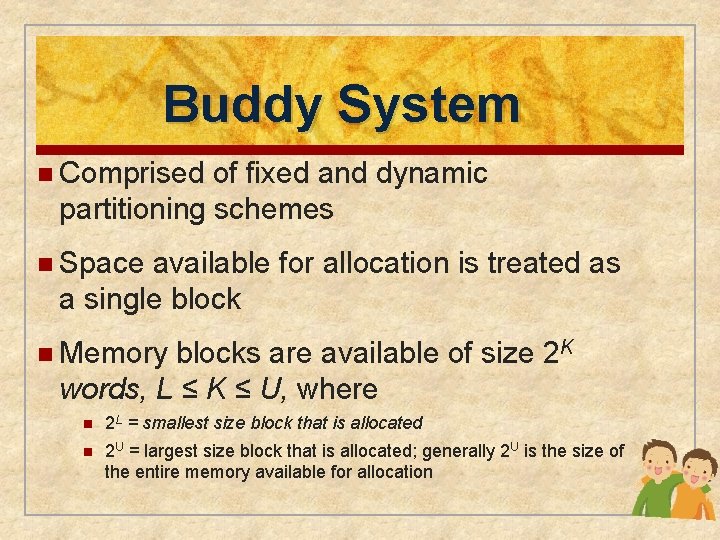
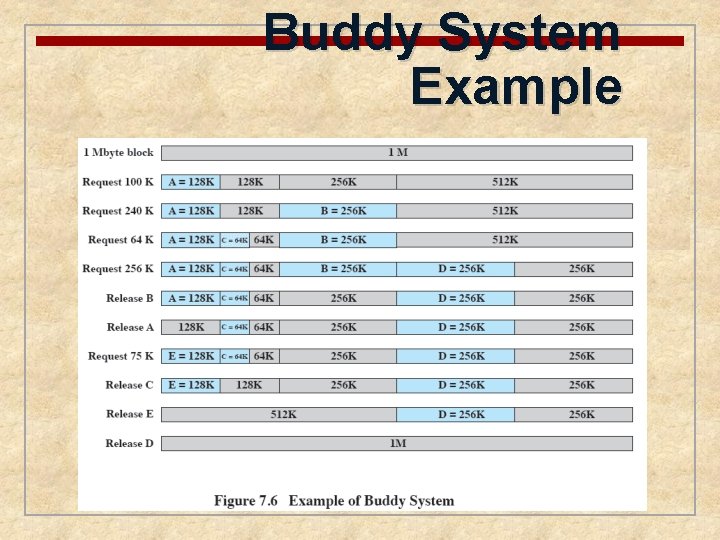
Buddy System n Comprised of fixed and dynamic partitioning schemes n Space available for allocation is treated as a single block n Memory blocks are available of size 2 K words, L ≤ K ≤ U, where n 2 L = smallest size block that is allocated n 2 U = largest size block that is allocated; generally 2 U is the size of the entire memory available for allocation
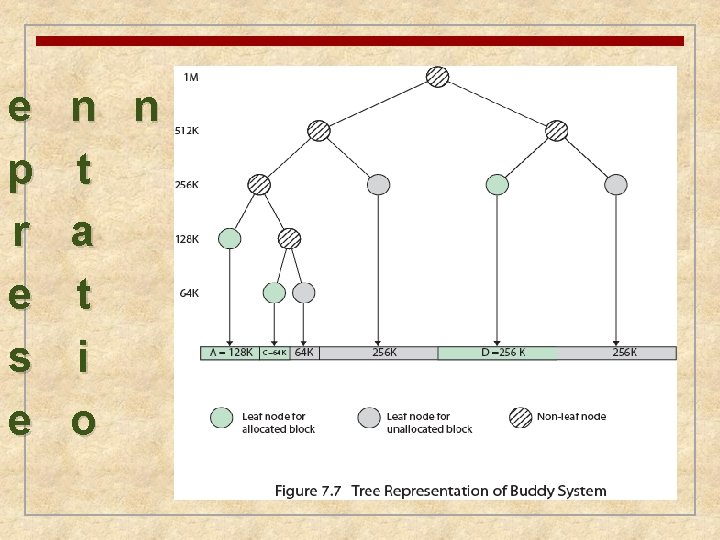
Buddy System Example
e p r e s e n n t a t i o
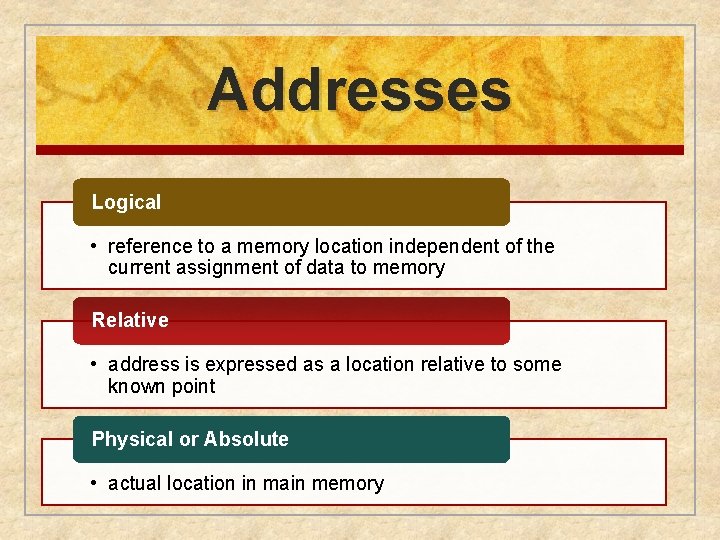
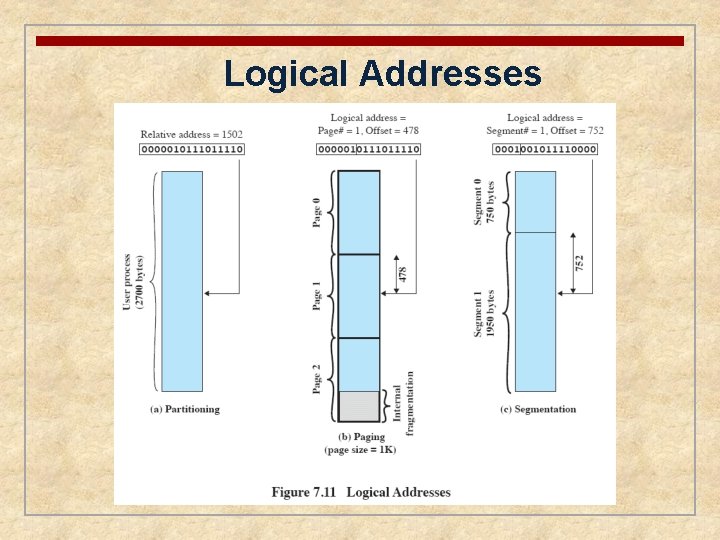
Addresses Logical • reference to a memory location independent of the current assignment of data to memory Relative • address is expressed as a location relative to some known point Physical or Absolute • actual location in main memory
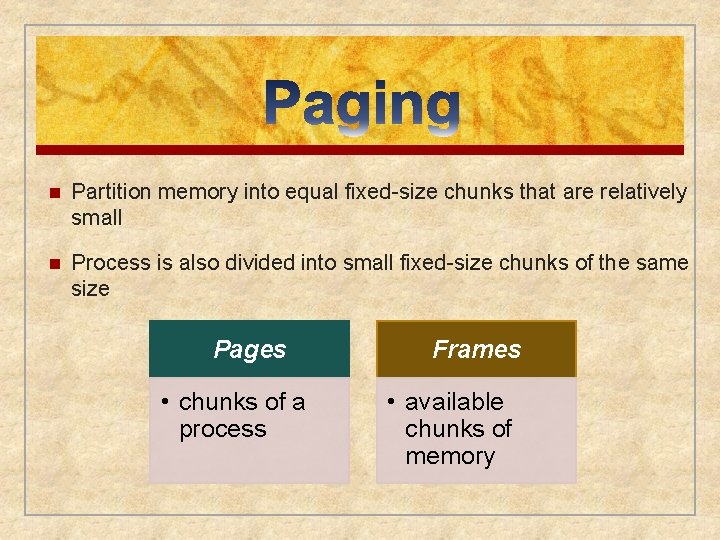
n Partition memory into equal fixed-size chunks that are relatively small n Process is also divided into small fixed-size chunks of the same size Pages • chunks of a process Frames • available chunks of memory
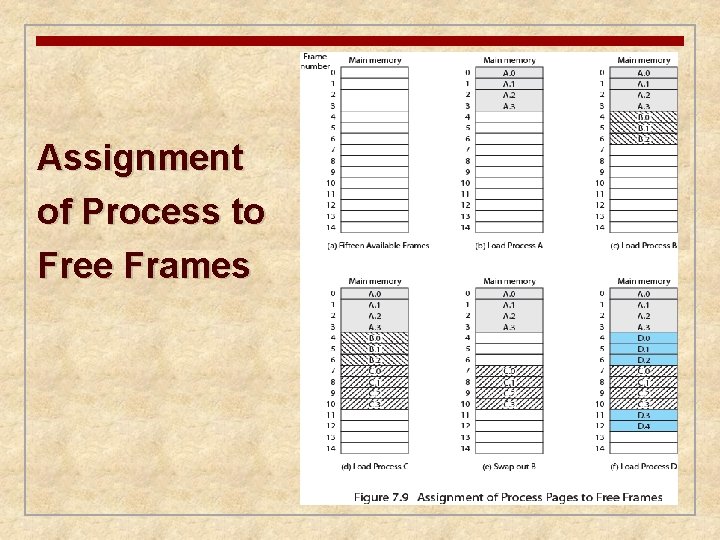
Assignment of Process to Free Frames
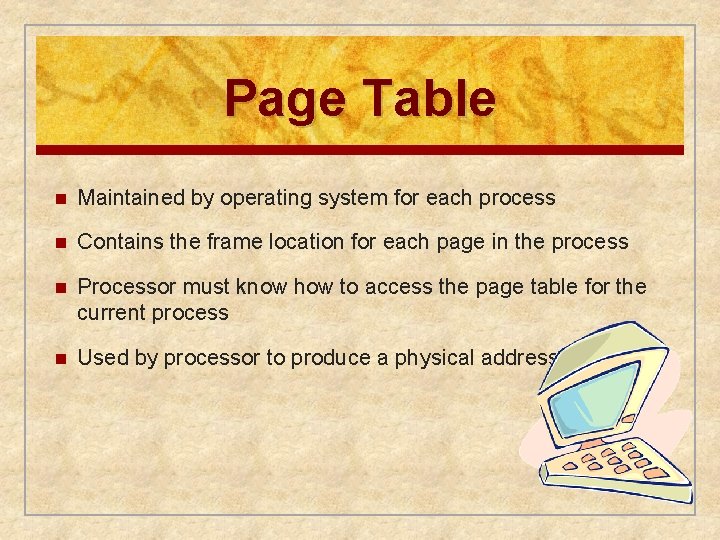
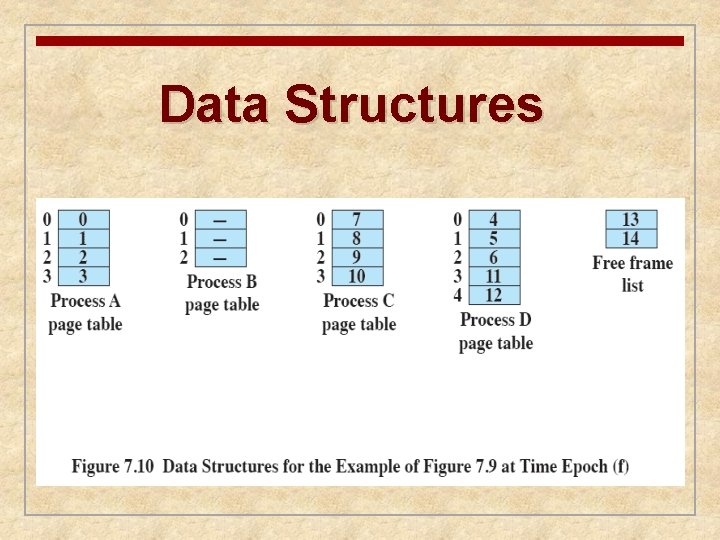
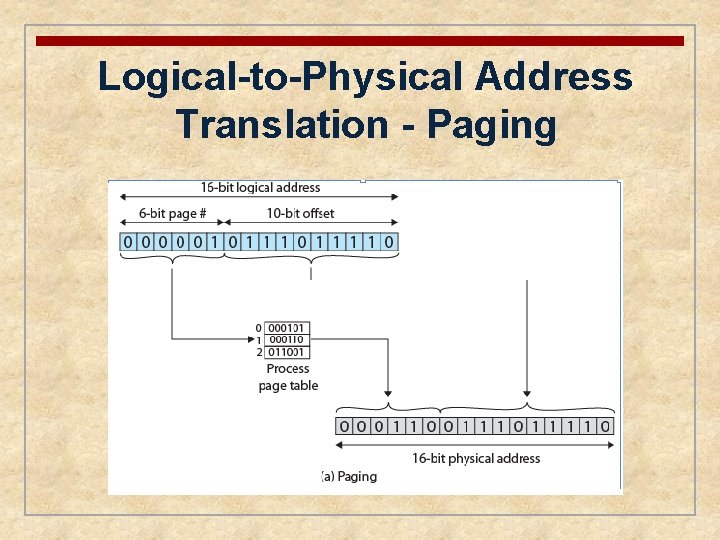
Page Table n Maintained by operating system for each process n Contains the frame location for each page in the process n Processor must know how to access the page table for the current process n Used by processor to produce a physical address
Data Structures
Logical Addresses
Logical-to-Physical Address Translation - Paging
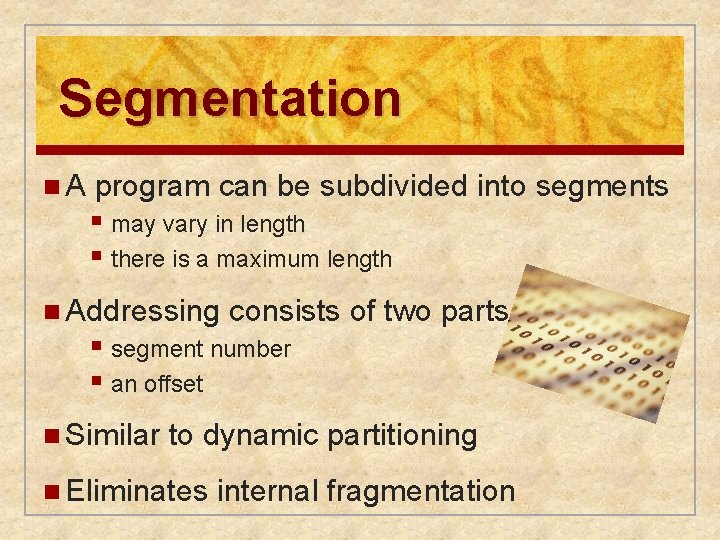
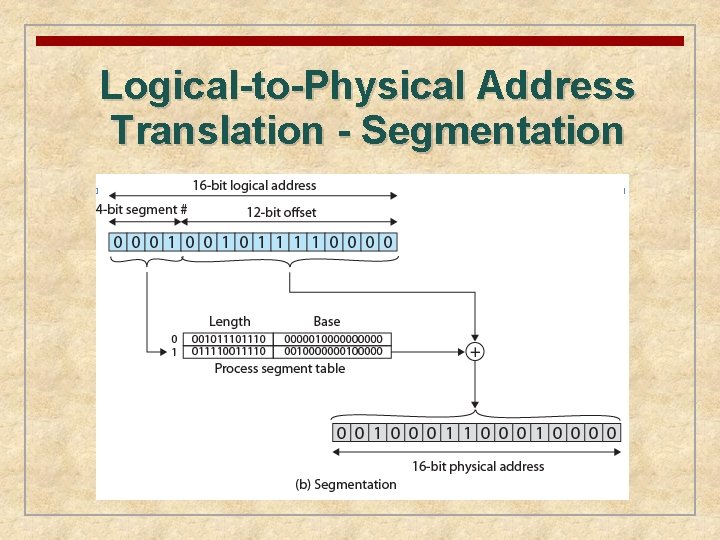
Segmentation n. A program can be subdivided into segments § may vary in length § there is a maximum length n Addressing consists of two parts: § segment number § an offset n Similar to dynamic partitioning n Eliminates internal fragmentation
Logical-to-Physical Address Translation - Segmentation
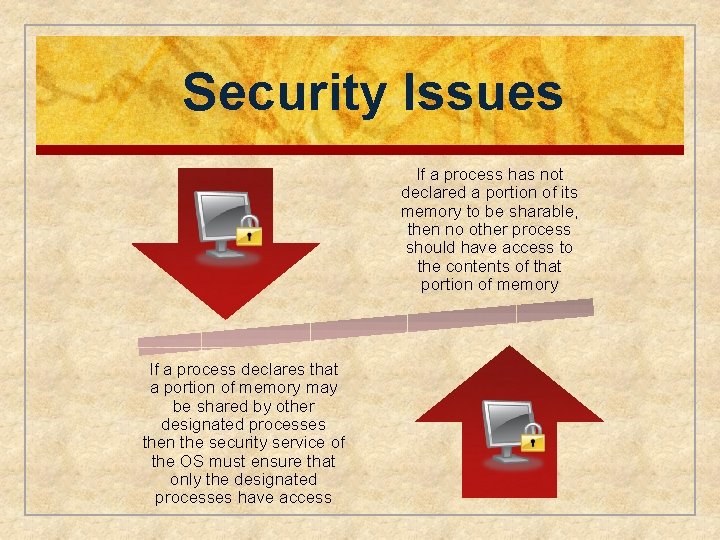
Security Issues If a process has not declared a portion of its memory to be sharable, then no other process should have access to the contents of that portion of memory If a process declares that a portion of memory may be shared by other designated processes then the security service of the OS must ensure that only the designated processes have access
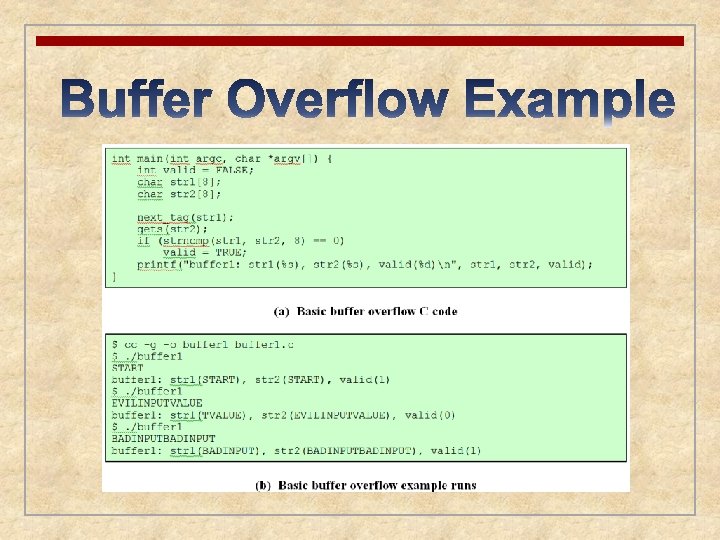
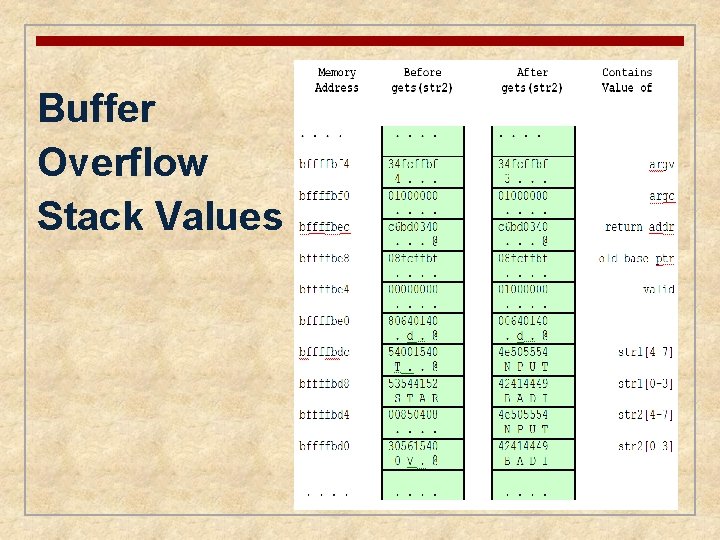
Buffer Overflow Attacks n Security threat related to memory management n Also known as a buffer overrun n Can occur when a process attempts to store data beyond the limits of a fixed-sized buffer n One of the most prevalent and dangerous types of security attacks
Buffer Overflow Stack Values
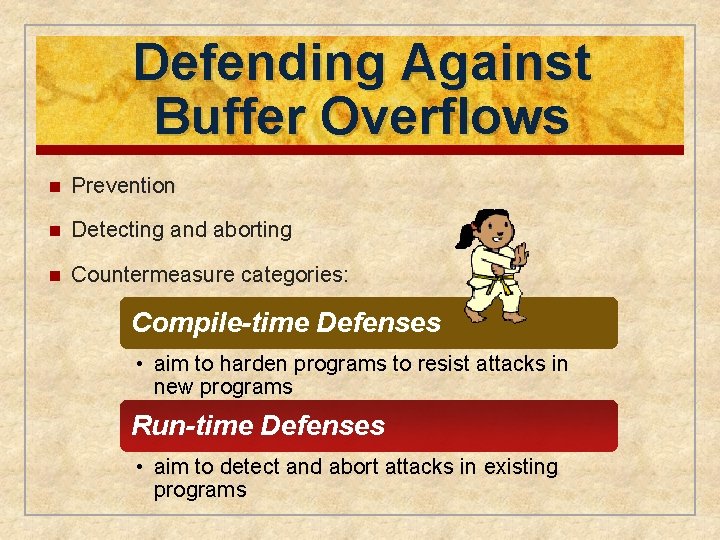
Defending Against Buffer Overflows n Prevention n Detecting and aborting n Countermeasure categories: Compile-time Defenses • aim to harden programs to resist attacks in new programs Run-time Defenses • aim to detect and abort attacks in existing programs
n Memory Management n n n Summary one of the most important and complex tasks of an operating system needs to be treated as a resource to be allocated to and shared among a number of active processes desirable to maintain as many processes in main memory as possible desirable to free programmers from size restriction in program development basic tools are paging and segmentation (possible to combine) n n paging – small fixed-sized pages segmentation – pieces of varying size