
Operating Systems CMPSC 473 Multithreading models Tutorial on
![Pthreads Naming Convention • Types: pthread[_object]_t • Functions: pthread[_object]_action • Constants/Macros: PTHREAD_PURPOSE • Examples:](https://slidetodoc.com/presentation_image_h/f844542f5157906e8879c19bc5fe6ef3/image-13.jpg "Pthreads Naming Convention • Types: pthread[_object]_t • Functions: pthread[_object]_action • Constants/Macros: PTHREAD_PURPOSE • Examples:")
![int main(int argc, char *argv) { double array[100]; double sum; pthread_t worker_thread; struct arguments](https://slidetodoc.com/presentation_image_h/f844542f5157906e8879c19bc5fe6ef3/image-17.jpg "int main(int argc, char *argv) { double array[100]; double sum; pthread_t worker_thread; struct arguments")
![pthread_join() example int main(int argc, char *argv) { double array[100]; double sum; pthread_t worker_thread;](https://slidetodoc.com/presentation_image_h/f844542f5157906e8879c19bc5fe6ef3/image-25.jpg "pthread_join() example int main(int argc, char *argv) { double array[100]; double sum; pthread_t worker_thread;")
![Creating a Detached Thread int main() { pthread_attr_t attr; pthread_t tids[NUM_THREADS]; int x; pthread_attr_init(&attr);](https://slidetodoc.com/presentation_image_h/f844542f5157906e8879c19bc5fe6ef3/image-34.jpg "Creating a Detached Thread int main() { pthread_attr_t attr; pthread_t tids[NUM_THREADS]; int x; pthread_attr_init(&attr);")
- Slides: 34
Operating Systems CMPSC 473 Multi-threading models Tutorial on pthreads Lecture 10: September 30 2010 Instructor: Bhuvan Urgaonkar
Multithreading Models • Many-to-One • One-to-One • Many-to-Many
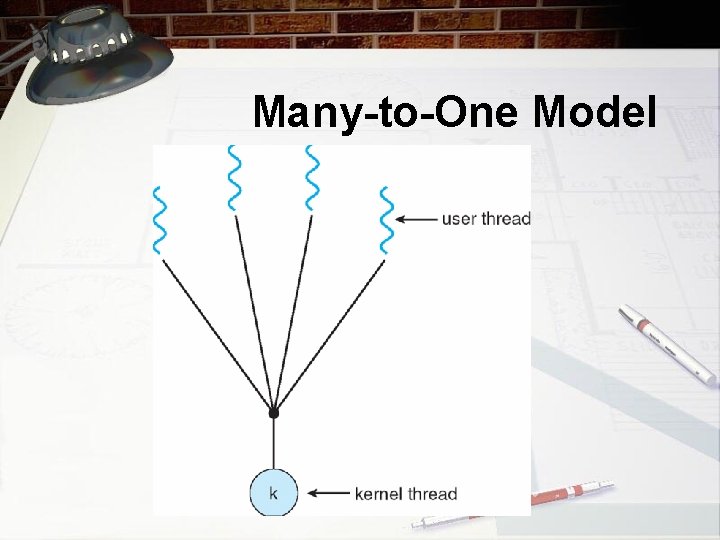
Many-to-One • Many user-level threads mapped to single kernel thread • Examples: – Solaris Green Threads – GNU Portable Threads
Many-to-One Model
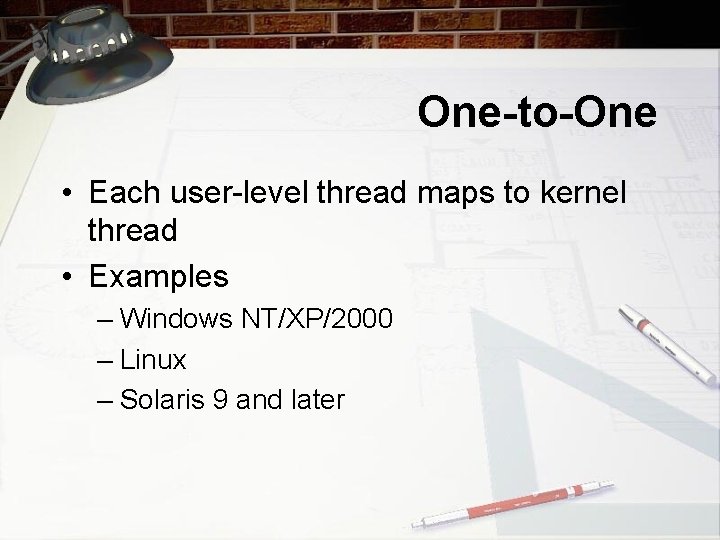
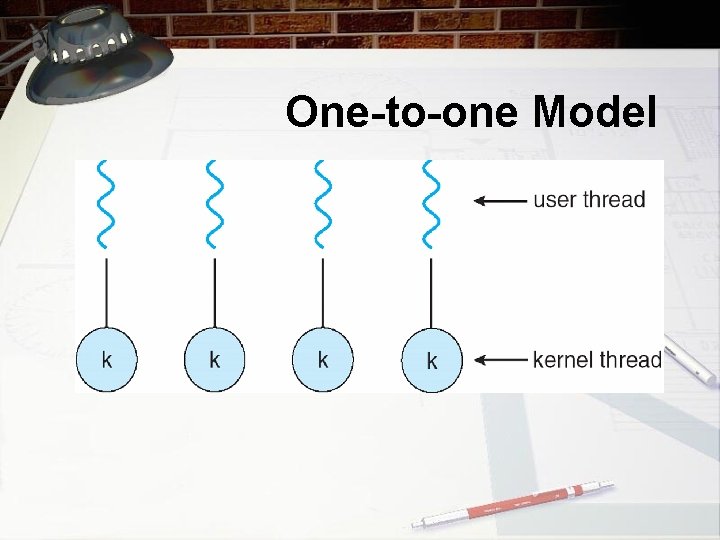
One-to-One • Each user-level thread maps to kernel thread • Examples – Windows NT/XP/2000 – Linux – Solaris 9 and later
One-to-one Model
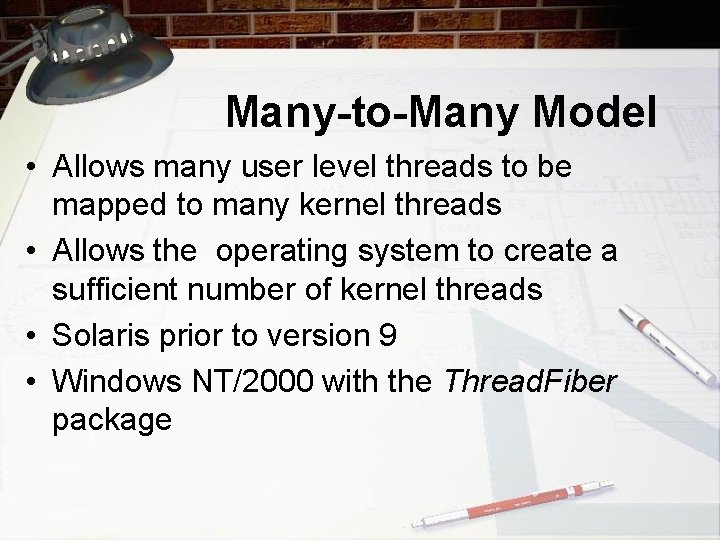
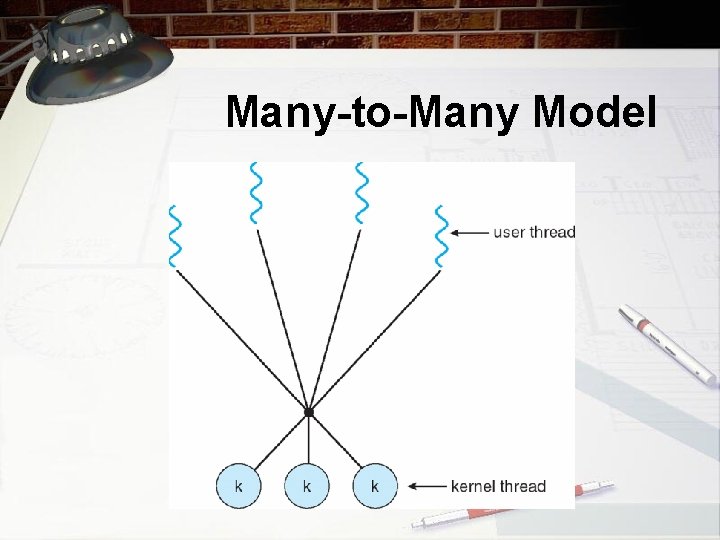
Many-to-Many Model • Allows many user level threads to be mapped to many kernel threads • Allows the operating system to create a sufficient number of kernel threads • Solaris prior to version 9 • Windows NT/2000 with the Thread. Fiber package
Many-to-Many Model
Thread Libraries • Thread library provides programmer with API for creating and managing threads • Two primary ways of implementing – Library entirely in user space: we will study in the next class how this can be implemented – Kernel-level library supported by the OS
Thread Pools • Create a number of threads in a pool where they await work • Advantages: – Usually slightly faster to service a request with an existing thread than create a new thread – Allows the number of threads in the application(s) to be bound to the size of the pool
Pthreads • May be provided either as user-level or kernel-level • A POSIX standard (IEEE 1003. 1 c) API for thread creation and synchronization • API specifies behavior of the thread library, implementation is up to development of the library • Common in UNIX operating systems (Solaris, Linux, Mac OS X)
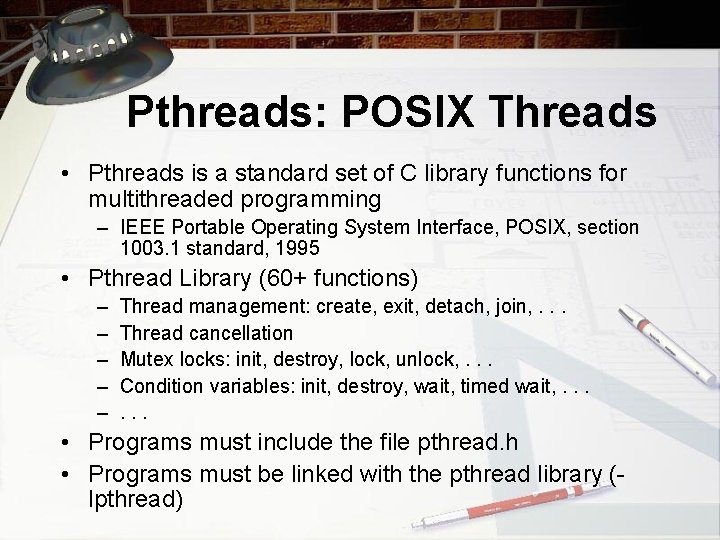
Pthreads: POSIX Threads • Pthreads is a standard set of C library functions for multithreaded programming – IEEE Portable Operating System Interface, POSIX, section 1003. 1 standard, 1995 • Pthread Library (60+ functions) – – – Thread management: create, exit, detach, join, . . . Thread cancellation Mutex locks: init, destroy, lock, unlock, . . . Condition variables: init, destroy, wait, timed wait, . . . • Programs must include the file pthread. h • Programs must be linked with the pthread library (lpthread)
Pthreads Naming Convention • Types: pthread[_object]_t • Functions: pthread[_object]_action • Constants/Macros: PTHREAD_PURPOSE • Examples: – – – pthread_t: the type of a thread pthread_create(): creates a thread pthread_mutex_t: the type of a mutex lock pthread_mutex_lock(): lock a mutex PTHREAD_CREATE_DETACHED
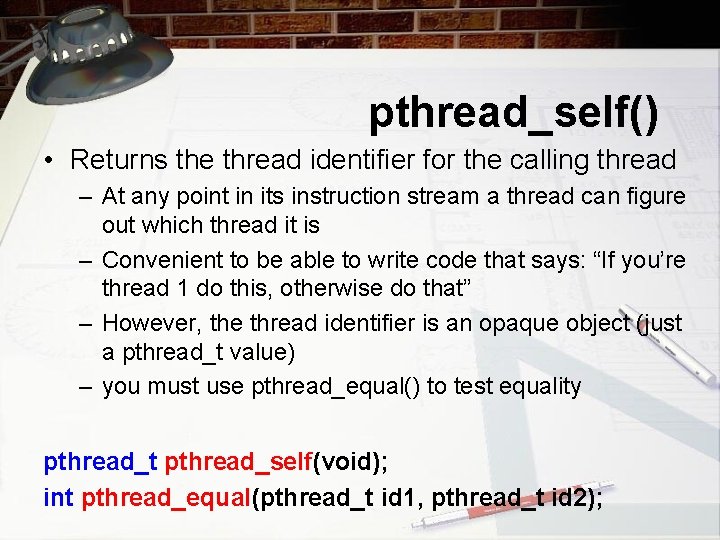
pthread_self() • Returns the thread identifier for the calling thread – At any point in its instruction stream a thread can figure out which thread it is – Convenient to be able to write code that says: “If you’re thread 1 do this, otherwise do that” – However, the thread identifier is an opaque object (just a pthread_t value) – you must use pthread_equal() to test equality pthread_t pthread_self(void); int pthread_equal(pthread_t id 1, pthread_t id 2);
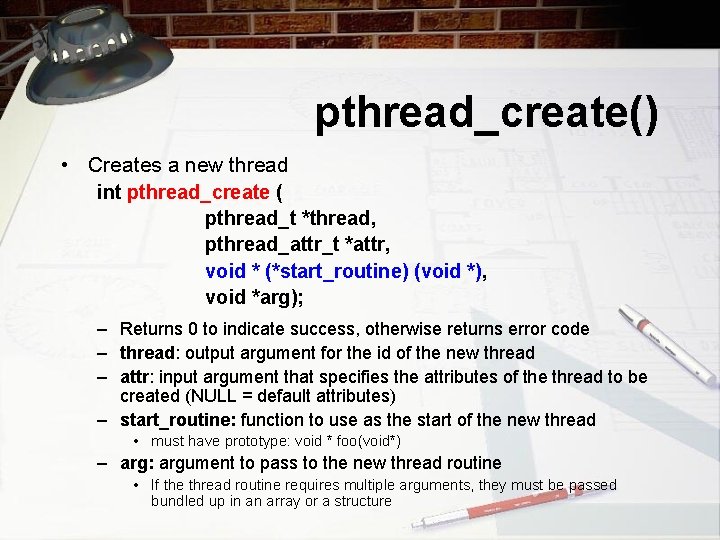
pthread_create() • Creates a new thread int pthread_create ( pthread_t *thread, pthread_attr_t *attr, void * (*start_routine) (void *), void *arg); – Returns 0 to indicate success, otherwise returns error code – thread: output argument for the id of the new thread – attr: input argument that specifies the attributes of the thread to be created (NULL = default attributes) – start_routine: function to use as the start of the new thread • must have prototype: void * foo(void*) – arg: argument to pass to the new thread routine • If the thread routine requires multiple arguments, they must be passed bundled up in an array or a structure
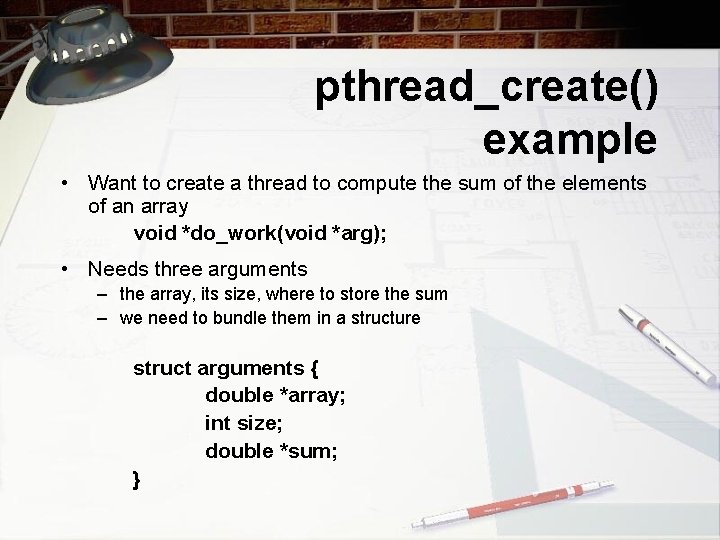
pthread_create() example • Want to create a thread to compute the sum of the elements of an array void *do_work(void *arg); • Needs three arguments – the array, its size, where to store the sum – we need to bundle them in a structure struct arguments { double *array; int size; double *sum; }
int main(int argc, char *argv) { double array[100]; double sum; pthread_t worker_thread; struct arguments *arg; pthread_create() example arg = (struct arguments *)calloc(1, sizeof(struct arguments)); arg->array = array; arg->size=100; arg->sum = ∑ if (pthread_create(&worker_thread, NULL, do_work, (void *)arg)) { fprintf(stderr, ”Error while creating threadn”); exit(1); }. . . }
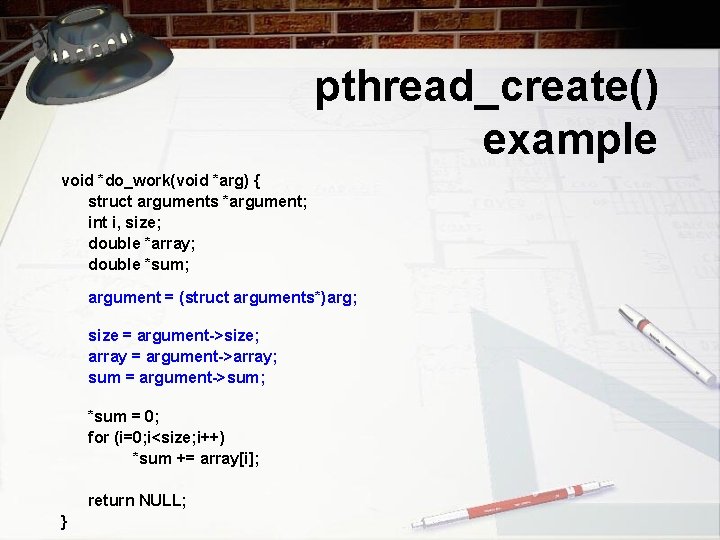
pthread_create() example void *do_work(void *arg) { struct arguments *argument; int i, size; double *array; double *sum; argument = (struct arguments*)arg; size = argument->size; array = argument->array; sum = argument->sum; *sum = 0; for (i=0; i<size; i++) *sum += array[i]; return NULL; }
Comments about the example • The “main thread” continues its normal execution after creating the “child thread” • IMPORTANT: If the main thread terminates, then all threads are killed! – We will see that there is a join() function • Of course, memory is shared by the parent and the child (the array, the location of the sum) – nothing prevents the parent from doing something to it while the child is still executing – which may lead to a wrong computation – we will see that Pthreads provides mutual exclusion mechanisms • The bundling and unbundling of arguments is a bit
Memory Management of Args • The parent thread allocates memory for the arguments • Warning #1: you don’t want to free that memory before the child thread has a chance to read it – That would be a race condition – Better to let the child do the freeing • Warning #2: if you create multiple threads you want to be careful there is no sharing of arguments, or that the sharing is safe – For instance, if you reuse the same data structure for all threads and modify its fields before each call to pthread_create(), some threads may not be able to read the arguments destined to them – Safest way: have a separate arg structure for each thread
pthread_exit() • Terminates the calling thread void pthread_exit(void *retval); – The return value is made available to another thread calling a pthread_join() – The previous example had the thread just return from function do_work() • In this case the call to pthread_exit() is implicit • The return value of the function serves as the argument to the (implicitly called) pthread_exit().
Thread Cancellation • Terminating a thread before it has finished • Two general approaches: – Asynchronous cancellation terminates the target thread immediately – Deferred cancellation allows the target thread to periodically check if it should be cancelled
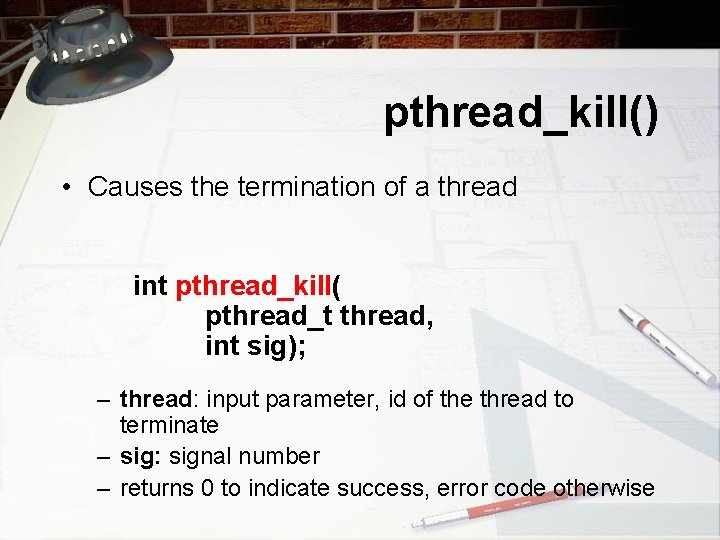
pthread_kill() • Causes the termination of a thread int pthread_kill( pthread_t thread, int sig); – thread: input parameter, id of the thread to terminate – sig: signal number – returns 0 to indicate success, error code otherwise
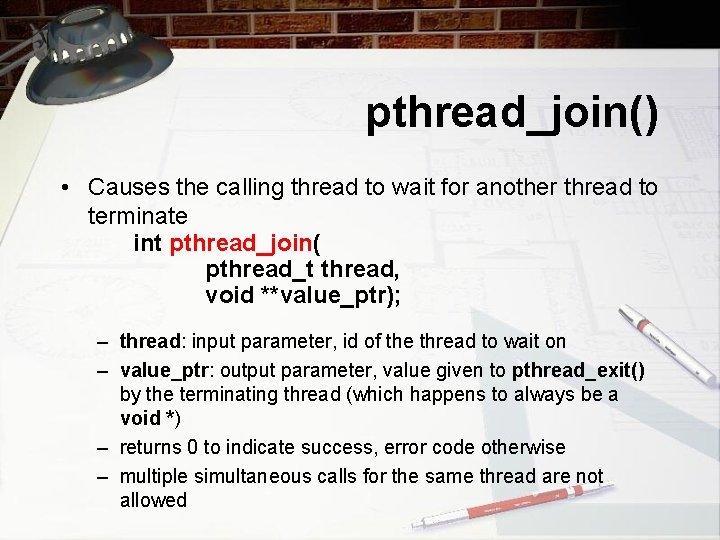
pthread_join() • Causes the calling thread to wait for another thread to terminate int pthread_join( pthread_t thread, void **value_ptr); – thread: input parameter, id of the thread to wait on – value_ptr: output parameter, value given to pthread_exit() by the terminating thread (which happens to always be a void *) – returns 0 to indicate success, error code otherwise – multiple simultaneous calls for the same thread are not allowed
pthread_join() example int main(int argc, char *argv) { double array[100]; double sum; pthread_t worker_thread; struct arguments *arg; void *return_value; arg = (struct arguments *)calloc(1, sizeof(struct arguments)); arg->array = array; arg->size=100; arg->sum = ∑ if (pthread_create(&worker_thread, NULL, do_work, (void *)arg)) { fprintf(stderr, ”Error while creating threadn”); exit(1); }. . . if (pthread_join(worker_thread, &return_value)) { fprintf(stderr, ”Error while waiting for threadn”); exit(1); } }
pthread_join() Warning • This is a common “bug” that first-time pthread programmers encounter • Without the call to pthread_join() the previous program may end immediately, with the main thread reaching the end of main() and exiting, thus killing all other threads perhaps even before they have had a chance to execute
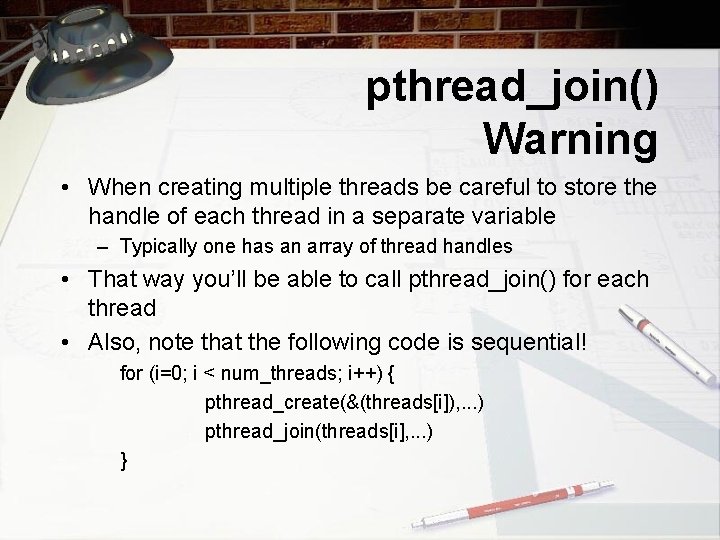
pthread_join() Warning • When creating multiple threads be careful to store the handle of each thread in a separate variable – Typically one has an array of thread handles • That way you’ll be able to call pthread_join() for each thread • Also, note that the following code is sequential! for (i=0; i < num_threads; i++) { pthread_create(&(threads[i]), . . . ) pthread_join(threads[i], . . . ) }
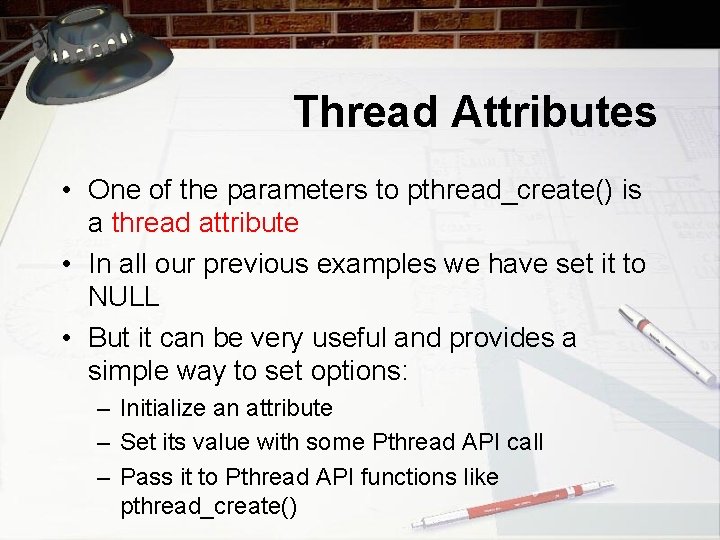
Thread Attributes • One of the parameters to pthread_create() is a thread attribute • In all our previous examples we have set it to NULL • But it can be very useful and provides a simple way to set options: – Initialize an attribute – Set its value with some Pthread API call – Pass it to Pthread API functions like pthread_create()
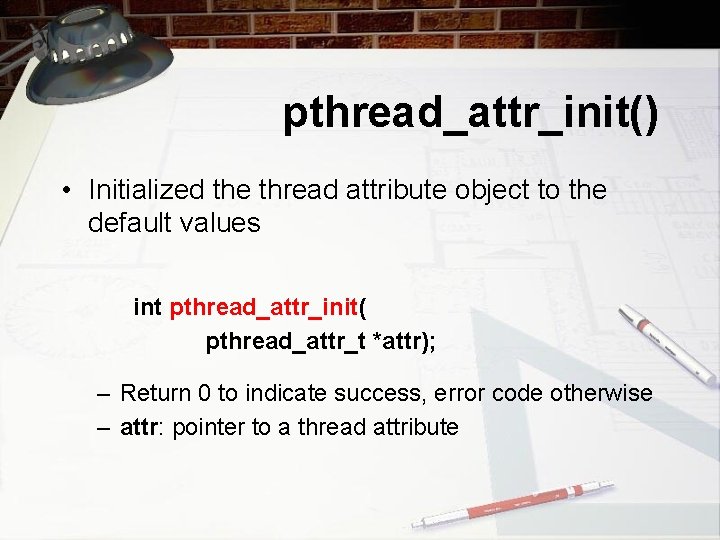
pthread_attr_init() • Initialized the thread attribute object to the default values int pthread_attr_init( pthread_attr_t *attr); – Return 0 to indicate success, error code otherwise – attr: pointer to a thread attribute
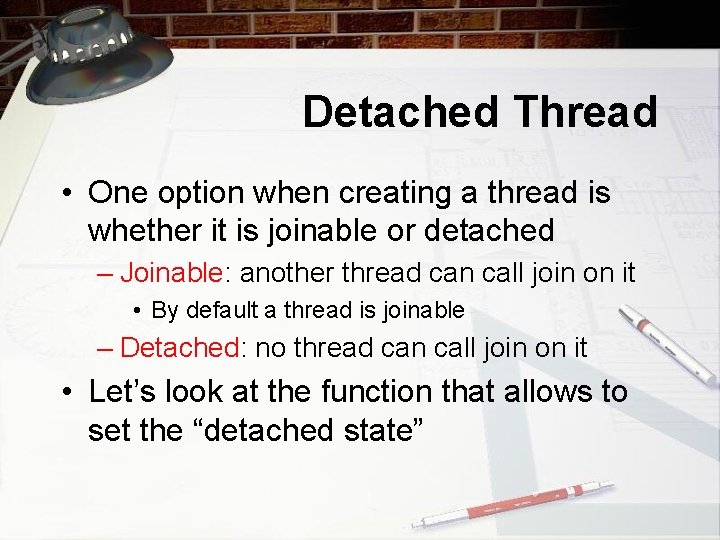
Detached Thread • One option when creating a thread is whether it is joinable or detached – Joinable: another thread can call join on it • By default a thread is joinable – Detached: no thread can call join on it • Let’s look at the function that allows to set the “detached state”
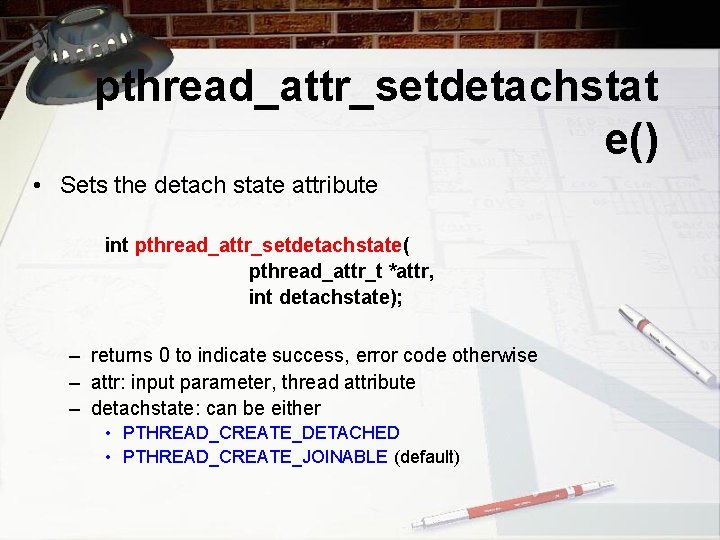
pthread_attr_setdetachstat e() • Sets the detach state attribute int pthread_attr_setdetachstate( pthread_attr_t *attr, int detachstate); – returns 0 to indicate success, error code otherwise – attr: input parameter, thread attribute – detachstate: can be either • PTHREAD_CREATE_DETACHED • PTHREAD_CREATE_JOINABLE (default)
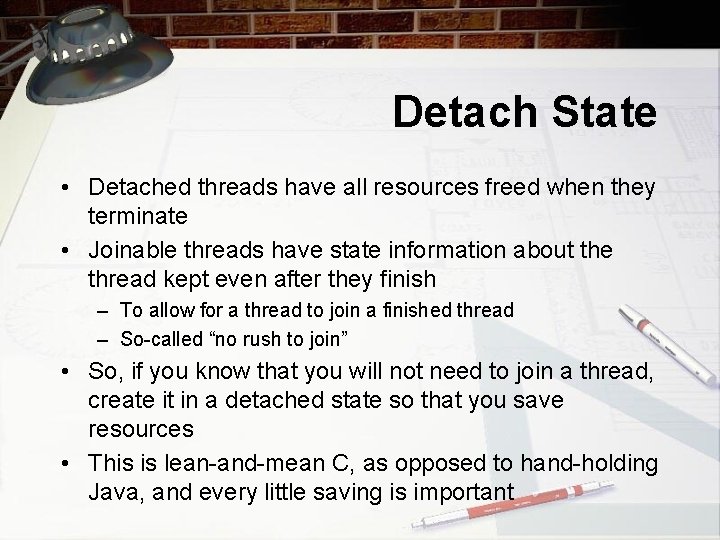
Detach State • Detached threads have all resources freed when they terminate • Joinable threads have state information about the thread kept even after they finish – To allow for a thread to join a finished thread – So-called “no rush to join” • So, if you know that you will not need to join a thread, create it in a detached state so that you save resources • This is lean-and-mean C, as opposed to hand-holding Java, and every little saving is important
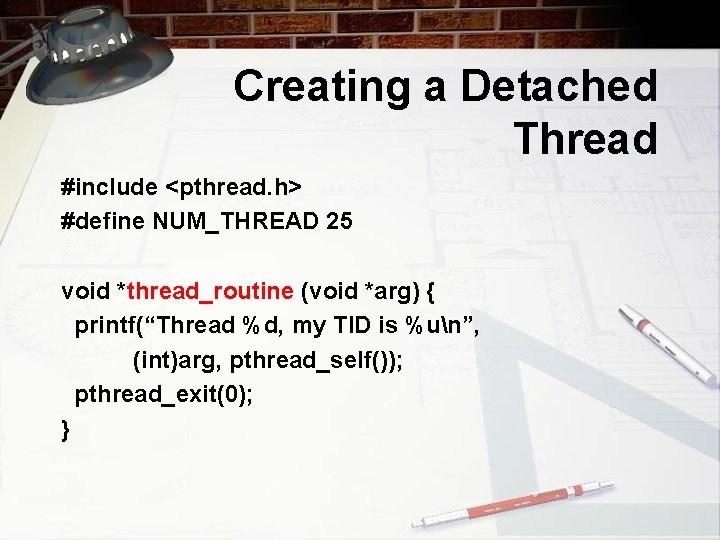
Creating a Detached Thread #include <pthread. h> #define NUM_THREAD 25 void *thread_routine (void *arg) { printf(“Thread %d, my TID is %un”, (int)arg, pthread_self()); pthread_exit(0); }
Creating a Detached Thread int main() { pthread_attr_t attr; pthread_t tids[NUM_THREADS]; int x; pthread_attr_init(&attr); pthread_attr_setdetachstate(&attr, PTHREAD_CREATE_DETACHED); phthread_create(&(tids[x]), &attr, thread_routine, (void *)x); . . . // should take a while otherwise. . . // the child may not have time to run }