
Operating Systems 600 418 Deadlocks Department of Computer
![Banker’s Algorithm - Safety Procedure Local Data Structures: – Work: vector [1. . m],](https://slidetodoc.com/presentation_image_h2/123fe346d6d856782bb4ab3fe4ef5de5/image-23.jpg "Banker’s Algorithm - Safety Procedure Local Data Structures: – Work: vector [1. . m],")
- Slides: 33
Operating Systems 600. 418 Deadlocks Department of Computer Science The Johns Hopkins University CS 600. 318/418 Jonathan S. Shapiro Spring 01/Deadlocks 1
Deadlocks Lecture 4 Reading: Silberschatz & Galvin chapter 7 Additional Reading: Stallings chapter 6 CS 600. 318/418 Jonathan S. Shapiro Spring 01/Deadlocks 2
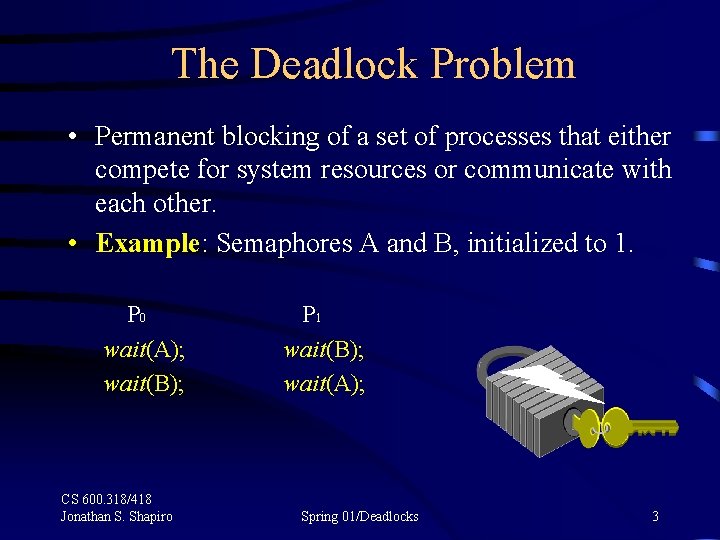
The Deadlock Problem • Permanent blocking of a set of processes that either compete for system resources or communicate with each other. • Example: Semaphores A and B, initialized to 1. P 0 wait(A); wait(B); CS 600. 318/418 Jonathan S. Shapiro P 1 wait(B); wait(A); Spring 01/Deadlocks 3
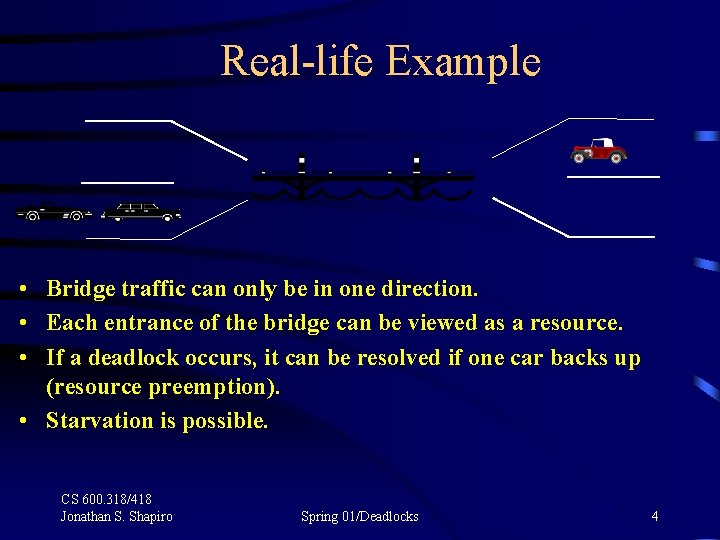
Real-life Example • Bridge traffic can only be in one direction. • Each entrance of the bridge can be viewed as a resource. • If a deadlock occurs, it can be resolved if one car backs up (resource preemption). • Starvation is possible. CS 600. 318/418 Jonathan S. Shapiro Spring 01/Deadlocks 4
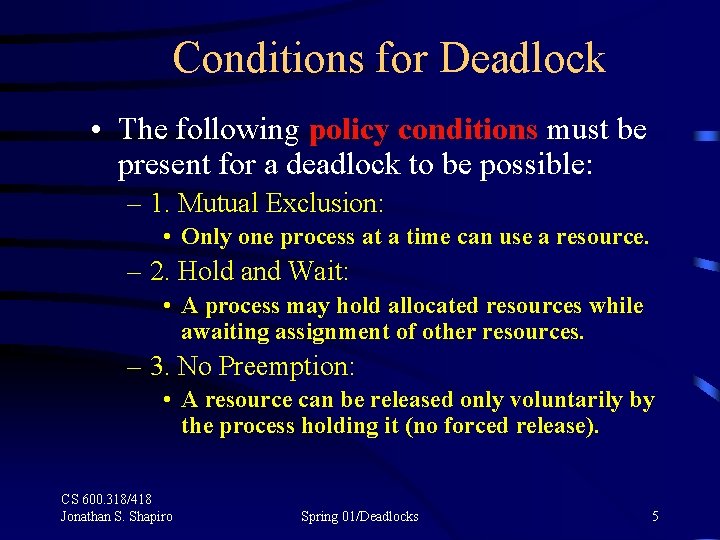
Conditions for Deadlock • The following policy conditions must be present for a deadlock to be possible: – 1. Mutual Exclusion: • Only one process at a time can use a resource. – 2. Hold and Wait: • A process may hold allocated resources while awaiting assignment of other resources. – 3. No Preemption: • A resource can be released only voluntarily by the process holding it (no forced release). CS 600. 318/418 Jonathan S. Shapiro Spring 01/Deadlocks 5
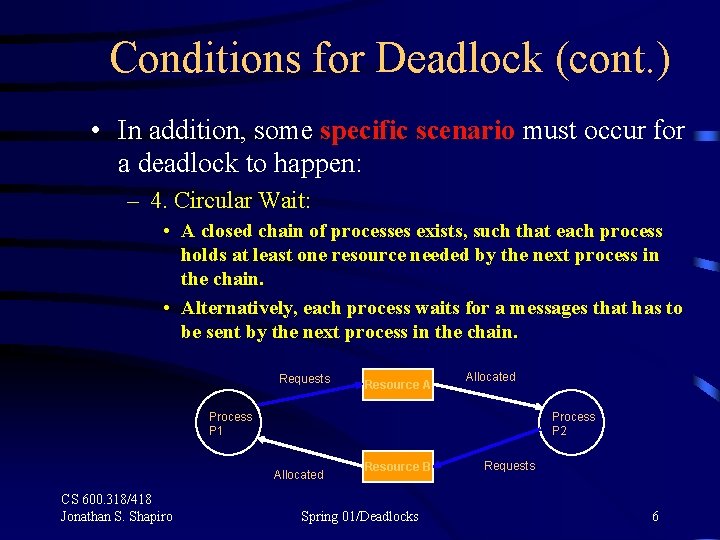
Conditions for Deadlock (cont. ) • In addition, some specific scenario must occur for a deadlock to happen: – 4. Circular Wait: • A closed chain of processes exists, such that each process holds at least one resource needed by the next process in the chain. • Alternatively, each process waits for a messages that has to be sent by the next process in the chain. Requests Resource A Allocated Process P 1 Process P 2 Allocated CS 600. 318/418 Jonathan S. Shapiro Resource B Spring 01/Deadlocks Requests 6
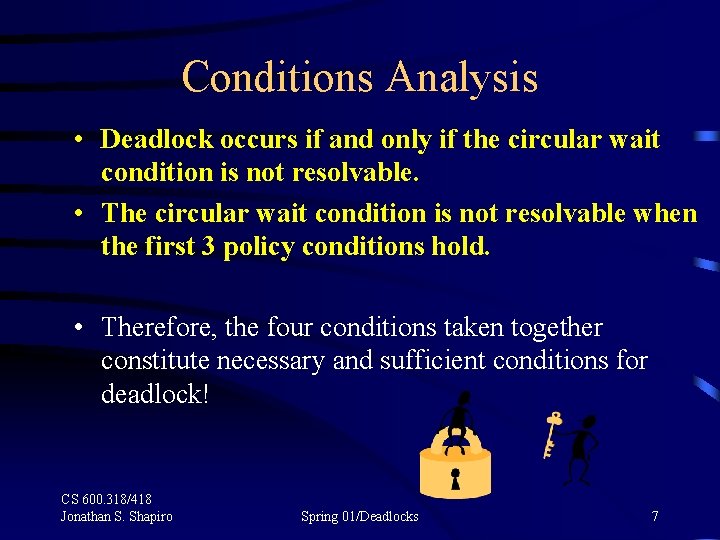
Conditions Analysis • Deadlock occurs if and only if the circular wait condition is not resolvable. • The circular wait condition is not resolvable when the first 3 policy conditions hold. • Therefore, the four conditions taken together constitute necessary and sufficient conditions for deadlock! CS 600. 318/418 Jonathan S. Shapiro Spring 01/Deadlocks 7
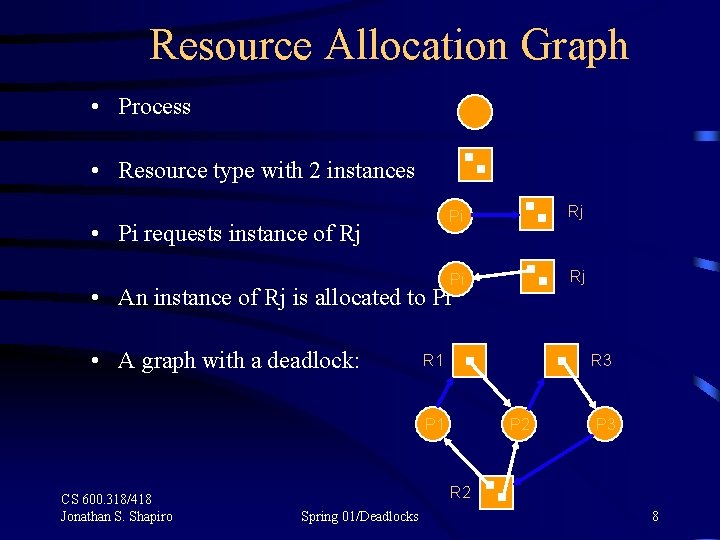
Resource Allocation Graph • Process • Resource type with 2 instances • Pi requests instance of Rj Pi Rj • An instance of Rj is allocated to Pi • A graph with a deadlock: R 1 R 3 P 1 CS 600. 318/418 Jonathan S. Shapiro P 2 P 3 R 2 Spring 01/Deadlocks 8
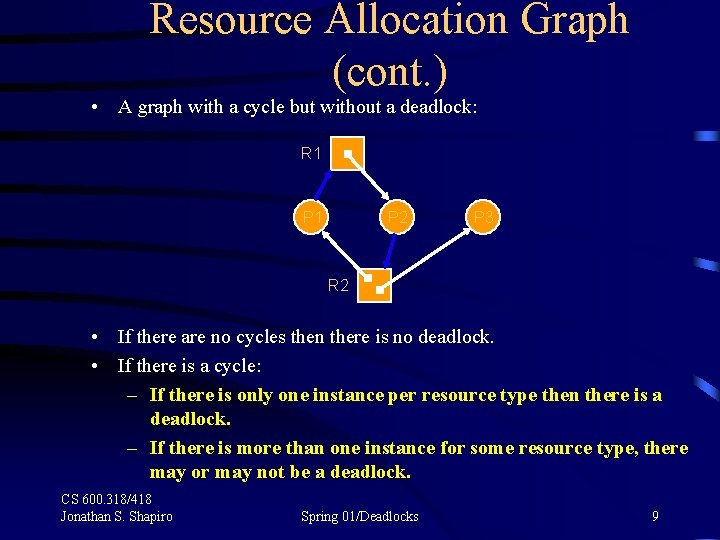
Resource Allocation Graph (cont. ) • A graph with a cycle but without a deadlock: R 1 P 2 P 3 R 2 • If there are no cycles then there is no deadlock. • If there is a cycle: – If there is only one instance per resource type then there is a deadlock. – If there is more than one instance for some resource type, there may or may not be a deadlock. CS 600. 318/418 Jonathan S. Shapiro Spring 01/Deadlocks 9
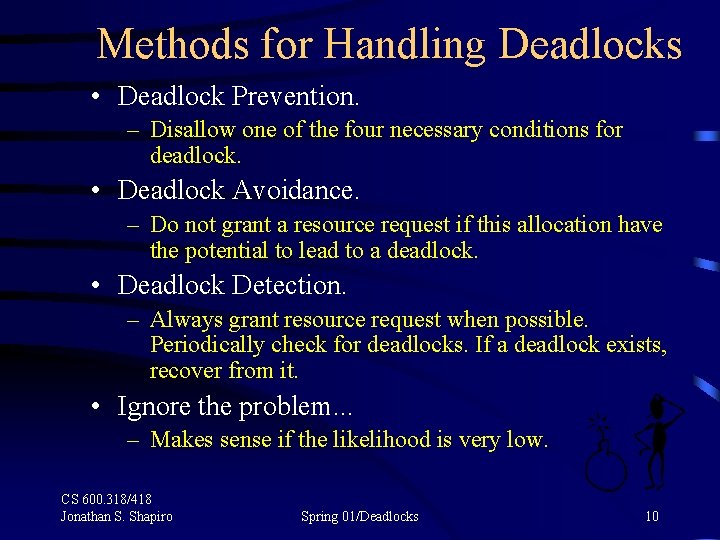
Methods for Handling Deadlocks • Deadlock Prevention. – Disallow one of the four necessary conditions for deadlock. • Deadlock Avoidance. – Do not grant a resource request if this allocation have the potential to lead to a deadlock. • Deadlock Detection. – Always grant resource request when possible. Periodically check for deadlocks. If a deadlock exists, recover from it. • Ignore the problem. . . – Makes sense if the likelihood is very low. CS 600. 318/418 Jonathan S. Shapiro Spring 01/Deadlocks 10
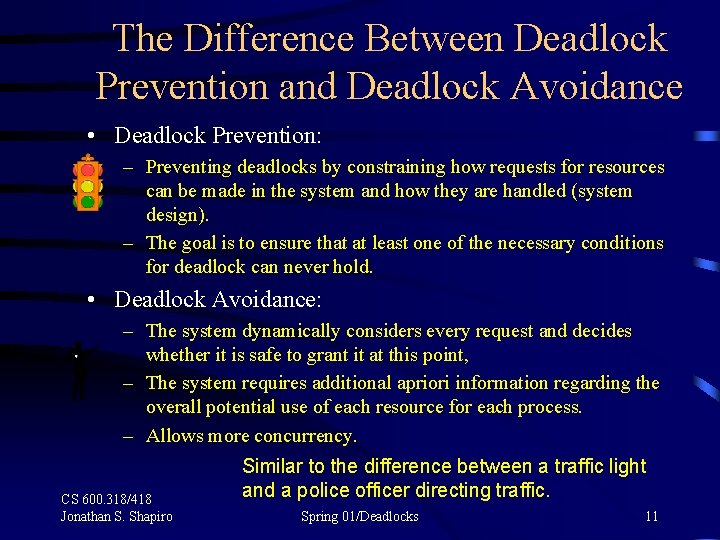
The Difference Between Deadlock Prevention and Deadlock Avoidance • Deadlock Prevention: – Preventing deadlocks by constraining how requests for resources can be made in the system and how they are handled (system design). – The goal is to ensure that at least one of the necessary conditions for deadlock can never hold. • Deadlock Avoidance: – The system dynamically considers every request and decides whether it is safe to grant it at this point, – The system requires additional apriori information regarding the overall potential use of each resource for each process. – Allows more concurrency. Similar to the difference between a traffic light and a police officer directing traffic. CS 600. 318/418 Jonathan S. Shapiro Spring 01/Deadlocks 11
Deadlock Prevention Eliminate one of the four conditions: – Mutual Exclusion: • Well, if we need it then we need it. – Hold and Wait: • Require a process to request and be allocated all its resources before it begins execution, or allow process to request resources only when the process has none. • May lead to low resource utilization. • Starvation is a problem - a process may be held for a long time waiting for all its required resources. • If it needs additional resources, it releases all of the currently held resources and then requests all of those it needs (the application needs to be aware of all of the required resources). CS 600. 318/418 Jonathan S. Shapiro Spring 01/Deadlocks 12
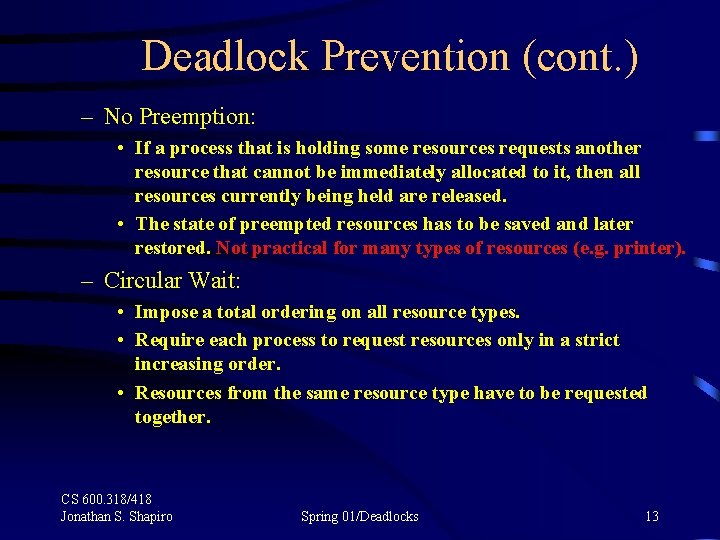
Deadlock Prevention (cont. ) – No Preemption: • If a process that is holding some resources requests another resource that cannot be immediately allocated to it, then all resources currently being held are released. • The state of preempted resources has to be saved and later restored. Not practical for many types of resources (e. g. printer). – Circular Wait: • Impose a total ordering on all resource types. • Require each process to request resources only in a strict increasing order. • Resources from the same resource type have to be requested together. CS 600. 318/418 Jonathan S. Shapiro Spring 01/Deadlocks 13
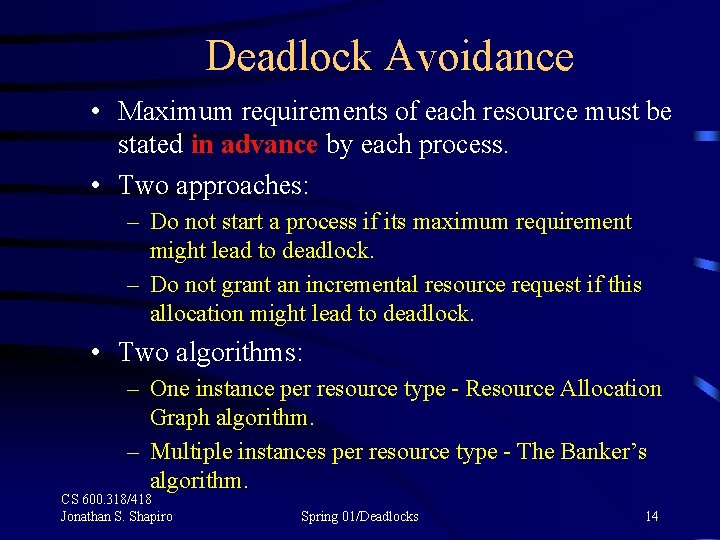
Deadlock Avoidance • Maximum requirements of each resource must be stated in advance by each process. • Two approaches: – Do not start a process if its maximum requirement might lead to deadlock. – Do not grant an incremental resource request if this allocation might lead to deadlock. • Two algorithms: – One instance per resource type - Resource Allocation Graph algorithm. – Multiple instances per resource type - The Banker’s algorithm. CS 600. 318/418 Jonathan S. Shapiro Spring 01/Deadlocks 14
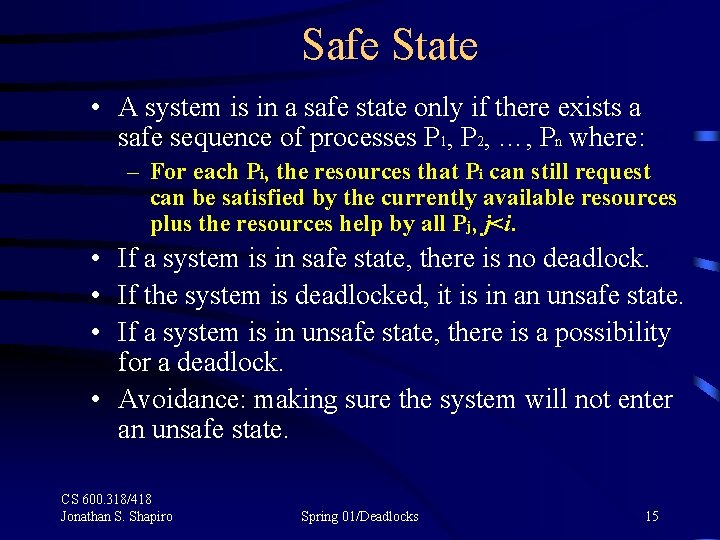
Safe State • A system is in a safe state only if there exists a safe sequence of processes P 1, P 2, …, Pn where: – For each Pi, the resources that Pi can still request can be satisfied by the currently available resources plus the resources help by all Pj, j<i. • If a system is in safe state, there is no deadlock. • If the system is deadlocked, it is in an unsafe state. • If a system is in unsafe state, there is a possibility for a deadlock. • Avoidance: making sure the system will not enter an unsafe state. CS 600. 318/418 Jonathan S. Shapiro Spring 01/Deadlocks 15
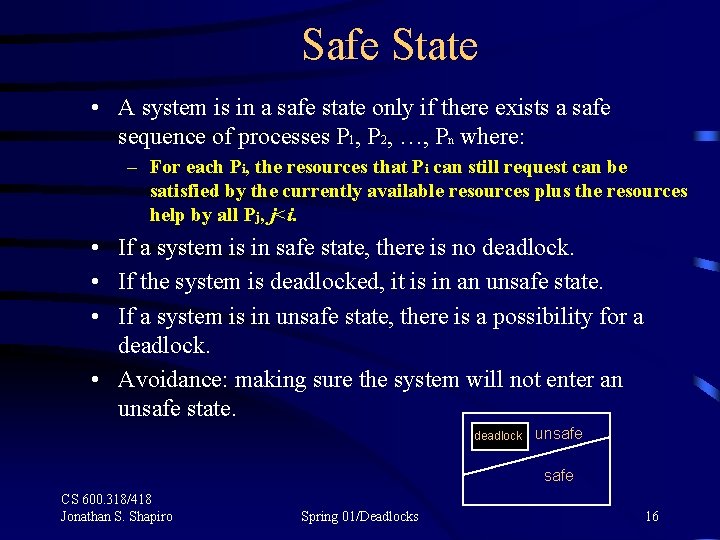
Safe State • A system is in a safe state only if there exists a safe sequence of processes P 1, P 2, …, Pn where: – For each Pi, the resources that Pi can still request can be satisfied by the currently available resources plus the resources help by all Pj, j<i. • If a system is in safe state, there is no deadlock. • If the system is deadlocked, it is in an unsafe state. • If a system is in unsafe state, there is a possibility for a deadlock. • Avoidance: making sure the system will not enter an unsafe state. deadlock unsafe CS 600. 318/418 Jonathan S. Shapiro Spring 01/Deadlocks 16
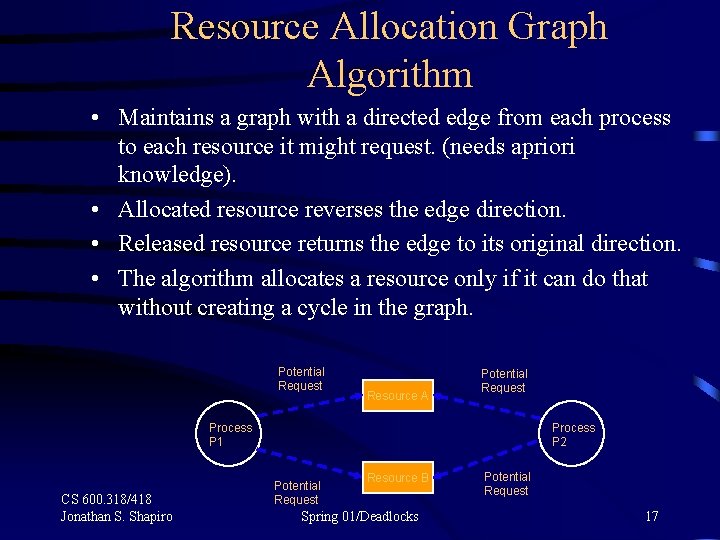
Resource Allocation Graph Algorithm • Maintains a graph with a directed edge from each process to each resource it might request. (needs apriori knowledge). • Allocated resource reverses the edge direction. • Released resource returns the edge to its original direction. • The algorithm allocates a resource only if it can do that without creating a cycle in the graph. Potential Request Resource A Potential Request Process P 1 CS 600. 318/418 Jonathan S. Shapiro Process P 2 Potential Request Resource B Spring 01/Deadlocks Potential Request 17
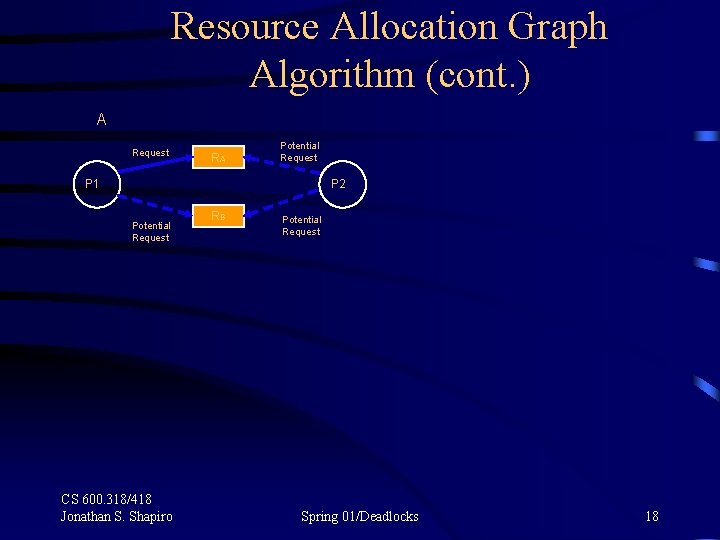
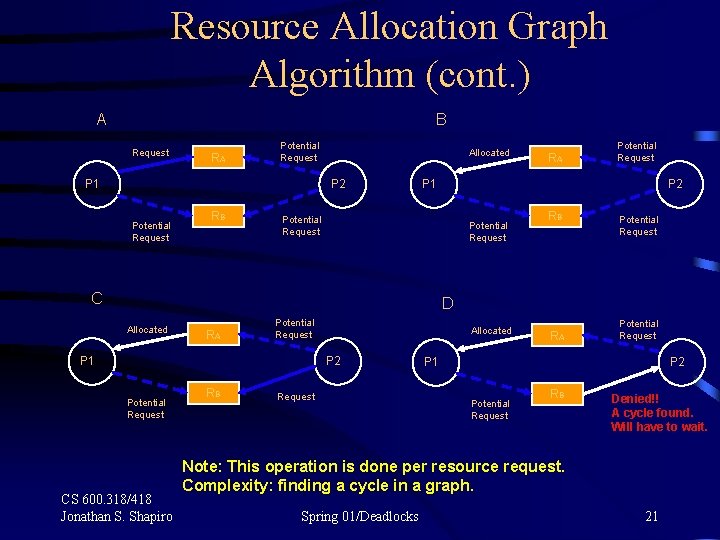
Resource Allocation Graph Algorithm (cont. ) A Request RA Potential Request P 1 P 2 Potential Request CS 600. 318/418 Jonathan S. Shapiro RB Potential Request Spring 01/Deadlocks 18
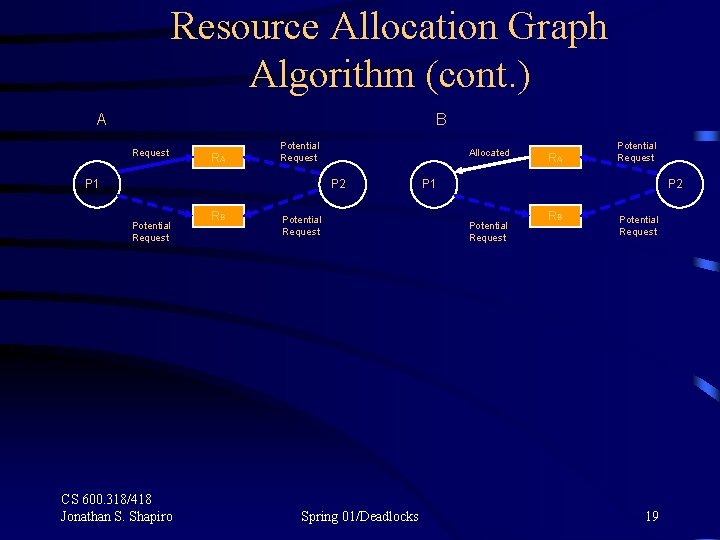
Resource Allocation Graph Algorithm (cont. ) A B Request RA Potential Request P 1 Allocated P 2 Potential Request CS 600. 318/418 Jonathan S. Shapiro RB Potential Request Spring 01/Deadlocks RA Potential Request P 1 P 2 Potential Request RB Potential Request 19
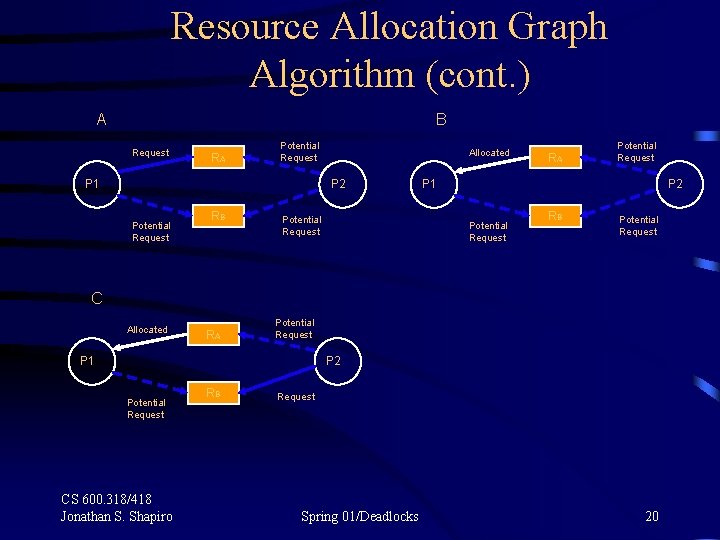
Resource Allocation Graph Algorithm (cont. ) A B Request RA Potential Request P 1 Allocated P 2 Potential Request RB Potential Request RA Potential Request P 1 P 2 Potential Request RB Potential Request C Allocated RA Potential Request P 1 P 2 Potential Request CS 600. 318/418 Jonathan S. Shapiro RB Request Spring 01/Deadlocks 20
Resource Allocation Graph Algorithm (cont. ) A B Request RA Potential Request P 1 Allocated P 2 Potential Request RB RA Potential Request P 1 P 2 Potential Request C RB Potential Request D Allocated RA Potential Request P 1 Allocated P 2 Potential Request CS 600. 318/418 Jonathan S. Shapiro RB Request RA Potential Request P 1 P 2 Potential Request RB Denied!! A cycle found. Will have to wait. Note: This operation is done per resource request. Complexity: finding a cycle in a graph. Spring 01/Deadlocks 21
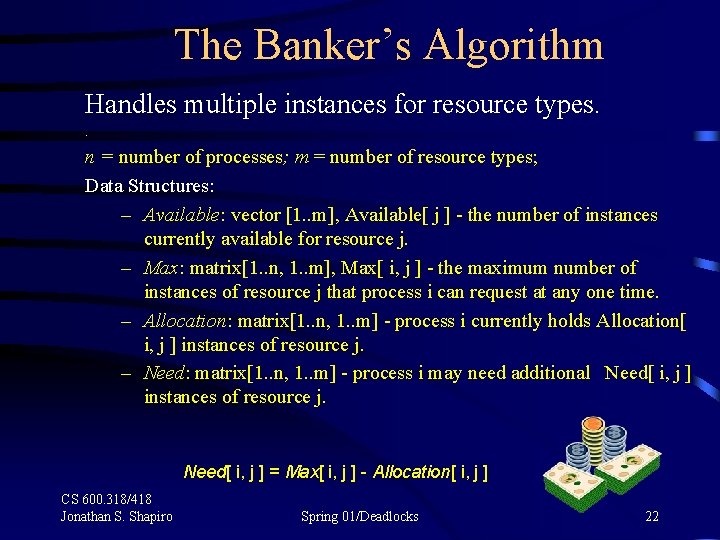
The Banker’s Algorithm Handles multiple instances for resource types. . n = number of processes; m = number of resource types; Data Structures: – Available: vector [1. . m], Available[ j ] - the number of instances currently available for resource j. – Max: matrix[1. . n, 1. . m], Max[ i, j ] - the maximum number of instances of resource j that process i can request at any one time. – Allocation: matrix[1. . n, 1. . m] - process i currently holds Allocation[ i, j ] instances of resource j. – Need: matrix[1. . n, 1. . m] - process i may need additional Need[ i, j ] instances of resource j. Need[ i, j ] = Max[ i, j ] - Allocation[ i, j ] CS 600. 318/418 Jonathan S. Shapiro Spring 01/Deadlocks 22
Banker’s Algorithm - Safety Procedure Local Data Structures: – Work: vector [1. . m], initialize Work to Available. – Finish: vector[1. . n], initialized to false for each process i. 1. Find process i such that Finish[ i ] = false and Needi Work if i exists do Work : = Work + Allocationi Finish[ i ] : = true Go back to 1. 2. ( no such i exists ) if Finish[ i ] = true for all i in 1. . n, then the system is in a safe state. Otherwise, the processes whose index is false may potentially be involved in a deadlock in the future. CS 600. 318/418 Jonathan S. Shapiro Spring 01/Deadlocks 23
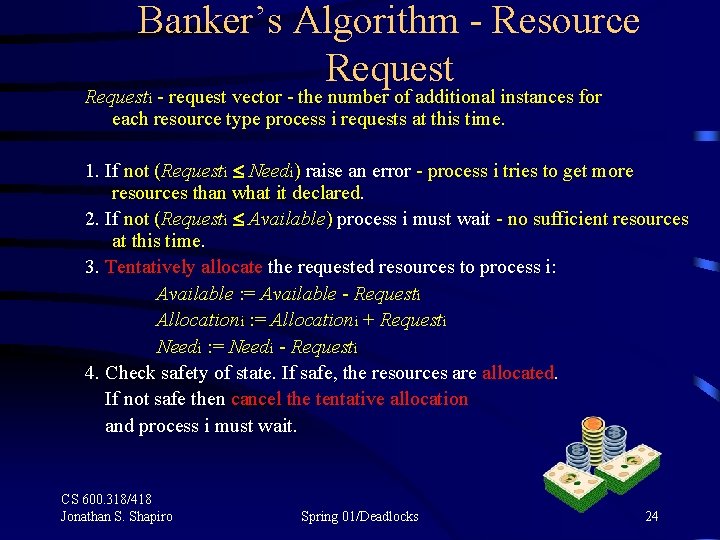
Banker’s Algorithm - Resource Requesti - request vector - the number of additional instances for each resource type process i requests at this time. 1. If not (Requesti Needi) raise an error - process i tries to get more resources than what it declared. 2. If not (Requesti Available) process i must wait - no sufficient resources at this time. 3. Tentatively allocate the requested resources to process i: Available : = Available - Requesti Allocationi : = Allocationi + Requesti Needi : = Needi - Requesti 4. Check safety of state. If safe, the resources are allocated. If not safe then cancel the tentative allocation and process i must wait. CS 600. 318/418 Jonathan S. Shapiro Spring 01/Deadlocks 24
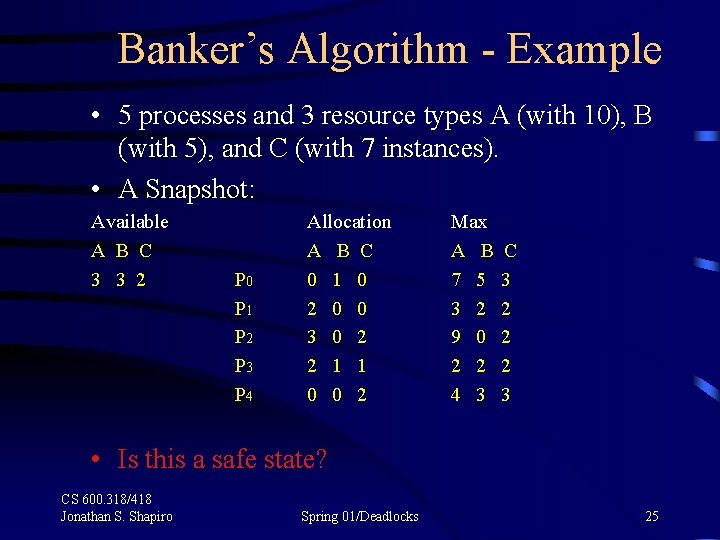
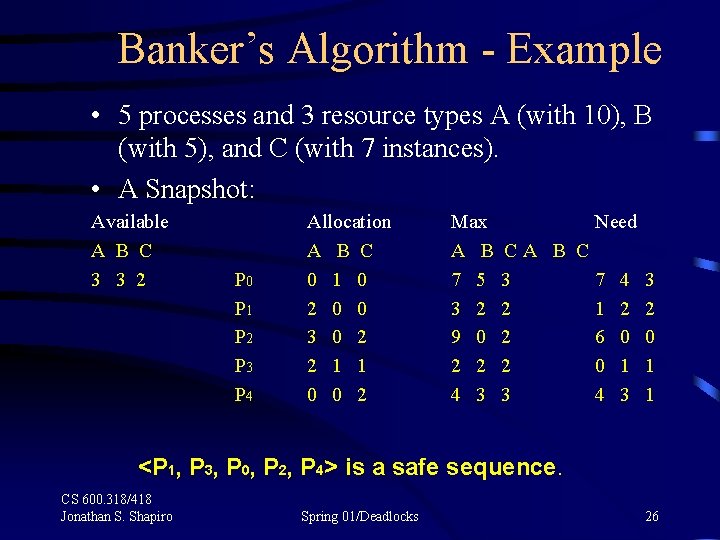
Banker’s Algorithm - Example • 5 processes and 3 resource types A (with 10), B (with 5), and C (with 7 instances). • A Snapshot: Available A B C 3 3 2 P 0 P 1 P 2 P 3 P 4 Allocation A B C 0 1 0 2 0 0 3 0 2 2 1 1 0 0 2 Max A B 7 5 3 2 9 0 2 2 4 3 C 3 2 2 2 3 • Is this a safe state? CS 600. 318/418 Jonathan S. Shapiro Spring 01/Deadlocks 25
Banker’s Algorithm - Example • 5 processes and 3 resource types A (with 10), B (with 5), and C (with 7 instances). • A Snapshot: Available A B C 3 3 2 P 0 P 1 P 2 P 3 P 4 Allocation A B C 0 1 0 2 0 0 3 0 2 2 1 1 0 0 2 Max A B 7 5 3 2 9 0 2 2 4 3 Need CA B C 3 7 4 3 2 1 2 2 2 6 0 0 2 0 1 1 3 4 3 1 <P 1, P 3, P 0, P 2, P 4> is a safe sequence. CS 600. 318/418 Jonathan S. Shapiro Spring 01/Deadlocks 26
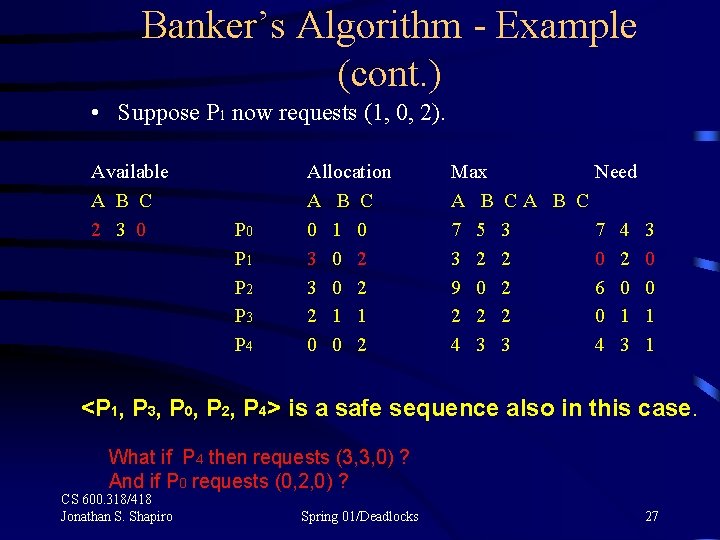
Banker’s Algorithm - Example (cont. ) • Suppose P 1 now requests (1, 0, 2). Available A B C 2 3 0 P 1 P 2 P 3 P 4 Allocation A B C 0 1 0 3 0 2 2 1 1 0 0 2 Max A B 7 5 3 2 9 0 2 2 4 3 Need CA B C 3 7 4 3 2 0 2 6 0 0 2 0 1 1 3 4 3 1 <P 1, P 3, P 0, P 2, P 4> is a safe sequence also in this case. What if P 4 then requests (3, 3, 0) ? And if P 0 requests (0, 2, 0) ? CS 600. 318/418 Jonathan S. Shapiro Spring 01/Deadlocks 27
Deadlock Detection • The system may enter a deadlock state. • The system needs: – An algorithm that periodically determines whether a deadlock has occurred in the system. – A procedure to recover from a deadlock. • Two algorithms: – One instance per resource type. – Multiple instances per resource type. CS 600. 318/418 Jonathan S. Shapiro Spring 01/Deadlocks 28
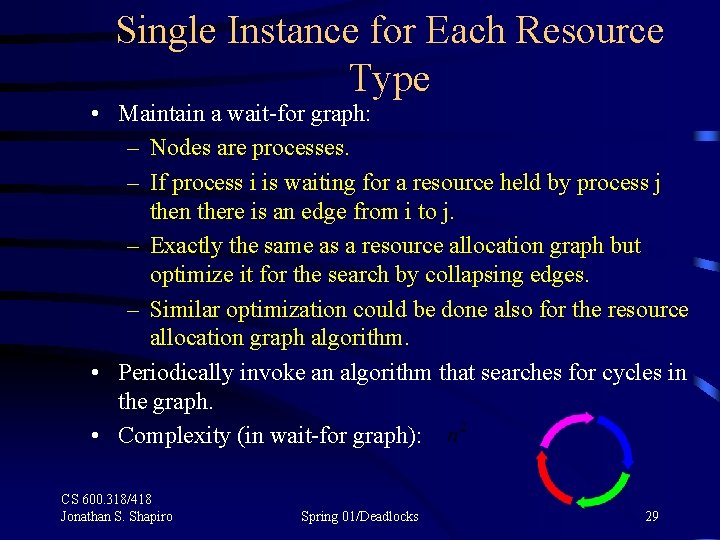
Single Instance for Each Resource Type • Maintain a wait-for graph: – Nodes are processes. – If process i is waiting for a resource held by process j then there is an edge from i to j. – Exactly the same as a resource allocation graph but optimize it for the search by collapsing edges. – Similar optimization could be done also for the resource allocation graph algorithm. • Periodically invoke an algorithm that searches for cycles in the graph. • Complexity (in wait-for graph): CS 600. 318/418 Jonathan S. Shapiro Spring 01/Deadlocks 29
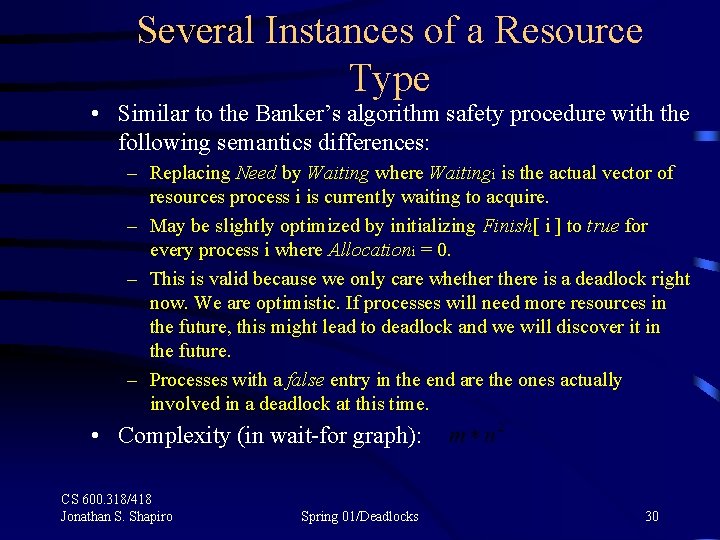
Several Instances of a Resource Type • Similar to the Banker’s algorithm safety procedure with the following semantics differences: – Replacing Need by Waiting where Waitingi is the actual vector of resources process i is currently waiting to acquire. – May be slightly optimized by initializing Finish[ i ] to true for every process i where Allocationi = 0. – This is valid because we only care whethere is a deadlock right now. We are optimistic. If processes will need more resources in the future, this might lead to deadlock and we will discover it in the future. – Processes with a false entry in the end are the ones actually involved in a deadlock at this time. • Complexity (in wait-for graph): CS 600. 318/418 Jonathan S. Shapiro Spring 01/Deadlocks 30
Detection Algorithm Usage When or how often to invoke ? – In the extreme case - every time a request for resource cannot be granted immediately. • This comes with enormous cost (think about complexity). – Reasonable alternative - periodically. But what period to use? • How long are we willing to wait after it happens to be detected. • How much system resources are we willing to commit to the detection. CS 600. 318/418 Jonathan S. Shapiro Spring 01/Deadlocks 31
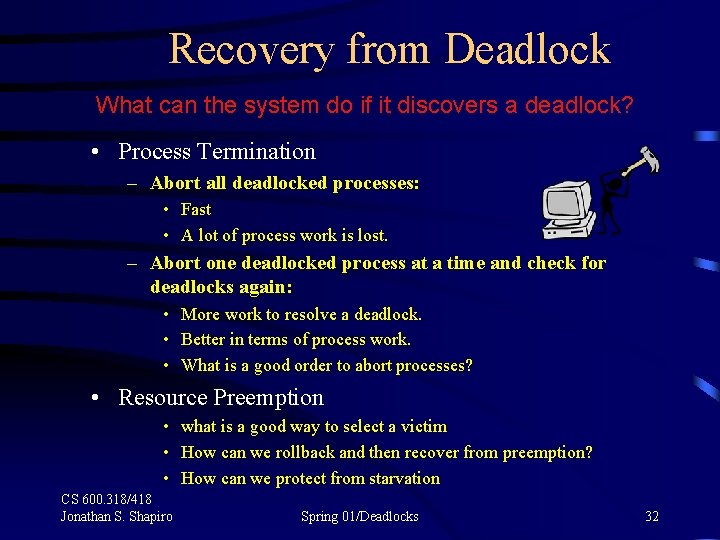
Recovery from Deadlock What can the system do if it discovers a deadlock? • Process Termination – Abort all deadlocked processes: • Fast • A lot of process work is lost. – Abort one deadlocked process at a time and check for deadlocks again: • More work to resolve a deadlock. • Better in terms of process work. • What is a good order to abort processes? • Resource Preemption • what is a good way to select a victim • How can we rollback and then recover from preemption? • How can we protect from starvation CS 600. 318/418 Jonathan S. Shapiro Spring 01/Deadlocks 32
An Integrated Deadlock Approach In a practical system, some of the previous approaches can be integrated. • Group Resources into a number of different classes and order them. • Use prevention of circular wait to prevent deadlock between resource classes. • Use the best approach for each class to handle deadlocks within each class. CS 600. 318/418 Jonathan S. Shapiro Spring 01/Deadlocks 33