
Operating System support for Multimedia b Qo S
Operating System support for Multimedia b Qo. S (Quality of Service) in Multimedia OS • Ashish Ranjan b Multimedia File System • Jaydeep Punde b CPU Scheduling in Multimedia OS • Arun Singal
Operating system b Operating system is responsible for orderly and controlled allocation of resources among the various executing programs competing for them. b Main emphasis of commodity OS (unix, NT) is to reach fairness and efficiency. b No guarantee given to an application for timely execution.
Multimedia characteristics b Multimedia needs real time support. b If data is not processed at certain pace and within a certain deadline the data looses its meaning. b Adhering to deadlines is desirable but not absolutely necessary, i. e it is soft real time in nature.
Problems with existing systems b Does not support soft real time characteristic of multimedia stream. b When real time algorithms applied, other application starve. b Need to support all types of application, i. e both best effort and real time.
Problems Cont. . . b No existing algorithm to satisfy both best effort and real time need. b So, how to schedule/reserve resources for application?
Qo. S Paradigm b Qo. S means to provide reliable and efficient data delivery service. b To support all types of application, a middleware necessary to manage resources. b Encompasses both HRT and SRT paradigm. b Provides probabilistic assurance that resource requirement will be satisfied a certain fraction of time.
Qo. S Requirements b Multimedia Qo. S requirement as described by the high level parameters are • • Throughput Delay Jitter reliability
Resource Management and Qo. S b Tasks • Specification – It is concerned with capturing application level quality of service requirements and management policies • Qo. S mapping – This is concerned with converting the high level specification into actual resource level parameters (low level parameters)
Tasks Contd. . • Admission control – includes a test whether enough resources are available to satisfy the request without interfering with the previously granted request • allocation and scheduling – This is where actual resources are allocated and scheduled • Accounting/Policing – implies tracking down the resources consumed by the task • Deallocation
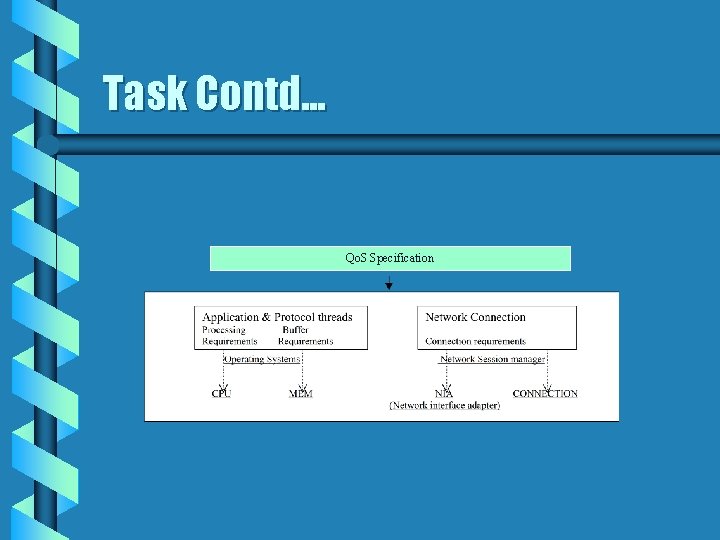
Task Contd. . . Qo. S Specification
Mapping b Why Mapping is necessary? b Qo. S parametres are specified at a high level b Exact resource requirement are not known to application
Qo. S Mapping b Scaling • As the data passes trough different layers of protocol, protocol headers are attached to the frame, which increases its size, and hence scaling of required application bandwidth is done b Delay Partioning • The delay is partitioned across each module.
Bottlenecks for providing Qo. S • Qo. S should be supported at all layers of communication • Data packets from the network are processed in First in first out basis for all connection • Kernel do a lot of hidden processing with high priority • The layered architecture of the communication systems may imply considerable data movement in the protocols • Accounting in OS.
Nemesis b Designed with a view to support Qo. S paradigm b Single address space to avoid context swithching
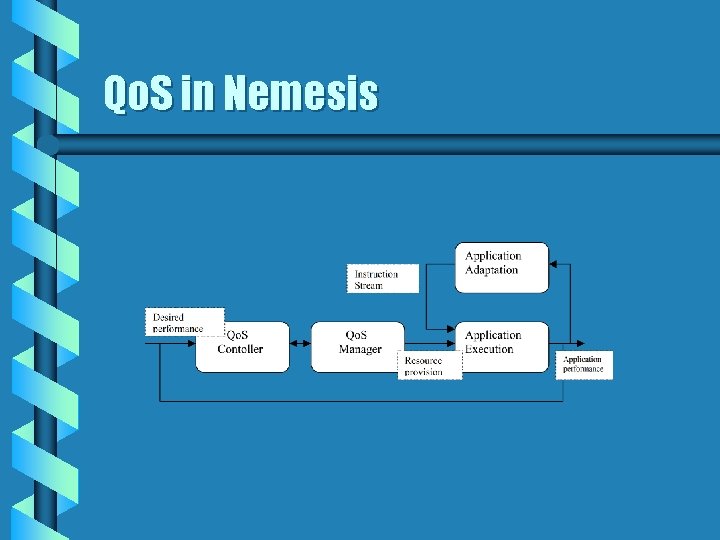
Qo. S in Nemesis
Conclusion b Qo. S paradigm encompasses both HRT and SRT and hence is best suited for multimedia system. b Qo. S should be provided at each layer to achieve the desired goal.
References: • [1] Ralf Steinmetz , "Analyzing the Multimedia Operating System", IEEE Multi. Media, 2, 1, pp 68 -84 (Spring 1995). • [2] T. Plagemann, V. Goebel, P. Halvorsen, O. Anshus, "Operating system support for multimedia systems", Computer communications, 23, 3, pp 267289, (2000). • [4] P. Goyal and X. Guo and H. Vin "A hierarchical CPU scheduler for multimedia operating systems ", In Proceedings of the Second Symposium on Operating Systems Design and Implementation (OSDI). USENIX, October 1996.
References: • [5] Schulzrinne, H. , "Operating System Issues for Continuous Media, " Multimedia Systems, vol. 4, pp. 269 -280, Oct. 1996.
- Slides: 18