
OPERATING SYSTEM CONCEPTS baileyzhangsohu com 1 7 Deadlocks
OPERATING SYSTEM CONCEPTS 操作系统概念 张 柏 礼 bailey_zhang@sohu. com 东南大学计算机学院 1
7 Deadlocks l Objectives l To develop a description of deadlocks, which prevent sets of concurrent processes from completing their tasks l To present a number of different methods for preventing or avoiding deadlocks in a computer system 2
7 Deadlocks l l l l 7. 1 System Model 7. 2 Deadlock Characterization 7. 3 Methods for Handling Deadlocks 7. 4 Deadlock Prevention 7. 5 Deadlock Avoidance 7. 6 Deadlock Detection 7. 7 Recovery from Deadlock 3
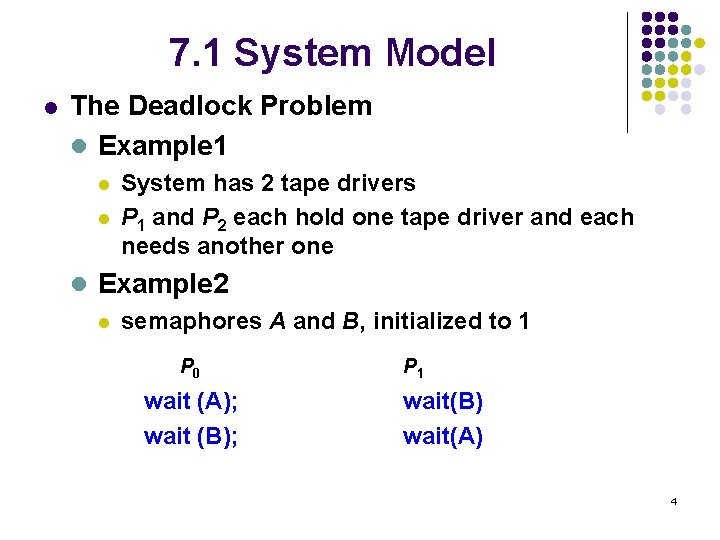
7. 1 System Model l The Deadlock Problem l Example 1 l l System has 2 tape drivers P 1 and P 2 each hold one tape driver and each needs another one l Example 2 l semaphores A and B, initialized to 1 P 0 wait (A); wait (B); P 1 wait(B) wait(A) 4
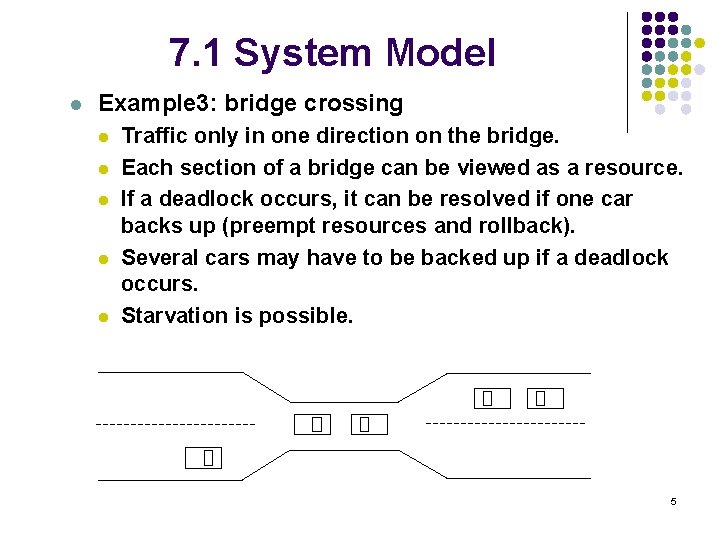
7. 1 System Model l Example 3: bridge crossing l l l Traffic only in one direction on the bridge. Each section of a bridge can be viewed as a resource. If a deadlock occurs, it can be resolved if one car backs up (preempt resources and rollback). Several cars may have to be backed up if a deadlock occurs. Starvation is possible. 5
7. 1 System Model l System model l Resource are partitioned into several types R 1, R 2, . . . , Rm l l CPU cycles memory space I/O devices: prints, tape drivers Each resource type Ri may have Wi instances. l To process, all instances of this type are identical(等同的) 6
7. 1 System Model l Each process utilizes a resource as follows: l request § l l l If the request can’t be granted immediately, the process must wait until it can acquire the resource. use Release A set of processes is in a deadlock state l Each is holding a resource and waiting to acquire a resource held by another process in the set 7
7 Deadlocks l l l l 7. 1 System Model 7. 2 Deadlock Characterization 7. 3 Methods for Handling Deadlocks 7. 4 Deadlock Prevention 7. 5 Deadlock Avoidance 7. 6 Deadlock Detection 7. 7 Recovery from Deadlock 8
7. 2 Deadlock Characterization l Necessary conditions(死锁的必要条件) l Mutual exclusion (存在互斥) l l Hold and wait(保持等待) l l To non-sharable resource(临界资源) 1)only one process at a time can use the resource(临界 资源) 2)If another process requests that resource, it must wait until the resource has been released a process holding at least one resource is waiting to acquire additional resources held by other processes No preemption(非剥夺性) l l Resources can’t be preempted a resource can be released only voluntarily(自愿地) by the process holding it, after that process has completed its task 9
7. 2 Deadlock Characterization l Circular wait(循环等待) l there exists a set {P 0, P 1, …, Pn} of waiting processes such that § § § l P 0 is waiting for a resource that is held by P 1, P 1 is waiting for a resource that is held by P 2, …, Pn– 1 is waiting for a resource that is held by Pn, and Pn is waiting for a resource that is held by P 0 It implies the hold-and-wait condition All four conditions must hold for deadlock to occur 10
7. 2 Deadlock Characterization l Resource-Allocation Graph(资源分配图) l Be a directed graph, can describe the deadlocks precisely l A set of vertices V and a set of edges E. l V is partitioned into two types: § § l l P = {P 1, P 2, …, Pn}, the set consisting of all the processes in the system R = {R 1, R 2, …, Rm}, the set consisting of all resource types in the system request edge – directed edge Pi Rj assignment edge – directed edge Rj Pi 11
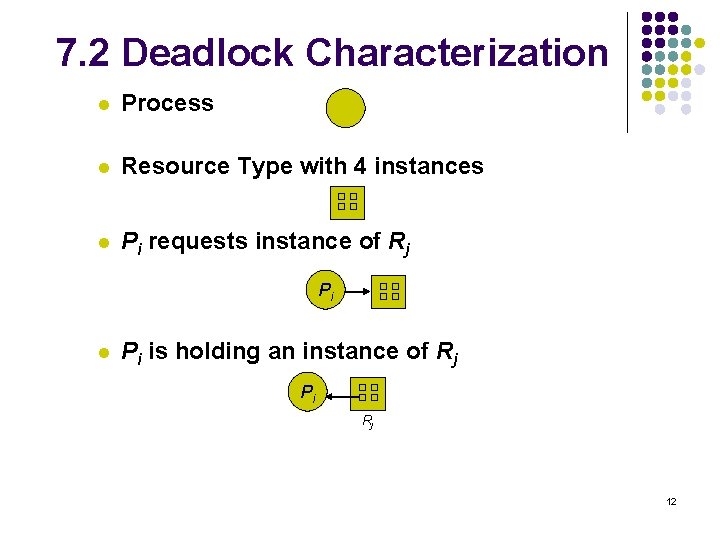
7. 2 Deadlock Characterization l Process l Resource Type with 4 instances l Pi requests instance of Rj Pi l Pi is holding an instance of Rj Pi Rj 12
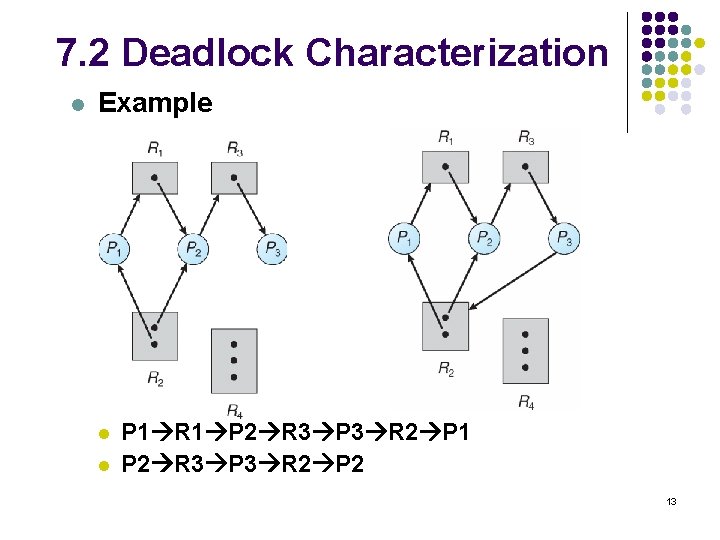
7. 2 Deadlock Characterization l Example l l P 1 R 1 P 2 R 3 P 3 R 2 P 2 13
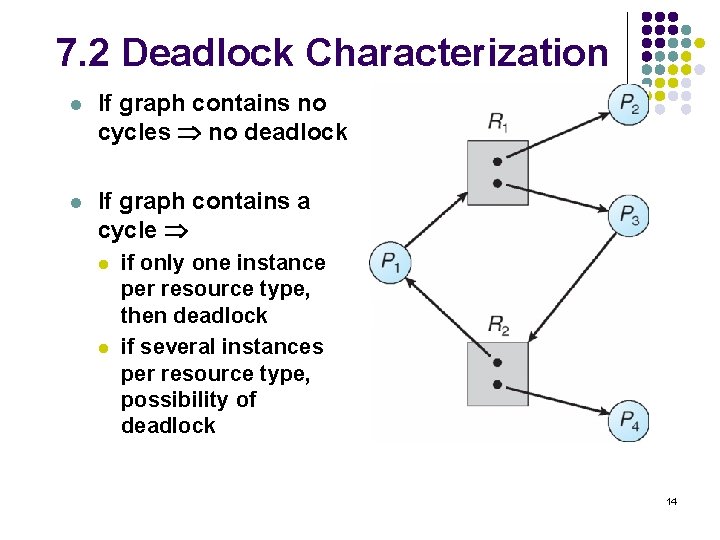
7. 2 Deadlock Characterization l If graph contains no cycles no deadlock l If graph contains a cycle l l if only one instance per resource type, then deadlock if several instances per resource type, possibility of deadlock 14
7 Deadlocks l l l l 7. 1 System Model 7. 2 Deadlock Characterization 7. 3 Methods for Handling Deadlocks 7. 4 Deadlock Prevention 7. 5 Deadlock Avoidance 7. 6 Deadlock Detection 7. 7 Recovery from Deadlock 15
7. 3 Methods for Handling Deadlocks l Three ways l 1)Prevention or avoidance (预防或避免) l l l Use a protocol to prevent or avoid deadlocks Ensure that the system will never enter a deadlock state Prevention § l Provides a set of methods for ensuring that at least one of necessary conditions cannot be held Avoidance § § using the addition information Decide whether the current request can be satisfied or must be delay 16
7. 3 Methods for Handling Deadlocks l 2)Detection and recovery l l l Allow the system to enter a deadlock state Detect it and then recover 3)Ignorance l l Ignore the problem and pretend that deadlocks never occur in the system used by most operating systems, including UNIX and windows § § § It is cheaper than other methods Deadlocks occur infrequently If necessarily, the application developer can write programs to hand deadlocks 17
7 Deadlocks l l l l 7. 1 System Model 7. 2 Deadlock Characterization 7. 3 Methods for Handling Deadlocks 7. 4 Deadlock Prevention 7. 5 Deadlock Avoidance 7. 6 Deadlock Detection 7. 7 Recovery from Deadlock 18
7. 4 Deadlock Prevention l Mutual Exclusion l must hold for non-sharable resources(临界 资源) 19
7. 4 Deadlock Prevention l Hold and Wait Solution protocols: must guarantee that whenever a process requests a resource, it does not hold any other resources ☆Need process to request and be allocated all its resources before it begins execution l Or ☆ Allow process to request resources only when the process has none l Before requesting, any resources that have allocated to the process must be release l Low resource utilization; starvation possible 20
7. 4 Deadlock Prevention l No Preemption l Solution Protocol 1(谦让型 released): l If a process P 1 that is holding some resources requests another resource that cannot be immediately allocated to it (must wait) § § § all resources currently being held by P 1 are released/preempted Preempted resources are added to the list of resources for which the process is waiting Process P 1 will be restarted only when it can regain its old resources, as well as the new ones that it is requesting 21
7. 4 Deadlock Prevention l Solution Protocol 2(抢夺型 preempt): l If a process requests some resource, we first check whether they are available § § l If they are not and are allocated to the waiting processes Preempt these resource from the waiting processes Be applied to the resources whose state can be easily saved and restored later. l Such as CPU registers or memory 22
7. 4 Deadlock Prevention l Circular Wait l Solution Protocol l l impose a total ordering of all resource types require that each process requests resources in an increasing order of enumeration Using this protocol can be proven that the circular-wait cannot hold Example: witness An appropriate ordering of all resource types is defined difficultly 23
7 Deadlocks l l l l 7. 1 System Model 7. 2 Deadlock Characterization 7. 3 Methods for Handling Deadlocks 7. 4 Deadlock Prevention 7. 5 Deadlock Avoidance 7. 6 Deadlock Detection 7. 7 Recovery from Deadlock 24
7. 5 Deadlock Avoidance l Side effects of deadlock prevention l l low device utilization and reduce system throughput. Deadlock avoidance l For every request l The system requires additional information § § § l the resources currently available the resources currently allocated, and the future requests and releases of each process The system decides whether the current request can be satisfied or must wait to avoid a possible future deadlock 25
7. 5 Deadlock Avoidance l The simplest and most useful deadlock avoidance model l requires that each process declare the maximum number of resources of each type that it may need. § § l Using the priori information to construct an deadlockavoidance algorithm Resource-allocation state is defined by the number of available and allocated resources, and the maximum demands of the processes The algorithm dynamically examines the resource-allocation state to ensure that there can never be a circular-wait condition 26
7. 5 Deadlock Avoidance l Safe State When a process requests an available resource, system must decide if immediate allocation leaves the system in a safe state l System is in safe state if there exists a safe sequence。 —A sequence of processes <P 1, P 2, …, Pn> is a safe sequence: l for P 1, the resources that P 1 can still request can be satisfied l for each Pi, the resources that Pi can still request can be satisfied by currently available resources + resources held by all the Pj, with j < i. That is: l 27
7. 5 Deadlock Avoidance l That is: § If the resources that Pi needs are not immediately available, then Pi can wait until all Pj have finished (j < i) § When Pj is finished, Pi can obtain needed resources, execute, return allocated resources, and terminate § When Pi terminates, Pi +1 can obtain its needed resources, and so on 28
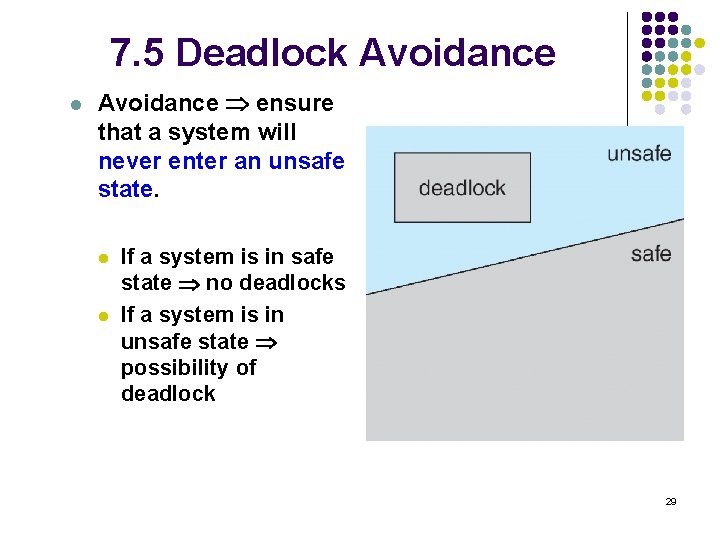
7. 5 Deadlock Avoidance l Avoidance ensure that a system will never enter an unsafe state. l l If a system is in safe state no deadlocks If a system is in unsafe state possibility of deadlock 29
7. 5 Deadlock Avoidance l Two avoidance algorithms l Resource allocation graph algorithm l l every resource type has a single instance. Banker’s algorithm l every type has any number of instances 30
7. 5 Deadlock Avoidance l Resource allocation graph algorithm l Claim edge(需求边) l l l Claim edge Pj Rj indicated that process Pj may request resource Rj represented by a dashed line Claim edge converts to request edge when a process requests a resource Request edge converted to an assignment edge when the resource is allocated to the process When a resource is released by a process, assignment edge reconverts to a claim edge Resources must be claimed a priori in the system 31
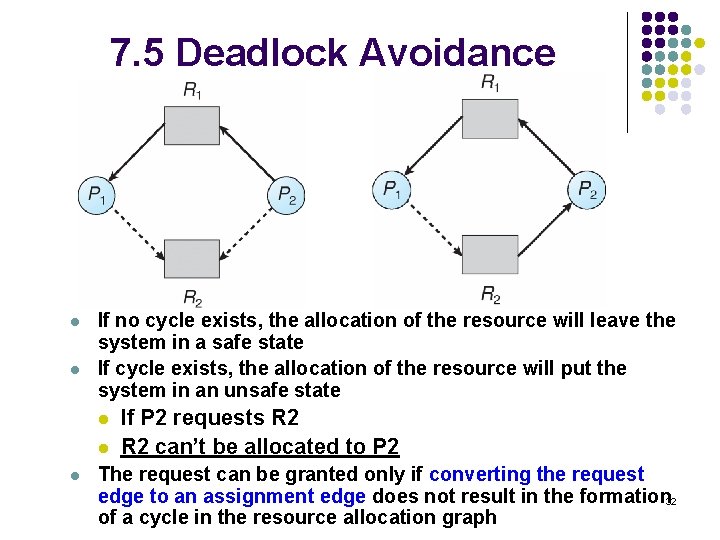
7. 5 Deadlock Avoidance l l If no cycle exists, the allocation of the resource will leave the system in a safe state If cycle exists, the allocation of the resource will put the system in an unsafe state l l l If P 2 requests R 2 can’t be allocated to P 2 The request can be granted only if converting the request edge to an assignment edge does not result in the formation 32 of a cycle in the resource allocation graph
7. 5 Deadlock Avoidance l Banker’s Algorithm l precondition l Multiple instances of each resource type l Each process must a priori claim maximum use. l When a process requests a resource, it may have to wait (for judging). l When a process gets all its resources, it must return them in a finite amount of time. 33
7. 5 Deadlock Avoidance l Data Structures Let n = number of processes, and m = number of resources types l Available(可用资源向量): § § l Vector of length m If available [j] = k, there are k instances of resource type Rj available Max(最大需求矩阵): § § nⅹm matrix. If Max [i, j] = k, then process Pi may request at most k instances of resource type Rj 34
7. 5 Deadlock Avoidance 35
7. 5 Deadlock Avoidance l Allocation(分配矩阵): § § l n ⅹ m matrix. If Allocation[i, j] = k then Pi is currently allocated k instances of Rj Need(需求矩阵): § § § n ⅹ m matrix. If Need[i, j] = k, then Pi may need k more instances of Rj to complete its task Need [i, j] = Max[i, j] – Allocation [i, j] 36
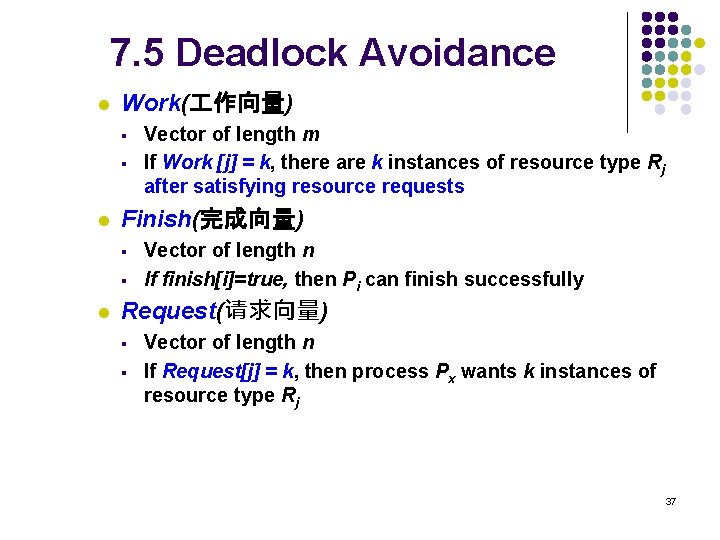
7. 5 Deadlock Avoidance l Work( 作向量) § § l Finish(完成向量) § § l Vector of length m If Work [j] = k, there are k instances of resource type Rj after satisfying resource requests Vector of length n If finish[i]=true, then Pi can finish successfully Request(请求向量) § § Vector of length n If Request[j] = k, then process Px wants k instances of resource type Rj 37
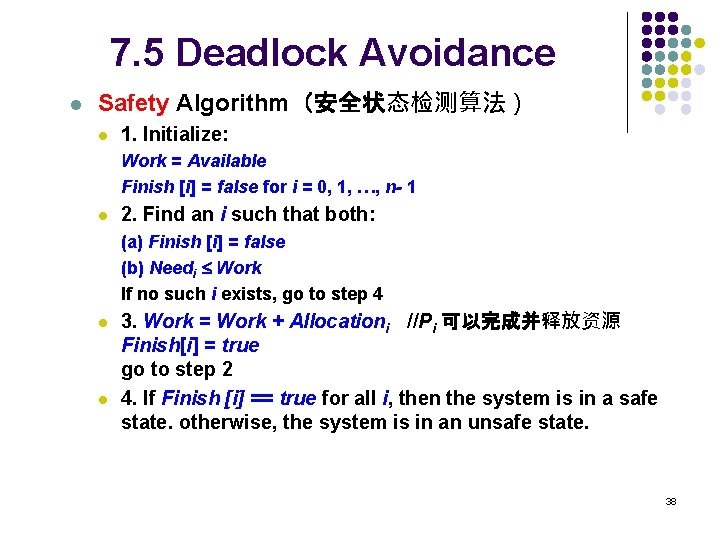
7. 5 Deadlock Avoidance l Safety Algorithm(安全状态检测算法) l 1. Initialize: Work = Available Finish [i] = false for i = 0, 1, …, n- 1 l 2. Find an i such that both: (a) Finish [i] = false (b) Needi Work If no such i exists, go to step 4 l l 3. Work = Work + Allocationi //Pi 可以完成并释放资源 Finish[i] = true go to step 2 4. If Finish [i] == true for all i, then the system is in a safe state. otherwise, the system is in an unsafe state. 38
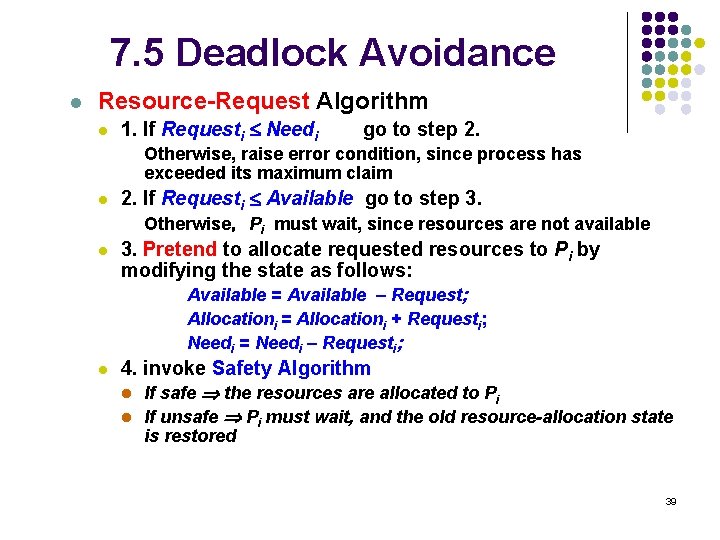
7. 5 Deadlock Avoidance l Resource-Request Algorithm l 1. If Requesti Needi go to step 2. Otherwise, raise error condition, since process has exceeded its maximum claim l 2. If Requesti Available go to step 3. Otherwise,Pi must wait, since resources are not available l 3. Pretend to allocate requested resources to Pi by modifying the state as follows: Available = Available – Request; Allocationi = Allocationi + Requesti; Needi = Needi – Requesti; l 4. invoke Safety Algorithm l If safe the resources are allocated to Pi l If unsafe Pi must wait, and the old resource-allocation state is restored 39
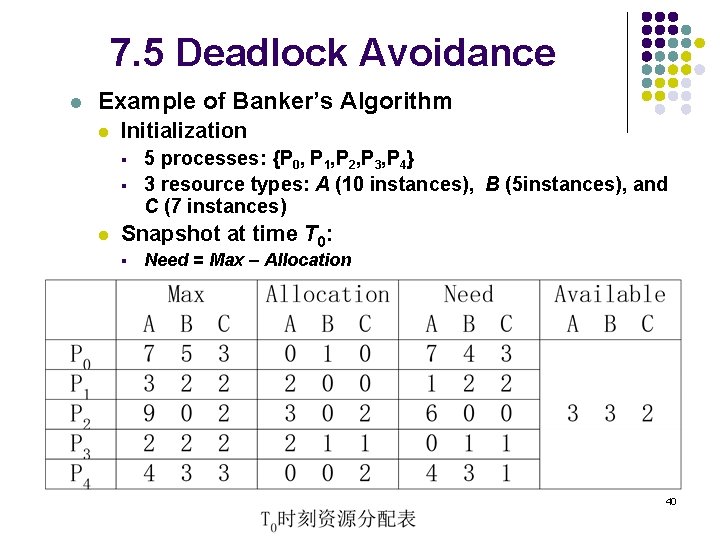
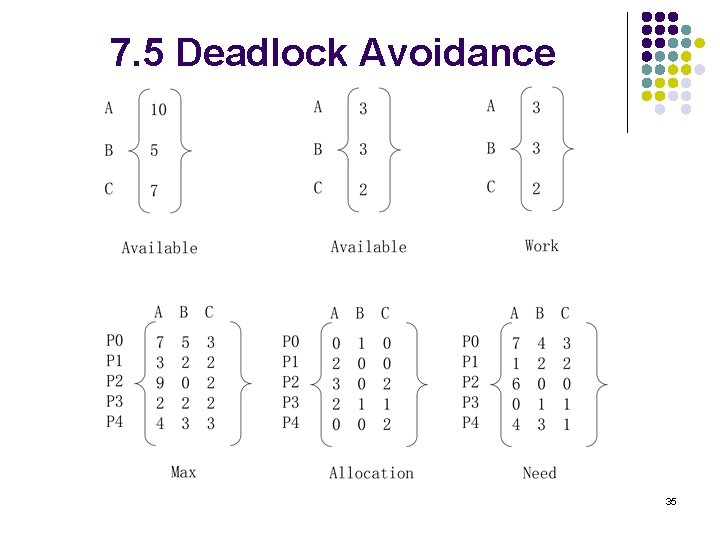
7. 5 Deadlock Avoidance l Example of Banker’s Algorithm l Initialization § § l 5 processes: {P 0, P 1, P 2, P 3, P 4} 3 resource types: A (10 instances), B (5 instances), and C (7 instances) Snapshot at time T 0: § Need = Max – Allocation 40
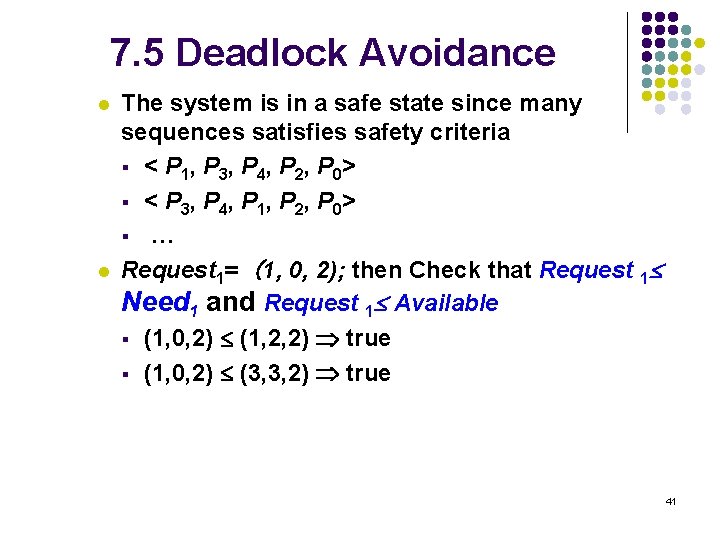
7. 5 Deadlock Avoidance l l The system is in a safe state since many sequences satisfies safety criteria § < P 1, P 3, P 4, P 2, P 0> § < P 3, P 4, P 1, P 2, P 0> § … Request 1=(1, 0, 2); then Check that Request 1 Need 1 and Request 1 Available § (1, 0, 2) (1, 2, 2) true § (1, 0, 2) (3, 3, 2) true 41
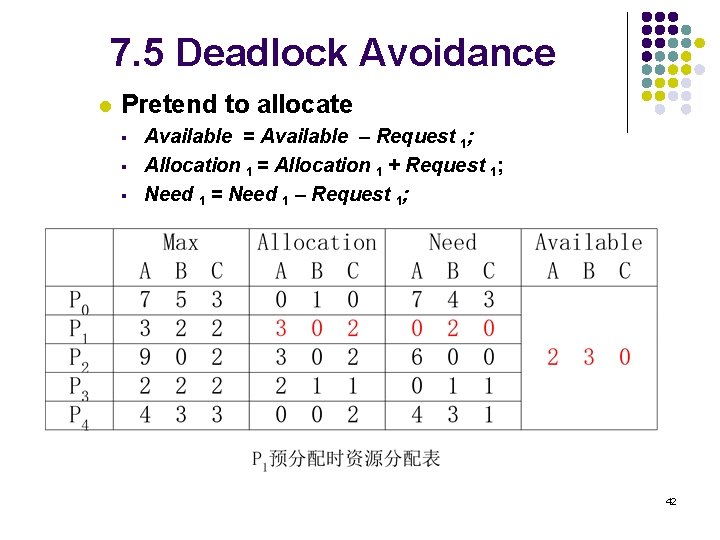
7. 5 Deadlock Avoidance l Pretend to allocate § § § Available = Available – Request 1; Allocation 1 = Allocation 1 + Request 1; Need 1 = Need 1 – Request 1; 42
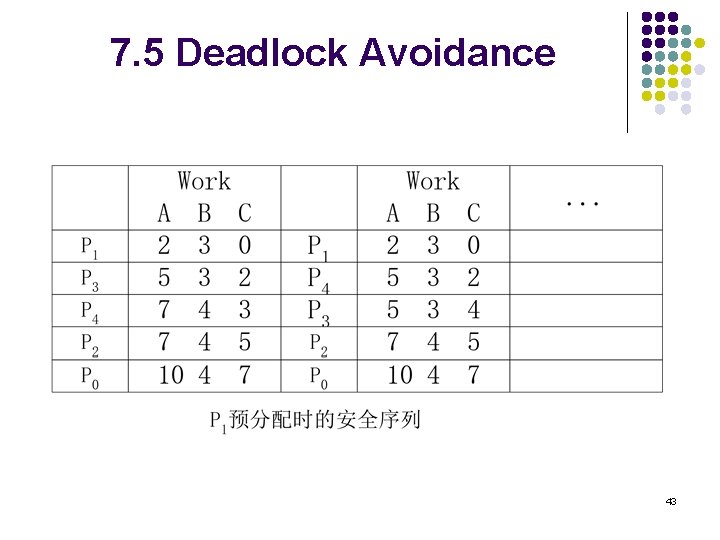
7. 5 Deadlock Avoidance 43
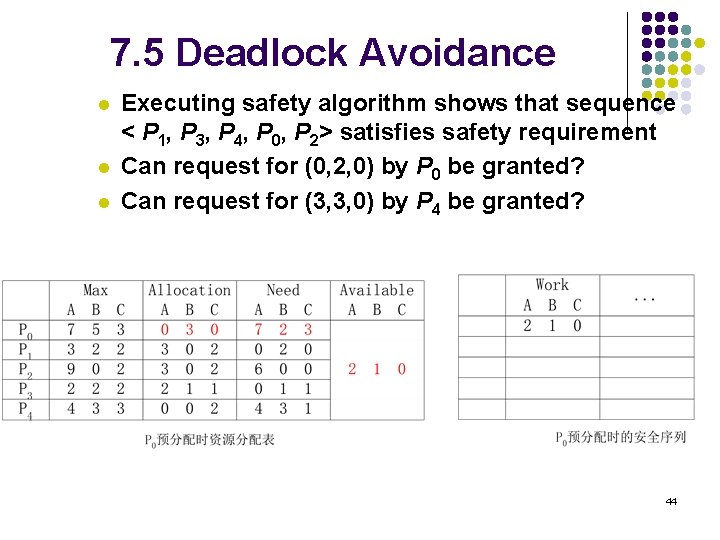
7. 5 Deadlock Avoidance l l l Executing safety algorithm shows that sequence < P 1, P 3, P 4, P 0, P 2> satisfies safety requirement Can request for (0, 2, 0) by P 0 be granted? Can request for (3, 3, 0) by P 4 be granted? 44
7 Deadlocks l l l l 7. 1 System Model 7. 2 Deadlock Characterization 7. 3 Methods for Handling Deadlocks 7. 4 Deadlock Prevention 7. 5 Deadlock Avoidance 7. 6 Deadlock Detection 7. 7 Recovery from Deadlock 45
7. 6 Deadlock Detection l If allowing system to enter deadlock state, the system should provide l Detection algorithm l l An algorithm that examines the state of the system to determine whether a deadlock has occurred. Recovery algorithm l An algorithm to recover from the deadlock. 46
7. 6 Deadlock Detection l Two detection algorithms l Wait-for graph l l Every type has one single instance Detection-algorithm l l Be similar to safety algorithm Every type has any number of instances 47
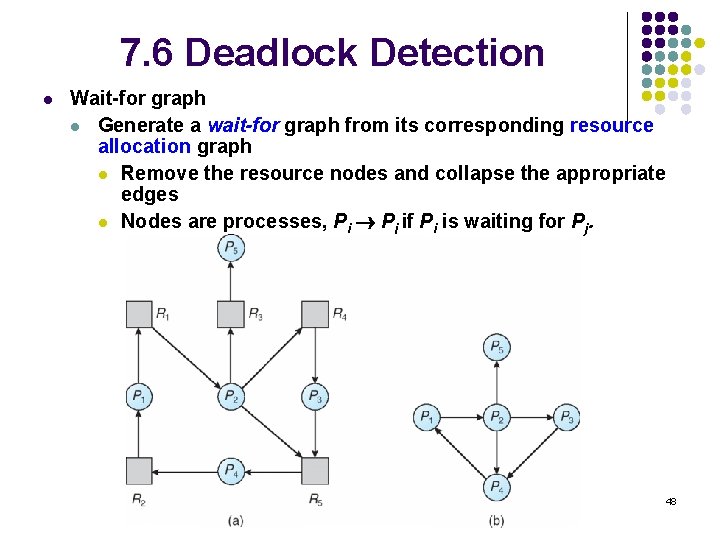
7. 6 Deadlock Detection l Wait-for graph l Generate a wait-for graph from its corresponding resource allocation graph l Remove the resource nodes and collapse the appropriate edges l Nodes are processes, Pi Pj if Pi is waiting for Pj. 48
7. 6 Deadlock Detection l Periodically invoke an algorithm that searches for a cycle in the graph. l An algorithm to detect a cycle in a graph requires an order of n 2 operations, where n is the number of vertices in the graph. 49
7. 6 Deadlock Detection l Banker’s Algorithm l l Use for several Instances of a Resource Type Data structure l Available: A vector of length m indicates the number of available resources of each type l Allocation: An n x m matrix defines the number of resources of each type currently allocated to each process l Request: An n x m matrix indicates the current request of each process. If Request [ij] = k, then process Pi is requesting k more instances of resource type. Rj. 50
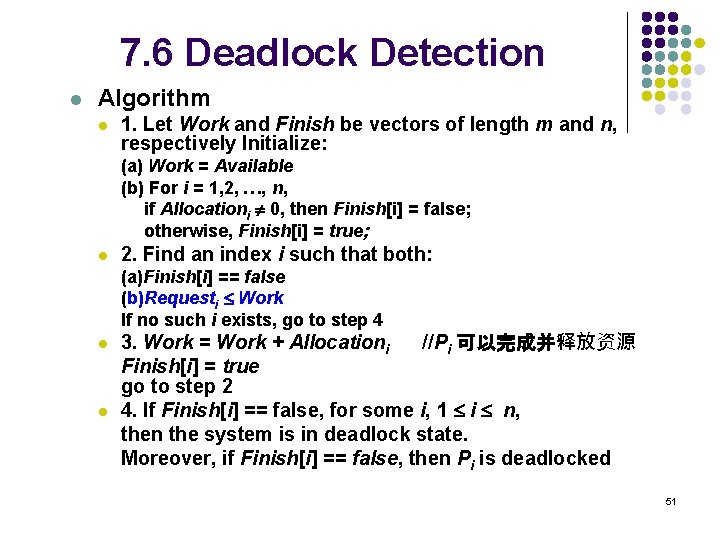
7. 6 Deadlock Detection l Algorithm l 1. Let Work and Finish be vectors of length m and n, respectively Initialize: (a) Work = Available (b) For i = 1, 2, …, n, if Allocationi 0, then Finish[i] = false; otherwise, Finish[i] = true; l 2. Find an index i such that both: (a)Finish[i] == false (b)Requesti Work If no such i exists, go to step 4 l l 3. Work = Work + Allocationi //Pi 可以完成并释放资源 Finish[i] = true go to step 2 4. If Finish[i] == false, for some i, 1 i n, then the system is in deadlock state. Moreover, if Finish[i] == false, then Pi is deadlocked 51
7. 6 Deadlock Detection l Detection-Algorithm Usage l When, and how often, to invoke detection algorithm. it depends on: l l How often a deadlock is likely to occur? How many processes will need to be rolled back? § l If detection algorithm is invoked for every resource request l l At least one for each disjoint cycle Incur a considerable overhead If detection algorithm is invoked arbitrarily l l there may be many cycles in the resource graph so we would not be able to tell which of many deadlocked processes “caused” the deadlock 52
7 Deadlocks l l l l 7. 1 System Model 7. 2 Deadlock Characterization 7. 3 Methods for Handling Deadlocks 7. 4 Deadlock Prevention 7. 5 Deadlock Avoidance 7. 6 Deadlock Detection 7. 7 Recovery from Deadlock 53
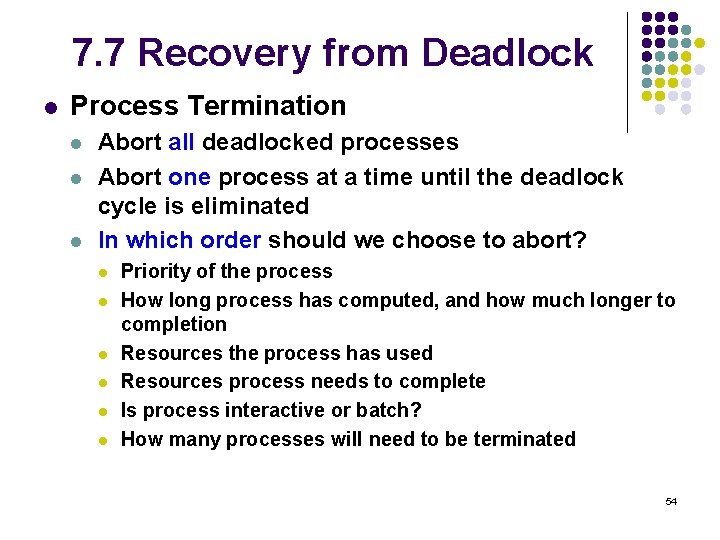
7. 7 Recovery from Deadlock l Process Termination l l l Abort all deadlocked processes Abort one process at a time until the deadlock cycle is eliminated In which order should we choose to abort? l l l Priority of the process How long process has computed, and how much longer to completion Resources the process has used Resources process needs to complete Is process interactive or batch? How many processes will need to be terminated 54
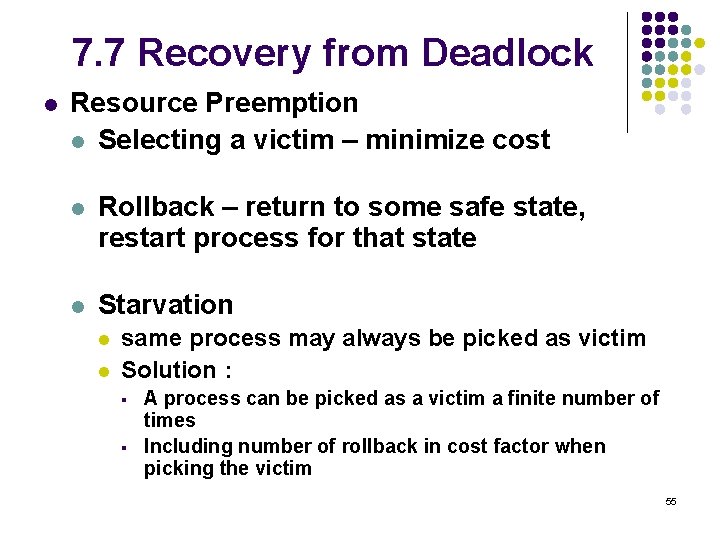
7. 7 Recovery from Deadlock l Resource Preemption l Selecting a victim – minimize cost l Rollback – return to some safe state, restart process for that state l Starvation l l same process may always be picked as victim Solution: § § A process can be picked as a victim a finite number of times Including number of rollback in cost factor when picking the victim 55
Exercise l l l 7. 2 7. 5 7. 11 56
Experiment l 7. 13 57
- Slides: 57