
Operating System BCA D NANDHINI ASSISTANT PROFESSOR IN
Operating System BCA

D. NANDHINI ASSISTANT PROFESSOR IN COMPUTER SCIENCE NMC BCA
Deadlocks BCA
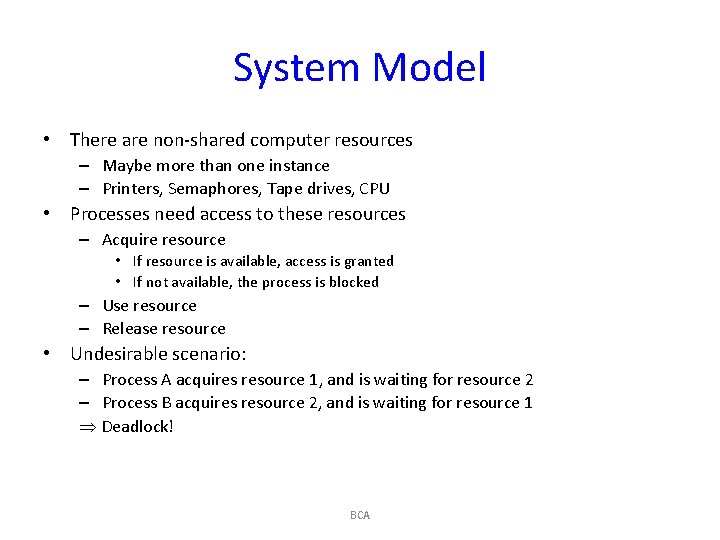
System Model • There are non-shared computer resources – Maybe more than one instance – Printers, Semaphores, Tape drives, CPU • Processes need access to these resources – Acquire resource • If resource is available, access is granted • If not available, the process is blocked – Use resource – Release resource • Undesirable scenario: – Process A acquires resource 1, and is waiting for resource 2 – Process B acquires resource 2, and is waiting for resource 1 Deadlock! BCA
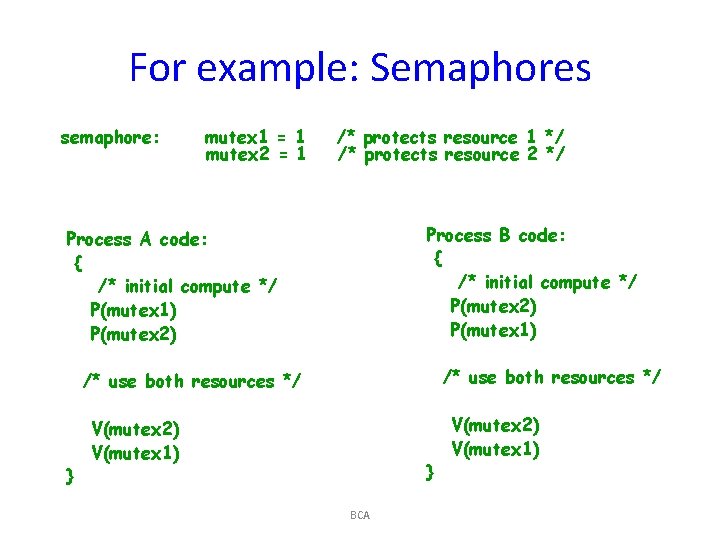
For example: Semaphores semaphore: mutex 1 = 1 mutex 2 = 1 /* protects resource 1 */ /* protects resource 2 */ Process B code: { /* initial compute */ P(mutex 2) P(mutex 1) Process A code: { /* initial compute */ P(mutex 1) P(mutex 2) /* use both resources */ } V(mutex 2) V(mutex 1) } BCA V(mutex 2) V(mutex 1)
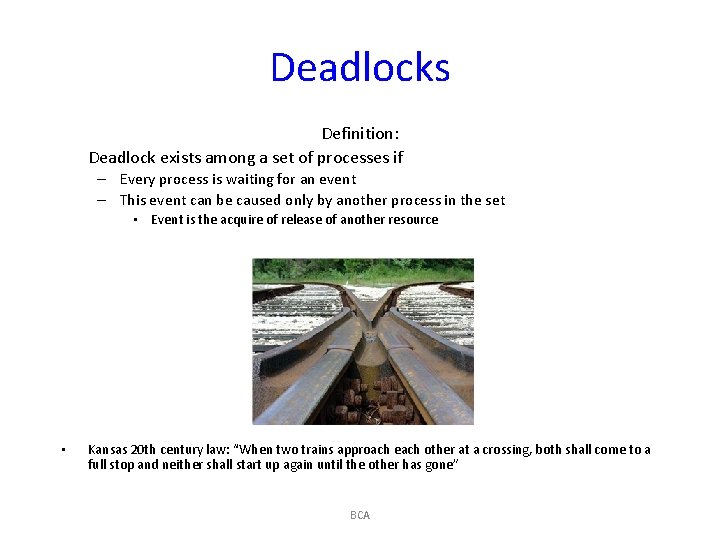
Deadlocks Definition: Deadlock exists among a set of processes if – Every process is waiting for an event – This event can be caused only by another process in the set • Event is the acquire of release of another resource • Kansas 20 th century law: “When two trains approach each other at a crossing, both shall come to a full stop and neither shall start up again until the other has gone” BCA
Four Conditions for Deadlock • Necessary conditions for deadlock to exist: – Mutual Exclusion • At least one resource must be held is in non-sharable mode – Hold and wait • There exists a process holding a resource, and waiting for another – No preemption • Resources cannot be preempted – Circular wait • There exists a set of processes {P 1, P 2, … PN}, such that – P 1 is waiting for P 2, P 2 for P 3, …. and PN for P 1 All four conditions must hold for deadlock to occur BCA
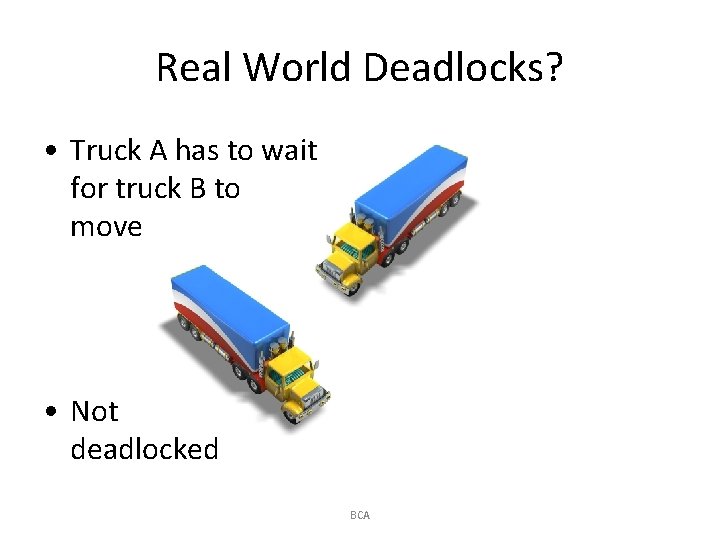
Real World Deadlocks? • Truck A has to wait for truck B to move • Not deadlocked BCA
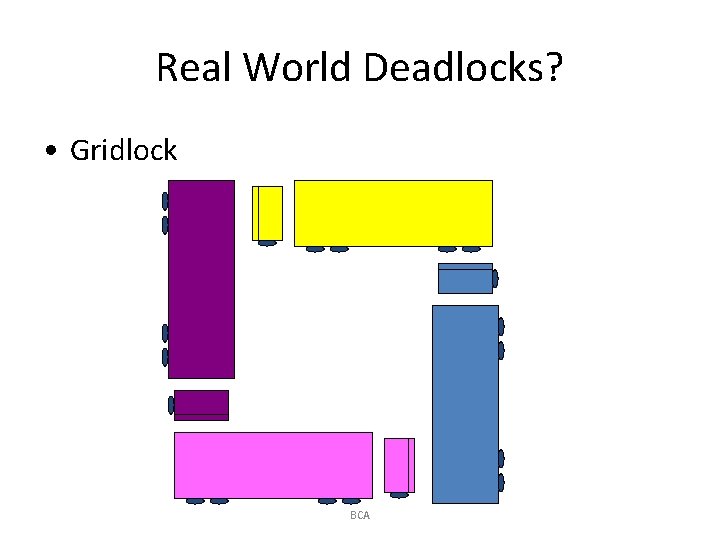
Real World Deadlocks? • Gridlock BCA
Avoiding deadlock • How do cars do it? – Never block an intersection – Must back up if you find yourself doing so • Why does this work? – “Breaks” a wait-for relationship – Illustrates a sense in which intransigent waiting (refusing to release a resource) is one key element of true deadlock! BCA
Testing for deadlock • Steps – Collect “process state” and use it to build a graph • Ask each process “are you waiting for anything”? • Put an edge in the graph if so – We need to do this in a single instant of time, not while things might be changing • Now need a way to test for cycles in our graph BCA
Testing for deadlock • One way to find cycles – Look for a node with no outgoing edges – Erase this node, and also erase any edges coming into it • Idea: This was a process people might have been waiting for, but it wasn’t waiting for anything else – If (and only if) the graph has no cycles, we’ll eventually be able to erase the whole graph! • This is called a graph reduction algorithm BCA
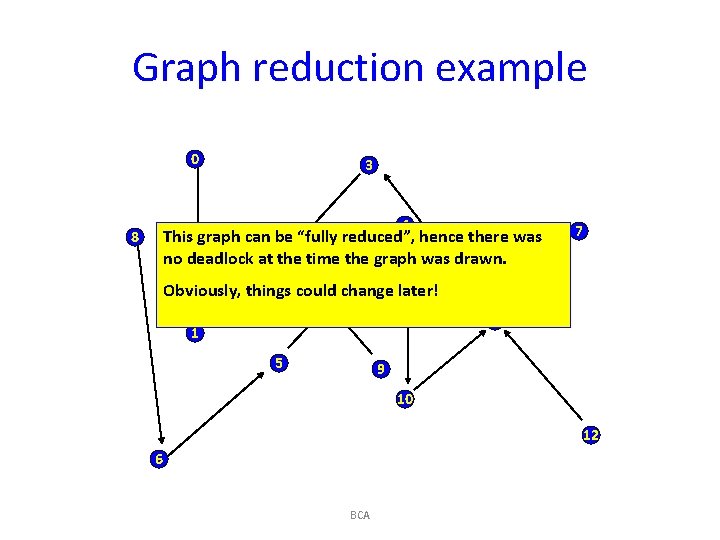
Graph reduction example 0 3 4 This graph can be “fully reduced”, hence there was 2 time the graph was drawn. no deadlock at the 8 7 Obviously, things could change later! 11 1 5 9 10 12 6 BCA
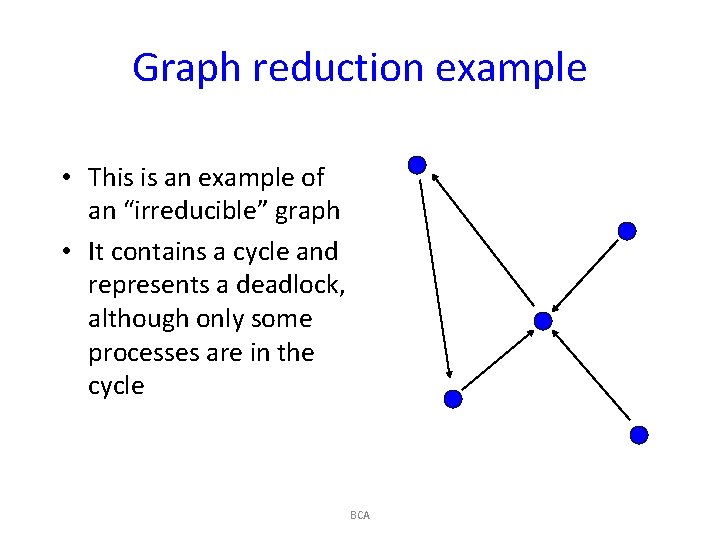
Graph reduction example • This is an example of an “irreducible” graph • It contains a cycle and represents a deadlock, although only some processes are in the cycle BCA
What about “resource” waits? • Processes usually don’t wait for each other. • Instead, they wait for resources used by other processes. – Process A needs access to the critical section of memory process B is using • Can we extend our graphs to represent resource wait? BCA
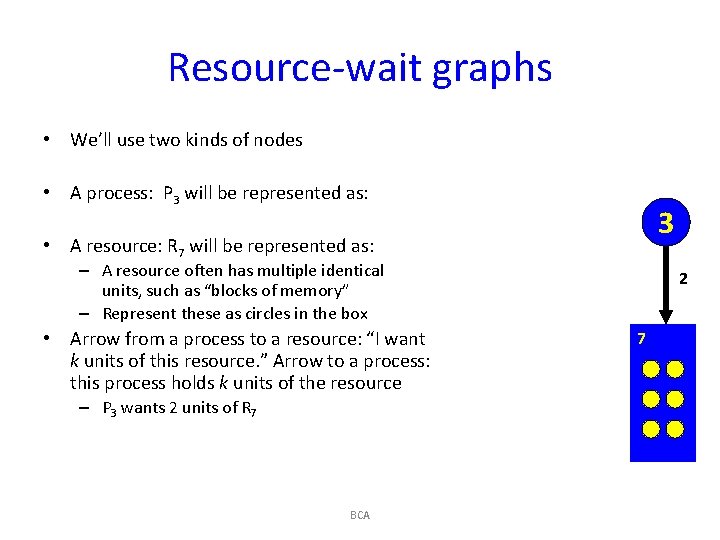
Resource-wait graphs • We’ll use two kinds of nodes • A process: P 3 will be represented as: 3 • A resource: R 7 will be represented as: – A resource often has multiple identical units, such as “blocks of memory” – Represent these as circles in the box • Arrow from a process to a resource: “I want k units of this resource. ” Arrow to a process: this process holds k units of the resource – P 3 wants 2 units of R 7 BCA 2 7
A tricky choice… • When should resources be treated as “different classes”? – To be in the same class, resources do need to be equivalent • “memory pages” are different from “printers” – But for some purposes, we might want to split memory pages into two groups • Fast memory. Slow memory – Proves useful in doing “ordered resource allocation” BCA
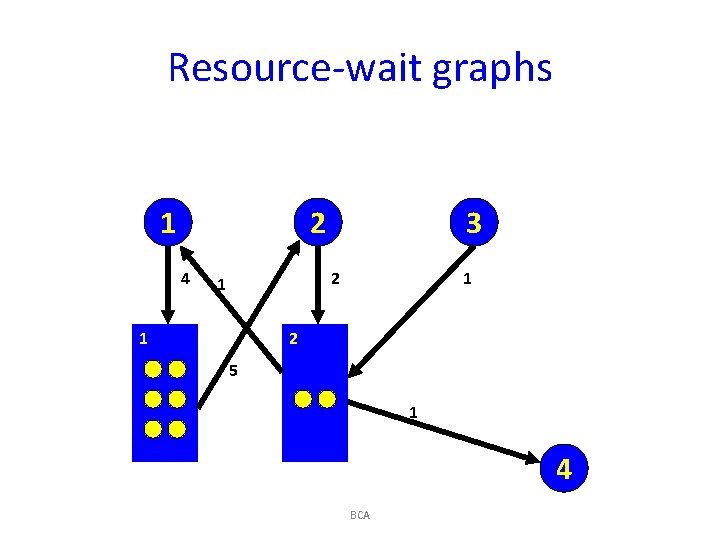
Resource-wait graphs 1 2 4 3 2 1 1 1 2 5 1 4 BCA
Reduction rules • Find a process that can have all its current requests satisfied (e. g. the “available amount” of any resource it wants is at least enough to satisfy the request) • Erase that process (in effect: grant the request, let it run, and eventually it will release the resource) • Continue until we either erase the graph or have an irreducible component. In the latter case we’ve identified a deadlock BCA
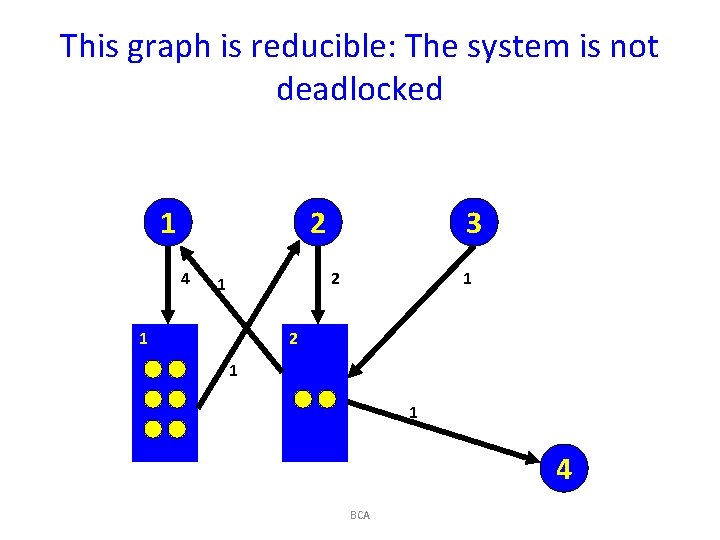
This graph is reducible: The system is not deadlocked 1 2 4 3 2 1 1 1 2 1 1 4 BCA
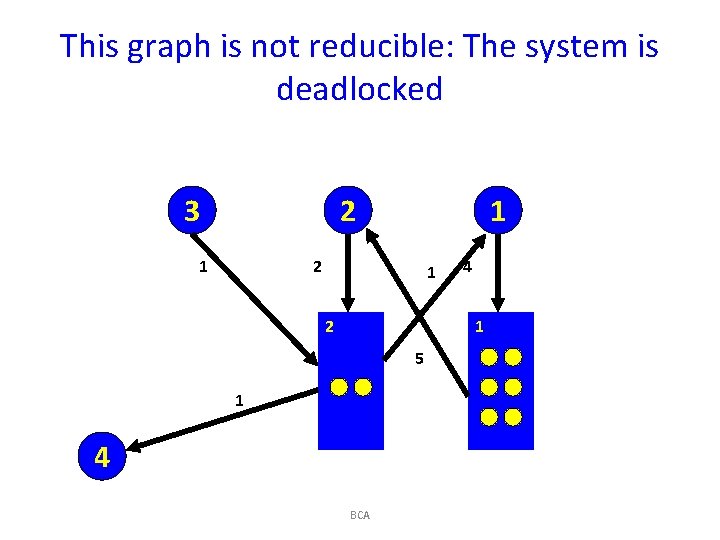
This graph is not reducible: The system is deadlocked 3 2 1 1 2 4 1 5 1 4 BCA
Dealing with Deadlocks 1. Reactive Approaches: – Periodically check for evidence of deadlock • – For example, using a graph reduction algorithm Then need a way to recover • • Could blue screen and reboot the computer Could pick a “victim” and terminate that thread – – • But this is only possible in certain kinds of applications Basically, thread needs a way to clean up if it gets terminated and has to exit in a hurry! Often thread would then “retry” from scratch (despite drawbacks, database systems do this) BCA
Dealing with Deadlocks 2. Proactive Approaches: – Deadlock Prevention • • – Prevent one of the 4 necessary conditions from arising …. This will prevent deadlock from occurring Deadlock Avoidance • • Carefully allocate resources based on future knowledge Deadlocks are prevented 3. Ignore the problem – – Pretend deadlocks will never occur Ostrich approach… but surprisingly common! BCA
Deadlock Prevention BCA
Deadlock Prevention • Can the OS prevent deadlocks? • Prevention: Negate one of necessary conditions – Mutual exclusion: • Make resources sharable • Not always possible (printers? ) – Hold and wait • Do not hold resources when waiting for another Request all resources before beginning execution Processes do not know what all they will need Starvation (if waiting on many popular resources) Low utilization (Need resource only for a bit) • Alternative: Release all resources before requesting anything new – Still has the last two problems BCA
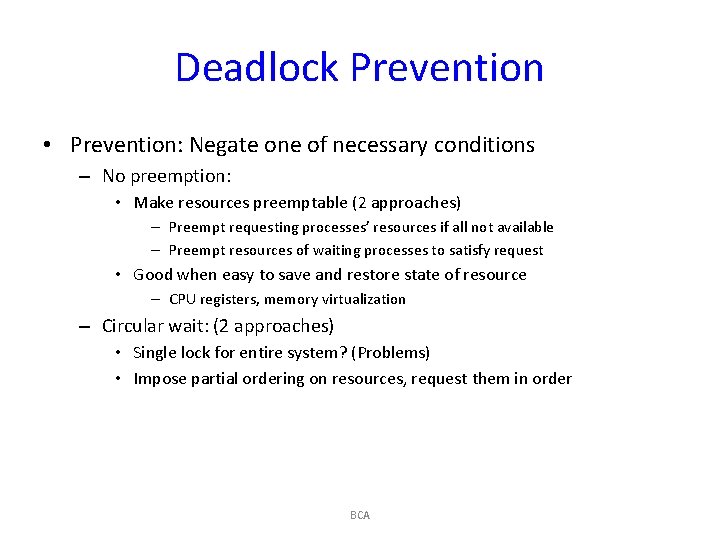
Deadlock Prevention • Prevention: Negate one of necessary conditions – No preemption: • Make resources preemptable (2 approaches) – Preempt requesting processes’ resources if all not available – Preempt resources of waiting processes to satisfy request • Good when easy to save and restore state of resource – CPU registers, memory virtualization – Circular wait: (2 approaches) • Single lock for entire system? (Problems) • Impose partial ordering on resources, request them in order BCA
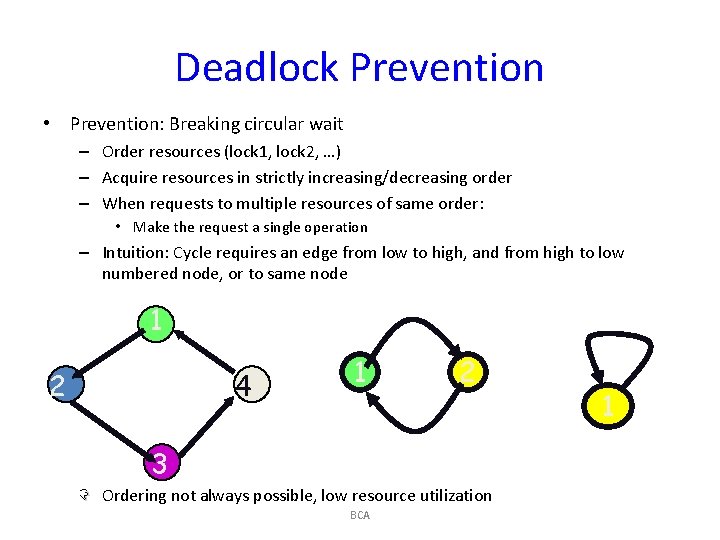
Deadlock Prevention • Prevention: Breaking circular wait – Order resources (lock 1, lock 2, …) – Acquire resources in strictly increasing/decreasing order – When requests to multiple resources of same order: • Make the request a single operation – Intuition: Cycle requires an edge from low to high, and from high to low numbered node, or to same node 1 2 4 1 2 3 Ordering not always possible, low resource utilization BCA 1
Deadlock Avoidance BCA
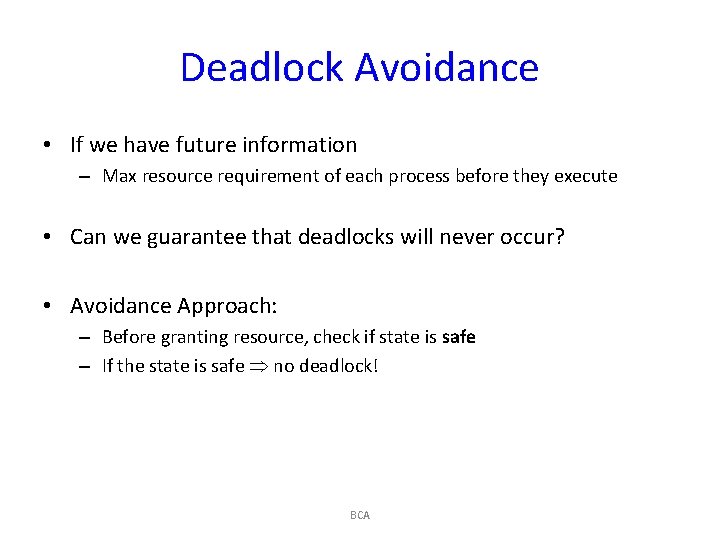
Deadlock Avoidance • If we have future information – Max resource requirement of each process before they execute • Can we guarantee that deadlocks will never occur? • Avoidance Approach: – Before granting resource, check if state is safe – If the state is safe no deadlock! BCA
Safe State • A state is said to be safe, if it has a process sequence {P 1, P 2, …, Pn}, such that for each Pi, the resources that Pi can still request can be satisfied by the currently available resources plus the resources held by all Pj, where j < i • State is safe because OS can definitely avoid deadlock – by blocking any new requests until safe order is executed • This avoids circular wait condition – Process waits until safe state is guaranteed BCA
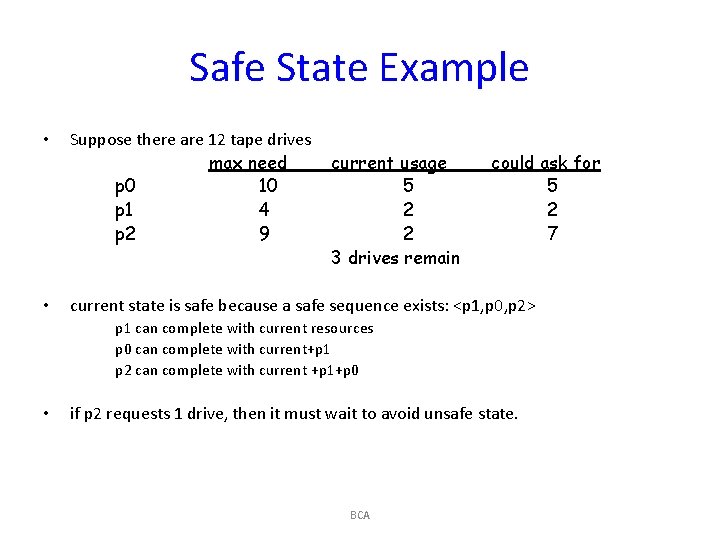
Safe State Example • • Suppose there are 12 tape drives max need p 0 10 p 1 4 p 2 9 current usage 5 2 2 3 drives remain could ask for 5 2 7 current state is safe because a safe sequence exists: <p 1, p 0, p 2> p 1 can complete with current resources p 0 can complete with current+p 1 p 2 can complete with current +p 1+p 0 • if p 2 requests 1 drive, then it must wait to avoid unsafe state. BCA
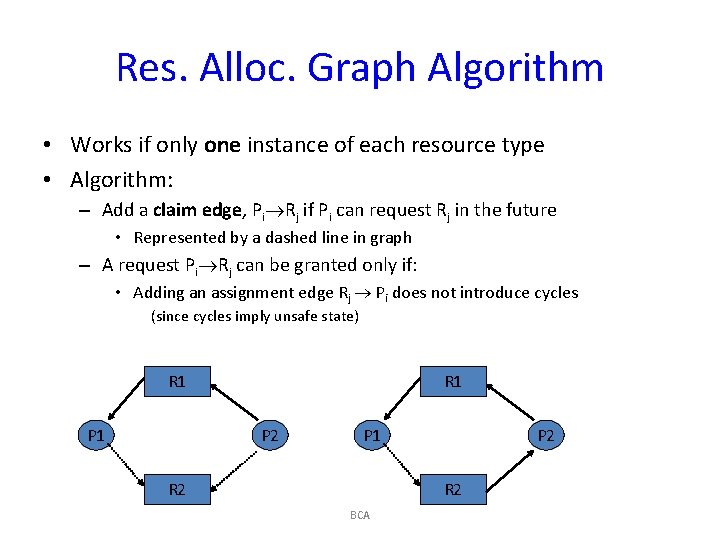
Res. Alloc. Graph Algorithm • Works if only one instance of each resource type • Algorithm: – Add a claim edge, Pi Rj if Pi can request Rj in the future • Represented by a dashed line in graph – A request Pi Rj can be granted only if: • Adding an assignment edge Rj Pi does not introduce cycles (since cycles imply unsafe state) R 1 P 1 R 1 P 2 P 1 R 2 P 2 R 2 BCA
Res. Alloc. Graph issues: • A little complex to implement – Would need to make it part of the system – E. g. build a “resource management” library • Very conservative BCA
Banker’s Algorithm • Suppose we know the “worst case” resource needs of processes in advance – A bit like knowing the credit limit on your credit cards. (This is why they call it the Banker’s Algorithm) • Observation: Suppose we just give some process ALL the resources it could need… – Then it will execute to completion. – After which it will give back the resources. • Like a bank: If Visa just hands you all the money your credit lines permit, at the end of the month, you’ll pay your entire bill, right? BCA
Banker’s Algorithm • So… – A process pre-declares its worst-case needs – Then it asks for what it “really” needs, a little at a time – The algorithm decides when to grant requests • It delays a request unless: – – – It can find a sequence of processes… …. such that it could grant their outstanding need… … so they would terminate… … letting it collect their resources… … and in this way it can execute everything to completion! BCA
Banker’s Algorithm • How will it really do this? – The algorithm will just implement the graph reduction method for resource graphs – Graph reduction is “like” finding a sequence of processes that can be executed to completion • So: given a request – Build a resource graph – See if it is reducible, only grant request if so – Else must delay the request until someone releases some resources, at which point can test again BCA
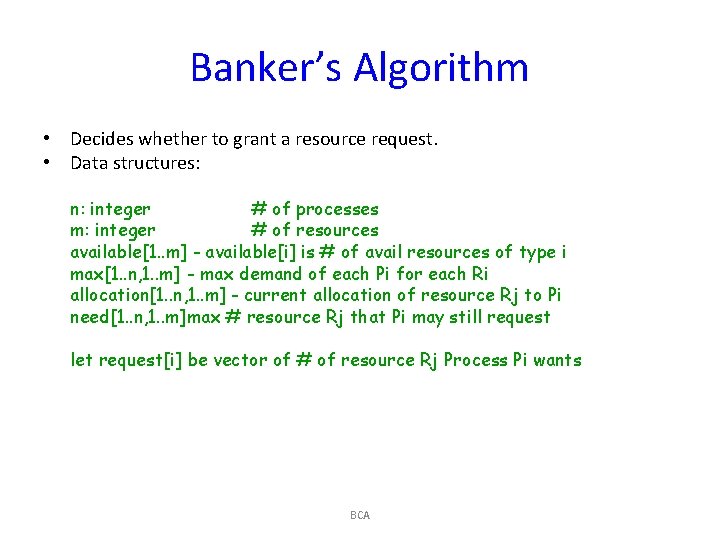
Banker’s Algorithm • Decides whether to grant a resource request. • Data structures: n: integer # of processes m: integer # of resources available[1. . m] - available[i] is # of avail resources of type i max[1. . n, 1. . m] - max demand of each Pi for each Ri allocation[1. . n, 1. . m] - current allocation of resource Rj to Pi need[1. . n, 1. . m]max # resource Rj that Pi may still request let request[i] be vector of # of resource Rj Process Pi wants BCA
![Basic Algorithm 1. If request[i] > need[i] then error (asked for too much) 2.](http://slidetodoc.com/presentation_image_h2/31d185a0f45899c71061998e696f8ae7/image-38.jpg "Basic Algorithm 1. If request[i] > need[i] then error (asked for too much) 2.")
Basic Algorithm 1. If request[i] > need[i] then error (asked for too much) 2. If request[i] > available[i] then wait (can’t supply it now) 3. Resources are available to satisfy the request Let’s assume that we satisfy the request. Then we would have: available = available - request[i] allocation[i] = allocation [i] + request[i] need[i] = need [i] - request [i] Now, check if this would leave us in a safe state: if yes, grant the request, if no, then leave the state as is and cause process to wait. BCA
![Safety Check free[1. . m] = available /* how many resources are available */](http://slidetodoc.com/presentation_image_h2/31d185a0f45899c71061998e696f8ae7/image-39.jpg "Safety Check free[1. . m] = available /* how many resources are available */")
Safety Check free[1. . m] = available /* how many resources are available */ finish[1. . n] = false (for all i) /* none finished yet */ Step 1: Find an i such that finish[i]=false and need[i] <= work /* find a proc that can complete its request now */ if no such i exists, go to step 3 /* we’re done */ Step 2: Found an i: finish [i] = true /* done with this process */ free = free + allocation [i] /* assume this process were to finish, and its allocation back to the available list */ go to step 1 Step 3: If finish[i] = true for all i, the system is safe. Else Not BCA
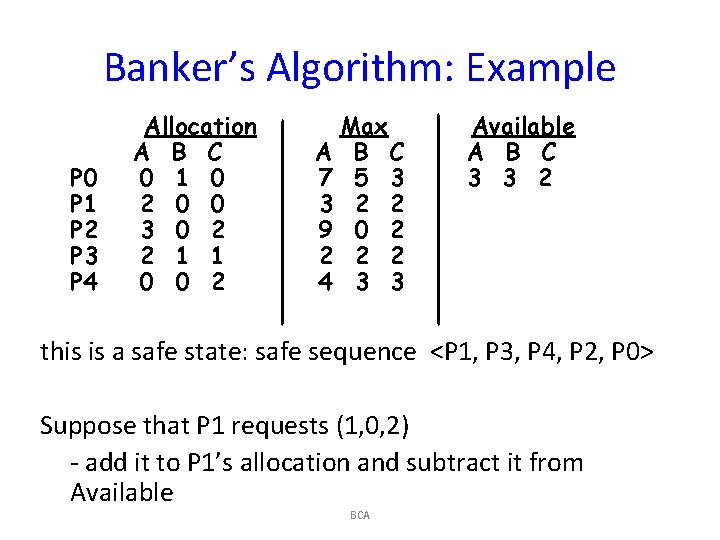
Banker’s Algorithm: Example P 0 P 1 P 2 P 3 P 4 Allocation A B C 0 1 0 2 0 0 3 0 2 2 1 1 0 0 2 Max A B C 7 5 3 3 2 2 9 0 2 2 4 3 3 Available A B C 3 3 2 this is a safe state: safe sequence <P 1, P 3, P 4, P 2, P 0> Suppose that P 1 requests (1, 0, 2) - add it to P 1’s allocation and subtract it from Available BCA
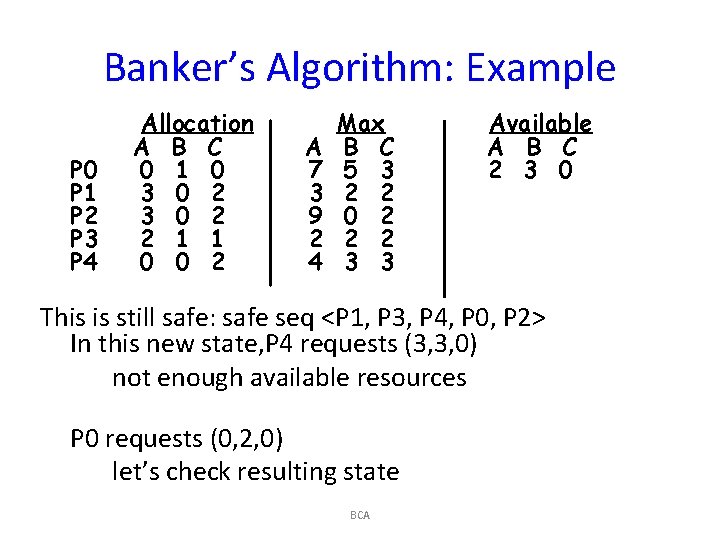
Banker’s Algorithm: Example P 0 P 1 P 2 P 3 P 4 Allocation A B C 0 1 0 3 0 2 2 1 1 0 0 2 A 7 3 9 2 4 Max B C 5 3 2 2 0 2 2 2 3 3 Available A B C 2 3 0 This is still safe: safe seq <P 1, P 3, P 4, P 0, P 2> In this new state, P 4 requests (3, 3, 0) not enough available resources P 0 requests (0, 2, 0) let’s check resulting state BCA
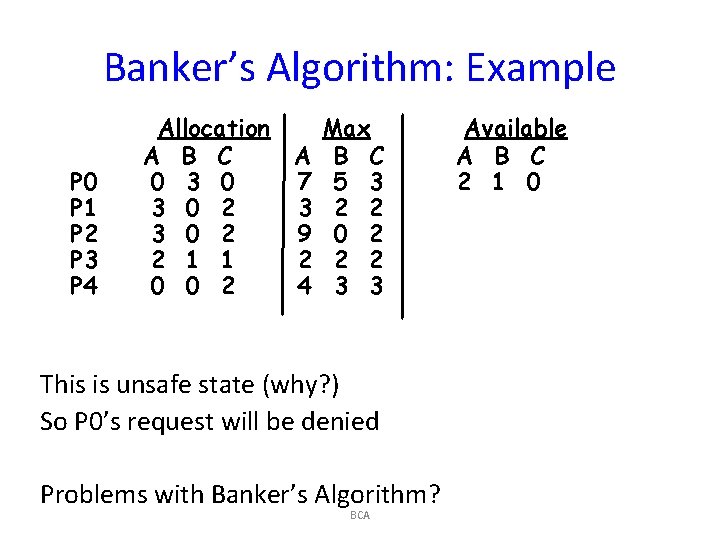
Banker’s Algorithm: Example P 0 P 1 P 2 P 3 P 4 Allocation A B C 0 3 0 2 2 1 1 0 0 2 A 7 3 9 2 4 Max B C 5 3 2 2 0 2 2 2 3 3 This is unsafe state (why? ) So P 0’s request will be denied Problems with Banker’s Algorithm? BCA Available A B C 2 1 0
Deadlock Detection & Recovery • If neither avoidance or prevention is implemented, deadlocks can (and will) occur. • Coping with this requires: – Detection: finding out if deadlock has occurred • Keep track of resource allocation (who has what) • Keep track of pending requests (who is waiting for what) – Recovery: untangle the mess. • Expensive to detect, as well as recover BCA
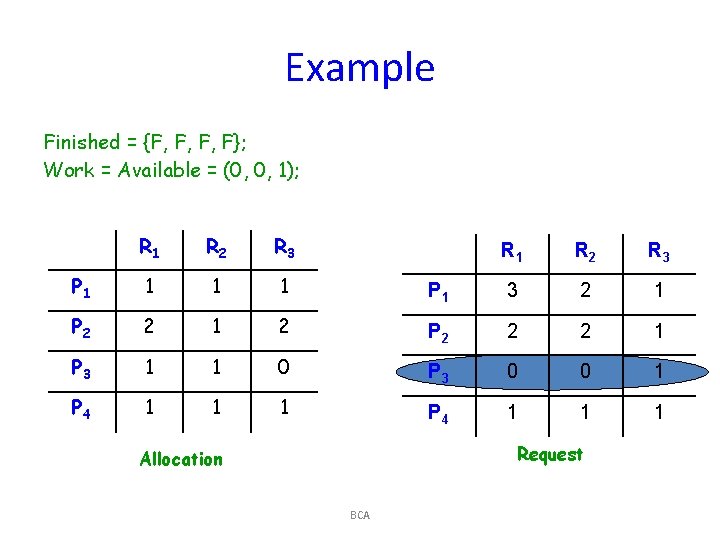
Example Finished = {F, F, F, F}; Work = Available = (0, 0, 1); R 1 R 2 R 3 P 1 1 P 2 2 1 P 3 1 P 4 1 R 2 R 3 P 1 3 2 1 2 P 2 2 2 1 1 0 P 3 0 0 1 1 1 P 4 1 1 1 Request Allocation BCA
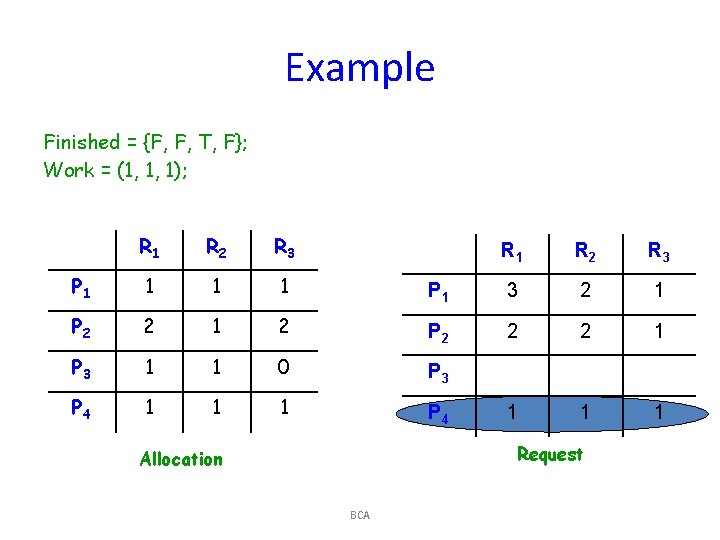
Example Finished = {F, F, T, F}; Work = (1, 1, 1); R 1 R 2 R 3 P 1 1 P 2 2 1 P 3 1 P 4 1 R 2 R 3 P 1 3 2 1 2 P 2 2 2 1 1 0 P 3 1 1 P 4 1 1 1 Request Allocation BCA
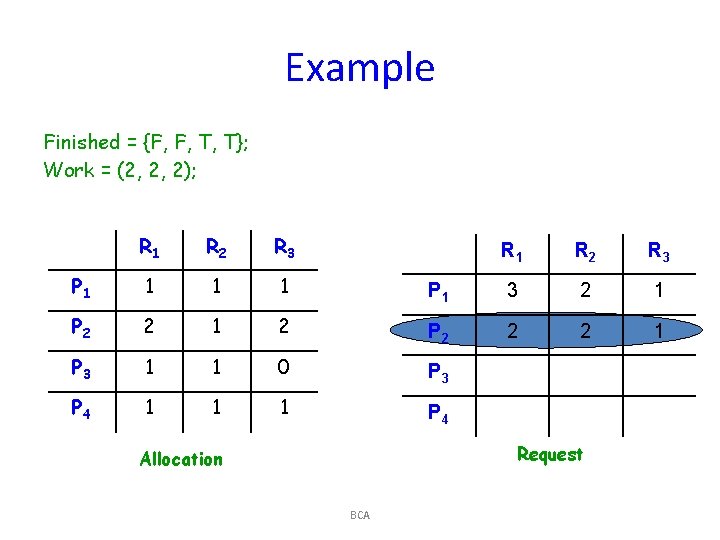
Example Finished = {F, F, T, T}; Work = (2, 2, 2); R 1 R 2 R 3 P 1 1 P 2 2 1 P 3 1 P 4 1 R 2 R 3 P 1 3 2 1 2 P 2 2 2 1 1 0 P 3 1 1 P 4 Request Allocation BCA
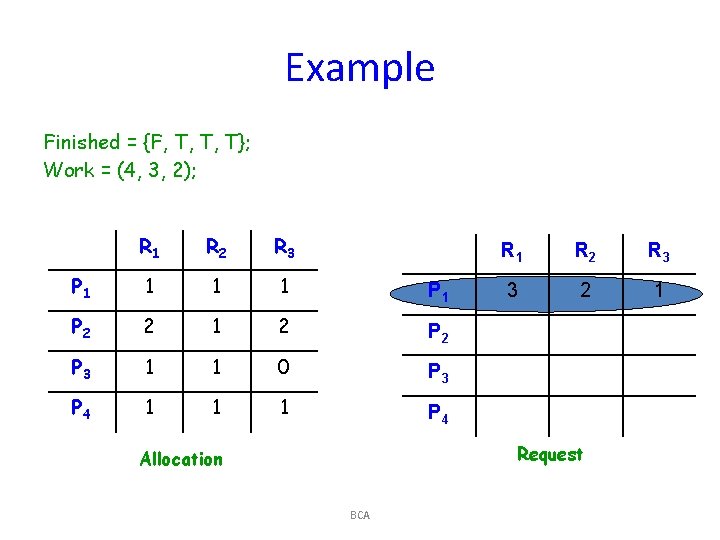
Example Finished = {F, T, T, T}; Work = (4, 3, 2); R 1 R 2 R 3 P 1 1 P 1 P 2 2 1 2 P 3 1 1 0 P 3 P 4 1 1 1 P 4 R 1 R 2 R 3 3 2 1 Request Allocation BCA
When to run Detection Algorithm? • • For every resource request? For every request that cannot be immediately satisfied? Once every hour? When CPU utilization drops below 40%? BCA
Deadlock Recovery • Killing one/all deadlocked processes – Crude, but effective – Keep killing processes, until deadlock broken – Repeat the entire computation • Preempt resource/processes until deadlock broken – Selecting a victim (# resources held, how long executed) – Rollback (partial or total) – Starvation (prevent a process from being executed) BCA
- Slides: 49