
Operating Calibrating and Maintaining Irrigation Systems Lesson 4
Operating, Calibrating, and Maintaining Irrigation Systems Lesson 4
Next Generation Science/Common Core Standards Addressed! • CCSS. ELA Literacy. RST. 9‐ 10. 1 Cite specific textual evidence to support analysis of science and technical texts, attending to the precise details of explanations or descriptions. • CCSS. ELA Literacy. RST. 9‐ 10. 3 Follow precisely a complex multistep procedure when carrying out experiments, taking measurements, or performing technical tasks, attending to special cases or exceptions defined in the text. • CCSS. ELA Literacy. RST. 11‐ 12. 1 Cite specific textual evidence to support analysis of science and technical texts, attending to important distinctions the author makes and to any gaps or inconsistencies in the account. • CCSS. ELA Literacy. RST. 11‐ 12. 3 Follow precisely a complex multistep procedure when carrying out experiments, taking measurements, or performing technical tasks; analyze the specific results based on explanations in the text
Agriculture, Food and Natural Resource Standards Addressed> • PST. 02. Operate machinery and equipment while observing all safety precautions in AFNR settings. – PST. 02. 02. c. Adjust equipment, machinery and power units for safe and efficient operation in AFNR power, structural and technical systems.
Bell Work / Objectives! • Describe the irrigation methods used in agriculture. • Explain the operating principles of irrigation systems used in agriculture. • Describe the calibration of irrigation systems used in agriculture. • Explain the maintenance of irrigation systems used in agriculture.
Terms • • • Available water Border strip irrigation Center‐pivot irrigation Chemigation Efficiency Evaportranspiration Field capacity Permanent wilting point Sprinkler irrigation • • Subsurface irrigation Surface irrigation Trickle or drip irrigation Water‐application efficiency • Water‐conveyance efficiency • Water‐use efficiency • Wheel movement irrigation
Interest Approach • Lead a discussion with students concerning average annual rainfall and the amount required by different crops to produce an average crop. • Explain that irrigation is used in agriculture to supplement annual rainfall. • Use this discussion to lead into objective #1.
Objective #1 What are the irrigation methods used in agriculture?
Methods of irrigation • Subsurface irrigation – watering from below using capillary rise from a zone of soil lower in the soil profile • Surface irrigation – Water come from open ditches – involves flooding the soil surface with water released from canals or piping systems – field needs to have a slight slope to drain properly
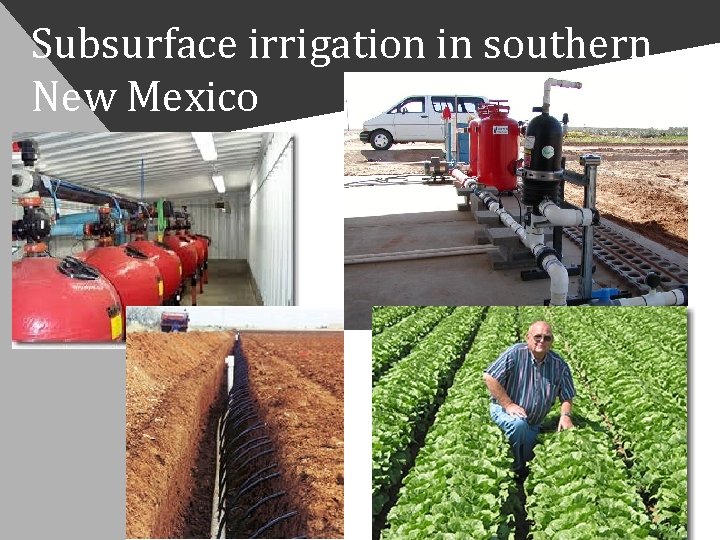
Subsurface irrigation in southern New Mexico
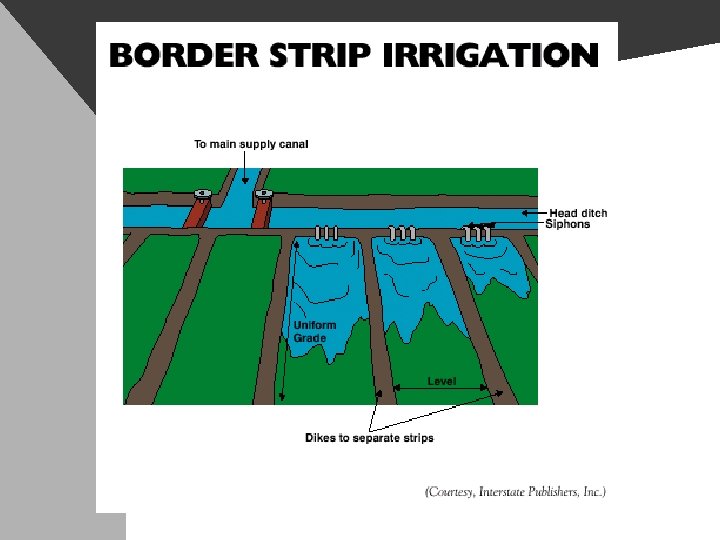
Methods of irrigation • Border strip irrigation – involves covering the entire soil surface of a field with a sheet of water – divide fields into smaller parts by using dikes, then each section is flooded in turns • Furrow irrigation – distributes water through furrows with crops planted on ridges – best suited for row crops

• Border irrigation • Furrow irrigation
Methods of irrigation • Sprinkler irrigation – systems that pump water under pressure through pipes to a sprinkler head – can be used for chemigation • applying chemicals like fertilizer or herbicides in the water • Solid‐set irrigation – entire field set up for irrigation and left until harvest • Traveling‐gun irrigation – uses one large sprinkler mounted on a trailer that moves across the field
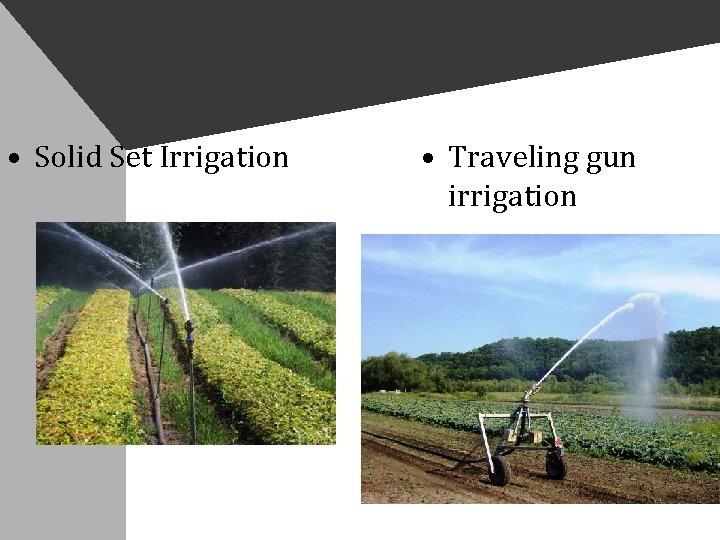
• Solid Set Irrigation • Traveling gun irrigation
Methods of irrigation • Center-pivot irrigation – central pivot point with the watering line elevated above the crop – line slowly moves in a circle to cover entire field • Wheel-move irrigation – consists of a line of sprinklers mounted on the wheels at both ends • Trickle or drip irrigation – involves the use of plastic pipes on the ground running down a crop row with special emitters spaced along pipe
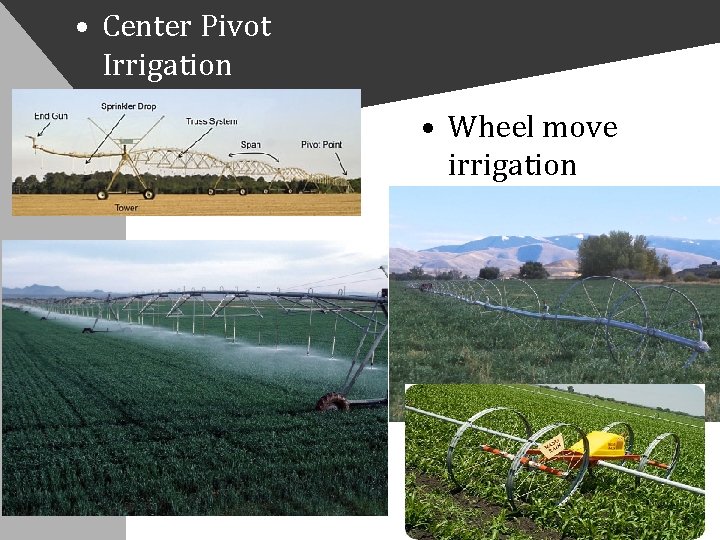
• Center Pivot Irrigation • Wheel move irrigation
Objective #2 What are the operating principles of irrigation systems used in agriculture?
Human dependence on irrigation • Current concepts made possible by modern power sources to deep well pumps and reservoirs. • Increasing demands of water and drought makes effective use of water essential. • Irrigation is a major user of water, system needs to be planned, designed, and operated efficiently. • Water requirements and time vary with crops. • Sufficient water should be available and maintained for optimum growth. • It is expensive to pump water/plan for wise use.
Irrigation operating principles • Evapotranspiration – amount of moisture lost due to evaporation and transpiration • planning and managing irrigation, the soil’s capacity to store available water is important • water‐holding capacity of the soil must be known
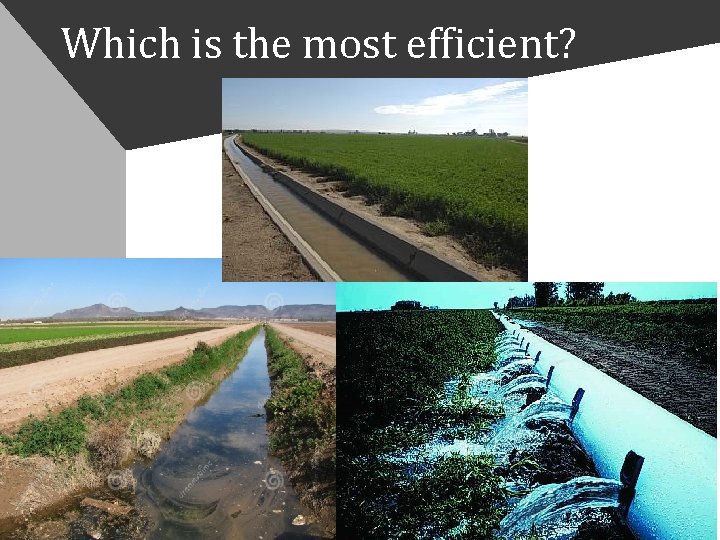
Which is the most efficient?

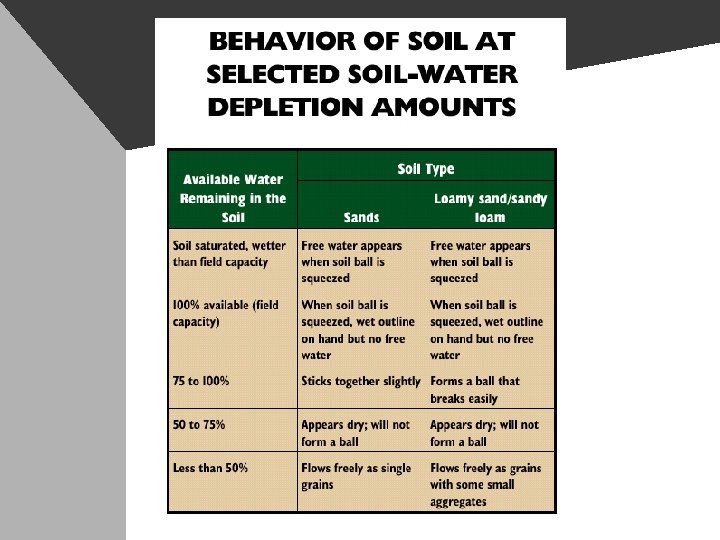
Irrigation operating principles • Field capacity – water content after a soil is wetted and allowed to drain 1 to 2 days. – Represents the upper limit of water available to plants • Permanent wilting point – represent the lower limit of water available to plants • Available water – difference between field capacity and permanent wilting point
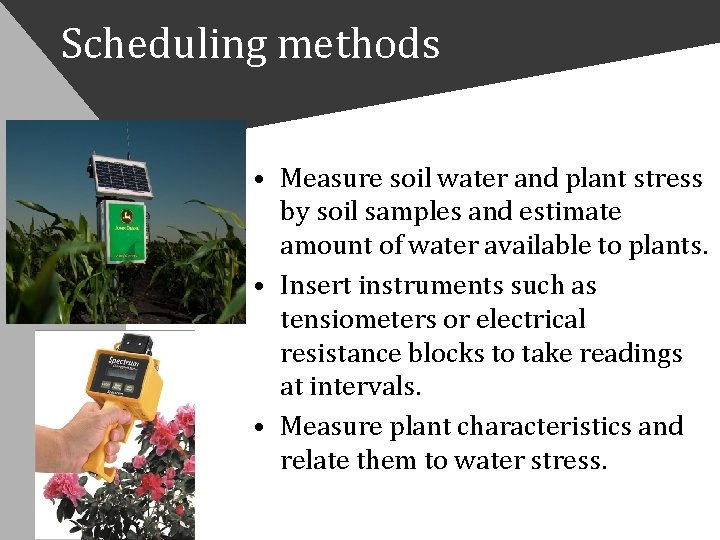
Scheduling methods • Measure soil water and plant stress by soil samples and estimate amount of water available to plants. • Insert instruments such as tensiometers or electrical resistance blocks to take readings at intervals. • Measure plant characteristics and relate them to water stress.
Objective #3 How are irrigation systems calibrated?
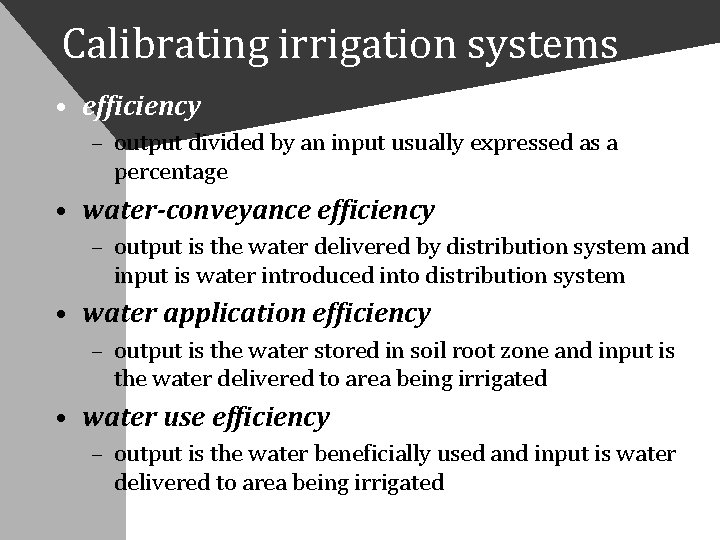
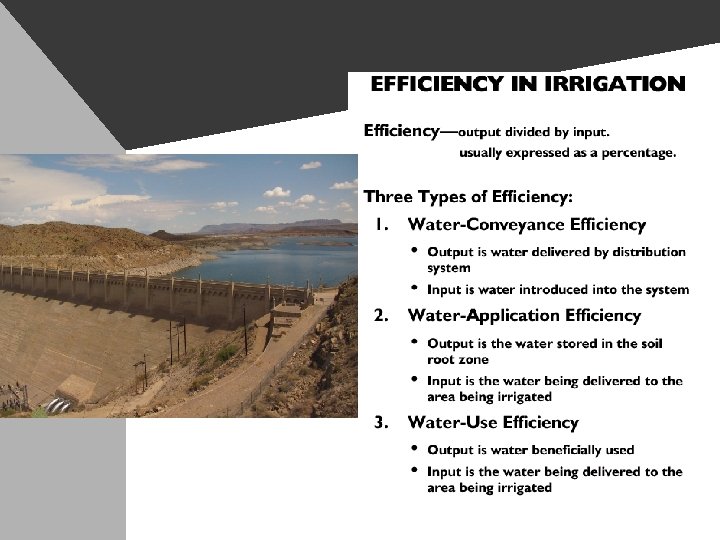
Calibrating irrigation systems • efficiency – output divided by an input usually expressed as a percentage • water-conveyance efficiency – output is the water delivered by distribution system and input is water introduced into distribution system • water application efficiency – output is the water stored in soil root zone and input is the water delivered to area being irrigated • water use efficiency – output is the water beneficially used and input is water delivered to area being irrigated
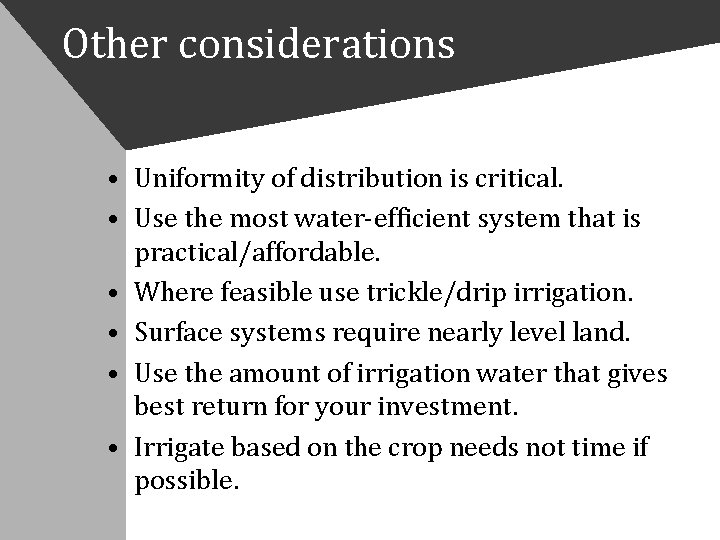
Other considerations • Uniformity of distribution is critical. • Use the most water‐efficient system that is practical/affordable. • Where feasible use trickle/drip irrigation. • Surface systems require nearly level land. • Use the amount of irrigation water that gives best return for your investment. • Irrigate based on the crop needs not time if possible.
Objective #4 How are irrigation systems maintained?
Irrigation system maintenance • • • Follow manufacturer’s recommendations. Saving water is an important consideration. Avoid water pollution. System is matched to crop, soil and terrain. Maintain all systems efficiently. Transport water in sealed ditches/pipes to avoid evaporation. • Systems should contain devices to measure and control water flow.
Review • What are the irrigation methods used in agriculture? • What are the operating principles of irrigation systems used in agriculture? • How are irrigation systems calibrated?
The End!
- Slides: 32