
Operating Calibrating and Maintaining Feed Handling Systems Lesson
Operating, Calibrating, and Maintaining Feed Handling Systems Lesson 8
Next Generation Science/Common Core Standards Addressed! n CCSS. ELA Literacy. RST. 9‐ 10. 1 Cite specific textual evidence to support analysis of science and technical texts, attending to the precise details of explanations or descriptions. n CCSS. ELA Literacy. RST. 9‐ 10. 7 Translate quantitative or technical information expressed in words in a text into visual form (e. g. , a table or chart) and translate information expressed visually or mathematically (e. g. , in an equation) into words. n CCSS. ELA Literacy. RST. 11‐ 12. 3 Follow precisely a complex multistep procedure when carrying out experiments, taking measurements, or performing technical tasks; analyze the specific results based on explanations in the text n HSSIC. A. 1 Understand statistics as a process for making inferences about population parameters based on a random sample from that population. (HS‐LS 2‐ 6)
Agriculture, Food and Natural Resource Standards Addressed! n PST. 02. Operate machinery and equipment while observing all safety – PST. 02. 02. b. Apply safety principles and applicable regulations to operate equipment, machinery and power units used in AFNR power, structural and technical systems. precautions in AFNR settings.
Bell Work / Student Learning Objectives 1 1 2 3 What Factors should you consider when building feeders in your shop class? Describe the operation of feed handling systems. Explain the calibration of feed handling systems. Describe the maintenance of feed handling systems.
Terms n The following terms are presented in the lesson. n Forage Palatability Pneumatic Roughage n n n
Interest Approach n n Who works for someone who has livestock or owns their on livestock? Where does the feed for these animals come from? What type of equipment is used to deliver feed to livestock? Is there much maintenance with feed handling equipment?

Feeding Roughages! n n n Loose hay, bales and stacks, Commonly fed in self-feeders or spread on ground, Self feeding causes high feed losses often up to 50% Trampling causes natural vegetation loss Feed losses can be as low as 5 - 10% by controlling access
Feeding Silage, Haylage, Dry Chopped Hay n n Most efficient with the use of a feeder (bunk) made of wood, concrete, steel, or rubber. Feeders hold feed for storage and while it is eaten. They may also protect feed from the weather.
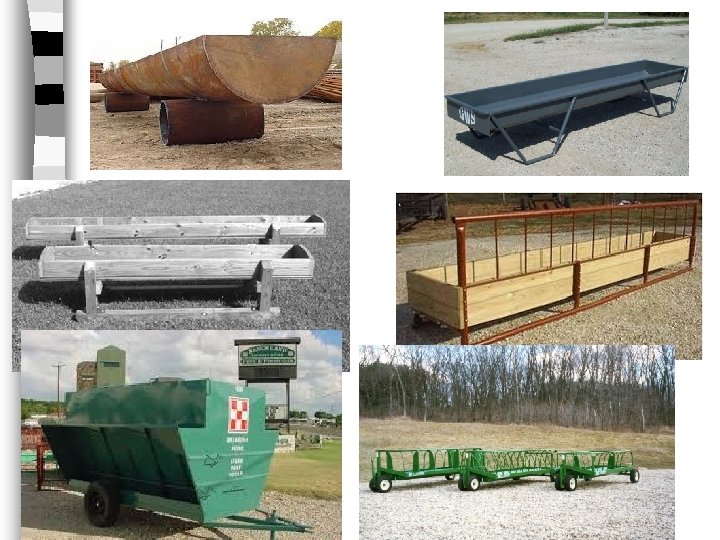
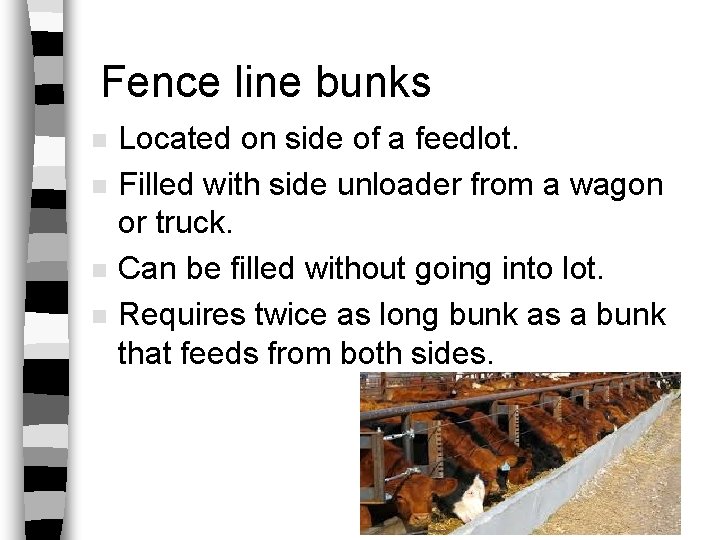
Fence line bunks n n Located on side of a feedlot. Filled with side unloader from a wagon or truck. Can be filled without going into lot. Requires twice as long bunk as a bunk that feeds from both sides.
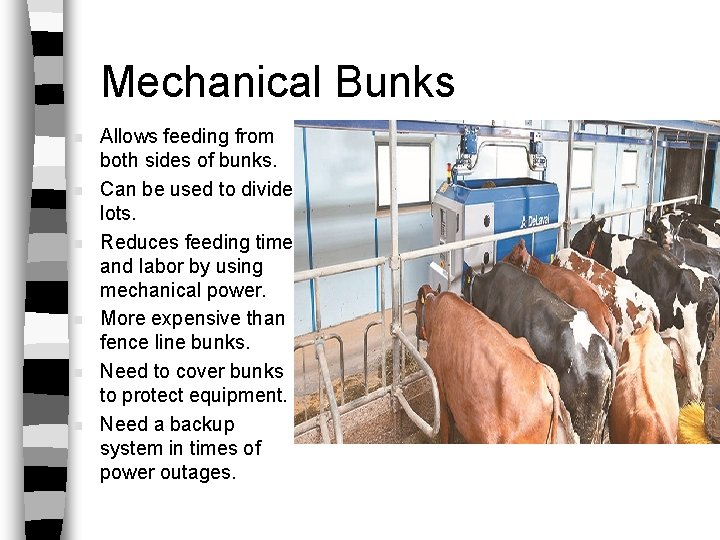
Mechanical Bunks n n n Allows feeding from both sides of bunks. Can be used to divide lots. Reduces feeding time and labor by using mechanical power. More expensive than fence line bunks. Need to cover bunks to protect equipment. Need a backup system in times of power outages.
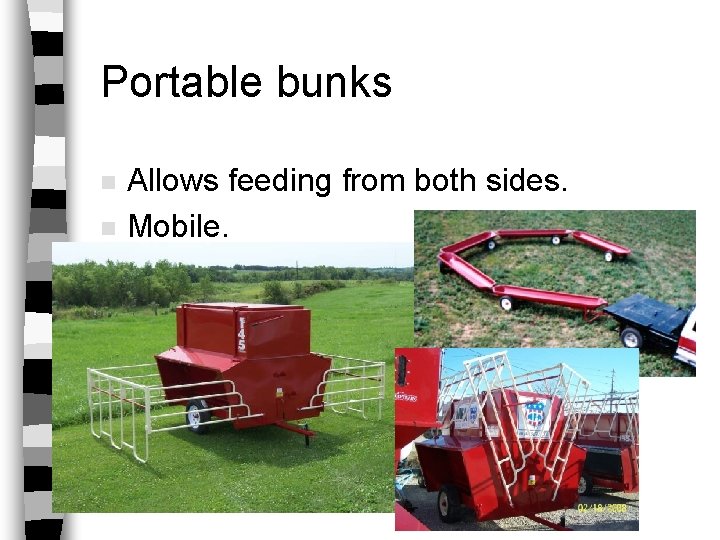
Portable bunks n n Allows feeding from both sides. Mobile.

Feeding Energy & Protein Supplements n Examples – Corn – Cotton Seed meal/cake n n Recommend these be fed in bunk or self-feeder. Can be fed in the same bunk as the roughages.
Maintaining and building. Selffeeders & bunks! n n n Drainage holes need to be present to remove rainwater. Drain holes can’t be to large or it will result if feed loss. May be wood or metal structures.
Advantages of Self-feeders & bunks n Palatability – feed tastes good to the animal n n feed with greatest palatability in eaten within 4 days feed is offered free choice so animal can eat as much as it wants
Feed Centers n n Provides for receiving, drying, storing, unloading, elevating, and conveying provides also for processing grain and additives
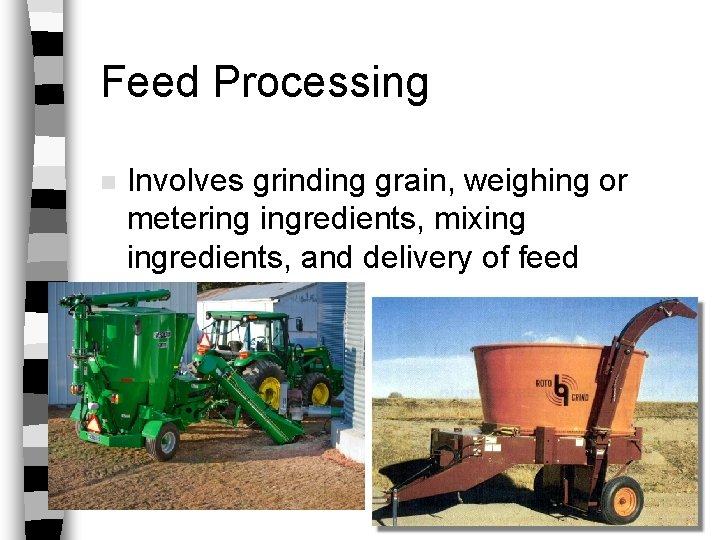
Feed Processing n Involves grinding grain, weighing or metering ingredients, mixing ingredients, and delivery of feed
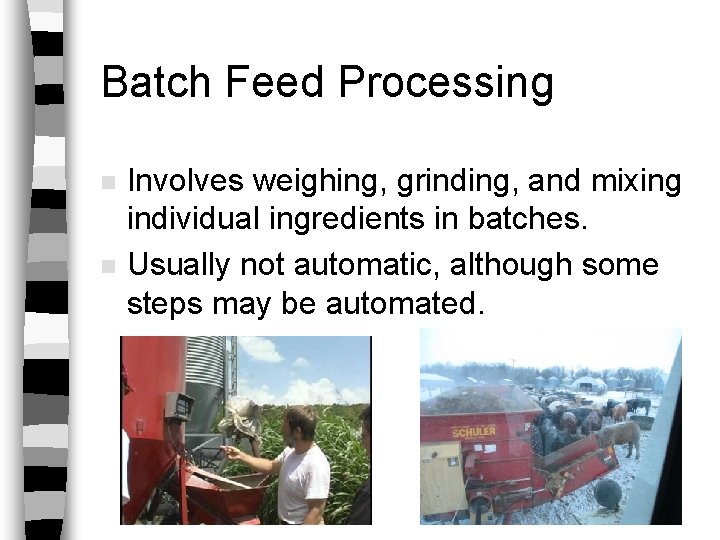
Batch Feed Processing n n Involves weighing, grinding, and mixing individual ingredients in batches. Usually not automatic, although some steps may be automated.
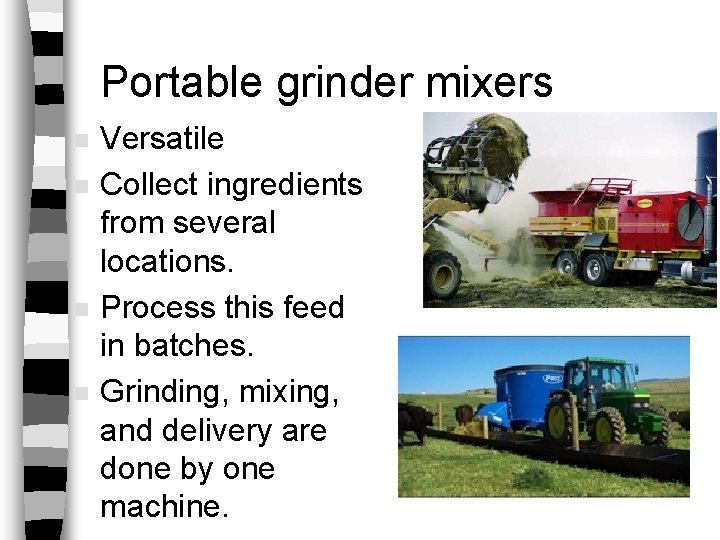
Portable grinder mixers n n Versatile Collect ingredients from several locations. Process this feed in batches. Grinding, mixing, and delivery are done by one machine.
Stationary mills with mixers n n n Offers good control over feed composition. Wagon or truck delivers the completed feed to bulk tank or self-feeder. pneumatic system – systems that convey by airstream
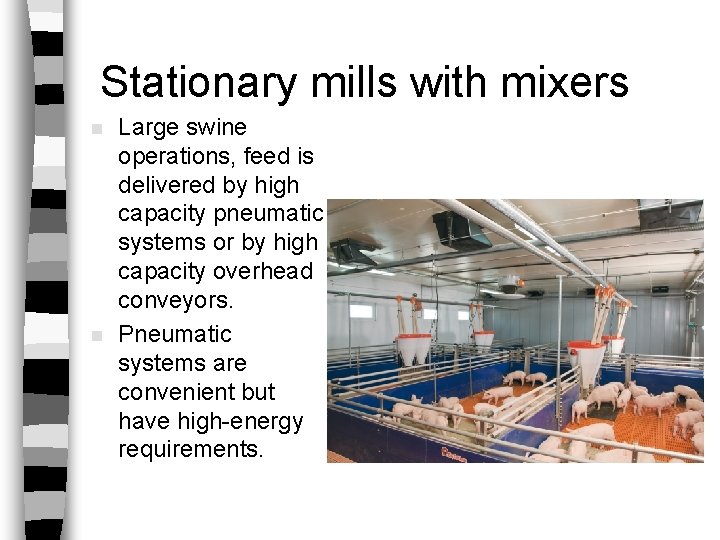
Stationary mills with mixers n n Large swine operations, feed is delivered by high capacity pneumatic systems or by high capacity overhead conveyors. Pneumatic systems are convenient but have high-energy requirements.
Feed handling systems n n Designed to be efficient and convenient. All steps in feed handling and processing operations require close monitoring.
Initial Settings n Rations require accuracy in metering, processing, grinding, and mixing ingredients. n Initial settings for equipment can be found using tables provided by equipment manufacturer.
Testing to insure quality n n Send in samples to test that the feed contains proper quantities of nutrients and additives. If feed is not ground sufficiently or ground too much, change the screen in the mill.
Dispensing Feed n Dispensing feed in bunks, effort and care must be taken to spread the material evenly throughout the entire bunk.
Feeder Settings n n n Daily observations can tell if the feeders are set properly. Excess feed around feeder the setting is open to much. If feed is completely cleaned up, not enough of an opening is present.
Objective #3 Describe the maintenance of feed handling systems. n How are feed handling systems maintained?
Feed handling systems n n To function properly, proper maintenance of equipment must be followed. Adequate and timely adjustments, repair, lubrication, protection from weather, and proper clean-up determine life of equipment.
Review n n n How are feed handling systems operated? How are feed handling systems calibrated? How are feed handling systems maintained?
The end!
- Slides: 30