
Operant Conditioning Part I William G Huitt Educational
- Slides: 17
Operant Conditioning Part I William G. Huitt Educational Psychology Interactive Last rev: June 2012
Operant Conditioning The study of the of consequences on Ivanimpact Pavlov—Russian scientist voluntary behavior. trained in biology and medicine Major theorists Studied digestive system in dogs – Edward Thorndike – John Watson – B. F. Skinner Dominant learning paradigm in USA psychology from the 1930 s to the 1950 s
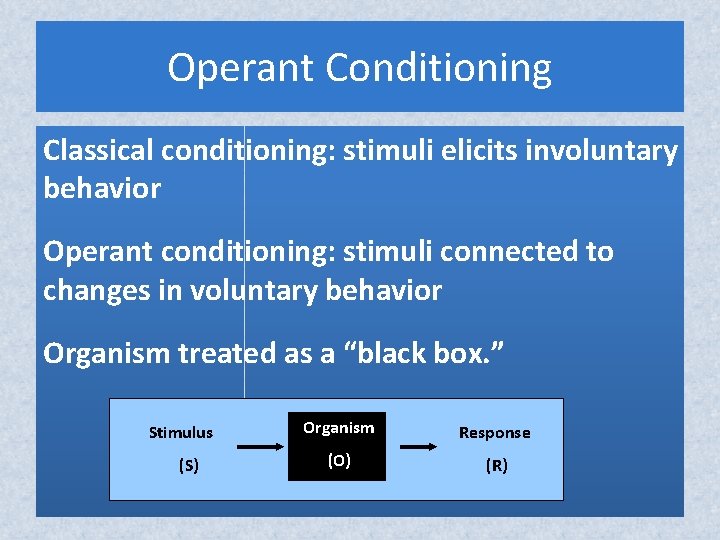
Operant Conditioning Classical conditioning: stimuli elicits involuntary behavior Operant conditioning: stimuli connected to changes in voluntary behavior Organism treated as a “black box. ” Stimulus (S) Organism Response (O) (R)
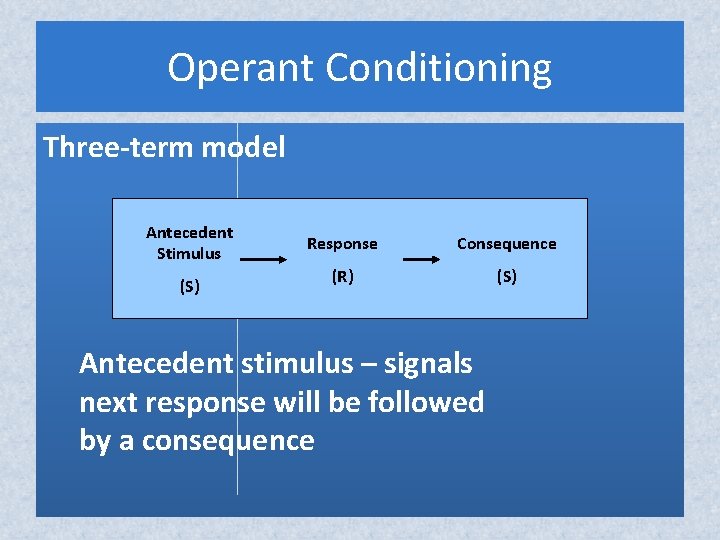
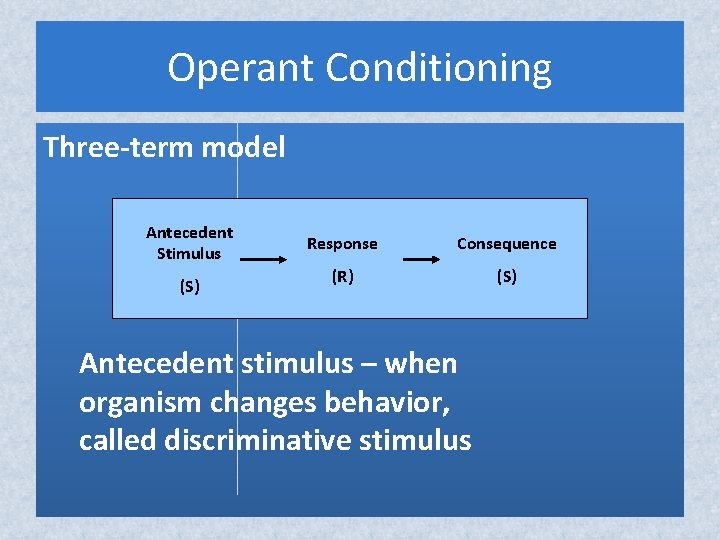
Operant Conditioning Three-term model Antecedent Stimulus (S) Response Consequence (R) (S) Antecedent stimulus – signals next response will be followed by a consequence
Operant Conditioning Three-term model Antecedent Stimulus (S) Response Consequence (R) (S) Antecedent stimulus – when organism changes behavior, called discriminative stimulus
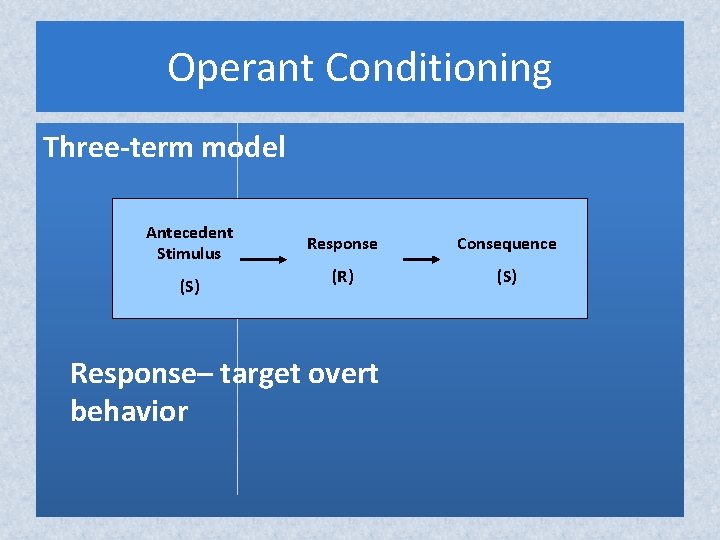
Operant Conditioning Three-term model Antecedent Stimulus (S) Response Consequence (R) (S) Response– target overt behavior
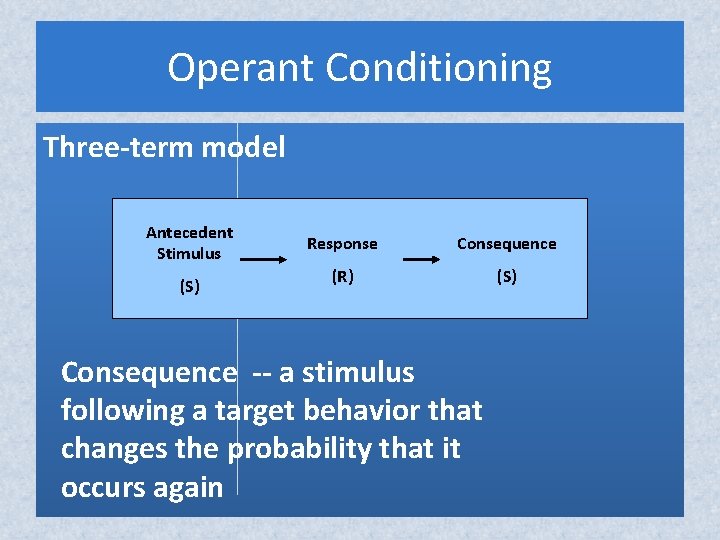
Operant Conditioning Three-term model Antecedent Stimulus (S) Response Consequence (R) (S) Consequence -- a stimulus following a target behavior that changes the probability that it occurs again
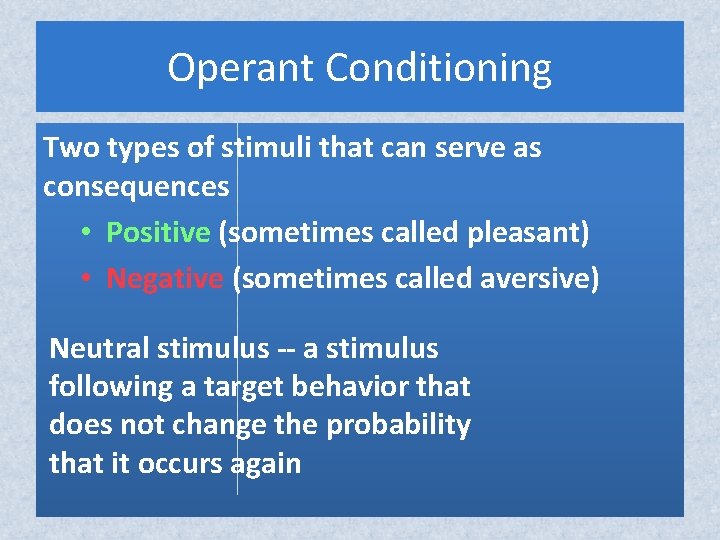
Operant Conditioning Two types of stimuli that can serve as consequences • Positive (sometimes called pleasant) • Negative (sometimes called aversive) Neutral stimulus -- a stimulus following a target behavior that does not change the probability that it occurs again
Operant Conditioning Two actions can be taken with the stimuli: • They can be ADDED to the learner’s environment • They can be SUBTRACTED from the learner’s environment
Operant Conditioning Two results can be achieved: • Adding or subtracting (removing) the stimulus results in an INCREASE in the probability the behavior occurs again • Adding or subtracting (removing) the stimulus results in a DECREASE in the probability the behavior occurs again
Operant Conditioning Neutral stimulus – If adding or subtracting a stimulus following a target behavior does not change the probability that it occurs again
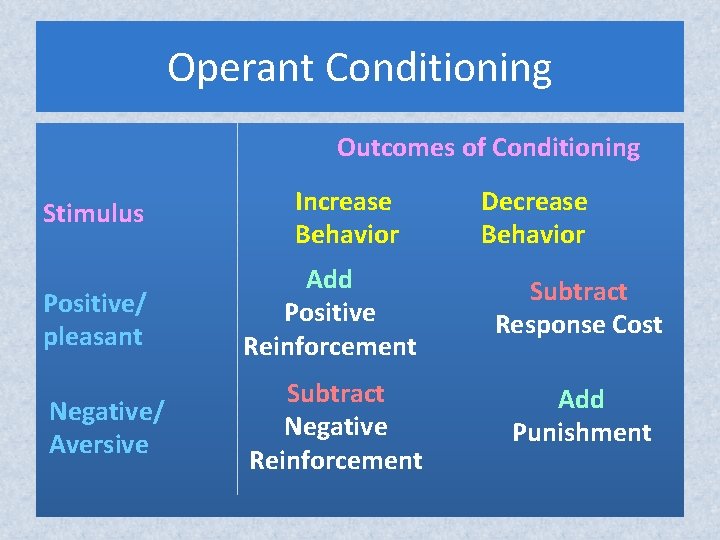
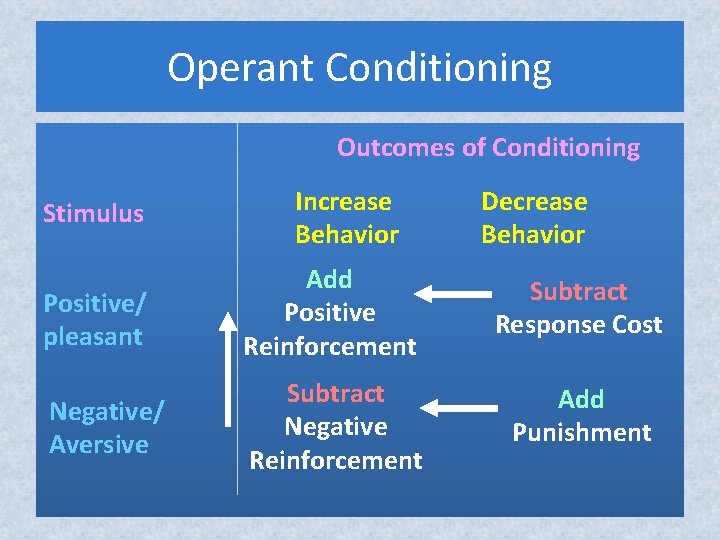
Operant Conditioning Four major operant conditioning techniques result from • Considering the purpose (increase or decrease a target behavior • Selecting a stimulus (positive/pleasant or negative/aversive • Determine action to be taken (add or subtract)
Operant Conditioning Outcomes of Conditioning Increase Behavior Decrease Behavior
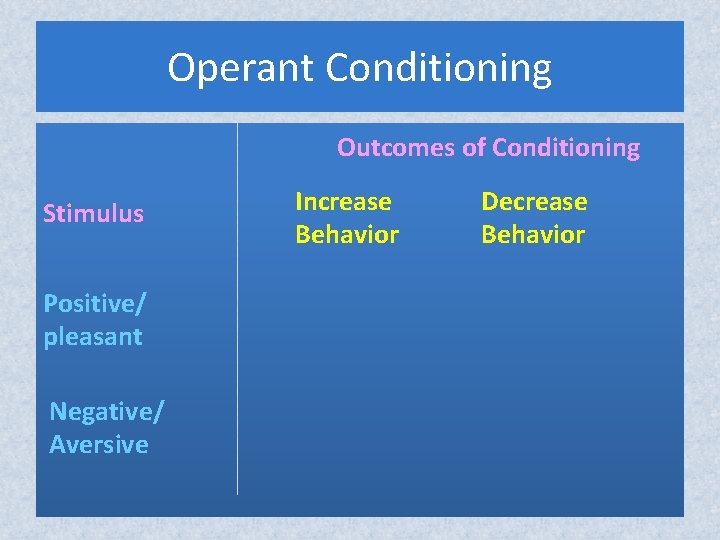
Operant Conditioning Outcomes of Conditioning Stimulus Positive/ pleasant Negative/ Aversive Increase Behavior Decrease Behavior
Operant Conditioning Outcomes of Conditioning Stimulus Increase Behavior Decrease Behavior Positive/ pleasant Add Positive Reinforcement Subtract Response Cost Negative/ Aversive Subtract Negative Reinforcement Add Punishment
Operant Conditioning Outcomes of Conditioning Stimulus Increase Behavior Decrease Behavior Positive/ pleasant Add Positive Reinforcement Subtract Response Cost Negative/ Aversive Subtract Negative Reinforcement Add Punishment
Operant Conditioning To learn about using schedules when deciding how to apply operant conditioning