
OPERA Open PLC European Research Alliance 6 TH
- Slides: 10
OPERA Open PLC European Research Alliance 6 TH FRAMEWORK PROGRAMME OPERA-COPRAS Brussels October 14 th 2004 Possible Collaborations Author: Luis J. Legorburu Date: October 14 th 2004
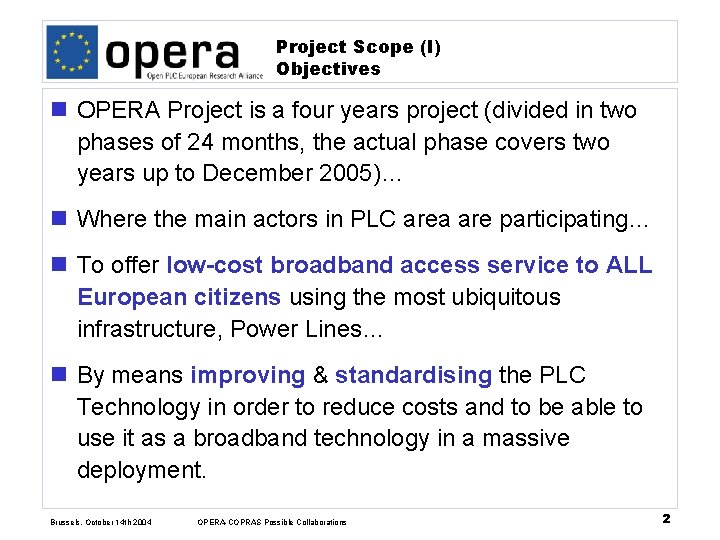
Project Scope (I) Objectives n OPERA Project is a four years project (divided in two phases of 24 months, the actual phase covers two years up to December 2005)… n Where the main actors in PLC area are participating… n To offer low-cost broadband access service to ALL European citizens using the most ubiquitous infrastructure, Power Lines… n By means improving & standardising the PLC Technology in order to reduce costs and to be able to use it as a broadband technology in a massive deployment. Brussels, October 14 th 2004 OPERA-COPRAS Possible Collaborations 2
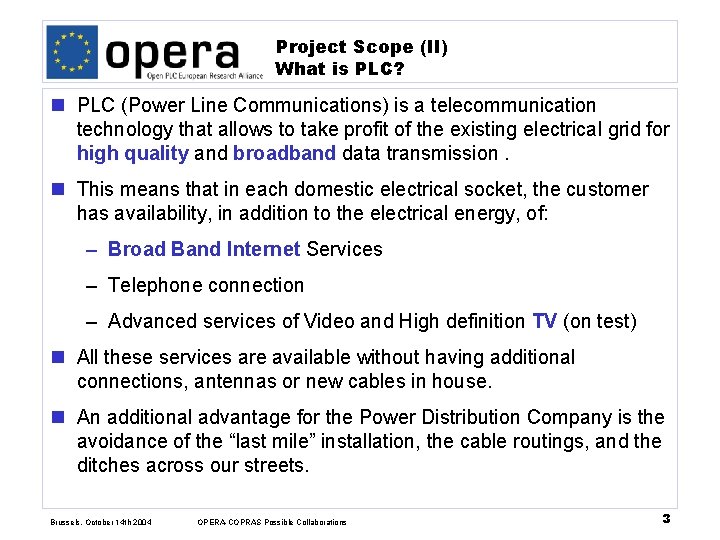
Project Scope (II) What is PLC? n PLC (Power Line Communications) is a telecommunication technology that allows to take profit of the existing electrical grid for high quality and broadband data transmission. n This means that in each domestic electrical socket, the customer has availability, in addition to the electrical energy, of: – Broad Band Internet Services – Telephone connection – Advanced services of Video and High definition TV (on test) n All these services are available without having additional connections, antennas or new cables in house. n An additional advantage for the Power Distribution Company is the avoidance of the “last mile” installation, the cable routings, and the ditches across our streets. Brussels, October 14 th 2004 OPERA-COPRAS Possible Collaborations 3
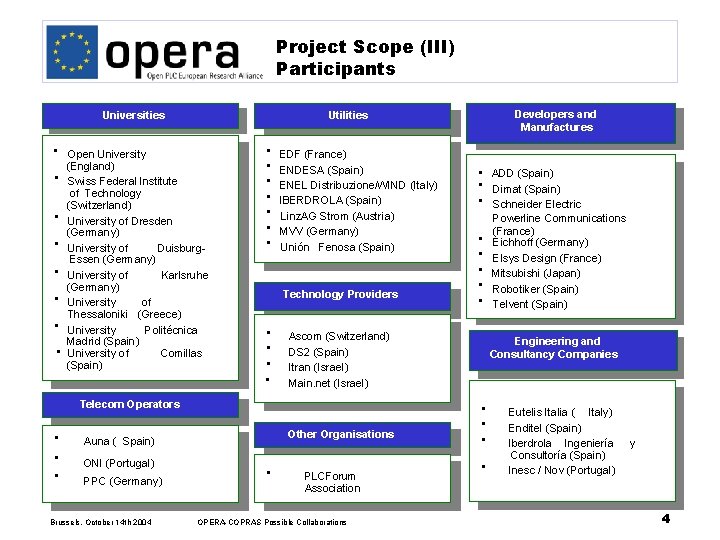
Project Scope (III) Participants Universities • Open University (England) • Swiss Federal Institute of Technology (Switzerland) • University of Dresden (Germany) • University of Duisburg. Essen (Germany) • University of Karlsruhe (Germany) • University of Thessaloniki (Greece) • University Politécnica Madrid (Spain) • University of Comillas (Spain) • • EDF (France) ENDESA (Spain) ENEL Distribuzione/WIND (Italy) IBERDROLA (Spain) Linz. AG Strom (Austria) MVV (Germany) Unión Fenosa (Spain) Technology Providers • • Auna ( Spain) • ONI (Portugal) • PPC (Germany) Brussels, October 14 th 2004 Other Organisations • • ADD (Spain) • Dimat (Spain) • Schneider Electric Powerline Communications (France) • Eichhoff (Germany) • Elsys Design (France) • Mitsubishi (Japan) • Robotiker (Spain) • Telvent (Spain) Ascom (Switzerland) DS 2 (Spain) Itran (Israel) Main. net (Israel) Telecom Operators • Developers and Manufactures Utilities PLCForum Association OPERA-COPRAS Possible Collaborations Engineering and Consultancy Companies • • Eutelis Italia ( Italy) Enditel (Spain) Iberdrola Ingeniería Consultoría (Spain) Inesc / Nov (Portugal) y 4
Technologies, specifications, other outputs that are intended to be European or global standards or may contribute to standardisation work n Our Project have into its objectives to contibute to the Standardisation of PLC sys-tems for the following issues: – Functional requirements: topologies of PLC networks and system requirements (performance, Qo. S, network management, electric safety specifications, dimensions, target cost). – Access system specification: PHY layer, MAC layer, coexistence indoor-access, MIB for NMS, PLC network/services interfaces. – PLC equipment specification: specification of requirements of PLC equipment. – EMC: there are only standard & compliance at national level and the objective is European level. – Interface with narrow band PLC System. n Those specifications will be taken to standardisation bodies and will be the basis for the manufacture of (standard) new generation PLC systems to be used in the deployment. Brussels, October 14 th 2004 OPERA-COPRAS Possible Collaborations 5
Specific WPs addressing activities required to interface with standards bodies n Workpackage 5: “Specification & standardisation” – Objectives • To specify the requirements of the new PLC Integrated Network that will be the reference for the work of all workpackages. • To drive the PLC standardisation in the competent organisations. – Budget: 170 Man/months (both for Specifying and Addressing) Brussels, October 14 th 2004 OPERA-COPRAS Possible Collaborations 6
Coordinating standardisation related activity with other IST projects n Up to this moment, our only process to coordinating standardisation related activity with other IST projects either in FP 6 or other Framework Programmes is the present one: – COPRAS Brussels, October 14 th 2004 OPERA-COPRAS Possible Collaborations 7
Coordination with standards bodies/industry consortia, concerned activity & involved organisations n Standards body or industry consortium; Forecasted Contacts: – CENELEC SC 205 A working Group 10 on PLC standardisation – Work Group WG 3 of the committee CISPR/I (EMC of Information technology equipment, multimedia equipment and receivers) which are developing a standard on product EMC Brussels, October 14 th 2004 OPERA-COPRAS Possible Collaborations n Activities Involved: Workpackage 5 – Our deliverable D 59 consists in the Deliverables updating to transform them to proposal documents (final drafts) for the standardisation bodies. – The Contacts have not started yet. Our Proposal documents for the standardisation bodies will be released at month 24 (End of 2005), as stated in our milestones. 8
Standardisation Issues Addressing Specific Areas (I) n Expected results that may concern standardization issues. : – Specification of requirements of PLC System. – Specification of requirements of PLC Equipment. – PLC EMC aspects: measurements, disturbance voltage, radiation, immunity, approval testing… – PLC de facto standard. – Proposal documents for the standardisation bodies Brussels, October 14 th 2004 OPERA-COPRAS Possible Collaborations 9
Standardisation Issues Addressing Specific Areas (II) n Detailed Tech. & Spec. and Standards related Outputs (Deliverables): – D 45 Specification of PLC system requirements. – D 46 General specification of PLC PHY layer – D 47 General specification of PLC MAC layer – D 48 Specification of common MIB for all PLC equipment. – D 49 Solutions for coexistence between Access and Indoor systems – D 50 Specification of standard interfaces. – D 51 Specification of requirements of PLC equipment: • Access network PLC equipment • Customer premises equipment • User’s terminals – D 52 Specification for EMC measurements to be performed. – D 53 Report on disturbance voltage measurement method. – D 56 Specifications for PLC type approval testing. – D 57 Specification of interfaces between home automation and PLC and between AMR and PLC systems. – D 58 Report on the progress of PLC standardisation. – D 59 Deliverables update to transform them to proposal documents (final drafts) for the standardisation bodies. Brussels, October 14 th 2004 OPERA-COPRAS Possible Collaborations 10