
Opening the Door Motivational Interviewing Clinical Supervision Jacque

- Slides: 38
Opening the Door: Motivational Interviewing & Clinical Supervision Jacque Elder, Psy. D. Karen Grimley, LCSW
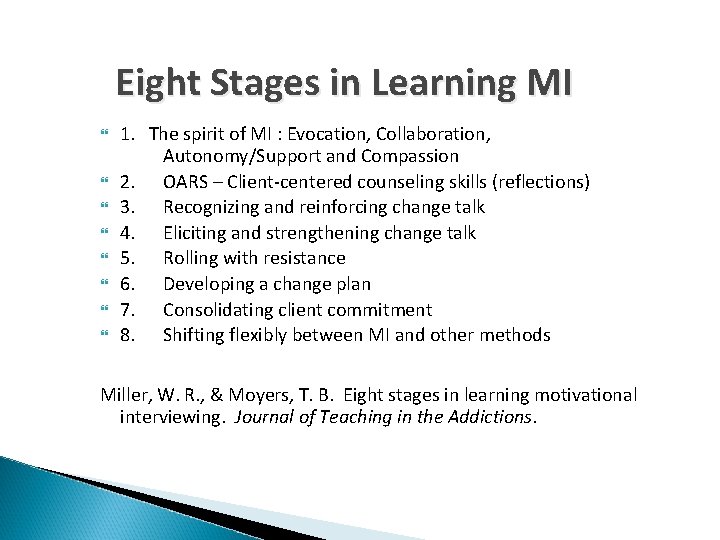
Eight Stages in Learning MI 1. The spirit of MI : Evocation, Collaboration, Autonomy/Support and Compassion 2. OARS – Client-centered counseling skills (reflections) 3. Recognizing and reinforcing change talk 4. Eliciting and strengthening change talk 5. Rolling with resistance 6. Developing a change plan 7. Consolidating client commitment 8. Shifting flexibly between MI and other methods Miller, W. R. , & Moyers, T. B. Eight stages in learning motivational interviewing. Journal of Teaching in the Addictions.
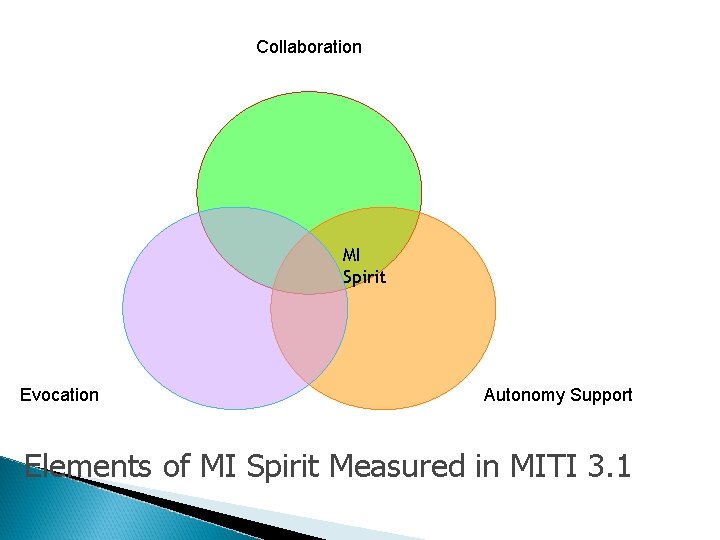
Collaboration MI Spirit Evocation Autonomy Support Elements of MI Spirit Measured in MITI 3. 1
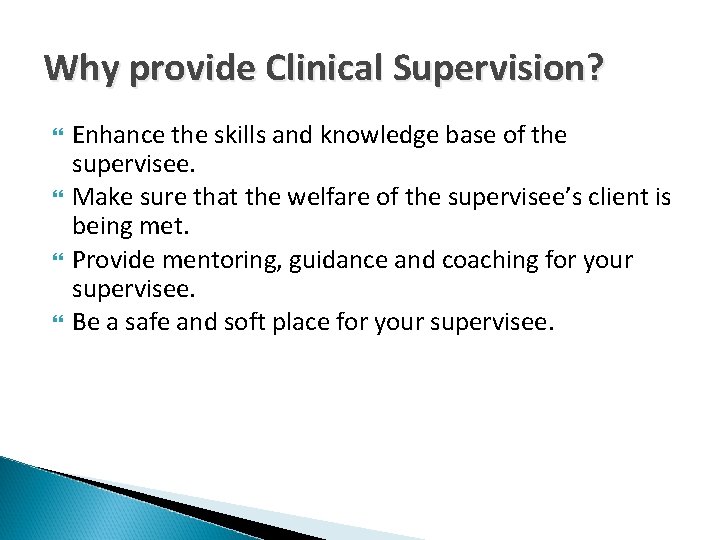
Why provide Clinical Supervision? Enhance the skills and knowledge base of the supervisee. Make sure that the welfare of the supervisee’s client is being met. Provide mentoring, guidance and coaching for your supervisee. Be a safe and soft place for your supervisee.
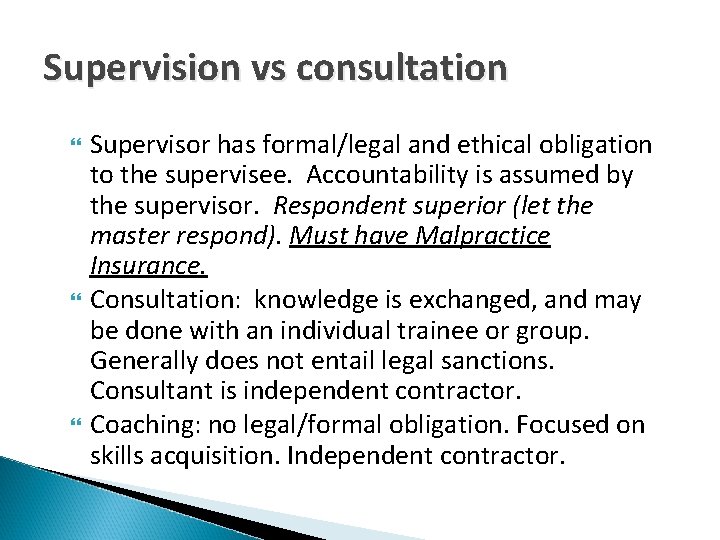
Supervision vs consultation Supervisor has formal/legal and ethical obligation to the supervisee. Accountability is assumed by the supervisor. Respondent superior (let the master respond). Must have Malpractice Insurance. Consultation: knowledge is exchanged, and may be done with an individual trainee or group. Generally does not entail legal sanctions. Consultant is independent contractor. Coaching: no legal/formal obligation. Focused on skills acquisition. Independent contractor.
Everyone has the right to a supervisory session free from interruptions and distractions. How many practitioners receive this?
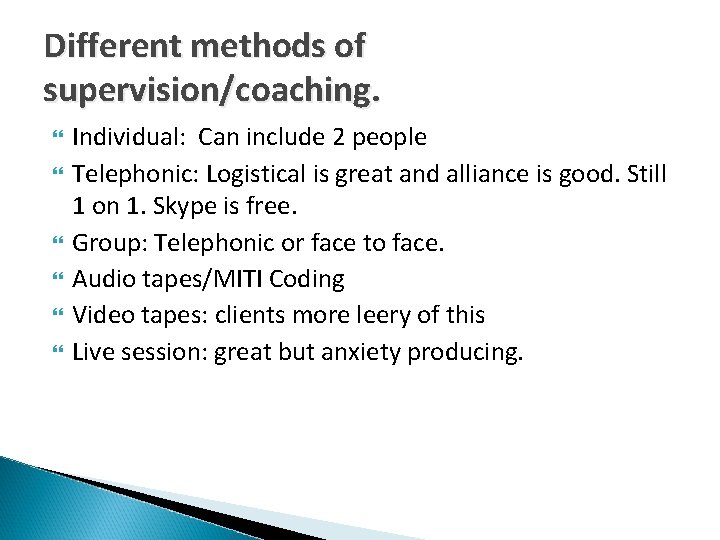
Different methods of supervision/coaching. Individual: Can include 2 people Telephonic: Logistical is great and alliance is good. Still 1 on 1. Skype is free. Group: Telephonic or face to face. Audio tapes/MITI Coding Video tapes: clients more leery of this Live session: great but anxiety producing.
Fogel (“…the rebellious supervisor”) “My whole purpose in supervision has been to create such a safe environment that the trainee can function in his/her own style and feel cherished enough to ask for help when the going gets rough. We can then reflect, explore options, and discover together the process which feels suited to the trainee’s present psychic state and skills”
Why use MITI Coding in Coaching or Clinical Supervision? Feedback and follow-up show the best results (Project EMMEE) Opens the door that has been closed. Has fidelity so we know it is an good approximation of skill. Big leaps of skills with 4 -5 sessions of coding and feedback.
MITI Empirically validated instrument Treatment integrity measure in clinical trials of MI Means of providing feedback in supervision to improve practice Measure of interviewer behaviour only Typically single pass 2 components; GLOBAL scores BEHAVIOR counts
What are we doing, exactly? BEHAVIOR COUNTS Running tally without judgement or observation of accuracy – simply to count 5 measures GLOBAL SCORES Reflect the holistic evaluation of the interview, the Gestalt 5 dimensions
Coding tapes Audio tapes used, random 20 minute segment Target behavior of the intervention must be known Two passes may be used initially to help become better coders Always use your manual Practice, practice!
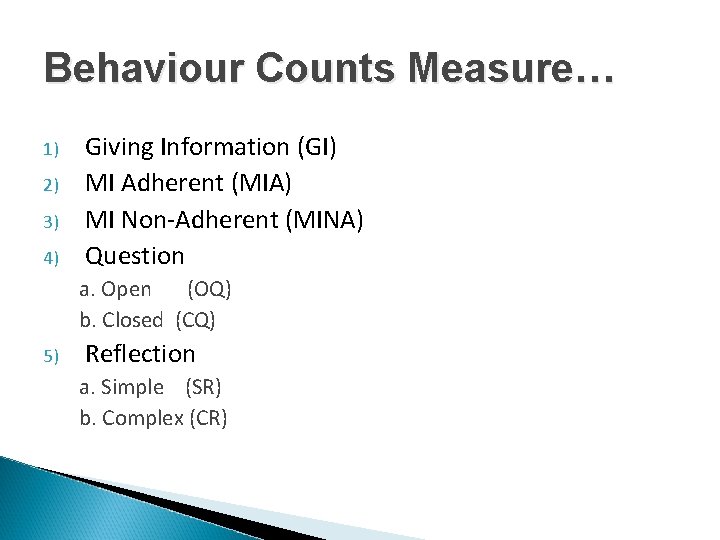
Behaviour Counts Measure… 1) 2) 3) 4) Giving Information (GI) MI Adherent (MIA) MI Non-Adherent (MINA) Question a. Open (OQ) b. Closed (CQ) 5) Reflection a. Simple (SR) b. Complex (CR)
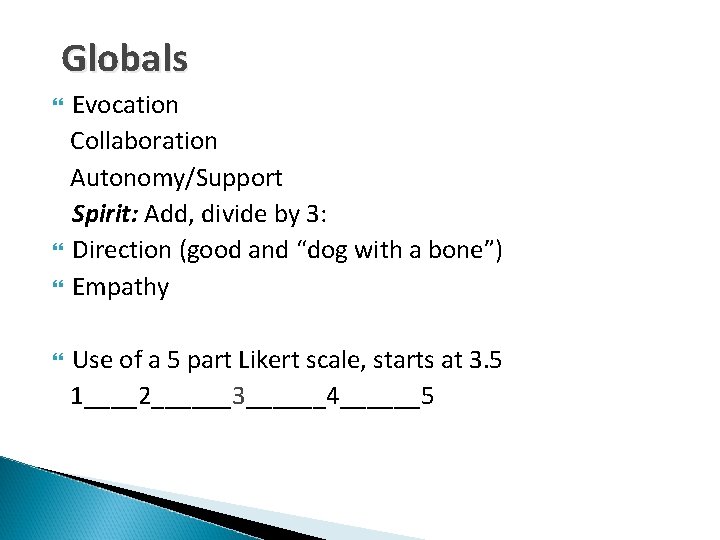
Globals Evocation Collaboration Autonomy/Support Spirit: Add, divide by 3: Direction (good and “dog with a bone”) Empathy Use of a 5 part Likert scale, starts at 3. 5 1____2______3______4______5
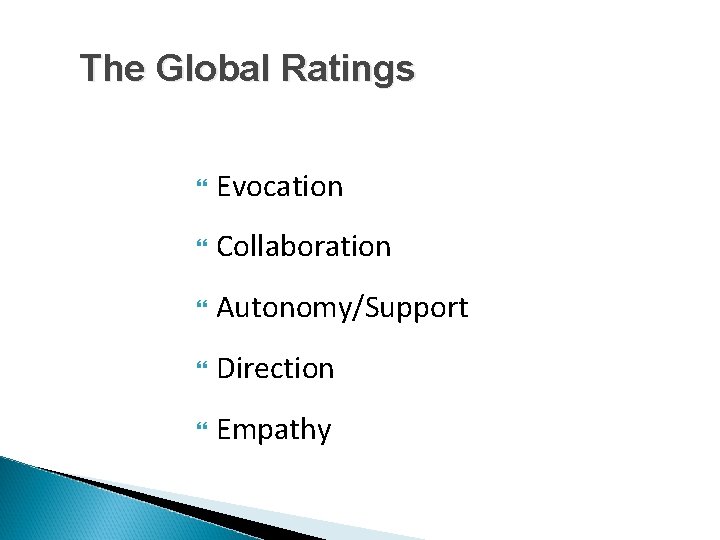
The Global Ratings Evocation Collaboration Autonomy/Support Direction Empathy
Evocation Eliciting information and ideas from the client and doing so in a way that moves the session forward, rather than taking history. Curious, and assumes that the client has “internal treatment plan”. Just ask!
Collaboration Taking your “expert or practitioner” hat off before the session and it may sounds like a conversation between 2 equal parnters.
Autonomy/Support Stating the obvious: The client will do what they want to do regardless of what we say or do. This is true is all areas: family, school, job. Optimistic: assuming that they will move towards health, and respecting their choice not to choose change or health. We do share our optimism for them!
Direction Is there a compass moving towards the Target Behavior? Who is leading the session? Too much listening? Talkative client? What to do! 5: Strategic and dancing. 5: “Dog with a bone!”
Empathy Rogers: You take off your “shoes” of your values, judgments and worldview, knowing that are waiting for you outside the door. Curious, entering the world as if it is a journey (which it is). Measures the extent to which the clinician understands or makes an effort to grasp the client’s perspective and feelings. Not to be confused with warmth or advocacy.
The MITI results and feedback Get ready to use your best MI skills. Have your feedback sheet ready and use it. Feedback must be gentle, gentle. Hold your supervisee up. (Kindergarten. . ) Share 3 things they did right. Ask them what pops out right away.
Using Empathy in Supervision We were once all counselors-in-training. Being willing to talk about our own mistakes as counselors. Form an alliance (80/20 formula) Acceptance works better than judgment. Careful not to over-identify with the supervisee (parallel experiences). Entering the supervisee’s “internal world”.
MITI Fun Practice One person is supervisor/coach Other is supervisee/trainee Coaches: Provide your feedback, best MI skills. Supervisees: Provide feedback for your coach.
MITI Hard to do… Coaching can and should be directive. Tendency to pick a skill that is not the problem. Each sheet has a variety of things for the supervisor to pick from. Why you and not them? Biggest dilemmas? What would you think?
Work ‘em, baby! Structured skills activities planned ahead of time by coach. Set the session up: We will be working and it will probably involved rolepaly. OK to start out as therapist, and they will slip into it within a few minutes. Have them record the session!
MITI Rowdy Coaching Have fun, and really get into the client role. Be that client from heck, yet let them develop the role. Make sure you get the strengths of the client as well. Switch back and forth, debrief.
Group activity – giving feedback on the MITI
MI Change Plan: Small Group Supervision Leader: Set up session. Debrief will be at end. Each supervisee picks a skill they believe they need to work on. Pick out the activity and do it. Watch your time, and move it along so activity is done
Increasing Micro-skills Listen for Change Talk and answer accordingly. (Activity) Don’t worry about open vs. closed questions or reflections except when ready. Adding MI-adherent (affirm, emphasize control, support, asking permission. ) Role-play supports, higher-level affirmations. Reducing MI non-adherent (advice, confront, direct, not using permission).
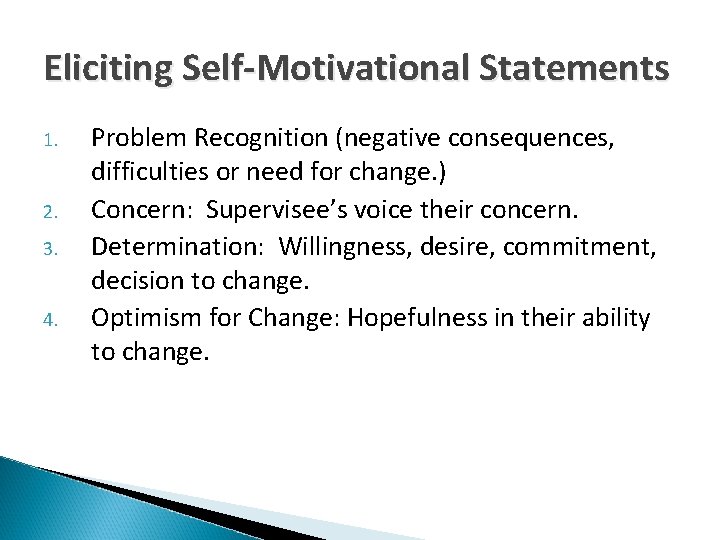
Eliciting Self-Motivational Statements 1. 2. 3. 4. Problem Recognition (negative consequences, difficulties or need for change. ) Concern: Supervisee’s voice their concern. Determination: Willingness, desire, commitment, decision to change. Optimism for Change: Hopefulness in their ability to change.
How to elicit selfmotivational statements
Using Extremes: “Even though you are aware that you may end up very frustrated with this client , you are not ready to give up on them. ”
Looking Forward…Where you would like to be with your MI 1 month from now? One year from now? What did you need to do to get there? How will you do that?
Looking Backward…Think about an experience in your life that you thought would be impossible to succeed in, and yet you did succeed. Tell me about that…
Siding with the Negative: “It may not be possible for you to help this person. ”
Questions, Answers and Evaluations
Where we can be reached Jacque Elder Psy. D. , Member of MINT, Clinical Training Institute jacelder@gmail. com Phone 708 -717 -8528 www. motivationalinterviewing. info Karen Grimley, LCSW, Member of MINT Loyola Hospital, Alcohol Prevention Injury Project Email: kgrimleylcsw@gmail. com
Resources. Motivational Interviewing: Preparing People for Change, 3 rd Edition. Miller and Rollnick, Guilford Press, 2013. Building Motivational Skills: A Workbook for Practitioners, Rosengren, 2009, Guilford Press. Motivational Interviewing for Healthcare, Rollnick and Butler, 2008, Guildford Press. Web resources: www. motivationalinterviewing. com CASAA: casaa. unm. edu