
Opening opportunities Founding father was late professor Pentti

- Slides: 21
Opening opportunities
• Founding father was (late) professor Pentti Malaska (TSE) • Established in 1992 as an auxiliary unit of Turku School of Economics (1992– 2009), Special Unit of University of Turku (2010– 2013) Department at the Turku School of Economics, University of Turku August 2013– • Offices in Turku, Helsinki and Tampere • Personnel: 65 • Ongoing research, development and education projects: 30 -35 • Turnover: 2, 8 M€ (2016) • The FFRC organises an international conference annually, bringing together significant actors from the field and others who are interested in the future www. futuresconference. fi
FFRC principles as perceived by outsider researchers Nováky, E. , & Monda, E. (2015). Futures studies in Finland. Society and Economy, 37(1), 31 -48. 1. If you do something, do it with fun! Researchers search for projects according to their interests 2. Working in teams, building new connections: Half of team members are from FFRC, other half exterior contributors 3. Freedom: The employees know their deadlines, tasks, and the framework of the project they are involved in, thus they can work flexibly
Special characteristics of FFRC • One of the few university departments on futures studies in the world, discipline was established in 2013 with full master ja post-graduate programmme. • International research co-operation and funding is in important role. • Critical mass of researchers ensures continuity of academic work. • Basic research, applied research, development projects and social relevance of research are equally appreciated and they enrich each other. • Transdisciplinary approach, e. g. personnel consists of people with diverse scientific background. • FRRC has the national special task of developing futures studies and foresight in Finland. • Futures studies is one of the focus areas of research of UTU. • 80 -70 % of funding comes from external sources.
Researching Possible Futures The Finland Futures Research Centre (FFRC) is a transdisciplinary academic research, training, and development organization. Our core value is to create a responsible and sustainable future. We research alternative futures, and the challenges and possibilities included in them. Academic research places special emphasis on foresight, environmental and energy research, sociocultural research, food and consumption, bio-economy and education. In addition, we continually aim to develop the scientific foundations and methods of futures studies. Our rigorous and multidisciplinary basic research creates a foundation for both applied and tailor-made research.
Introducing some of the FFRC’s research projects: Neo-Carbon Enabling Neo-Growth Society – Transformative Energy Futures 2050 (NEO-FORE) Tekes, the Finnish Funding Agency for Technology and Innovation: 2014– 2019 This five year research project started in July 2014 for exploring possible futures of an economy enabled by Neo -Carbon in a peer-to-peer society. It is the foresight part of a larger “Neo-Carbon Energy” project, in which a new renewables-based energy production and storage system is being developed by Technical Research Centre of Finland (VTT) and Lappeenranta University of Technology (LUT). The horizon scanning of the changing world and energy landscape is complemented with Futures Cliniques and other innovative foresight tools and processes. Case studies of China, Africa and Latin America are included. European Futures for Energy Efficiency (EUFORIE) European Commission, Horizon 2020: 2015– 2018 EUFORIE studies energy efficiency at different spatial scales and from different perspectives and uses different analysis tools by an interdisciplinary research consortium. The EUFORIE Consortium consists of three universities and one research institute with a strong background in energy and environmental issues, and/or sustainability analysis. The Function and Management of Aquatic Ecosystems in the Changing Environment: the Effects of Economically viable city centre and urbanizing downtown (ENCORE) Turku Urban Research Programme: 2015– 2016 This research project focuses on innovative urban development. The aim of the project is to explore the novel success factors of city centres and illustrate the future possibilities of urban planning.
The Novel Protein Sources for Food Security (Sceno. Prot) The Strategic Research Council of the Academy of Finland: 2015– 2018 Sceno. Prot aims at finding ways to achieve the 2030 target in protein self-sufficiency. These can include, for example, various production and supply-side paths to both increase resource efficiency and to promote novel protein products. Green Economy Transitions in the Least Developed Countries: Multi scale Analysis of Energy and Forest Use in Laos and Cambodia (GET-LDC) Academy of Finland: 2014– 2018 The GET-LDC research project analyses green economy transitions in Cambodia and Laos. Green economy expectations in the LDC context, especially in Laos and Cambodia, relate particularly to the forest and energy sectors. Maximising wellbeing and minimising emissions: Backcasting social visions for a low carbon Europe (MAXWELL) EU Horizon 2020 Marie Sklodowska Curie Action: 2015– 2016 This postdoctoral fellowship has been awarded to Tadhg O' Mahony to explore different conceptions of wellbeing and develop future energy scenarios of the EU to 2050. The scenarios will be modelled and a lowcarbon Europe will be backcast. The project will then establish the policy frameworks and actions necessary to maximise wellbeing and minimise emissions in the EU. Promotion of Capacity and Energy Education Development in the Caribbean Region (PROCEED) European Union: 2013– 2017 The project focuses on higher education capacity building in energy access and efficiency in Barbados, Cuba and Jamaica. As small island developing states (SIDS), the partner countries have limited access to international energy markets, their resources are scarce and energy efficiency is low.
The Function and Management of Aquatic Ecosystems in the Changing Environment: the Effects of Paradigm Shifts (AQUADIGM) Academy of Finland: 2013– 2016 This project combines natural scientific knowledge of the function and management of aquatic ecosystems with historical analysis of the origin of paradigms and with futures study of the possible revision of the paradigms and effects of paradigm shifts. Human Being and Value in the Sixt Wave (HUVA) Tekes and co-operation companies: 2015– 2016 This project tackles the hardest problem companies are faced with today: how to enable and motivate people to perform in the fierce market environment? Bastu – Sixth Wave Entrepreneurship The Finnish Innovation Fund Sitra & City of Turku: 2015– Bastu is an operating tool, a platform and a network. The project is a part of the co-operation between the Finnish Innovation Fund Sitra and the City of Turku promoting the circular economy.
Futures Images of Working Life as Seen by Young Women (Omasi) European Social Fund: 2015– 2017 The project maps visions and experiential knowledge of working life among special groups of young women. The aim of the project is to increase authorities’ and employers’ knowledge of the young women’s expectations about working life and their educational choices. Get Another Life (UTUA) European Social Fund: 2015– 2017 The main objective of the UTUA project is to improve employability of unemployed and/or unprivileged people. Challenging situations in labor markets such as long-term, structural unemployment and career turning points or outdated competences are hardships which need to be addressed in a new and fresh way.
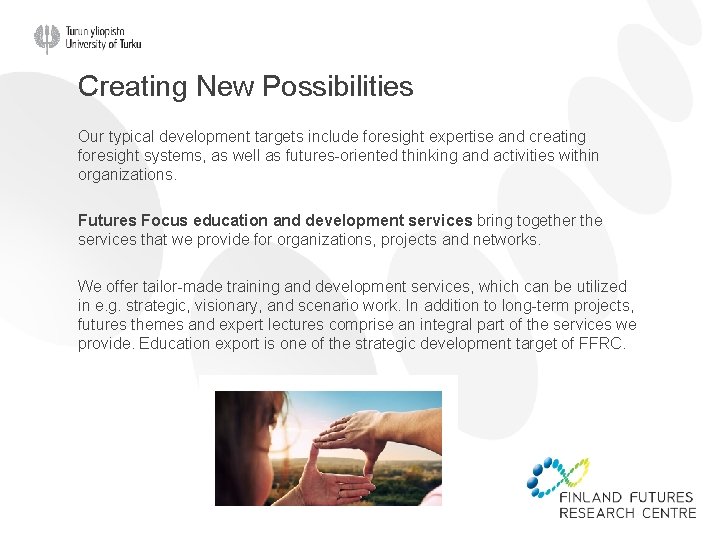
Creating New Possibilities Our typical development targets include foresight expertise and creating foresight systems, as well as futures-oriented thinking and activities within organizations. Futures Focus education and development services bring together the services that we provide for organizations, projects and networks. We offer tailor-made training and development services, which can be utilized in e. g. strategic, visionary, and scenario work. In addition to long-term projects, futures themes and expert lectures comprise an integral part of the services we provide. Education export is one of the strategic development target of FFRC.
Waking Up to Futures-Oriented Thinking We train futures-oriented experts by providing academic education for both undergraduate and postgraduate students. Finland Futures Academy (FFA), coordinated by the FFRC, is a national network of universities that provide academic education and research programmes in futures studies. The FFA’s study module is offered in member universities throughout Finland. Multidisciplinary Sustainable Development Study Module International Master’s Degree Programme in Futures Studies (MA) Postgraduate Studies in Futures Studies (Ph. D, D. Sc. (Econ. and Bus. Adm. ))
The Master Degree Programme in Futures Studies The students enrolled in the Master’s Programme will take a Master of Arts degree, the size of 120 ECTS credits. The two-year programme is instructed in English. Citizens of a country outside the European Union (EU) and the European Economic Area (EEA) or Switzerland will be charged a tuition fee of 10 000€ per academic year. The university offers generous scholarships for students liable to pay tuition fees.
Objectives The Master’s Degree Programme in Futures Studies is designed to educate foresight experts who help organisations to harness future opportunities and avoid unnecessary risks. The programme trains students to become professionals who are competent to choose from various methods when facing a particular development challenge. The students will get a versatile toolkit to implement foresight thinking for the benefit of a given organisation. The programme includes plenty of rehearsal, case-studies and real-life experiences on using foresight methodology, ranging from quantitative and qualitative methods to innovative and creative futures design techniques. The students will become visionary thinkers with a futures-oriented state of mind. They will qualify to a wide array of expert positions in the strategic/foresight units of private companies or public institutions. The programme also serves as an excellent basis for building a consultant business.
Postgraduate Studies in Futures Studies In the Futures Studies Postgraduate studies the doctoral candidates will deepen their understanding and skills in Futures Studies in order to be able to act as an independent researcher in the field of Futures Studies. At Turku School of Economics (TSE), a wide range of research topics have been carried out in the field of Futures Studies. You can specialise in, for example, business foresight, the future of energy and environmental issues, education, large scale socio-economic transitions, future consciousness and futures studies methodology. The doctorate degree consists of 240 ECTS credits. As a full-time student, the doctorate degree can be completed in four years. The scope of postgraduate studies is 60 ECTS credits. The most important part of the doctorate degree is the doctoral thesis.
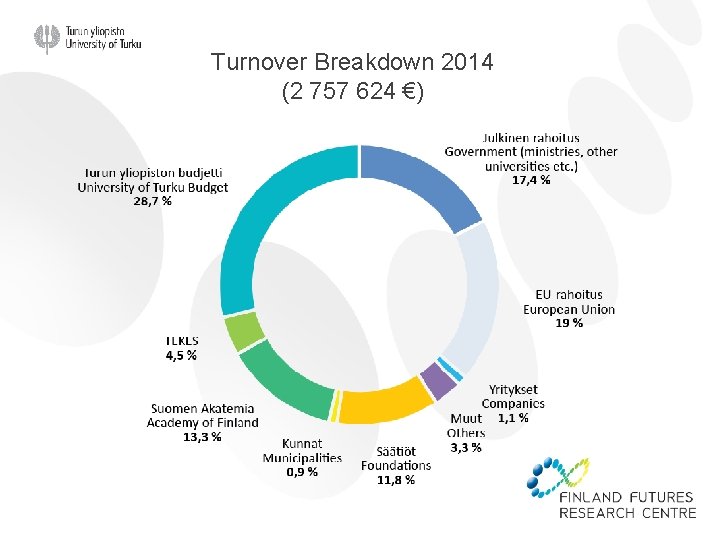
Turnover Breakdown 2014 (2 757 624 €)
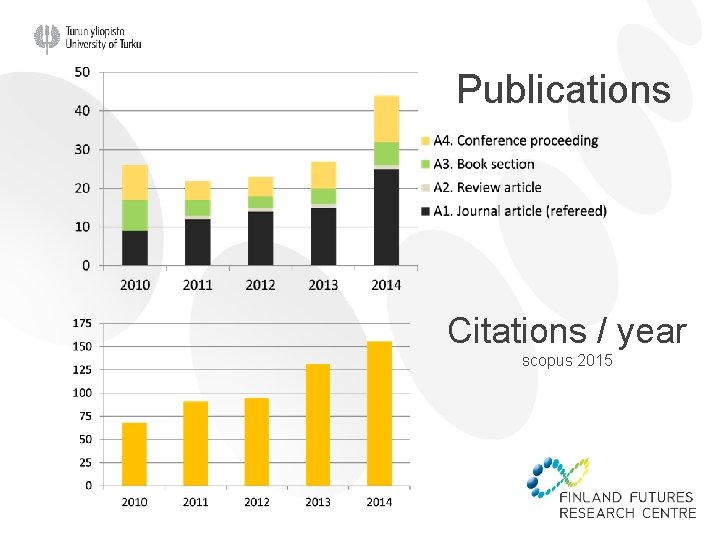
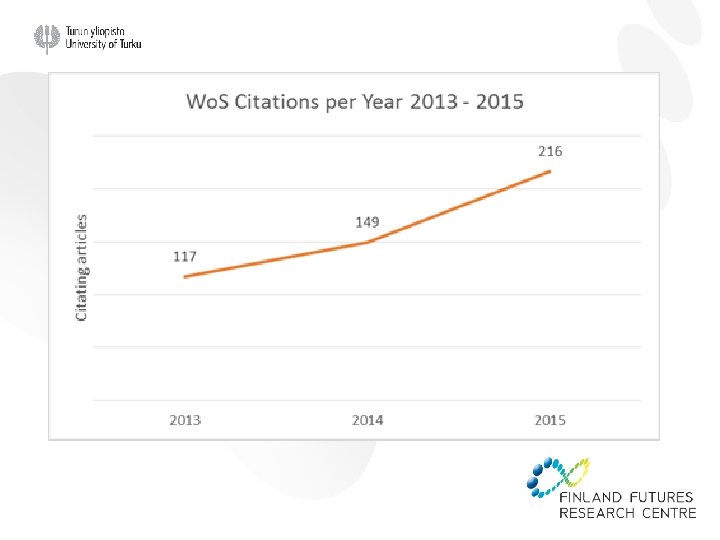
Publications Citations / year Scopus 2015
Contact us! Finland Futures Research Centre (FFRC) Turku School of Economics FI-20014 Turun yliopisto, Finland Rehtorinpellonkatu 3, Turku + 358 2 333 9530 Director Juha Kaskinen Korkeavuorenkatu 25 A 2 FI-00130 Helsinki + 358 9 698 0056 Regional Manager: Professor Sirkka Heinonen Åkerlundinkatu 2 FI-33100 Tampere + 358 2 333 9837 Regional Manager Jarmo Vehmas firstname. surname@utu. fi tutu-info@utu. fi/ffrc
Many thanks for your attention! • • • Director Juha Kaskinen (Dr. Soc. Sc. ) Finland Futures Research Centre FI-20014 University of Turku Tel. +358 2 4814 528; +358 40 5439 645 Email juha. kaskinen@utu. fi http: //www. utu. fi/en/units/ffrc