
Opening Exercise If you do not have tape



- Slides: 72
Opening Exercise • If you do not have tape diagram experience try to solve the problem on using a diagram or algebra. 94 children are in a reading club. One-third of the boys and three-sevenths of the girls prefer fiction. If 36 students prefer fiction, how many girls prefer fiction? © 2014. All rights reserved. Duplication and/or distribution of this material is prohibited without written consent from Common Core, Inc. www. commoncore. org
Tape Diagrams © 2014. All rights reserved. Duplication and/or distribution of this material is prohibited without written consent from Common Core, Inc. www. commoncore. org
Session Objectives • Experience how proficiency in the tape diagram method can be developed in students and colleagues. • Experience how to support understanding of various types of word problems as outlined in the Progressions document. • Mathematical Practice 5: Use appropriate tools strategically and demonstrate this knowledge by using a tape diagram to solve problems. © 2014. All rights reserved. Duplication and/or distribution of this material is prohibited without written consent from Common Core, Inc. www. commoncore. org
Agenda – Tape Diagrams • • Introduction to Tape Diagrams Practice Set 1 Practice Set 2 Practice Set 3 Practice Set 4 Practice Set 5 Practice Set 6 Practice Set 7 © 2014. All rights reserved. Duplication and/or distribution of this material is prohibited without written consent from Common Core, Inc. www. commoncore. org
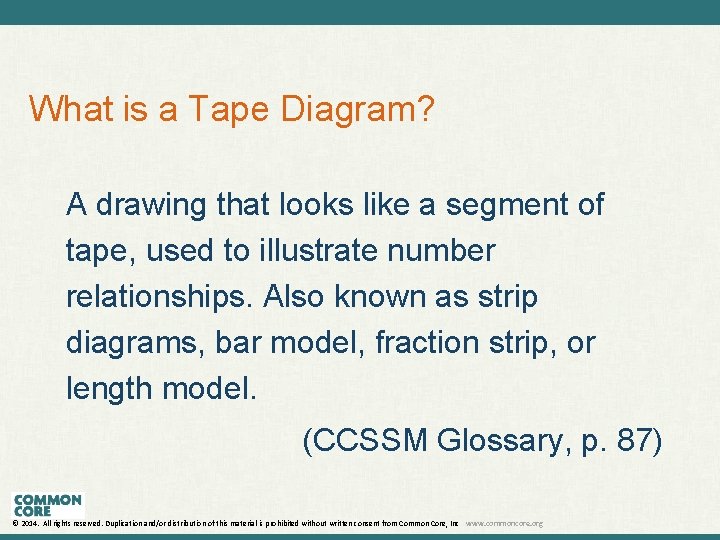
What is a Tape Diagram? A drawing that looks like a segment of tape, used to illustrate number relationships. Also known as strip diagrams, bar model, fraction strip, or length model. (CCSSM Glossary, p. 87) © 2014. All rights reserved. Duplication and/or distribution of this material is prohibited without written consent from Common Core, Inc. www. commoncore. org
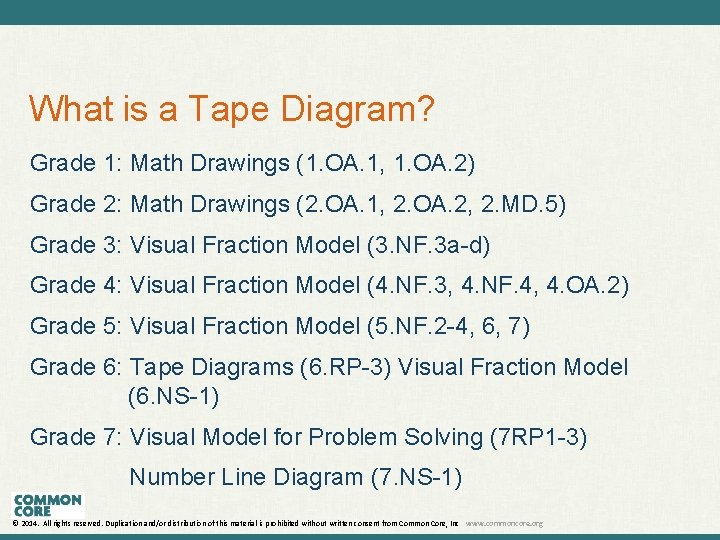
What is a Tape Diagram? Grade 1: Math Drawings (1. OA. 1, 1. OA. 2) Grade 2: Math Drawings (2. OA. 1, 2. OA. 2, 2. MD. 5) Grade 3: Visual Fraction Model (3. NF. 3 a-d) Grade 4: Visual Fraction Model (4. NF. 3, 4. NF. 4, 4. OA. 2) Grade 5: Visual Fraction Model (5. NF. 2 -4, 6, 7) Grade 6: Tape Diagrams (6. RP-3) Visual Fraction Model (6. NS-1) Grade 7: Visual Model for Problem Solving (7 RP 1 -3) Number Line Diagram (7. NS-1) © 2014. All rights reserved. Duplication and/or distribution of this material is prohibited without written consent from Common Core, Inc. www. commoncore. org
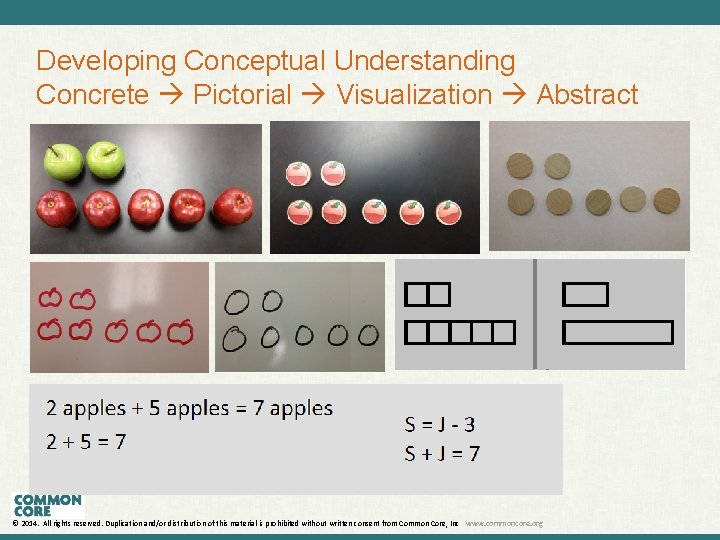
Developing Conceptual Understanding Concrete Pictorial Visualization Abstract © 2014. All rights reserved. Duplication and/or distribution of this material is prohibited without written consent from Common Core, Inc. www. commoncore. org
Forms of the Tape Diagram Part Whole Model Fraction Model Whole 3 pieces of size one-third Part Additive Comparison Model smaller quantity Models for Ratios & Multiplicative Comparison difference larger quantity 4 times as many as; a 1: 4 ratio © 2014. All rights reserved. Duplication and/or distribution of this material is prohibited without written consent from Common Core, Inc. www. commoncore. org
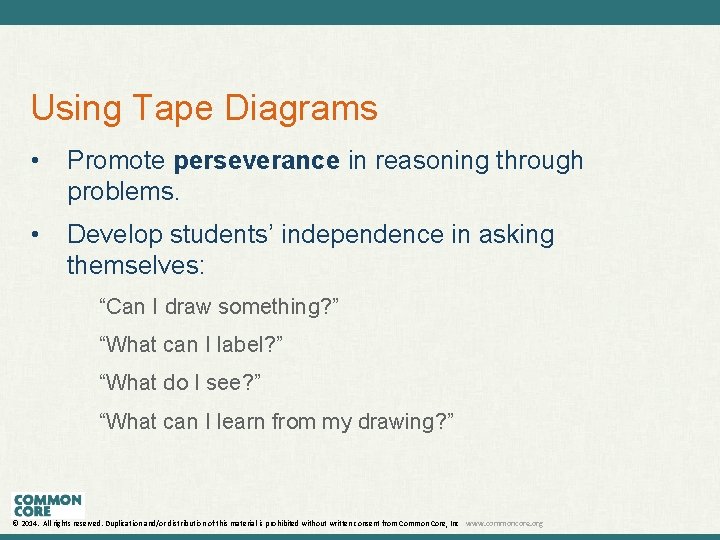
Using Tape Diagrams • Promote perseverance in reasoning through problems. • Develop students’ independence in asking themselves: “Can I draw something? ” “What can I label? ” “What do I see? ” “What can I learn from my drawing? ” © 2014. All rights reserved. Duplication and/or distribution of this material is prohibited without written consent from Common Core, Inc. www. commoncore. org
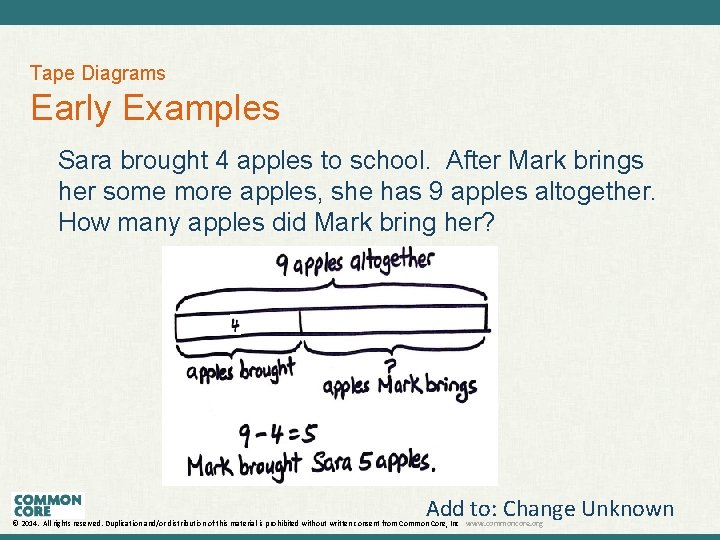
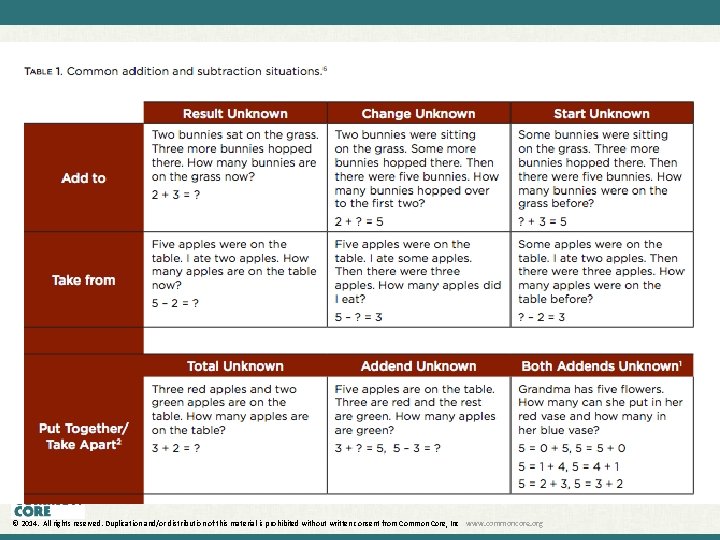
Tape Diagrams Early Examples Sara brought 4 apples to school. After Mark brings her some more apples, she has 9 apples altogether. How many apples did Mark bring her? Add to: Change Unknown © 2014. All rights reserved. Duplication and/or distribution of this material is prohibited without written consent from Common Core, Inc. www. commoncore. org
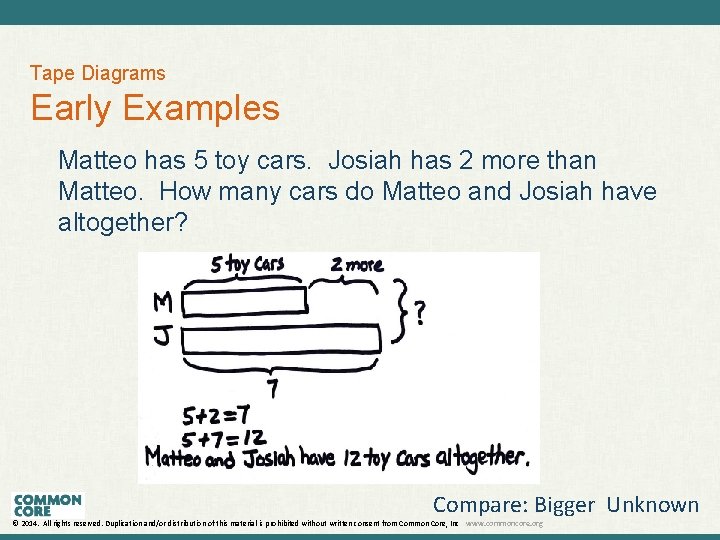
Tape Diagrams Early Examples Matteo has 5 toy cars. Josiah has 2 more than Matteo. How many cars do Matteo and Josiah have altogether? Compare: Bigger Unknown © 2014. All rights reserved. Duplication and/or distribution of this material is prohibited without written consent from Common Core, Inc. www. commoncore. org
Agenda – Tape Diagrams • • Introduction to Tape Diagrams Practice Set 1 Practice Set 2 Practice Set 3 Practice Set 4 Practice Set 5 Practice Set 6 © 2014. All rights reserved. Duplication and/or distribution of this material is prohibited without written consent from Common Core, Inc. www. commoncore. org
Example A: Rose has a vase with 13 flowers. She puts 7 more flowers in the vase. How many flowers are in the vase? G 1 M 4 L 19 © 2014. All rights reserved. Duplication and/or distribution of this material is prohibited without written consent from Common Core, Inc. www. commoncore. org
Example B: Nine dogs were playing at the park. Some more dogs came to the park. Then there were 11 dogs. How many more dogs came to the park? G 1 M 4 L 20 © 2014. All rights reserved. Duplication and/or distribution of this material is prohibited without written consent from Common Core, Inc. www. commoncore. org
Example C: Ben and Peter caught 17 tadpoles. They gave some to Anton. They have 4 tadpoles left. How many tadpoles did they give to Anton? G 1 M 4 L 21 © 2014. All rights reserved. Duplication and/or distribution of this material is prohibited without written consent from Common Core, Inc. www. commoncore. org
Example D: Some yellow beads were on Tamra’s bracelet. After she put 14 purple beads on the bracelet, there were 18 beads. How many yellow beads did Tamra’s bracelet have at first? G 1 M 4 L 20 © 2014. All rights reserved. Duplication and/or distribution of this material is prohibited without written consent from Common Core, Inc. www. commoncore. org
Example E: Kiana found some shells at the beach. She gave 8 shells to her brother. Now she has 9 shells left. How many shells did Kiana find at the beach? G 1 M 4 L 21 © 2014. All rights reserved. Duplication and/or distribution of this material is prohibited without written consent from Common Core, Inc. www. commoncore. org
Example F: The students were playing with 7 balls on the playground. They accidentally kicked some of the balls into a big puddle and now some are muddy! What is one way the balls might look? GK M 4 L 18 © 2014. All rights reserved. Duplication and/or distribution of this material is prohibited without written consent from Common Core, Inc. www. commoncore. org
Stop to Reflect: What did you notice about the problems in Problem Set 1? • They were all addition or subtraction problems, and were all conducive to use of the Part-Whole model. © 2014. All rights reserved. Duplication and/or distribution of this material is prohibited without written consent from Common Core, Inc. www. commoncore. org
Agenda – Tape Diagrams • • Introduction to Tape Diagrams Problem Set 1: Addition and Subtraction Models – Part Whole Problem Set 2 Problem Set 3 Problem Set 4 Problem Set 5 Problem Set 6 Problem Set 7 © 2014. All rights reserved. Duplication and/or distribution of this material is prohibited without written consent from Common Core, Inc. www. commoncore. org
Example A: Rose wrote 8 letters. Nikii wrote 12 letters. How many more letters did Nikii write than Rose? G 1 M 6 L 1 © 2014. All rights reserved. Duplication and/or distribution of this material is prohibited without written consent from Common Core, Inc. www. commoncore. org
Example B: Ben played 9 songs on his banjo. Lee played 3 more songs than Ben. How many songs did Lee play? G 1 M 6 L 1 © 2014. All rights reserved. Duplication and/or distribution of this material is prohibited without written consent from Common Core, Inc. www. commoncore. org
Example C: Rose saw 14 monkeys at the zoo. She saw 5 fewer monkeys than foxes. How many foxes did Rose see? G 1 M 6 L 17 © 2014. All rights reserved. Duplication and/or distribution of this material is prohibited without written consent from Common Core, Inc. www. commoncore. org
Example D: Emi planted 12 flowers. Rose planted 3 fewer flowers than Emi. How many flowers did Rose plant? G 1 M 6 L 2 © 2014. All rights reserved. Duplication and/or distribution of this material is prohibited without written consent from Common Core, Inc. www. commoncore. org
Example E: Peter has 8 more green crayons than yellow crayons. Peter has 10 green crayons. How many yellow crayons does Peter have? G 1 M 6 L 23 © 2014. All rights reserved. Duplication and/or distribution of this material is prohibited without written consent from Common Core, Inc. www. commoncore. org
Stop to Reflect: What did you notice about the problems in Problem Set 2? • They were all additive comparison problems and were all conducive to use of the Comparison model. © 2014. All rights reserved. Duplication and/or distribution of this material is prohibited without written consent from Common Core, Inc. www. commoncore. org
© 2014. All rights reserved. Duplication and/or distribution of this material is prohibited without written consent from Common Core, Inc. www. commoncore. org
Agenda – Tape Diagrams • • Introduction to Tape Diagrams Problem Set 1: Addition and Subtraction Models: Part Whole Problem Set 2: Addition Comparison Problems Problem Set 3 Problem Set 4 Problem Set 5 Problem Set 6 Problem Set 7 © 2014. All rights reserved. Duplication and/or distribution of this material is prohibited without written consent from Common Core, Inc. www. commoncore. org
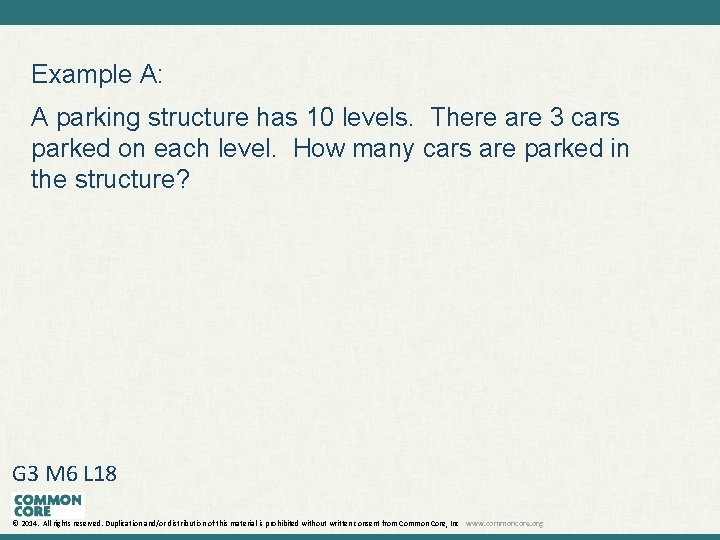
Example A: A parking structure has 10 levels. There are 3 cars parked on each level. How many cars are parked in the structure? G 3 M 6 L 18 © 2014. All rights reserved. Duplication and/or distribution of this material is prohibited without written consent from Common Core, Inc. www. commoncore. org
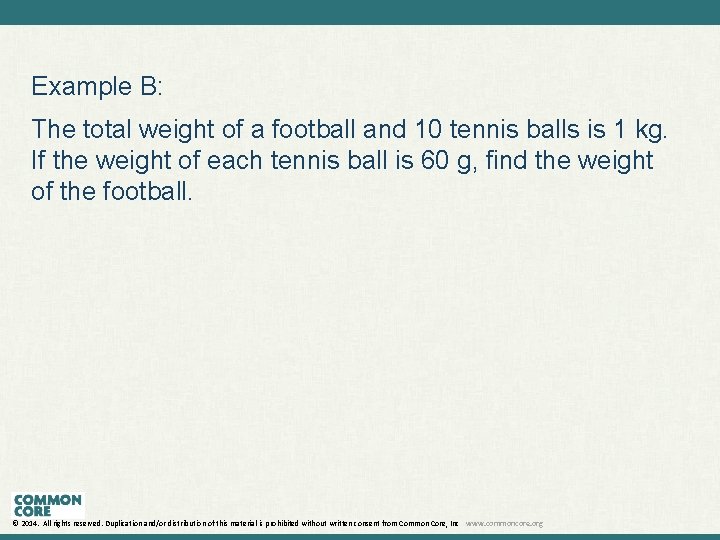
Example B: The total weight of a football and 10 tennis balls is 1 kg. If the weight of each tennis ball is 60 g, find the weight of the football. © 2014. All rights reserved. Duplication and/or distribution of this material is prohibited without written consent from Common Core, Inc. www. commoncore. org
Stop to Reflect: What did you notice about the problems in Problem Set 3? • The problems were all multiplication or division problems that were conducive to using the Part-Whole model. © 2014. All rights reserved. Duplication and/or distribution of this material is prohibited without written consent from Common Core, Inc. www. commoncore. org
Agenda – Tape Diagrams • • Introduction to Tape Diagrams Problem Set 1: Addition and Subtraction Models: Part Whole Problem Set 2: Addition Comparison Problems Problem Set 3: Multiplication and Division Models: Part Whole Problem Set 4 Problem Set 5 Problem Set 6 © 2014. All rights reserved. Duplication and/or distribution of this material is prohibited without written consent from Common Core, Inc. www. commoncore. org
Example A: There are 400 children at Park Elementary School. Park High School has 4 times as many students. How many students in all attend both schools? G 4 M 3 © 2014. All rights reserved. Duplication and/or distribution of this material is prohibited without written consent from Common Core, Inc. www. commoncore. org
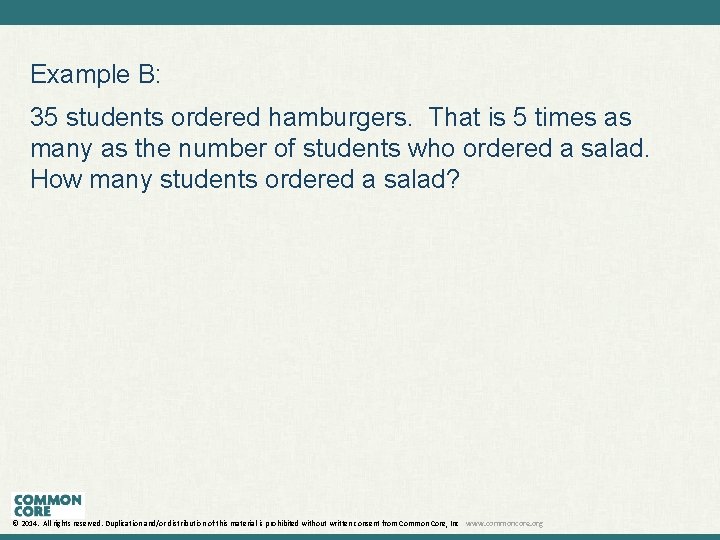
Example B: 35 students ordered hamburgers. That is 5 times as many as the number of students who ordered a salad. How many students ordered a salad? © 2014. All rights reserved. Duplication and/or distribution of this material is prohibited without written consent from Common Core, Inc. www. commoncore. org
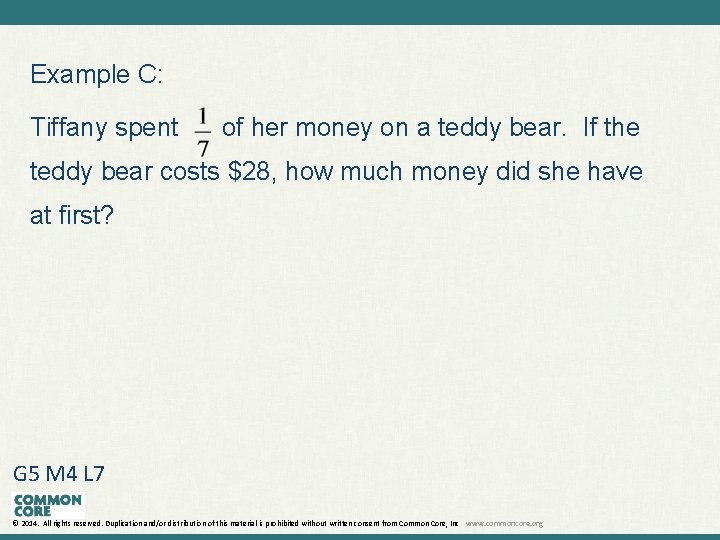
Example C: Tiffany spent of her money on a teddy bear. If the teddy bear costs $28, how much money did she have at first? G 5 M 4 L 7 © 2014. All rights reserved. Duplication and/or distribution of this material is prohibited without written consent from Common Core, Inc. www. commoncore. org
Example D: Sarah is 9 years old. Sarah’s grandfather is 90 years old. Sarah’s grandfather is how many times as old as Sarah? G 4 M 1 L 1 © 2014. All rights reserved. Duplication and/or distribution of this material is prohibited without written consent from Common Core, Inc. www. commoncore. org
Stop to Reflect: What did you notice about the problems in Problem Set 4? • The problems were all multiplicative comparison problems that were conducive to using the Comparison model. © 2014. All rights reserved. Duplication and/or distribution of this material is prohibited without written consent from Common Core, Inc. www. commoncore. org
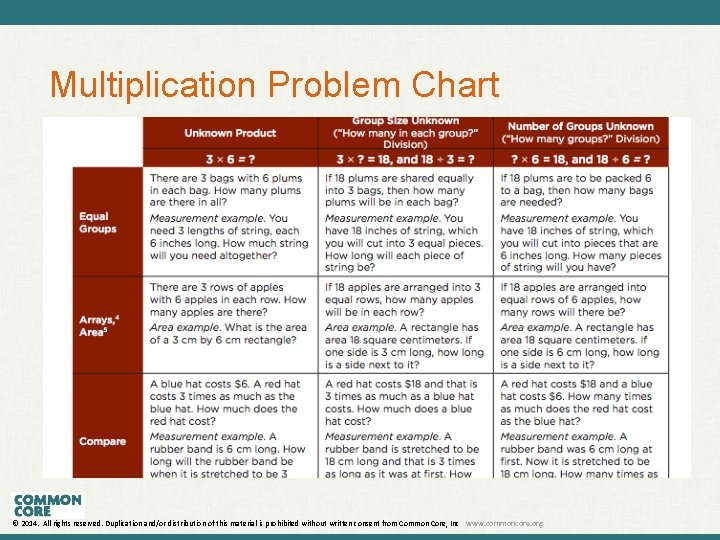
Multiplication Problem Chart © 2014. All rights reserved. Duplication and/or distribution of this material is prohibited without written consent from Common Core, Inc. www. commoncore. org
Agenda – Tape Diagrams • • Introduction to Tape Diagrams Problem Set 1: Addition and Subtraction Models: Part Whole Problem Set 2: Addition Comparison Problems Problem Set 3: Multiplication and Division Models: Part Whole Problem Set 4: Multiplication Comparison Problems Problem Set 5 Problem Set 6 Problem Set 7 © 2014. All rights reserved. Duplication and/or distribution of this material is prohibited without written consent from Common Core, Inc. www. commoncore. org
Example A: David spent 2/5 of his money on a storybook. The storybook cost $20. How much did he have at first? © 2014. All rights reserved. Duplication and/or distribution of this material is prohibited without written consent from Common Core, Inc. www. commoncore. org
Example B: Max spent 3/5 of his money in a shop and 1/4 of the remainder in another shop. What fraction of his money was left? If he had $90 left, how much did he have at first? © 2014. All rights reserved. Duplication and/or distribution of this material is prohibited without written consent from Common Core, Inc. www. commoncore. org
Example C: Alex bought some chairs. One third of them were red and one fourth of them were blue. The remaining chairs were yellow. What fraction of the chairs were yellow? © 2014. All rights reserved. Duplication and/or distribution of this material is prohibited without written consent from Common Core, Inc. www. commoncore. org
Example D: Jim had 360 stamps. He sold 1/3 of them on Monday and 1/4 of the remainder on Tuesday. How many stamps did he sell on Tuesday? © 2014. All rights reserved. Duplication and/or distribution of this material is prohibited without written consent from Common Core, Inc. www. commoncore. org
Example E: Three-fifths of Jan’s money is twice as much as Lena’s money. What fraction of Jan’s money is Lena’s money? © 2014. All rights reserved. Duplication and/or distribution of this material is prohibited without written consent from Common Core, Inc. www. commoncore. org
Example F: Henry bought 280 blue and red paper cups. He used 1/3 of the blue ones and 1/2 of the red ones at a party. If he had an equal number of blue cups and red cups left, how many cups did he use altogether? © 2014. All rights reserved. Duplication and/or distribution of this material is prohibited without written consent from Common Core, Inc. www. commoncore. org
Stop to Reflect: What did you notice about the problems in Problem Set 5? • The problems were all fraction problems that were conducive to using the Part Whole model. © 2014. All rights reserved. Duplication and/or distribution of this material is prohibited without written consent from Common Core, Inc. www. commoncore. org
Agenda – Tape Diagrams • • Introduction to Tape Diagrams Problem Set 1: Addition and Subtraction Models: Part Whole Problem Set 2: Addition Comparison Problems Problem Set 3: Multiplication and Division Models: Part Whole Problem Set 4: Multiplication Comparison Problems Problem Set 5: Fraction Models: Part Whole Problem Set 6: Problem Set 7: © 2014. All rights reserved. Duplication and/or distribution of this material is prohibited without written consent from Common Core, Inc. www. commoncore. org
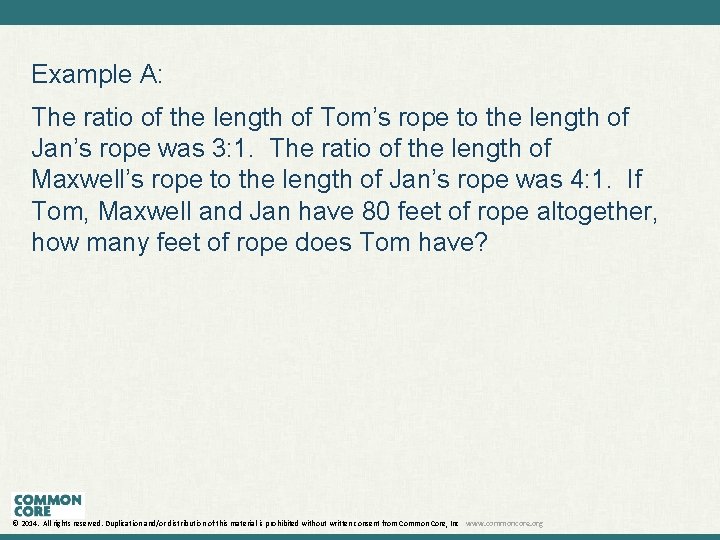
Example A: The ratio of the length of Tom’s rope to the length of Jan’s rope was 3: 1. The ratio of the length of Maxwell’s rope to the length of Jan’s rope was 4: 1. If Tom, Maxwell and Jan have 80 feet of rope altogether, how many feet of rope does Tom have? © 2014. All rights reserved. Duplication and/or distribution of this material is prohibited without written consent from Common Core, Inc. www. commoncore. org
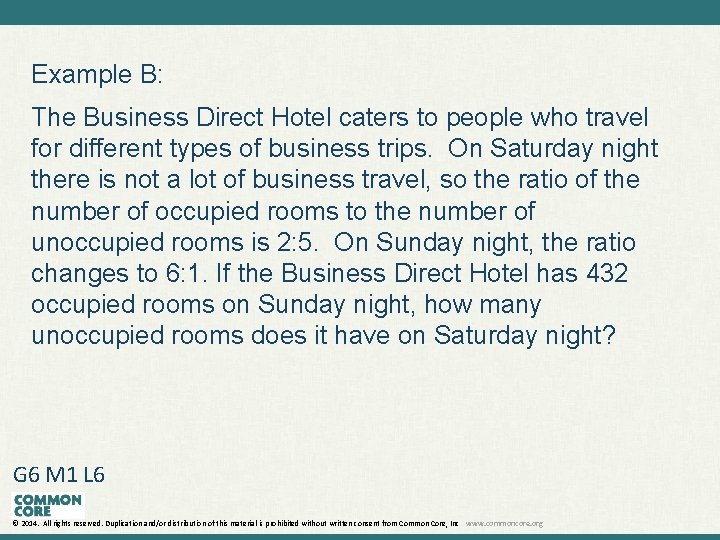
Example B: The Business Direct Hotel caters to people who travel for different types of business trips. On Saturday night there is not a lot of business travel, so the ratio of the number of occupied rooms to the number of unoccupied rooms is 2: 5. On Sunday night, the ratio changes to 6: 1. If the Business Direct Hotel has 432 occupied rooms on Sunday night, how many unoccupied rooms does it have on Saturday night? G 6 M 1 L 6 © 2014. All rights reserved. Duplication and/or distribution of this material is prohibited without written consent from Common Core, Inc. www. commoncore. org
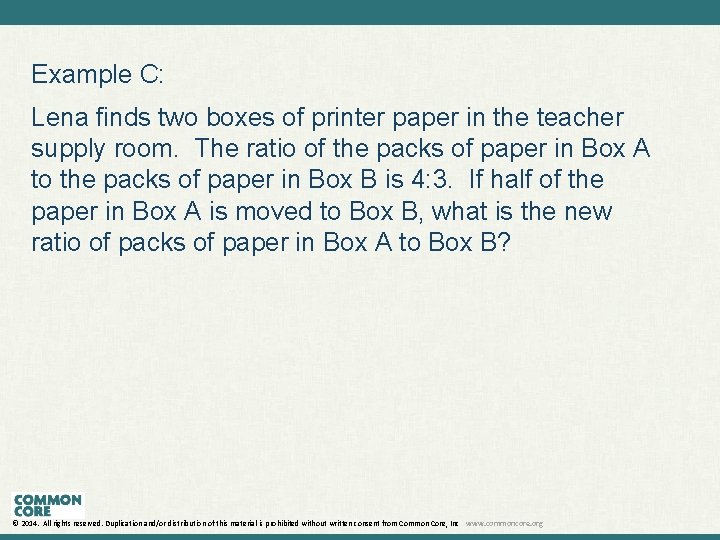
Example C: Lena finds two boxes of printer paper in the teacher supply room. The ratio of the packs of paper in Box A to the packs of paper in Box B is 4: 3. If half of the paper in Box A is moved to Box B, what is the new ratio of packs of paper in Box A to Box B? © 2014. All rights reserved. Duplication and/or distribution of this material is prohibited without written consent from Common Core, Inc. www. commoncore. org
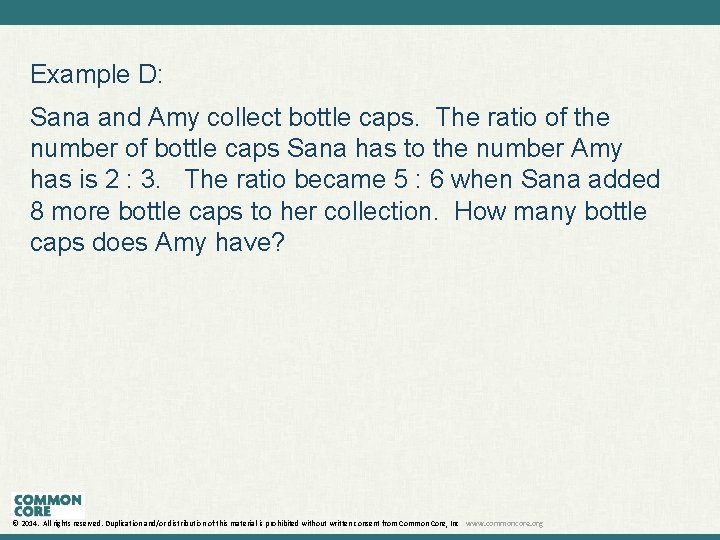
Example D: Sana and Amy collect bottle caps. The ratio of the number of bottle caps Sana has to the number Amy has is 2 : 3. The ratio became 5 : 6 when Sana added 8 more bottle caps to her collection. How many bottle caps does Amy have? © 2014. All rights reserved. Duplication and/or distribution of this material is prohibited without written consent from Common Core, Inc. www. commoncore. org
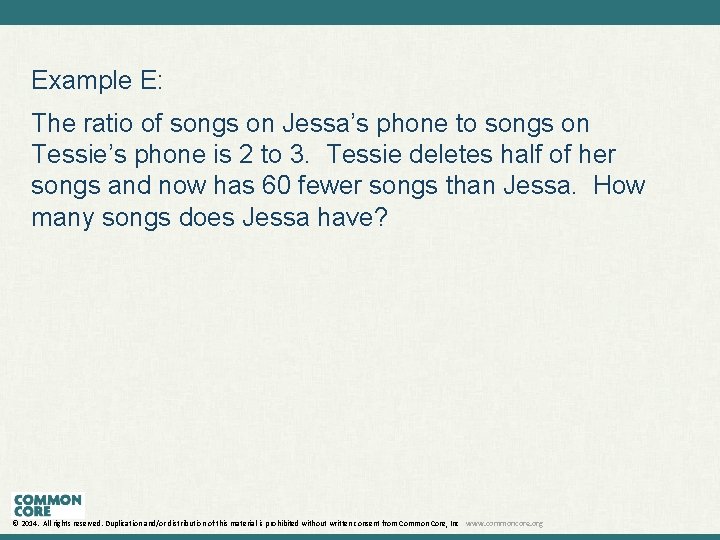
Example E: The ratio of songs on Jessa’s phone to songs on Tessie’s phone is 2 to 3. Tessie deletes half of her songs and now has 60 fewer songs than Jessa. How many songs does Jessa have? © 2014. All rights reserved. Duplication and/or distribution of this material is prohibited without written consent from Common Core, Inc. www. commoncore. org
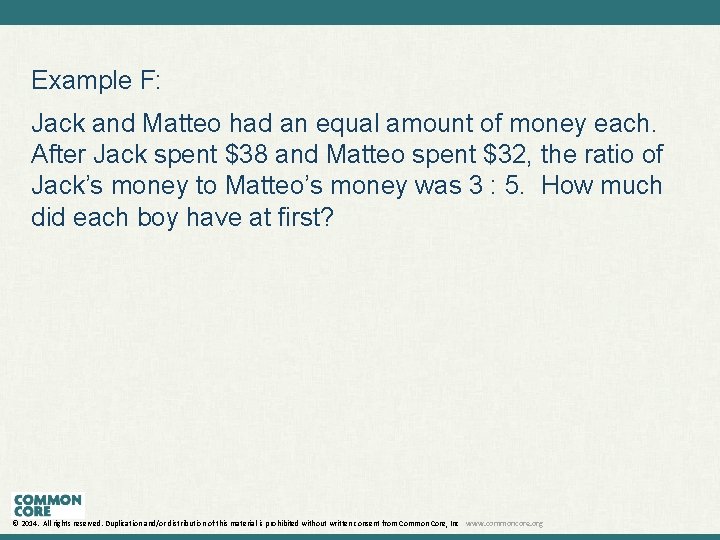
Example F: Jack and Matteo had an equal amount of money each. After Jack spent $38 and Matteo spent $32, the ratio of Jack’s money to Matteo’s money was 3 : 5. How much did each boy have at first? © 2014. All rights reserved. Duplication and/or distribution of this material is prohibited without written consent from Common Core, Inc. www. commoncore. org
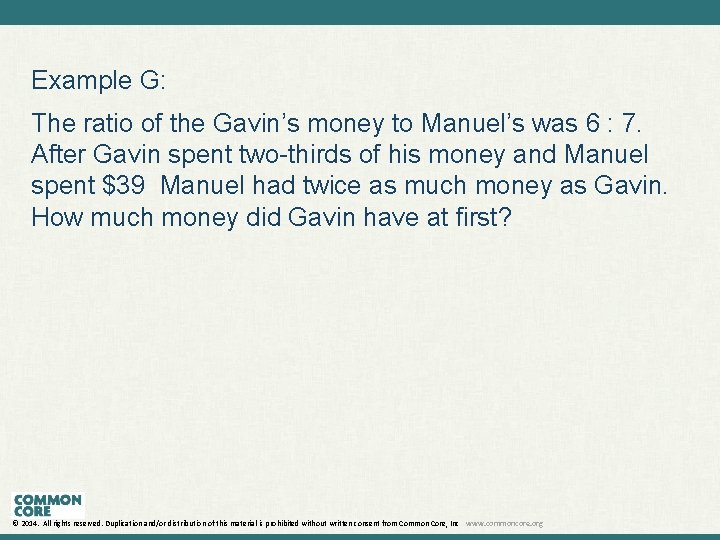
Example G: The ratio of the Gavin’s money to Manuel’s was 6 : 7. After Gavin spent two-thirds of his money and Manuel spent $39 Manuel had twice as much money as Gavin. How much money did Gavin have at first? © 2014. All rights reserved. Duplication and/or distribution of this material is prohibited without written consent from Common Core, Inc. www. commoncore. org
Stop to Reflect: What did you notice about the problems in Problem Set 6? • The problems were all ratio problems that were conducive to using the Comparison model. © 2014. All rights reserved. Duplication and/or distribution of this material is prohibited without written consent from Common Core, Inc. www. commoncore. org
Opening Exercise: 94 children are in a reading club. One-third of the boys and three-sevenths of the girls prefer fiction. If 36 students prefer fiction, how many girls prefer fiction? © 2014. All rights reserved. Duplication and/or distribution of this material is prohibited without written consent from Common Core, Inc. www. commoncore. org
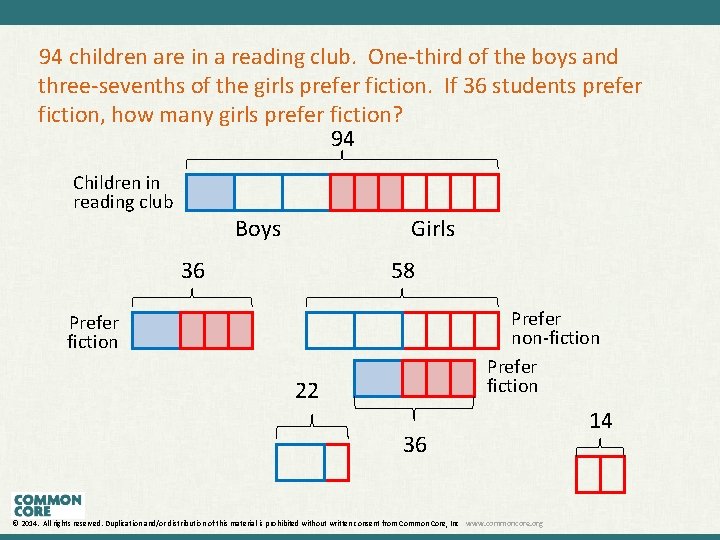
94 children are in a reading club. One-third of the boys and three-sevenths of the girls prefer fiction. If 36 students prefer fiction, how many girls prefer fiction? 94 Children in reading club Boys Girls 36 58 Prefer non-fiction Prefer fiction 22 36 © 2014. All rights reserved. Duplication and/or distribution of this material is prohibited without written consent from Common Core, Inc. www. commoncore. org 14
Agenda – Tape Diagrams • • Introduction to Tape Diagrams Problem Set 1: Addition and Subtraction Models: Part Whole Problem Set 2: Addition Comparison Problems Problem Set 3: Multiplication and Division Models: Part Whole Problem Set 4: Multiplication Comparison Problems Problem Set 5: Fraction Models: Part Whole Problem Set 6: Ratio Models Problem Set 7: © 2014. All rights reserved. Duplication and/or distribution of this material is prohibited without written consent from Common Core, Inc. www. commoncore. org
Double Number Line Diagrams Example A: Percentage Problems Mia’s weekly salary is $928. This is 80% of Sana’s weekly salary. Find Sana’s weekly salary. © 2014. All rights reserved. Duplication and/or distribution of this material is prohibited without written consent from Common Core, Inc. www. commoncore. org
Double Number Line Diagrams Example B: Rate Problems A photocopier can print 12 copies in 36 seconds. At this rate, how many copies can it print in 1 minute? © 2014. All rights reserved. Duplication and/or distribution of this material is prohibited without written consent from Common Core, Inc. www. commoncore. org
Example C: A club had 600 members. 60% of them were males. When 200 new members joined the club, the percentage of male members was reduced to 50%. How many of the new members were males? © 2014. All rights reserved. Duplication and/or distribution of this material is prohibited without written consent from Common Core, Inc. www. commoncore. org
Using Variables with Tape Diagrams Example D: Mary had $460. She bought 6 beach towels at $x each. Express the amount of money she had left in terms of x. If x = 17, how much money did she have left? © 2014. All rights reserved. Duplication and/or distribution of this material is prohibited without written consent from Common Core, Inc. www. commoncore. org
Using Variables with Tape Diagrams Example E: Max had x brownies. He ate 4 brownies and shared the remaining brownies among his 6 friends equally. How many brownies did each friend receive? Express your answer in terms of x. If x = 34 , how many brownies did each friend receive? © 2014. All rights reserved. Duplication and/or distribution of this material is prohibited without written consent from Common Core, Inc. www. commoncore. org
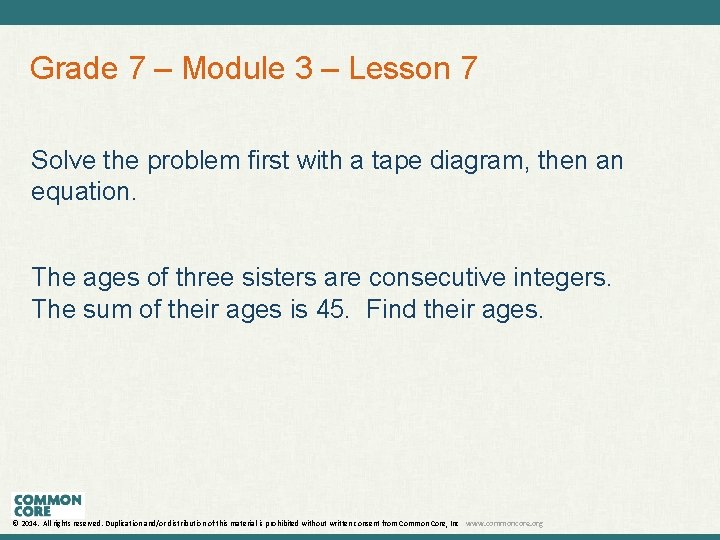
Grade 7 – Module 3 – Lesson 7 Solve the problem first with a tape diagram, then an equation. The ages of three sisters are consecutive integers. The sum of their ages is 45. Find their ages. © 2014. All rights reserved. Duplication and/or distribution of this material is prohibited without written consent from Common Core, Inc. www. commoncore. org
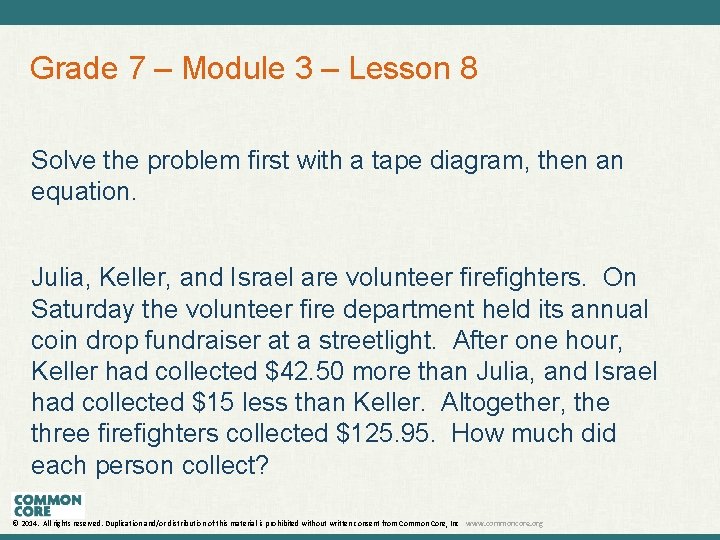
Grade 7 – Module 3 – Lesson 8 Solve the problem first with a tape diagram, then an equation. Julia, Keller, and Israel are volunteer firefighters. On Saturday the volunteer fire department held its annual coin drop fundraiser at a streetlight. After one hour, Keller had collected $42. 50 more than Julia, and Israel had collected $15 less than Keller. Altogether, the three firefighters collected $125. 95. How much did each person collect? © 2014. All rights reserved. Duplication and/or distribution of this material is prohibited without written consent from Common Core, Inc. www. commoncore. org
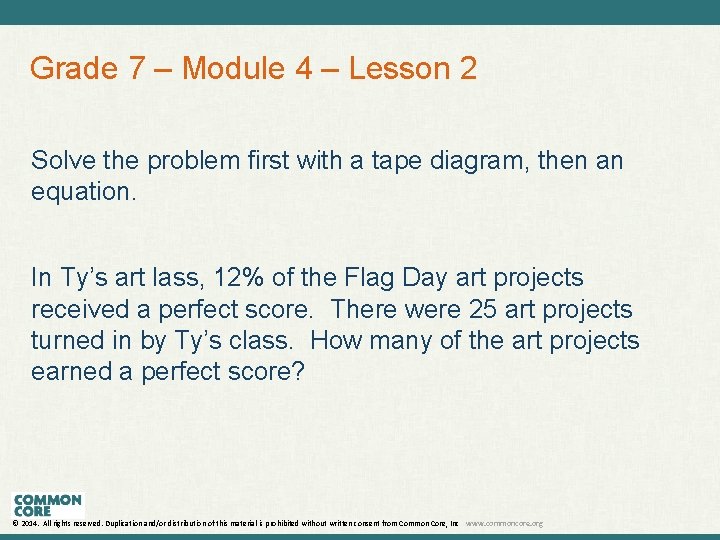
Grade 7 – Module 4 – Lesson 2 Solve the problem first with a tape diagram, then an equation. In Ty’s art lass, 12% of the Flag Day art projects received a perfect score. There were 25 art projects turned in by Ty’s class. How many of the art projects earned a perfect score? © 2014. All rights reserved. Duplication and/or distribution of this material is prohibited without written consent from Common Core, Inc. www. commoncore. org
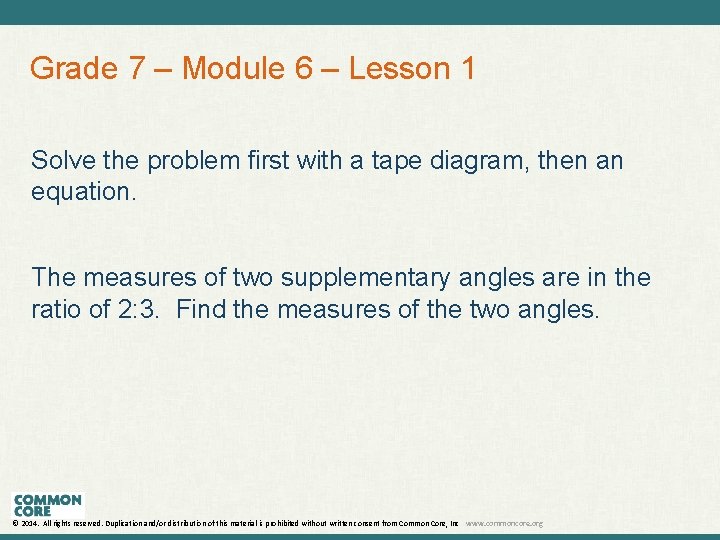
Grade 7 – Module 6 – Lesson 1 Solve the problem first with a tape diagram, then an equation. The measures of two supplementary angles are in the ratio of 2: 3. Find the measures of the two angles. © 2014. All rights reserved. Duplication and/or distribution of this material is prohibited without written consent from Common Core, Inc. www. commoncore. org
Grade 7 – Module 6 – Lesson 1 Solve the problem first with a tape diagram, then an equation. In a pair of complementary angles, the measurement of the larger angle is three times that of the smaller angle. Find the measures of the two angles. © 2014. All rights reserved. Duplication and/or distribution of this material is prohibited without written consent from Common Core, Inc. www. commoncore. org
Algebra I – Module 1 – Lesson 25 Solve the problem first with a tape diagram, then an equation. In a school choir, one-half of the members were girls. At the end of the year, 3 boys left the choir, and the ratio of boys to girls became 3: 4. How many boys remained in the choir? © 2014. All rights reserved. Duplication and/or distribution of this material is prohibited without written consent from Common Core, Inc. www. commoncore. org
Key Points • When building proficiency in tape diagraming skills start with simple accessible situations and add complexities one at a time. • Develop habits of mind in students to reflect on the size of bars relative to one another. • Part-whole models are more helpful in modeling situations where: _____________ • Compare to models are more helpful in modeling situations where: _____________ © 2014. All rights reserved. Duplication and/or distribution of this material is prohibited without written consent from Common Core, Inc. www. commoncore. org
Session Objectives • Experience how proficiency in the tape diagram method can be developed in students and colleagues. • Experience how to support understanding of various types of word problems as outlined in the Progressions document. • Mathematical Practice 5: Use appropriate tools strategically and demonstrate this knowledge by using a tape diagram to solve problems. © 2014. All rights reserved. Duplication and/or distribution of this material is prohibited without written consent from Common Core, Inc. www. commoncore. org
Feedback • Now that you’ve experienced either one, two or three days, comment on what you learned each day. • Comment on the order of the sessions (Day 1: Major Works 3 -5, Day 2: Major Works 6 -8, Day 3: Tape Diagrams). • We welcome any other comments. © 2014. All rights reserved. Duplication and/or distribution of this material is prohibited without written consent from Common Core, Inc. www. commoncore. org