
Opening Closing Arguments Prepping for the Moot Court

- Slides: 19
Opening & Closing Arguments Prepping for the Moot Court
What is an “opening statement”? ● Once the jury has been chosen, the attorneys for both sides deliver an opening statement about the case to the jury. Opening statements outline the facts that the attorneys expect to prove during the trial. ● An opening statement should present the jury with an orderly and easy to understand version of the case from the attorney's perspective. ● In criminal trials, the prosecuting attorney goes first. ● Opening statements are factual statements made by attorneys to explain the case. ● Opening statements are limited to the facts in the case. ● While one may provide legal theories, which are reasons for the defendant's actions, these statements may not be argumentative.
What Makes A Good Opening Statement? ● Your basics of public speaking: ○ Volume / pitch ○ Speed ○ Eye contact ○ Do not talk above / below the audience ○ Know your material ○ Organize your material ○ Outlines are okay - but do NOT read off a script ○ Visual aids
Organization Methods ● Issue by Issue ● Chronologically ● Witness by witness
But Wait - How Do I Do An Opening Without Arguing? ! ● Two words: WORD CHOICE. ○ Talk about facts that are going to support your conclusion - they will know what you are getting at. ○ Load up the objective facts ○ Use descriptive words to create feeling and paint the picture ■ This makes it arguing without arguing.
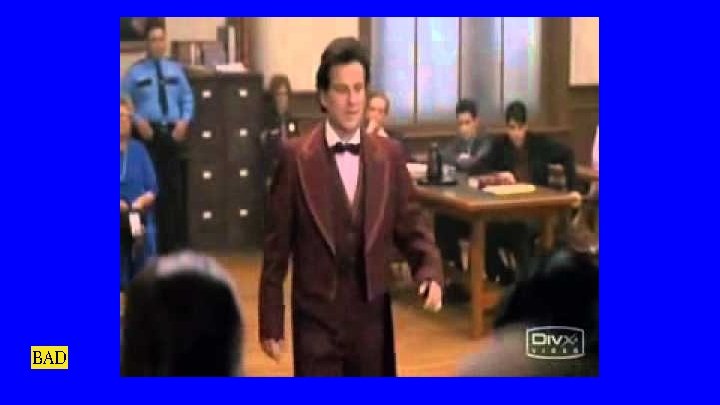
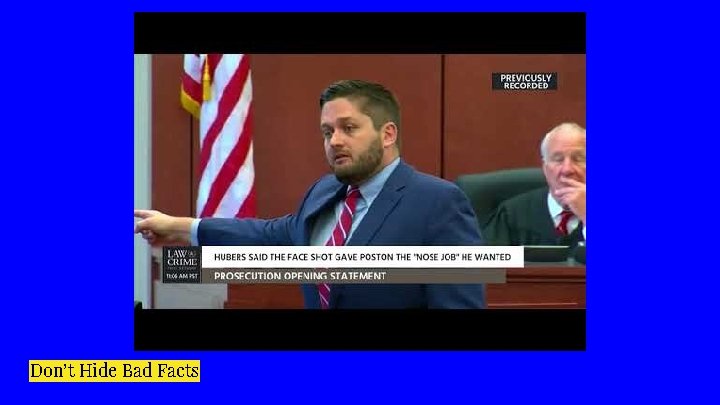
What NOT to do: ● Avoid over promising in an opening. ○ If notice the other side does this, take notes and talk about what was promised in your closing. ● Hide weaknesses ○ A jury often will assume omission if not addressed in your opening. ○ No one likes being lied to. ● Do not use bad body language ○ Crossing arms ○ Looking down ○ Leaning on podium
BAD
Don’t Hide Bad Facts
So Where Do I Begin? ● You will get your case - take a look at the facts and make sure you know them. Develop your legal theories / defenses based on those facts. ● Everything you do going forward will be based on your theory of the case. ● Pick your poison ○ Theme vs. Theory
Consider starting here: “May it please the Court. Respective Counsel. My name is ______ and I have the pleasure of representing _______. . . ” “The evidence you will hear in this trial will prove that. . . ” “The facts show that my client. . . ”
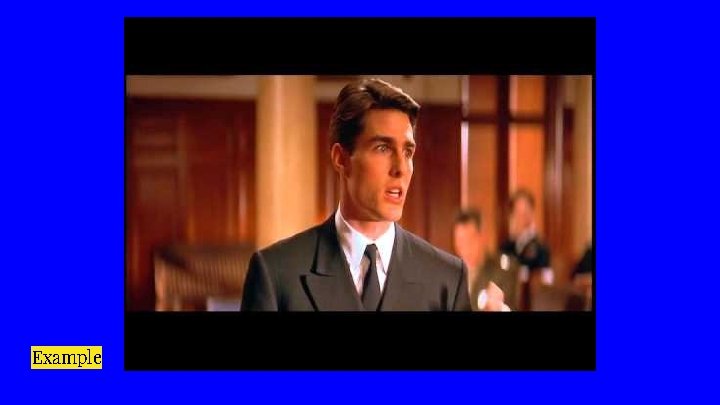
Example
So What About A Closing?
So What’s The Difference From An Opening? Your purpose has now shifted fundamentally Now trying to actively persuade and actually argue the merits of your position, the weight of the evidence and why it should be considered for your client. After each side has presented all its evidence, each side makes a closing statement to the jury. In these closing arguments, attorneys summarize what has been established or not established during the trial. The closing argument presents attorneys with their last chance to persuade the jury. The defense delivers the first closing argument to the jury. The closing argument of the prosecution ends the evidence phase of the trial.
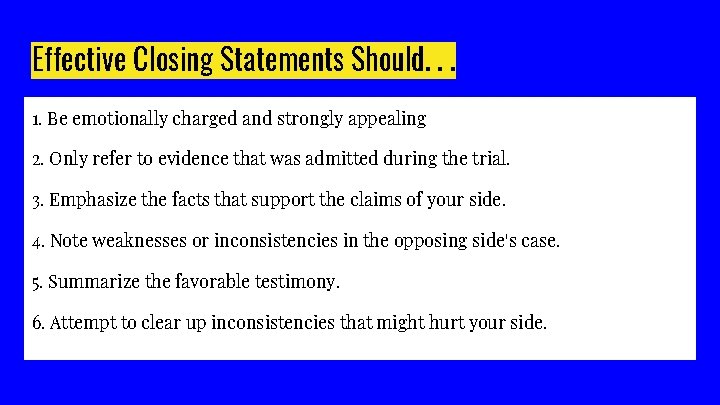
Effective Closing Statements Should. . . 1. Be emotionally charged and strongly appealing 2. Only refer to evidence that was admitted during the trial. 3. Emphasize the facts that support the claims of your side. 4. Note weaknesses or inconsistencies in the opposing side's case. 5. Summarize the favorable testimony. 6. Attempt to clear up inconsistencies that might hurt your side.
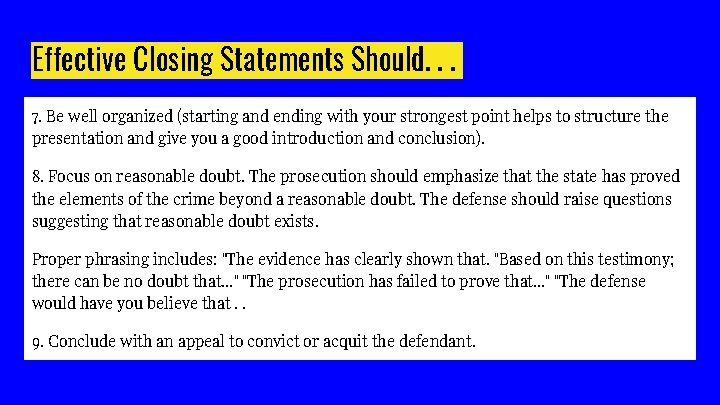
Effective Closing Statements Should. . . 7. Be well organized (starting and ending with your strongest point helps to structure the presentation and give you a good introduction and conclusion). 8. Focus on reasonable doubt. The prosecution should emphasize that the state has proved the elements of the crime beyond a reasonable doubt. The defense should raise questions suggesting that reasonable doubt exists. Proper phrasing includes: "The evidence has clearly shown that. "Based on this testimony; there can be no doubt that. . . " "The prosecution has failed to prove that. . . " "The defense would have you believe that. . 9. Conclude with an appeal to convict or acquit the defendant.
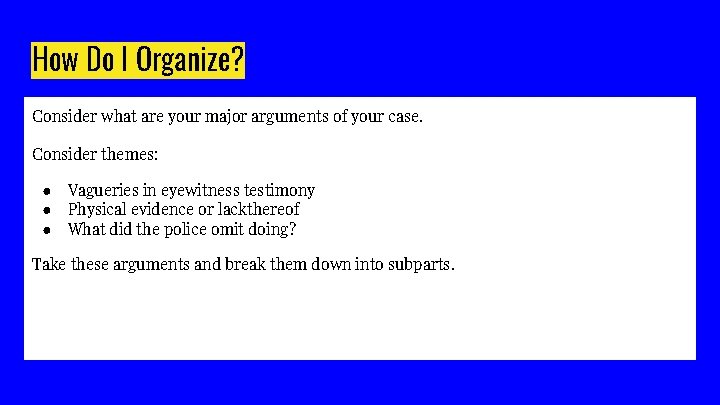
How Do I Organize? Consider what are your major arguments of your case. Consider themes: ● ● ● Vagueries in eyewitness testimony Physical evidence or lackthereof What did the police omit doing? Take these arguments and break them down into subparts.
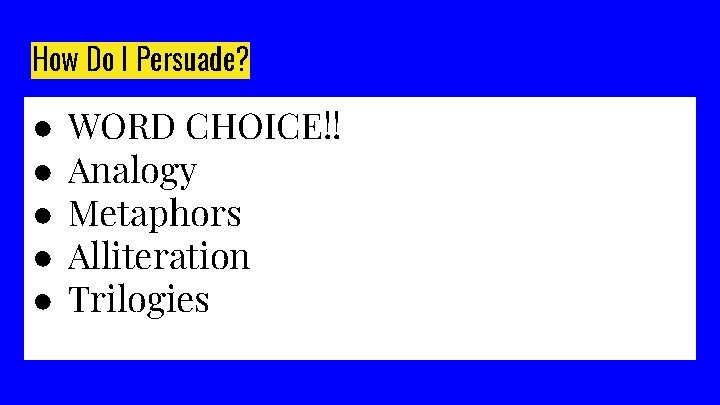
How Do I Persuade? ● ● ● WORD CHOICE!! Analogy Metaphors Alliteration Trilogies
Alliteration & Repetition
Example