
Opening Assignment Turn in your assignment from yesterday
- Slides: 25
Opening Assignment • Turn in your assignment from yesterday if you have not already done so. • What do you think is going to be John F. Kennedy’s legacy or the thing for which he will be most remembered? • Why?
THE NEW FRONTIER AND THE GREAT SOCIETY KENNEDY AND JOHNSON LEAD AMERICA IN THE 1960 S
• Essential Learning Goal: – During the 1960’s American domestic and foreign policy was primarily guided by the need to address problems domestically with poverty and social insecurity, as well as, internationally with confrontations with communism. • Learning Targets: – I can identify the election of 1960 including; Richard Nixon, John F. Kennedy, and the importance of T. V. – I can explain the US and Soviet confrontation over Cuba including the Bay of Pigs and the Cuban Missile Crisis. – I can recognize the symbolism of the Berlin Wall as a sign of the differences between East and West during the Cold War.
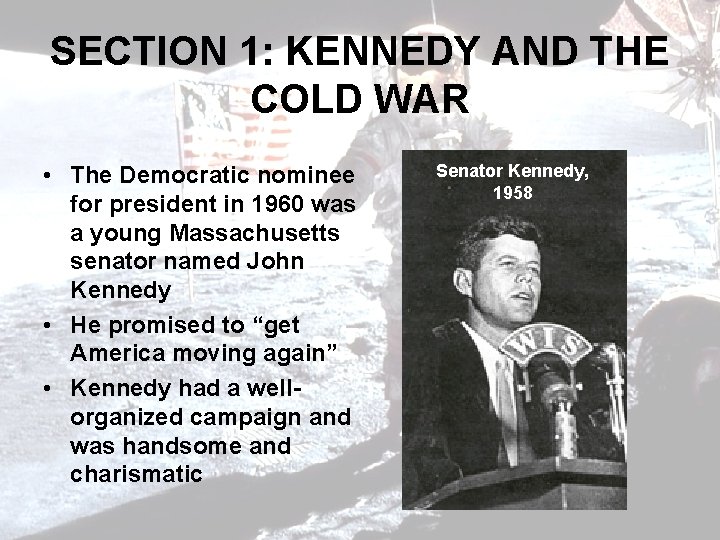
SECTION 1: KENNEDY AND THE COLD WAR • The Democratic nominee for president in 1960 was a young Massachusetts senator named John Kennedy • He promised to “get America moving again” • Kennedy had a wellorganized campaign and was handsome and charismatic Senator Kennedy, 1958
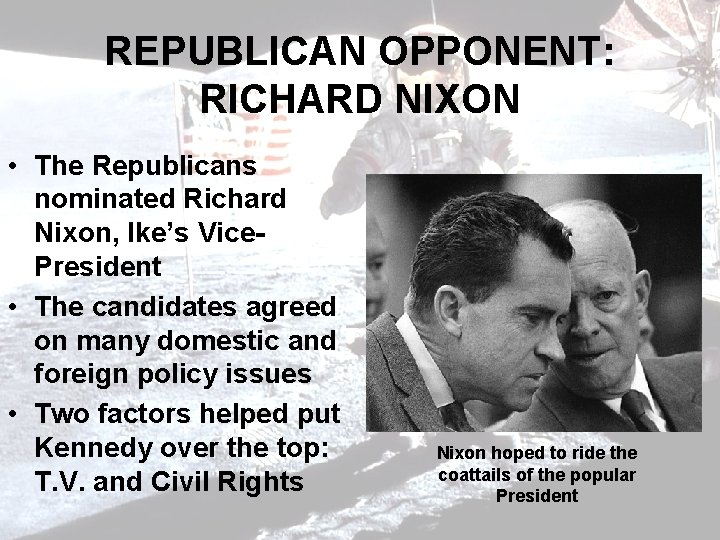
REPUBLICAN OPPONENT: RICHARD NIXON • The Republicans nominated Richard Nixon, Ike’s Vice. President • The candidates agreed on many domestic and foreign policy issues • Two factors helped put Kennedy over the top: T. V. and Civil Rights Nixon hoped to ride the coattails of the popular President
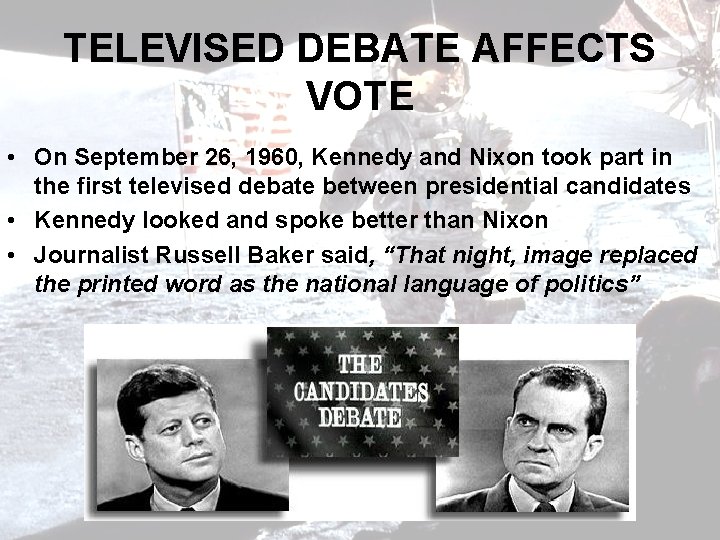
TELEVISED DEBATE AFFECTS VOTE • On September 26, 1960, Kennedy and Nixon took part in the first televised debate between presidential candidates • Kennedy looked and spoke better than Nixon • Journalist Russell Baker said, “That night, image replaced the printed word as the national language of politics”
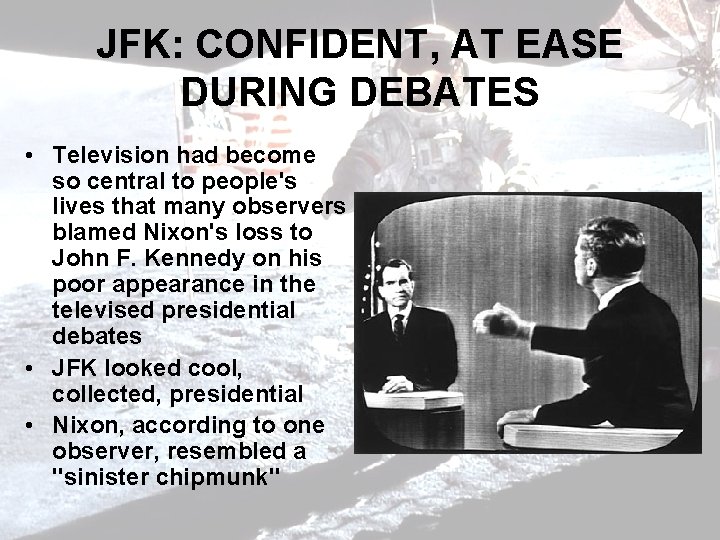
JFK: CONFIDENT, AT EASE DURING DEBATES • Television had become so central to people's lives that many observers blamed Nixon's loss to John F. Kennedy on his poor appearance in the televised presidential debates • JFK looked cool, collected, presidential • Nixon, according to one observer, resembled a "sinister chipmunk"
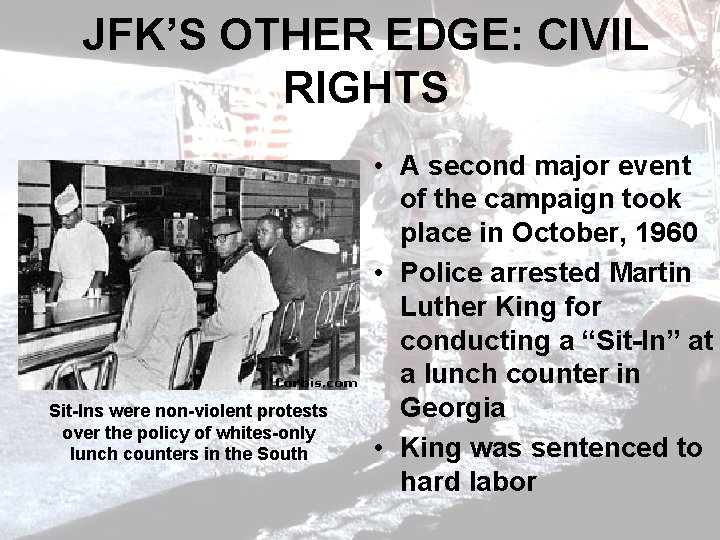
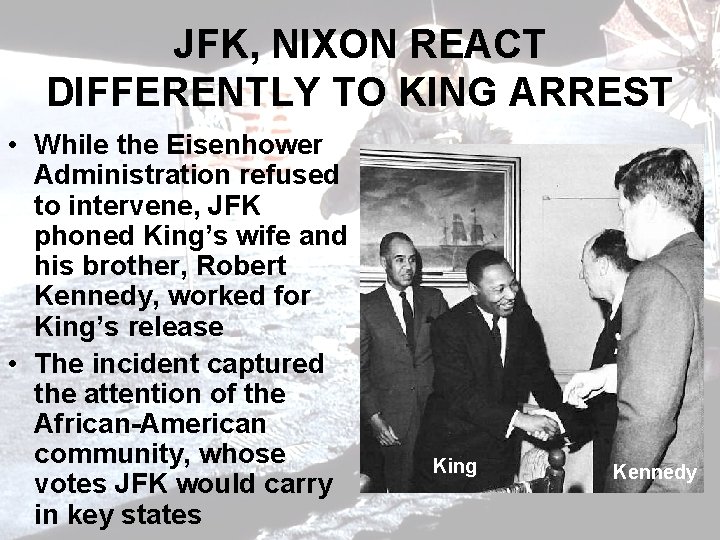
JFK’S OTHER EDGE: CIVIL RIGHTS Sit-Ins were non-violent protests over the policy of whites-only lunch counters in the South • A second major event of the campaign took place in October, 1960 • Police arrested Martin Luther King for conducting a “Sit-In” at a lunch counter in Georgia • King was sentenced to hard labor
JFK, NIXON REACT DIFFERENTLY TO KING ARREST • While the Eisenhower Administration refused to intervene, JFK phoned King’s wife and his brother, Robert Kennedy, worked for King’s release • The incident captured the attention of the African-American community, whose votes JFK would carry in key states King Kennedy
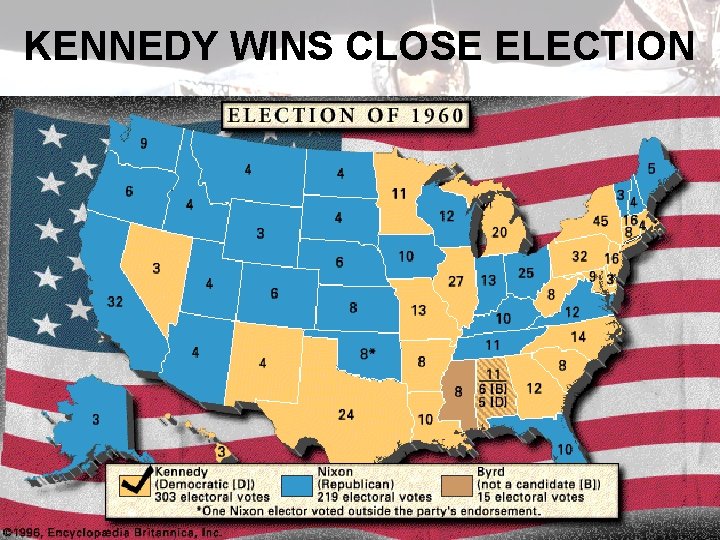
KENNEDY WINS CLOSE ELECTION
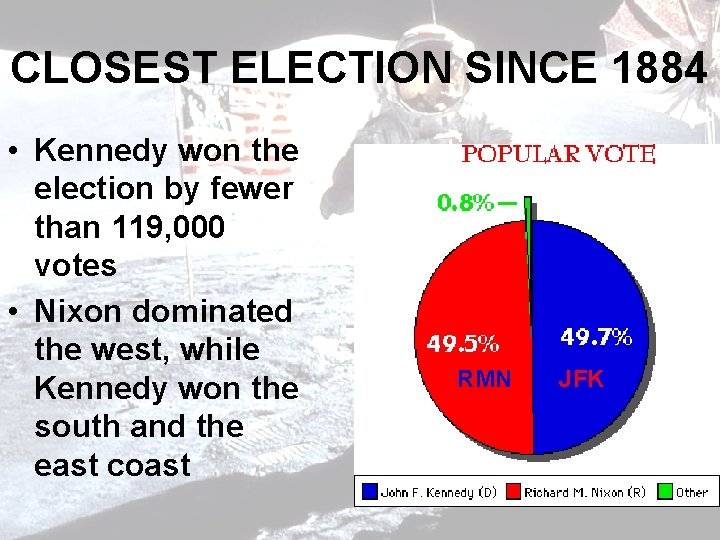
CLOSEST ELECTION SINCE 1884 • Kennedy won the election by fewer than 119, 000 votes • Nixon dominated the west, while Kennedy won the south and the east coast RMN JFK
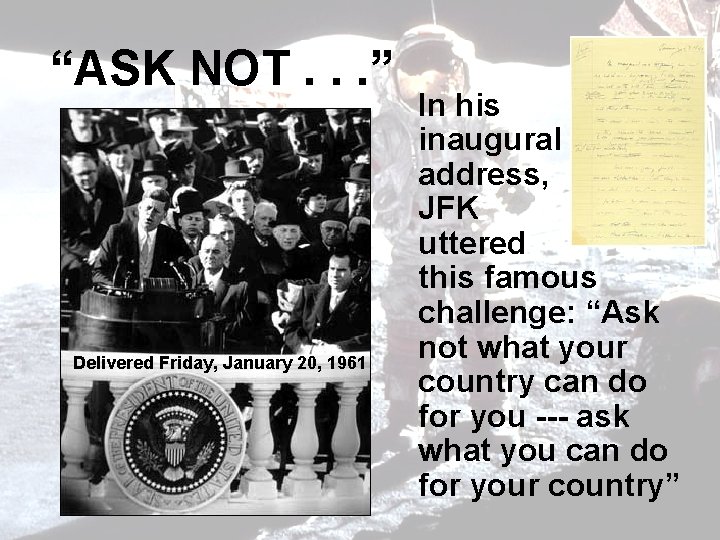
“ASK NOT. . . ” Delivered Friday, January 20, 1961 In his inaugural address, JFK uttered this famous challenge: “Ask not what your country can do for you --- ask what you can do for your country”
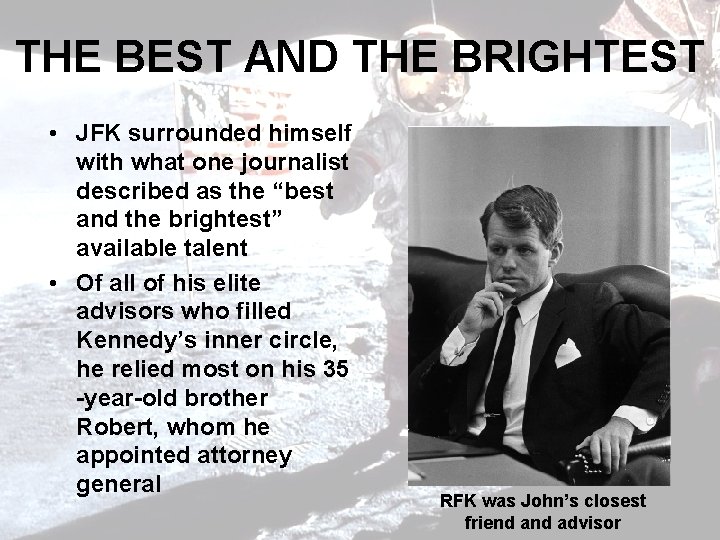
THE BEST AND THE BRIGHTEST • JFK surrounded himself with what one journalist described as the “best and the brightest” available talent • Of all of his elite advisors who filled Kennedy’s inner circle, he relied most on his 35 -year-old brother Robert, whom he appointed attorney general RFK was John’s closest friend advisor
FOCUS ON THE COLD WAR • From the beginning of his term in early 1961, JFK focused on the Cold War (Soviet relations) • JFK tripled our nuclear capability, increased troops, ships and artillery, and created the Green Berets (Special Forces)
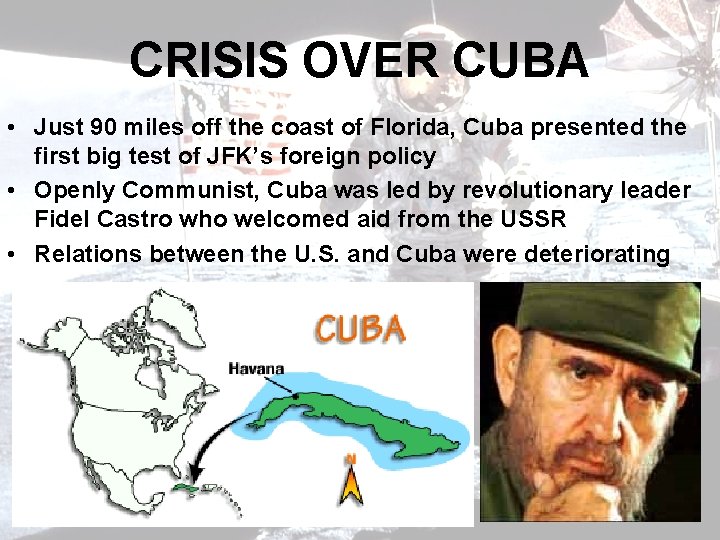
CRISIS OVER CUBA • Just 90 miles off the coast of Florida, Cuba presented the first big test of JFK’s foreign policy • Openly Communist, Cuba was led by revolutionary leader Fidel Castro who welcomed aid from the USSR • Relations between the U. S. and Cuba were deteriorating
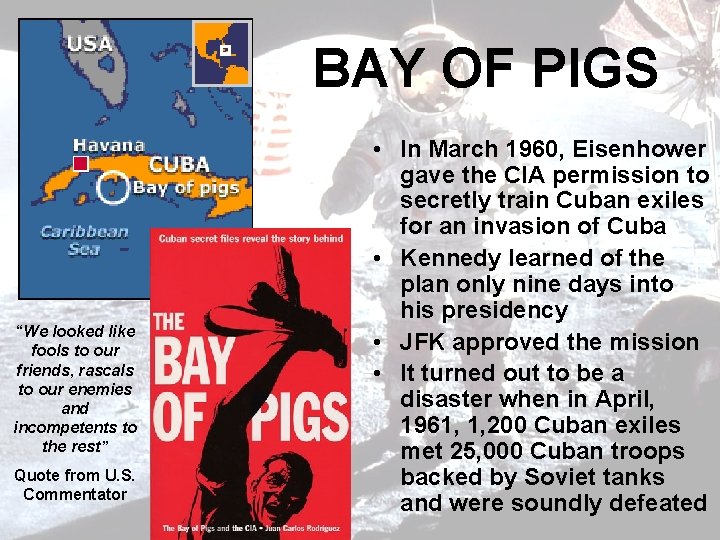
BAY OF PIGS “We looked like fools to our friends, rascals to our enemies and incompetents to the rest” Quote from U. S. Commentator • In March 1960, Eisenhower gave the CIA permission to secretly train Cuban exiles for an invasion of Cuba • Kennedy learned of the plan only nine days into his presidency • JFK approved the mission • It turned out to be a disaster when in April, 1961, 1, 200 Cuban exiles met 25, 000 Cuban troops backed by Soviet tanks and were soundly defeated
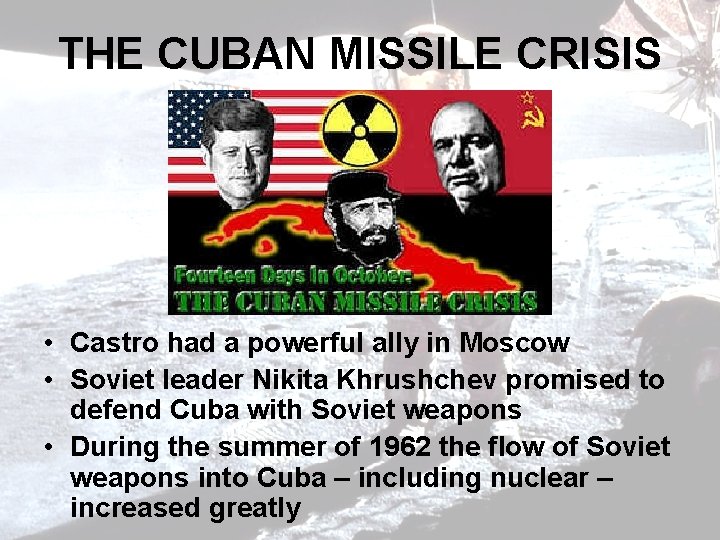
THE CUBAN MISSILE CRISIS • Castro had a powerful ally in Moscow • Soviet leader Nikita Khrushchev promised to defend Cuba with Soviet weapons • During the summer of 1962 the flow of Soviet weapons into Cuba – including nuclear – increased greatly
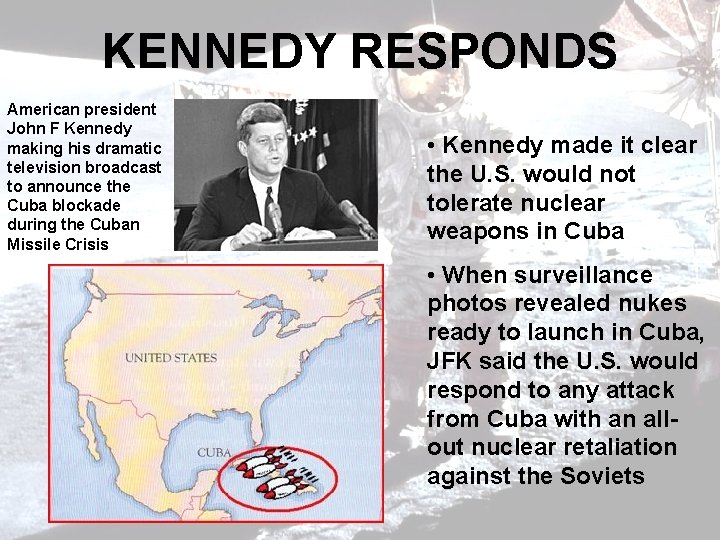
KENNEDY RESPONDS American president John F Kennedy making his dramatic television broadcast to announce the Cuba blockade during the Cuban Missile Crisis • Kennedy made it clear the U. S. would not tolerate nuclear weapons in Cuba • When surveillance photos revealed nukes ready to launch in Cuba, JFK said the U. S. would respond to any attack from Cuba with an allout nuclear retaliation against the Soviets
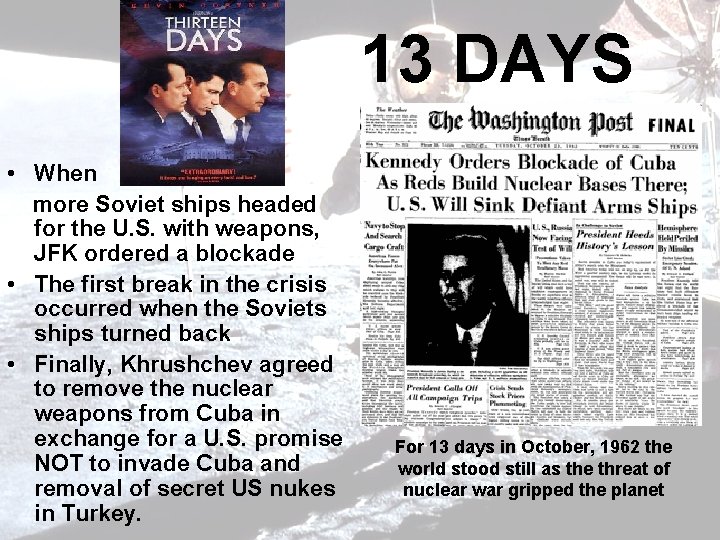
13 DAYS • When more Soviet ships headed for the U. S. with weapons, JFK ordered a blockade • The first break in the crisis occurred when the Soviets ships turned back • Finally, Khrushchev agreed to remove the nuclear weapons from Cuba in exchange for a U. S. promise NOT to invade Cuba and removal of secret US nukes in Turkey. For 13 days in October, 1962 the world stood still as the threat of nuclear war gripped the planet
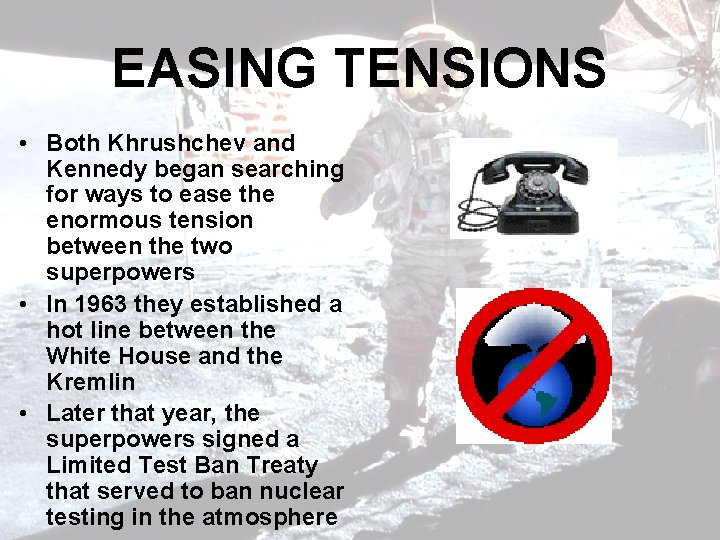
EASING TENSIONS • Both Khrushchev and Kennedy began searching for ways to ease the enormous tension between the two superpowers • In 1963 they established a hot line between the White House and the Kremlin • Later that year, the superpowers signed a Limited Test Ban Treaty that served to ban nuclear testing in the atmosphere
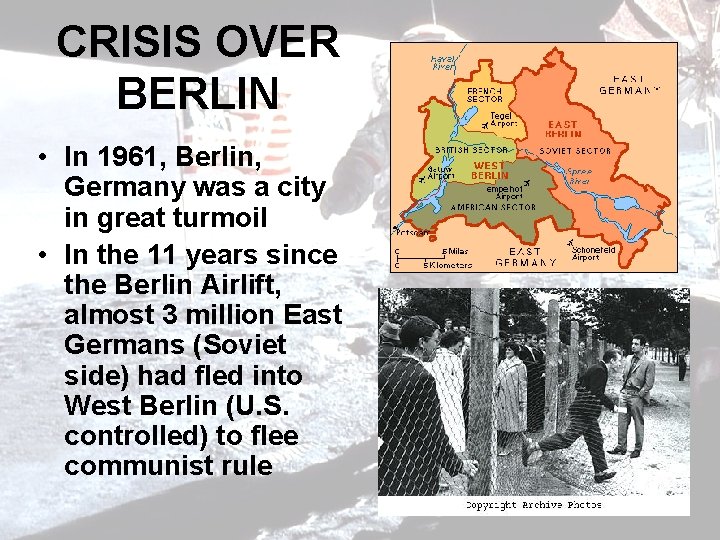
CRISIS OVER BERLIN • In 1961, Berlin, Germany was a city in great turmoil • In the 11 years since the Berlin Airlift, almost 3 million East Germans (Soviet side) had fled into West Berlin (U. S. controlled) to flee communist rule
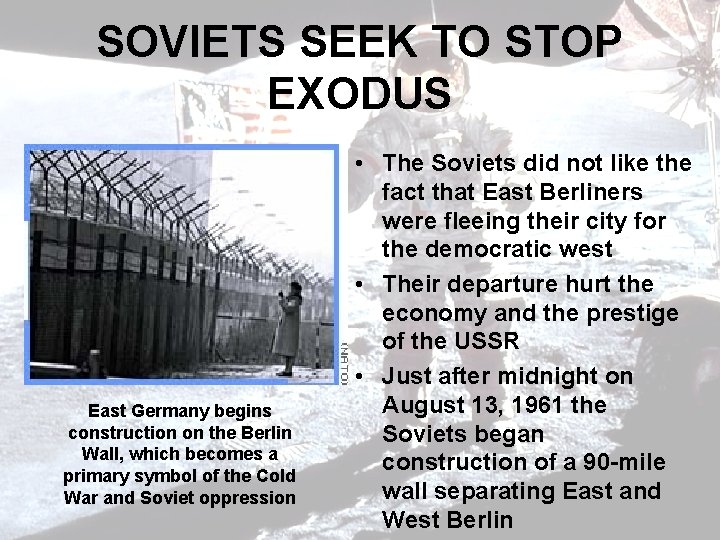
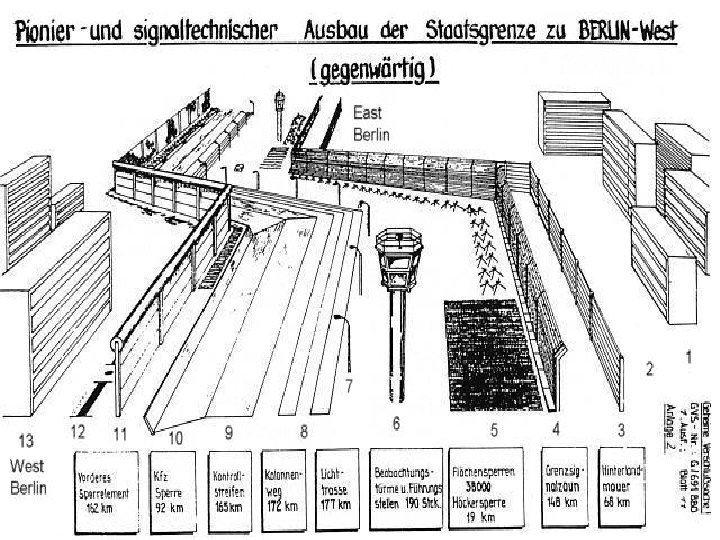
SOVIETS SEEK TO STOP EXODUS East Germany begins construction on the Berlin Wall, which becomes a primary symbol of the Cold War and Soviet oppression • The Soviets did not like the fact that East Berliners were fleeing their city for the democratic west • Their departure hurt the economy and the prestige of the USSR • Just after midnight on August 13, 1961 the Soviets began construction of a 90 -mile wall separating East and West Berlin
HOMEWORK Chapter 20 Section 2 Read Pages 678 – 683 Main Idea Questions A–E Skill. Builder Page 681 #1 – 2
Ticket out the Door 1. Explain how television changed the race for the presidency. 2. How did Kennedy support the Civil Rights movement? 3. What happened at the Bay of Pigs? How was the U. S. involved? 4. What caused the Cuban Missile Crisis in 1962? How did Kennedy respond? 5. Why was the Berlin Wall constructed?