
Opening Assignment 1 What does an atom look


- Slides: 33
Opening Assignment • 1. What does an atom look like? • Draw a picture and label the different parts. • 2. How does the atom of a carbon atom look different from an atom of a gold atom?
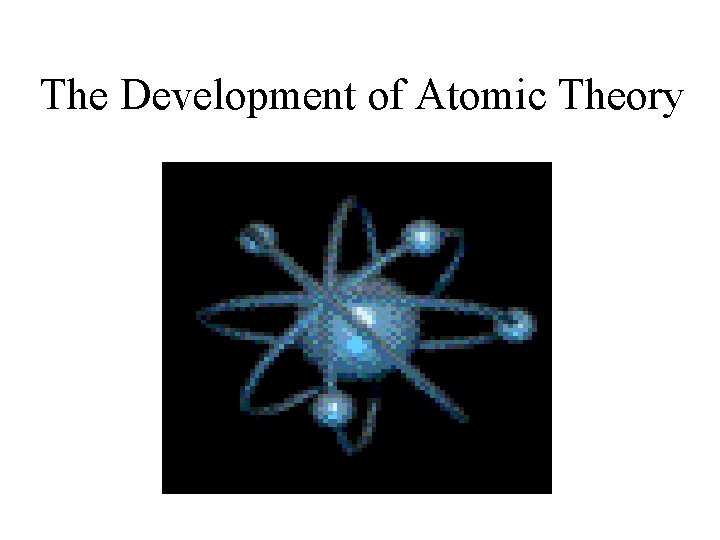
The Development of Atomic Theory
(Question 1) Do Theories in Science Stay the Same? • Ideas and theories in Science change as new information is gathered. Our theory about the atom has changed over time as new studies are done. Even though no one has ever seen an atom up close we are still able to make new discoveries – just like we have made new discoveries about dinosaurs.
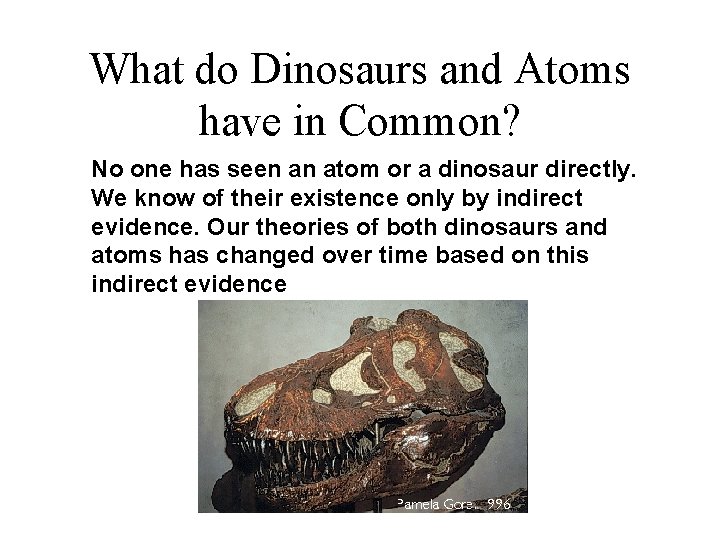
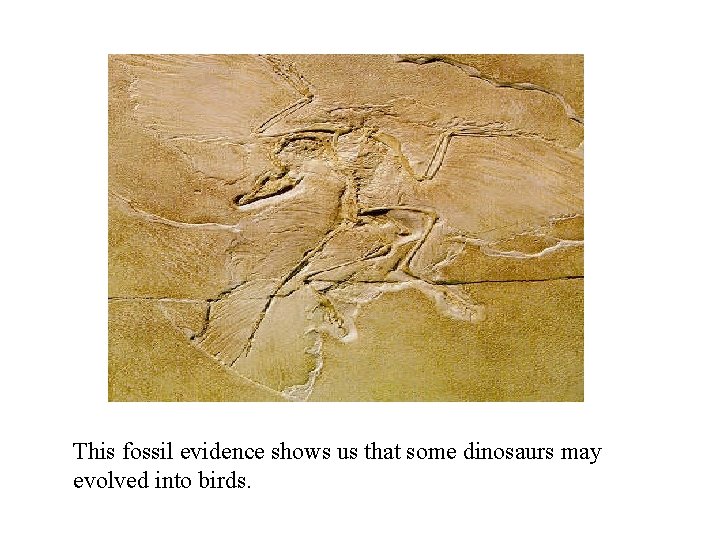
What do Dinosaurs and Atoms have in Common? No one has seen an atom or a dinosaur directly. We know of their existence only by indirect evidence. Our theories of both dinosaurs and atoms has changed over time based on this indirect evidence
This fossil evidence shows us that some dinosaurs may evolved into birds.
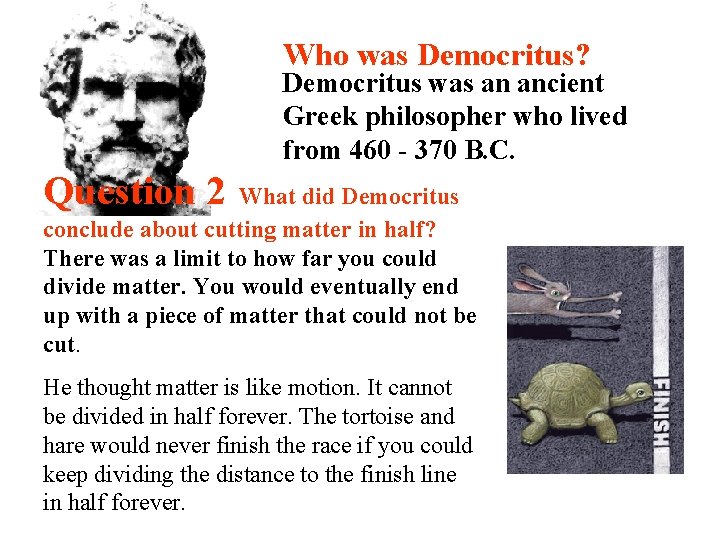
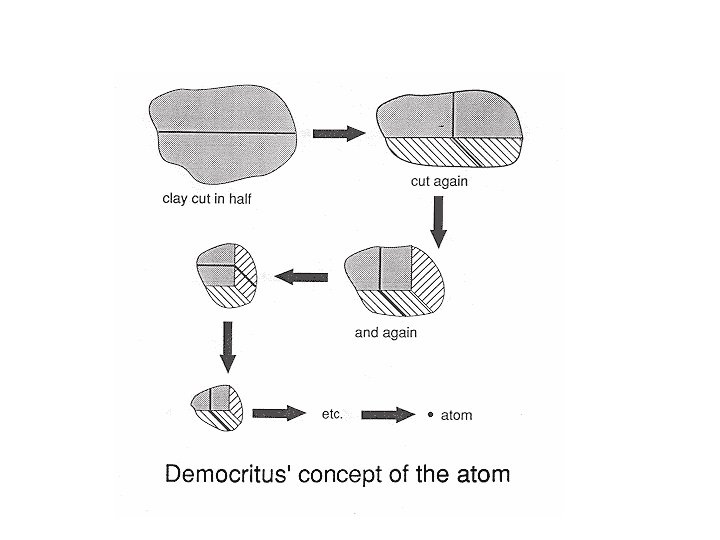
Who was Democritus? Democritus was an ancient Greek philosopher who lived from 460 - 370 B. C. Question 2 What did Democritus conclude about cutting matter in half? There was a limit to how far you could divide matter. You would eventually end up with a piece of matter that could not be cut. He thought matter is like motion. It cannot be divided in half forever. The tortoise and hare would never finish the race if you could keep dividing the distance to the finish line in half forever.
Question 3 What does the Greek word atomos mean? • The Greek word “atomos” means not able to be divided or “indivisible. ”
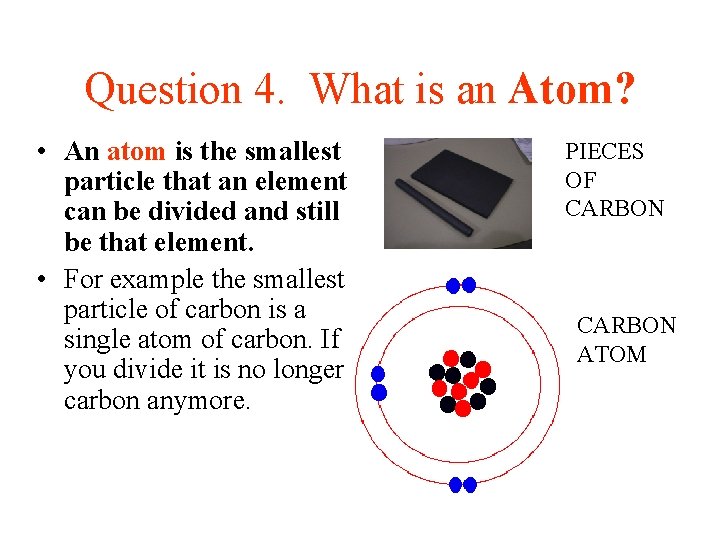
Question 4. What is an Atom? • An atom is the smallest particle that an element can be divided and still be that element. • For example the smallest particle of carbon is a single atom of carbon. If you divide it is no longer carbon anymore. PIECES OF CARBON ATOM
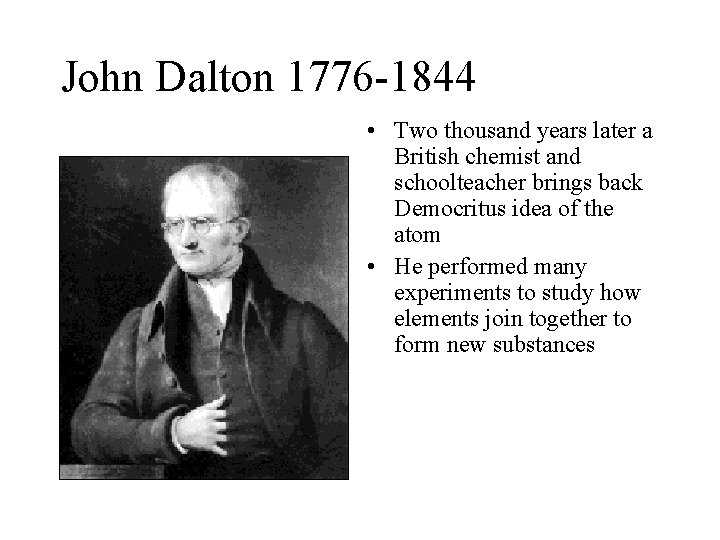
John Dalton 1776 -1844 • Two thousand years later a British chemist and schoolteacher brings back Democritus idea of the atom • He performed many experiments to study how elements join together to form new substances
Question 5. What new ideas did John Dalton propose about the atom? • All substances are made up of atoms which are small particles that cannot be created, divided, or destroyed. • Atoms of the same element are exactly alike and atoms of different elements are different. • Atoms join with other atoms to form different substances (new compounds)
Question 5 -- What new ideas did John Dalton propose about the atom? • Every new compound is made up of atoms of different elements that combine in specific ratios. For example --- 2 hydrogen atoms combine with 1 oxygen atom to form water.
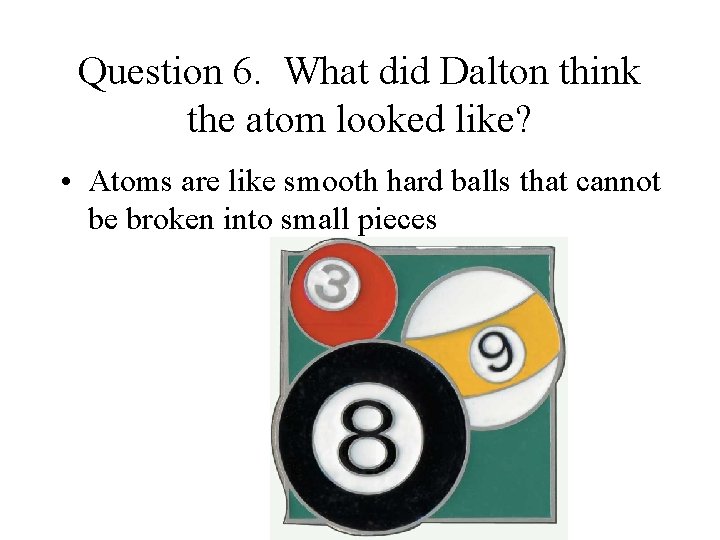
Question 6. What did Dalton think the atom looked like? • Atoms are like smooth hard balls that cannot be broken into small pieces
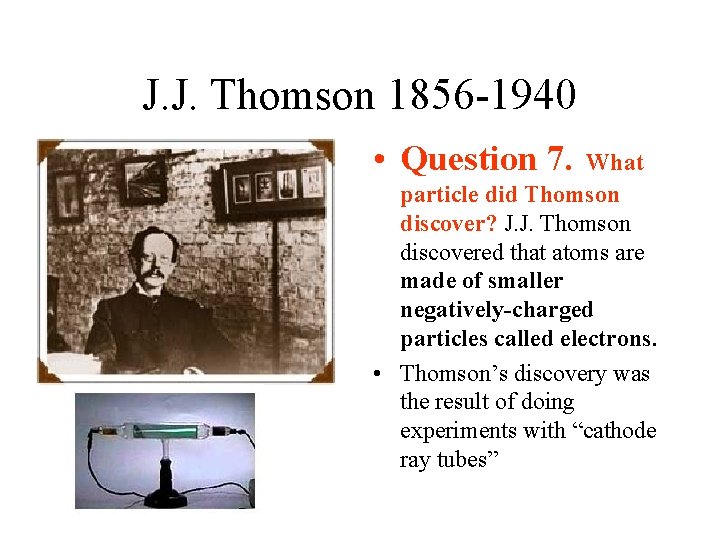
J. J. Thomson 1856 -1940 • Question 7. What particle did Thomson discover? J. J. Thomson discovered that atoms are made of smaller negatively-charged particles called electrons. • Thomson’s discovery was the result of doing experiments with “cathode ray tubes”
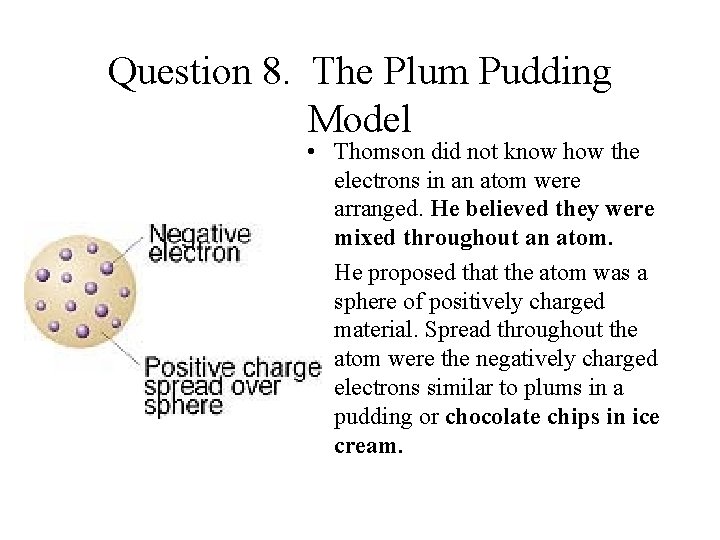
Question 8. The Plum Pudding Model • Thomson did not know how the electrons in an atom were arranged. He believed they were mixed throughout an atom. • He proposed that the atom was a sphere of positively charged material. Spread throughout the atom were the negatively charged electrons similar to plums in a pudding or chocolate chips in ice cream.
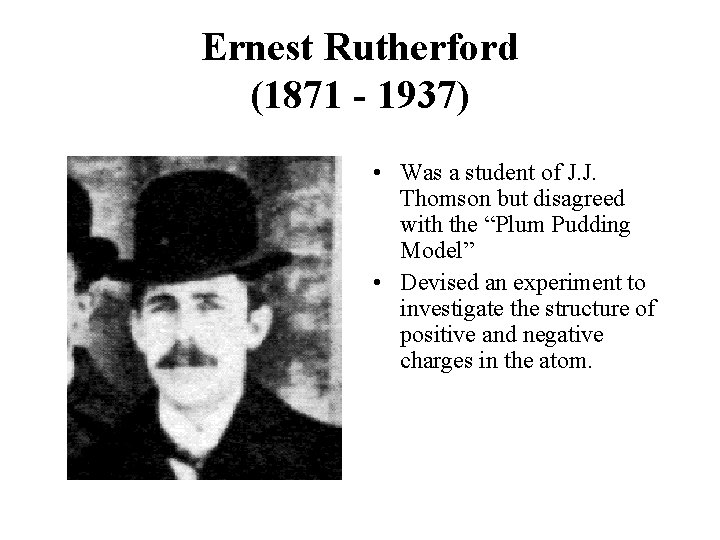
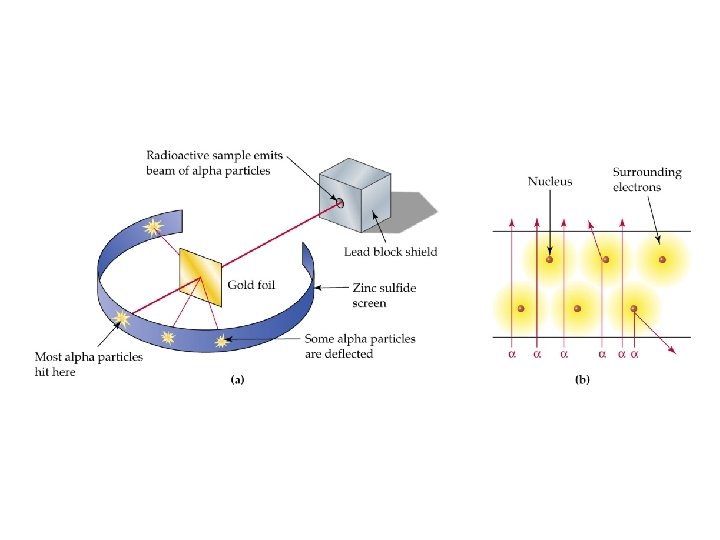
Ernest Rutherford (1871 - 1937) • Was a student of J. J. Thomson but disagreed with the “Plum Pudding Model” • Devised an experiment to investigate the structure of positive and negative charges in the atom.
Rutherford's Experiment: Nuclear Atom – You. Tube
What did most of the particles shot at the gold foil do? • Most of the particles traveled straight through the gold foil What was the surprising behavior of a few of the particles? • A few of the particles were deflected and some even bounced back
Question 9. What did Rutherford conclude? Result: Most of the positively charged particles went straight through the gold foil. Theory: Most of the matter of the atom is found in a very small part of the atom. This is called the nucleus of the atom. It is very tiny and extremely dense.
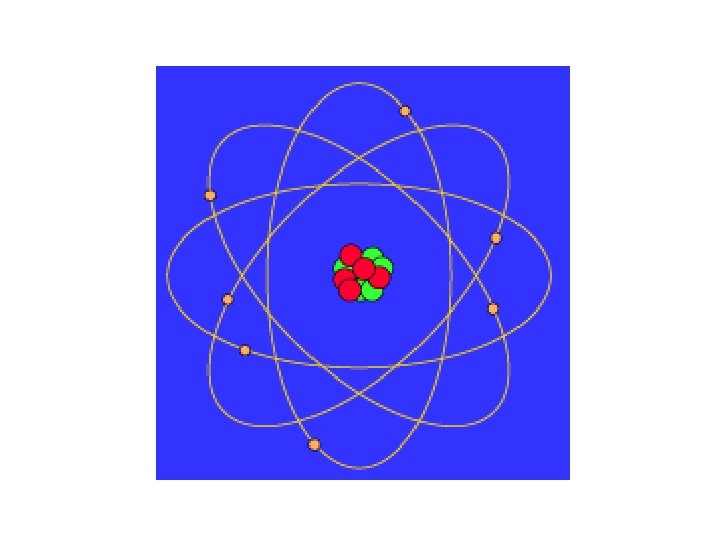
What did Rutherford conclude? Result: Some of the positively charged particles were deflected or even bounced back. Theory: Like charges repel so the nucleus must have a positive charge. If electrons have a negative charge they could not be in a positively charged nucleus. Electrons must surround the nucleus at a distance.
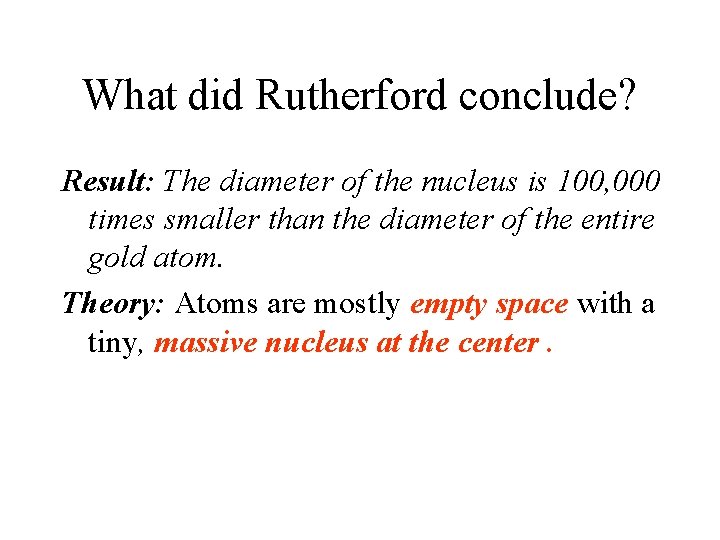
What did Rutherford conclude? Result: The diameter of the nucleus is 100, 000 times smaller than the diameter of the entire gold atom. Theory: Atoms are mostly empty space with a tiny, massive nucleus at the center.
The Discovery of the Atomic Nucleus (3 of 15) – You. Tube
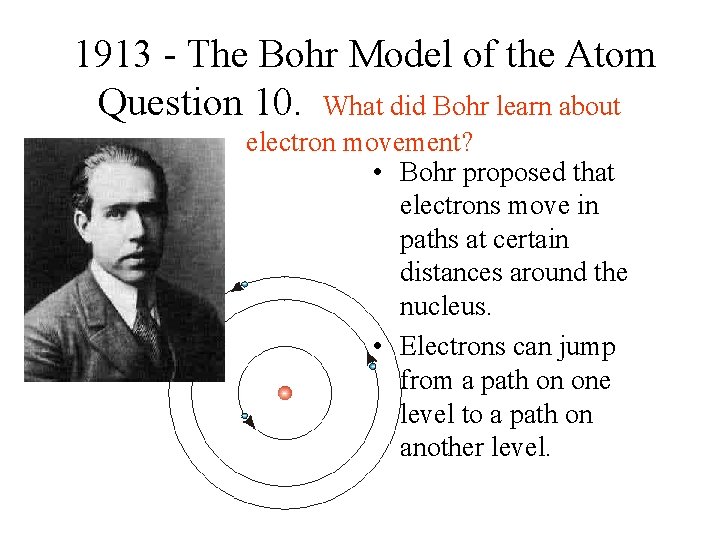
1913 - The Bohr Model of the Atom Question 10. What did Bohr learn about electron movement? • Bohr proposed that electrons move in paths at certain distances around the nucleus. • Electrons can jump from a path on one level to a path on another level.
Opening assignment: How small is an atom? 1. Which is larger … a proton? neutron? or an electron? 2. Which has a greater mass… a proton, neutron or an electron? 3. Take a guess… how many atoms make up a penny?
Comparing the particles of an atom electrons weigh very little Protons and neutrons weigh 2, 000 times greater than an electron Proton and neutron have an atomic mass of 1 AMU = 1 atomic mass unit • 1 electron – mass is close to zero
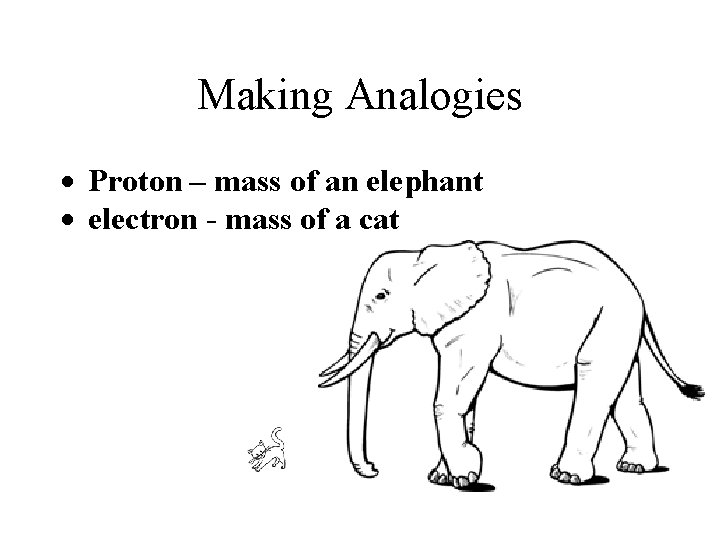
Making Analogies Proton – mass of an elephant electron - mass of a cat
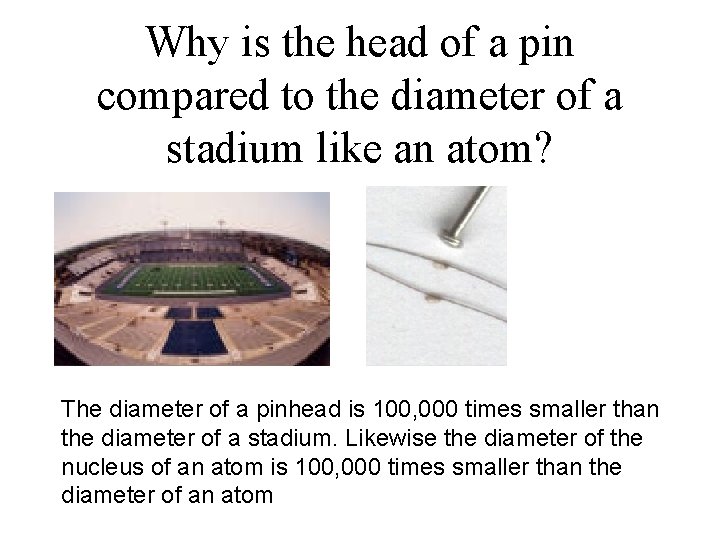
Why is the head of a pin compared to the diameter of a stadium like an atom? The diameter of a pinhead is 100, 000 times smaller than the diameter of a stadium. Likewise the diameter of the nucleus of an atom is 100, 000 times smaller than the diameter of an atom
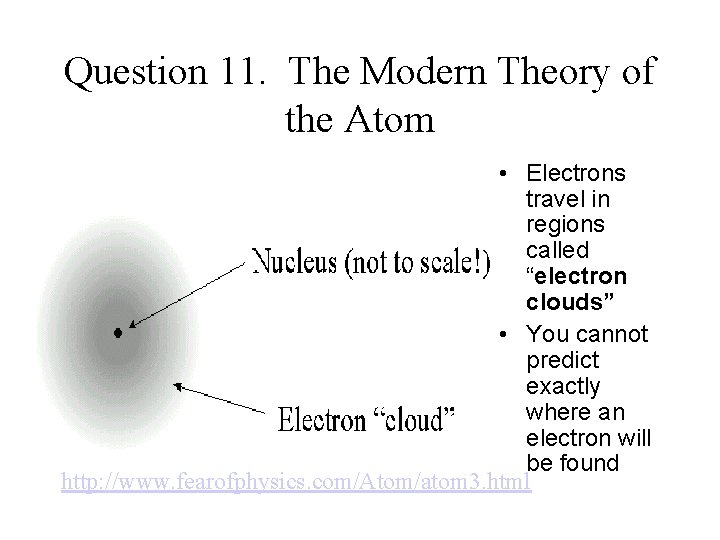
Question 11. The Modern Theory of the Atom • Electrons travel in regions called “electron clouds” • You cannot predict exactly where an electron will be found http: //www. fearofphysics. com/Atom/atom 3. html
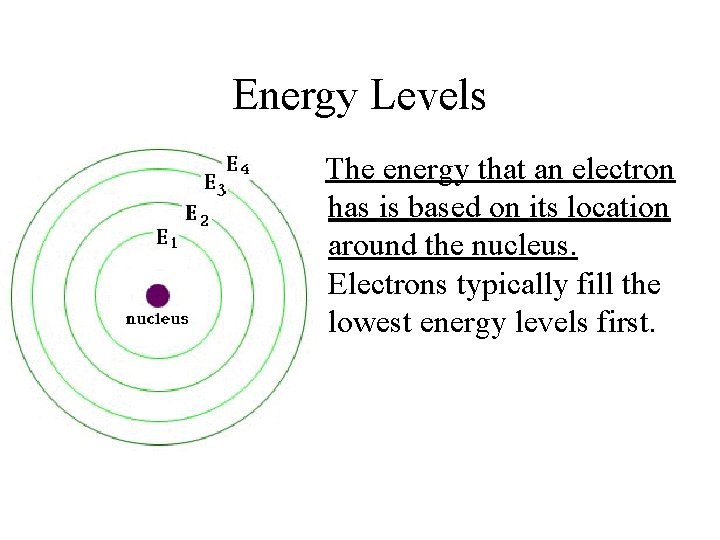
Energy Levels The energy that an electron has is based on its location around the nucleus. Electrons typically fill the lowest energy levels first.
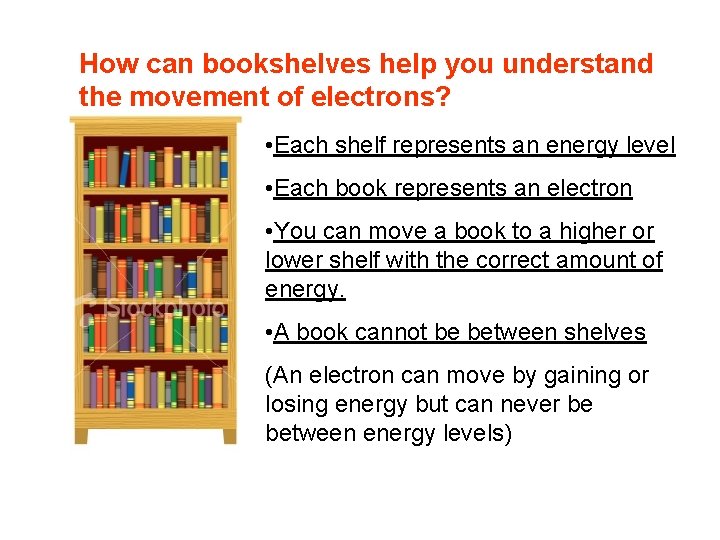
How can bookshelves help you understand the movement of electrons? • Each shelf represents an energy level • Each book represents an electron • You can move a book to a higher or lower shelf with the correct amount of energy. • A book cannot be between shelves (An electron can move by gaining or losing energy but can never be between energy levels)
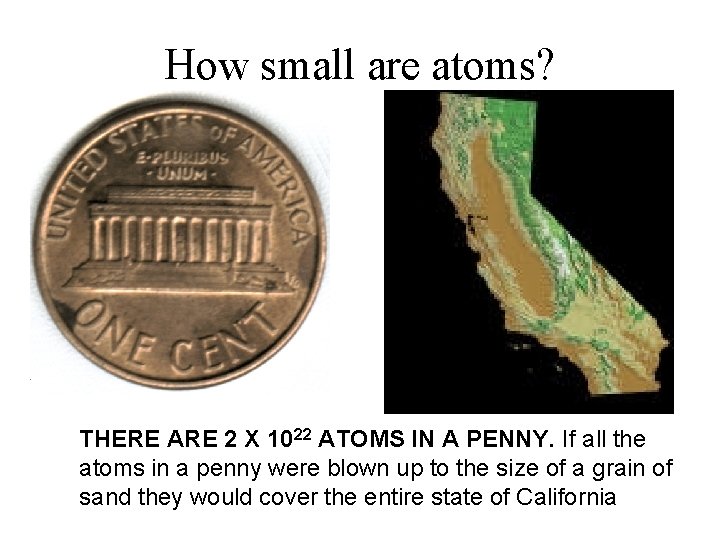
How small are atoms? THERE ARE 2 X 10²² ATOMS IN A PENNY. If all the atoms in a penny were blown up to the size of a grain of sand they would cover the entire state of California