
OpenEnded Responses What do I need to know

- Slides: 14
Open-Ended Responses What do I need to know to Assist? • How the Reading Test Set Up • Specifics about Open-Ended Questions • The Concepts Covered • Selecting a Passage & Prompt • Scoring
Test Set Up • Students will be given items to read. Possible formats include the following: – Story fiction – Poem fiction – Biography/Autobiography – Practical/How to/Advertisement – Informational – Essay or Editorial
Question Format • Following the passage, there will be 2 types of questions: multiple-choice (selected response) and open-ended tasks (writing assignments). • Students are expected to organize their thinking and statements in a short concise manner. • Students must have a beginning, middle, and end for all answers, especially summaries of stories
2007! • The 2007 PSSA is all about answering the question SPECIFICALLY and COMPLETELY. • For example, students will be asked to give a certain number of reasons, examples, etc. and they must respond accordingly. • If a student is asked to give 2 examples, they must give at least 2 examples.
Credit for Their Work • In order to receive full credit for these items, the student needs to provide a COMPLETE and CORRECT answer to the question/task.
Text Based Support & Personal Examples/Comments • Students will need to provide text-based support. This means students should provide specific, appropriate, and accurate details or examples. • Sometimes it will be appropriate to include a personal example or comment, and other times it will not be appropriate. It all depends on the prompt.
Strategies • Students will be permitted to underline/highlight key information, but students will need to know what is important. • Students may look back in the passage for context clues, underline words, etc.
Additional Strategy • CUCC C - Circle key directions U - Underline information that accompanied key direction C - Count up the number of parts needed for a complete answer (then answer the question) C - Check to be sure all parts of the task have been addressed
Sample CUCC • Prompt: What Challenges did Earl Encounter? Use at least three examples from the passage in your response. Identify at least one trait Dick Fosburry possessed. Explain how this trait helped him become a successful high jumper. Use at least two examples from the passage to support your response.
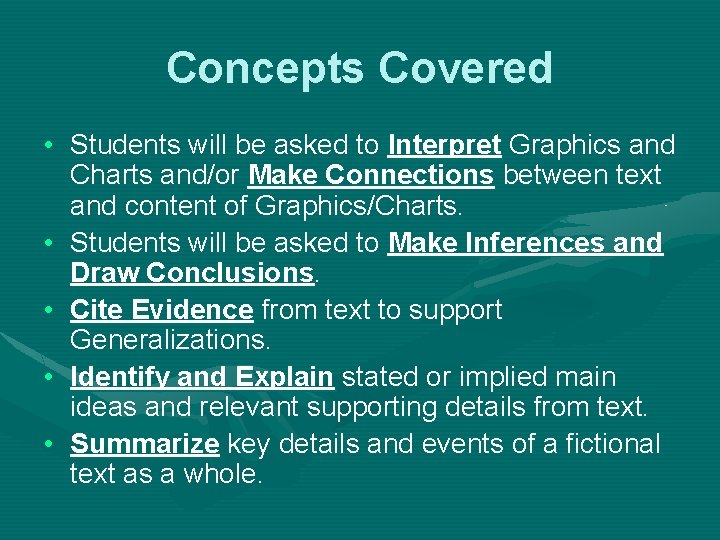
Concepts Covered • Students will be asked to Interpret Graphics and Charts and/or Make Connections between text and content of Graphics/Charts. • Students will be asked to Make Inferences and Draw Conclusions. • Cite Evidence from text to support Generalizations. • Identify and Explain stated or implied main ideas and relevant supporting details from text. • Summarize key details and events of a fictional text as a whole.
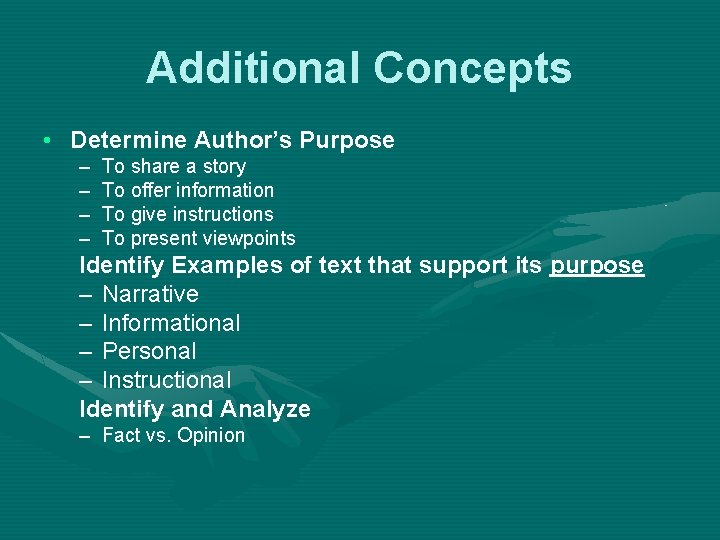
Additional Concepts • Determine Author’s Purpose – – To share a story To offer information To give instructions To present viewpoints Identify Examples of text that support its purpose – Narrative – Informational – Personal – Instructional Identify and Analyze – Fact vs. Opinion
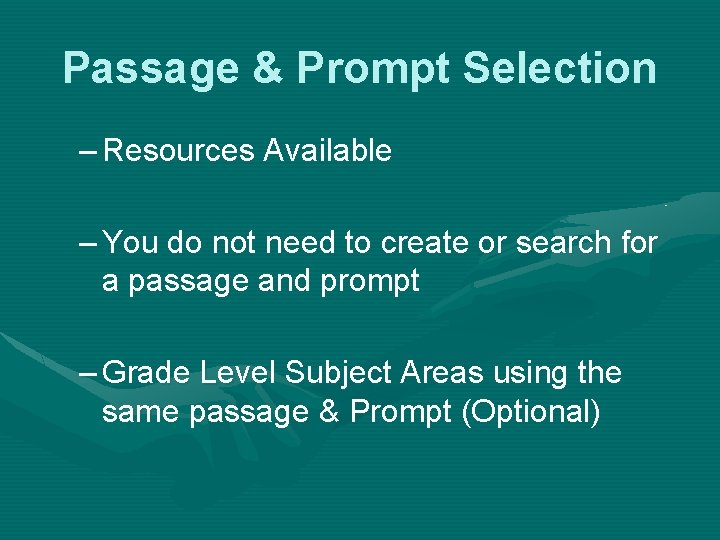
Passage & Prompt Selection – Resources Available – You do not need to create or search for a passage and prompt – Grade Level Subject Areas using the same passage & Prompt (Optional)
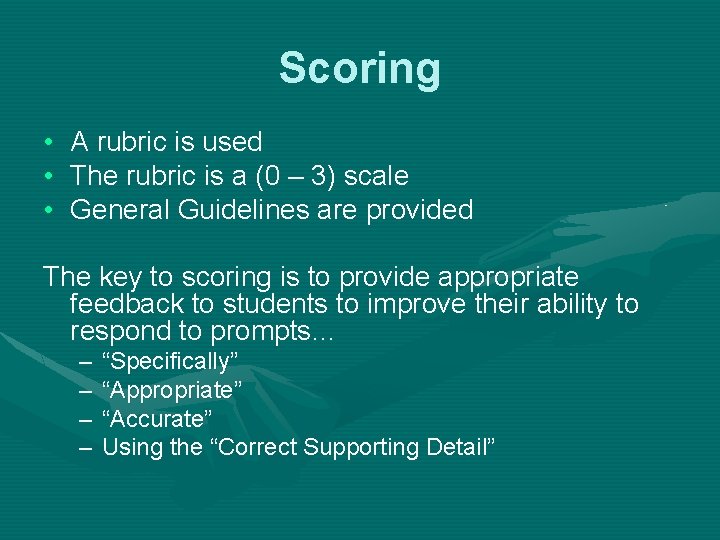
Scoring • • • A rubric is used The rubric is a (0 – 3) scale General Guidelines are provided The key to scoring is to provide appropriate feedback to students to improve their ability to respond to prompts… – – “Specifically” “Appropriate” “Accurate” Using the “Correct Supporting Detail”
Pervasive & Consistent Approach • MS Faculty - Each faculty member Core/Encore/Specials will provide (1) openended response to a reading passage to their students during the school year • • A schedule is organized for implementation Passages and Prompts are consistent Template for Student response is consistent Passages are submitted • Consistency is used in scoring