
OPENCities a driver for successful cities Internationalisation OPENCities

- Slides: 15
OPENCities – a driver for successful cities Internationalisation OPENCities is a British Council project funded by URBACT and led by Belfast City Council in collaboration with a network of European Cities
OPENCities – a driver for successful cities OPENCities Internationalisation: Key Questions • What do we mean by city internationalisation? Why do cities seek to become more international? • What is the role of population internationalisation in the process of becoming an international city? • What are the promising practices that cities are developing, and how do they work? OPENCities is a British Council project funded by URBACT and led by Belfast City Council in collaboration with a network of European Cities
OPENCities – a driver for successful cities Drivers for Internationalisation: Globalisation Intensifying globalisation + interconnection = new urban policy challenges • • Nearly all sectors heavily contested through international competition Improved human mobility - cities subject to dynamic population changes and immigration flows Increasing trends towards an inter-governmental approach to managing important policy issues Specialisation within sophisticated global value chains Seamless global connectivity Attractive business environment Internationally appealing quality of life Retention and expansion of internationally oriented traders/investors OPENCities is a British Council project funded by URBACT and led by Belfast City Council in collaboration with a network of European Cities
OPENCities – a driver for successful cities Internationalisation: Target Groups INTERNATIONAL TALENT • Corporate Employees • Students • Research and Development OECD “Global War for Talent” OPENCities is a British Council project fundedsee by URBACT andretention led by All aspiring international cities must now talent and attraction as vital to Belfast City Council in collaboration with a network of European Cities their internationalisation efforts, whether through direct incentives, immigration assistance, social and cultural support, or public-private investment in research
OPENCities – a driver for successful cities How do cities look to internationalise? 1) Large cities - highly active and engaged, aim to host a critical mass of activity, and make international-facing orientation intrinsic to policy-making mosaic. (e. g. Sao Paulo, Mumbai and Istanbul) 2) Smaller cities – look for distinctive cultural niche or economic specialisation based on established reputations with inherent international implications. (e. g. Zurich, Edinburgh and Boston) 3) Secondary cities – aim to escape constraints of national urban system by attracting investment, events and people internationally. (e. g. Manchester, Barcelona, Cape Town and Toronto) 4) Historical cities – look to re-configure international positioning, based on an indelible legacy of seeking an international role (e. g. Amsterdam, Venice) Requirements for Internationalisation • Organisational and fiscal capabilities • Identifiable match between economic/social assets and international demand • Strong, historically well-developed fields that can generate the critical mass in other milieus (economic, social and cultural) • Can have EXPLICIT (Madrid Global) and IMPLICIT strategies (Vienna, cross-cutting approach) OPENCities is a British Council project funded by URBACT and led by Belfast City Council in collaboration with a network of European Cities
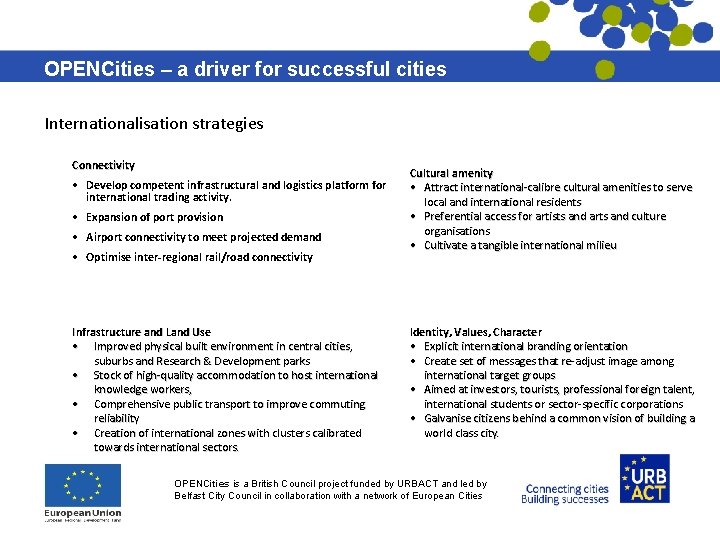
OPENCities – a driver for successful cities Internationalisation strategies Connectivity • Develop competent infrastructural and logistics platform for international trading activity. • Expansion of port provision • Airport connectivity to meet projected demand • Optimise inter-regional rail/road connectivity Infrastructure and Land Use • Improved physical built environment in central cities, suburbs and Research & Development parks • Stock of high-quality accommodation to host international knowledge workers, • Comprehensive public transport to improve commuting reliability • Creation of international zones with clusters calibrated towards international sectors. Cultural amenity • Attract international-calibre cultural amenities to serve local and international residents • Preferential access for artists and arts and culture organisations • Cultivate a tangible international milieu Identity, Values, Character • Explicit international branding orientation • Create set of messages that re-adjust image among international target groups • Aimed at investors, tourists, professional foreign talent, international students or sector-specific corporations • Galvanise citizens behind a common vision of building a world class city. OPENCities is a British Council project funded by URBACT and led by Belfast City Council in collaboration with a network of European Cities
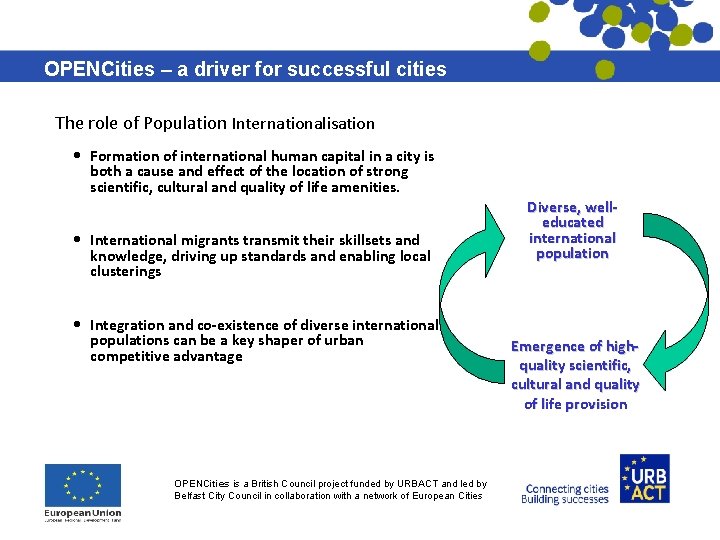
OPENCities – a driver for successful cities The role of Population Internationalisation • Formation of international human capital in a city is both a cause and effect of the location of strong scientific, cultural and quality of life amenities. • International migrants transmit their skillsets and knowledge, driving up standards and enabling local clusterings Diverse, welleducated international population • Integration and co-existence of diverse international populations can be a key shaper of urban competitive advantage OPENCities is a British Council project funded by URBACT and led by Belfast City Council in collaboration with a network of European Cities Emergence of highquality scientific, cultural and quality of life provision
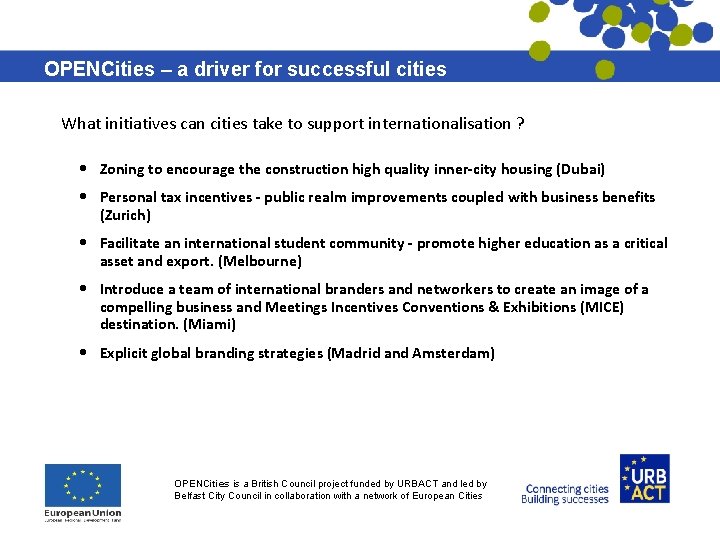
OPENCities – a driver for successful cities What initiatives can cities take to support internationalisation ? • Zoning to encourage the construction high quality inner-city housing (Dubai) • Personal tax incentives - public realm improvements coupled with business benefits (Zurich) • Facilitate an international student community - promote higher education as a critical asset and export. (Melbourne) • Introduce a team of international branders and networkers to create an image of a compelling business and Meetings Incentives Conventions & Exhibitions (MICE) destination. (Miami) • Explicit global branding strategies (Madrid and Amsterdam) OPENCities is a British Council project funded by URBACT and led by Belfast City Council in collaboration with a network of European Cities
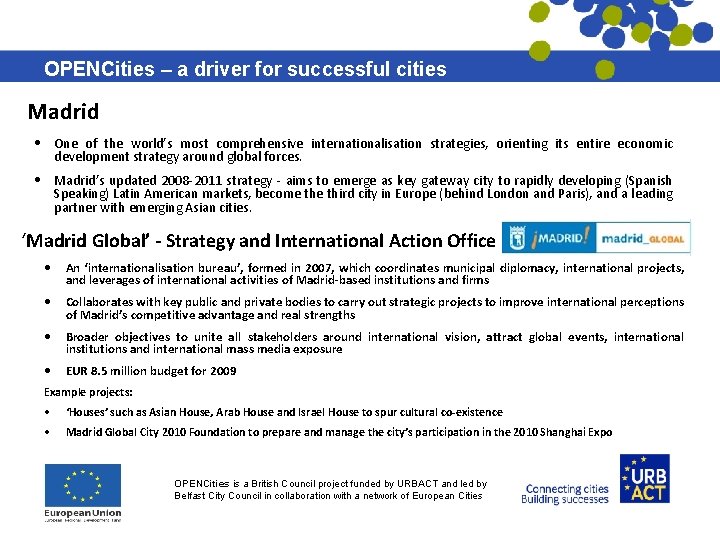
OPENCities – a driver for successful cities Madrid • One of the world’s most comprehensive internationalisation strategies, orienting its entire economic development strategy around global forces. • Madrid’s updated 2008 -2011 strategy - aims to emerge as key gateway city to rapidly developing (Spanish Speaking) Latin American markets, become third city in Europe (behind London and Paris), and a leading partner with emerging Asian cities. ‘Madrid Global’ - Strategy and International Action Office • An ‘internationalisation bureau’, formed in 2007, which coordinates municipal diplomacy, international projects, and leverages of international activities of Madrid-based institutions and firms • Collaborates with key public and private bodies to carry out strategic projects to improve international perceptions of Madrid’s competitive advantage and real strengths • Broader objectives to unite all stakeholders around international vision, attract global events, international institutions and international mass media exposure • EUR 8. 5 million budget for 2009 Example projects: • • ‘Houses’ such as Asian House, Arab House and Israel House to spur cultural co-existence Madrid Global City 2010 Foundation to prepare and manage the city’s participation in the 2010 Shanghai Expo OPENCities is a British Council project funded by URBACT and led by Belfast City Council in collaboration with a network of European Cities
OPENCities – a driver for successful cities Vienna • Since 1989 and EU enlargement, new geo-political and spatio-economic motivations to internationalise its business and population base. • Aims to compete with rival cities for gateway status - Prague, Berlin and Bratislava – high availability of wellqualified knowledge workers, excellent infrastructure, outstanding quality of life, and favourable tax framework. • Strategy builds upon image as a meeting point of East and West – promoted through global liaison offices. n Vienna Business Agency (VBA) - drives innovation, provides professional consulting and global city marketing. Examples of internationalisation policies: • Leading integration of Danube economic zone – institutionalised co-operation of 22 cities in areas of tourism marketing strategy, culture and infrastructure. • New Vienna Immigration Commission – consensus-built organisation arguing in favour of ‘soft’ mechanisms to attract and retain highly qualified immigrants. • Enhanced links with Bratislava - externalised several cross-border projects focused on sustainable industrial development and transport infrastructure OPENCities is a British Council project funded by URBACT and led by Belfast City Council in collaboration with a network of European Cities
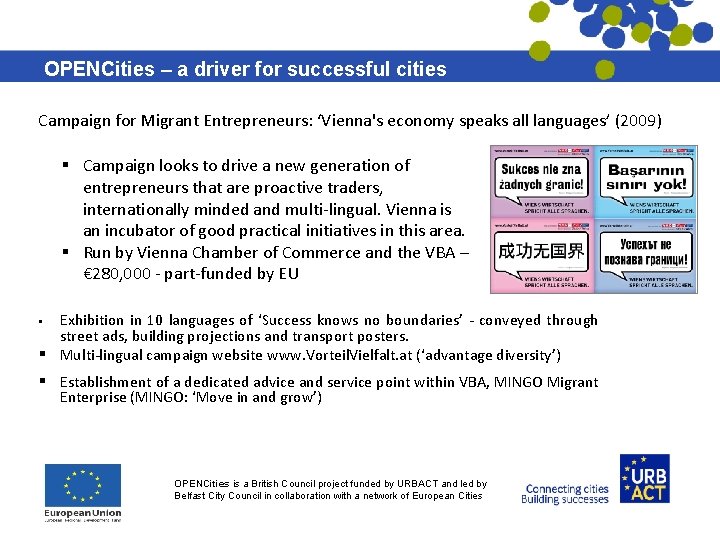
OPENCities – a driver for successful cities Campaign for Migrant Entrepreneurs: ‘Vienna's economy speaks all languages’ (2009) § Campaign looks to drive a new generation of entrepreneurs that are proactive traders, internationally minded and multi-lingual. Vienna is an incubator of good practical initiatives in this area. § Run by Vienna Chamber of Commerce and the VBA – € 280, 000 - part-funded by EU Exhibition in 10 languages of ‘Success knows no boundaries’ - conveyed through street ads, building projections and transport posters. § Multi-lingual campaign website www. Vorteil. Vielfalt. at (‘advantage diversity’) § § Establishment of a dedicated advice and service point within VBA, MINGO Migrant Enterprise (MINGO: ‘Move in and grow’) OPENCities is a British Council project funded by URBACT and led by Belfast City Council in collaboration with a network of European Cities
OPENCities – a driver for successful cities Amsterdam • Looks to preserve its regional strength in business services, insurance, advertising, law and management consultancy, and fully regain its international functions. 2006 strategy prioritises (re)placing Amsterdam among the top five most popular cities in Europe by 2030. • Reasserting liberal and cosmopolitan credentials, new policies to improve openness to wider range of populations and business. Focus on utilising untapped potential of emerging markets (esp. Indian and Chinese firms) § § 2008 opening of Expat Centre in the city’s World Trade Centre to provide a ‘one-stop shop’ for arriving high-skilled migrants – full support on taxes, healthcare, education New fund created to support nine large scale events –such as the Amsterdam India Festival - that will raise international profile as a creative, innovative trading city OPENCities is a British Council project funded by URBACT and led by Belfast City Council in collaboration with a network of European Cities
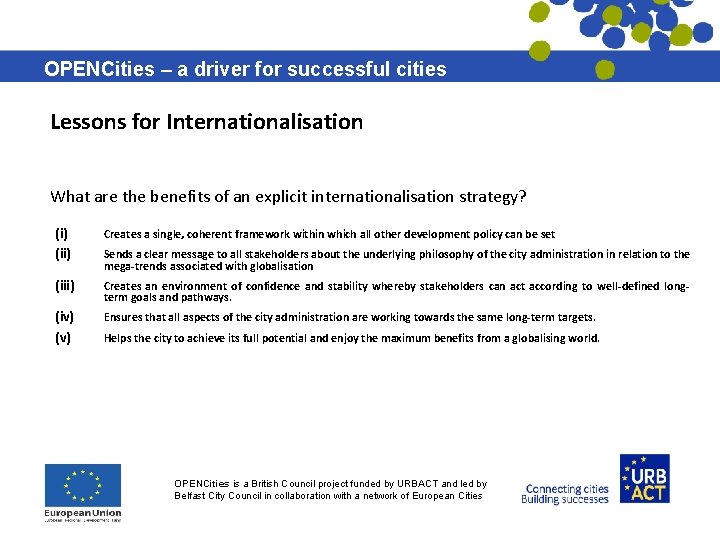
OPENCities – a driver for successful cities Lessons for Internationalisation What are the benefits of an explicit internationalisation strategy? (i) (ii) Creates a single, coherent framework within which all other development policy can be set (iii) Creates an environment of confidence and stability whereby stakeholders can act according to well-defined longterm goals and pathways. (iv) (v) Ensures that all aspects of the city administration are working towards the same long-term targets. Sends a clear message to all stakeholders about the underlying philosophy of the city administration in relation to the mega-trends associated with globalisation Helps the city to achieve its full potential and enjoy the maximum benefits from a globalising world. OPENCities is a British Council project funded by URBACT and led by Belfast City Council in collaboration with a network of European Cities
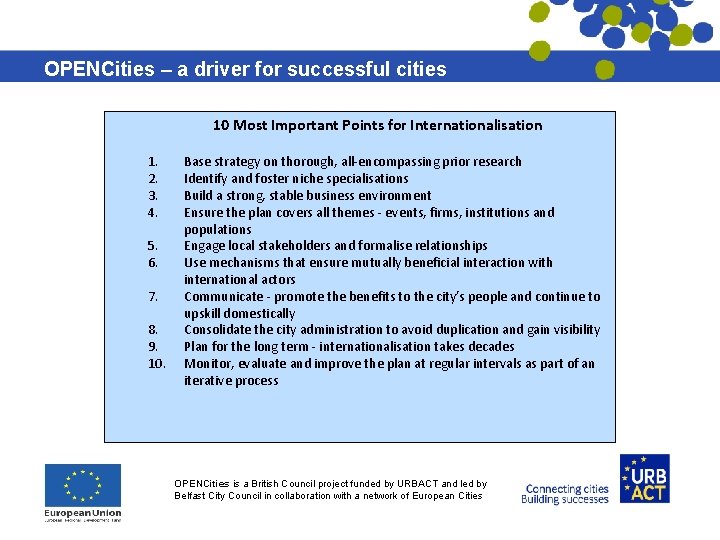
OPENCities – a driver for successful cities 10 Most Important Points for Internationalisation 1. 2. 3. 4. 5. 6. 7. 8. 9. 10. Base strategy on thorough, all-encompassing prior research Identify and foster niche specialisations Build a strong, stable business environment Ensure the plan covers all themes - events, firms, institutions and populations Engage local stakeholders and formalise relationships Use mechanisms that ensure mutually beneficial interaction with international actors Communicate - promote the benefits to the city’s people and continue to upskill domestically Consolidate the city administration to avoid duplication and gain visibility Plan for the long term - internationalisation takes decades Monitor, evaluate and improve the plan at regular intervals as part of an iterative process OPENCities is a British Council project funded by URBACT and led by Belfast City Council in collaboration with a network of European Cities
OPENCities – a driver for successful cities OPENCities is a British Council project funded by URBACT and led by Belfast City Council in collaboration with a network of European Cities