
Open up your laptops go to Mr Hyatt
- Slides: 21
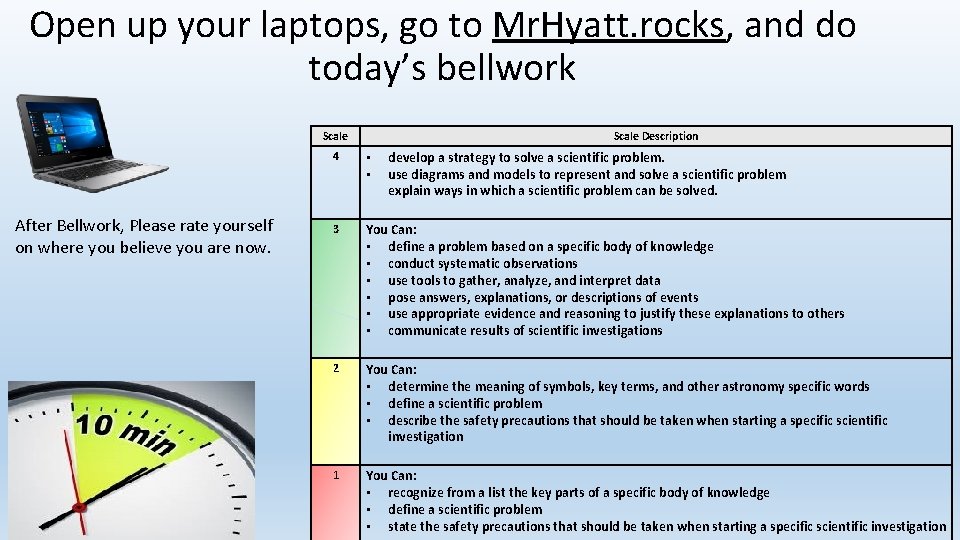
Open up your laptops, go to Mr. Hyatt. rocks, and do today’s bellwork Scale After Bellwork, Please rate yourself on where you believe you are now. Scale Description develop a strategy to solve a scientific problem. use diagrams and models to represent and solve a scientific problem explain ways in which a scientific problem can be solved. 4 • • 3 You Can: • define a problem based on a specific body of knowledge • conduct systematic observations • use tools to gather, analyze, and interpret data • pose answers, explanations, or descriptions of events • use appropriate evidence and reasoning to justify these explanations to others • communicate results of scientific investigations 2 You Can: • determine the meaning of symbols, key terms, and other astronomy specific words • define a scientific problem • describe the safety precautions that should be taken when starting a specific scientific investigation 1 You Can: • recognize from a list the key parts of a specific body of knowledge • define a scientific problem • state the safety precautions that should be taken when starting a specific scientific investigation
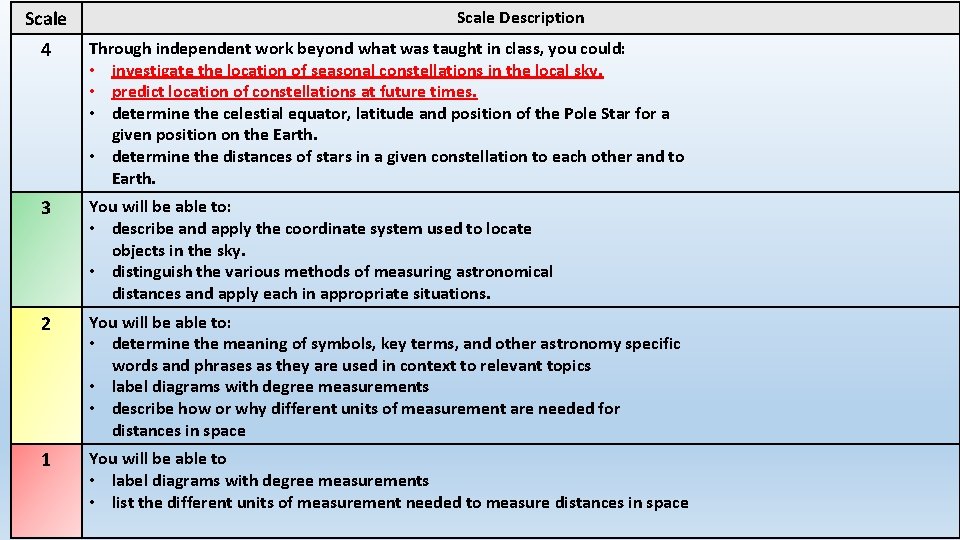
Scale Description 4 Through independent work beyond what was taught in class, you could: • investigate the location of seasonal constellations in the local sky. • predict location of constellations at future times. • determine the celestial equator, latitude and position of the Pole Star for a given position on the Earth. • determine the distances of stars in a given constellation to each other and to Earth. 3 You will be able to: • describe and apply the coordinate system used to locate objects in the sky. • distinguish the various methods of measuring astronomical distances and apply each in appropriate situations. 2 You will be able to: • determine the meaning of symbols, key terms, and other astronomy specific words and phrases as they are used in context to relevant topics • label diagrams with degree measurements • describe how or why different units of measurement are needed for distances in space 1 You will be able to • label diagrams with degree measurements • list the different units of measurement needed to measure distances in space
Lets. Constellations start Astronomy!!
Today’s questions… • What is a constellation? • Why are constellations useful? • How has the use of constellations changed over time? • (write these at the top of the page in your science journal)
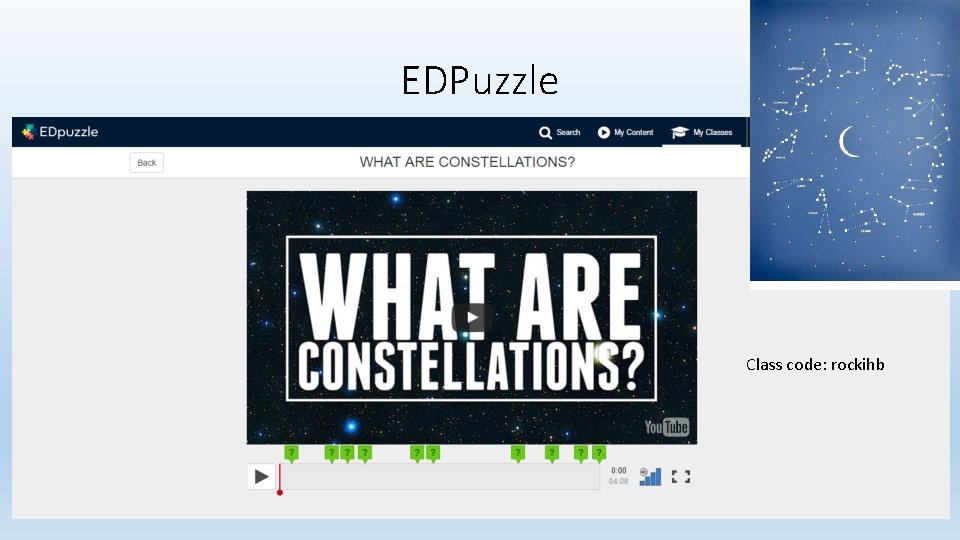
EDPuzzle Class code: rockihb
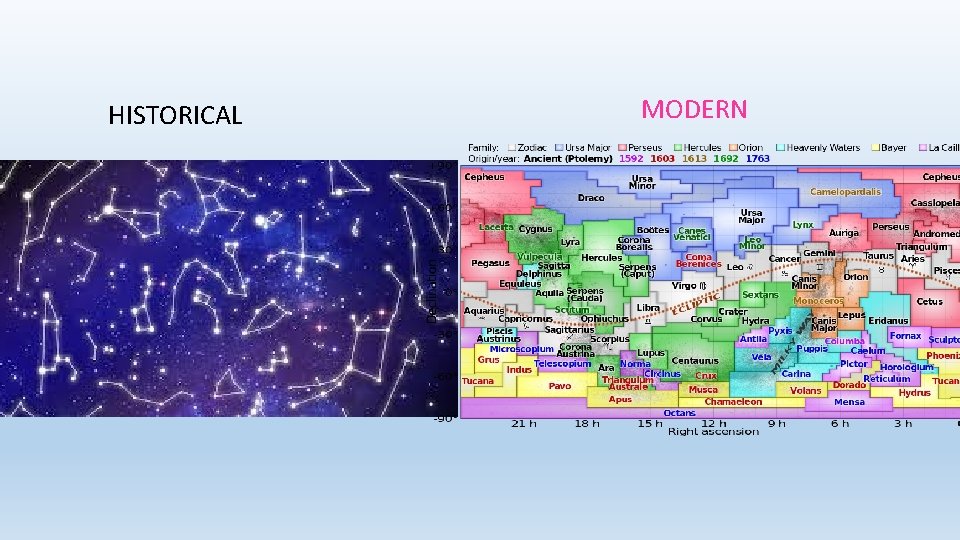
definition • Constellation: (MODERN ASTRONOMY) • Internationally defined area of the sky. (IAU) • HISTORICALLY: • A perceived pattern or picture in the sky formed by prominent stars within apparent proximity to one another.
HISTORICAL MODERN
Constellation Facts • There are 88 recognized (by the IAU) constellations • 31 are predominantly in the northern sky • kept historical names • 57 are predominantly in the southern sky • no ancient counterparts • A star pattern that is not officially classified as a constellation is known as an asterism • Big Dipper (ursa major) • Little Dipper (ursa minor) • Orion’s Belt (orion)
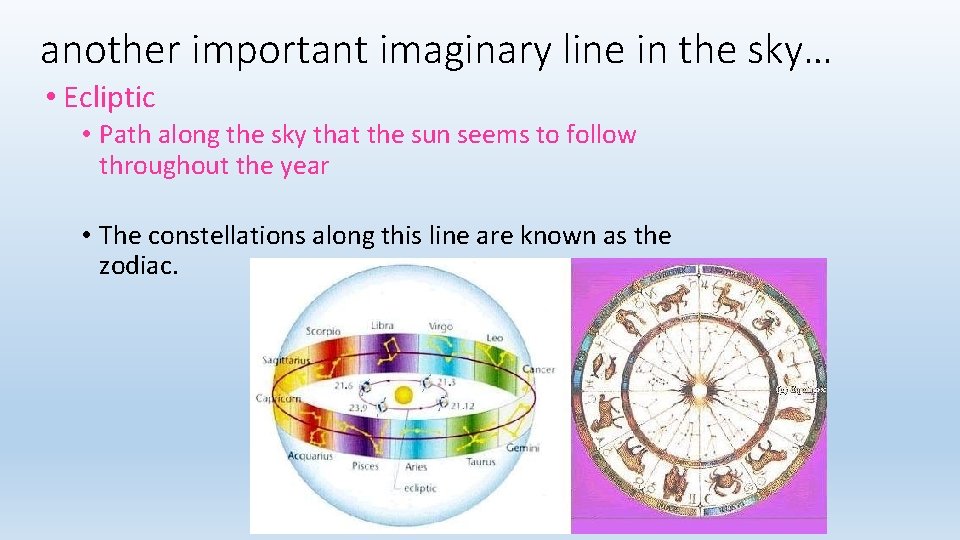
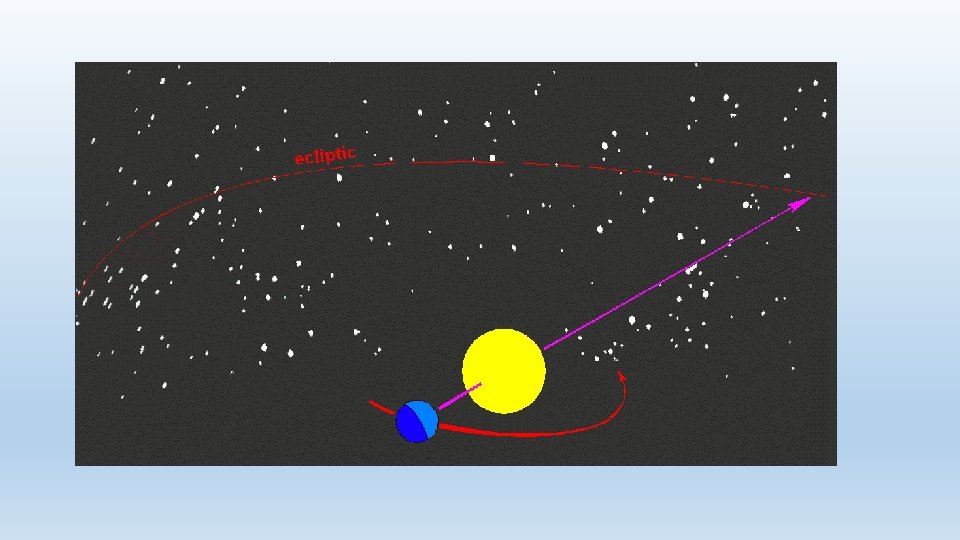
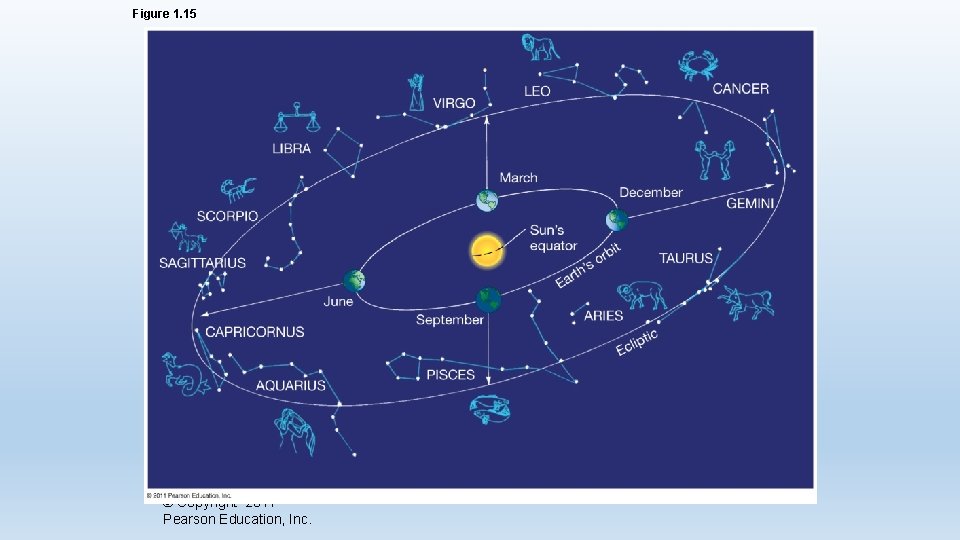
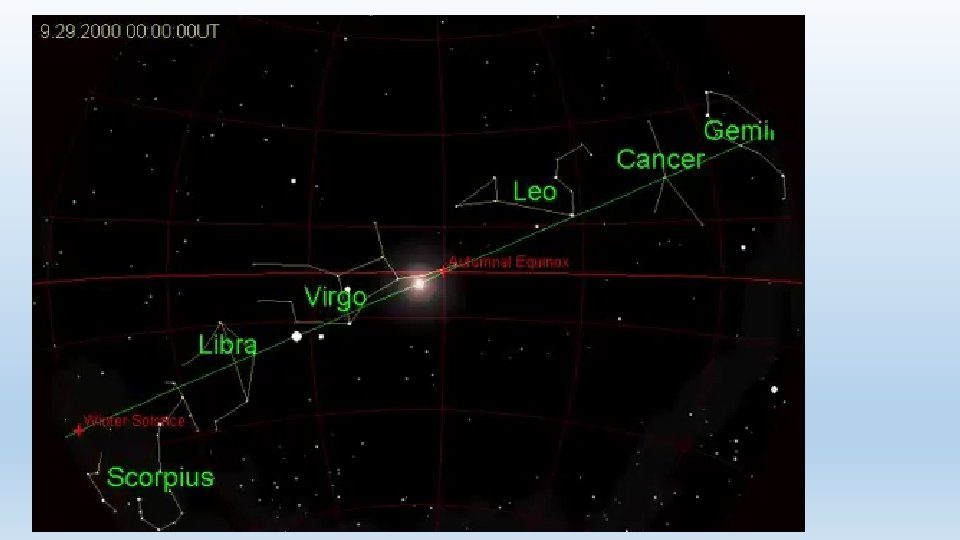
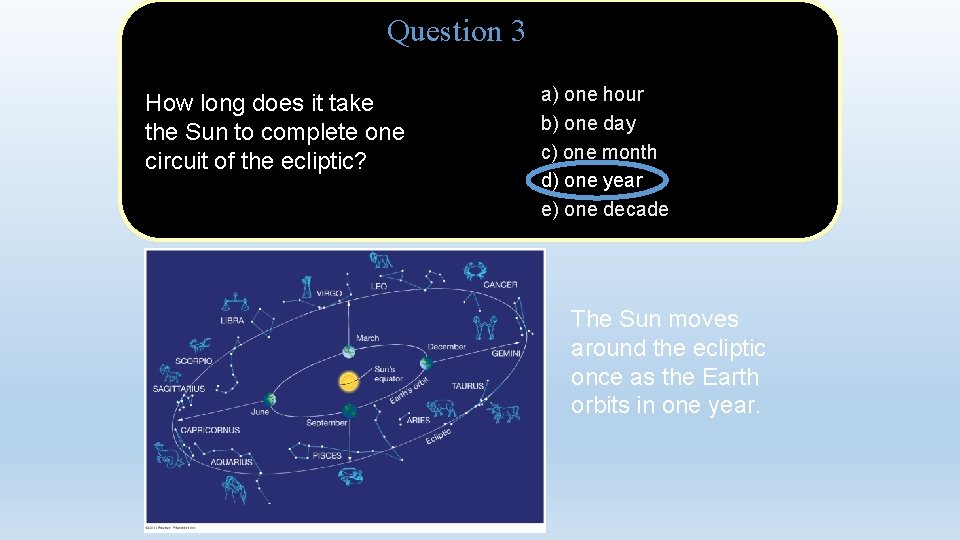
another important imaginary line in the sky… • Ecliptic • Path along the sky that the sun seems to follow throughout the year • The constellations along this line are known as the zodiac.
Figure 1. 15 © Copyright 2011 Pearson Education, Inc.
Question 1 How long does it take the Sun to complete one circuit of the ecliptic? a) one hour b) one day c) one month d) one year e) one decade
Question 3 How long does it take the Sun to complete one circuit of the ecliptic? a) one hour b) one day c) one month d) one year e) one decade The Sun moves around the ecliptic once as the Earth orbits in one year.
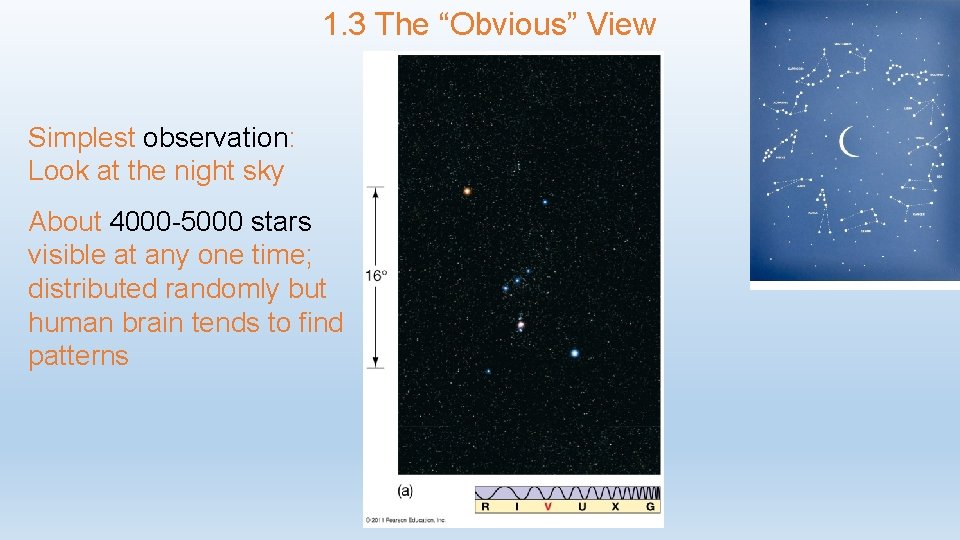
1. 3 The “Obvious” View Simplest observation: Look at the night sky About 4000 -5000 stars visible at any one time; distributed randomly but human brain tends to find patterns
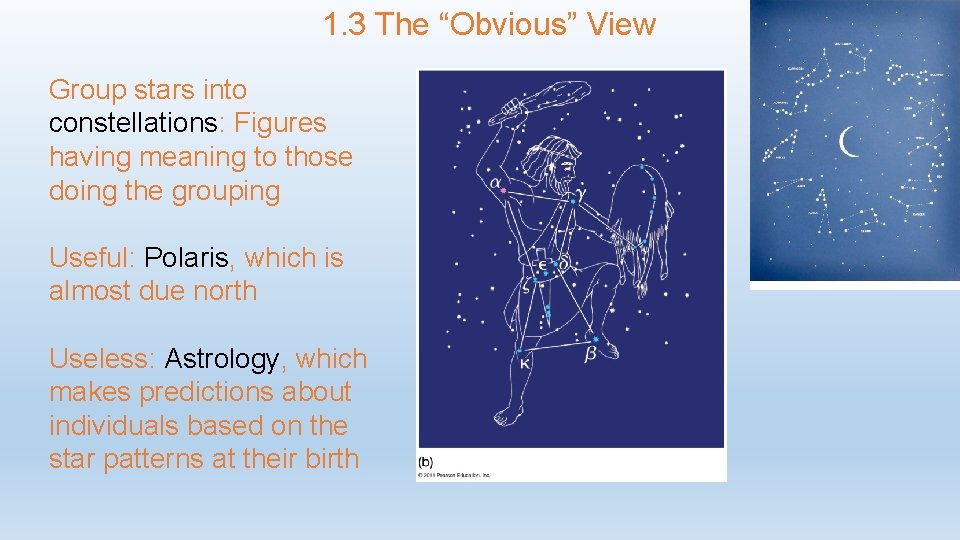
1. 3 The “Obvious” View Group stars into constellations: Figures having meaning to those doing the grouping Useful: Polaris, which is almost due north Useless: Astrology, which makes predictions about individuals based on the star patterns at their birth
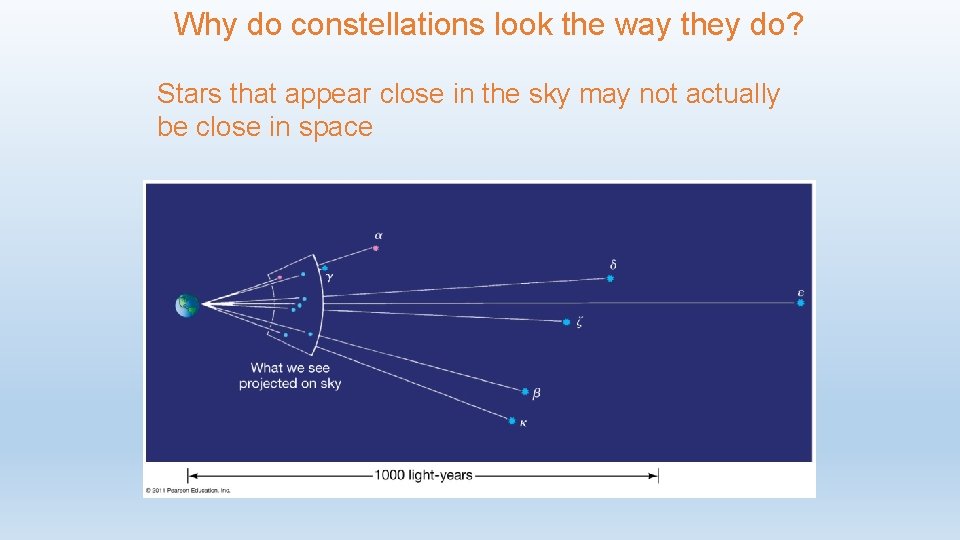
Why do constellations look the way they do? Stars that appear close in the sky may not actually be close in space
Today’s questions… • What is a constellation? • Why are constellations useful? • How has the use of constellations changed over time? • (write these at the top of the page in your science journal)
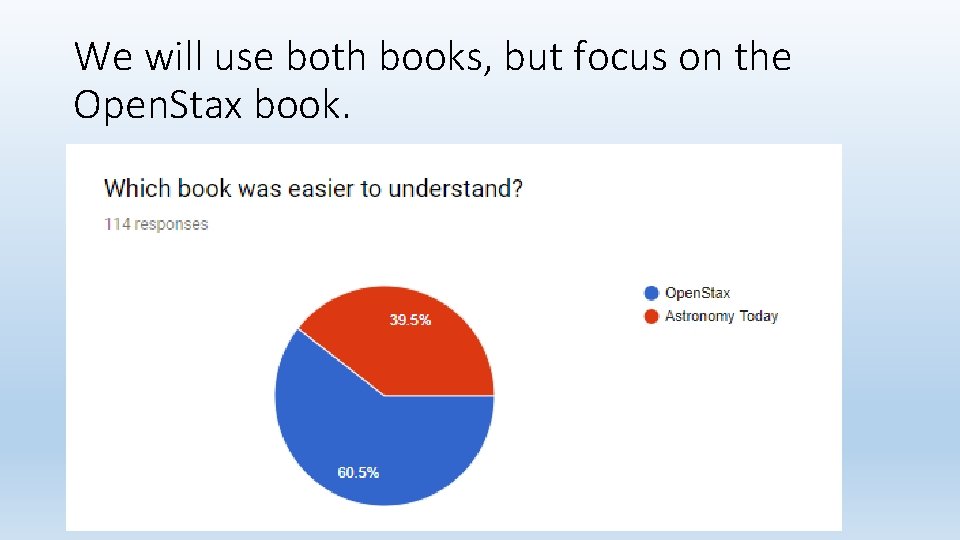
We will use both books, but focus on the Open. Stax book.
Independent Reading. Section 2. 1 in your book. I have uploaded just this section to the website Summarize this section in your notebook, using your own words. Use only two or three sentences for each topic. You are also responsible for the vocab words. I’m checking this tomorrow!
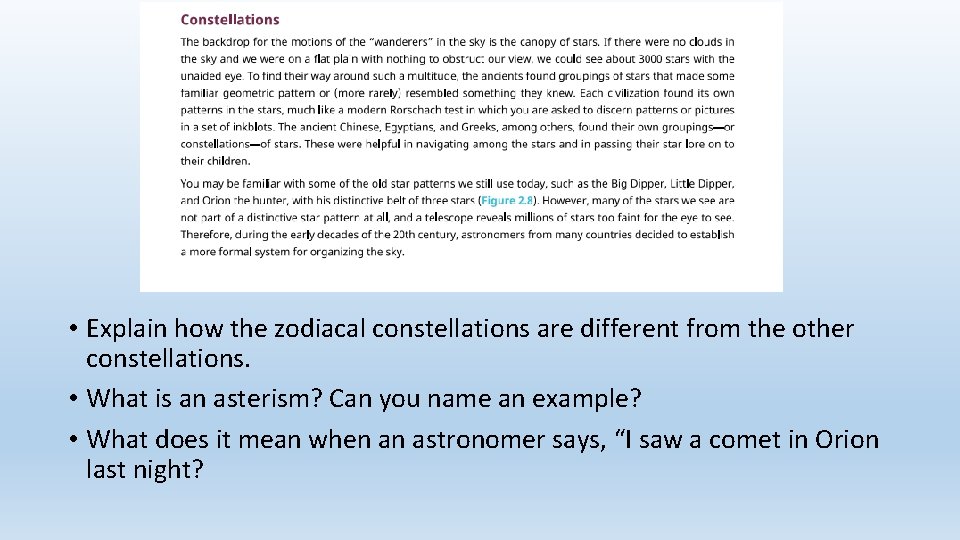
• Explain how the zodiacal constellations are different from the other constellations. • What is an asterism? Can you name an example? • What does it mean when an astronomer says, “I saw a comet in Orion last night?