
Open TTO org DILIGENT Phase 2 Market Value
- Slides: 23
Open. TTO. org - DILIGENT Phase 2 – Market Value Proposition MVP Objective What is Value? Benefits are Business Needs A Day-In-The-Life Building The VP Is Difficult Confidence Index © 2004 Open. TTO. org walter. adamson@opentto. org 1
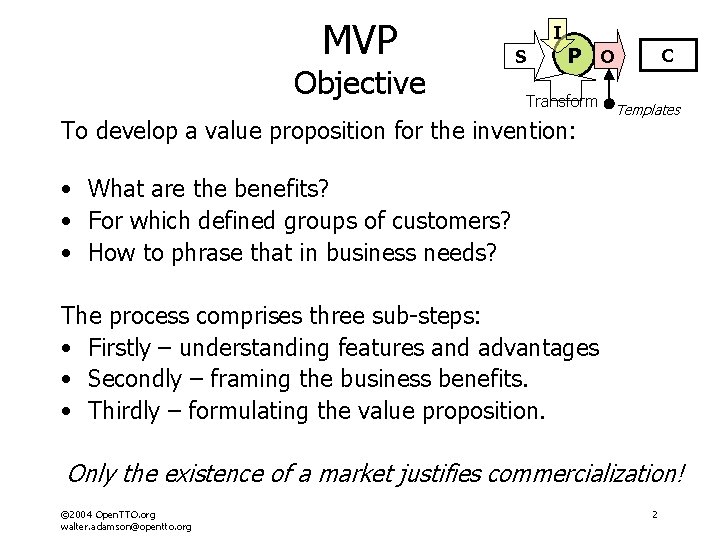
MVP Objective I S P O Transform To develop a value proposition for the invention: C Templates • What are the benefits? • For which defined groups of customers? • How to phrase that in business needs? The process comprises three sub-steps: • Firstly – understanding features and advantages • Secondly – framing the business benefits. • Thirdly – formulating the value proposition. Only the existence of a market justifies commercialization! © 2004 Open. TTO. org walter. adamson@opentto. org 2
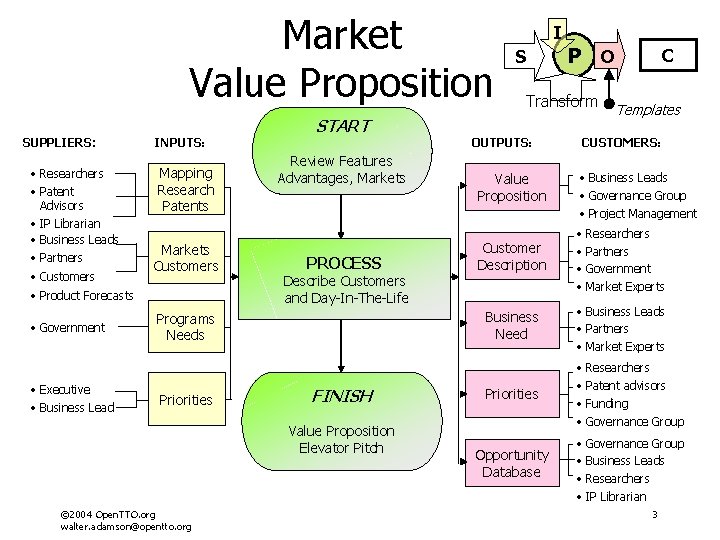
Market Value Proposition SUPPLIERS: • Researchers • Patent Advisors • IP Librarian • Business Leads • Partners • Customers • Product Forecasts • Government • Executive • Business Lead INPUTS: Mapping Research Patents Markets Customers START Review Features Advantages, Markets PROCESS Describe Customers and Day-In-The-Life Programs Needs Priorities FINISH Value Proposition Elevator Pitch © 2004 Open. TTO. org walter. adamson@opentto. org I S P O Transform OUTPUTS: Value Proposition C Templates CUSTOMERS: • Business Leads • Governance Group • Project Management Customer Description • Researchers • Partners • Government • Market Experts Business Need • Business Leads • Partners • Market Experts Priorities • Researchers • Patent advisors • Funding • Governance Group Opportunity Database • Governance Group • Business Leads • Researchers • IP Librarian 3
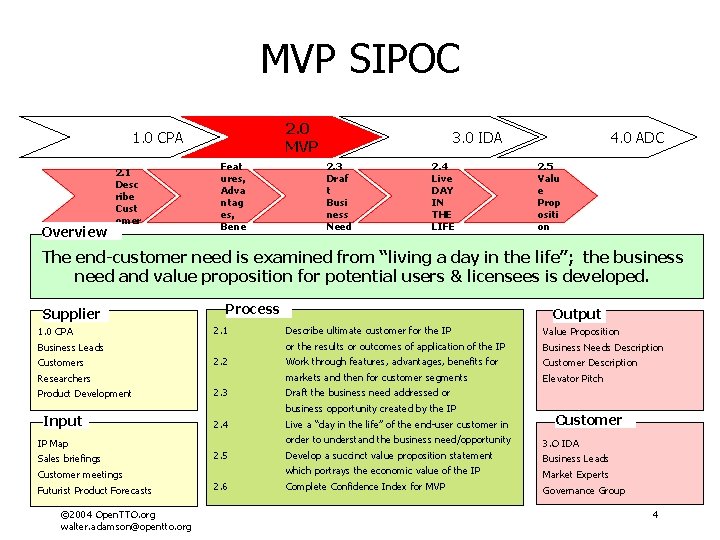
MVP SIPOC 1. 0 CPA Overview 2. 1 Desc ribe Cust omer 2. 2 Feat ures, Adva ntag es, Bene fits 2. 0 MVP 3. 0 IDA 2. 3 Draf t Busi ness Need 2. 4 Live DAY IN THE LIFE 4. 0 ADC 2. 5 Valu e Prop ositi on The end-customer need is examined from “living a day in the life”; the business need and value proposition for potential users & licensees is developed. Supplier 1. 0 CPA Process 2. 1 Business Leads Customers 2. 2 Researchers Product Development Input IP Map Sales briefings Customer meetings Futurist Product Forecasts © 2004 Open. TTO. org walter. adamson@opentto. org 2. 3 Output Describe ultimate customer for the IP Value Proposition or the results or outcomes of application of the IP Business Needs Description Work through features, advantages, benefits for Customer Description markets and then for customer segments Elevator Pitch Draft the business need addressed or business opportunity created by the IP 2. 4 Live a “day in the life” of the end-user customer in order to understand the business need/opportunity 2. 5 Develop a succinct value proposition statement which portrays the economic value of the IP 2. 6 Complete Confidence Index for MVP Customer 3. O IDA Business Leads Market Experts Governance Group 4
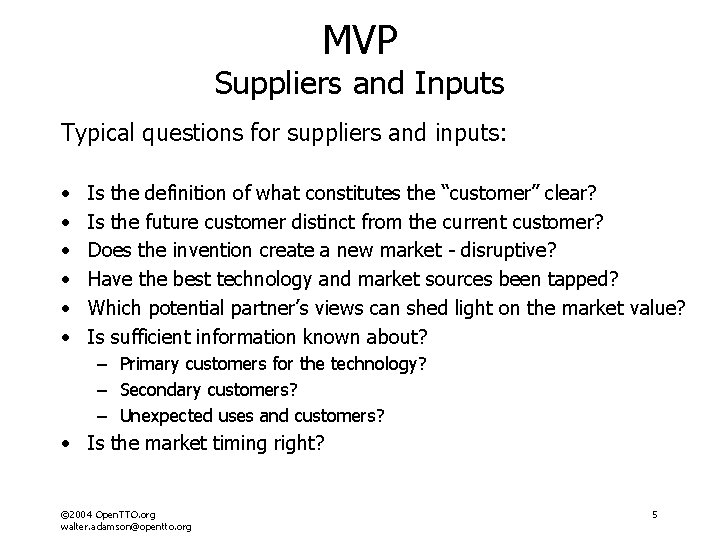
MVP Suppliers and Inputs Typical questions for suppliers and inputs: • • • Is the definition of what constitutes the “customer” clear? Is the future customer distinct from the current customer? Does the invention create a new market - disruptive? Have the best technology and market sources been tapped? Which potential partner’s views can shed light on the market value? Is sufficient information known about? – Primary customers for the technology? – Secondary customers? – Unexpected uses and customers? • Is the market timing right? © 2004 Open. TTO. org walter. adamson@opentto. org 5
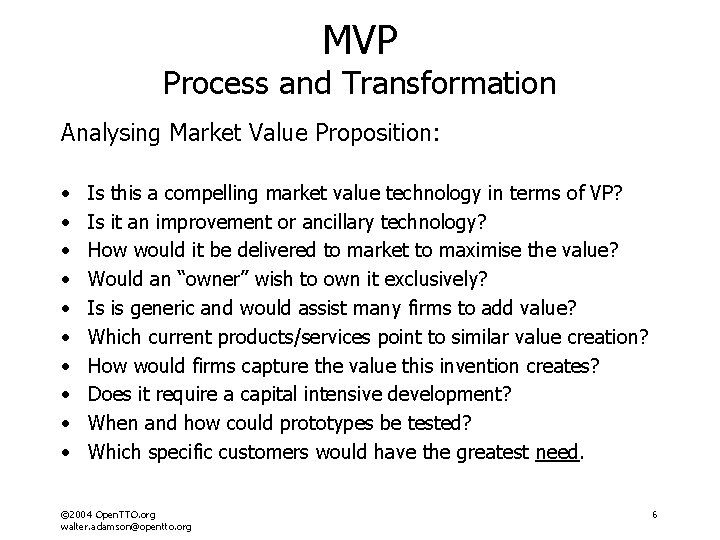
MVP Process and Transformation Analysing Market Value Proposition: • • • Is this a compelling market value technology in terms of VP? Is it an improvement or ancillary technology? How would it be delivered to market to maximise the value? Would an “owner” wish to own it exclusively? Is is generic and would assist many firms to add value? Which current products/services point to similar value creation? How would firms capture the value this invention creates? Does it require a capital intensive development? When and how could prototypes be tested? Which specific customers would have the greatest need. © 2004 Open. TTO. org walter. adamson@opentto. org 6
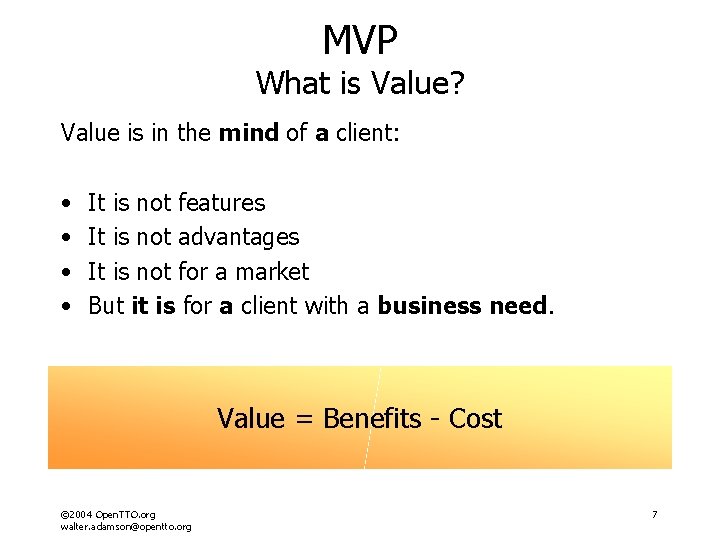
MVP What is Value? Value is in the mind of a client: • • It is not features It is not advantages It is not for a market But it is for a client with a business need. Value = Benefits - Cost © 2004 Open. TTO. org walter. adamson@opentto. org 7
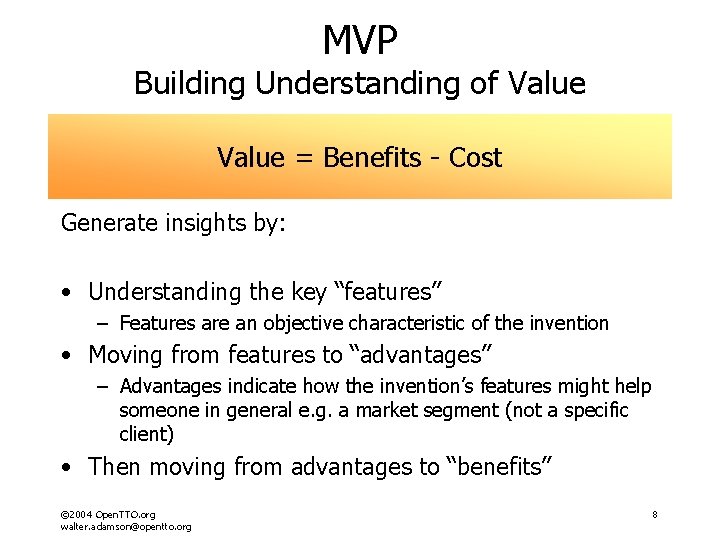
MVP Building Understanding of Value = Benefits - Cost Generate insights by: • Understanding the key “features” – Features are an objective characteristic of the invention • Moving from features to “advantages” – Advantages indicate how the invention’s features might help someone in general e. g. a market segment (not a specific client) • Then moving from advantages to “benefits” © 2004 Open. TTO. org walter. adamson@opentto. org 8
MVP Benefits are Business Needs Benefits exist only with a particular business: • “Business needs” require a business, a market segment is an approximation • “Benefits” for a market segment are only “features” or “advantages” speculating on the needs of a particular business • That is one reason why product-oriented companies struggle to become service-oriented e. g. HP Be as specific as possible in defining a business or a tight market segment in order to test the invention in relation to the business needs © 2004 Open. TTO. org walter. adamson@opentto. org 9
MVP Generate New Views of the “Market” • Build on the research and other disclosures – Lessons learned – Be sure the ideas are not out of date • Start in a related but new topical area – – GO to meetings and conferences in new fields Link up with a Senior faculty member Read books, journals, magazines, the paper Collaborate in interdisciplinary teams • Talk with companies & partners of interest • Assess the “Market” with an open mind © 2004 Open. TTO. org walter. adamson@opentto. org 10
MVP A Day-In-The-Life 1 The most powerful tool is a “Day in the Life”: • • • Take a real day in the life of the customer Ideally work with industry customer Understand business needs and tensions Capture potential licensee’s mindset and foresight The assess importance and role of invention from their perspective Caveat: But don’t get locked in the day-to-day. © 2004 Open. TTO. org walter. adamson@opentto. org 11
MVP A Day-In-The-Life 2 Joint formulation of value proposition: • • Build the story step-by-step Understand the key drivers for the licensee Engage in positive inquiry Analyze how the purchasing decisions will be made Understand the channel to market Map the value chain and the “margin motivation” Revisit the IP Map and the Technology Roadmap © 2004 Open. TTO. org walter. adamson@opentto. org 12
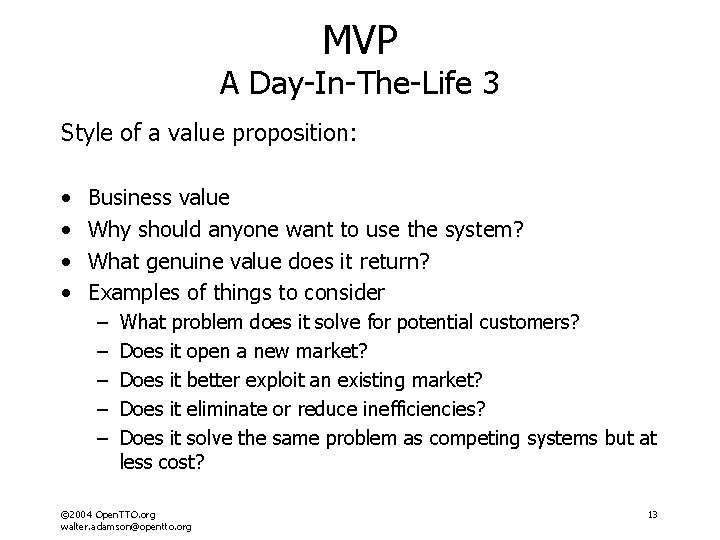
MVP A Day-In-The-Life 3 Style of a value proposition: • • Business value Why should anyone want to use the system? What genuine value does it return? Examples of things to consider – – – What problem does it solve for potential customers? Does it open a new market? Does it better exploit an existing market? Does it eliminate or reduce inefficiencies? Does it solve the same problem as competing systems but at less cost? © 2004 Open. TTO. org walter. adamson@opentto. org 13
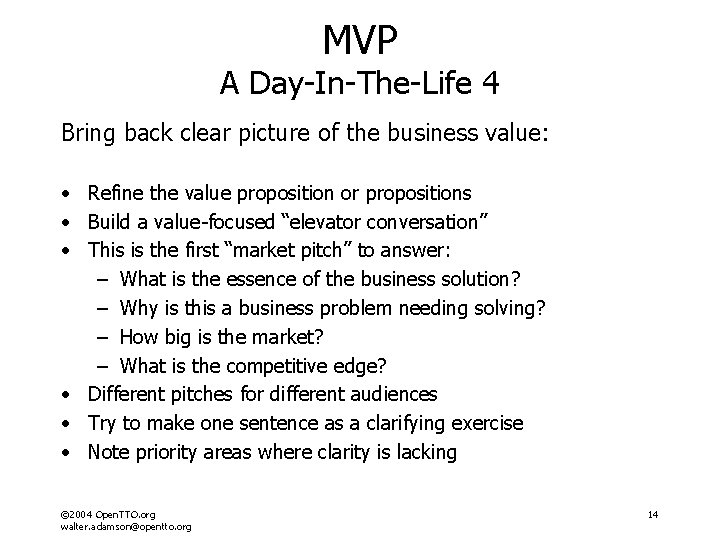
MVP A Day-In-The-Life 4 Bring back clear picture of the business value: • Refine the value proposition or propositions • Build a value-focused “elevator conversation” • This is the first “market pitch” to answer: – What is the essence of the business solution? – Why is this a business problem needing solving? – How big is the market? – What is the competitive edge? • Different pitches for different audiences • Try to make one sentence as a clarifying exercise • Note priority areas where clarity is lacking © 2004 Open. TTO. org walter. adamson@opentto. org 14
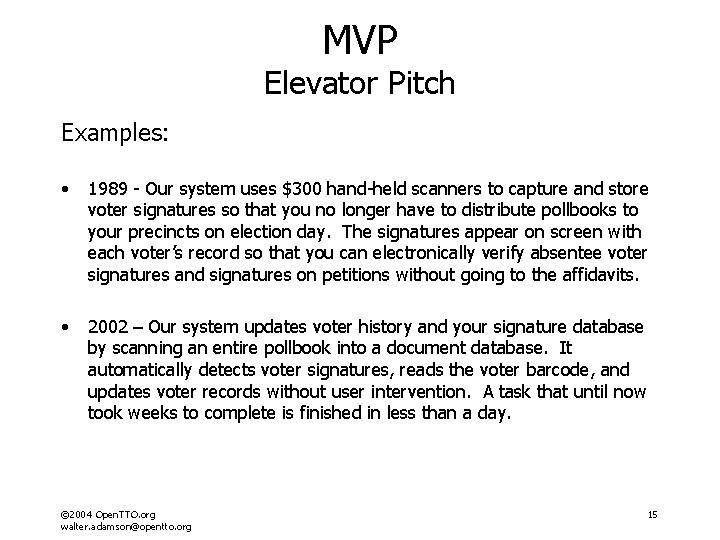
MVP Elevator Pitch Examples: • 1989 - Our system uses $300 hand-held scanners to capture and store voter signatures so that you no longer have to distribute pollbooks to your precincts on election day. The signatures appear on screen with each voter’s record so that you can electronically verify absentee voter signatures and signatures on petitions without going to the affidavits. • 2002 – Our system updates voter history and your signature database by scanning an entire pollbook into a document database. It automatically detects voter signatures, reads the voter barcode, and updates voter records without user intervention. A task that until now took weeks to complete is finished in less than a day. © 2004 Open. TTO. org walter. adamson@opentto. org 15
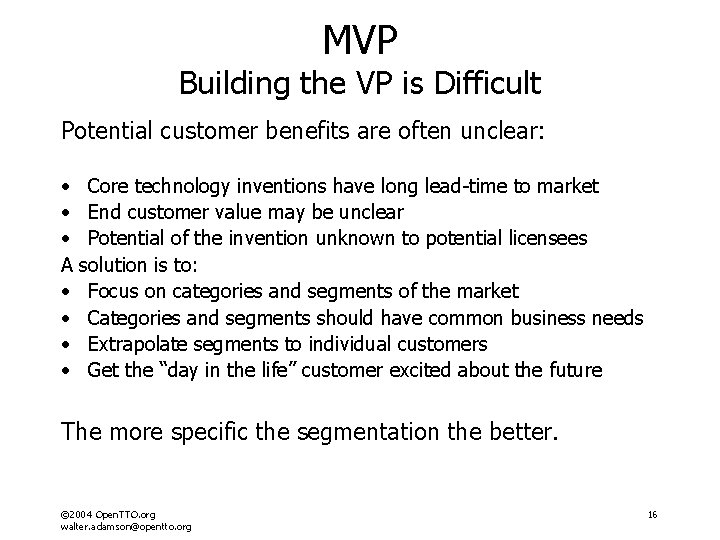
MVP Building the VP is Difficult Potential customer benefits are often unclear: • • • A • • Core technology inventions have long lead-time to market End customer value may be unclear Potential of the invention unknown to potential licensees solution is to: Focus on categories and segments of the market Categories and segments should have common business needs Extrapolate segments to individual customers Get the “day in the life” customer excited about the future The more specific the segmentation the better. © 2004 Open. TTO. org walter. adamson@opentto. org 16
MVP Business Feel Generating the VP is not a clear process: • The people involved have to have “business feel” • Requires inquiring minds and exploring customer needs • Also requires “authenticity” and integrity An innovation begins in the eye#: • Be able to express the idea appropriately • Use language and examples from the customer’s domain • Try to find the “eye” of one of the participants • Have them describe their version of the benefits & value • Accept negativity with good grace © 2004 Open. TTO. org walter. adamson@opentto. org 17
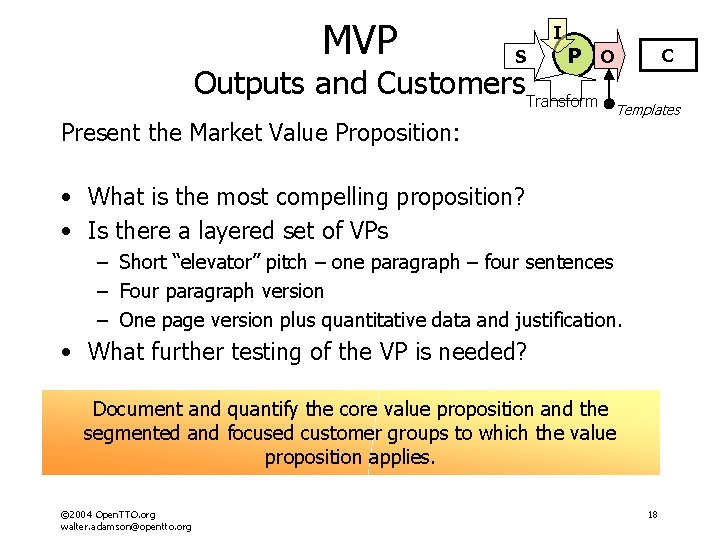
MVP I S P O Outputs and Customers. Transform Present the Market Value Proposition: C Templates • What is the most compelling proposition? • Is there a layered set of VPs – Short “elevator” pitch – one paragraph – four sentences – Four paragraph version – One page version plus quantitative data and justification. • What further testing of the VP is needed? Document and quantify the core value proposition and the segmented and focused customer groups to which the value proposition applies. © 2004 Open. TTO. org walter. adamson@opentto. org 18
MVP Business Case 1 Not a business plan but “making the case”: • Clarify the problem • Certify domain expertise • Outline key technical and business provisions • Point of departure for additional documents What is it not: • Not a business plan • No a marketing plan • Not a design document Awakening interest in the idea and the potential © 2004 Open. TTO. org walter. adamson@opentto. org 19
MVP Business Case 2 Suggested sections: • Introduction and elevator pitch – ½ to 1 page • Discussion of value proposition – 1 page • Discussion of feasibility of idea/technology – 1 to 2 pages • Overview of the resources needed – 1 to 2 pages • Risk overview of commercialization – ½ to 1 page Plus conclusion: • Summarize the benefits for an investor or collaborator • Mention the timing of inputs and exits • Back up with the funds or key first resources required © 2004 Open. TTO. org walter. adamson@opentto. org 20
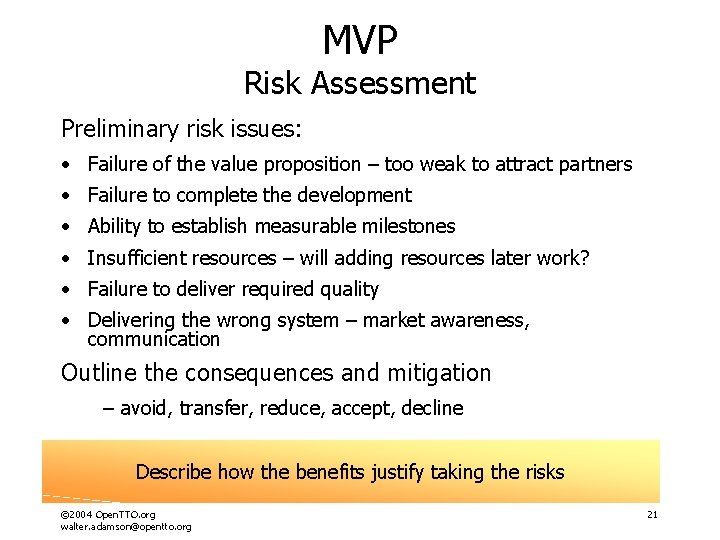
MVP Risk Assessment Preliminary risk issues: • Failure of the value proposition – too weak to attract partners • Failure to complete the development • Ability to establish measurable milestones • Insufficient resources – will adding resources later work? • Failure to deliver required quality • Delivering the wrong system – market awareness, communication Outline the consequences and mitigation – avoid, transfer, reduce, accept, decline Describe how the benefits justify taking the risks © 2004 Open. TTO. org walter. adamson@opentto. org 21
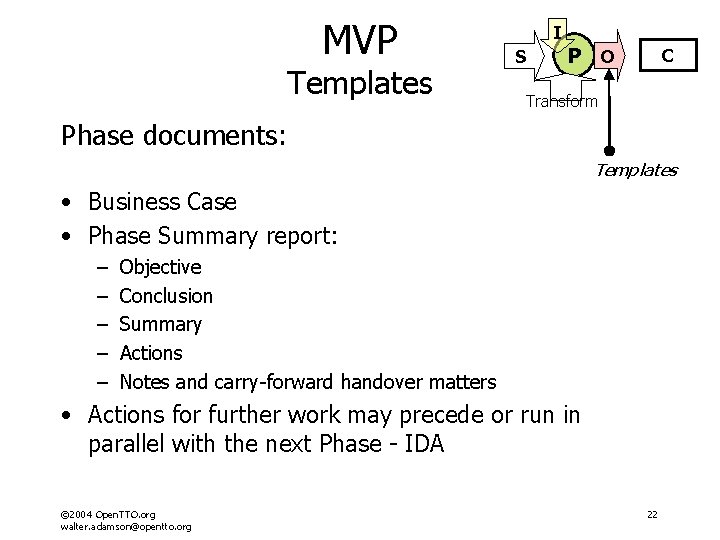
MVP Templates I S P O C Transform Phase documents: Templates • Business Case • Phase Summary report: – – – Objective Conclusion Summary Actions Notes and carry-forward handover matters • Actions for further work may precede or run in parallel with the next Phase - IDA © 2004 Open. TTO. org walter. adamson@opentto. org 22
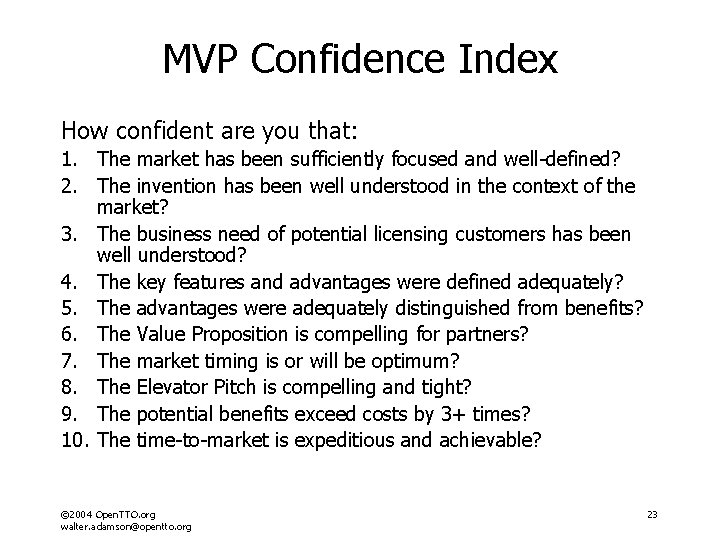
MVP Confidence Index How confident are you that: 1. The market has been sufficiently focused and well-defined? 2. The invention has been well understood in the context of the market? 3. The business need of potential licensing customers has been well understood? 4. The key features and advantages were defined adequately? 5. The advantages were adequately distinguished from benefits? 6. The Value Proposition is compelling for partners? 7. The market timing is or will be optimum? 8. The Elevator Pitch is compelling and tight? 9. The potential benefits exceed costs by 3+ times? 10. The time-to-market is expeditious and achievable? © 2004 Open. TTO. org walter. adamson@opentto. org 23