
Open Source software Licensing Computer science department third
- Slides: 24
Open Source software Licensing Computer science department third year cs Lecturer : yasmin maki
What is a license? Grants permission to use a copyrighted work • Can grant any or all of the rights associated with copyright • Can impose other restrictions, such as type or place or usage, or duration of the license • Does not transfer ownership of the copyright •
A software license is the contract between the software owner and the licensee defining terms of use of software
ﺍﻟﻌﻘﻮﺩ Contracts Must have three things: � - Offer - Acceptance - Consideration : information that should be kept in mind when making a decision
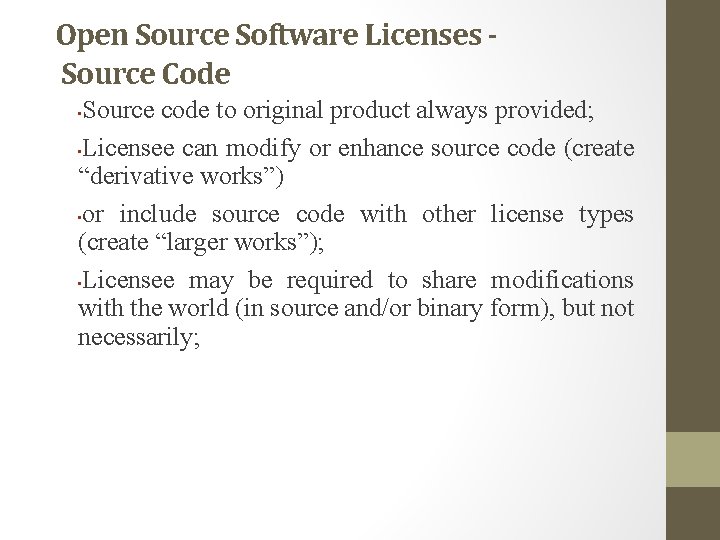
Open Source Software Licenses Source Code Source code to original product always provided; • Licensee can modify or enhance source code (create “derivative works”) • or include source code with other license types (create “larger works”); • Licensee may be required to share modifications with the world (in source and/or binary form), but not necessarily; •
An open source licensor must give the licensee � certain rights to be considered open source Basically, the licensee has the right to use, � modify or distribute the software, and the right to access the source code.
Prominent Open Source Vendors IBM � Red Hat � Sun Microsystems �
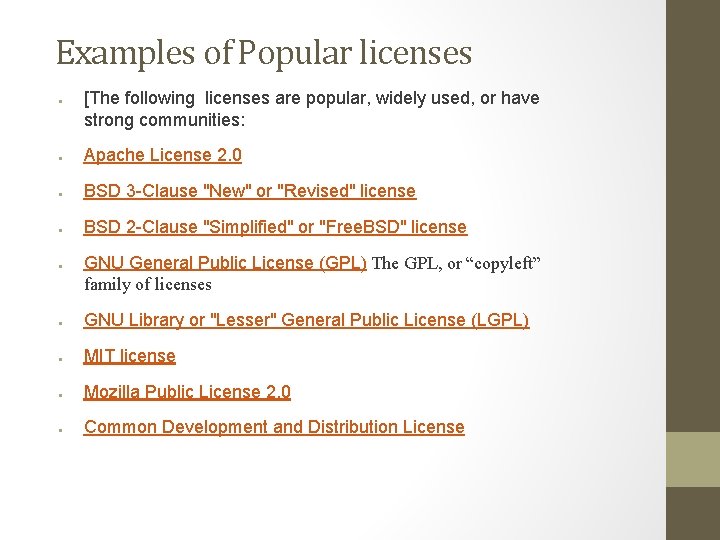
Examples of Popular licenses ● [The following licenses are popular, widely used, or have strong communities: ● Apache License 2. 0 ● BSD 3 -Clause "New" or "Revised" license ● BSD 2 -Clause "Simplified" or "Free. BSD" license ● GNU General Public License (GPL) The GPL, or “copyleft” family of licenses ● GNU Library or "Lesser" General Public License (LGPL) ● MIT license ● Mozilla Public License 2. 0 ● Common Development and Distribution License
Other open source licenses � Traditional proprietary licenses � Shareware/freeware � Public domain (not a license, but a way of accessing software) �
"Copyleft" refers to licenses that allow derivative works but • require them to use the same license as the original work. For example, if you write some software and release it under • the GNU General Public License (a widely-used copyleft license), and then someone else modifies that software and distributes their modified version, the modified version must be licensed under the GNU GPL too — including any new code written specifically to go into the modified version.
The GPL family of licenses Basic rights under the GPL – access to source code, right to make derivative works � “Copyleft” � The Library or Lesser General Public License �
The BSD family of licenses Same basic rights as GPL � No copyleft provisions, i. e. licensees can take software licensed under the BSD private � Can re-release software under a different license �
Shareware/Freeware May be free or may not � Licensor does not provide the right to make derivative works or give access to source code �
Public Domain Author retains no copyrights if software is in the public domain � Open source software authors retain copyrights � Open source licenses contain restrictions, just different ones than licensees may be used to � The restrictions in open source licenses are based on copyright law and depend on it for their effectiveness. �
Problems with the GPL Linking to GPL programs � No explicit patent grant � Does no discuss trademark rights � Does not discuss duration ● Silent on sub licensing � Relies exclusively on license law, not contract �
GNU Library or "Lesser" General Public License (LGPL)● a Lesser GPL, which applies to libraries to be used in “nonfree” software, that is to say that you don’t have to relicense the software under the GPL. �
The Berkeley Software Distribution License (BSD) There are two types here as well, 2 -clause and 3 -clause. The 2 -clause form is newer, even though the 3 clause license is called the “New” one. 2 -clause is referred to as “simplified” or “Free. BSD”. No copyleft/reciprocity provision � Does not mention patents �
BSD-style license Key terms: � � License grant: unlimited use, modification, distribution � No warranties; disclaimer of consequential damages � No endorsement
The Mozilla Public License (MPL) Professionally written � Includes an explicit patent grant, including a reciprocal grant for contributors � Includes many specific provisions that are absent in the GPL and BSD but which are often in licenses. �
The Common Public License (CPL) Developed and owned by IBM � Includes a limited patent license � Contains a reciprocity provision � Contains a patent defense provision � Indemnity provision ﺗﻘﺪﻳﻢ ﺗﻌﻮﻳﺾ �
Multiple Licensing and other strategies Microsoft’s Shared Source License � Public Source � Multiple Licensing � Licensing in phases �
How do licensors make money with open source software? Usually by providing other services, such as: � Support � Training � Customization � Integration � Certification � Offering warranties �
Other open content licenses include: GNU Free Documentation License � Open Content License � Free Art License � Open Game License � October Open Game License �
Considerations before licensing with Creative Commons or other open content license Make sure you understand what rights you are retaining and which ones you are giving up � Make sure you own the copyright � Make sure your work is subject to copyright law � “Be specific about what you are licensing” �