
Open Source Copyright Copyleft CPS 82 Fall 2008
- Slides: 8
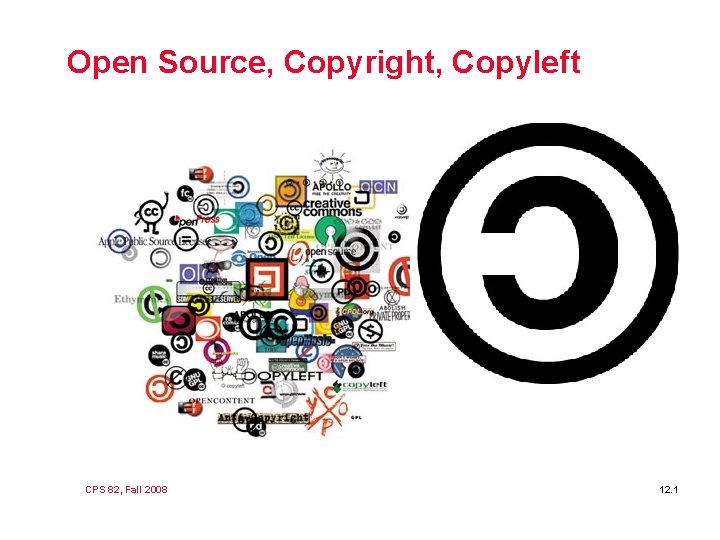
Open Source, Copyright, Copyleft CPS 82, Fall 2008 12. 1
http: //www. gnu. org/copyleft/ l To copyleft a program, we first state that it is copyrighted; then we add distribution terms, which are a legal instrument that gives everyone the rights to use, modify, and redistribute the program's code or any program derived from it but only if the distribution terms are unchanged. Thus, the code and the freedoms become legally inseparable. l Proprietary software developers use copyright to take away the users' freedom; we use copyright to guarantee their freedom. That's why we reverse the name, changing “copyright” into “copyleft. ” CPS 82, Fall 2008 12. 2
Open Source, www. opensource. org Free Redistribution: can’t force, can’t prevent sale 2. Source code: must be available, cheap or free 3. License to modify, redistribution with same terms 4. Integrity of author’s source (patchable, versioning) 5. No discrimination against persons or groups 6. No discrimination against fields of endeavor 7. Distribution “no strings”, no further licensing 8. License not bound to whole, part redistribution ok 12. 3 CPS 82, Fall 2008 9. No further restrictions, e. g. , cannot require open 1.
Open Source licenses l Copyleft licenses compared to free licenses Ø Copyleft is “viral”, requires redistribution to be the same or similar Ø Free licenses have no downstream restrictions l GPL is the Gnu Public License Ø Currently v 3, which is a complex, legal license X 11 or BSD or Apache Ø All are free/open, but not viral, e. g. , may permit commercial or proprietary products l CPS 82, Fall 2008 12. 4
LGPL: Lesser (nee Library) GPL l Proprietary software developers, seeking to deny the free competition an important advantage, will try to convince authors not to contribute libraries to the GPL-covered collection. For example, they may appeal to the ego, promising “more users for this library” if we let them use the code in proprietary software products. Popularity is tempting, and it is easy for a library developer to rationalize the idea that boosting the popularity of that one library is what the community needs above all. CPS 82, Fall 2008 12. 5
Freedom l l l But we should not listen to these temptations, because we can achieve much more if we stand together. We free software developers should support one another. By releasing libraries that are limited to free software only, we can help each other's free software packages outdo the proprietary alternatives. The whole free software movement will have more popularity, because free software as a whole will stack up better against the competition. http: //www. youtube. com/watch? v=WLrr. Bs 8 JBQo http: //www. youtube. com/watch? v=0 HYuv 0 Q 7 sd. Q CPS 82, Fall 2008 12. 6
One program, two licenses l If you want to distribute an open source/free project Ø We’ll license the code to you without payment l If you want to distribute or use code commercially Ø You can pay for a different license l Are other products sold with different licenses? Ø Volume licensing Ø Others? CPS 82, Fall 2008 12. 7
License and Royalty l http: //mp 3 licensing. com/royalty/ Ø Why is mp 3 subject to licensing? Ø 100 Million euros in 2005 (Wikipedia) Ø Patent grants license l Why isn’t this a copyright issue? Ø What is copyrightable? Ø What is patentable? CPS 82, Fall 2008 12. 8